

SIST ISO 7425-1:2022
(Main)Hydraulic fluid power cylinders - Dimensions and tolerances of housings for elastomer- energized, plastic-faced seals - Part 1: Piston seal housings
General Information
- Abstract
This document specifies the dimensions and associated tolerances for a series of hydraulic cylinder piston seal housings to accommodate elastomer-energized, plastic-faced seals used in reciprocating applications.
This document does not stipulate details of seal design, since the manner of construction of seals varies with each manufacturer. The design and material of the seals, and any associated anti-extrusion components, are determined by conditions such as temperature and pressure.
This document only applies to the dimensional characteristics of products manufactured in accordance with this document. It does not apply to their functional characteristics.
- Status
- Published
- Publication Date
- 28-Feb-2022
- Technical Committee
- IHPV - Hydraulics and pneumatics
- Current Stage
- 6060 - National Implementation/Publication (Adopted Project)
- Start Date
- 03-Feb-2022
- Due Date
- 10-Apr-2022
- Completion Date
- 01-Mar-2022
Buy Documents




ISO 7425-1:2021 - Hydraulic fluid power cylinders -- Dimensions and tolerances of housings for elastomer-energized, plastic-faced seals
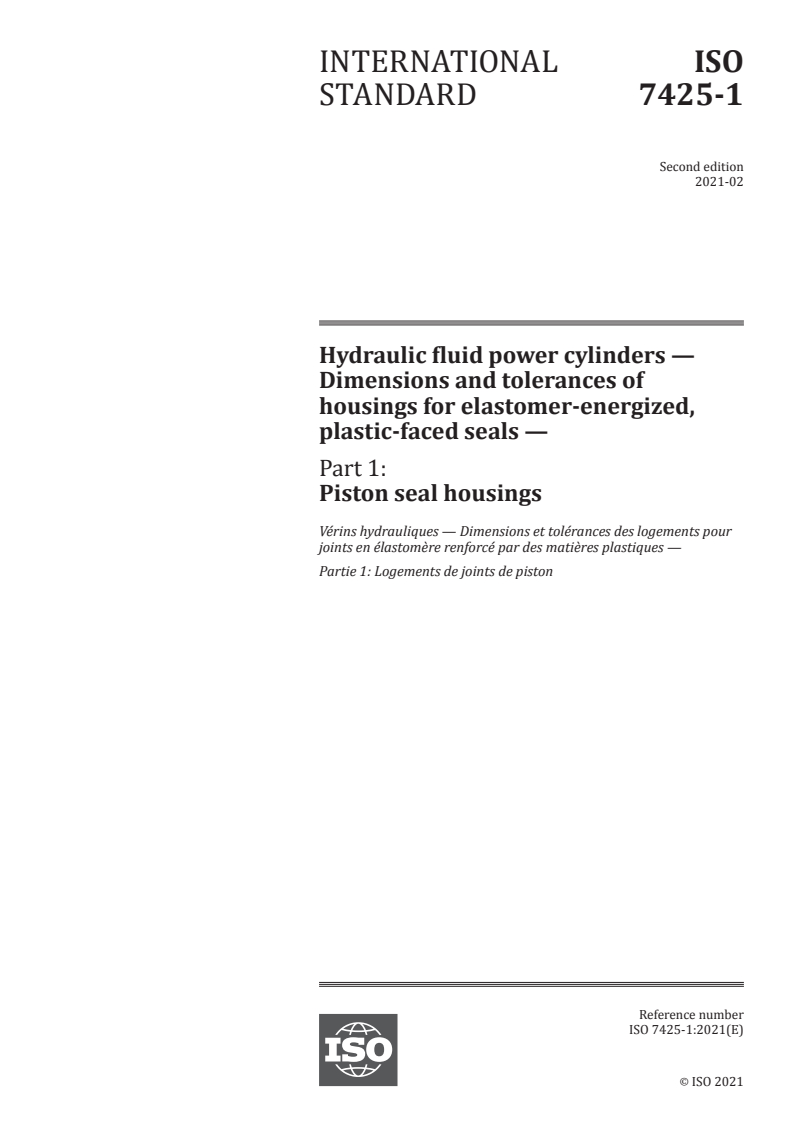
ISO 7425-1:2021 - Hydraulic fluid power cylinders — Dimensions and tolerances of housings for elastomer-energized, plastic-faced seals — Part 1: Piston seal housings/22/2021

ISO 7425-1:2021 - Vérins hydrauliques -- Dimensions et tolérances des logements pour joints en élastomère renforcé par des matières plastiques
ISO 7425-1:2021 - Vérins hydrauliques — Dimensions et tolérances des logements pour joints en élastomère renforcé par des matières plastiques — Partie 1: Logements de joints de piston/22/2021
Overview
SIST ISO 7425-1:2022 establishes standardized dimensions and tolerances for piston seal housings in hydraulic fluid power cylinders. This standard is specifically intended for housings accommodating elastomer-energized, plastic-faced seals used in reciprocating applications. By defining the geometric requirements for seal housings, it facilitates interchangeability and reliable performance of hydraulic cylinder components across manufacturers and applications, supporting the global hydraulic fluid power industry.
This part of the ISO 7425 series is applicable only to the dimensional characteristics of piston seal housings and does not address specific seal designs, materials, or the functional characteristics of completed assemblies. Its focus is to help manufacturers, designers, and users ensure compatibility of seal housings within hydraulic cylinders and promote consistent product quality.
Key Topics
- Dimensions and Tolerances: Provides standardized measurements for piston seal housings, including bore diameters, axial lengths, and radial depths, supporting compatibility with elastomer-energized, plastic-faced seals.
- Surface Finish: Specifies surface finish requirements to promote seal life and optimized sealing performance, referencing ISO surface texture standards where applicable.
- Extrusion Gaps: Outlines considerations for the allowable gap between the piston and cylinder wall, crucial for preventing seal extrusion under pressure.
- Lead-in Chamfers: Defines minimum dimensions for chamfers on housing components or assembly tools to protect seals from damage during assembly.
- Consultation Guidance: Advises consulting seal manufacturers for details outside the scope of dimensional tolerances, such as anti-extrusion elements or special sealing surface requirements.
Applications
SIST ISO 7425-1:2022 is essential for professionals involved in the design, manufacturing, and maintenance of hydraulic cylinders. Key practical applications include:
- Hydraulic Cylinder Manufacturing: Ensures consistent machining of piston seal housings, facilitating the use of standardized seals from different suppliers.
- Fluid Power System Design: Helps designers specify cylinder components that meet global industry requirements, ensuring compatibility and reliable operation in reciprocating applications.
- Quality Assurance: Provides measurable criteria for dimensional inspection and compliance verification in hydraulic component production.
- Maintenance and Replacement: Assists maintenance engineers in selecting and fitting replacement seals by providing guidance on standard housing dimensions and tolerances, thus minimizing downtime.
This ISO standard is widely used in industries such as construction machinery, material handling, automotive, and industrial automation, wherever hydraulic cylinders are part of the fluid power system.
Related Standards
SIST ISO 7425-1:2022 references and complements several other international standards, including:
- ISO 3320: Specifies cylinder bores and piston rod diameters for fluid power systems.
- ISO 4287: Defines surface texture and roughness parameters essential for sealing surfaces.
- ISO 5598: Provides key terminology and definitions used in fluid power systems.
- ISO 5597: Addresses dimensions and tolerances for single-acting piston and rod seal housings.
- ISO 1302: Covers indication of surface texture in technical documentation.
Additional references to standards for surface finish measurement (ISO 3274, ISO 4288), geometrical tolerancing (ISO 1101), edge definition (ISO 13715), and more can support full compliance and best practices in cylinder and seal housing design.
By applying SIST ISO 7425-1:2022, manufacturers and users can ensure the precision, reliability, and safety of hydraulic fluid power systems in line with international expectations.
Relations
- Effective Date
- 23-Apr-2020
Buy Documents
ISO 7425-1:2021 - Hydraulic fluid power cylinders -- Dimensions and tolerances of housings for elastomer-energized, plastic-faced seals
ISO 7425-1:2021 - Hydraulic fluid power cylinders — Dimensions and tolerances of housings for elastomer-energized, plastic-faced seals — Part 1: Piston seal housings/22/2021
ISO 7425-1:2021 - Vérins hydrauliques -- Dimensions et tolérances des logements pour joints en élastomère renforcé par des matières plastiques
ISO 7425-1:2021 - Vérins hydrauliques — Dimensions et tolérances des logements pour joints en élastomère renforcé par des matières plastiques — Partie 1: Logements de joints de piston/22/2021
Get Certified
Connect with accredited certification bodies for this standard

Institut za varilstvo d.o.o. (Welding Institute)
Slovenia's leading welding institute since 1952. ISO 3834, EN 1090, pressure equipment certification, NDT personnel, welder qualification. Only IIW Au
Sponsored listings
Frequently Asked Questions
SIST ISO 7425-1:2022 is a standard published by the Slovenian Institute for Standardization (SIST). Its full title is "Hydraulic fluid power cylinders - Dimensions and tolerances of housings for elastomer- energized, plastic-faced seals - Part 1: Piston seal housings". This standard covers: This document specifies the dimensions and associated tolerances for a series of hydraulic cylinder piston seal housings to accommodate elastomer-energized, plastic-faced seals used in reciprocating applications. This document does not stipulate details of seal design, since the manner of construction of seals varies with each manufacturer. The design and material of the seals, and any associated anti-extrusion components, are determined by conditions such as temperature and pressure. This document only applies to the dimensional characteristics of products manufactured in accordance with this document. It does not apply to their functional characteristics.
This document specifies the dimensions and associated tolerances for a series of hydraulic cylinder piston seal housings to accommodate elastomer-energized, plastic-faced seals used in reciprocating applications. This document does not stipulate details of seal design, since the manner of construction of seals varies with each manufacturer. The design and material of the seals, and any associated anti-extrusion components, are determined by conditions such as temperature and pressure. This document only applies to the dimensional characteristics of products manufactured in accordance with this document. It does not apply to their functional characteristics.
SIST ISO 7425-1:2022 is classified under the following ICS (International Classification for Standards) categories: 23.100.20 - Cylinders. The ICS classification helps identify the subject area and facilitates finding related standards.
SIST ISO 7425-1:2022 has the following relationships with other standards: It is inter standard links to SIST ISO 7425-1:1997. Understanding these relationships helps ensure you are using the most current and applicable version of the standard.
SIST ISO 7425-1:2022 is available in PDF format for immediate download after purchase. The document can be added to your cart and obtained through the secure checkout process. Digital delivery ensures instant access to the complete standard document.
Standards Content (Sample)
SLOVENSKI STANDARD
01-april-2022
Nadomešča:
SIST ISO 7425-1:1997
Fluidna tehnika - Hidravlika - Mere in tolerance gnezd za z elastomerom -
prednapeta plastična tesnila - 1. del: Gnezda batnih tesnilk
Hydraulic fluid power cylinders - Dimensions and tolerances of housings for elastomer-
energized, plastic-faced seals - Part 1: Piston seal housings
Vérins hydrauliques -- Dimensions et tolérances des logements pour joints en
élastomère renforcé par des matières plastiques
Ta slovenski standard je istoveten z: ISO 7425-1:2021
ICS:
23.100.20 Hidravlični valji Cylinders
2003-01.Slovenski inštitut za standardizacijo. Razmnoževanje celote ali delov tega standarda ni dovoljeno.
INTERNATIONAL ISO
STANDARD 7425-1
Second edition
2021-02
Hydraulic fluid power cylinders —
Dimensions and tolerances of
housings for elastomer-energized,
plastic-faced seals —
Part 1:
Piston seal housings
Vérins hydrauliques — Dimensions et tolérances des logements pour
joints en élastomère renforcé par des matières plastiques —
Partie 1: Logements de joints de piston
Reference number
©
ISO 2021
© ISO 2021
All rights reserved. Unless otherwise specified, or required in the context of its implementation, no part of this publication may
be reproduced or utilized otherwise in any form or by any means, electronic or mechanical, including photocopying, or posting
on the internet or an intranet, without prior written permission. Permission can be requested from either ISO at the address
below or ISO’s member body in the country of the requester.
ISO copyright office
CP 401 • Ch. de Blandonnet 8
CH-1214 Vernier, Geneva
Phone: +41 22 749 01 11
Email: copyright@iso.org
Website: www.iso.org
Published in Switzerland
ii © ISO 2021 – All rights reserved
Contents Page
Foreword .iv
Introduction .v
1 Scope . 1
2 Normative references . 1
3 Terms and definitions . 1
4 Symbols . 2
5 Seal housings . 2
5.1 General . 2
5.2 Axial length. 3
5.3 Radial depth . 3
6 Dimensions and tolerances . 3
7 Extrusion gap . 3
8 Surface finish . 3
8.1 General statement . 3
8.2 Sliding and static sealing surfaces . 3
9 Lead-in chamfer . 4
10 Identification statement . 5
Bibliography . 8
Foreword
ISO (the International Organization for Standardization) is a worldwide federation of national standards
bodies (ISO member bodies). The work of preparing International Standards is normally carried out
through ISO technical committees. Each member body interested in a subject for which a technical
committee has been established has the right to be represented on that committee. International
organizations, governmental and non-governmental, in liaison with ISO, also take part in the work.
ISO collaborates closely with the International Electrotechnical Commission (IEC) on all matters of
electrotechnical standardization.
The procedures used to develop this document and those intended for its further maintenance are
described in the ISO/IEC Directives, Part 1. In particular, the different approval criteria needed for the
different types of ISO documents should be noted. This document was drafted in accordance with the
editorial rules of the ISO/IEC Directives, Part 2 (see www .iso .org/ directives).
Attention is drawn to the possibility that some of the elements of this document may be the subject of
patent rights. ISO shall not be held responsible for identifying any or all such patent rights. Details of
any patent rights identified during the development of the document will be in the Introduction and/or
on the ISO list of patent declarations received (see www .iso .org/ patents).
Any trade name used in this document is information given for the convenience of users and does not
constitute an endorsement.
For an explanation of the voluntary nature of standards, the meaning of ISO specific terms and
expressions related to conformity assessment, as well as information about ISO's adherence to the
World Trade Organization (WTO) principles in the Technical Barriers to Trade (TBT), see www .iso .org/
iso/ foreword .html.
This document was prepared by Technical Committee ISO/TC 131, Fluid power systems, Subcommittee
SC 7, Sealing devices.
This second edition cancels and replaces the first edition (ISO 7425-1:1988), which has been technically
revised.
The main changes compared to the previous edition are as follows:
— 60 bore was added to Table 3 to ensure consistency with ISO 3320 and to Clause 8 to ensure
consistency with ISO 5597.
A list of all parts in the ISO 7425 series can be found on the ISO website.
Any feedback or questions on this document should be directed to the user's national standards body.
A complete listing of these bodies can be found at www .iso .org/ members .html.
iv © ISO 2021 – All rights reserved
Introduction
In hydraulic fluid power systems, power is transmitted and controlled through a liquid under pressure
within an enclosed circuit. Sealing devices are used to contain the pressurized fluid with components
with elements with linear motion, i.e. hydraulic cylinders. In general, these sealing devices are used
with both cylinder rod and piston seal housings. This document covers piston seal housings.
This document is one part of the ISO 7425 series of standards covering dimensions and tolerances of
reciprocating seal housings.
INTERNATIONAL STANDARD ISO 7425-1:2021(E)
Hydraulic fluid power cylinders — Dimensions and
tolerances of housings for elastomer-energized, plastic-
faced seals —
Part 1:
Piston seal housings
1 Scope
This document specifies the dimensions and associated tolerances for a series of hydraulic cylinder
piston seal housings to accommodate elastomer-energized, plastic-faced seals used in reciprocating
applications.
This document does not stipulate details of seal design, since the manner of construction of seals
varies with each manufacturer. The design and material of the seals, and any associated anti-extrusion
components, are determined by conditions such as temperature and pressure.
This document only applies to the dimensional characteristics of products manufactured in accordance
with this document. It does not apply to their functional characteristics.
2 Normative references
The following documents are referred to in the text in such a way that some or all of their content
constitutes requirements of this document. For dated references, only the edition cited applies. For
undated references, the latest edition of the referenced document (including any amendments) applies.
ISO 3320, Fluid power systems and components — Cylinder bores and piston rod diameters and area
ratios — Metric series
ISO 4287:1997, Geometrical Product Specifications (GPS) — Surface texture: Profile method — Terms,
definitions and surface texture parameters
ISO 5598, Fluid power systems and components — Vocabulary
3 Terms and definitions
For the purposes of this document, the terms and definitions given in ISO 5598 apply.
ISO and IEC maintain terminological database
...
INTERNATIONAL ISO
STANDARD 7425-1
Second edition
2021-02
Hydraulic fluid power cylinders —
Dimensions and tolerances of
housings for elastomer-energized,
plastic-faced seals —
Part 1:
Piston seal housings
Vérins hydrauliques — Dimensions et tolérances des logements pour
joints en élastomère renforcé par des matières plastiques —
Partie 1: Logements de joints de piston
Reference number
©
ISO 2021
© ISO 2021
All rights reserved. Unless otherwise specified, or required in the context of its implementation, no part of this publication may
be reproduced or utilized otherwise in any form or by any means, electronic or mechanical, including photocopying, or posting
on the internet or an intranet, without prior written permission. Permission can be requested from either ISO at the address
below or ISO’s member body in the country of the requester.
ISO copyright office
CP 401 • Ch. de Blandonnet 8
CH-1214 Vernier, Geneva
Phone: +41 22 749 01 11
Email: copyright@iso.org
Website: www.iso.org
Published in Switzerland
ii © ISO 2021 – All rights reserved
Contents Page
Foreword .iv
Introduction .v
1 Scope . 1
2 Normative references . 1
3 Terms and definitions . 1
4 Symbols . 2
5 Seal housings . 2
5.1 General . 2
5.2 Axial length. 3
5.3 Radial depth . 3
6 Dimensions and tolerances . 3
7 Extrusion gap . 3
8 Surface finish . 3
8.1 General statement . 3
8.2 Sliding and static sealing surfaces . 3
9 Lead-in chamfer . 4
10 Identification statement . 5
Bibliography . 8
Foreword
ISO (the International Organization for Standardization) is a worldwide federation of national standards
bodies (ISO member bodies). The work of preparing International Standards is normally carried out
through ISO technical committees. Each member body interested in a subject for which a technical
committee has been established has the right to be represented on that committee. International
organizations, governmental and non-governmental, in liaison with ISO, also take part in the work.
ISO collaborates closely with the International Electrotechnical Commission (IEC) on all matters of
electrotechnical standardization.
The procedures used to develop this document and those intended for its further maintenance are
described in the ISO/IEC Directives, Part 1. In particular, the different approval criteria needed for the
different types of ISO documents should be noted. This document was drafted in accordance with the
editorial rules of the ISO/IEC Directives, Part 2 (see www .iso .org/ directives).
Attention is drawn to the possibility that some of the elements of this document may be the subject of
patent rights. ISO shall not be held responsible for identifying any or all such patent rights. Details of
any patent rights identified during the development of the document will be in the Introduction and/or
on the ISO list of patent declarations received (see www .iso .org/ patents).
Any trade name used in this document is information given for the convenience of users and does not
constitute an endorsement.
For an explanation of the voluntary nature of standards, the meaning of ISO specific terms and
expressions related to conformity assessment, as well as information about ISO's adherence to the
World Trade Organization (WTO) principles in the Technical Barriers to Trade (TBT), see www .iso .org/
iso/ foreword .html.
This document was prepared by Technical Committee ISO/TC 131, Fluid power systems, Subcommittee
SC 7, Sealing devices.
This second edition cancels and replaces the first edition (ISO 7425-1:1988), which has been technically
revised.
The main changes compared to the previous edition are as follows:
— 60 bore was added to Table 3 to ensure consistency with ISO 3320 and to Clause 8 to ensure
consistency with ISO 5597.
A list of all parts in the ISO 7425 series can be found on the ISO website.
Any feedback or questions on this document should be directed to the user's national standards body.
A complete listing of these bodies can be found at www .iso .org/ members .html.
iv © ISO 2021 – All rights reserved
Introduction
In hydraulic fluid power systems, power is transmitted and controlled through a liquid under pressure
within an enclosed circuit. Sealing devices are used to contain the pressurized fluid with components
with elements with linear motion, i.e. hydraulic cylinders. In general, these sealing devices are used
with both cylinder rod and piston seal housings. This document covers piston seal housings.
This document is one part of the ISO 7425 series of standards covering dimensions and tolerances of
reciprocating seal housings.
INTERNATIONAL STANDARD ISO 7425-1:2021(E)
Hydraulic fluid power cylinders — Dimensions and
tolerances of housings for elastomer-energized, plastic-
faced seals —
Part 1:
Piston seal housings
1 Scope
This document specifies the dimensions and associated tolerances for a series of hydraulic cylinder
piston seal housings to accommodate elastomer-energized, plastic-faced seals used in reciprocating
applications.
This document does not stipulate details of seal design, since the manner of construction of seals
varies with each manufacturer. The design and material of the seals, and any associated anti-extrusion
components, are determined by conditions such as temperature and pressure.
This document only applies to the dimensional characteristics of products manufactured in accordance
with this document. It does not apply to their functional characteristics.
2 Normative references
The following documents are referred to in the text in such a way that some or all of their content
constitutes requirements of this document. For dated references, only the edition cited applies. For
undated references, the latest edition of the referenced document (including any amendments) applies.
ISO 3320, Fluid power systems and components — Cylinder bores and piston rod diameters and area
ratios — Metric series
ISO 4287:1997, Geometrical Product Specifications (GPS) — Surface texture: Profile method — Terms,
definitions and surface texture parameters
ISO 5598, Fluid power systems and components — Vocabulary
3 Terms and definitions
For the purposes of this document, the terms and definitions given in ISO 5598 apply.
ISO and IEC maintain terminological databases for use in standardization at the following addresses:
— ISO Online browsing platform: available at https:// www .iso .org/ obp
— IEC Electropedia: available at http:// www .electropedia .org/
4 Symbols
a roughness of the side surface of the seal housing
b roughness of the static pressure mating surface of the seal housing
C axial length of the lead-in chamfer
C0 reference material ratio level (see ISO 4287:1997, 4.5
...
INTERNATIONAL ISO
STANDARD 7425-1
Second edition
2021-02
Hydraulic fluid power cylinders —
Dimensions and tolerances of
housings for elastomer-energized,
plastic-faced seals —
Part 1:
Piston seal housings
Vérins hydrauliques — Dimensions et tolérances des logements pour
joints en élastomère renforcé par des matières plastiques —
Partie 1: Logements de joints de piston
Reference number
©
ISO 2021
© ISO 2021
All rights reserved. Unless otherwise specified, or required in the context of its implementation, no part of this publication may
be reproduced or utilized otherwise in any form or by any means, electronic or mechanical, including photocopying, or posting
on the internet or an intranet, without prior written permission. Permission can be requested from either ISO at the address
below or ISO’s member body in the country of the requester.
ISO copyright office
CP 401 • Ch. de Blandonnet 8
CH-1214 Vernier, Geneva
Phone: +41 22 749 01 11
Email: copyright@iso.org
Website: www.iso.org
Published in Switzerland
ii © ISO 2021 – All rights reserved
Contents Page
Foreword .iv
Introduction .v
1 Scope . 1
2 Normative references . 1
3 Terms and definitions . 1
4 Symbols . 2
5 Seal housings . 2
5.1 General . 2
5.2 Axial length. 3
5.3 Radial depth . 3
6 Dimensions and tolerances . 3
7 Extrusion gap . 3
8 Surface finish . 3
8.1 General statement . 3
8.2 Sliding and static sealing surfaces . 3
9 Lead-in chamfer . 4
10 Identification statement . 5
Bibliography . 8
Foreword
ISO (the International Organization for Standardization) is a worldwide federation of national standards
bodies (ISO member bodies). The work of preparing International Standards is normally carried out
through ISO technical committees. Each member body interested in a subject for which a technical
committee has been established has the right to be represented on that committee. International
organizations, governmental and non-governmental, in liaison with ISO, also take part in the work.
ISO collaborates closely with the International Electrotechnical Commission (IEC) on all matters of
electrotechnical standardization.
The procedures used to develop this document and those intended for its further maintenance are
described in the ISO/IEC Directives, Part 1. In particular, the different approval criteria needed for the
different types of ISO documents should be noted. This document was drafted in accordance with the
editorial rules of the ISO/IEC Directives, Part 2 (see www .iso .org/ directives).
Attention is drawn to the possibility that some of the elements of this document may be the subject of
patent rights. ISO shall not be held responsible for identifying any or all such patent rights. Details of
any patent rights identified during the development of the document will be in the Introduction and/or
on the ISO list of patent declarations received (see www .iso .org/ patents).
Any trade name used in this document is information given for the convenience of users and does not
constitute an endorsement.
For an explanation of the voluntary nature of standards, the meaning of ISO specific terms and
expressions related to conformity assessment, as well as information about ISO's adherence to the
World Trade Organization (WTO) principles in the Technical Barriers to Trade (TBT), see www .iso .org/
iso/ foreword .html.
This document was prepared by Technical Committee ISO/TC 131, Fluid power systems, Subcommittee
SC 7, Sealing devices.
This second edition cancels and replaces the first edition (ISO 7425-1:1988), which has been technically
revised.
The main changes compared to the previous edition are as follows:
— 60 bore was added to Table 3 to ensure consistency with ISO 3320 and to Clause 8 to ensure
consistency with ISO 5597.
A list of all parts in the ISO 7425 series can be found on the ISO website.
Any feedback or questions on this document should be directed to the user's national standards body.
A complete listing of these bodies can be found at www .iso .org/ members .html.
iv © ISO 2021 – All rights reserved
Introduction
In hydraulic fluid power systems, power is transmitted and controlled through a liquid under pressure
within an enclosed circuit. Sealing devices are used to contain the pressurized fluid with components
with elements with linear motion, i.e. hydraulic cylinders. In general, these sealing devices are used
with both cylinder rod and piston seal housings. This document covers piston seal housings.
This document is one part of the ISO 7425 series of standards covering dimensions and tolerances of
reciprocating seal housings.
INTERNATIONAL STANDARD ISO 7425-1:2021(E)
Hydraulic fluid power cylinders — Dimensions and
tolerances of housings for elastomer-energized, plastic-
faced seals —
Part 1:
Piston seal housings
1 Scope
This document specifies the dimensions and associated tolerances for a series of hydraulic cylinder
piston seal housings to accommodate elastomer-energized, plastic-faced seals used in reciprocating
applications.
This document does not stipulate details of seal design, since the manner of construction of seals
varies with each manufacturer. The design and material of the seals, and any associated anti-extrusion
components, are determined by conditions such as temperature and pressure.
This document only applies to the dimensional characteristics of products manufactured in accordance
with this document. It does not apply to their functional characteristics.
2 Normative references
The following documents are referred to in the text in such a way that some or all of their content
constitutes requirements of this document. For dated references, only the edition cited applies. For
undated references, the latest edition of the referenced document (including any amendments) applies.
ISO 3320, Fluid power systems and components — Cylinder bores and piston rod diameters and area
ratios — Metric series
ISO 4287:1997, Geometrical Product Specifications (GPS) — Surface texture: Profile method — Terms,
definitions and surface texture parameters
ISO 5598, Fluid power systems and components — Vocabulary
3 Terms and definitions
For the purposes of this document, the terms and definitions given in ISO 5598 apply.
ISO and IEC maintain terminological databases for use in standardization at the following addresses:
— ISO Online browsing platform: available at https:// www .iso .org/ obp
— IEC Electropedia: available at http:// www .electropedia .org/
4 Symbols
a roughness of the side surface of the seal housing
b roughness of the static pressure mating surface of the seal housing
C axial length of the lead-in chamfer
C0 reference material ratio level (see ISO 4287:1997, 4.5
...
NORME ISO
INTERNATIONALE 7425-1
Deuxième édition
2021-02
Vérins hydrauliques — Dimensions
et tolérances des logements pour
joints en élastomère renforcé par des
matières plastiques —
Partie 1:
Logements de joints de piston
Hydraulic fluid power cylinders — Dimensions and tolerances of
housings for elastomer-energized, plastic-faced seals —
Part 1: Piston seal housings
Numéro de référence
©
ISO 2021
DOCUMENT PROTÉGÉ PAR COPYRIGHT
© ISO 2021
Tous droits réservés. Sauf prescription différente ou nécessité dans le contexte de sa mise en œuvre, aucune partie de cette
publication ne peut être reproduite ni utilisée sous quelque forme que ce soit et par aucun procédé, électronique ou mécanique,
y compris la photocopie, ou la diffusion sur l’internet ou sur un intranet, sans autorisation écrite préalable. Une autorisation peut
être demandée à l’ISO à l’adresse ci-après ou au comité membre de l’ISO dans le pays du demandeur.
ISO copyright office
Case postale 401 • Ch. de Blandonnet 8
CH-1214 Vernier, Genève
Tél.: +41 22 749 01 11
E-mail: copyright@iso.org
Web: www.iso.org
Publié en Suisse
ii © ISO 2021 – Tous droits réservés
Sommaire Page
Avant-propos .iv
Introduction .v
1 Domaine d'application . 1
2 Références normatives . 1
3 Termes et définitions . 1
4 Symboles . 2
5 Logements de joints . 2
5.1 Généralités . 2
5.2 Longueur axiale . 3
5.3 Profondeur radiale . 3
6 Dimensions et tolérances . 3
7 Intervalle d'extrusion . 3
8 État de surface . 3
8.1 Constat général . 3
8.2 Surfaces d'étanchéité dynamiques et statiques . 3
9 Chanfrein d'entrée . 4
10 Phrase d’identification . 5
Bibliographie . 8
Avant-propos
L'ISO (Organisation internationale de normalisation) est une fédération mondiale d'organismes
nationaux de normalisation (comités membres de l'ISO). L'élaboration des Normes internationales est
en général confiée aux comités techniques de l'ISO. Chaque comité membre intéressé par une étude
a le droit de faire partie du comité technique créé à cet effet. Les organisations internationales,
gouvernementales et non gouvernementales, en liaison avec l'ISO participent également aux travaux.
L'ISO collabore étroitement avec la Commission électrotechnique internationale (IEC) en ce qui
concerne la normalisation électrotechnique.
Les procédures utilisées pour élaborer le présent document et celles destinées à sa mise à jour sont
décrites dans les Directives ISO/IEC, Partie 1. Il convient, en particulier de prendre note des différents
critères d'approbation requis pour les différents types de documents ISO. Le présent document a été
rédigé conformément aux règles de rédaction données dans les Directives ISO/IEC, Partie 2 (voir www
.iso .org/ directives).
L'attention est attirée sur le fait que certains des éléments du présent document peuvent faire l'objet de
droits de propriété intellectuelle ou de droits analogues. L'ISO ne saurait être tenue pour responsable
de ne pas avoir identifié de tels droits de propriété et averti de leur existence. Les détails concernant
les références aux droits de propriété intellectuelle ou autres droits analogues identifiés lors de
l'élaboration du document sont indiqués dans l'Introduction et/ou dans la liste des déclarations de
brevets reçues par l'ISO (voir www .iso .org/ brevets).
Les appellations commerciales éventuellement mentionnées dans le présent document sont données
pour information, par souci de commodité, à l’intention des utilisateurs et ne sauraient constituer un
engagement.
Pour une explication de la nature volontaire des normes, la signification des termes et expressions
spécifiques de l'ISO liés à l'évaluation de la conformité, ou pour toute information au sujet de l'adhésion
de l'ISO aux principes de l’Organisation mondiale du commerce (OMC) concernant les obstacles
techniques au commerce (OTC), voir www .iso .org/ avant -propos.
Le présent document a été élaboré par le comité technique ISO/TC 131, Transmissions hydrauliques et
pneumatiques, sous-comité SC7, Dispositifs d'étanchéité.
Cette deuxième édition annule et remplace la première édition (ISO 7425-1:1988), qui a fait l’objet d’une
révision technique.
Les principales modifications par rapport à l’édition précédente sont les suivantes:
— Ajout de l’alésage 60 dans le Tableau 3 par cohérence avec l’ISO 3320 et ajout de l’Article 8 par
cohérence avec l’ISO 5597.
Une liste de toutes les parties de la série ISO 7425 se trouve sur le site web de l’ISO.
Il convient que l’utilisateur adresse tout retour d’information ou toute question concernant le présent
document à l’organisme national de normalisation de son pays. Une liste exhaustive desdits organismes
se trouve à l’adresse https:// www .iso .org/ fr/ members .html.
iv © ISO 2021 – Tous droits réservés
Introduction
Dans les systèmes de transmissions hydrauliques, l'énergie est transmise et commandée par
l'intermédiaire d'un liquide sous pression circulant en circuit fermé. Les dispositifs d'étanchéité sont
utilisés pour maintenir le fluide sous pression dans les composants ayant des éléments animés d'un
mouvement linéaire, c’est-à-dire des vérins hydrauliques. En général, ces dispositifs d'étanchéité sont
utilisés avec des logements de joint pour tiges de piston et pour pistons de vérins. Le présent document
traite des logements de joints de piston.
Le présent document fait partie de la série de normes ISO 7425 traitant des dimensions et tolérances
des logements de joints à mouvement alternatif.
NORME INTERNATIONALE ISO 7425-1:2021(F)
Vérins hydrauliques — Dimensions et tolérances des
logements pour joints en élastomère renforcé par des
matières plastiques —
Partie 1:
Logements de joints de piston
1 Domaine d'application
Le présent document spécifie les dimensions et les tolérances associées pour une série de logements de
joints de piston destinés à recevoir des joints dynamiques élastomère, à surface plastique utilisés dans
les applications à mouvement alternatif.
Le présent document ne détaille pas les détails de construction des joints, celle-ci variant avec
chaque fabricant. La conception et le matériau des joints, ainsi que ceux des éléments anti-extrusion
éventuellement associés sont déterminés par les conditions d’utilisation, telles que température et
pression.
Le présent document s’applique uniquement aux caractéristiques dimensionnelles de produits fabriqués
conformément à ce document. Il ne s’applique pas à leurs caractéristiques fonctionnelles.
2 Références normatives
Les documents suivants sont cités dans le texte de sorte qu’ils constituent, pour tout ou partie de leur
contenu, des exigences du présent document. Pour les références datées, seule l’édition citée s’applique.
Pour les références non datées, la dernière édition du document de référence s'applique (y compris les
éventuels amendements).
ISO 3320, Transmissions et composants hydrauliques et pneumatiques — Alésages des vérins et diamètres
des tiges de piston et rapports de surface — Série métrique
ISO 4287:1997, Spécification géométrique des produits (GPS) — État de surface: Méthode du profil —
Termes, définitions et paramètres d'état de surface
ISO 5598, Transmissions hydrauliques et pneumatiques — Vocabulaire
3 Termes et définitions
Pour les besoins du présent document, les définitions données dans l’ISO 5598 s’appliquent.
L’ISO et l’IEC tiennent à jour des bases de données terminologiques destinées à être utilisées en
normalisation, consultables aux adresses suivantes:
— ISO Online browsing platform: disponible à l’adresse https:// www .iso .org/ obp
— IEC Electropedia: disponible à l’adresse http:// www .electropedia .org/
4 Symboles
a rugosité de la surface latérale du logement de joint
b rugosité de la surface d'ajustement de pression statique du logement de joint
C longueur axiale du chanfrein d’entrée
C0 taux de longueur portante par rapport à une référence (voir ISO 4287:1997, 4.5.4)
D diamètre d'alésage (diamètre extérieur du logement de joint)
d diamètre de la gorge du joint de piston (diamètre intérieur du logement de joint)
d diamètre de passage du piston
e
...
NORME ISO
INTERNATIONALE 7425-1
Deuxième édition
2021-02
Vérins hydrauliques — Dimensions
et tolérances des logements pour
joints en élastomère renforcé par des
matières plastiques —
Partie 1:
Logements de joints de piston
Hydraulic fluid power cylinders — Dimensions and tolerances of
housings for elastomer-energized, plastic-faced seals —
Part 1: Piston seal housings
Numéro de référence
©
ISO 2021
DOCUMENT PROTÉGÉ PAR COPYRIGHT
© ISO 2021
Tous droits réservés. Sauf prescription différente ou nécessité dans le contexte de sa mise en œuvre, aucune partie de cette
publication ne peut être reproduite ni utilisée sous quelque forme que ce soit et par aucun procédé, électronique ou mécanique,
y compris la photocopie, ou la diffusion sur l’internet ou sur un intranet, sans autorisation écrite préalable. Une autorisation peut
être demandée à l’ISO à l’adresse ci-après ou au comité membre de l’ISO dans le pays du demandeur.
ISO copyright office
Case postale 401 • Ch. de Blandonnet 8
CH-1214 Vernier, Genève
Tél.: +41 22 749 01 11
E-mail: copyright@iso.org
Web: www.iso.org
Publié en Suisse
ii © ISO 2021 – Tous droits réservés
Sommaire Page
Avant-propos .iv
Introduction .v
1 Domaine d'application . 1
2 Références normatives . 1
3 Termes et définitions . 1
4 Symboles . 2
5 Logements de joints . 2
5.1 Généralités . 2
5.2 Longueur axiale . 3
5.3 Profondeur radiale . 3
6 Dimensions et tolérances . 3
7 Intervalle d'extrusion . 3
8 État de surface . 3
8.1 Constat général . 3
8.2 Surfaces d'étanchéité dynamiques et statiques . 3
9 Chanfrein d'entrée . 4
10 Phrase d’identification . 5
Bibliographie . 8
Avant-propos
L'ISO (Organisation internationale de normalisation) est une fédération mondiale d'organismes
nationaux de normalisation (comités membres de l'ISO). L'élaboration des Normes internationales est
en général confiée aux comités techniques de l'ISO. Chaque comité membre intéressé par une étude
a le droit de faire partie du comité technique créé à cet effet. Les organisations internationales,
gouvernementales et non gouvernementales, en liaison avec l'ISO participent également aux travaux.
L'ISO collabore étroitement avec la Commission électrotechnique internationale (IEC) en ce qui
concerne la normalisation électrotechnique.
Les procédures utilisées pour élaborer le présent document et celles destinées à sa mise à jour sont
décrites dans les Directives ISO/IEC, Partie 1. Il convient, en particulier de prendre note des différents
critères d'approbation requis pour les différents types de documents ISO. Le présent document a été
rédigé conformément aux règles de rédaction données dans les Directives ISO/IEC, Partie 2 (voir www
.iso .org/ directives).
L'attention est attirée sur le fait que certains des éléments du présent document peuvent faire l'objet de
droits de propriété intellectuelle ou de droits analogues. L'ISO ne saurait être tenue pour responsable
de ne pas avoir identifié de tels droits de propriété et averti de leur existence. Les détails concernant
les références aux droits de propriété intellectuelle ou autres droits analogues identifiés lors de
l'élaboration du document sont indiqués dans l'Introduction et/ou dans la liste des déclarations de
brevets reçues par l'ISO (voir www .iso .org/ brevets).
Les appellations commerciales éventuellement mentionnées dans le présent document sont données
pour information, par souci de commodité, à l’intention des utilisateurs et ne sauraient constituer un
engagement.
Pour une explication de la nature volontaire des normes, la signification des termes et expressions
spécifiques de l'ISO liés à l'évaluation de la conformité, ou pour toute information au sujet de l'adhésion
de l'ISO aux principes de l’Organisation mondiale du commerce (OMC) concernant les obstacles
techniques au commerce (OTC), voir www .iso .org/ avant -propos.
Le présent document a été élaboré par le comité technique ISO/TC 131, Transmissions hydrauliques et
pneumatiques, sous-comité SC7, Dispositifs d'étanchéité.
Cette deuxième édition annule et remplace la première édition (ISO 7425-1:1988), qui a fait l’objet d’une
révision technique.
Les principales modifications par rapport à l’édition précédente sont les suivantes:
— Ajout de l’alésage 60 dans le Tableau 3 par cohérence avec l’ISO 3320 et ajout de l’Article 8 par
cohérence avec l’ISO 5597.
Une liste de toutes les parties de la série ISO 7425 se trouve sur le site web de l’ISO.
Il convient que l’utilisateur adresse tout retour d’information ou toute question concernant le présent
document à l’organisme national de normalisation de son pays. Une liste exhaustive desdits organismes
se trouve à l’adresse https:// www .iso .org/ fr/ members .html.
iv © ISO 2021 – Tous droits réservés
Introduction
Dans les systèmes de transmissions hydrauliques, l'énergie est transmise et commandée par
l'intermédiaire d'un liquide sous pression circulant en circuit fermé. Les dispositifs d'étanchéité sont
utilisés pour maintenir le fluide sous pression dans les composants ayant des éléments animés d'un
mouvement linéaire, c’est-à-dire des vérins hydrauliques. En général, ces dispositifs d'étanchéité sont
utilisés avec des logements de joint pour tiges de piston et pour pistons de vérins. Le présent document
traite des logements de joints de piston.
Le présent document fait partie de la série de normes ISO 7425 traitant des dimensions et tolérances
des logements de joints à mouvement alternatif.
NORME INTERNATIONALE ISO 7425-1:2021(F)
Vérins hydrauliques — Dimensions et tolérances des
logements pour joints en élastomère renforcé par des
matières plastiques —
Partie 1:
Logements de joints de piston
1 Domaine d'application
Le présent document spécifie les dimensions et les tolérances associées pour une série de logements de
joints de piston destinés à recevoir des joints dynamiques élastomère, à surface plastique utilisés dans
les applications à mouvement alternatif.
Le présent document ne détaille pas les détails de construction des joints, celle-ci variant avec
chaque fabricant. La conception et le matériau des joints, ainsi que ceux des éléments anti-extrusion
éventuellement associés sont déterminés par les conditions d’utilisation, telles que température et
pression.
Le présent document s’applique uniquement aux caractéristiques dimensionnelles de produits fabriqués
conformément à ce document. Il ne s’applique pas à leurs caractéristiques fonctionnelles.
2 Références normatives
Les documents suivants sont cités dans le texte de sorte qu’ils constituent, pour tout ou partie de leur
contenu, des exigences du présent document. Pour les références datées, seule l’édition citée s’applique.
Pour les références non datées, la dernière édition du document de référence s'applique (y compris les
éventuels amendements).
ISO 3320, Transmissions et composants hydrauliques et pneumatiques — Alésages des vérins et diamètres
des tiges de piston et rapports de surface — Série métrique
ISO 4287:1997, Spécification géométrique des produits (GPS) — État de surface: Méthode du profil —
Termes, définitions et paramètres d'état de surface
ISO 5598, Transmissions hydrauliques et pneumatiques — Vocabulaire
3 Termes et définitions
Pour les besoins du présent document, les définitions données dans l’ISO 5598 s’appliquent.
L’ISO et l’IEC tiennent à jour des bases de données terminologiques destinées à être utilisées en
normalisation, consultables aux adresses suivantes:
— ISO Online browsing platform: disponible à l’adresse https:// www .iso .org/ obp
— IEC Electropedia: disponible à l’adresse http:// www .electropedia .org/
4 Symboles
a rugosité de la surface latérale du logement de joint
b rugosité de la surface d'ajustement de pression statique du logement de joint
C longueur axiale du chanfrein d’entrée
C0 taux de longueur portante par rapport à une référence (voir ISO 4287:1997, 4.5.4)
D diamètre d'alésage (diamètre extérieur du logement de joint)
d diamètre de la gorge du joint de piston (diamètre intérieur du logement de joint)
d diamètre de passage du piston
e
...