

SIST EN 12697-43:2023
(Main)Bituminous mixtures - Test methods - Part 43: Resistance to fuel
General Information
- Abstract
This document specifies a test method to determine the resistance of a bituminous mixture or pavement to fuels. The procedure involves initial soaking of a test specimen made in the laboratory or cored from a pavement in a fuel, followed by a brushing period with a brush test device. The material loss of the specimen is a measure of the resistance to that fuel for that bituminous mixture.
- Status
- Published
- Public Enquiry End Date
- 08-Sep-2021
- Publication Date
- 17-Aug-2023
- Technical Committee
- CES - Roads
- Current Stage
- 6060 - National Implementation/Publication (Adopted Project)
- Start Date
- 20-Jun-2023
- Due Date
- 25-Aug-2023
- Completion Date
- 18-Aug-2023

Overview
EN 12697-43:2023 - Bituminous mixtures: Test methods - Part 43: Resistance to fuel (CEN) specifies a laboratory method to assess how a bituminous mixture or in-situ pavement resists attack by fuels. The test combines a controlled chemical exposure (immersion in fuel) with a mechanical abrasion stage (brush test). The measured material loss after immersion and brushing is used to quantify fuel resistance of asphalt mixtures.
Key topics and technical requirements
- Test principle: Partial immersion of a cylindrical specimen in the specified fuel, cleaning and drying, followed by sequential brushing cycles using an epicyclical brush device. Total brushing time is 120 s (two 30 s cycles and one 60 s cycle). Material loss after immersion and after brushing are recorded.
- Specimen preparation:
- Four cylindrical specimens are required.
- Porous asphalt (voids ≥ 10 %): diameter (150 ± 2) mm, height (50 ± 5) mm.
- Non‑porous asphalt (voids < 10 %): diameter (100 ± 2) mm, height (50 ± 5) mm.
- Specimens may be laboratory-made (EN 12697-35, -30, -31) or cored from pavement (EN 12697-27).
- Apparatus & tolerances:
- Beaker dimensions, glass rod to avoid air entrapment, and controlled fuel dosing to prevent specimen damage.
- Balance with maximum permissible error 0.1 g; ventilated conditioning chamber at 25 ± 2 °C.
- Two brush-test device options: adapted laboratory mixer or adapted milling machine; rotation speed (60 ± 3) min⁻¹.
- Steel brush specification (cup brush, crimped steel wires, outer Ø 60 mm, trim length ≈ 17 mm) and replacement rules.
- Soft-haired brush for cleaning and a pH‑meter for any required checks.
- Fuels: Use fuels at the concentration normally encountered in practice; safety precautions for high-concentration fuels and disposal of soiled water are emphasized.
- Results: Report combined and separate material losses (chemical and mechanical), visual inspection notes, specimen details and test conditions.
Applications and users
- Used by: materials laboratories, pavement engineers, road authorities, asphalt producers, contractors, and specification writers.
- Practical uses:
- Compare fuel resistance of different asphalt mixes (porous vs non‑porous).
- Support material selection where fuel spills or leaks are a risk (service stations, garage forecourts, heavy vehicle areas).
- Provide evidence for pavement specifications, quality control and forensic investigation of surface damage after fuel exposure.
Related standards (normative references)
- EN 12697‑6, -7, -27, -30, -31, -33, -35 (specimen preparation, bulk density, sampling, mixing and compaction methods)
- CEN/TC 227 suite for road materials and asphalt test methods
Keywords: EN 12697-43:2023, bituminous mixtures, resistance to fuel, brush test, porous asphalt, non‑porous asphalt, specimen preparation, pavement testing.
Relations
- Effective Date
- 01-Sep-2023
- Effective Date
- 28-Jan-2026
- Effective Date
- 28-Jan-2026
- Effective Date
- 28-Jan-2026
- Effective Date
- 28-Jan-2026
- Effective Date
- 28-Jan-2026
- Effective Date
- 28-Jan-2026
- Effective Date
- 28-Jan-2026
- Referred By
SIST EN 13108-20:2016 - Bituminous mixtures - Material specifications - Part 20: Type Testing - Effective Date
- 28-Jan-2026
- Effective Date
- 28-Jan-2026
- Referred By
SIST EN 13108-4:2016 - Bituminous mixtures - Material specifications - Part 4: Hot Rolled Asphalt - Effective Date
- 28-Jan-2026
- Referred By
SIST EN 13108-6:2016 - Bituminous mixtures - Material specifications - Part 6: Mastic Asphalt - Effective Date
- 28-Jan-2026
- Referred By
SIST EN 13108-20:2006 - Bituminous mixtures - Material specifications - Part 20: Type Testing - Effective Date
- 28-Jan-2026
- Referred By
SIST EN 13108-7:2016 - Bituminous mixtures - Material specifications - Part 7: Porous Asphalt - Effective Date
- 28-Jan-2026
- Effective Date
- 28-Jan-2026
Get Certified
Connect with accredited certification bodies for this standard

Zavod za gradbeništvo Slovenije (ZAG) - Inšpekcija
ZAG inspection body for construction products, structures, and materials.
Sponsored listings
Frequently Asked Questions
SIST EN 12697-43:2023 is a standard published by the Slovenian Institute for Standardization (SIST). Its full title is "Bituminous mixtures - Test methods - Part 43: Resistance to fuel". This standard covers: This document specifies a test method to determine the resistance of a bituminous mixture or pavement to fuels. The procedure involves initial soaking of a test specimen made in the laboratory or cored from a pavement in a fuel, followed by a brushing period with a brush test device. The material loss of the specimen is a measure of the resistance to that fuel for that bituminous mixture.
This document specifies a test method to determine the resistance of a bituminous mixture or pavement to fuels. The procedure involves initial soaking of a test specimen made in the laboratory or cored from a pavement in a fuel, followed by a brushing period with a brush test device. The material loss of the specimen is a measure of the resistance to that fuel for that bituminous mixture.
SIST EN 12697-43:2023 is classified under the following ICS (International Classification for Standards) categories: 93.080.20 - Road construction materials. The ICS classification helps identify the subject area and facilitates finding related standards.
SIST EN 12697-43:2023 has the following relationships with other standards: It is inter standard links to SIST EN 12697-43:2014, SIST EN 12697-6:2020, SIST EN 12697-27:2017, SIST EN 12697-35:2025, SIST EN 12697-30:2019, SIST EN 12697-7:2022, SIST EN 12697-31:2019, SIST EN 12697-33:2019+A1:2022, SIST EN 13108-20:2016, SIST EN 13108-2:2016, SIST EN 13108-4:2016, SIST EN 13108-6:2016, SIST EN 13108-20:2006, SIST EN 13108-7:2016, SIST EN 13108-9:2016. Understanding these relationships helps ensure you are using the most current and applicable version of the standard.
SIST EN 12697-43:2023 is available in PDF format for immediate download after purchase. The document can be added to your cart and obtained through the secure checkout process. Digital delivery ensures instant access to the complete standard document.
Standards Content (Sample)
SLOVENSKI STANDARD
01-september-2023
Nadomešča:
SIST EN 12697-43:2014
Bitumenske zmesi - Preskusne metode - 43. del: Odpornost proti gorivu
Bituminous mixtures - Test methods - Part 43: Resistance to fuel
Asphalt - Prüfverfahren - Teil 43: Widerstand gegen Treibstoffe
Mélanges bitumineux - Méthodes d'essais - Partie 43 : Résistance aux carburants
Ta slovenski standard je istoveten z: EN 12697-43:2023
ICS:
93.080.20 Materiali za gradnjo cest Road construction materials
2003-01.Slovenski inštitut za standardizacijo. Razmnoževanje celote ali delov tega standarda ni dovoljeno.
EN 12697-43
EUROPEAN STANDARD
NORME EUROPÉENNE
April 2023
EUROPÄISCHE NORM
ICS 93.080.20 Supersedes EN 12697-43:2014
English Version
Bituminous mixtures - Test methods - Part 43: Resistance
to fuel
Mélanges bitumineux - Méthodes d'essais - Partie 43 : Asphalt - Prüfverfahren - Teil 43: Widerstand gegen
Résistance aux carburants Treibstoffe
This European Standard was approved by CEN on 3 March 2023.
CEN members are bound to comply with the CEN/CENELEC Internal Regulations which stipulate the conditions for giving this
European Standard the status of a national standard without any alteration. Up-to-date lists and bibliographical references
concerning such national standards may be obtained on application to the CEN-CENELEC Management Centre or to any CEN
member.
This European Standard exists in three official versions (English, French, German). A version in any other language made by
translation under the responsibility of a CEN member into its own language and notified to the CEN-CENELEC Management
Centre has the same status as the official versions.
CEN members are the national standards bodies of Austria, Belgium, Bulgaria, Croatia, Cyprus, Czech Republic, Denmark, Estonia,
Finland, France, Germany, Greece, Hungary, Iceland, Ireland, Italy, Latvia, Lithuania, Luxembourg, Malta, Netherlands, Norway,
Poland, Portugal, Republic of North Macedonia, Romania, Serbia, Slovakia, Slovenia, Spain, Sweden, Switzerland, Türkiye and
United Kingdom.
EUROPEAN COMMITTEE FOR STANDARDIZATION
COMITÉ EUROPÉEN DE NORMALISATION
EUROPÄISCHES KOMITEE FÜR NORMUNG
CEN-CENELEC Management Centre: Rue de la Science 23, B-1040 Brussels
© 2023 CEN All rights of exploitation in any form and by any means reserved Ref. No. EN 12697-43:2023 E
worldwide for CEN national Members.
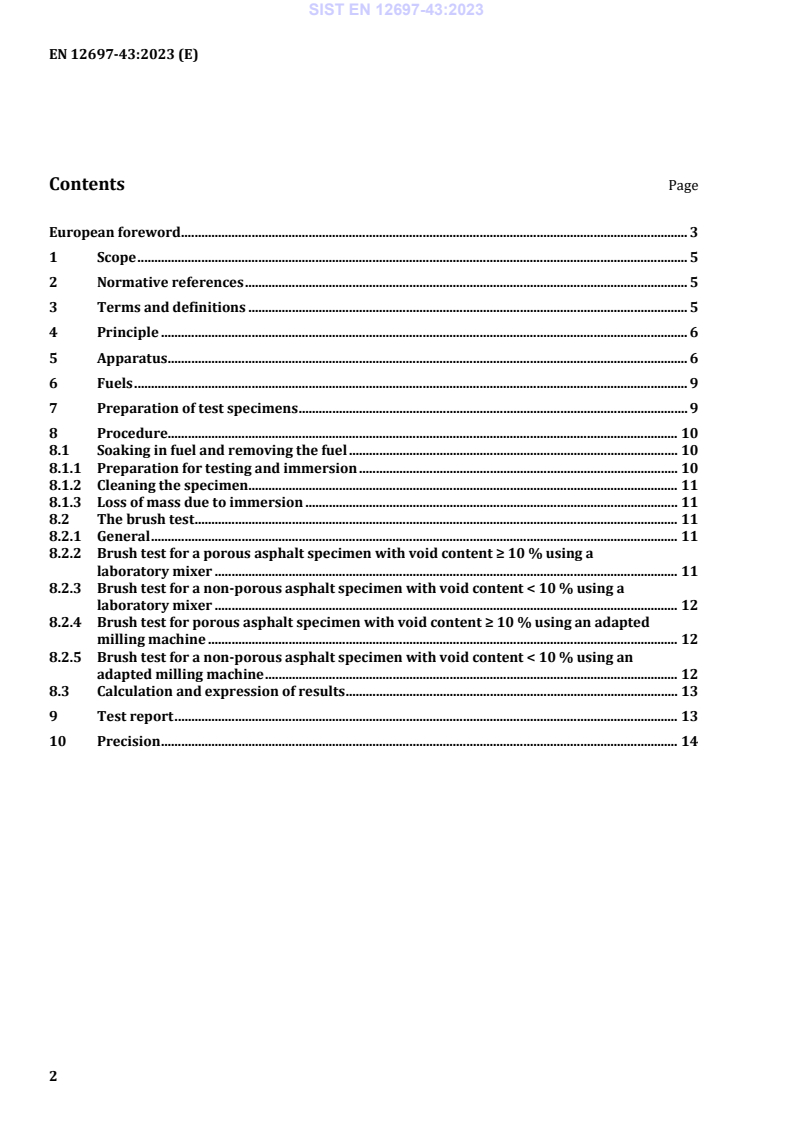
Contents Page
European foreword . 3
1 Scope . 5
2 Normative references . 5
3 Terms and definitions . 5
4 Principle . 6
5 Apparatus . 6
6 Fuels . 9
7 Preparation of test specimens . 9
8 Procedure. 10
8.1 Soaking in fuel and removing the fuel . 10
8.1.1 Preparation for testing and immersion . 10
8.1.2 Cleaning the specimen . 11
8.1.3 Loss of mass due to immersion . 11
8.2 The brush test . 11
8.2.1 General . 11
8.2.2 Brush test for a porous asphalt specimen with void content ≥ 10 % using a
laboratory mixer . 11
8.2.3 Brush test for a non-porous asphalt specimen with void content < 10 % using a
laboratory mixer . 12
8.2.4 Brush test for porous asphalt specimen with void content ≥ 10 % using an adapted
milling machine . 12
8.2.5 Brush test for a non-porous asphalt specimen with void content < 10 % using an
adapted milling machine . 12
8.3 Calculation and expression of results . 13
9 Test report . 13
10 Precision . 14
European foreword
This document (EN 12697-43:2023) has been prepared by Technical Committee CEN/TC 227 “Road
materials”, the secretariat of which is held by BSI.
This European Standard shall be given the status of a national standard, either by publication of an
identical text or by endorsement, at the latest by October 2023, and conflicting national standards shall
be withdrawn at the latest by October 2023.
Attention is drawn to the possibility that some of the elements of this document may be the subject of
patent rights. CEN shall not be held responsible for identifying any or all such patent rights.
This document supersedes EN 12697-43:2014.
The main changes compared to the previous edition are listed below:
— the title no longer refers to hot mix asphalt;
— general editorial update according to current standard template and CEN/CENELEC Internal
Regulations Part 3:2019;
-1”
— general editorial change of rotation speed indicated with “rpm” to “min ;
— [Clause 2] deletion of reference to EN 13108-20:2006;
— [Clause 2] added reference to EN 12697-7;
— [5.3] paragraph revised and the term accuracy amended to maximum permissible error;
— [5.6.2] keys referring to Figure 3 corrected to letters;
— [5.6.2] corrected reference to Clause 5.7 in Figure 3, E;
— [5.8] completion of description of soft-haired brush;
— [5.8] introduction of new Figure 5 (example of soft-haired brush). Following Figures re-numbered;
— [5.9] introduction of new Clause with description of pH-meter;
— [7.2] tolerance for the height of specimen amended from “40 to 60 mm” to “(50 ± 5) mm”;
— [7.2] specimens to be tested amended from three to four;
— [7.2] clarified description of porous asphalt and non-porous asphalt with respect to void content;
— [7.2] introduction of paragraph with description of the use of compaction methods;
— [7.2] introduction of explanatory NOTE regarding the impact of height on the result;
— [7.2] introduction of explanatory NOTE regarding the impact of different compaction methods;
— [7.3] reference to EN 13108-20:2006. Annex A deleted;
— [7.3] addition of EN 12697-7 for the determination of bulk density;
— [8.1.1] amended description for the immersion of fuel of the test specimen;
— [8.1.1] changed storage temperature for the immersed specimen to 20 ± 2 °C;
— [8.1.1] introduction of explanatory NOTE regarding influence of the fuel temperature;
— [8.1.2] introduction of “WARNING” regarding the disposal of the soiled water;
— [8.1.3] the term “accuracy” amended to read “to the nearest”. NOTE changed to normal text;
— [8.2.1] clarified description of porous asphalt and non-porous asphalt with respect to void content;
— [8.2.2], [8.2.2.1], [8.2.2.2], [8.2.3], [8.2.3.1], [8.2.3.2], [8.2.4], [8.2.5] amended titles;
— [8.2.5] paragraph with “EXAMPLE” amended to normal text;
— [8.3] deletion of conflictiong and superfluous paragraph “Carry out the test with three specimens”;
— [8.3] added references to Formulas;
— [Clause 9] bullets in test report revised and completed with additional information to be given.
A list of all parts in the EN 12697 series can be found on the CEN website.
Any feedback and questions on this document should be directed to the users’ national standards body.
A complete listing of these bodies can be found on the CEN website.
According to the CEN-CENELEC Internal Regulations, the national standards organisations of the
following countries are bound to implement this European Standard: Austria, Belgium, Bulgaria,
Croatia, Cyprus, Czech Republic, Denmark, Estonia, Finland, France, Germany, Greece, Hungary, Iceland,
Ireland, Italy, Latvia, Lithuania, Luxembourg, Malta, Netherlands, Norway, Poland, Portugal, Republic of
North Macedonia, Romania, Serbia, Slovakia, Slovenia, Spain, Sweden, Switzerland, Türkiye and the
United Kingdom.
1 Scope
This document specifies a test method to determine the resistance of a bituminous mixture or
pavement to fuels. The procedure involves initial soaking of a test specimen made in the laboratory or
cored from a pavement in a fuel, followed by a brushing period with a brush test device. The material
loss of the specimen is a measure of the resistance to that fuel for that bituminous mixture.
2 Normative references
The following documents are referred to in the text in such a way that some or all of their content
constitutes requirements of this document. For dated references, only the edition cited applies. For
undated references, the latest edition of the referenced document (including any amendments) applies.
EN 12697-6, Bituminous mixtures - Test methods - Part 6: Determination of bulk density of bituminous
specimens
EN 12697-7, Bituminous mixtures - Test methods - Part 7: Determination of the bulk density of bituminous
specimens by gamma rays
EN 12697-27, Bituminous mixtures - Test methods - Part 27: Sampling
EN 12697-30, Bituminous mixtures - Test methods - Part 30: Specimen preparation by impact compactor
EN 12697-31, Bituminous mixtures - Test methods - Part 31: Specimen preparation by gyratory
compactor
EN 12697-33, Bituminous mixtures - Test method - Part 33: Specimen prepared by roller compactor
EN 12697-35, Bituminous mixtures - Test methods - Part 35: Laboratory mixing
3 Terms and definitions
For the purposes of this document, the following terms and definitions apply.
ISO and IEC maintain terminology databases for use in standardization at the following addresses:
— IEC Electropedia: available at https://www.electropedia.org/
— ISO Online browsing platform: available at https://www.iso.org/obp
3.1
fuel
liquid (petroleum product) that might be spilled accidentally or sprayed deliberately onto an asphalt
pavement and can cause damage to the asphalt mixture
4 Principle
A cylindrical test specimen with a known mass is immersed partly in a bath with the specified fuel for a
specified period of time. After removal from the bath, cleaning with water and drying for 24 h at 25 °C,
the loss of mass of the specimen is measured and the immersed surface is visually inspected. Then an
abrasive loading is applied onto the immersed surface of the test specimen by a steel brush mounted
onto a brush test device. The steel brush moves in epicycloids passages over the surface. After 30 s the
brushing stops and the specimen is removed. The loss of mass is measured and the brushed surface is
visually inspected. The specimen is then put back and the same procedure is carried out again after 30 s
and after 60 s, when the brushed surface is visually inspected again.
The total brushing time is 120 s (two brushing periods of 30 s and one of 60 s). The combined material
loss after the immersion and the brush test is the main parameter for the resistance to the particular
fuel. As additional information the material loss after the immersion (chemical loading) and the brush
test (mechanical loading) are further informative parameters for the resistance to the particular fuel.
5 Apparatus
5.1 Beaker with glass rod
Cylindrical beaker made of glass for soaking the test specimen in the fuel. The container shall be flat-
bottomed and have an internal diameter of at least 140 mm (with porous asphalt specimens at least
190 mm) and an internal depth of at least 150 mm. A glass rod with a length of 70 mm and a diameter of
8 mm is put on one side of the bottom of the beaker so that one side of the immersed specimen can rest
on the bottom of the beaker and the other side on the glass rod to prevent the enclosure of air under the
immersed specimen.
5.2 Glass funnel
The size of the funnel shall be chosen in such a way that the rate of flow of the fluid into the beaker is as
small as possible to prevent any damage to the specimen because of the injection of the fluid in the
beaker.
5.3 Balance, with a maximum permissible error of 0,1 g.
5.4 Ventilated conditioning chamber, capable of maintaining temperature of (25 ± 2) °C in the
vicinity of the specimen.
5.5 Impact hammer, gyrator or roller compactor
Impact hammer (according to EN 12697-30), gyrator (according to EN 12697-31) or roller compactor
(according to EN 12697-33) to prepare laboratory made specimens.
5.6 Brush test device
Two different devices for the brush test are available.
5.6.1 Test device based on a laboratory mixer
Any mixer according to EN 12697-35 can be used. This mixer with epicyclical motion covers an area
with a diameter 5 mm less than the diameter of the specimen. The rotation speed shall be (60 ± 3)
−1
min .
The steel brush is connected to the mixer (see Figure 1).
SIST EN 12697-43:2
...