

SIST EN 13894-1:2004
(Main)Products and systems for the protection and repair of concrete structures - Test methods - Determination of fatigue under dynamic loading - Part 1: During cure
- Abstract
This Part of this European Standard specifies laboratory method of testing to ascertain how dynamic loading affects strength development of structural bonding agents during curing.
- Status
- Published
- Publication Date
- 31-Mar-2004
- Technical Committee
- BBB - Concrete, reinforced concrete and prestressed concrete
- Current Stage
- 6060 - National Implementation/Publication (Adopted Project)
- Start Date
- 01-Apr-2004
- Due Date
- 01-Apr-2004
- Completion Date
- 01-Apr-2004



SIST EN 13894-1:2004 is the Slovenian adoption of EN 13894-1:2003 for products and systems used to protect and repair concrete structures. It specifies a laboratory test method for checking how dynamic loading during cure affects the strength development of structural bonding agents, so manufacturers and test laboratories can compare cured joints with an unstressed control.
What does SIST EN 13894-1:2004 specify?
SIST EN 13894-1:2004 specifies one laboratory method for testing structural bonding agents while they are curing under dynamic load. The method is aimed at assessing the effect of cycling on strength development, not at service-life performance of a completed repair.
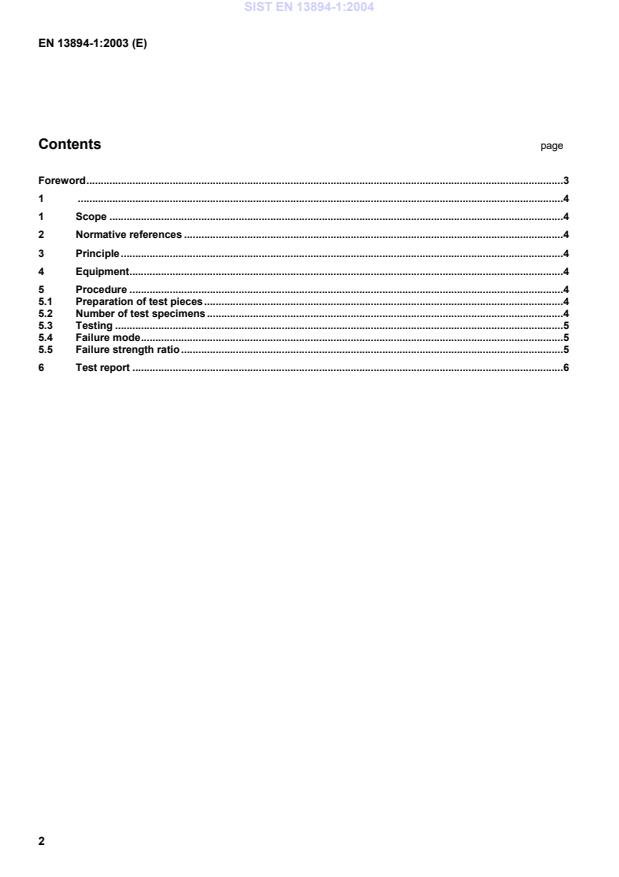
The document is organized into:
- Scope
- Normative references
- Principle
- Equipment
- Procedure
- Test report
Figure 1 shows the thick adherent shear test specimen, and Figure 2 shows the loading assembly used for cyclic straining.
What are the key requirements of SIST EN 13894-1:2004?
Clause 3 - test principle. SIST EN 13894-1:2004 uses a thick adherent shear test specimen and applies dynamic tensile loading along the specimen axis during curing. In practice, the result shows whether curing under movement changes the bonded joint strength compared with a stationary control.
Clause 4 - equipment. SIST EN 13894-1:2004 requires steel adherents, a loading plate, grit blasting equipment, a dynamic tension machine with strain control, and a static tension machine. This matters because the test depends on both controlled surface preparation and a machine that can hold a repeatable cyclic strain during cure.
Clause 5.1 - specimen preparation. SIST EN 13894-1:2004 requires the steel bonding surfaces to be cleaned, blasted to the specified surface-cleanliness grade in EN ISO 8501-1, and protected against unintended bonding on the butting faces. In practice, the surface condition has to be consistent or the test result will reflect preparation quality instead of adhesive behaviour.
Clause 5.2 - test layout. SIST EN 13894-1:2004 tests specimens in pairs and uses two groups: one group cured under dynamic load and one control group cured stationary. That gives the reader a direct comparison between vibrating and non-vibrating curing conditions.
Clause 5.3 - testing sequence. SIST EN 13894-1:2004 starts cyclic loading shortly after mixing, continues it during cure, then finishes the cure period and finally tests the joints in tension. For a laboratory, this means the timing of mixing, loading, curing, and tensile testing must be tightly coordinated.
Clause 5.4 - failure mode. SIST EN 13894-1:2004 records failures as Type A cohesion failure in the adhesive or Type B adhesion failure at an interface, with mixed failures reported as an area ratio. This helps users see whether the joint failed inside the adhesive or at the bond line.
Clause 5.5 - failure strength ratio. SIST EN 13894-1:2004 compares the mean failure strength of the cycled specimens with the mean failure strength of the control specimens. In practice, the ratio is the key comparison value for judging how much dynamic loading during cure affected the bonded joint.
Clause 6 - reporting. SIST EN 13894-1:2004 requires the report to identify the method used, the laboratory, the product, specimen preparation details, storage conditions, test date, each failure load, each failure mode, and the failure strength ratio. That makes the test traceable for product qualification or comparative testing.
What terms does SIST EN 13894-1:2004 define?
- Structural bonding agents - the adhesive materials whose strength development is being checked during cure.
- Thick adherent shear test specimen - the bonded test piece used to measure joint behaviour under the method.
- Dynamic loading - repeated loading applied while the adhesive is curing.
- Control specimen - a specimen cured stationary for comparison with the dynamically loaded specimens.
- Failure strength ratio - the comparison between the mean failure strength of cycled specimens and the mean failure strength of control specimens.
- Cohesion failure - failure within the adhesive layer itself.
- Adhesion failure - failure at one of the bonded interfaces.
Who uses SIST EN 13894-1:2004?
SIST EN 13894-1:2004 is used by test laboratories, adhesive and repair-material manufacturers, and quality teams working with concrete protection and repair products. It is also relevant to specifiers and buyers who need a repeatable laboratory method for comparing how products behave when they cure under dynamic loading.
In practice, these users apply the standard when preparing specimens, running cyclic cure tests, checking failure mode, and documenting results for product assessment or technical approval.
What changed in SIST EN 13894-1:2004 from the previous edition?
SIST EN 13894-1:2004 is identical to EN 13894-1:2003.
Which standards are used with SIST EN 13894-1:2004?
- EN ISO 8501-1:2001 - provides the visual surface-cleanliness grades used for preparing the steel adherents before bonding.
What does the SIST EN 13894-1:2004 document contain?
SIST EN 13894-1:2004 contains the full test method for preparing thick adherent shear specimens, loading them dynamically during cure, and testing them in tension afterwards. It also contains the equipment list, the specimen-preparation steps, the paired-test arrangement, and the calculation of failure strength ratio.
The document includes two technical figures:
- Figure 1 - the specimen geometry
- Figure 2 - the cyclic straining assembly
Clause 6 lists the information that has to appear in the test report, including specimen identification, failure load, failure mode, and the final ratio used to compare cycled and control results.
Relations
- Effective Date
- 28-Jan-2026
- Effective Date
- 22-Dec-2008
Get Certified
Connect with accredited certification bodies for this standard

DIBt (Deutsches Institut für Bautechnik)
German Institute for Building Technology.
DIN CERTCO
DIN Group product certification.

Aboma Certification B.V.
Specialized in construction, metal, and transport sectors.
Sponsored listings
Frequently Asked Questions
SIST EN 13894-1:2004 is a standard published by the Slovenian Institute for Standardization (SIST). Its full title is "Products and systems for the protection and repair of concrete structures - Test methods - Determination of fatigue under dynamic loading - Part 1: During cure". This standard covers: This Part of this European Standard specifies laboratory method of testing to ascertain how dynamic loading affects strength development of structural bonding agents during curing.
This Part of this European Standard specifies laboratory method of testing to ascertain how dynamic loading affects strength development of structural bonding agents during curing.
SIST EN 13894-1:2004 is classified under the following ICS (International Classification for Standards) categories: 91.080.40 - Concrete structures. The ICS classification helps identify the subject area and facilitates finding related standards.
SIST EN 13894-1:2004 has the following relationships with other standards: It is inter standard links to SIST EN ISO 8501-1:2002; is excused to SIST EN 13894-2:2003. Understanding these relationships helps ensure you are using the most current and applicable version of the standard.
SIST EN 13894-1:2004 is associated with the following European legislation: EU Directives/Regulations: 305/2011, 89/106/EEC. When a standard is cited in the Official Journal of the European Union, products manufactured in conformity with it benefit from a presumption of conformity with the essential requirements of the corresponding EU directive or regulation.
SIST EN 13894-1:2004 is available in PDF format for immediate download after purchase. The document can be added to your cart and obtained through the secure checkout process. Digital delivery ensures instant access to the complete standard document.
Standards Content (Sample)
2003-01.Slovenski inštitut za standardizacijo. Razmnoževanje celote ali delov tega standarda ni dovoljeno.Produkte und Systeme für den Schutz und die Instandsetzung von Betontragwerken - Prüfverfahren - Bestimmung der Dauerschwingfestigkeit unter dynamischer Belastung - Teil 1: Während des AushärtenProduits et systemes de protection et de réparation des structures en béton - Méthodes d'essai - Détermination de la fatigue sous charge dynamique - Partie 1: Pendant le durcissementProducts and systems for the protection and repair of concrete structures - Test methods - Determination of fatigue under dynamic loading - Part 1: During cure91.080.40Betonske konstrukcijeConcrete structuresICS:Ta slovenski standard je istoveten z:EN 13894-1:2003SIST EN 13894-1:2004en01-april-2004SIST EN 13894-1:2004SLOVENSKI
STANDARD
EUROPEAN STANDARDNORME EUROPÉENNEEUROPÄISCHE NORMEN 13894-1October 2003ICS 91.080.40English versionProducts and systems for the protection and repair of concretestructures - Test methods - Determination of fatigue underdynamic loading - Part 1: During cureProduits et systèmes de protection et de réparation desstructures en béton - Méthodes d'essai - Détermination dela fatigue sous charge dynamique - Partie 1: Pendant ledurcissementProdukte und Systeme für den Schutz und dieInstandsetzung von Betontragwerken - Prüfverfahren -Bestimmung der Dauerschwingfestigkeit unter dynamischerBelastung - Teil 1: Während des AushärtenThis European Standard was approved by CEN on 10 July 2003.CEN members are bound to comply with the CEN/CENELEC Internal Regulations which stipulate the conditions for giving this EuropeanStandard the status of a national standard without any alteration. Up-to-date lists and bibliographical references concerning such nationalstandards may be obtained on application to the Management Centre or to any CEN member.This European Standard exists in three official versions (English, French, German). A version in any other language made by translationunder the responsibility of a CEN member into its own language and notified to the Management Centre has the same status as the officialversions.CEN members are the national standards bodies of Austria, Belgium, Czech Republic, Denmark, Finland, France, Germany, Greece,Hungary, Iceland, Ireland, Italy, Luxembourg, Malta, Netherlands, Norway, Portugal, Slovakia, Spain, Sweden, Switzerland and UnitedKingdom.EUROPEAN COMMITTEE FOR STANDARDIZATIONCOMITÉ EUROPÉEN DE NORMALISATIONEUROPÄISCHES KOMITEE FÜR NORMUNGManagement Centre: rue de Stassart, 36
B-1050 Brussels© 2003 CENAll rights of exploitation in any form and by any means reservedworldwide for CEN national Members.Ref. No. EN 13894-1:2003 ESIST EN 13894-1:2004
...