

SIST EN 16064:2012
(Main)Packaging - Rigid plastic containers - PET finish 30/25 High (18,5)
- Abstract
This European Standard specifies the dimensions and requirements of the 30 mm tall screw finish with three (3) thread starts for flat waters and non-carbonated beverages.
This finish can be used for aseptic filling and filling with introduction of nitrogen. The dimension (18,5) is the height in millimetres from the top of finish to the bottom of the support ledge.
This finish is designed to take a tamper evident plastic closure only. During first opening, the tamper evident band will separate from the closure shell and stay on a one-way bottle neck or like bottles in the returnable market, the tamper evident band will tear but will remain connected to the closure shell.
- Status
- Published
- Public Enquiry End Date
- 19-Jun-2010
- Publication Date
- 17-Jan-2012
- Technical Committee
- EPO - Packaging - sales and grouped
- Current Stage
- 6060 - National Implementation/Publication (Adopted Project)
- Start Date
- 17-Jan-2012
- Due Date
- 23-Mar-2012
- Completion Date
- 18-Jan-2012



SIST EN 16064:2012 is a Slovenian standard published by SIST for a polyethylene terephthalate (PET) finish on rigid plastic containers. It specifies the dimensions and requirements for a 30 mm tall screw finish with three thread starts for flat waters and non-carbonated beverages. The finish is intended for use with a tamper evident plastic closure, including applications with aseptic filling and nitrogen dosing.
What does SIST EN 16064:2012 specify?
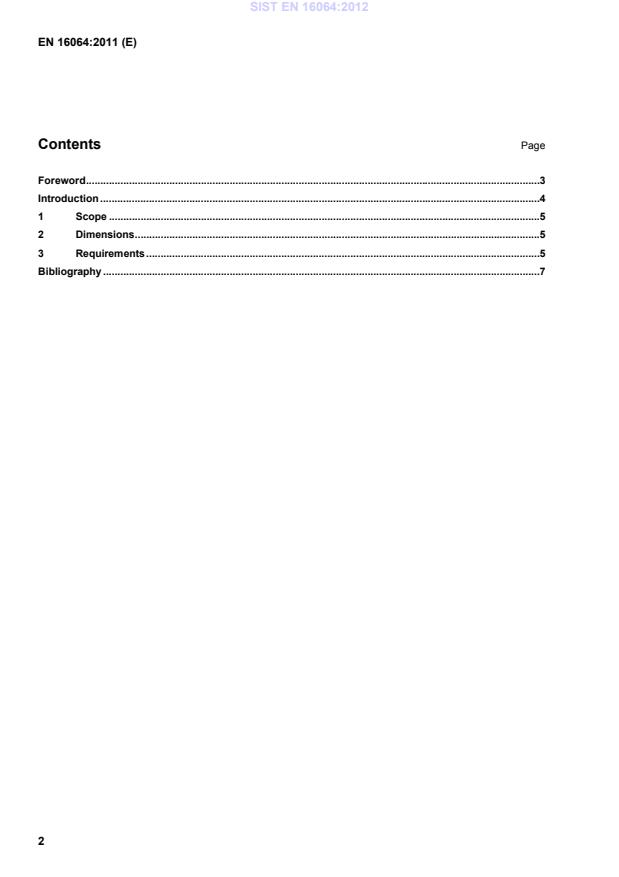
SIST EN 16064:2012 defines the PET finish 30/25 High (18,5) by its dimensions and by the requirements that affect closure fit and leak tightness. The document is organized into a foreword, introduction, scope, dimensions, requirements and bibliography.
In practical terms, the standard is for bottle and closure compatibility. The height reference of 18,5 mm is measured from the top of the finish to the bottom of the support ledge, so mould design and inspection can use the same datum.
The finish is designed for a tamper evident plastic closure only. On first opening, the tamper evident band either separates from the closure shell and stays on a one-way bottle neck, or tears while remaining connected to the closure shell in returnable-market type bottles.
What are the key requirements of SIST EN 16064:2012?
SIST EN 16064:2012 puts most of its technical control in Clause 2 and Clause 3. The main points are the thread form, the tolerances on the finish geometry, and the limits on defects that could affect sealing or closure application.
Geometry and thread form
Clause 2.1 and Figure 1 define the finish shape and dimensions. The standard also notes an alternate version with different diameters, so tooling and inspection need to follow the stated geometry, not a generic PET neck profile.
Clause 2.2 specifies three thread starts, spaced 120° apart, with a defined lead and thread lead-in and run-out. In practice, this controls how the closure engages the neck and helps keep capping behaviour consistent across production.
Clause 2.3 gives a general tolerance for the other radii, and Clause 2.4 gives a reference weight at the stated height and density. These details matter for mould making and for checking that the finish is built to the intended profile and mass.
Sealing surface and defect limits
Clause 3 says the finish is a top, side and inside seal finish. It must be smooth and free of defects that could create leaks, and flash must stay within the stated limit and must not be continuous.
For blown bottles, Clause 3 requires the control diameter C area to be free of defects down to 4 mm below the internal bore and across the sealing surface. This is important because the closure seals in this area, so any damage here can affect leakage and package performance.
Closure application and fit
Clause 3 also sets the limits that support good closure application. The sealing surface may deviate only slightly from parallel with the neck support ledge, and the thread mismatch at the mould seam is limited.
The standard further requires that variations in Ø E follow those of Ø T uniformly, that there be no overhang between Ø F and Ø G through 360°, and that only a limited one-sided flash step is allowed. It also says Ø G does not exceed Ø E. In practice, these are the checks that prevent interference, uneven closure seating and weak sealing.
What terms does SIST EN 16064:2012 define?
- PET - Polyethylene terephthalate, the plastic named in the finish designation.
- tamper evident plastic closure - A closure designed so its tamper evident band shows first opening by separating or tearing.
- closure shell - The main body of the closure that remains after opening.
- support ledge - The ledge used as the reference point for the 18,5 mm height.
- thread starts - The three starting points of the screw thread, arranged 120° apart.
- one-way bottle neck - A bottle neck where the tamper evident band stays on the neck after opening.
- control diameter C - The critical diameter area used to check defects near the sealing surface.
Who uses SIST EN 16064:2012?
SIST EN 16064:2012 is used by packaging engineers, bottle and closure manufacturers, and mould makers who need a common neck finish design. Beverage producers use it when specifying bottles for flat waters and non-carbonated beverages, especially where aseptic filling or nitrogen dosing is involved.
Quality teams use the standard for incoming inspection, dimensional checks and release criteria. Buyers and specifiers use it to make sure the bottle finish and the tamper evident closure will work together on the filling line.
What changed in SIST EN 16064:2012 from the previous edition?
SIST EN 16064:2012 is identified as identical to EN 16064:2011.
What does the SIST EN 16064:2012 document contain?
SIST EN 16064:2012 contains one figure with the design and dimensions of the finish, plus short clauses on dimensions and requirements. The requirements section covers sealing behaviour, defect limits, thread matching and closure application, which are the points most often needed for design review and line qualification.
The introduction says the standard is based on CE.T.I.E. (International Technical Centre for Bottling and related Packaging) data sheet GME 30.21 (2007). The bibliography gives that data sheet as the related reference.
Relations
- Effective Date
- 28-Jan-2026
- Effective Date
- 28-Jan-2026
- Effective Date
- 28-Jan-2026
- Effective Date
- 28-Jan-2026
- Effective Date
- 28-Jan-2026
Get Certified
Connect with accredited certification bodies for this standard

BRCGS (Brand Reputation Compliance Global Standards)
Global food safety and quality standards owner.
Sponsored listings
Frequently Asked Questions
SIST EN 16064:2012 is a standard published by the Slovenian Institute for Standardization (SIST). Its full title is "Packaging - Rigid plastic containers - PET finish 30/25 High (18,5)". This standard covers: This European Standard specifies the dimensions and requirements of the 30 mm tall screw finish with three (3) thread starts for flat waters and non-carbonated beverages. This finish can be used for aseptic filling and filling with introduction of nitrogen. The dimension (18,5) is the height in millimetres from the top of finish to the bottom of the support ledge. This finish is designed to take a tamper evident plastic closure only. During first opening, the tamper evident band will separate from the closure shell and stay on a one-way bottle neck or like bottles in the returnable market, the tamper evident band will tear but will remain connected to the closure shell.
This European Standard specifies the dimensions and requirements of the 30 mm tall screw finish with three (3) thread starts for flat waters and non-carbonated beverages. This finish can be used for aseptic filling and filling with introduction of nitrogen. The dimension (18,5) is the height in millimetres from the top of finish to the bottom of the support ledge. This finish is designed to take a tamper evident plastic closure only. During first opening, the tamper evident band will separate from the closure shell and stay on a one-way bottle neck or like bottles in the returnable market, the tamper evident band will tear but will remain connected to the closure shell.
SIST EN 16064:2012 is classified under the following ICS (International Classification for Standards) categories: 55.100 - Bottles. Pots. Jars. The ICS classification helps identify the subject area and facilitates finding related standards.
SIST EN 16064:2012 has the following relationships with other standards: It is inter standard links to SIST EN ISO 20728:2018, SIST EN ISO 15156-3:2015, SIST EN ISO 7539-11:2015, SIST EN ISO 7539-9:2008, SIST EN ISO 15156-3:2010. Understanding these relationships helps ensure you are using the most current and applicable version of the standard.
SIST EN 16064:2012 is available in PDF format for immediate download after purchase. The document can be added to your cart and obtained through the secure checkout process. Digital delivery ensures instant access to the complete standard document.
Standards Content (Sample)
2003-01.Slovenski inštitut za standardizacijo. Razmnoževanje celote ali delov tega standarda ni dovoljeno.Verpackung - Kunststoffbehältnisse - PET-Verschlussmundstück 30/25 H (18,5)Emballage - Récipients en plastique rigide - Bague PET 30/25 H (18,5)Packaging - Rigid plastic containers - PET finish 30/25 High (18,5)55.100Steklenice. Lonci. KozarciBottles. Pots. JarsICS:Ta slovenski standard je istoveten z:EN 16064:2011SIST EN 16064:2012en,fr,de01-marec-2012SIST EN 16064:2012SLOVENSKI
STANDARD
EUROPEAN STANDARD NORME EUROPÉENNE EUROPÄISCHE NORM
EN 16064
November 2011 ICS 55.100 English Version
Packaging - Rigid plastic containers - PET finish 30/25 High (18,5)
Emballage - Récipients en plastique rigide - Bague PET 30/25 Haute (18,5)
Verpackung - Kunststoffbehältnisse - PET-Verschlussmundstück 30/25 hoch (18,5) This European Standard was approved by CEN on 29 October 2011.
CEN members are bound to comply with the CEN/CENELEC Internal Regulations which stipulate the conditions for giving this European Standard the status of a national standard without any alteration. Up-to-date lists and bibliographical references concerning such national standards may be obtained on application to the CEN-CENELEC Management Centre or to any CEN member.
This European Standard exists in three official versions (English, French, German). A version in any other language made by translation under the responsibility of a CEN member into its own language and notified to the CEN-CENELEC Management Centre has the same status as the official versions.
CEN members are the national standards bodies of Austria, Belgium, Bulgaria, Croatia, Cyprus, Czech Republic, Denmark, Estonia, Finland, France, Germany, Greece, Hungary, Iceland, Ireland, Italy, Latvia, Lithuania, Luxembourg, Malta, Netherlands, Norway, Poland, Portugal, Romania, Slovakia, Slovenia, Spain, Sweden, Switzerland and United Kingdom.
EUROPEAN COMMITTEE FOR STANDARDIZATION
COMITÉ EUROPÉEN DE NORMALISATION EUROPÄISCHES KOMITEE FÜR NORMUNG
Management Centre:
Avenue Marnix 17,
B-1000 Brussels © 2011 CEN All rights of exploitation in any form and by any means reserved worldwide for CEN national Members. Ref. No. EN 16064:2011: ESIST EN 16064:2012
...