

SIST EN 4125:2010
(Main)Aerospace series - Nuts, anchor, self-locking, fixed, two lug, reduced series, with incremental counterbore, in heat resisting steel, MoS2 lubricated - Classification: 900 MPa (at ambient temperature)/315 °C
General Information
- Abstract
This standard specifies the characteristics of self-locking two lug, reduced series, incremental counterbored fixed anchor nuts, in heat resisting steel, MoS2 lubricated.
Classification: 900 MPa / 315 °C.
- Status
- Published
- Publication Date
- 01-Feb-2010
- Technical Committee
- I13 - Imaginarni 13
- Current Stage
- 6060 - National Implementation/Publication (Adopted Project)
- Start Date
- 01-Feb-2010
- Due Date
- 08-Apr-2010
- Completion Date
- 02-Feb-2010


Overview
SIST EN 4125:2010 is a European standard established by CEN that specifies the characteristics and technical requirements for aerospace nuts. These nuts are self-locking, fixed two-lug anchor nuts designed for high-performance applications where heat resistance and mechanical strength are critical. Manufactured from heat-resisting steel and lubricated with molybdenum disulphide (MoS2), these nuts are classified for a mechanical strength of 900 MPa at ambient temperature and can operate effectively at temperatures up to 315 °C.
This standard is essential for aerospace manufacturers, engineers, and quality assurance professionals focusing on fasteners with specific environmental and mechanical requirements in defense and aviation industries.
Key Topics
- Self-locking Two Lug Nuts: Defined as fixed anchor nuts featuring two lugs and a reduced series design, improving security and resistance against loosening under vibration and thermal cycling.
- Heat Resisting Steel: Materials complying with aerospace-grade heat-resistant steel specifications (EN 2398, EN 2399, EN 3638, EN 3639) ensuring performance at elevated temperatures.
- MoS2 Lubrication: Use of molybdenum disulphide as a dry lubricant to reduce friction during installation and operation, while maintaining locking integrity under harsh conditions.
- Incremental Counterbore Design: Provides additional mechanical engagement, optimized for aerospace fastening applications.
- Dimensional and Tolerance Specifications: Detailed dimensions and tolerances align with ISO 5855-2 (MJ threads) and ISO 8788 standards for fit and form precision.
- Performance Ratings: Minimum tensile strength of 900 MPa at ambient temperature and thermal endurance up to 315 °C without permanent degradation.
- Marking and Identification: Compliance with EN 2424 for product marking to ensure traceability and quality control in aerospace supply chains.
- Quality and Certification: Manufacturer qualifications and product approval processes are aligned with EN 9100 and EN 9133 aerospace quality management systems.
Applications
SIST EN 4125:2010 nuts are predominantly utilized in the aerospace and defense industries where reliability under extreme operational environments is mandatory. Typical applications include:
- Aircraft structural assembly: Securing components that must withstand high mechanical loads and temperature variations.
- Engine and turbine assemblies: Components exposed to high-temperature conditions requiring heat-resistant fasteners.
- Spacecraft components: Fasteners compatible with thermal cycling and high tensile strength demands.
- Military aerospace hardware: High-reliability fastening solutions capable of maintaining performance in challenging environments.
Their specified mechanical properties and self-locking features make them suited for use in vibration-intensive locations and heat-prone zones.
Related Standards
- EN 2398, EN 2399, EN 3638, EN 3639: Define material grades for heat-resisting steel used in fastening components.
- ISO 5855-2: Limits and dimensions for MJ thread bolts and nuts in aerospace applications.
- ISO 8788: Tolerances of form and position for metric aerospace nuts.
- EN 2424: Standards for marking aerospace products, ensuring identification and traceability.
- EN 2491: Guidelines on MoS2 dry lubricant coating methods employed on aerospace fasteners.
- EN 9100 and EN 9133: Quality management and product qualification standards for aerospace parts manufacturers.
- TR 3791: Material recommendations for self-locking nuts with temperature classifications up to 425 °C.
Keywords: SIST EN 4125:2010, aerospace nuts, self-locking nuts, heat resisting steel nuts, molybdenum disulphide lubrication, aerospace fasteners, two lug nuts, high tensile nuts, incremental counterbore, aerospace standard nuts, mechanical strength, aviation fasteners, aerospace quality management, high temperature fasteners.
Relations
- Effective Date
- 28-Jan-2026
- Effective Date
- 28-Jan-2026
- Effective Date
- 28-Jan-2026
- Effective Date
- 28-Jan-2026
- Effective Date
- 28-Jan-2026
- Effective Date
- 28-Jan-2026
- Effective Date
- 28-Jan-2026
- Effective Date
- 28-Jan-2026
- Effective Date
- 28-Jan-2026
Get Certified
Connect with accredited certification bodies for this standard

BUREAU VERITAS Certification Germany
Bureau Veritas certification in Germany.

Element Materials Technology
Materials testing and product certification.

AQMS Ltd.
AQMS provides ISO certification to SMEs across the UK.
Sponsored listings
Frequently Asked Questions
SIST EN 4125:2010 is a standard published by the Slovenian Institute for Standardization (SIST). Its full title is "Aerospace series - Nuts, anchor, self-locking, fixed, two lug, reduced series, with incremental counterbore, in heat resisting steel, MoS2 lubricated - Classification: 900 MPa (at ambient temperature)/315 °C". This standard covers: This standard specifies the characteristics of self-locking two lug, reduced series, incremental counterbored fixed anchor nuts, in heat resisting steel, MoS2 lubricated. Classification: 900 MPa / 315 °C.
This standard specifies the characteristics of self-locking two lug, reduced series, incremental counterbored fixed anchor nuts, in heat resisting steel, MoS2 lubricated. Classification: 900 MPa / 315 °C.
SIST EN 4125:2010 is classified under the following ICS (International Classification for Standards) categories: 49.030.30 - Nuts. The ICS classification helps identify the subject area and facilitates finding related standards.
SIST EN 4125:2010 has the following relationships with other standards: It is inter standard links to SIST EN 9100:2018, SIST EN 9133:2018, SIST EN ISO 15792-1:2008, SIST EN 2398:2008, SIST EN 2491:2011, SIST EN 2399:2008, SIST EN 840-6:2004+A1:2008, SIST EN 2424:2008, SIST EN 3638:2026. Understanding these relationships helps ensure you are using the most current and applicable version of the standard.
SIST EN 4125:2010 is available in PDF format for immediate download after purchase. The document can be added to your cart and obtained through the secure checkout process. Digital delivery ensures instant access to the complete standard document.
Standards Content (Sample)
2003-01.Slovenski inštitut za standardizacijo. Razmnoževanje celote ali delov tega standarda ni dovoljeno.Aeronavtika - Zakovne matice, samovarovalne, fiksne, dvostranske, skrajšana serija, z izvrtino za valjaste vijake, iz toplotnoodpornega jekla, mazane z MoS2 - Klasifikacija: 900 MPa (pri temperaturi okolice)/315 °CLuft- und Raumfahrt - Annietmuttern, selbstsichernd, beiderseitig verkürzter Flansch, mit tiefer zylindrischer Aussenkung, aus hochwarmfestem Stahl, MoS2-geschmiert - Klasse: 900 MPa (bei Raumtemperatur) / 315 °CSérie aérospatiale - Écrous à river, à freinage interne, fixes, double patte, série réduite, avec chambrage très profond, en acier résistant à chaud, lubrifiés MoS2 - Classification: 900 MPa (à température ambiante)/315 °CAerospace series - Nuts, anchor, self-locking, fixed, two lug, reduced series, with incremental counterbore, in heat resisting steel, MoS2 lubricated - Classification: 900 MPa (at ambient temperature)/315 °C49.030.30MaticeNutsICS:Ta slovenski standard je istoveten z:EN 4125:2010SIST EN 4125:2010en,de01-marec-2010SIST EN 4125:2010SLOVENSKI
STANDARD
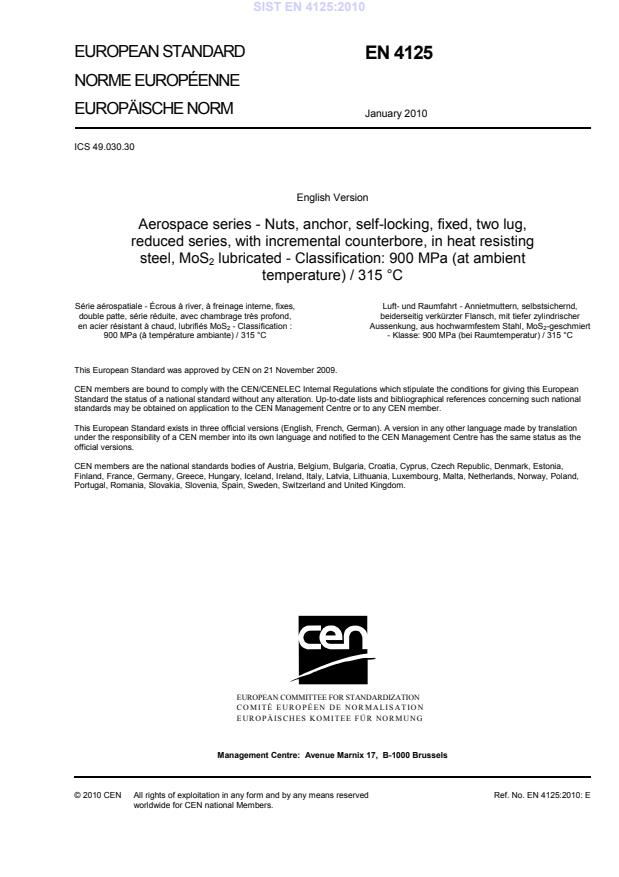
EUROPEAN STANDARD NORME EUROPÉENNE EUROPÄISCHE NORM
EN 4125
January 2010 ICS 49.030.30 English Version
Aerospace series - Nuts, anchor, self-locking, fixed, two lug, reduced series, with incremental counterbore, in heat resisting steel, MoS2 lubricated - Classification: 900 MPa (at ambient temperature) / 315 °C
Série aérospatiale - Écrous à river, à freinage interne, fixes, double patte, série réduite, avec chambrage très profond, en acier résistant à chaud, lubrifiés MoS2 - Classification : 900 MPa (à température ambiante) / 315 °C
Luft- und Raumfahrt - Annietmuttern, selbstsichernd, beiderseitig verkürzter Flansch, mit tiefer zylindrischer Aussenkung, aus hochwarmfestem Stahl, MoS2-geschmiert - Klasse: 900 MPa (bei Raumtemperatur) / 315 °C This European Standard was approved by CEN on 21 November 2009.
CEN members are bound to comply with the CEN/CENELEC Internal Regulations which stipulate the conditions for giving this European Standard the status of a national standard without any alteration. Up-to-date lists and bibliographical references concerning such national standards may be obtained on application to the CEN Management Centre or to any CEN member.
This European Standard exists in three official versions (English, French, German). A version in any other language made by translation under the responsibility of a CEN member into its own language and notified to the CEN Management Centre has the same status as the official versions.
CEN members are the national standards bodies of Austria, Belgium, Bulgaria, Croatia, Cyprus, Czech Republic, Denmark, Estonia, Finland, France, Germany, Greece, Hungary, Iceland, Ireland, Italy, Latvia, Lithuania, Luxembourg, Malta, Netherlands, Norway, Poland, Portugal, Romania, Slovakia, Slovenia, Spain, Sweden, Switzerland and United Kingdom.
EUROPEAN COMMITTEE FOR STANDARDIZATION
COMITÉ EUROPÉEN DE NORMALISATION EUROPÄISCHES KOMITEE FÜR NORMUNG
Management Centre:
Avenue Marnix 17,
B-1000 Brussels © 2010 CEN All rights of exploitation in any form and by any means reserved worldwide for CEN national Members. Ref. No. EN 4125:2010: ESIST EN 4125:2010
...