

SIST EN 353-2:2025/oprA1:2026
(Amendment)Personal fall protection equipment - Part 2: Guided type fall arresters including a flexible anchor line
- Abstract
This document specifies requirements, test methods, marking, manufacturer’s instructions and information and packaging for guided type fall arresters including a flexible anchor line forming a single product. This anchor line is attached to an upper anchor point for vertical and inclined applications; for horizontal applications, the anchor point can be located at the user’s foot level. Guided type fall arresters including a flexible anchor line conforming to this document are components of one of the fall arrest systems covered by EN 363:2018. Other types of fall arresters are specified in EN 353-1:2014+A1:2017 or EN 360:2023.
- Status
- Not Published
- Public Enquiry End Date
- 04-Nov-2026
- Technical Committee
- OVP - Personal protecting equipment
- Current Stage
- 4020 - Public enquire (PE) (Adopted Project)
- Start Date
- 03-Sep-2026
- Due Date
- 21-Jan-2027
- Completion Date
- 02-Oct-2026

SIST EN 353-2:2025/oprA1:2026 is the Slovenian draft amendment to EN 353-2:2024 for guided type fall arresters including a flexible anchor line. It updates the European standard that specifies how these personal fall protection devices are checked, marked and documented. The document is aimed at manufacturers, test laboratories, and anyone selecting or verifying this type of fall arrest equipment.
What does SIST EN 353-2:2025/oprA1:2026 specify?
SIST EN 353-2:2025/oprA1:2026 specifies amendments to EN 353-2:2024, not a standalone product standard. The underlying EN 353-2:2024 covers requirements, test methods, marking, manufacturer’s instructions and information, and packaging for guided type fall arresters including a flexible anchor line forming a single product.
The product is described as one that attaches to an upper anchor point for vertical and inclined applications. For horizontal applications, the anchor point may be at the user’s foot level. The standard also places these devices within the fall arrest systems covered by EN 363:2018.
The amendment is organized as a foreword and six modification clauses. The base standard also includes informative Annex ZA for the link with EU legislation.
| Part of the amendment | What it changes |
|---|---|
| Clause 2 | Normative references |
| 5.2.1.2 | Method for a test on the energy dissipating element |
| 5.2.2.2 | Static strength test method |
| 5.3.2 | Dynamic performance method |
| 5.3.6 | Override function method |
| 5.5 | Dynamic tests for horizontal and inclined applications |
What are the key requirements of SIST EN 353-2:2025/oprA1:2026?
SIST EN 353-2:2025/oprA1:2026 mainly tightens how the existing EN 353-2:2024 tests are carried out and documented. The practical effect is to make the test setup, measurement point and reference documents clearer for laboratories and manufacturers.
- Clause 2 adds footnotes to EN 364:1992, EN 365:2004 and EN ISO 9227:2022. In practice, this tells users to apply the referenced corrected versions when following the standard.
- In 5.2.1.2, the method for the energy dissipating element is clarified. The test setup now makes the loading position and the measurement of the element’s initial length more explicit, so labs can set up and record the same test in the same way.
- In 5.2.2.2, the static strength test arrangement is revised. The sample preparation now refers more clearly to the flexible anchor line, the GTFA and any stopper device, which helps prevent different interpretations of how the specimen is mounted.
- In 5.3.2, one paragraph in the dynamic performance method is deleted and the remaining text is renumbered. For users, this means the dynamic performance procedure must be followed in its updated sequence.
- In 5.3.6, the figure for the override function is replaced. That matters because the figure defines the test arrangement, and test rigs are often built directly from the standard’s diagrams.
- In 5.5.4.6, the horizontal and inclined application figures are updated so that arrest distance H is measured from the release point above the test edge. This changes the reference point used in the result, so it affects how the test outcome is read and reported.
- The document keeps the product context tied to EN 363:2018. In practice, that means these devices are treated as components in a complete fall arrest system, not as stand-alone protection.
What terms does SIST EN 353-2:2025/oprA1:2026 define?
- GTFA - Guided type fall arrester, the device type covered by the standard.
- Flexible anchor line - The line used with the arrester to form the anchorage path for the single product.
- Energy dissipating element - The part whose length and loading behaviour are examined in the method of 5.2.1.2.
- Stopper device - A device on the flexible anchor line mentioned in the static strength test arrangement.
- Stopper knot - A knot on the flexible anchor line that may be present in the test arrangement.
- Connection element - The element loaded during the test methods and connected to the GTFA.
- Arrest distance H - The distance used in the horizontal and inclined application tests.
Who uses SIST EN 353-2:2025/oprA1:2026?
Manufacturers of guided type fall arresters use SIST EN 353-2:2025/oprA1:2026 to design the product, choose the test setup, and prepare marking, instructions and packaging. Test laboratories use it to run the static, dynamic and horizontal/inclined application methods in a repeatable way.
It is also relevant for conformity assessment bodies, product specifiers, buyers and safety managers who need to confirm that a guided type fall arrester with a flexible anchor line fits the intended fall arrest system and is documented according to the standard.
What changed in SIST EN 353-2:2025/oprA1:2026 from the previous edition?
SIST EN 353-2:2025/oprA1:2026 modifies EN 353-2:2024. The changes stated in the amendment are:
- updated footnotes for the normative references in Clause 2
- clarification of the method in 5.2.1.2
- revision of the static strength test method and figure in 5.2.2.2
- deletion of one paragraph in 5.3.2 and renumbering of the remaining text
- replacement of the figure for the override function in 5.3.6
- revision of the horizontal and inclined application figures in 5.5, including the reference used for arrest distance H
Which standards are used with SIST EN 353-2:2025/oprA1:2026?
- EN 363:2018 - identifies the fall arrest systems in which the product is used.
- EN 353-1:2014+A1:2017 - covers other guided type fall arresters.
- EN 360:2023 - covers another fall arrester type mentioned for distinction.
- EN 364:1992 - cited in Clause 2, with an updated footnote in this amendment.
- EN 365:2004 - cited in Clause 2, with an updated footnote in this amendment.
- EN ISO 9227:2022 - cited in Clause 2, with an updated footnote in this amendment.
What does the SIST EN 353-2:2025/oprA1:2026 document contain?
The amendment contains a foreword and six technical modification clauses. Those clauses adjust the reference standards, refine a test method for the energy dissipating element, revise the static strength setup, remove one paragraph from the dynamic performance method, replace the override-function figure, and update the figures and reference point used for horizontal and inclined application tests.
It is a concise document focused on test method clarity rather than on redefining the whole product family. For a reader, the main value is knowing exactly where EN 353-2:2024 has been edited before using it for testing, product development or conformity work.
Relations
- Effective Date
- 22-Apr-2026
Get Certified
Connect with accredited certification bodies for this standard

CIS Institut d.o.o.
Personal Protective Equipment (PPE) certification body. Notified Body NB-2890 for EU Regulation 2016/425 PPE.

Kiwa BDA Testing
Building and construction product certification.
Kmetijski inštitut Slovenije
Agricultural Institute of Slovenia. Soil testing, plant health, agricultural product analysis.
Sponsored listings
Frequently Asked Questions
SIST EN 353-2:2025/oprA1:2026 is a draft published by the Slovenian Institute for Standardization (SIST). Its full title is "Personal fall protection equipment - Part 2: Guided type fall arresters including a flexible anchor line". This standard covers: This document specifies requirements, test methods, marking, manufacturer’s instructions and information and packaging for guided type fall arresters including a flexible anchor line forming a single product. This anchor line is attached to an upper anchor point for vertical and inclined applications; for horizontal applications, the anchor point can be located at the user’s foot level. Guided type fall arresters including a flexible anchor line conforming to this document are components of one of the fall arrest systems covered by EN 363:2018. Other types of fall arresters are specified in EN 353-1:2014+A1:2017 or EN 360:2023.
This document specifies requirements, test methods, marking, manufacturer’s instructions and information and packaging for guided type fall arresters including a flexible anchor line forming a single product. This anchor line is attached to an upper anchor point for vertical and inclined applications; for horizontal applications, the anchor point can be located at the user’s foot level. Guided type fall arresters including a flexible anchor line conforming to this document are components of one of the fall arrest systems covered by EN 363:2018. Other types of fall arresters are specified in EN 353-1:2014+A1:2017 or EN 360:2023.
SIST EN 353-2:2025/oprA1:2026 is classified under the following ICS (International Classification for Standards) categories: 13.340.60 - Protection against falling and slipping. The ICS classification helps identify the subject area and facilitates finding related standards.
SIST EN 353-2:2025/oprA1:2026 has the following relationships with other standards: It is inter standard links to SIST EN 353-2:2025. Understanding these relationships helps ensure you are using the most current and applicable version of the standard.
SIST EN 353-2:2025/oprA1:2026 is associated with the following European legislation: EU Directives/Regulations: 2016/425; Standardization Mandates: M/571, M/571 AMD 1, M/571 AMD 2. When a standard is cited in the Official Journal of the European Union, products manufactured in conformity with it benefit from a presumption of conformity with the essential requirements of the corresponding EU directive or regulation.
SIST EN 353-2:2025/oprA1:2026 is available in PDF format for immediate download after purchase. The document can be added to your cart and obtained through the secure checkout process. Digital delivery ensures instant access to the complete standard document.
Standards Content (Sample)
SLOVENSKI STANDARD
01-oktober-2026
Osebna oprema za varovanje pred padci - 2. del: Drseče naprave za zaustavljanje
na gibljivem vodilu
Personal fall protection equipment - Part 2: Guided type fall arresters including a flexible
anchor line
Persönliche Absturzschutzausrüstung - Teil 2: Mitlaufende Auffanggeräte einschließlich
beweglicher Führung
Équipement de protection individuelle contre les chutes de hauteur - Partie 2 : Antichutes
mobiles incluant un support d'assurage flexible
Ta slovenski standard je istoveten z: EN 353-2:2024/prA1
ICS:
13.340.60 Zaščita pred padci in zdrsi Protection against falling and
slipping
2003-01.Slovenski inštitut za standardizacijo. Razmnoževanje celote ali delov tega standarda ni dovoljeno.
DRAFT
EUROPEAN STANDARD
EN 353-2:2024
NORME EUROPÉENNE
EUROPÄISCHE NORM
prA1
August 2026
ICS 13.340.60
English Version
Personal fall protection equipment - Part 2: Guided type
fall arresters including a flexible anchor line
Équipement de protection individuelle contre les Persönliche Absturzschutzausrüstung - Teil 2:
chutes de hauteur - Partie 2 : Antichutes mobiles Mitlaufende Auffanggeräte einschließlich beweglicher
incluant un support d'assurage flexible Führung
This draft amendment is submitted to CEN members for enquiry. It has been drawn up by the Technical Committee CEN/TC 160.
This draft amendment A1, if approved, will modify the European Standard EN 353-2:2024. If this draft becomes an amendment,
CEN members are bound to comply with the CEN/CENELEC Internal Regulations which stipulate the conditions for inclusion of
this amendment into the relevant national standard without any alteration.
This draft amendment was established by CEN in three official versions (English, French, German). A version in any other
language made by translation under the responsibility of a CEN member into its own language and notified to the CEN-CENELEC
Management Centre has the same status as the official versions.
CEN members are the national standards bodies of Austria, Belgium, Bulgaria, Croatia, Cyprus, Czech Republic, Denmark, Estonia,
Finland, France, Germany, Greece, Hungary, Iceland, Ireland, Italy, Latvia, Lithuania, Luxembourg, Malta, Netherlands, Norway,
Poland, Portugal, Republic of North Macedonia, Romania, Serbia, Slovakia, Slovenia, Spain, Sweden, Switzerland, Türkiye and
United Kingdom.
Recipients of this draft are invited to submit, with their comments, notification of any relevant patent rights of which they are
aware and to provide supporting documentation.
Warning : This document is not a European Standard. It is distributed for review and comments. It is subject to change without
notice and shall not be referred to as a European Standard.
EUROPEAN COMMITTEE FOR STANDARDIZATION
COMITÉ EUROPÉEN DE NORMALISATION
EUROPÄISCHES KOMITEE FÜR NORMUNG
CEN-CENELEC Management Centre: Rue de la Science 23, B-1040 Brussels
© 2026 CEN All rights of exploitation in any form and by any means reserved Ref. No. EN 353-2:2024/prA1:2026 E
worldwide for CEN national Members.
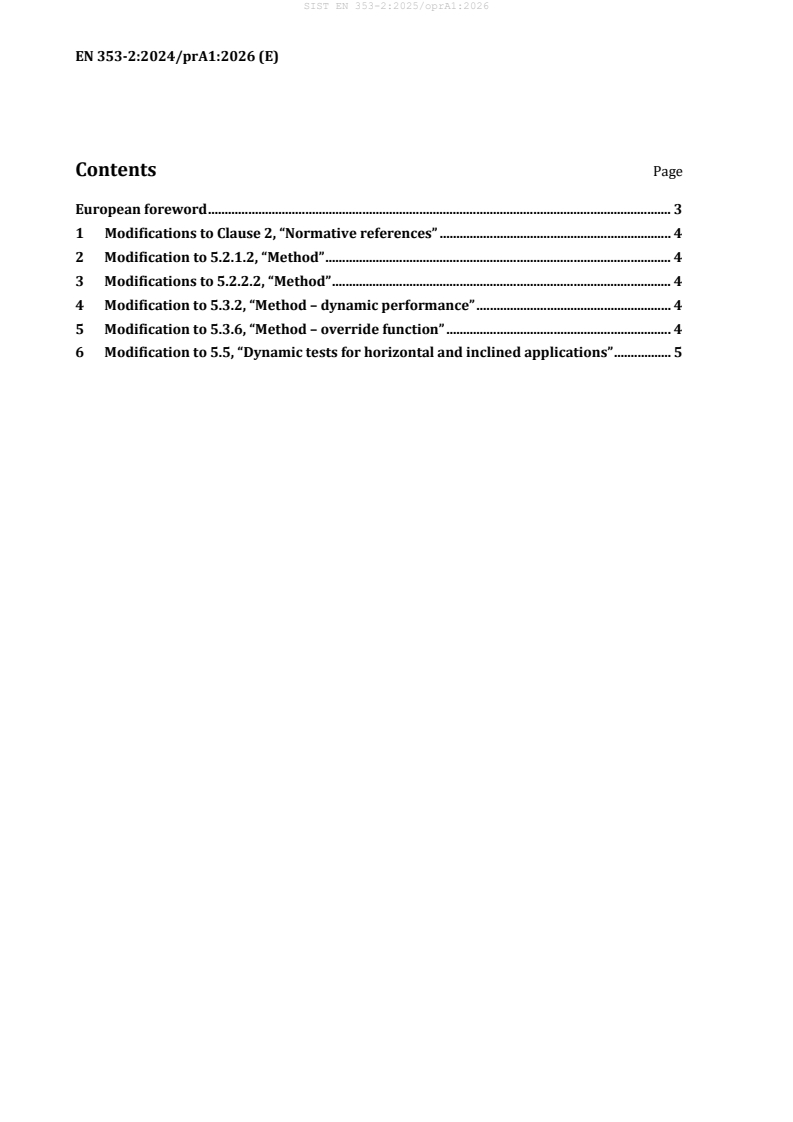
Contents Page
European foreword . 3
1 Modifications to Clause 2, “Normative references” .
...