

oSIST prEN 196-14:2026
(Main)Method of testing cement - Part 14: Determination of tricalcium silicate (C3S), dicalcium silicate (C2S), tricalcium aluminate (C3A) and tetracalcium aluminoferrite (C4AF) of common cement and clinker
- Abstract
This document describes the analytical procedures used to determine the content of tricalcium silicate (C3S), dicalcium silicate (C2S), tricalcium aluminate (C3A) and tetracalcium aluminoferrite (C4AF) of cement starting from a chemical analysis on cement. The method can be applied on all common cements as defined on EN 197-1.
This document also describes the calculation procedures for determining of tricalcium silicate (C3S), dicalcium silicate (C2S), aluminate (C3A) and tetracalcium aluminoferrite (C4AF) in the Portland cement clinker as defined in the EN 197-1.
In both cases, for cement and clinker, the calculation method is based on the Bogue method assuming each phase has a pure composition. This is a conventional method, whereby the actual mineralogical composition can differ from the results obtained using this method.
For the determination of the various chemical species of clinker, cement and basic-complexing residue (BCR) described in this document, the method is indicated in the relevant clause.
- Status
- Not Published
- Public Enquiry End Date
- 22-Oct-2026
- Technical Committee
- CAA - Mineral binders and masonry
- Current Stage
- 4020 - Public enquire (PE) (Adopted Project)
- Start Date
- 06-Aug-2026
- Due Date
- 24-Dec-2026

oSIST prEN 196-14:2026 is a draft European Standard from CEN for cement laboratories. It specifies analytical procedures and Bogue-based calculation methods for estimating tricalcium silicate (C3S), dicalcium silicate (C2S), tricalcium aluminate (C3A) and tetracalcium aluminoferrite (C4AF) in common cement and Portland cement clinker. It is intended for people who need phase estimates from chemical analysis in testing, quality control and product evaluation.
What does oSIST prEN 196-14:2026 specify?
oSIST prEN 196-14:2026 specifies how to derive clinker-phase contents from chemical analysis of cement or clinker, using the Bogue method and defined corrections for non-clinker contributions. The document applies to common cements as defined in EN 197-1 and to Portland cement clinker as defined there.
The document treats the calculated phase contents as conventional estimates. That matters in practice because the actual mineralogical composition can differ from the calculated result, so the method is used for consistent comparison and control rather than direct phase identification.
The document is organized into 17 clauses:
- clauses 1 to 5 cover scope, references, definitions, method principle and reporting format
- clauses 6 to 10 cover ignition, constant mass, sample preparation, reagents and apparatus
- clauses 11 to 16 cover clinker and cement analysis, the BCR residue, sulfate and carbon dioxide determinations
- clause 17 covers calculation and expression of results
- the bibliography lists supporting documents and background references
What are the key requirements of oSIST prEN 196-14:2026?
oSIST prEN 196-14:2026 requires the analyst to start from chemical analysis and then apply the correct calculation path for clinker, cement and the BCR residue. The practical point is that the method is not a single formula - it is a workflow with defined measurements, corrections and result reporting rules.
Clinker and cement analysis
- Clause 11 requires clinker analysis for CaO, SiO2, Al2O3 and Fe2O3 in accordance with EN 196-2, then free lime is measured by ethylene glycol extraction. This matters because free CaO is corrected out of the clinker balance before phase calculation.
- Clause 11 also treats carbonated free lime separately, and it is derived from carbon dioxide measured on clinker carbonation. In practice, this avoids counting carbonate-derived lime as reactive clinker lime.
- Clause 12 requires the cement test sample to be analysed for CaO, SiO2, Al2O3, Fe2O3, SO3 and CO2 in accordance with EN 196-2. That gives the oxide basis needed to estimate clinker phases in blended cement.
BCR residue and supporting determinations
- Clause 13 defines the BCR residue procedure using a base-complexing treatment, filtration, washing, drying and weighing. This residue is used to separate the cement matrix from the portion treated as slag or pozzolanic material in the calculation model.
- Clause 14 requires direct analysis of the BCR residue for the same key oxides and species, using ICP-OES with EN 17200 and EN 17197 after digestion to EN 13656, or equivalent methods shown to be equivalent. This matters because the residue contribution must be removed from the cement balance when clinker content is calculated.
- Clauses 15 and 16 require gravimetric sulfate and carbon dioxide determinations on the cement test sample. These measurements support the corrections for calcium sulfate and carbonate in the clinker-phase calculation.
Calculation and reporting
- Clause 17 applies the Bogue method to calculate C3S, C2S, C3A and C4AF, with corrections for free lime, carbonated lime, insoluble silica, sulfate and BCR residue. The practical effect is that the calculation reflects the cement type and the non-clinker constituents rather than assuming a pure clinker.
- Clause 17 gives separate calculation paths for several cement type families, and it includes adjustment factors for some types based on BCR content. It also warns that some materials, such as magnesian limestone or recycled concrete fines in certain cement types, can make the published formulas unsuitable, so the user has to choose the right calculation route.
- Clause 5 sets how masses, volumes, solution factors and results are to be expressed, and it requires recording all individual test results. That supports traceability and consistent reporting between laboratories.
What terms does oSIST prEN 196-14:2026 define?
- Bogue method - A calculation procedure that estimates the potential proportions of the main clinker minerals from the oxide composition of cement or clinker.
- BCR residue - The residue obtained after treatment with the base-complexing reagent, used as a separate fraction in the cement calculation model.
- Free lime - Reactive CaO in clinker, determined by ethylene glycol extraction.
- Carbonated free lime - Lime present as carbonate-derived CaO in clinker, determined from carbon dioxide.
- Common cements - The cement family covered by EN 197-1 and used as the main application area for this part.
- Portland cement clinker - The clinker form covered by EN 197-1 and used for the clinker-phase calculation path.
Who uses oSIST prEN 196-14:2026?
oSIST prEN 196-14:2026 is used by cement producers, testing laboratories, quality control teams and technical staff who need calculated clinker-phase contents from chemical analysis. It is relevant for routine laboratory testing, production control, conformity work and product development for common cement and clinker. Buyers and specifiers may also use the reported results when they need a comparable chemical indication of clinker phase composition.
Which standards are used with oSIST prEN 196-14:2026?
- EN 196-2 - Provides the cement chemical analysis methods used throughout the document, including ignition-related preparation, oxide analysis, sulfate and carbon dioxide determinations.
- CEN/TS 196-4 - Provides the quantitative determination of constituents used when clinker content in cement has to be established.
- EN 17200 - Supports ICP-MS analysis of inorganic substances after digestion of the BCR residue.
- EN 17197 - Supports ICP-OES analysis of inorganic substances after digestion of the BCR residue.
- EN 13656 - Provides the digestion step for the BCR residue before elemental analysis.
- ISO 385 - Specifies burettes used for volumetric work.
- ISO 835 - Specifies graduated pipettes used for volumetric work.
- EN 197-1 - Defines the common cements and Portland cement clinker to which the method applies.
- EN 196-7 - Cited in the bibliography for sampling and sample preparation of common cement and its constituents.
What does the oSIST prEN 196-14:2026 document contain?
oSIST prEN 196-14:2026 contains the method principle, the required reagents and apparatus, and the step-by-step procedures for clinker, cement and BCR residue analysis. It also contains the free lime extraction procedure, the residue preparation workflow, the analytical routes for sulfate and carbon dioxide, and the calculation schemes for different cement families.
The document includes a general outline figure for the analytical workflow and calculation logic. It also gives the expression rules for reporting masses, volumes, factors and results, so laboratories can report data in a consistent format.
The calculation section is the core of the document. It provides the Bogue-based equations for estimating C3S, C2S, C3A and C4AF from corrected oxide data and shows how to adapt the calculation when cement composition or BCR content changes.
Get Certified
Connect with accredited certification bodies for this standard

DIBt (Deutsches Institut für Bautechnik)
German Institute for Building Technology.

DIN CERTCO
DIN Group product certification.

Aboma Certification B.V.
Specialized in construction, metal, and transport sectors.
Sponsored listings
Frequently Asked Questions
oSIST prEN 196-14:2026 is a draft published by the Slovenian Institute for Standardization (SIST). Its full title is "Method of testing cement - Part 14: Determination of tricalcium silicate (C3S), dicalcium silicate (C2S), tricalcium aluminate (C3A) and tetracalcium aluminoferrite (C4AF) of common cement and clinker". This standard covers: This document describes the analytical procedures used to determine the content of tricalcium silicate (C3S), dicalcium silicate (C2S), tricalcium aluminate (C3A) and tetracalcium aluminoferrite (C4AF) of cement starting from a chemical analysis on cement. The method can be applied on all common cements as defined on EN 197-1. This document also describes the calculation procedures for determining of tricalcium silicate (C3S), dicalcium silicate (C2S), aluminate (C3A) and tetracalcium aluminoferrite (C4AF) in the Portland cement clinker as defined in the EN 197-1. In both cases, for cement and clinker, the calculation method is based on the Bogue method assuming each phase has a pure composition. This is a conventional method, whereby the actual mineralogical composition can differ from the results obtained using this method. For the determination of the various chemical species of clinker, cement and basic-complexing residue (BCR) described in this document, the method is indicated in the relevant clause.
This document describes the analytical procedures used to determine the content of tricalcium silicate (C3S), dicalcium silicate (C2S), tricalcium aluminate (C3A) and tetracalcium aluminoferrite (C4AF) of cement starting from a chemical analysis on cement. The method can be applied on all common cements as defined on EN 197-1. This document also describes the calculation procedures for determining of tricalcium silicate (C3S), dicalcium silicate (C2S), aluminate (C3A) and tetracalcium aluminoferrite (C4AF) in the Portland cement clinker as defined in the EN 197-1. In both cases, for cement and clinker, the calculation method is based on the Bogue method assuming each phase has a pure composition. This is a conventional method, whereby the actual mineralogical composition can differ from the results obtained using this method. For the determination of the various chemical species of clinker, cement and basic-complexing residue (BCR) described in this document, the method is indicated in the relevant clause.
oSIST prEN 196-14:2026 is classified under the following ICS (International Classification for Standards) categories: 91.100.10 - Cement. Gypsum. Lime. Mortar. The ICS classification helps identify the subject area and facilitates finding related standards.
oSIST prEN 196-14:2026 is available in PDF format for immediate download after purchase. The document can be added to your cart and obtained through the secure checkout process. Digital delivery ensures instant access to the complete standard document.
Standards Content (Sample)
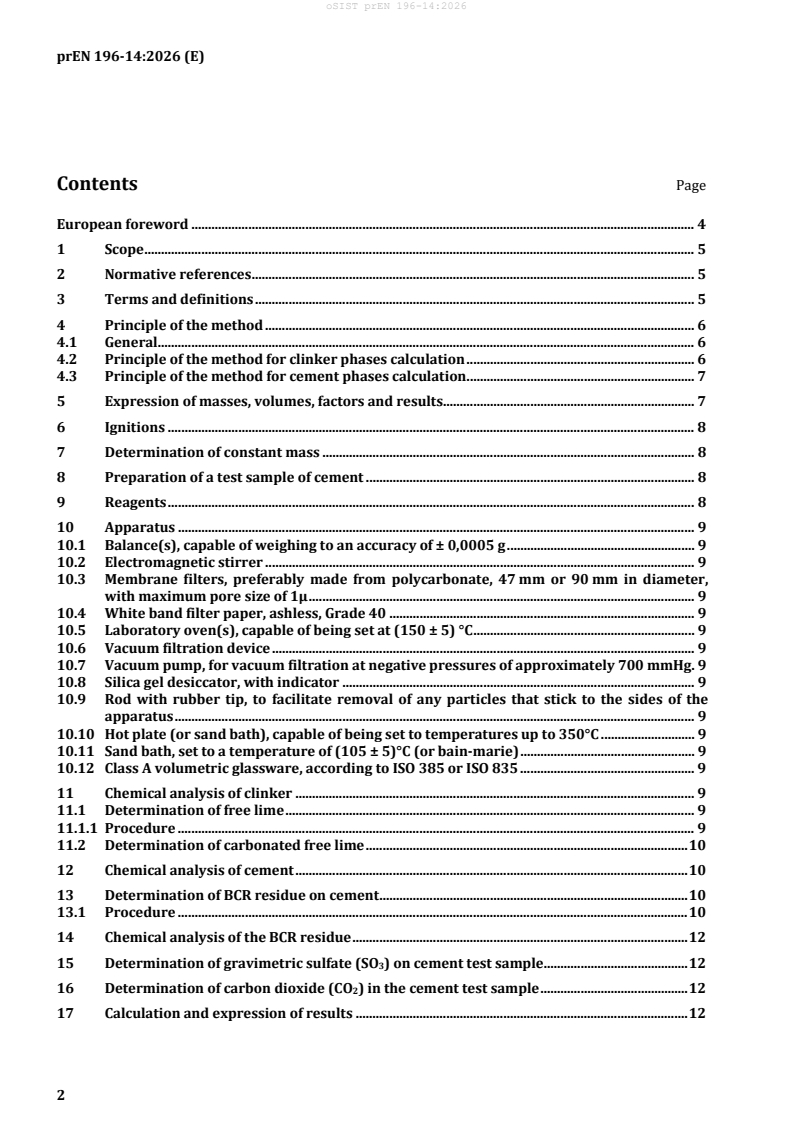
Contents
- 1 Scope
- 2 Normative references
- 3 Terms and definitions
- 3.1 Bogue method
- 4 Principle of the method
- 4.1 General
- 4.2 Principle of the method for clinker phases calculation
- 4.3 Principle of the method for cement phases calculation
- 5 Expression of masses, volumes, factors and results
- 6 Ignitions
- 7 Determination of constant mass
- 8 Preparation of a test sample of cement
- 9 Reagents
- 9.2 EDTA - dihydrated disodium salt of ethylenediaminetetra-acetic acid
- 9.4 Diethylamine (DEA): [(C H )2NH]
- 9.5 Ethanol 95 %: [C H OH]
- 9.6 Anhydrous sodium carbonate (Na CO )
- 9.7 Perchloric acid, (HClO )
- 9.8 Acetic acid, glacial (CH3COOH)
- 9.9 Hydrochloric acid, (HCl)
- 9.10 Hydrochloric acid 12 % (HCl): Dilute 100 ml of concentrated HCl (9.9) with 250 ml of
- 9.11 Hydrochloric acid, dilute (1 + 1)
- 9.12 Hydrochloric acid, 0,1 N solution
- 9.13 Ethylene glycol
- 9.14 Ethyl alcohol, anhydrous
- 9.15 Bromocresol green indicator
- 10 Apparatus
- 10.1 Balance(s), capable of weighing to an accuracy of ± 0,0005 g
- 10.2 Electromagnetic stirrer
- 10.3 Membrane filters, preferably made from polycarbonate, 47 mm or 90 mm in
- 10.5 Laboratory oven(s), capable of being set at (150 ± 5) °C
- 10.6 Vacuum filtration device
- 10.8 Silica gel desiccator, with indicator
- 10.9 Rod with rubber tip, to facilitate removal of any particles that stick to the sides of
- 10.10 Hot plate (or sand bath), capable of being set to temperatures up to 350°C
- 10.11 Sand bath, set to a temperature of (105 ± 5)°C (or bain-marie)
- 11 Chemical analysis of clinker
- 11.1 Determination of free lime
- 11.2 Determination of carbonated free lime
- 12 Chemical analysis of cement
- 13 Determination of BCR residue on cement
- 13.1 Procedure
- 14 Chemical analysis of the BCR residue
- 15 Determination of gravimetric sulfate (SO ) on cement test sample
- 16 Determination of carbon dioxide (CO ) in the cement test sample
- 17 Calculation and expression of results
- 17.1 Calculation of C S, C S, C A and C AF content in the clinker
- 17.2 Calculation of C3S, C2S, C3A and C4AF of different cement type denomination
- 0 R SO3 C
- 17.3 Calculation of the C3S, C2S, C3A, C4AF of clinker according to Bogue for cement types
- 17.4 Calculation of the C3S, C2S, C3A, C4AF of clinker according to Bogue for cement types
- 17.5 Calculation of the C3S, C2S, C3A, C4AF of clinker according to Bogue for cement types
- 17.6 Calculation of the C S, C S, C A, C AF of clinker according to Bogue for cement types
- Bibliography
1 Scope
This document describes the analytical procedures used to determine the content of tricalcium silicate (C S), dicalcium silicate (C S), tricalcium aluminate (C A) and tetracalcium aluminoferrite (C AF) of 3 2 3 4 cement starting from a chemical analysis on cement. The method can be applied on all common cements as defined on EN 197-1.
This document also describes the calculation procedures for determining of tricalcium silicate (C S),
dicalcium silicate (C S), aluminate (C A) and tetracalcium aluminoferrite (C AF) in the Portland cement 2 3 4 clinker as defined in the EN 197-1.
In both cases, for cement and clinker, the calculation method is based on the Bogue method assuming each phase has a pure composition. This is a conventional method, whereby the actual mineralogical composition can differ from the results obtained using this method. For the determination of the various chemical species of clinker, cement and basic-complexing residue (BCR) described in this document, the method is indicated in the relevant clause.
2 Normative references
The following referenced documents are indispensable for the application of this document. For dated references, only the edition cited applies. For undated references, the latest edition of the referenced document (including any amendments) applies.
EN 196-2, Methods of testing cement — Part 2: Chemical analysis of cement CEN/TS 196-4, Methods of testing cement — Part 4: Quantitative determination of constituents EN 17200, Construction products: Assessment of release of dangerous substances - Analysis of inorganic substances in eluates and digests — Analysis by inductively coupled plasma mass spectrometry (ICP-MS) EN 17197, Construction products: Assessment of release of dangerous substances - Analysis of inorganic substances in eluates and digests — Analysis by inductively coupled plasma optical emission spectrometry (ICP-OES) EN 13656, Soil, treated biowaste, sludge and waste - Digestion with a hydrochloric (HCl), nitric (HNO3) and tetrafluoroboric (HBF4) or hydrofluoric (HF) acid mixture for subsequent determination of elements ISO 385, Laboratory glassware — Burettes ISO 835, Laboratory glassware — Graduated pipettes
3 Terms and definitions
For the purposes of this document, the following terms and definitions apply. ISO and IEC maintain terminology databases for use in standardization at the following addresses:
- ISO Online browsing platform: available at https://www.iso.org/obp/
- IEC Electropedia: available at https://www.electropedia.org/
3.1 Bogue method
calculation procedure for estimating the potential proportions of the main clinker minerals (tricalcium silicate – C S, dicalcium silicate – C S, tricalcium aluminate – C A, and tetracalcium aluminoferrite – C AF) 3 2 3 4
oSIST prEN 196-14:2026 prEN 196-14:2026(E) from the oxide composition of the cement or clinker, determined by chemical analysis, in accordance with the empirical formulas established by R.H. Bogue.(Bouge, 1947).
4 Principle of the method
4.1 General
The calculation procedure specified in this document is based on the assumptions inherent in the empirical formulas defined by the Bogue method.
4.2 Principle of the method for clinker phases calculation
From the chemical analysis of clinker, the contents of C S, C S, C A and C AF shall be determined by 3 2 3 4 application of the Bogue calculation.
To determine the amounts of CaO attributable to clinker, the following assumptions shall apply:
The amount of CaO* bound to the clinker phases is calculated from the total CaO content in the clinker (CaOₜ ₜ), corrected for free CaO (CaOₗ), CaO present as carbonate (CaO ), and CaO present as calcium O c sulfate (CaO ).
SO3 Ca The SO associated with calcium sulfate (SO ) is calculated from the total SO content in the clinker 3 3 3 tot Na,K (SO ), corrected for the fractions of SO present as sodium and potassium sulfates (SO ). 3 3 3 CaO* = CaOtot - (CaO + CaO ) – CaO l c SO3 Ca CaO = 0,70 SO SO3 3 Ca tot Na,K SO = SO - SO 3 3 3 Na,K SO = 0,849K O + 1,291Na O 3 2 2 where:
CaO* = is the total amount of CaO bound to C S, C S, C A and C AF in the clinker 3 2 3 4 CaOtot = is the total amount of CaO in the clinker CaO = is the total amount of free lime in the clinker (11.1)
CaO = is the total amount carbonated free lime (11.2) in the clinker
Ca SO = is the total amount of SO bound to CaSO in the clinker 3 3 4 tot SO = is the total amount of SO in the clinker 3 3 Na,K SO = is the total amount of SO bound to Na SO and K SO4 in the clinker 3 3 2 4 2 To determine the amounts of SiO attributable to clinker, the following assumptions shall apply:
The amount of SiO * bound to the clinker phases is calculated from the total amount of SiO in the clinker 2 2 (SiO ), corrected for total amount of SiO determined from the insoluble residue (SiO ) 2, tot 2 2, insoluble SiO *= SiO – SiO 2 2, tot 2, insoluble where:
SiO * = is the total amount of SiO bound to C S, C S, in the clinker. 2 2 3 2 SiO = is the total amount of SiO in the clinker 2, tot 2 SiO , = is the total amount of SiO determined from the insoluble residue (HCL, NaHCO3 2 insoluble 2 extraction) in the clinker in accordance with the method specified in EN 196-2.
oSIST prEN 196-14:2026 prEN 196-14:2026 (E)
4.3 Principle of the method for cement phases calculation
For cement, the clinker-phase contents (C S, C S, C A and C AF) are established on the basis of the 3 2 3 4 determined amounts of CaO, SiO , Al O and Fe O present in the cement, corrected for the oxide 2 2 3 2 3 contributions from constituents other than clinker.
To determine the amounts of CaO, SiO , Al O and Fe O attributable to clinker, the following assumptions 2 2 3 2 3 shall apply:
- Any sulfate (SO ) present in the cement is assumed to be in the form of calcium sulfate, and all
measured CO is assumed to originate from CaCO . The contributions of CaO, SiO , Al O and Fe O 2 3 2 2 3 2 3 from minor additional constituents and from calcium sulfate shall be taken as zero. - The residue obtained after treatment with the base-complexing reagent (BCR) is assumed to consist exclusively of granulated blast furnace slag and pozzolanic materials (natural pozzolana, siliceous fly ash and microsilica), and the dissolution during the procedure is assumed to be complete and selective.
On the basis of these assumptions, and using the calculated quantities of calcium sulfate and CaCO , the
percentages of CaO, SiO , Al O and Fe O originating from the clinker can be obtained by subtracting the 2 2 3 2 3 oxide fractions contributed by the cement matrix and the BCR residue, corrected for the amounts of gypsum and pozzolanic materials (see Figure 1)
Figure 1 — General outline of the analytical procedures and the chemical substances to be determined
5 Expression of masses, volumes, factors and results
Express masses in grams to the nearest 0,0001 g and volumes from burettes in millilitres to the nearest 0,05 ml.
Express the factors of solutions, given by the mean of three measurements, to three decimal places. Express the results, where a single test result has been obtained, as a percentage generally to two decimal places.
oSIST prEN 196-14:2026 prEN 196-14:2026(E) Express the results, where two test results have been obtained, as the mean of the results, as a percentage generally to two decimal places.
The results of all individual tests shall be recorded.
6 Ignitions
This is determined in accordance with EN 196-2.
7 Determination of constant mass
This is determined in accordance with EN 196-2.
8 Preparation of a test sample of cement
This is carried out as described in EN 196-2.
9 Reagents
Use only reagents of analytical quality (95 % minimum purity level). References to water mean distilled or de-ionized water having an electrical conductivity ≤ 0,5 mS/m. Unless otherwise stated percent means percent by mass.
Unless otherwise stated the concentrated liquid reagents used in this document have the following
densities (ρ) (in g/cm at 20 C):
The degree of dilution is always given as a volumetric sum, for example: dilute hydrochloric acid (1 + 2) means that 1 volume of concentrated hydrochloric acid is to be mixed with 2 volumes of water. 9.1 Triethanolamine (TEA): [N(CH CH OH) ] (d = 1,12 g/cm3).
2 2 3
9.2 EDTA - dihydrated disodium salt of ethylenediaminetetra-acetic acid
9.3 0,025M EDTA solution: In a litre flask, dissolve 9,3060 g of EDTA, previously dried in an oven at a temperature of (80 ± 2)°C for 4 days, add distilled water up to the calibration mark and blend
9.4 Diethylamine (DEA): [(C H )2NH]
2 5
9.5 Ethanol 95 %: [C H OH]
2 5
9.6 Anhydrous sodium carbonate (Na CO )
2 3
...