

SIST ISO 5561:1997
(Main)Black caraway and blond caraway (Carum carvi Linnaeus), whole -- Specification
General Information
- Abstract
Details the requirements for this product, describes sampling, methods of test, and packing and marking. Is not applicable to Carum bulbocastanum. The chemical requirements are indicated in an extra table.
- Status
- Published
- Publication Date
- 31-May-1997
- Technical Committee
- KŽP - Agricultural food products
- Current Stage
- 6060 - National Implementation/Publication (Adopted Project)
- Start Date
- 01-Jun-1997
- Due Date
- 01-Jun-1997
- Completion Date
- 01-Jun-1997
Buy Documents





ISO 5561:1990 - Black caraway and blond caraway (Carum carvi Linnaeus), whole — Specification Released:8/23/1990

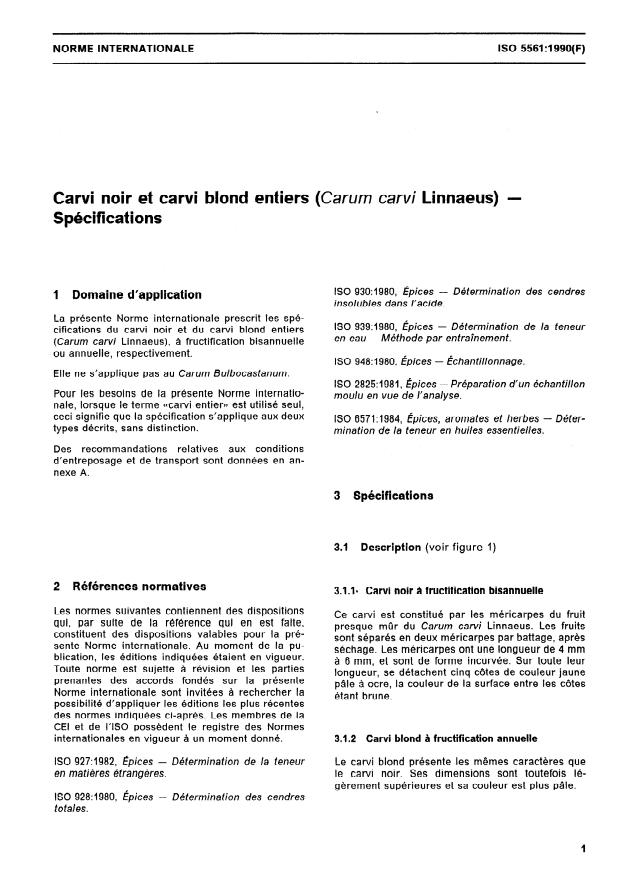
ISO 5561:1990 - Carvi noir et carvi blond entiers (Carum carvi Linnaeus) — Spécifications Released:8/23/1990

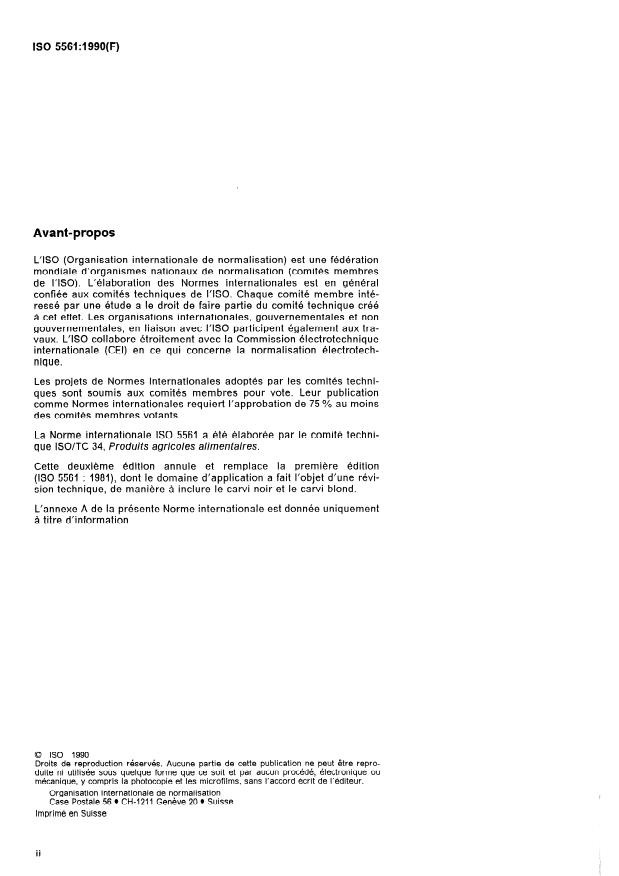

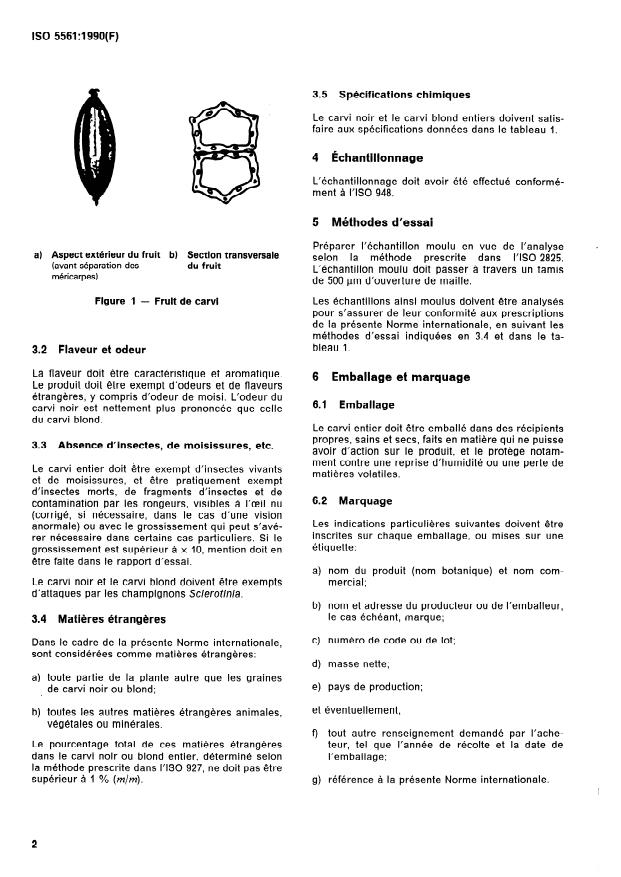
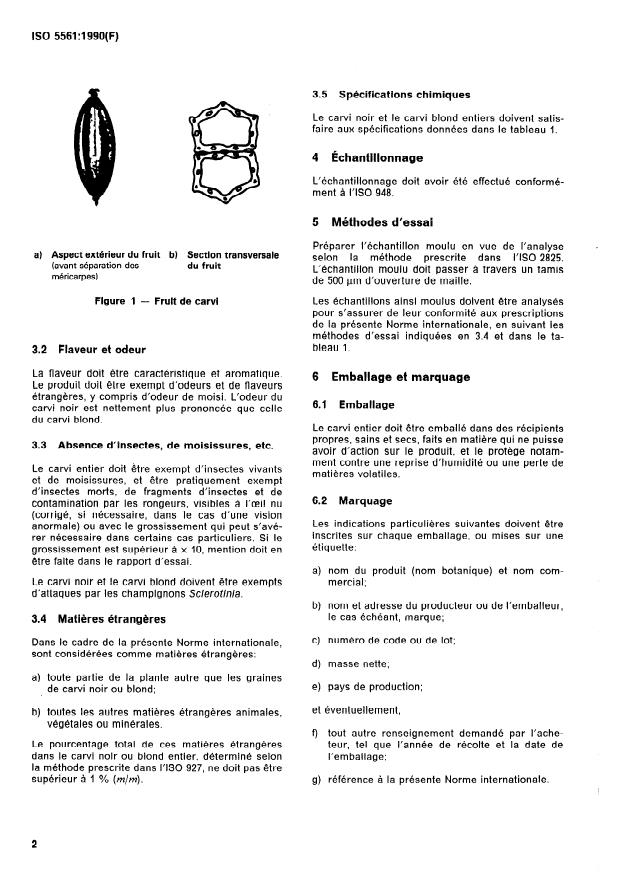
ISO 5561:1990 - Carvi noir et carvi blond entiers (Carum carvi Linnaeus) — Spécifications Released:8/23/1990
Overview
SIST ISO 5561:1997 is an international standard established by the International Organization for Standardization (ISO) that specifies the requirements for whole black caraway and blond caraway (Carum carvi Linnaeus). It defines criteria for product quality, sampling methods, testing protocols, packaging, and marking. This standard applies exclusively to Carum carvi and excludes Carum bulbocastanum. By adhering to SIST ISO 5561:1997, producers and suppliers ensure the consistency, safety, and authenticity of these caraway varieties for global trade and consumption.
Key Topics
Scope and Applicability
Covers whole black caraway (biannual fruiting) and blond caraway (annual fruiting), highlighting the physical and chemical specifications that differentiate these two forms.Product Description
- Black caraway: 4 to 6 mm in length with curved, pale yellow to ochre ribs and brown intercostal surfaces.
- Blond caraway: Similar shape but slightly larger and paler in color.
Quality Requirements
- Must be free from live insects, molds, and fungal infections (notably Sclerotinia).
- Not more than 1% by weight of foreign matter (non-caraway plant parts, animal, mineral, or other vegetative impurities).
- Characteristic aromatic flavor and absence of off-odors including moldy or foreign smells.
Chemical Specifications
- Maximum moisture content: 13% for black caraway and 12% for blond caraway.
- Total ash (dry matter) max 8%.
- Acid-insoluble ash max 2%.
- Essential oil content minimum 2.5% for black caraway and 1.95% for blond caraway, measured immediately after grinding.
Sampling and Testing
Sampling must comply with ISO 948. Samples are ground (per ISO 2825) and sieved through 500 μm mesh for analysis. Specific test methods referenced include ISO 927 for foreign matter, ISO 930/928 for ash, ISO 939 for moisture, and ISO 6571 for essential oils content.Packaging and Marking
- Packaging must protect against moisture, contamination, and loss of volatile oils.
- Containers should be clean, dry, and made of material inert to the product.
- Labels must include product name (botanical and commercial), producer/packer details, batch number, net weight, country of origin, and any client-specific information.
- Reference to SIST ISO 5561:1997 must be stated on the packaging.
Storage and Transport Recommendations
- Store in enclosed, well-ventilated, dry conditions free from pests, odors, and direct sunlight.
- Prevent exposure to excessive heat or moisture during transport and storage, particularly in ship holds.
- Fumigation might be necessary to ensure product safety.
Applications
SIST ISO 5561:1997 is primarily used by:
- Agricultural producers and farmers who cultivate and harvest black and blond caraway.
- Spice exporters and importers to ensure international quality compliance and facilitate trade.
- Food processors and spice manufacturers requiring standardized raw materials with verified chemical and sensory profiles.
- Quality control laboratories conducting official sampling and testing for conformity to internationally recognized benchmarks.
- Packaging and logistics providers ensuring optimal handling, storage, and transport conditions preserving product quality.
Compliance with this standard helps maintain product integrity, supports market access, and reassures end-users about the safety and authenticity of caraway seeds.
Related Standards
SIST ISO 5561:1997 works in conjunction with various other ISO standards relevant to spices and herbs:
- ISO 927:1982 – Determination of foreign matter in spices.
- ISO 930:1980 – Determination of acid-insoluble ash content.
- ISO 939:1980 – Determination of moisture content by distillation.
- ISO 948:1980 – Spice sampling methods.
- ISO 2825:1981 – Preparation of ground samples for analysis.
- ISO 6571:1984 – Determination of essential oil content in spices.
- ISO 928:1980 – Determination of total ash content.
These complementary standards provide a comprehensive framework supporting the implementation of quality assurance in spice production and trade.
Keywords: SIST ISO 5561:1997, black caraway, blond caraway, Carum carvi, spice specification, essential oil content, spice sampling, packaging standards, spice quality, moisture content, foreign matter in spices, spice testing, storage recommendations, international spice standards.
Relations
- Effective Date
- 25-Aug-2026
- Effective Date
- 12-May-2008
Buy Documents
ISO 5561:1990 - Black caraway and blond caraway (Carum carvi Linnaeus), whole — Specification Released:8/23/1990
ISO 5561:1990 - Carvi noir et carvi blond entiers (Carum carvi Linnaeus) — Spécifications Released:8/23/1990
ISO 5561:1990 - Carvi noir et carvi blond entiers (Carum carvi Linnaeus) — Spécifications Released:8/23/1990
Get Certified
Connect with accredited certification bodies for this standard

BSI Group
BSI (British Standards Institution) is the business standards company that helps organizations make excellence a habit.

Bureau Veritas
Bureau Veritas is a world leader in laboratory testing, inspection and certification services.

DNV
DNV is an independent assurance and risk management provider.
Sponsored listings
Frequently Asked Questions
SIST ISO 5561:1997 is a standard published by the Slovenian Institute for Standardization (SIST). Its full title is "Black caraway and blond caraway (Carum carvi Linnaeus), whole -- Specification". This standard covers: Details the requirements for this product, describes sampling, methods of test, and packing and marking. Is not applicable to Carum bulbocastanum. The chemical requirements are indicated in an extra table.
Details the requirements for this product, describes sampling, methods of test, and packing and marking. Is not applicable to Carum bulbocastanum. The chemical requirements are indicated in an extra table.
SIST ISO 5561:1997 is classified under the following ICS (International Classification for Standards) categories: 67.220.10 - Spices and condiments. The ICS classification helps identify the subject area and facilitates finding related standards.
SIST ISO 5561:1997 has the following relationships with other standards: It is inter standard links to SIST EN 3840:2009, ISO 5561:1981. Understanding these relationships helps ensure you are using the most current and applicable version of the standard.
SIST ISO 5561:1997 is available in PDF format for immediate download after purchase. The document can be added to your cart and obtained through the secure checkout process. Digital delivery ensures instant access to the complete standard document.
Standards Content (Sample)
SLOVENSKI STANDARD
01-junij-1997
Kumina (Carum carvi Linnaeus), v zrnu - Specifikacija
Black caraway and blond caraway (Carum carvi Linnaeus), whole -- Specification
Carvi noir et carvi blond entiers (Carum carvi Linnaeus) -- Spécifications
Ta slovenski standard je istoveten z: ISO 5561:1990
ICS:
67.220.10 =DþLPEH Spices and condiments
2003-01.Slovenski inštitut za standardizacijo. Razmnoževanje celote ali delov tega standarda ni dovoljeno.
ISO
INTERN.ATIONAL
STANDARD 5561
Second edition
1990-08-01
Black caraway and blond caraway (Carum carvi
Linnaeus), whole - Specification
Carvi noir et carvi blond entiers (Carum carvi Linnaeus) - Sp&ifkations
Reference number
Foreword
ISO (the International Organization for Standardization) is a worldwide
federation of national Standards bodies (ISO member bodies). The work
of preparing International Standards is normally carried out through ISO
technical committees. Esch member body interested in a subject for
which a technical committee has been established has the right to be
represented on that committee. International organizations, govern-
mental and non-governmental, in liaison with ISO, also take part in the
work. ISO collaborates closely with the International Electrotechnical
Commission (IEC) on all matters of electrotechnical standardization.
Draft International Standards adopted by the technical committees are
circulated to the member bodies for voting. Publication as an Interna-
tional Standard requires approval by at least 75 % of the member bodies
casting a vote.
International Standard ISO 5561 was prepared by Technical Committee
ISO/TC 34, Agricultural food prodercts.
This second edition cancels and replaces the fit-st edition
(ISO 5561 : 1981), the scope of which has been technically revised to in-
clude black and blond caraway.
Annex A of this International Standard is for information only.
0 ISO 1990
All rights reserveci. No part of this publication may be reproduced or utilized in any form
or by any means, electronie or mechanical, including photocopying and microfilm, without
Permission in wrltlng from the publlsher.
International Organization for Standardization
Case Postale 56 l CH-1211 Geneve 20 l Switzerland
Printed in Switzerland
ii
_----
INTERNATIONAL STANDARD
Black caraway and blond caraway (Carum carvi Linnaeus),
whole - Specification
ISO 930:1980, Spices and condiments - Determi-
1 Scope
na tion of acid-insoluble ash.
ISO 939:1980, Spices and condiments - Determi-
This International Standard specifies requirements
nation of moisture content - Entrainment method.
for whole black and blond caraway (Carum carvi
Linnaeus), having biennal and annual fructifrcation
ISO 948:1980, Spices and condiments - Sampling.
respectively.
ISO 2825:1981, Spices and condiments - Preparation
lt does not apply to Carum Buibocastanum.
of a ground Sample for analysis.
For the purposes of this International Standard,
ISO 6571:1984, Spices, condiments and herbs - De-
when the term “whole caraway” is used alone, it
termina tion of vola tile oil content.
means that the specification applies to both the
types of caraway described, without distinction.
Recommendations relating to storage and transport
conditions are given in annex A.
3 Requirements
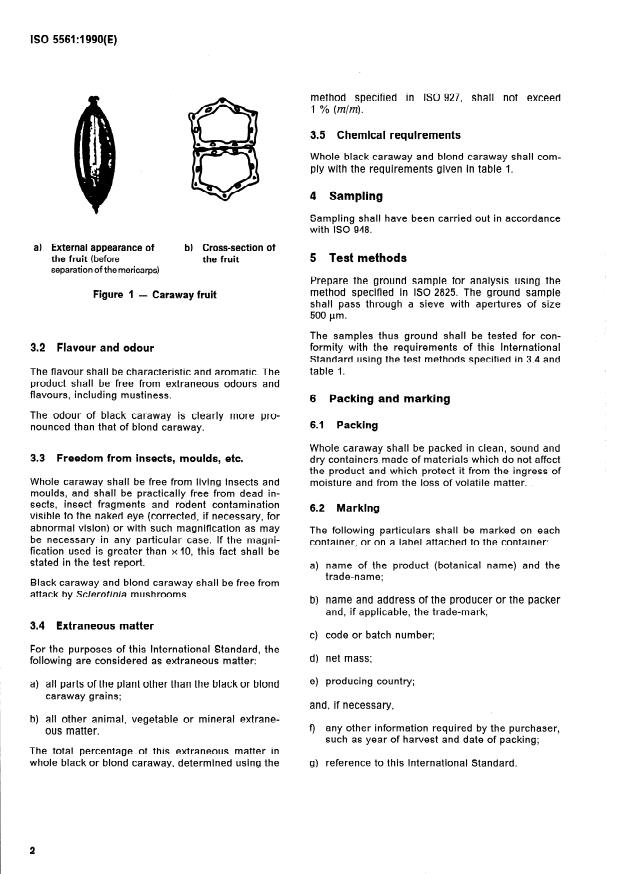
3.1 Description (see figure 1)
2 Narrnative references
3.1 .l Black caraway with biennial fructification
Black caraway consists of the mericarps of the
The following Standards contain provisions which,
nearly mature fruit of Carum carvi Linnaeus. The
through reference in this text, constitute provisions
fruits are Split into two mericarps by threshing after
of this International Standard. At the time of publi-
drying. The mericarps are 4 mm to 6 mm long and
cation, the editions indicated were valid. All stan-
falcate. Longitudinally, they bear five pale yellow to
dards are subject to revision, and Parties to
ochre ribs, the surface between the ribs being
agreements based on this International Standard
brown.
are encouraged to investigate the possibility of ap-
plying the most recent editions of the Standards in-
dicated below. Members of IEC and I
...
ISO
INTERN.ATIONAL
STANDARD 5561
Second edition
1990-08-01
Black caraway and blond caraway (Carum carvi
Linnaeus), whole - Specification
Carvi noir et carvi blond entiers (Carum carvi Linnaeus) - Sp&ifkations
Reference number
Foreword
ISO (the International Organization for Standardization) is a worldwide
federation of national Standards bodies (ISO member bodies). The work
of preparing International Standards is normally carried out through ISO
technical committees. Esch member body interested in a subject for
which a technical committee has been established has the right to be
represented on that committee. International organizations, govern-
mental and non-governmental, in liaison with ISO, also take part in the
work. ISO collaborates closely with the International Electrotechnical
Commission (IEC) on all matters of electrotechnical standardization.
Draft International Standards adopted by the technical committees are
circulated to the member bodies for voting. Publication as an Interna-
tional Standard requires approval by at least 75 % of the member bodies
casting a vote.
International Standard ISO 5561 was prepared by Technical Committee
ISO/TC 34, Agricultural food prodercts.
This second edition cancels and replaces the fit-st edition
(ISO 5561 : 1981), the scope of which has been technically revised to in-
clude black and blond caraway.
Annex A of this International Standard is for information only.
0 ISO 1990
All rights reserveci. No part of this publication may be reproduced or utilized in any form
or by any means, electronie or mechanical, including photocopying and microfilm, without
Permission in wrltlng from the publlsher.
International Organization for Standardization
Case Postale 56 l CH-1211 Geneve 20 l Switzerland
Printed in Switzerland
ii
_----
INTERNATIONAL STANDARD
Black caraway and blond caraway (Carum carvi Linnaeus),
whole - Specification
ISO 930:1980, Spices and condiments - Determi-
1 Scope
na tion of acid-insoluble ash.
ISO 939:1980, Spices and condiments - Determi-
This International Standard specifies requirements
nation of moisture content - Entrainment method.
for whole black and blond caraway (Carum carvi
Linnaeus), having biennal and annual fructifrcation
ISO 948:1980, Spices and condiments - Sampling.
respectively.
ISO 2825:1981, Spices and condiments - Preparation
lt does not apply to Carum Buibocastanum.
of a ground Sample for analysis.
For the purposes of this International Standard,
ISO 6571:1984, Spices, condiments and herbs - De-
when the term “whole caraway” is used alone, it
termina tion of vola tile oil content.
means that the specification applies to both the
types of caraway described, without distinction.
Recommendations relating to storage and transport
conditions are given in annex A.
3 Requirements
3.1 Description (see figure 1)
2 Narrnative references
3.1 .l Black caraway with biennial fructification
Black caraway consists of the mericarps of the
The following Standards contain provisions which,
nearly mature fruit of Carum carvi Linnaeus. The
through reference in this text, constitute provisions
fruits are Split into two mericarps by threshing after
of this International Standard. At the time of publi-
drying. The mericarps are 4 mm to 6 mm long and
cation, the editions indicated were valid. All stan-
falcate. Longitudinally, they bear five pale yellow to
dards are subject to revision, and Parties to
ochre ribs, the surface between the ribs being
agreements based on this International Standard
brown.
are encouraged to investigate the possibility of ap-
plying the most recent editions of the Standards in-
dicated below. Members of IEC and ISO maintain
registers of currently valid International Standards. 3.1.2 Blond caraway with annual fructification
Blond caraway has the Same characteristics as
ISO 927:1982, Spices and condiments - Determi-
black caraway. However, it is slightly larger and its
nation of extraneous matter content.
colour is paler.
ISO 928:1980, Spices and condiments - Determi-
nation of total ash.
method spec
...
ISO
NORME
INTERNATIONALE 5561
Deuxième édition
1990-08-o 1
Carvi noir et carvi blond entiers (Carum carvi
Linnaeus) - Spécifications
Black caraway and blond caraway (Carum car-vi Linnaeus), whole -
Specifica tion
Numéro de référence
Avant-propos
L’ISO (Organisation internationale de normalisation) est une fédération
mondiale d’organismes nationaux de normalisation (comités membres
de I’ISO). L’élaboration des Normes internationales est en général
confiée aux comités techniques de I’ISO. Chaque comité membre inté-
ressé par une étude a le droit de faire partie du comité technique créé
à cet effet. Les organisations internationales, gouvernementales et non
gouvernementales, en liaison avec I’ISO participent également aux tra-
vaux. L’ISO collabore étroitement avec la Commission électrotechnique
internationale (CEI) en ce qui concerne la normalisation électrotech-
nique.
Les projets de Normes internationales adoptés par les comités techni-
ques sont soumis aux comités membres pour vote. Leur publication
comme Normes internationales requiert l’approbation de 75 % au moins
des comités membres votants.
La Norme internationale ISO 5561 a été élaborée par le comité techni-
que ISO/TC 34, Produits agrkoles alimentaires.
Cette deuxième édition annule et remplace la première édition
(ISO 5561 : 1981), dont le domaine d’application a fait l’objet d’une révi-
sion technique, de manière à inclure le carvi noir et le carvi blond.
t
‘annexe A de la présente Norme internationale est donnée uniquement
L
à titre d’i nformation.
0 ISO 1990
Droits de reproduction réservés. Aucune partie de cette publication ne peut être repro-
duite ni utilisée sous quelque forme que ce soit et par aucun procédé, électronique ou
mécanique, y compris la photocopie et les microfilms, sans l’accord écrit de l’éditeur.
Organisation internationale de normalisation
Case Postale 56 l CH-1211 Genève 20 l Suisse
Imprimé en Suisse
ii
--
NORME INTERNATIONALE
Carvi noir et carvi blond entiers (Carum carvi Linnaeus) -
Spécifications
ISO 930:1980, Épices - Détermination des cendres
1 Domaine d’application
insolubles dans l’acide.
La présente Norme internationale prescrit les spé-
ISO 939:1980, Épices - Détermination de la teneur
cifications du carvi noir et du carvi blond entiers
en eau - Méthode par entraînement.
(Carum carvi Linnaeus), à fructification bisannuelle
ou annuelle, respectivement.
ISO 948: 1980, Épices - Échantillonnage.
Elle ne s’applique pas au Carum Bulbocastanum.
- Préparation d’un échantillon
ISO 2825:1981, Epices
Pour les besoins de la présente Norme internatio-
moulu en vue de l’analyse.
nale, lorsque le terme (carvi entier,, est utilisé seul,
ceci signifie que la spécification s’applique aux deux
ISO 6571:1984, Épices, aromates et herbes - Déter-
types décrits, sans distinction.
mination de la teneur en huiles essentielles.
Des recommandations relatives aux conditions
d’entreposage et de transport sont données en an-
nexe A.
3 Spécifications
3.1 Description (voir figure 1)
2 Références normatives
3.1 .le Carvi noir à fructification bisannuelle
Les normes suivantes contiennent des dispositions
Ce carvi est constitué par les méricarpes du fruit
qui, par suite de la référence qui en est faite,
presque mûr du Carum car-vi Linnaeus. Les fruits
constituent des dispositions valables pour la pré-
sont séparés en deux méricarpes par battage, après
sente Norme internationale. Au moment de la pu-
séchage. Les méricarpes ont une longueur de 4 mm
blication, les éditions indiquées étaient en vigueur.
à 6 mm, et sont de forme incurvée. Sur toute leur
Toute norme est sujette a révision et les parties
longueur, se détachent cinq côtes de couleur jaune
prenantes des accords fondés sur la présente
pâle à ocre, la couleur de la surface entre les côtes
Norme internationale sont invitées à rechercher la
étant brune.
possibilité d’appliquer les éditions les plus récentes
des normes indiquées ci-après. Les membres de la
CEI et de I’ISO possèdent le registre des Normes
internationales en vigueur a un moment donné. 3.1.2 Carvi blond à fructification annuelle
Le carvi blond présente les mêmes caractères que
ISO 927:1982, Épices - Détermination de la teneur
le carvi noir. Ses dimensions sont toutefois Ié-
en matières étrangères.
gèrement supérieures et sa couleur est plus pâle.
ISO 928:1980, Épices - Détermination des cendres
totales.
3.5 Spécifications chimiq
...
ISO
NORME
INTERNATIONALE 5561
Deuxième édition
1990-08-o 1
Carvi noir et carvi blond entiers (Carum carvi
Linnaeus) - Spécifications
Black caraway and blond caraway (Carum car-vi Linnaeus), whole -
Specifica tion
Numéro de référence
Avant-propos
L’ISO (Organisation internationale de normalisation) est une fédération
mondiale d’organismes nationaux de normalisation (comités membres
de I’ISO). L’élaboration des Normes internationales est en général
confiée aux comités techniques de I’ISO. Chaque comité membre inté-
ressé par une étude a le droit de faire partie du comité technique créé
à cet effet. Les organisations internationales, gouvernementales et non
gouvernementales, en liaison avec I’ISO participent également aux tra-
vaux. L’ISO collabore étroitement avec la Commission électrotechnique
internationale (CEI) en ce qui concerne la normalisation électrotech-
nique.
Les projets de Normes internationales adoptés par les comités techni-
ques sont soumis aux comités membres pour vote. Leur publication
comme Normes internationales requiert l’approbation de 75 % au moins
des comités membres votants.
La Norme internationale ISO 5561 a été élaborée par le comité techni-
que ISO/TC 34, Produits agrkoles alimentaires.
Cette deuxième édition annule et remplace la première édition
(ISO 5561 : 1981), dont le domaine d’application a fait l’objet d’une révi-
sion technique, de manière à inclure le carvi noir et le carvi blond.
t
‘annexe A de la présente Norme internationale est donnée uniquement
L
à titre d’i nformation.
0 ISO 1990
Droits de reproduction réservés. Aucune partie de cette publication ne peut être repro-
duite ni utilisée sous quelque forme que ce soit et par aucun procédé, électronique ou
mécanique, y compris la photocopie et les microfilms, sans l’accord écrit de l’éditeur.
Organisation internationale de normalisation
Case Postale 56 l CH-1211 Genève 20 l Suisse
Imprimé en Suisse
ii
--
NORME INTERNATIONALE
Carvi noir et carvi blond entiers (Carum carvi Linnaeus) -
Spécifications
ISO 930:1980, Épices - Détermination des cendres
1 Domaine d’application
insolubles dans l’acide.
La présente Norme internationale prescrit les spé-
ISO 939:1980, Épices - Détermination de la teneur
cifications du carvi noir et du carvi blond entiers
en eau - Méthode par entraînement.
(Carum carvi Linnaeus), à fructification bisannuelle
ou annuelle, respectivement.
ISO 948: 1980, Épices - Échantillonnage.
Elle ne s’applique pas au Carum Bulbocastanum.
- Préparation d’un échantillon
ISO 2825:1981, Epices
Pour les besoins de la présente Norme internatio-
moulu en vue de l’analyse.
nale, lorsque le terme (carvi entier,, est utilisé seul,
ceci signifie que la spécification s’applique aux deux
ISO 6571:1984, Épices, aromates et herbes - Déter-
types décrits, sans distinction.
mination de la teneur en huiles essentielles.
Des recommandations relatives aux conditions
d’entreposage et de transport sont données en an-
nexe A.
3 Spécifications
3.1 Description (voir figure 1)
2 Références normatives
3.1 .le Carvi noir à fructification bisannuelle
Les normes suivantes contiennent des dispositions
Ce carvi est constitué par les méricarpes du fruit
qui, par suite de la référence qui en est faite,
presque mûr du Carum car-vi Linnaeus. Les fruits
constituent des dispositions valables pour la pré-
sont séparés en deux méricarpes par battage, après
sente Norme internationale. Au moment de la pu-
séchage. Les méricarpes ont une longueur de 4 mm
blication, les éditions indiquées étaient en vigueur.
à 6 mm, et sont de forme incurvée. Sur toute leur
Toute norme est sujette a révision et les parties
longueur, se détachent cinq côtes de couleur jaune
prenantes des accords fondés sur la présente
pâle à ocre, la couleur de la surface entre les côtes
Norme internationale sont invitées à rechercher la
étant brune.
possibilité d’appliquer les éditions les plus récentes
des normes indiquées ci-après. Les membres de la
CEI et de I’ISO possèdent le registre des Normes
internationales en vigueur a un moment donné. 3.1.2 Carvi blond à fructification annuelle
Le carvi blond présente les mêmes caractères que
ISO 927:1982, Épices - Détermination de la teneur
le carvi noir. Ses dimensions sont toutefois Ié-
en matières étrangères.
gèrement supérieures et sa couleur est plus pâle.
ISO 928:1980, Épices - Détermination des cendres
totales.
3.5 Spécifications chimiq
...