

SIST-TS CEN/TS 17757:2023
(Main)Inorganic fertilizers - Determination of specific nutrients
General Information
- Abstract
This document specifies references to methods for the determination of the content of the following specific nutrients in inorganic fertilizers:
- the total nitrogen content;
- the ammoniacal nitrogen content;
- the nitric nitrogen content;
- the urea nitrogen content;
- the content of nitrogen from isobutylidenediurea (IBDU) and crotonylidenediurea (CDU);
- the cyanamide nitrogen content;
- the methylene-urea nitrogen content (and urea formaldehyde, if applicable);
- the total phosphorus content;
- the water-soluble phosphorus content;
- the neutral ammonium citrate soluble phosphorus content;
- the water-soluble potassium content;
- the total magnesium content;
- the water-soluble magnesium content;
- the total calcium content;
- the water-soluble calcium content;
- the total sulfur content;
- the water-soluble sulfur content;
- the total sodium content;
- the water-soluble sodium content.
This document is applicable to EU fertilizing products classified as PFC 1(C) and PFC 7 as long as the blend only consists of EU fertilizing products classified as PFC 1(C), PFC 2 and PFC 5 as specified in the Regulation (EU) 2019/1009 [1].
- Status
- Published
- Public Enquiry End Date
- 02-Jan-2022
- Publication Date
- 09-Jan-2023
- Technical Committee
- KAT - Soil quality
- Current Stage
- 6060 - National Implementation/Publication (Adopted Project)
- Start Date
- 06-Jan-2023
- Due Date
- 13-Mar-2023
- Completion Date
- 10-Jan-2023

Overview
CEN/TS 17757:2022 - "Inorganic fertilizers - Determination of specific nutrients" - is a CEN Technical Specification that lists and references standardized test methods for measuring targeted nutrient contents in inorganic fertilizers. It provides the normative references laboratories and manufacturers should use to determine nutrient fractions such as total and water‑soluble forms of nitrogen, phosphorus, potassium, magnesium, calcium, sulfur and sodium. The TS supports compliance with Regulation (EU) 2019/1009 for EU fertilizing products (notably PFC 1(C) and PFC 7 blends containing PFC 1(C), PFC 2 and PFC 5).
Key topics and technical requirements
- Scope: Specifies the analytical targets - e.g., total nitrogen, ammoniacal, nitric, urea, cyanamide, IBDU/CDU and methylene‑urea nitrogen; total and water‑soluble phosphorus; neutral ammonium citrate soluble phosphorus; water‑soluble potassium; total and water‑soluble magnesium, calcium, sulfur and sodium.
- Referenced methods: Declares existing EN standards for extraction and determination (sampling/sample prep per EN 1482 series). Examples include EN 15475 (ammoniacal N), EN 15604 (different N forms), EN 15705 (IBDU/CDU by HPLC), EN 15956–15959 (phosphorus extraction/determination), EN 15477 (water‑soluble K), EN 15960/15961 (total and water‑soluble Ca/Mg/Na/S) and EN 15749 (sulfate determination).
- Sampling & sample preparation: Requires representative sampling according to EN 1482 parts 1–3 and sample preparation per EN 1482‑2.
- Regulatory alignment: Enables measurement approaches for demonstrating conformity with Regulation (EU) 2019/1009. Note: some methods report results in mg/kg and may require conversion to percentage mass fractions for regulatory reporting.
Applications and users
- Who uses it:
- Accredited testing laboratories performing fertilizer analysis
- Fertilizer manufacturers and formulators for quality control and product specification
- Regulatory authorities and market surveillance bodies verifying compliance with EU fertilizing product rules
- Research institutions and agronomic service providers analyzing nutrient release and solubility
- Practical uses:
- Routine quality-control testing and batch release of inorganic fertilizers
- Verification of nutrient declarations on labels and safety/quality dossiers
- Characterization of water‑soluble vs. total nutrient fractions for agronomic performance and environmental assessment
- Harmonizing test methods across EU member states for consistent market surveillance
Related standards
- Regulation (EU) 2019/1009 - EU fertilizing products
- EN 1482 series - Sampling and sample preparation
- EN 15475, EN 15604, EN 15705, EN 15956–15961, EN 16196–16199 - referenced analytical methods
CEN/TS 17757:2022 functions as a practical roadmap to the accepted EN test methods for nutrient determination in inorganic fertilizers, helping laboratories and manufacturers meet EU regulatory and quality requirements.
Relations
- Effective Date
- 28-Jan-2026
- Effective Date
- 28-Jan-2026
- Effective Date
- 28-Jan-2026
- Effective Date
- 28-Jan-2026
- Effective Date
- 28-Jan-2026
- Refers
SIST EN 15560:2009 - Fertilizers - Determination of total nitrogen in calcium cyanamide nitrate free - Effective Date
- 28-Jan-2026
- Effective Date
- 28-Jan-2026
- Effective Date
- 28-Jan-2026
- Effective Date
- 28-Jan-2026
- Effective Date
- 28-Jan-2026
- Refers
SIST EN 16197:2013 - Fertilizers - Determination of magnesium by atomic absorption spectrometry - Effective Date
- 28-Jan-2026
- Effective Date
- 28-Jan-2026
- Effective Date
- 28-Jan-2026
- Effective Date
- 28-Jan-2026
- Effective Date
- 28-Jan-2026
Get Certified
Connect with accredited certification bodies for this standard

Control Union Certifications
Global certification for agriculture and sustainability.

ECOCERT
Organic and sustainability certification.

FSC International
Forest Stewardship Council certification.
Sponsored listings
Frequently Asked Questions
SIST-TS CEN/TS 17757:2023 is a technical specification published by the Slovenian Institute for Standardization (SIST). Its full title is "Inorganic fertilizers - Determination of specific nutrients". This standard covers: This document specifies references to methods for the determination of the content of the following specific nutrients in inorganic fertilizers: - the total nitrogen content; - the ammoniacal nitrogen content; - the nitric nitrogen content; - the urea nitrogen content; - the content of nitrogen from isobutylidenediurea (IBDU) and crotonylidenediurea (CDU); - the cyanamide nitrogen content; - the methylene-urea nitrogen content (and urea formaldehyde, if applicable); - the total phosphorus content; - the water-soluble phosphorus content; - the neutral ammonium citrate soluble phosphorus content; - the water-soluble potassium content; - the total magnesium content; - the water-soluble magnesium content; - the total calcium content; - the water-soluble calcium content; - the total sulfur content; - the water-soluble sulfur content; - the total sodium content; - the water-soluble sodium content. This document is applicable to EU fertilizing products classified as PFC 1(C) and PFC 7 as long as the blend only consists of EU fertilizing products classified as PFC 1(C), PFC 2 and PFC 5 as specified in the Regulation (EU) 2019/1009 [1].
This document specifies references to methods for the determination of the content of the following specific nutrients in inorganic fertilizers: - the total nitrogen content; - the ammoniacal nitrogen content; - the nitric nitrogen content; - the urea nitrogen content; - the content of nitrogen from isobutylidenediurea (IBDU) and crotonylidenediurea (CDU); - the cyanamide nitrogen content; - the methylene-urea nitrogen content (and urea formaldehyde, if applicable); - the total phosphorus content; - the water-soluble phosphorus content; - the neutral ammonium citrate soluble phosphorus content; - the water-soluble potassium content; - the total magnesium content; - the water-soluble magnesium content; - the total calcium content; - the water-soluble calcium content; - the total sulfur content; - the water-soluble sulfur content; - the total sodium content; - the water-soluble sodium content. This document is applicable to EU fertilizing products classified as PFC 1(C) and PFC 7 as long as the blend only consists of EU fertilizing products classified as PFC 1(C), PFC 2 and PFC 5 as specified in the Regulation (EU) 2019/1009 [1].
SIST-TS CEN/TS 17757:2023 is classified under the following ICS (International Classification for Standards) categories: 65.080 - Fertilizers. The ICS classification helps identify the subject area and facilitates finding related standards.
SIST-TS CEN/TS 17757:2023 has the following relationships with other standards: It is inter standard links to SIST EN 15956:2011, SIST EN 16198:2013, SIST EN 15562:2009, SIST EN 15476:2009, SIST EN 15478:2009, SIST EN 15560:2009, SIST EN 1482-1:2007, SIST EN 15475:2009, SIST EN 15750:2010, SIST EN 15604:2009, SIST EN 16197:2013, SIST EN 12944-2:2002, SIST EN 16196:2013, SIST EN 15957:2011, SIST EN 12944-1:2002. Understanding these relationships helps ensure you are using the most current and applicable version of the standard.
SIST-TS CEN/TS 17757:2023 is associated with the following European legislation: EU Directives/Regulations: 2019/1009; Standardization Mandates: M/564. When a standard is cited in the Official Journal of the European Union, products manufactured in conformity with it benefit from a presumption of conformity with the essential requirements of the corresponding EU directive or regulation.
SIST-TS CEN/TS 17757:2023 is available in PDF format for immediate download after purchase. The document can be added to your cart and obtained through the secure checkout process. Digital delivery ensures instant access to the complete standard document.
Standards Content (Sample)
SLOVENSKI STANDARD
01-februar-2023
Anorganska gnojila - Določevanje specifičnih hranil
Inorganic fertilizers - Determination of specific nutrients
Anorganische Düngemittel - Bestimmung spezifischer Nährstoffe
Engrais inorganiques - Détermination des éléments nutritifs spécifiques
Ta slovenski standard je istoveten z: CEN/TS 17757:2022
ICS:
65.080 Gnojila Fertilizers
2003-01.Slovenski inštitut za standardizacijo. Razmnoževanje celote ali delov tega standarda ni dovoljeno.
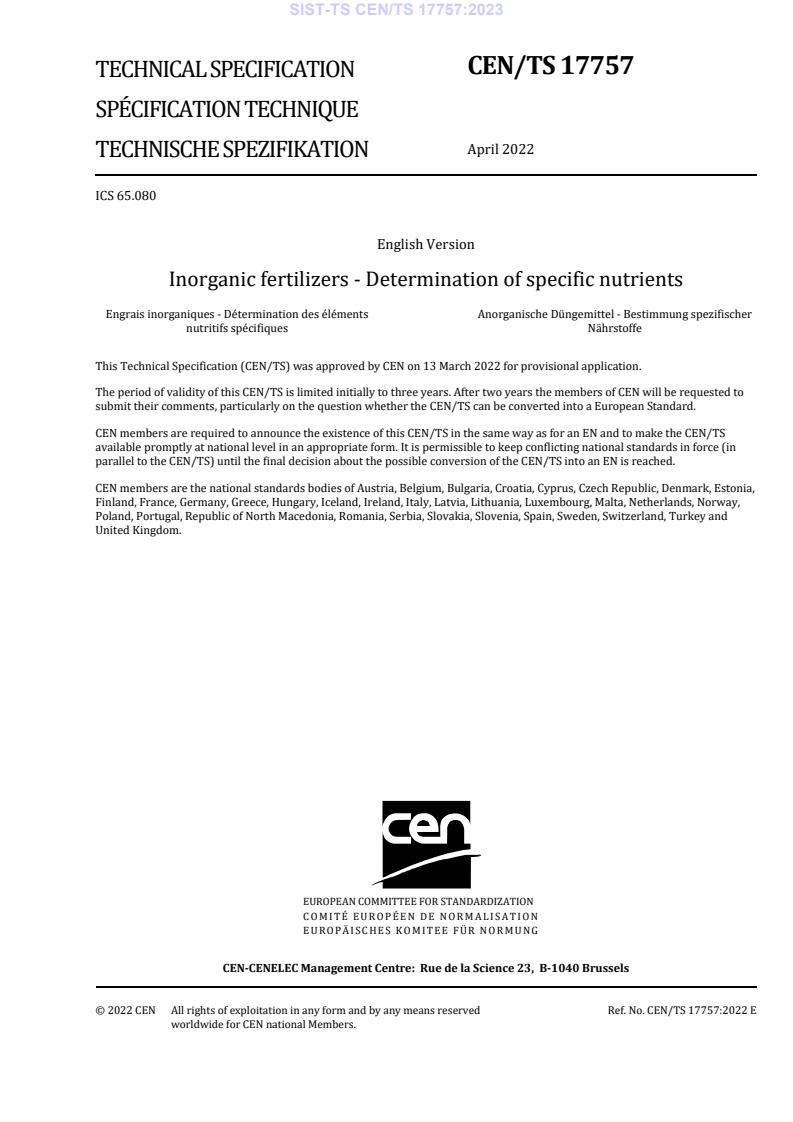
CEN/TS 17757
TECHNICAL SPECIFICATION
SPÉCIFICATION TECHNIQUE
April 2022
TECHNISCHE SPEZIFIKATION
ICS 65.080
English Version
Inorganic fertilizers - Determination of specific nutrients
Engrais inorganiques - Détermination des éléments Anorganische Düngemittel - Bestimmung spezifischer
nutritifs spécifiques Nährstoffe
This Technical Specification (CEN/TS) was approved by CEN on 13 March 2022 for provisional application.
The period of validity of this CEN/TS is limited initially to three years. After two years the members of CEN will be requested to
submit their comments, particularly on the question whether the CEN/TS can be converted into a European Standard.
CEN members are required to announce the existence of this CEN/TS in the same way as for an EN and to make the CEN/TS
available promptly at national level in an appropriate form. It is permissible to keep conflicting national standards in force (in
parallel to the CEN/TS) until the final decision about the possible conversion of the CEN/TS into an EN is reached.
CEN members are the national standards bodies of Austria, Belgium, Bulgaria, Croatia, Cyprus, Czech Republic, Denmark, Estonia,
Finland, France, Germany, Greece, Hungary, Iceland, Ireland, Italy, Latvia, Lithuania, Luxembourg, Malta, Netherlands, Norway,
Poland, Portugal, Republic of North Macedonia, Romania, Serbia, Slovakia, Slovenia, Spain, Sweden, Switzerland, Turkey and
United Kingdom.
EUROPEAN COMMITTEE FOR STANDARDIZATION
COMITÉ EUROPÉEN DE NORMALISATION
EUROPÄISCHES KOMITEE FÜR NORMUNG
CEN-CENELEC Management Centre: Rue de la Science 23, B-1040 Brussels
© 2022 CEN All rights of exploitation in any form and by any means reserved Ref. No. CEN/TS 17757:2022 E
worldwide for CEN national Members.
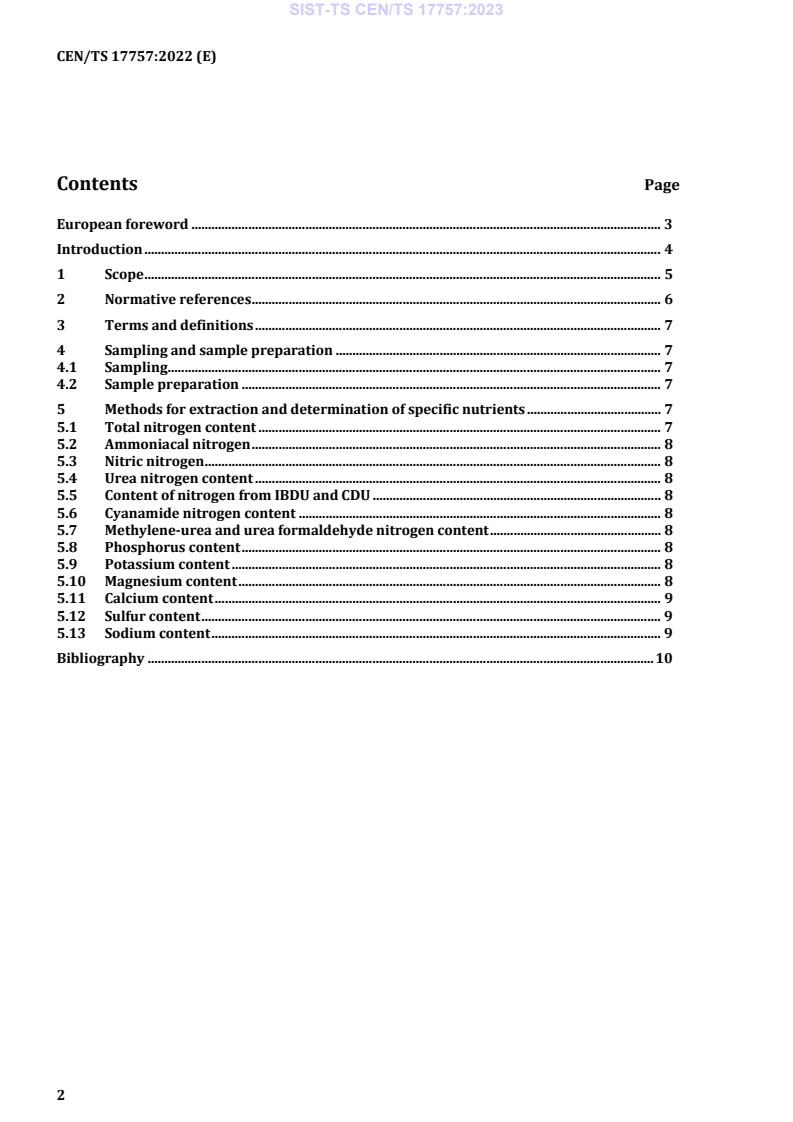
Contents Page
European foreword . 3
Introduction . 4
1 Scope . 5
2 Normative references . 6
3 Terms and definitions . 7
4 Sampling and sample preparation . 7
4.1 Sampling . 7
4.2 Sample preparation . 7
5 Methods for extraction and determination of specific nutrients . 7
5.1 Total nitrogen content . 7
5.2 Ammoniacal nitrogen . 8
5.3 Nitric nitrogen . 8
5.4 Urea nitrogen content . 8
5.5 Content of nitrogen from IBDU and CDU . 8
5.6 Cyanamide nitrogen content . 8
5.7 Methylene-urea and urea formaldehyde nitrogen content . 8
5.8 Phosphorus content . 8
5.9 Potassium content . 8
5.10 Magnesium content . 8
5.11 Calcium content . 9
5.12 Sulfur content . 9
5.13 Sodium content . 9
Bibliography . 10
European foreword
This document (CEN/TS 17757:2022) has been prepared by Technical Committee CEN/TC 260
“Fertilizers and liming materials”, the secretariat of which is held by DIN.
Attention is drawn to the possibility that some of the elements of this document may be the subject of
patent rights. CEN shall not be held responsible for identifying any or all such patent rights.
This document has been prepared under a standardization request given to CEN by the European
Commission and the European Free Trade Association.
Any feedback and questions on this document should be directed to the users’ national standards body.
A complete listing of these bodies can be found on the CEN website.
According to the CEN/CENELEC Internal Regulations, the national standards organisations of the
following countries are bound to announce this Technical Specification: Austria, Belgium, Bulgaria,
Croatia, Cyprus, Czech Republic, Denmark, Estonia, Finland, France, Germany, Greece, Hungary, Iceland,
Ireland, Italy, Latvia, Lithuania, Luxembourg, Malta, Netherlands, Norway, Poland, Portugal, Republic of
North Macedonia, Romania, Serbia, Slovakia, Slovenia, Spain, Sweden, Switzerland, Turkey and the United
Kingdom.
Introduction
Regulation (EU) 2019/1009 [1] lays down the rules on the making available on the market of EU
fertilizing products and the specific safety and quality requirements for the defined product function
categories (PFCs). Inorganic fertilizers have been classified into PFC 1(C).
The specific safety and quality requirements in relation to the following specific nutrients are defined in
this document as well as normative references of the test methods to be used in order to measure the
compliance with the related requirement in the Regulation (EU) 2019/1009 [1].
1 Scope
This document specifies references to methods for the determination of the content of the following
specific nutrients in inorganic fertilizers:
— the total nitrogen content;
— the ammoniacal nitrogen content;
— the nitric nitrogen content;
— the urea nitrogen content;
— the content of nitrogen from isobutylidenediurea (IBDU) and crotonylidenediurea (CDU);
— the cyanamide nitrogen content;
— the methylene-urea nitrogen content (and urea formaldehyde, if applicable);
— the total phosphorus content;
— the water-soluble phosphorus content;
— the neutral ammonium citrate soluble phosphorus content;
— the water-soluble potassium content;
— the total magnesium content;
— the water-soluble magnesium content;
— the total calcium content;
— the water-soluble calcium content;
— the total sulfur content;
— the water-soluble sulfur content;
— the total sodium content;
— the water-soluble sodium content.
This document is applicable to EU fertilizing products classified as PFC 1(C) and PFC 7 as long as the
blend only consists of EU fertilizing products classified as PFC 1(C), PFC 2 and PFC 5 as specified in the
Regulation (EU) 2019/1009 [1].
2 Normative references
T
...