

SIST EN 1294:2001
(Main)Door leaves - Determination of the behaviour under humidity variations in successive uniform climates
- Abstract
This European Standard describes the method which is to be used to test the behaviour under humidity variations of door leaves placed in successive uniform climates. This standard can be applied to all door leaves(e.g.solid, hollow core, panelled and glazed doors ), which are nominally flat and rigid, and which contain hygroscopic materials which might influence their behaviour during this test.
- Status
- Published
- Publication Date
- 31-Aug-2001
- Technical Committee
- ISTP - Doors and windows
- Current Stage
- 6060 - National Implementation/Publication (Adopted Project)
- Start Date
- 01-Sep-2001
- Due Date
- 01-Sep-2001
- Completion Date
- 01-Sep-2001
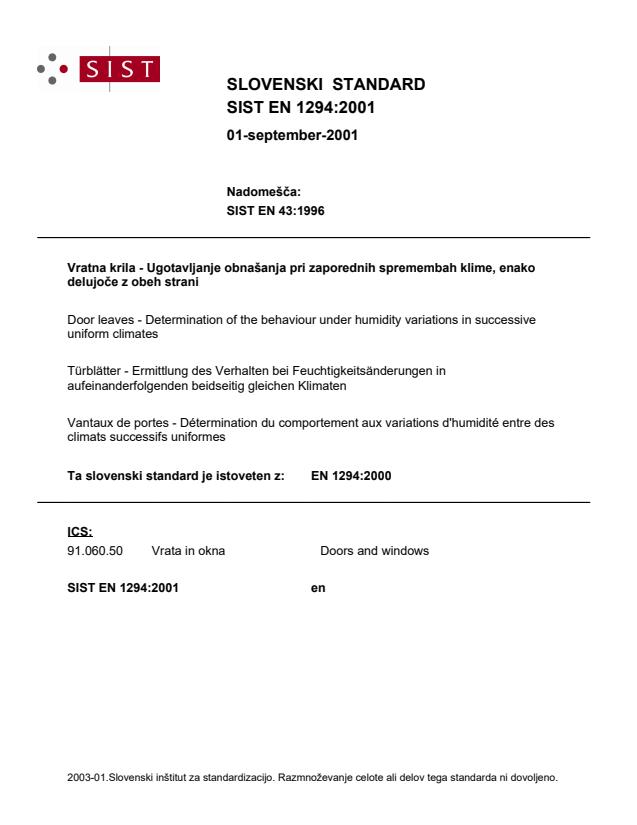

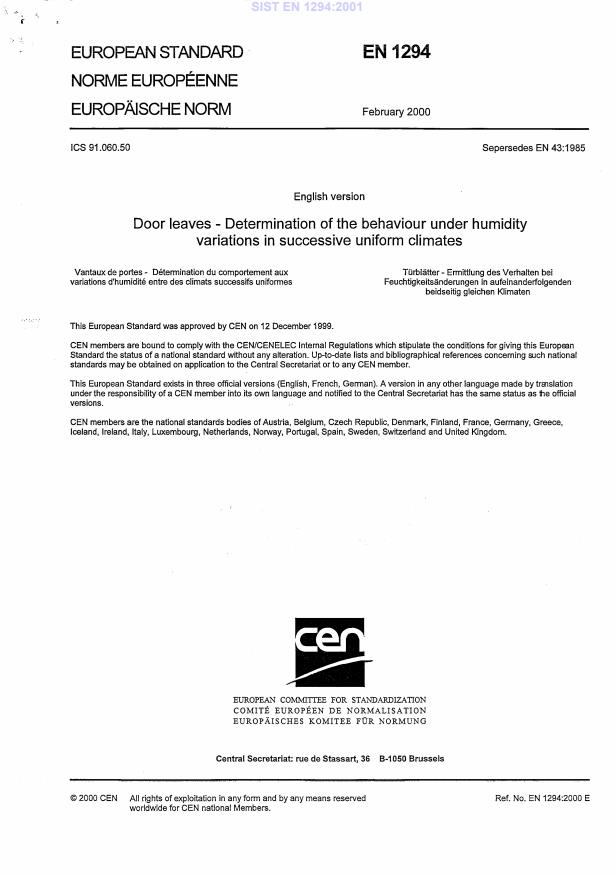
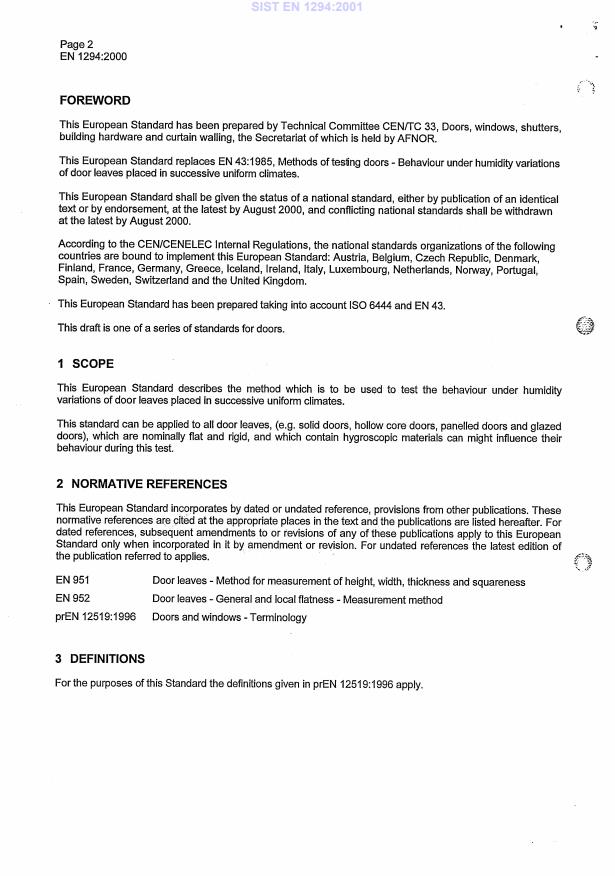
SIST EN 1294:2001 is the Slovenian standard adopted from EN 1294:2000. It describes a test method for checking how door leaves behave under humidity variations in successive uniform climates. The method is aimed at nominally flat, rigid door leaves that contain hygroscopic materials, so it is used where moisture response may affect performance in service.
What does SIST EN 1294:2001 specify?
SIST EN 1294:2001 specifies a method for testing the behaviour of door leaves under humidity variations in successive uniform climates. In practice, it gives a common laboratory way to see how a door leaf reacts when moisture conditions change in a controlled sequence.
The scope covers solid, hollow core, panelled and glazed door leaves, as long as they are nominally flat and rigid and contain hygroscopic materials. That matters because the standard is meant for leaf constructions whose moisture uptake or release can influence the result.
The document is focused on one test method for one performance question: how the door leaf behaves when exposed to changing humidity. It is part of the doors and windows field.
What are the key requirements of SIST EN 1294:2001?
SIST EN 1294:2001 uses a laboratory test on the door leaf itself. For a reader, that means the assessment is about the leaf’s response, not about the complete door set.
- The specimen is a door leaf. This keeps the test centered on the element most likely to move or distort when moisture changes.
- The exposure is made in successive uniform climates. In practice, the same type of controlled climate sequence is used so results can be compared from one test to another.
- The method applies to leaves that are nominally flat and rigid. That matters because the test is intended for products that should keep their shape under normal use.
- The standard includes solid, hollow core, panelled and glazed doors. This helps users apply one method across several common constructions.
- The door leaf contains hygroscopic materials. Those materials absorb or release moisture, so they are the reason humidity changes can affect the result.
- The purpose is to determine the behaviour under humidity variations. In practice, the test supports product checking where moisture-related movement, distortion or change in appearance is a concern.
What terms does SIST EN 1294:2001 define?
- Door leaf - the movable leaf of the door that is tested as the specimen.
- Humidity variations - changes in moisture condition that may cause the leaf to react.
- Successive uniform climates - a sequence of controlled climate conditions used for the test.
- Nominally flat and rigid - close to flat and stiff enough to be treated as such for this method.
- Hygroscopic materials - materials that absorb moisture from the environment or release it back.
- Panelled - a door-leaf construction made with panels.
- Glazed - a door leaf that includes glass.
Who uses SIST EN 1294:2001?
SIST EN 1294:2001 is used by manufacturers of door leaves, testing laboratories, and quality teams that need a common humidity-variation test. It is also relevant to buyers and specifiers in the doors and windows sector when they need to compare products on the same basis.
In practice, users apply it for product verification, design checks, and laboratory testing of moisture-related behaviour. It is most useful when a door leaf includes materials whose dimensions or shape may change with humidity.
What changed in SIST EN 1294:2001 from the previous edition?
SIST EN 1294:2001 is the Slovenian adoption of EN 1294:2000.
What does the SIST EN 1294:2001 document contain?
SIST EN 1294:2001 contains the test method for assessing door leaves under humidity variation in successive uniform climates. It provides the framework for applying controlled climate exposure and observing the leaf’s behaviour during the test.
The document is intended for laboratory testing and product assessment in the doors and windows field. Readers use it to judge whether a door leaf remains suitably stable when moisture conditions change.
Relations
- Effective Date
- 01-Sep-2001
- Refers
SIST EN 951:2000 - Door leaves - Method for measurement of height, width, thickness and squareness - Effective Date
- 28-Jan-2026
- Effective Date
- 28-Jan-2026
- Effective Date
- 28-Jan-2026
- Effective Date
- 28-Jan-2026
- Effective Date
- 28-Jan-2026
- Effective Date
- 28-Jan-2026
- Effective Date
- 28-Jan-2026
- Effective Date
- 28-Jan-2026
Get Certified
Connect with accredited certification bodies for this standard

DIBt (Deutsches Institut für Bautechnik)
German Institute for Building Technology.
DIN CERTCO
DIN Group product certification.

Aboma Certification B.V.
Specialized in construction, metal, and transport sectors.
Sponsored listings
Frequently Asked Questions
SIST EN 1294:2001 is a standard published by the Slovenian Institute for Standardization (SIST). Its full title is "Door leaves - Determination of the behaviour under humidity variations in successive uniform climates". This standard covers: This European Standard describes the method which is to be used to test the behaviour under humidity variations of door leaves placed in successive uniform climates. This standard can be applied to all door leaves(e.g.solid, hollow core, panelled and glazed doors ), which are nominally flat and rigid, and which contain hygroscopic materials which might influence their behaviour during this test.
This European Standard describes the method which is to be used to test the behaviour under humidity variations of door leaves placed in successive uniform climates. This standard can be applied to all door leaves(e.g.solid, hollow core, panelled and glazed doors ), which are nominally flat and rigid, and which contain hygroscopic materials which might influence their behaviour during this test.
SIST EN 1294:2001 is classified under the following ICS (International Classification for Standards) categories: 91.060.50 - Doors and windows. The ICS classification helps identify the subject area and facilitates finding related standards.
SIST EN 1294:2001 has the following relationships with other standards: It is inter standard links to SIST EN 43:1996, SIST EN 951:2000, SIST EN 12519:2018, SIST EN 952:2000, SIST EN 16580:2015, SIST EN ISO 11904-1:2004, SIST EN 15644:2009, SIST EN 12219:2000, SIST-TS CEN/TS 16526:2014. Understanding these relationships helps ensure you are using the most current and applicable version of the standard.
SIST EN 1294:2001 is associated with the following European legislation: EU Directives/Regulations: 305/2011, 89/106/EEC. When a standard is cited in the Official Journal of the European Union, products manufactured in conformity with it benefit from a presumption of conformity with the essential requirements of the corresponding EU directive or regulation.
SIST EN 1294:2001 is available in PDF format for immediate download after purchase. The document can be added to your cart and obtained through the secure checkout process. Digital delivery ensures instant access to the complete standard document.
Standards Content (Sample)
2003-01.Slovenski inštitut za standardizacijo. Razmnoževanje celote ali delov tega standarda ni dovoljeno.Türblätter - Ermittlung des Verhalten bei Feuchtigkeitsänderungen in aufeinanderfolgenden beidseitig gleichen KlimatenVantaux de portes - Détermination du comportement aux variations d'humidité entre des climats successifs uniformesDoor leaves - Determinatio
...