

SIST EN 1364-5:2026
(Main)Fire resistance tests for non-loadbearing elements - Part 5: Air transfer grilles
General Information
- Abstract
This document specifies a method for determining the fire resistance of air transfer grilles (ATG).
It is applicable to air transfer grilles intended for installation in building components (typically walls, floors or ceilings). The orientation of the installation of the air transfer grille can be vertical or horizontal.
The closing mechanism of the air transfer grille can come from expansion of material and/or from any mechanical or electrical closing device.
This document is applicable to fire resistant or fire resistant and smoke control air transfer grilles.
An additional test configuration is valid for fire resistant or fire resistant and smoke control air transfer grilles in applications where flame impingement is a risk during open state from start of fire (see Annex A).
This document evaluates the behaviour of the air transfer grille when exposed to the heating curve described in EN 1363 1 and the standard pressure described in EN 1363 1. It is not the intention of this test to provide quantitative information on the rate of leakage of smoke and/or hot gases or on the transmission or generation of fumes under fire conditions. Such phenomena are only noted in describing the general behaviour of test specimens during the test.
The determination of the rate of leakage of smoke at ambient temperature or at 200 °C as an optional requirement for ATG with declared smoke control is specified in EN 1634 3.
This document is not applicable to the determination of the fire resistance of air transfer grilles that are used in ducts because ATG are considered as separating elements. The test method for ATG used in ducts is described in the corresponding duct standards.
This document is not applicable to the determination of the fire resistance of a fire damper or a fire barrier connected to a duct one or both sides, as an ATG is tested as a fire-separating element on its own. Fire dampers are tested according to EN 1366 2. Non-mechanical fire barriers are tested according to EN 1366 12.
This document is not applicable to the determination of the fire resistance of air transfer grilles in fire doors, shutters and openable windows as specified in EN 1634 1 and EN 1364 2, because the deformation of fire doors, shutters and openable windows in fire conditions differs from the deformation of flexible/rigid walls. Moreover, the location of thermocouples in the door standard is too specific to be handled in this document.
All values given in this document are nominal unless otherwise specified.
- Status
- Published
- Public Enquiry End Date
- 30-Jul-2025
- Publication Date
- 17-Aug-2026
- Technical Committee
- POZ - Požarna varnost
- Current Stage
- 6060 - National Implementation/Publication (Adopted Project)
- Start Date
- 30-Jul-2026
- Due Date
- 04-Oct-2026
- Completion Date
- 18-Aug-2026

Overview
SIST EN 1364-5:2026 is a European standard specifying fire resistance tests for air transfer grilles (ATG) in non-loadbearing building elements. This standard, developed by the Slovenian Institute for Standardization (SIST), provides a consistent test method for evaluating fire resistant and smoke control grilles used in the construction of walls, floors, and ceilings. It is relevant to both vertical and horizontal installation scenarios.
The document establishes procedures to determine how air transfer grilles respond to standard fire exposure, ensures correct installation for fire separations, and supports product certification and compliance across the European construction industry.
Key Topics
Scope and Applicability
- Evaluates fire resistance of air transfer grilles intended for use in building elements that are not designed to bear load.
- Applies to ATGs that are either fire resistant or fire resistant with smoke control.
- Excludes ATGs used in ductwork, as well as those installed in fire doors, shutters, or windows.
- Covers both vertical and horizontal installation orientations.
Test Methods
- Specifies heating and pressure conditions based on EN 1363-1, using standardized fire exposure curves.
- Details specimen requirements, including size, spacing, and representative features (e.g., decorative covers).
- Outlines the use of thermocouples and other instrumentation to monitor grille and furnace behavior during testing.
Performance Criteria
- Focuses on measuring the integrity (E) and insulation (I) criteria under fire exposure.
- Optional smoke leakage testing is referenced to EN 1634-3.
- Notes on sustained flaming, structural deformation, and closure performance (manual, mechanical, or intumescent action).
Test Reporting & Direct Application
- Mandates comprehensive reporting of test conditions, results, observations, and classification.
- Provides guidance on the direct field of application for tested grilles, including the effects of orientation and installation specifics.
Applications
Fire resistant air transfer grilles play a crucial role in modern construction, particularly in the context of fire compartmentation and smoke control. Typical practical applications include:
- Commercial Buildings: Ensuring safe airflow between building zones while maintaining fire resistance in walls, floors, and ceilings.
- Residential Developments: Supporting passive fire protection strategies without sacrificing indoor air quality.
- Healthcare and Institutional Facilities: Integrating with HVAC systems to manage air transfer and containment during fire events.
- Industrial Settings: Where high-risk areas require robust fire separation yet demand controlled ventilation.
By testing and certifying air transfer grilles according to SIST EN 1364-5:2026, building designers and manufacturers ensure regulatory compliance, product reliability, and effective fire safety performance across European and international projects.
Related Standards
To provide a complete framework for passive fire protection and air transfer element testing, the following related standards are referenced or complementary to SIST EN 1364-5:2026:
- EN 1363-1: Fire resistance tests - General requirements
- EN 1363-2: Fire resistance tests - Alternative and additional procedures
- EN ISO 13943: Fire safety - Vocabulary
- EN 1634-3: Fire resistance and smoke control tests for door and shutter assemblies
- EN 1366-2: Fire resistance tests for service installations - Fire dampers
- EN 1366-12: Fire resistance tests for service installations - Non-mechanical fire barriers
- EN 1634-1/EN 1364-2: For fire doors, shutters, and openable windows (for cases outside the scope of EN 1364-5)
Using these standards together ensures a comprehensive and systematic approach to fire safety and performance verification of building products, supporting harmonized construction regulations and market access across Europe.
Keywords: air transfer grilles, fire resistance tests, fire safety, non-loadbearing elements, smoke control, building regulations, passive fire protection, SIST EN 1364-5, European standard, HVAC fire protection.
Relations
- Effective Date
- 01-Sep-2026
- Effective Date
- 29-Jul-2026
- Effective Date
- 29-Jul-2026
- Effective Date
- 29-Jul-2026
- Effective Date
- 29-Jul-2026
Get Certified
Connect with accredited certification bodies for this standard

DIBt (Deutsches Institut für Bautechnik)
German Institute for Building Technology.
DIN CERTCO
DIN Group product certification.

Kiwa BDA Testing
Building and construction product certification.
Sponsored listings
Frequently Asked Questions
SIST EN 1364-5:2026 is a standard published by the Slovenian Institute for Standardization (SIST). Its full title is "Fire resistance tests for non-loadbearing elements - Part 5: Air transfer grilles". This standard covers: This document specifies a method for determining the fire resistance of air transfer grilles (ATG). It is applicable to air transfer grilles intended for installation in building components (typically walls, floors or ceilings). The orientation of the installation of the air transfer grille can be vertical or horizontal. The closing mechanism of the air transfer grille can come from expansion of material and/or from any mechanical or electrical closing device. This document is applicable to fire resistant or fire resistant and smoke control air transfer grilles. An additional test configuration is valid for fire resistant or fire resistant and smoke control air transfer grilles in applications where flame impingement is a risk during open state from start of fire (see Annex A). This document evaluates the behaviour of the air transfer grille when exposed to the heating curve described in EN 1363 1 and the standard pressure described in EN 1363 1. It is not the intention of this test to provide quantitative information on the rate of leakage of smoke and/or hot gases or on the transmission or generation of fumes under fire conditions. Such phenomena are only noted in describing the general behaviour of test specimens during the test. The determination of the rate of leakage of smoke at ambient temperature or at 200 °C as an optional requirement for ATG with declared smoke control is specified in EN 1634 3. This document is not applicable to the determination of the fire resistance of air transfer grilles that are used in ducts because ATG are considered as separating elements. The test method for ATG used in ducts is described in the corresponding duct standards. This document is not applicable to the determination of the fire resistance of a fire damper or a fire barrier connected to a duct one or both sides, as an ATG is tested as a fire-separating element on its own. Fire dampers are tested according to EN 1366 2. Non-mechanical fire barriers are tested according to EN 1366 12. This document is not applicable to the determination of the fire resistance of air transfer grilles in fire doors, shutters and openable windows as specified in EN 1634 1 and EN 1364 2, because the deformation of fire doors, shutters and openable windows in fire conditions differs from the deformation of flexible/rigid walls. Moreover, the location of thermocouples in the door standard is too specific to be handled in this document. All values given in this document are nominal unless otherwise specified.
This document specifies a method for determining the fire resistance of air transfer grilles (ATG). It is applicable to air transfer grilles intended for installation in building components (typically walls, floors or ceilings). The orientation of the installation of the air transfer grille can be vertical or horizontal. The closing mechanism of the air transfer grille can come from expansion of material and/or from any mechanical or electrical closing device. This document is applicable to fire resistant or fire resistant and smoke control air transfer grilles. An additional test configuration is valid for fire resistant or fire resistant and smoke control air transfer grilles in applications where flame impingement is a risk during open state from start of fire (see Annex A). This document evaluates the behaviour of the air transfer grille when exposed to the heating curve described in EN 1363 1 and the standard pressure described in EN 1363 1. It is not the intention of this test to provide quantitative information on the rate of leakage of smoke and/or hot gases or on the transmission or generation of fumes under fire conditions. Such phenomena are only noted in describing the general behaviour of test specimens during the test. The determination of the rate of leakage of smoke at ambient temperature or at 200 °C as an optional requirement for ATG with declared smoke control is specified in EN 1634 3. This document is not applicable to the determination of the fire resistance of air transfer grilles that are used in ducts because ATG are considered as separating elements. The test method for ATG used in ducts is described in the corresponding duct standards. This document is not applicable to the determination of the fire resistance of a fire damper or a fire barrier connected to a duct one or both sides, as an ATG is tested as a fire-separating element on its own. Fire dampers are tested according to EN 1366 2. Non-mechanical fire barriers are tested according to EN 1366 12. This document is not applicable to the determination of the fire resistance of air transfer grilles in fire doors, shutters and openable windows as specified in EN 1634 1 and EN 1364 2, because the deformation of fire doors, shutters and openable windows in fire conditions differs from the deformation of flexible/rigid walls. Moreover, the location of thermocouples in the door standard is too specific to be handled in this document. All values given in this document are nominal unless otherwise specified.
SIST EN 1364-5:2026 is classified under the following ICS (International Classification for Standards) categories: 13.220.50 - Fire-resistance of building materials and elements; 91.060.99 - Other elements of buildings. The ICS classification helps identify the subject area and facilitates finding related standards.
SIST EN 1364-5:2026 has the following relationships with other standards: It is inter standard links to SIST EN 1364-5:2017, SIST EN 378-3:2008+A1:2012, SIST EN 378-3:2017+A1:2021, SIST EN 378-3:2017, SIST EN 13501-2:2023. Understanding these relationships helps ensure you are using the most current and applicable version of the standard.
SIST EN 1364-5:2026 is associated with the following European legislation: EU Directives/Regulations: 305/2011; Standardization Mandates: M/117. When a standard is cited in the Official Journal of the European Union, products manufactured in conformity with it benefit from a presumption of conformity with the essential requirements of the corresponding EU directive or regulation.
SIST EN 1364-5:2026 is available in PDF format for immediate download after purchase. The document can be added to your cart and obtained through the secure checkout process. Digital delivery ensures instant access to the complete standard document.
Standards Content (Sample)
SLOVENSKI STANDARD
01-september-2026
Nadomešča:
SIST EN 1364-5:2017
Preskusi požarne odpornosti nenosilnih elementov - 5. del: Prezračevalne rešetke
Fire resistance tests for non-loadbearing elements - Part 5: Air transfer grilles
Feuerwiderstandsprüfungen für nichttragende Bauteile - Teil 5: Lüftungsbausteine
Essais de résistance au feu des éléments non porteurs - Partie 5 : Grilles de transfert
Ta slovenski standard je istoveten z: EN 1364-5:2026
ICS:
13.220.50 Požarna odpornost Fire-resistance of building
gradbenih materialov in materials and elements
elementov
91.060.99 Drugi stavbni elementi Other elements of buildings
2003-01.Slovenski inštitut za standardizacijo. Razmnoževanje celote ali delov tega standarda ni dovoljeno.
EN 1364-5
EUROPEAN STANDARD
NORME EUROPÉENNE
July 2026
EUROPÄISCHE NORM
ICS 13.220.50; 91.060.99 Supersedes EN 1364-5:2017
English Version
Fire resistance tests for non-loadbearing elements - Part 5:
Air transfer grilles
Essais de résistance au feu des éléments non porteurs - Feuerwiderstandsprüfungen für nichttragende
Partie 5: Grilles de transfert Bauteile - Teil 5: Lüftungsbausteine
This European Standard was approved by CEN on 15 June 2026.
CEN members are bound to comply with the CEN/CENELEC Internal Regulations which stipulate the conditions for giving this
European Standard the status of a national standard without any alteration. Up-to-date lists and bibliographical references
concerning such national standards may be obtained on application to the CEN-CENELEC Management Centre or to any CEN
member.
This European Standard exists in three official versions (English, French, German). A version in any other language made by
translation under the responsibility of a CEN member into its own language and notified to the CEN-CENELEC Management
Centre has the same status as the official versions.
CEN members are the national standards bodies of Austria, Belgium, Bulgaria, Croatia, Cyprus, Czech Republic, Denmark, Estonia,
Finland, France, Germany, Greece, Hungary, Iceland, Ireland, Italy, Latvia, Lithuania, Luxembourg, Malta, Netherlands, Norway,
Poland, Portugal, Republic of North Macedonia, Romania, Serbia, Slovakia, Slovenia, Spain, Sweden, Switzerland, Türkiye and
United Kingdom.
EUROPEAN COMMITTEE FOR STANDARDIZATION
COMITÉ EUROPÉEN DE NORMALISATION
EUROPÄISCHES KOMITEE FÜR NORMUNG
CEN-CENELEC Management Centre: Rue de la Science 23, B-1040 Brussels
© 2026 CEN All rights of exploitation in any form and by any means reserved Ref. No. EN 1364-5:2026 E
worldwide for CEN national Members.
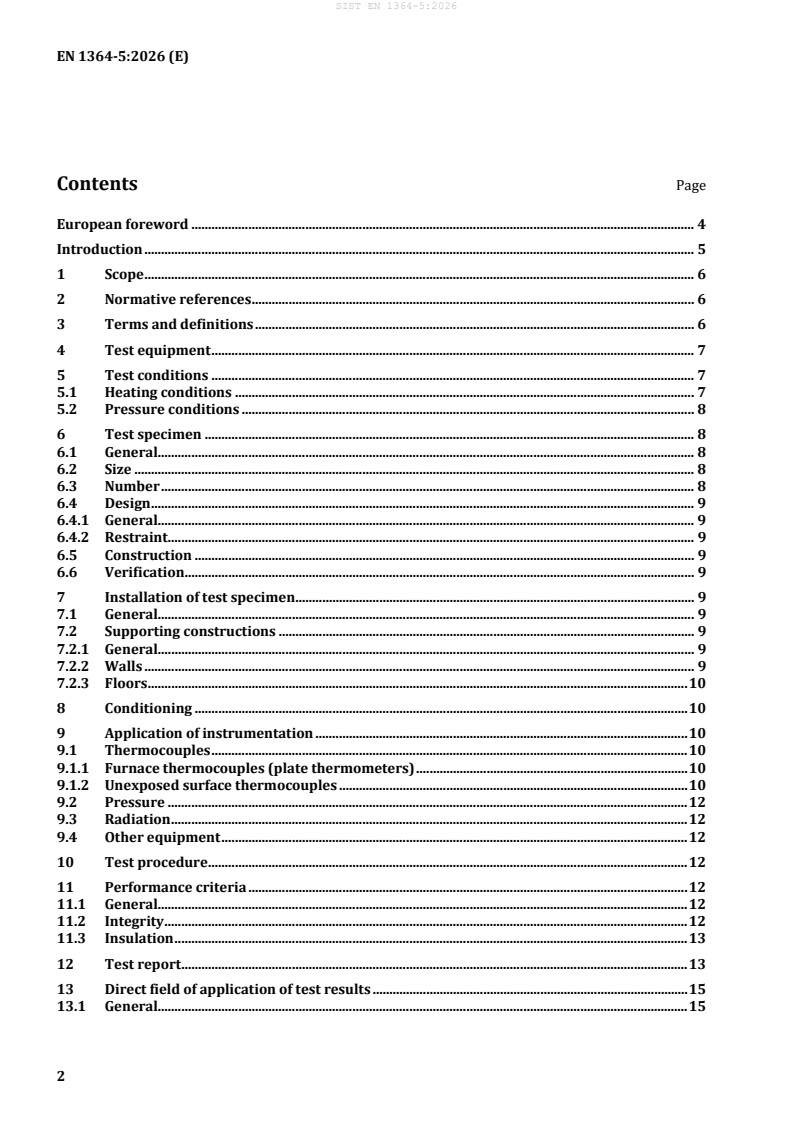
Contents Page
European foreword . 4
Introduction . 5
1 Scope . 6
2 Normative references . 6
3 Terms and definitions . 6
4 Test equipment . 7
5 Test conditions . 7
5.1 Heating conditions . 7
5.2 Pressure conditions . 8
6 Test specimen . 8
6.1 General. 8
6.2 Size . 8
6.3 Number . 8
6.4 Design . 9
6.4.1 General. 9
6.4.2 Restraint . 9
6.5 Construction . 9
6.6 Verification . 9
7 Installation of test specimen . 9
7.1 General. 9
7.2 Supporting constructions . 9
7.2.1 General. 9
7.2.2 Walls . 9
7.2.3 Floors . 10
8 Conditioning . 10
9 Application of instrumentation . 10
9.1 Thermocouples . 10
9.1.1 Furnace thermocouples (plate thermometers) . 10
9.1.2 Unexposed surface thermocouples . 10
9.2 Pressure . 12
9.3 Radiation . 12
9.4 Other equipment . 12
10 Test procedure . 12
11 Performance criteria . 12
11.1 General. 12
11.2 Integrity . 12
11.3 Insulation . 13
12 Test report . 13
13 Direct field of application of test results . 15
13.1 General. 15
13.2 Orientation . 15
13.3 Position . 15
13.4 Number . 16
13.5 Supporting construction . 16
13.5.1 Wall/floor grilles . 16
13.5.2 Ceiling grilles . 17
14 Figures . 18
Annex A (informative) Test configuration for immediate heat exposure . 25
Bibliography . 28
European foreword
This document (EN 1364-5:2026) has been prepared by Technical Committee CEN/TC 127 “Fire safety
in buildings”, the secretariat of which is held by BSI.
This European Standard shall be given the status of a national standard, either by publication of an
identical text or by endorsement, at the latest by January 2027, and conflicting national standards shall
be withdrawn at the latest by January 2027.
Attention is drawn to the possibility that some of the elements of this document may be the subject of
patent rights. CEN shall not be held responsible for identifying any or all such patent rights.
This document supersedes EN 1364-5:2017.
The EN 1364 series, under the general title Fire resistance tests for non-loadbearing elements, consists of
the following parts:
— Part 1: Walls
— Part 2: Ceilings
— Part 3: Curtain walling - Full configuration (complete assembly)
— Part 4: Curtain walling - Part configuration
— Part 5: Air transfer grilles
— Part 6: Cavity Barriers
This document has been prepared under a standardization request addressed to CEN by the European
Commission. The Standing Committee of the EFTA States subsequently approves these requests for its
Member States.
Any feedback and questions on this document should be directed to the users’ national standards body.
A complete listing of these bodies can be found on the CEN website.
According to the CEN-CENELEC Internal Regulations, the national standards organisations of the
following countries are bound to implement this European Standard: Austria, Belgium, Bulgaria, Croatia,
Cyprus, Czech Republic, Denmark, Estonia, Finland, France, Germany, Greece, Hungary, Iceland, Ireland,
Italy, Latvia, Lithuania, Luxembourg, Malta, Netherlands, Norway, Poland, Portugal, Republic of North
Macedonia, Romania, Serbia, Slovakia, Slovenia, Spain, Sweden, Switzerland, Türkiye and the United
Kingdom.
Introduction
The purpose of this test is to measure the ability of a representative specimen of an air transfer grille to
resist the spread of fire from one side to another.
A representative sample of the air transfer grille is exposed to a specified regime of heating and the
performance of the test specimen is monitored on the basis of criteria given in this document. Fire
resistance of the test specimen is expressed as the time for which the appropriate criteria have been
satisfied. The times so obtained are a measure of the adequacy of the construction in a fire but have no
direct relationship with the duration of a real fire.
WARNING 1 — The attention of all persons concerned with managing and carrying out this fire
resistance test is drawn to the fact that fire testing can be hazardous and that there is a possibility that
toxic and/or harmful smoke and gases can be involved during the test. Mechanical and operational
hazards might also arise during the construction of the test elements or structures, their testing and
disposal of test residues.
WARNING 2 — An assessment of all potential hazards and risks to health should be made and safety
precautions should be identified and provided. Written safety instructions should be issued. Appropriate
training should be given to relevant personnel. Laboratory personnel should ensure that they follow
written safety instructions at all times.
1 Scope
This document specifies a method for determining the fire resistance of air transfer grilles (ATG).
It is applicable to air transfer grilles intended for installation in building components (typically walls,
floors or ceilings). The orientation of the installation of the air transfer grille can be vertical or horizontal.
The closing mechanism of the air transfer grille can come from expansion of material and/or from any
mechanical or electrical closing device.
This document is applicable to fire resistant or fire resistant and smoke control air transfer grilles.
An additional test configuration is valid for fire resistant or fire resistant and smoke control air transfer
grilles in applications where flame impingement is a risk during open state from start of fire (see
Annex A).
This document evaluates the behaviour of the air transfer grille when exposed to the heating curve
described in EN 1363-1 and the standard pressure described in EN 1363-1. It is not the intention of this
test to provide quantitative information on the rate of leakage of smoke and/or hot gases or on the
transmission or generation of fumes under fire conditions. Such phenomena are only noted in describing
the general behaviour of test specimens during the test.
The determination of the rate of leakage of smoke at ambient temperature or at 200 °C as an optional
requirement for ATG with declared smoke control is specified in EN 1634-3.
This document is not applicable to the determination of the fire resistance of air transfer grilles that are
used in ducts because ATG are considered as separating elements. The test method for ATG used in ducts
is described in the corresponding duct standards.
This document is not applicable to the determination of the fire resistance of a fire damper or a fire
barrier connected to a duct one or both sides, as an ATG is tested as a fire-separating element on its own.
Fire dampers are tested according to EN 1366-2. Non-mechanical fire barriers are tested according to
EN 1366-12.
This document is not applicable to the determination of the fire resistance of air transfer grilles in fire
doors, shutters and openable windows as specified in EN 1634-1 and EN 1364-2, because the
deformation of fire doors, shutters and openable windows in fire conditions differs from the deformation
of flexible/rigid walls. Moreover, the location of thermocouples in the door standard is too specific to be
handled in this document.
All values given in this document are nominal unless otherwise specified.
2 Normative references
The following documents are referred to in the text in such a way that some or all of their content
constitutes requirements of this document. For dated references, only the edition cited applies. For
undated references, the latest edition of the referenced document (including any amendments) applies.
EN 1363-1, Fire resistance tests — Part 1: General requirements
EN 1363-2, Fire resistance tests — Part 2: Alternative and additional procedures
EN ISO 13943, Fire safety — Vocabulary (ISO 13943)
3 Terms and definitions
For the purposes of this document, the terms and definitions given in EN 1363-1, EN 1363-2,
EN ISO 13943 and the following apply.
3.1
air transfer grille
ATG
device consisting of an active/reactive part which can include a decorative cover as to be used in practice,
allowing movement of air at ambient temperature and pressure and providing fire resistance in case of
fire
3.2
air transfer grille flow zone
total visible surface area of the air transfer grille which allows air to flow from one side to the other
Note 1 to entry: This includes any air transfer grille frame
3.3
air transfer grille face
total surface area of the air transfer grille in its non-installed state
Note 1 to entry: This includes any air transfer grille frame
3.4
aperture
opening in the supporting construction in which the air transfer grille is installed and sealed off towards
the supporting construction
3.5
modular air transfer grille
air transfer grilles that can be fitted together to form a larger ATG unit
3.6
decorative cover
element which is not a part of the air transfer grille but may form part of the assembly achieving the fire
resistance performance
3.7
sustained flaming
continuous flaming for a period of time longer than 10 s
3.8
notional floor level
assumed floor level relative to the position of the building element in service
4 Test equipment
See EN 1363-1 and, if applicable, EN 1363-2.
5 Test conditions
5.1 Heating conditions
The heating conditions and the furnace atmosphere shall conform to those given in EN 1363-1 or, if
applicable, EN 1363-2.
5.2 Pressure conditions
Pressure conditions and tolerances shall be as given in EN 1363-1.
Depending on the field of application, air transfer grilles installed in vertical supporting constructions
can be tested in the positive or negative pressure zone. If the grille is intended for both zones, both
scenarios shall be tested.
If both tests are done in 1 set-up, the pressure level in the furnace will be organized such that the neutral
pressure plane is situated between the specimens to be tested in a negative and positive pressure zone.
The height of the neutral pressure plane in the furnace will therefore be adjusted according to the tested
specimen.
Air transfer grilles installed in horizontal supporting constructions are always considered as being
positioned in the positive pressure zone. For ATG installed in a horizontal separating element, the
pressure shall be controlled to (20 ± 3) Pa at 100 mm below the underside of the separating element to
which it is fixed.
The pressure during the test at the top and at the bottom of the ATG will be calculated and reported in
the test report and in the classification report. Also the corresponding height above notional floor level
of top and bottom of the ATG shall be reported.
NOTE The laboratories aim to achieve the specified pressures as soon as possible after commencement of the
test. However, it can happen that in case of some test configuration, high pressure at the beginning of the test can
be faced.
6 Test specimen
6.1 General
The test specimen consists of an air transfer grille together with a supporting construction. In cases
where multiple test specimens are included in a single test construction, they shall be the subject of a
separate evaluation.
6.2 Size
The test specimen shall be normally full size.
If modular air transfer grilles are tested, the largest assembly size shall be tested.
In order to avoid boundary effects, the distance between the perimeter of the air transfer grille and the
internal surfaces of the furnace shall be not less than 200 mm at any point.
In cases where multiple test specimens are included in a single test construction, the minimum distance
between adjacent air transfer grilles shall be not less than 200 mm. However, if a specific installation
requires smaller distance, then ATG shall be tested to the minimum separation used in practice.
6.3 Number
For grilles installed in vertical supporting constructions, the number of test specimens required is given
in EN 1363-1.
For horizontal separating elements, only one test specimen is required with fire exposure from the
underside.
For grilles that are not symmetrical, each side has to be tested.
Where an air transfer grille is intended for use both in floors and walls, the ATG shall be tested both
vertically and horizontally.
6.4 Design
6.4.1 General
The test specimen shall be fully representative of the air transfer grille used in practice, including any
special features which are unique to the grille, e.g. decorative covers.
Each shape (e.g. circular, rectangular) with maximum dimensions has to be tested, to give widest
application according to the field of direct application (Clause 13).
6.4.2 Restraint
The edges of the test specimen shall be restrained as in practice. The method of restraining the air
transfer grille is considered part of the test specimen.
6.5 Construction
The test specimen shall be constructed as described in EN 1363-1.
6.6 Verification
Verification of the test specimen shall be carried out as described in EN 1363-1.
7 Installation of test specimen
7.1 General
The test specimen shall be installed, as far as possible, in a manner representative of the use in practice.
Inclusion of decorative covers: Where decorative covers are to be supplied with the air transfer grille and
installed symmetrically, testing of the air transfer grille shall also include the decorative covers as part of
the test specimen. If the decorative cover will be installed non symmetrically, a test of the decorative
cover inside and outside the fire shall be required.
7.2 Supporting constructions
7.2.1 General
The standard supporting constructions given in EN 1363-1 apply.
The supporting construction chosen for the test may be a non-standard support construction. However,
the result is then only applicable to this non-standard support construction.
7.2.2 Walls
For air transfer grills intended to be installed in walls, the following supporting constructions described
in EN 1363-1 apply:
— high density rigid construction;
— low density rigid construction;
— flexible construction;
— non-standard supporting construction.
7.2.3 Floors
For air transfer grilles intended to be installed in floors, the following supporting constructions described
in EN 1363-1 apply:
— high density rigid construction;
— low density rigid construction;
— non-standard supporting construction.
NOTE Suspended ceilings described in EN 1364-2, are non-standard supporting constructions.
8 Conditioning
The test construction shall be conditioned in accordance with EN 1363-1.
9 Application of instrumentation
9.1 Thermocouples
9.1.1 Furnace thermocouples (plate thermometers)
Plate thermometers shall be provided in accordance with EN 1363-1. There shall be at least one for every
1,5 m of the exposed surface area of the test construction. Plate thermometers shall be oriented so that
side 'A' faces the back wall of the furnace for vertical test constructions and shall be oriented so that side
'A' faces the floor of the furnace for horizontal test constructions.
At the commencement of the test the furnace shall include minimum 3 thermometers irrespective of the
size of the test construction.
9.1.2 Unexposed surface thermocouples
9.1.2.1 General
Several thermocouples shall be placed in order to determine the insulation criteri
...