

SIST EN 16711-2:2016
(Main)Textiles - Determination of metal content - Part 2: Determination of metals extracted by acidic artificial perspiration solution
General Information
- Abstract
This European Standard specifies a procedure for determination of antimony (Sb), arsenic (As), cadmium (Cd), chromium (Cr), cobalt (Co), copper (Cu), lead (Pb), mercury (Hg), nickel (Ni) in natural and man-made textiles, including coated fabrics and garment components (e.g. buttons, zips, etc.) after extraction with acidic artificial perspiration solution.
- Status
- Published
- Public Enquiry End Date
- 08-May-2014
- Publication Date
- 08-Dec-2015
- Technical Committee
- ITEK - Textile and textile products
- Current Stage
- 6060 - National Implementation/Publication (Adopted Project)
- Start Date
- 25-Nov-2015
- Due Date
- 30-Jan-2016
- Completion Date
- 09-Dec-2015

Overview
SIST EN 16711-2:2016 is a European standard developed by CEN that specifies a standardized method for determining the metal content extracted from textiles using an acidic artificial perspiration solution. This standard targets the measurement of metals including antimony (Sb), arsenic (As), cadmium (Cd), chromium (Cr), cobalt (Co), copper (Cu), lead (Pb), mercury (Hg), and nickel (Ni) in both natural and synthetic textiles. The scope covers various textile products, such as coated fabrics and garment components like buttons and zips.
This procedure is critical for assessing metal exposure that may occur through skin contact, simulating perspiration conditions to evaluate metal release from textile materials. The standard is widely adopted across European countries, ensuring consistent safety and quality testing in the textile industry.
Key Topics
Extraction Procedure
The method involves cutting a representative textile specimen into small pieces and extracting soluble metals by immersion in an acidic artificial perspiration solution at 37 ± 2 °C. The solution mimics the chemical properties of human sweat including pH adjustment, enabling realistic simulation of metal leaching during actual wear.Metals Analyzed
The standard covers ten hazardous or regulated metals: Sb, As, Cd, Cr, Co, Cu, Pb, Hg, and Ni. These metals are often scrutinized because of their potential health risks when in prolonged contact with skin.Analytical Techniques
Post-extraction, metal quantification employs sensitive analytical methods such as:- Inductively Coupled Plasma Mass Spectrometry (ICP-MS)
- Inductively Coupled Plasma Optical Emission Spectrometry (ICP-OES)
- Atomic Absorption Spectrometry (AAS) including cold vapour technique for mercury
Sampling and Preparation
The sampling guidelines emphasize representative sub-sampling of textile parts, including all material components and colors. To avoid contamination, sharp ceramic scissors are recommended for cutting samples without metallic contact.Method Reliability
The standard reports on the method’s accuracy and precision based on interlaboratory studies, highlighting acceptable trueness and system precision in line with ISO 5725. It provides data on limits of detection and quantification, ensuring robust, reproducible testing.Reporting Requirements
Test reports must clearly state laboratory details, method specifications, sample description, and quantitative metal amounts expressed in milligrams per kilogram (mg/kg), including any deviations from the standard.
Applications
Textile Safety Testing
SIST EN 16711-2:2016 is essential for manufacturers and regulatory bodies to evaluate and control the release of harmful metals from textiles during consumer use, particularly garments worn close to the skin.Compliance with Regulations
This standard supports adherence to chemical safety regulations such as the European REACH regulation and other global requirements focused on restricting hazardous substances in consumer products.Quality Control
Textile producers use this method to screen raw materials, semi-finished, and finished products to ensure metal contents are within safe limits, preventing adverse health effects and potential legal issues.Research and Development
R&D laboratories rely on this standard for assessing the impact of different textile treatments, dyes, and coatings on metal release, facilitating safer product innovation.
Related Standards
EN 16711-1: Determination of metals using microwave digestion-complements Part 2 by analyzing total metal content rather than extractable metals through perspiration simulation.
EN ISO 105-E04: Tests for color fastness to perspiration-provides the basis for preparation of artificial perspiration solutions used in the extraction process.
EN ISO 11885 / EN ISO 17294-2: Methods for elemental analysis by ICP-OES and ICP-MS-used for metal quantification in the extraction solutions.
EN ISO 3071: Determination of pH of aqueous extract-relevant for ensuring the perspiration solution maintains the correct acidity during extraction.
By following SIST EN 16711-2:2016, textile manufacturers and testing laboratories can effectively assess metal leaching from textiles under simulated sweating conditions, ensuring consumer safety and regulatory compliance. The method’s standardized approach enables reliable, comparable results across various textiles and metal types, promoting transparency and quality in the textile industry.
Relations
- Effective Date
- 22-Apr-2026
- Effective Date
- 28-Jan-2026
- Effective Date
- 28-Jan-2026
- Effective Date
- 28-Jan-2026
- Effective Date
- 28-Jan-2026
- Effective Date
- 28-Jan-2026
- Effective Date
- 28-Jan-2026
- Effective Date
- 28-Jan-2026
- Effective Date
- 28-Jan-2026
- Effective Date
- 28-Jan-2026
- Effective Date
- 28-Jan-2026
- Effective Date
- 23-Sep-2026
- Effective Date
- 28-Jan-2026
Get Certified
Connect with accredited certification bodies for this standard

Control Union Certifications
Global certification for agriculture and sustainability.

Hohenstein Institut
Textile testing and certification.

Bureau Veritas Bangladesh
Bureau Veritas certification services in Bangladesh.
Sponsored listings
Frequently Asked Questions
SIST EN 16711-2:2016 is a standard published by the Slovenian Institute for Standardization (SIST). Its full title is "Textiles - Determination of metal content - Part 2: Determination of metals extracted by acidic artificial perspiration solution". This standard covers: This European Standard specifies a procedure for determination of antimony (Sb), arsenic (As), cadmium (Cd), chromium (Cr), cobalt (Co), copper (Cu), lead (Pb), mercury (Hg), nickel (Ni) in natural and man-made textiles, including coated fabrics and garment components (e.g. buttons, zips, etc.) after extraction with acidic artificial perspiration solution.
This European Standard specifies a procedure for determination of antimony (Sb), arsenic (As), cadmium (Cd), chromium (Cr), cobalt (Co), copper (Cu), lead (Pb), mercury (Hg), nickel (Ni) in natural and man-made textiles, including coated fabrics and garment components (e.g. buttons, zips, etc.) after extraction with acidic artificial perspiration solution.
SIST EN 16711-2:2016 is classified under the following ICS (International Classification for Standards) categories: 59.060.01 - Textile fibres in general. The ICS classification helps identify the subject area and facilitates finding related standards.
SIST EN 16711-2:2016 has the following relationships with other standards: It is inter standard links to SIST ISO 8288:1996, SIST EN 13631-14:2003, SIST EN ISO 11885:2009, SIST EN ISO 15586:2003, SIST EN 1233:1997, SIST EN ISO 17852:2008, SIST EN ISO 3071:2020, SIST EN ISO 105-E04:2013, SIST EN ISO 17294-2:2024, SIST EN ISO 3696:1998, SIST EN ISO 12846:2012, SIST EN 16781:2026, SIST EN 16779-2:2024. Understanding these relationships helps ensure you are using the most current and applicable version of the standard.
SIST EN 16711-2:2016 is available in PDF format for immediate download after purchase. The document can be added to your cart and obtained through the secure checkout process. Digital delivery ensures instant access to the complete standard document.
Standards Content (Sample)
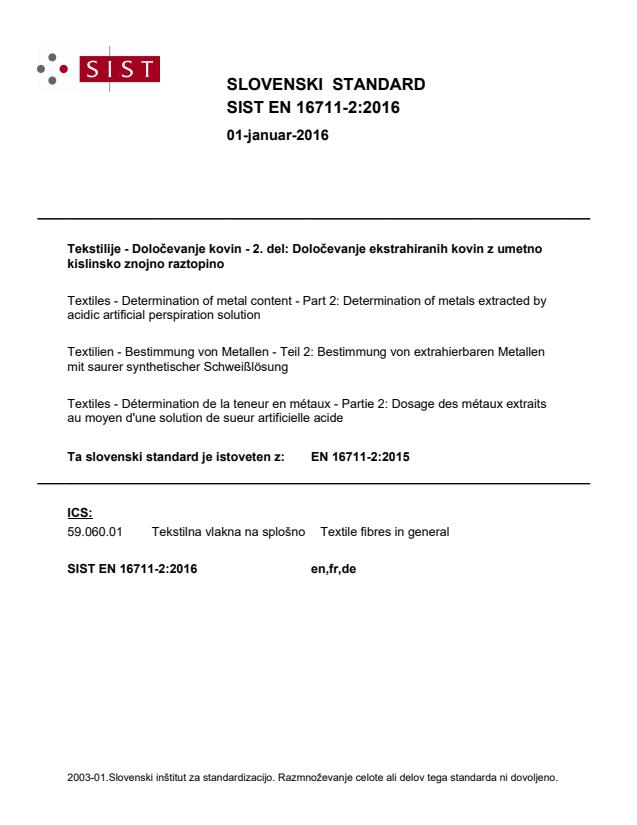
2003-01.Slovenski inštitut za standardizacijo. Razmnoževanje celote ali delov tega standarda ni dovoljeno.Textilien - Bestimmung von Metallen - Teil 2: Bestimmung von extrahierbaren Metallen mit saurer synthetischer SchweißlösungTextiles - Détermination de la teneur en métaux - Partie 2: Dosage des métaux extraits au moyen d'une solution de sueur artificielle acideTextiles - Determination of metal content - Part 2: Determination of metals extracted by acidic artificial perspiration solution59.060.01Tekstilna vlakna na splošnoTextile fibres in generalICS:Ta slovenski standard je istoveten z:EN 16711-2:2015SIST EN 16711-2:2016en,fr,de01-januar-2016SIST EN 16711-2:2016SLOVENSKI
STANDARD
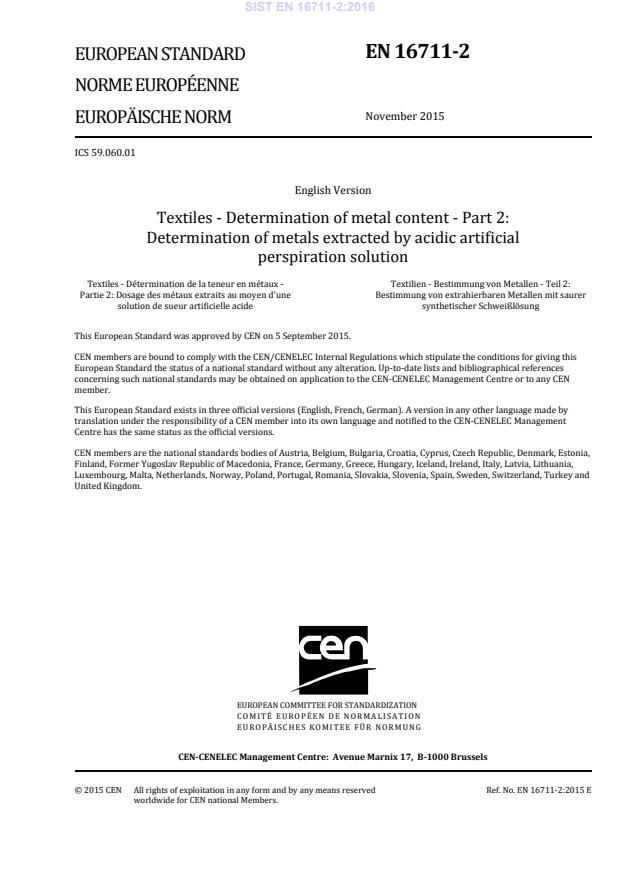
EUROPEAN STANDARD NORME EUROPÉENNE EUROPÄISCHE NORM
EN 16711-2
November
t r s w ICS
w {ä r x rä r s English Version
Textiles æ Determination of metal content æ Part
tã Determination of metals extracted by acidic artificial perspiration solution Textiles æ Dßtermination de la teneur en mßtaux æ Partie
tã Dosage des mßtaux extraits au moyen d 5une solution de sueur artificielle acide
Textilien æ Bestimmung von Metallen æ Teil
tã Bestimmung von extrahierbaren Metallen mit saurer synthetischer Schweißlösung This European Standard was approved by CEN on
w September
t r s wä
egulations which stipulate the conditions for giving this European Standard the status of a national standard without any alterationä Upætoædate lists and bibliographical references concerning such national standards may be obtained on application to the CENæCENELEC Management Centre or to any CEN memberä
translation under the responsibility of a CEN member into its own language and notified to the CENæCENELEC Management Centre has the same status as the official versionsä
CEN members are the national standards bodies of Austriaá Belgiumá Bulgariaá Croatiaá Cyprusá Czech Republicá Denmarká Estoniaá Finlandá Former Yugoslav Republic of Macedoniaá Franceá Germanyá Greeceá Hungaryá Icelandá Irelandá Italyá Latviaá Lithuaniaá Luxembourgá Maltaá Netherlandsá Norwayá Polandá Portugalá Romaniaá Slovakiaá Sloveniaá Spainá Swedená Switzerlandá Turkey and United Kingdomä
EUROPEAN COMMITTEE FOR STANDARDIZATION COMITÉ EUROPÉEN DE NORMALISATION EUROPÄISCHES KOMITEE FÜR NORMUNG
CEN-CENELEC Management Centre:
Avenue Marnix 17,
B-1000 Brussels
t r s w CEN All rights of exploitation in any form and by any means reserved worldwide for CEN national Membersä Refä Noä EN
s x y s sæ tã t r s w ESIST EN 16711-2:2016
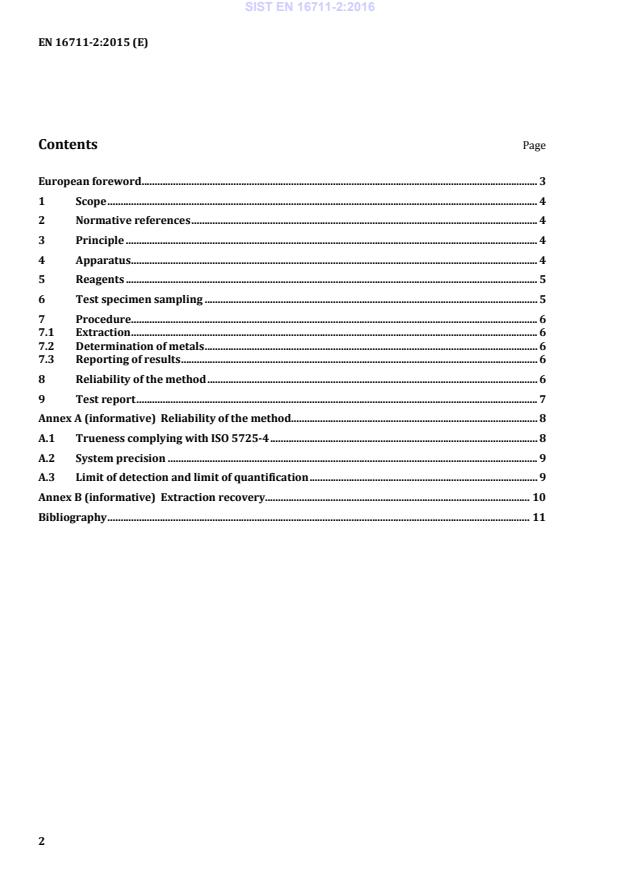
Reliability of the method. 8 A.1 Trueness complying with ISO 5725-4 . 8 A.2 System precision . 9 A.3 Limit of detection and limit of quantification . 9 Annex B (informative)
Extraction recovery. 10 Bibliography . 11
...