

SIST EN ISO 1833-26:2020
(Main)Textiles - Quantitative chemical analysis - Part 26: Mixtures of melamine with certain other fibres (method using hot formic acid) (ISO 1833-26:2020)
General Information
- Abstract
This document specifies a method using hot formic acid to determine the mass percentage of melamine fibres after removal of non-fibrous matter, in textiles made of mixtures of:
— melamine fibres
with
— cotton, polypropylene or aramid fibres.
- Status
- Published
- Public Enquiry End Date
- 01-Jul-2020
- Publication Date
- 08-Nov-2020
- Technical Committee
- ITEK - Textile and textile products
- Current Stage
- 6060 - National Implementation/Publication (Adopted Project)
- Start Date
- 29-Oct-2020
- Due Date
- 03-Jan-2021
- Completion Date
- 09-Nov-2020
Buy Documents






Overview
The SIST EN ISO 1833-26:2020 standard, titled Textiles - Quantitative chemical analysis - Part 26: Mixtures of melamine with certain other fibres (method using hot formic acid), specifies a precise chemical testing method to determine the mass percentage of melamine fibres in textile blends. This standardized method uses hot formic acid to dissolve melamine fibres from mixtures containing melamine combined with other fibres such as cotton, polypropylene, or aramid. The document, issued by the European Committee for Standardization (CEN) in collaboration with ISO Technical Committee ISO/TC 38, ensures consistent and reproducible analysis within the textile industry.
Key Topics
- Purpose: Quantitative chemical determination of melamine fibre content in textile mixtures after removal of non-fibrous matter.
- Materials Analyzed: Textiles containing mixtures of melamine fibres with cotton, polypropylene, or aramid fibres.
- Principle: Melamine fibres are selectively dissolved using hot formic acid (90% mass fraction), while other fibres remain undissolved. The dry residue is washed, dried, and weighed to calculate the percentage of melamine by difference.
- Chemical Reagents:
- Hot formic acid solution (90% by mass)
- Dilute ammonia solution used for washing residue
- Test Procedure:
- Specimen immersed and shaken in hot formic acid at 90 ± 2 °C for one hour.
- Subsequent filtration, washing, drying, and weighing of the residue.
- Apparatus Required:
- Conical flask with glass stopper (minimum 200 ml capacity)
- Shaking water bath or equivalent shaking device maintaining precise temperature and agitation frequency (about 160 cycles/min)
- Precision: The method offers reliable results with confidence limits within ±2 percentage points at 95% confidence for homogeneous mixtures.
Applications
- Textile Quality Control: Enables accurate monitoring of melamine fibre proportions in blended fabrics to verify conformity with product specifications.
- Product Development: Facilitates research into new textile blends containing melamine for flame retardant and high-performance applications.
- Regulatory Compliance: Supports compliance verification regarding fibre content labeling requirements and safety standards.
- Material Characterization: Useful for laboratory analysis in textile manufacturing, recycling, and forensic fiber studies.
This method is valuable for textile engineers, quality inspectors, chemists, and laboratories requiring standardized, reproducible chemical fiber analysis to distinguish melamine fibres from commonly blended fibres like cotton, polypropylene, and aramid.
Related Standards
- ISO 1833-1: General principles of quantitative chemical testing of textile fibres; provides fundamental guidelines and procedures referenced in ISO 1833-26 for chemical analysis.
- Other parts of the ISO 1833 series: Cover chemical analysis methods for various fibre mixtures that enable comprehensive testing protocols across textile types.
- Relevant CEN and ISO textile standards addressing fibre identification, labeling, and testing procedures in the textile industry.
By adhering to SIST EN ISO 1833-26:2020, textile laboratories and manufacturers can ensure accurate, internationally recognized determination of melamine fibre content, supporting quality assurance and product development in advanced textile applications.
Relations
- Effective Date
- 01-Dec-2020
Buy Documents
Get Certified
Connect with accredited certification bodies for this standard

Control Union Certifications
Global certification for agriculture and sustainability.

ECOCERT
Organic and sustainability certification.

Hohenstein Institut
Textile testing and certification.
Sponsored listings
Frequently Asked Questions
SIST EN ISO 1833-26:2020 is a standard published by the Slovenian Institute for Standardization (SIST). Its full title is "Textiles - Quantitative chemical analysis - Part 26: Mixtures of melamine with certain other fibres (method using hot formic acid) (ISO 1833-26:2020)". This standard covers: This document specifies a method using hot formic acid to determine the mass percentage of melamine fibres after removal of non-fibrous matter, in textiles made of mixtures of: — melamine fibres with — cotton, polypropylene or aramid fibres.
This document specifies a method using hot formic acid to determine the mass percentage of melamine fibres after removal of non-fibrous matter, in textiles made of mixtures of: — melamine fibres with — cotton, polypropylene or aramid fibres.
SIST EN ISO 1833-26:2020 is classified under the following ICS (International Classification for Standards) categories: 59.060.01 - Textile fibres in general; 71.040.40 - Chemical analysis. The ICS classification helps identify the subject area and facilitates finding related standards.
SIST EN ISO 1833-26:2020 has the following relationships with other standards: It is inter standard links to SIST EN ISO 1833-26:2013. Understanding these relationships helps ensure you are using the most current and applicable version of the standard.
SIST EN ISO 1833-26:2020 is associated with the following European legislation: Standardization Mandates: M/532. When a standard is cited in the Official Journal of the European Union, products manufactured in conformity with it benefit from a presumption of conformity with the essential requirements of the corresponding EU directive or regulation.
SIST EN ISO 1833-26:2020 is available in PDF format for immediate download after purchase. The document can be added to your cart and obtained through the secure checkout process. Digital delivery ensures instant access to the complete standard document.
Standards Content (Sample)
SLOVENSKI STANDARD
01-december-2020
Nadomešča:
SIST EN ISO 1833-26:2013
Tekstilije - Kvantitativna kemična analiza - 26. del: Mešanice melamina z nekaterimi
drugimi vlakni (metoda z uporabo vroče mravljične kisline) (ISO 1833-26:2020)
Textiles - Quantitative chemical analysis - Part 26: Mixtures of melamine with certain
other fibres (method using hot formic acid) (ISO 1833-26:2020)
Textilien - Quantitative chemische Analyse - Teil 26: Mischungen aus Melamin und
Baumwolle oder Aramidfasern (Verfahren mit heißer Ameisensäure) (ISO 1833-26:2020)
Textiles - Analyse chimique quantitative - Partie 26: Mélanges de fibres de mélamine
avec certaines autres fibres (méthode à l’acide formique chaud) (ISO 1833-26:2020)
Ta slovenski standard je istoveten z: EN ISO 1833-26:2020
ICS:
59.060.01 Tekstilna vlakna na splošno Textile fibres in general
71.040.40 Kemijska analiza Chemical analysis
2003-01.Slovenski inštitut za standardizacijo. Razmnoževanje celote ali delov tega standarda ni dovoljeno.
EN ISO 1833-26
EUROPEAN STANDARD
NORME EUROPÉENNE
October 2020
EUROPÄISCHE NORM
ICS 59.060.01 Supersedes EN ISO 1833-26:2013
English Version
Textiles - Quantitative chemical analysis - Part 26:
Mixtures of melamine with certain other fibres (method
using hot formic acid) (ISO 1833-26:2020)
Textiles - Analyse chimique quantitative - Partie 26: Textilien - Quantitative chemische Analyse - Teil 26:
Mélanges de fibres de mélamine avec certaines autres Mischungen aus Melamin und Baumwolle oder
fibres (méthode à l'acide formique chaud) (ISO 1833- Aramidfasern (Verfahren mit heißer Ameisensäure)
26:2020) (ISO 1833-26:2020)
This European Standard was approved by CEN on 19 October 2020.
CEN members are bound to comply with the CEN/CENELEC Internal Regulations which stipulate the conditions for giving this
European Standard the status of a national standard without any alteration. Up-to-date lists and bibliographical references
concerning such national standards may be obtained on application to the CEN-CENELEC Management Centre or to any CEN
member.
This European Standard exists in three official versions (English, French, German). A version in any other language made by
translation under the responsibility of a CEN member into its own language and notified to the CEN-CENELEC Management
Centre has the same status as the official versions.
CEN members are the national standards bodies of Austria, Belgium, Bulgaria, Croatia, Cyprus, Czech Republic, Denmark, Estonia,
Finland, France, Germany, Greece, Hungary, Iceland, Ireland, Italy, Latvia, Lithuania, Luxembourg, Malta, Netherlands, Norway,
Poland, Portugal, Republic of North Macedonia, Romania, Serbia, Slovakia, Slovenia, Spain, Sweden, Switzerland, Turkey and
United Kingdom.
EUROPEAN COMMITTEE FOR STANDARDIZATION
COMITÉ EUROPÉEN DE NORMALISATION
EUROPÄISCHES KOMITEE FÜR NORMUNG
CEN-CENELEC Management Centre: Rue de la Science 23, B-1040 Brussels
© 2020 CEN All rights of exploitation in any form and by any means reserved Ref. No. EN ISO 1833-26:2020 E
worldwide for CEN national Members.
Contents Page
European foreword . 3
European foreword
This document (EN ISO 1833-26:2020) has been prepared by Technical Committee ISO/TC 38
"Textiles" in collaboration with Technical Committee CEN/TC 248 “Textiles and textile products” the
secretariat of which is held by BSI.
This European Standard shall be given the status of a national standard, either by publication of an
identical text or by endorsement, at the latest by April 2021, and conflicting national standards shall be
withdrawn at the latest by April 2021.
Attention is drawn to the possibility that some of the elements of this document may be the subject of
patent rights. CEN shall not be held responsible for identifying any or all such patent rights.
This document supersedes EN ISO 1833-26:2013.
According to the CEN-CENELEC Internal Regulations, the national standards organizations of the
following countries are bound to implement this European Standard: Austria, Belgium, Bulgaria,
Croatia, Cyprus, Czech Republic, Denmark, Estonia, Finland, France, Germany, Greece, Hungary, Iceland,
Ireland, Italy, Latvia, Lithuania, Luxembourg, Malta, Netherlands, Norway, Poland, Portugal, Republic of
North Macedonia, Romania, Serbia, Slovakia, Slovenia, Spain, Sweden, Switzerland, Turkey and the
United Kingdom.
Endorsement notice
The text of ISO 1833-26:2020 has been approved by CEN as EN ISO 1833-26:2020 without any
modification.
INTERNATIONAL ISO
STANDARD 1833-26
Second edition
2020-10
Textiles — Quantitative chemical
analysis —
Part 26:
Mixtures of melamine with certain
other fibres (method using hot
formic acid)
Textiles — Analyse chimique quantitative —
Partie 26: Mélanges de fibres de mélamine avec certaines autres fibres
(méthode à l’acide formique chaud)
Reference number
ISO 1833-26:2020(E)
©
ISO 2020
ISO 1833-26:2020(E)
© ISO 2020
All rights reserved. Unless otherwise specified, or required in the context of its implementation, no part of this publication may
be reproduced or utilized otherwise in any form or by any means, electronic or mechanical, including photocopying, or posting
on the internet or an intranet, without prior written permission. Permission can be requested from either ISO at the address
below or ISO’s member body in the country of the requester.
ISO copyright office
CP 401 • Ch. de Blandonnet 8
CH-1214 Vernier, Geneva
Phone: +41 22 749 01 11
Email: copyright@iso.org
Website: www.iso.org
Published in Switzerland
ii © ISO 2020 – All rights reserved
ISO 1833-26:2020(E)
Contents Page
Foreword .iv
1 Scope . 1
2 Normative references . 1
3 Terms and definitions . 1
4 Principle . 1
5 Reagents . 1
5.1 General . 1
6 Apparatus . 2
6.1 General .
...
SLOVENSKI STANDARD
oSIST prEN ISO 1833-26:2020
01-junij-2020
Tekstilije - Kvantitativna kemična analiza - 26. del: Mešanica ?? (spremenjen
angleški naslov!) (metoda z uporabo vroče mravljične kisline) (ISO/DIS 1833-
26:2020)
Textiles - Quantitative chemical analysis - Part 26: Mixtures of melamine with certain
other fibres (method using hot formic acid) (ISO/DIS 1833-26:2020)
Textilien - Quantitative chemische Analyse - Teil 26: Mischungen aus Melamin und
Baumwolle oder Aramidfasern (Verfahren mit heißer Ameisensäure) (ISO/DIS 1833-
26:2020)
Textiles - Analyse chimique quantitative - Partie 26: Mélanges de fibres de mélamine
avec certaines autres fibres (méthode à l’acide formique chaud) (ISO/DIS 1833-26:2020)
Ta slovenski standard je istoveten z: prEN ISO 1833-26
ICS:
59.060.01 Tekstilna vlakna na splošno Textile fibres in general
oSIST prEN ISO 1833-26:2020 de
2003-01.Slovenski inštitut za standardizacijo. Razmnoževanje celote ali delov tega standarda ni dovoljeno.
oSIST prEN ISO 1833-26:2020
oSIST prEN ISO 1833-26:2020
ENTWURF
EUROPÄISCHE NORM
prEN ISO 1833-26
EUROPEAN STANDARD
NORME EUROPÉENNE
April 2020
ICS 59.060.01 Vorgesehen als Ersatz für EN ISO 1833-26:2013
Deutsche Fassung
Textilien - Quantitative chemische Analyse - Teil 26:
Mischungen aus Melamin und Baumwolle oder Aramidfasern
(Verfahren mit heißer Ameisensäure) (ISO/DIS 1833-
26:2020)
Textiles - Quantitative chemical analysis - Part 26: Textiles - Analyse chimique quantitative - Partie 26:
Mixtures of melamine with certain other fibres (method Mélanges de fibres de mélamine avec certaines autres
using hot formic acid) (ISO/DIS 1833-26:2020) fibres (méthode à l'acide formique chaud) (ISO/DIS
1833-26:2020)
Dieser Europäische Norm-Entwurf wird den CEN-Mitgliedern zur parallelen Umfrage vorgelegt. Er wurde vom Technischen
Komitee CEN/TC 248 erstellt.
Wenn aus diesem Norm-Entwurf eine Europäische Norm wird, sind die CEN-Mitglieder gehalten, die CEN-Geschäftsordnung zu
erfüllen, in der die Bedingungen festgelegt sind, unter denen dieser Europäischen Norm ohne jede Änderung der Status einer
nationalen Norm zu geben ist.
Dieser Europäische Norm-Entwurf wurde von CEN in drei offiziellen Fassungen (Deutsch, Englisch, Französisch) erstellt. Eine
Fassung in einer anderen Sprache, die von einem CEN-Mitglied in eigener Verantwortung durch Übersetzung in seine
Landessprache gemacht und dem CEN-CENELEC-Management-Zentrum mitgeteilt worden ist, hat den gleichen Status wie die
offiziellen Fassungen.
CEN-Mitglieder sind die nationalen Normungsinstitute von Belgien, Bulgarien, Dänemark, Deutschland, Estland, Finnland,
Frankreich, Griechenland, Irland, Island, Italien, Kroatien, Lettland, Litauen, Luxemburg, Malta, den Niederlanden, Norwegen,
Österreich, Polen, Portugal, der Republik Nordmazedonien, Rumänien, Schweden, der Schweiz, Serbien, der Slowakei, Slowenien,
Spanien, der Tschechischen Republik, der Türkei, Ungarn, dem Vereinigten Königreich und Zypern.
Die Empfänger dieses Norm-Entwurfs werden gebeten, mit ihren Kommentaren jegliche relevante Patentrechte, die sie kennen,
mitzuteilen und unterstützende Dokumentationen zur Verfügung zu stellen.
Warnvermerk : Dieses Schriftstück hat noch nicht den Status einer Europäischen Norm. Es wird zur Prüfung und Stellungnahme
vorgelegt. Es kann sich noch ohne Ankündigung ändern und darf nicht als Europäischen Norm in Bezug genommen werden.
EUROPÄISCHES KOMITEE FÜR NORMUNG
EUROPEAN COMMITTEE FOR STANDARDIZATION
COMITÉ EUROPÉEN DE NORMALISATION
CEN-CENELEC Management-Zentrum: Rue de la Science 23, B-1040 Brüssel
© 2020 CEN Alle Rechte der Verwertung, gleich in welcher Form und in welchem Ref. Nr. prEN ISO 1833-26:2020 D
Verfahren, sind weltweit den nationalen Mitgliedern von CEN
vorbehalten.
oSIST prEN ISO 1833-26:2020
prEN ISO 1833-26:2020 (D)
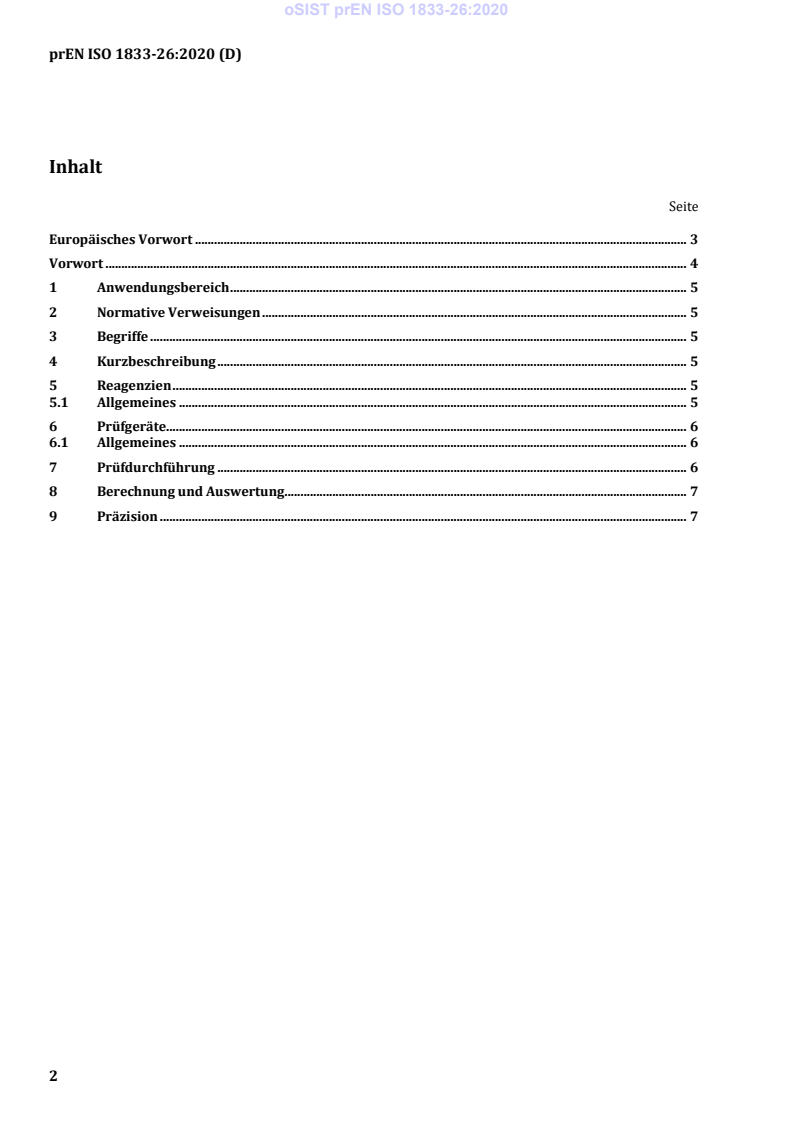
Inhalt
Seite
Europäisches Vorwort . 3
Vorwort . 4
1 Anwendungsbereich . 5
2 Normative Verweisungen . 5
3 Begriffe . 5
4 Kurzbeschreibung . 5
5 Reagenzien . 5
5.1 Allgemeines . 5
6 Prüfgeräte . 6
6.1 Allgemeines . 6
7 Prüfdurchführung . 6
8 Berechnung und Auswertung . 7
9 Präzision . 7
oSIST prEN ISO 1833-26:2020
prEN ISO 1833-26:2020 (D)
Europäisches Vorwort
Dieses Dokument (prEN ISO 1833-26:2020) wurde vom Technischen Komitee ISO/TC 38 „Textiles“ in
Zusammenarbeit mit dem Technischen Komitee CEN/TC 248 „Textilien und textile Erzeugnisse“ erarbeitet,
dessen Sekretariat von BSI gehalten wird.
Dieses Dokument ist derzeit zur parallelen Umfrage vorgelegt.
Dieses Dokument wird EN ISO 1833-26:2013 ersetzen.
Anerkennungsnotiz
Der Text von ISO/DIS 1833-26:2020 wurde von CEN als prEN ISO 1833-26:2020 ohne irgendeine
Abänderung genehmigt.
oSIST prEN ISO 1833-26:2020
prEN ISO 1833-26:2020 (D)
Vorwort
ISO (die Internationale Organisation für Normung) ist eine weltweite Vereinigung nationaler
Normungsinstitute (ISO-Mitgliedsorganisationen). Die Erstellung von Internationalen Normen wird
üblicherweise von Technischen Komitees von ISO durchgeführt. Jede Mitgliedsorganisation, die Interesse an
einem Thema hat, für welches ein Technisches Komitee gegründet wurde, hat das Recht, in diesem Komitee
vertreten zu sein. Internationale staatliche und nichtstaatliche Organisationen, die in engem Kontakt mit ISO
stehen, nehme
...