

SIST EN 17635:2023
(Main)Glass in buildig - Shatter properties - Requirements and assessment methods
General Information
- Abstract
This document gives test methods to assess the shatter properties of different types of monolithic flat glass for use in building and construction works, for which a specific fragmentation pattern is required when tested under defined conditions.
NOTE Thermally treated monolithic glass is a product for which such a requirement exists.
- Status
- Published
- Public Enquiry End Date
- 30-Mar-2021
- Publication Date
- 09-Jan-2023
- Technical Committee
- STV - Steklo, svetloba in razsvetljava v gradbeništvu
- Current Stage
- 6060 - National Implementation/Publication (Adopted Project)
- Start Date
- 07-Dec-2022
- Due Date
- 11-Feb-2023
- Completion Date
- 10-Jan-2023

Overview
EN 17635:2022 - Glass in building - Shatter properties - Requirements and assessment methods (CEN) specifies test methods to assess the shatter properties of monolithic flat glass used in building and construction where a defined fragmentation pattern is required. The standard enables manufacturers, test laboratories and specifiers to declare fragmentation behaviour (shatter properties) in the Declaration of Performance (DoP), in particular for thermally treated monolithic glass.
Key topics and technical requirements
- Scope: Test methods for assessing shatter/fragmentation behaviour of monolithic flat glass for building use.
- Two assessment methods:
- Method A – for glass expected to fragment into numerous small, blunt-edged pieces.
- Method B – for glass expected to fracture more like annealed glass, with controls on “islands” and “particles”.
- Specimen dimensions and number: Test specimens are 360 mm × 1 100 mm; five specimens are tested per method.
- Impact tool and position:
- Pointed steel tool (examples: ~75 g hammer, spring-loaded centre punch); point radius ≈ 0.2 mm.
- Method A impact point: 13 mm from longest edge (mid-point). Method B impact point: 20 mm from longest edge.
- Test setup: Specimen laid flat, unrestrained, fragments held interlocked (e.g., small frame or tape) to prevent scattering.
- Timing and exclusion zones: Particle counting and measurements made between 3–5 minutes after fracture; an area of 100 mm radius around the impact point and a 25 mm border are excluded from assessment.
- Method A metrics:
- Particle counting using a 50 mm × 50 mm mask in the region of coarsest fracture.
- Minimum particle count requirements depend on nominal thickness and application (shower enclosure vs other applications).
- Maximum length of the longest particle: 100 mm.
- Method B metrics:
- Every fragment classified as reaching the excluded area or as an “island” (≥ 100 mm²) or “particle” (< 100 mm²).
- Area calculated from fragment mass, thickness and density using the specified formula.
- Acceptance criteria per specimen: usually no more than 2 islands; no island area > 1 000 mm²; total particle area ≤ 5 000 mm². At least 4 of 5 specimens must meet these limits; a single failing specimen has relaxed limits (up to 3 islands, combined area ≤ 50 000 mm²).
- Result coding: Shatter properties reported using codes (e.g., S for shower enclosure under Method A, T for other Method A applications, D for Method B).
Applications and users
- Who uses this standard: glass manufacturers, independent testing laboratories, façade and glazing specifiers, product certifiers, and building code authorities.
- Practical uses:
- Declare shatter behaviour in the DoP for thermally treated and other monolithic glass products.
- Support product selection for safety-critical glazing (e.g., shower enclosures, doors, internal partitions).
- Verify production quality and third‑party testing for compliance with contractual or regulatory requirements.
Related standards
- EN 17635:2022 is intended to be referenced from hEN product standards for glass (part of Clause 4 “Characteristics”). It aligns with mandates (e.g., Mandate M/135) and complements product-specific standards and testing protocols used across CEN member states.
Keywords: EN 17635:2022, shatter properties, glass in building, monolithic flat glass, fragmentation test, Method A, Method B, thermally treated glass, Declaration of Performance (DoP).
Frequently Asked Questions
SIST EN 17635:2023 is a standard published by the Slovenian Institute for Standardization (SIST). Its full title is "Glass in buildig - Shatter properties - Requirements and assessment methods". This standard covers: This document gives test methods to assess the shatter properties of different types of monolithic flat glass for use in building and construction works, for which a specific fragmentation pattern is required when tested under defined conditions. NOTE Thermally treated monolithic glass is a product for which such a requirement exists.
This document gives test methods to assess the shatter properties of different types of monolithic flat glass for use in building and construction works, for which a specific fragmentation pattern is required when tested under defined conditions. NOTE Thermally treated monolithic glass is a product for which such a requirement exists.
SIST EN 17635:2023 is classified under the following ICS (International Classification for Standards) categories: 81.040.20 - Glass in building. The ICS classification helps identify the subject area and facilitates finding related standards.
SIST EN 17635:2023 is associated with the following European legislation: EU Directives/Regulations: 305/2011; Standardization Mandates: M/135. When a standard is cited in the Official Journal of the European Union, products manufactured in conformity with it benefit from a presumption of conformity with the essential requirements of the corresponding EU directive or regulation.
SIST EN 17635:2023 is available in PDF format for immediate download after purchase. The document can be added to your cart and obtained through the secure checkout process. Digital delivery ensures instant access to the complete standard document.
Standards Content (Sample)
SLOVENSKI STANDARD
01-februar-2023
Steklo v gradbeništvu - Lastnosti loma - Zahteve in metode ocenjevanja
Glass in buildig - Shatter properties - Requirements and assessment methods
Glas in Bauwesen - Brucheigenschaften - Anforderungen und Bewertungsmethoden
Verre dans la construction - Comportement lors du bris - Exigences et méthodes
d'évaluation
Ta slovenski standard je istoveten z: EN 17635:2022
ICS:
81.040.20 Steklo v gradbeništvu Glass in building
2003-01.Slovenski inštitut za standardizacijo. Razmnoževanje celote ali delov tega standarda ni dovoljeno.
EN 17635
EUROPEAN STANDARD
NORME EUROPÉENNE
November 2022
EUROPÄISCHE NORM
ICS 81.040.20
English Version
Glass in building - Shatter properties - Requirements and
assessment methods
Verre dans la construction - Comportement lors du bris Glas im Bauwesen - Brucheigenschaften -
- Exigences et méthodes d'évaluation Anforderungen und Bewertungsmethoden
This European Standard was approved by CEN on 30 October 2022.
CEN members are bound to comply with the CEN/CENELEC Internal Regulations which stipulate the conditions for giving this
European Standard the status of a national standard without any alteration. Up-to-date lists and bibliographical references
concerning such national standards may be obtained on application to the CEN-CENELEC Management Centre or to any CEN
member.
This European Standard exists in three official versions (English, French, German). A version in any other language made by
translation under the responsibility of a CEN member into its own language and notified to the CEN-CENELEC Management
Centre has the same status as the official versions.
CEN members are the national standards bodies of Austria, Belgium, Bulgaria, Croatia, Cyprus, Czech Republic, Denmark, Estonia,
Finland, France, Germany, Greece, Hungary, Iceland, Ireland, Italy, Latvia, Lithuania, Luxembourg, Malta, Netherlands, Norway,
Poland, Portugal, Republic of North Macedonia, Romania, Serbia, Slovakia, Slovenia, Spain, Sweden, Switzerland, Türkiye and
United Kingdom.
EUROPEAN COMMITTEE FOR STANDARDIZATION
COMITÉ EUROPÉEN DE NORMALISATION
EUROPÄISCHES KOMITEE FÜR NORMUNG
CEN-CENELEC Management Centre: Rue de la Science 23, B-1040 Brussels
© 2022 CEN All rights of exploitation in any form and by any means reserved Ref. No. EN 17635:2022 E
worldwide for CEN national Members.
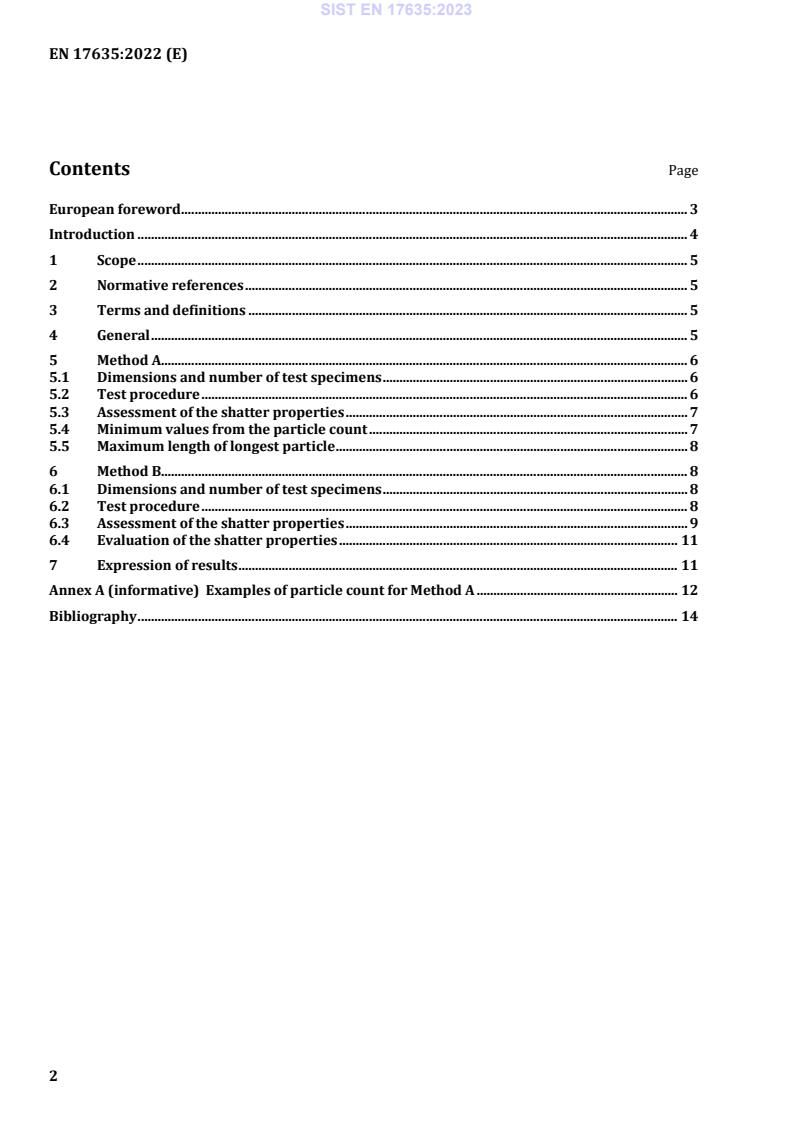
Contents Page
European foreword . 3
Introduction . 4
1 Scope . 5
2 Normative references . 5
3 Terms and definitions . 5
4 General . 5
5 Method A. 6
5.1 Dimensions and number of test specimens . 6
5.2 Test procedure . 6
5.3 Assessment of the shatter properties . 7
5.4 Minimum values from the particle count . 7
5.5 Maximum length of longest particle . 8
6 Method B. 8
6.1 Dimensions and number of test specimens . 8
6.2 Test procedure . 8
6.3 Assessment of the shatter properties . 9
6.4 Evaluation of the shatter properties . 11
7 Expression of results . 11
Annex A (informative) Examples of particle count for Method A . 12
Bibliography . 14
European foreword
This document (EN 17635:2022) has been prepared by Technical Committee CEN/TC 129 “Glass in
building”, the secretariat of which is held by NBN.
This European Standard shall be given the status of a national standard, either by publication of an
identical text or by endorsement, at the latest by May 2023, and conflicting national standards shall be
withdrawn at the latest by May 2023.
Attention is drawn to the possibility that some of the elements of this document may be the subject of
patent rights. CEN shall not be held responsible for identifying any or all such patent rights.
This document has been prepared under a Standardization Request given to CEN by the European
Commission and the European Free Trade Association.
Any feedback and questions on this document should be directed to the users’ national standards body.
A complete listing of these bodies can be found on the CEN website.
According to the CEN-CENELEC Internal Regulations, the national standards organisations of the
following countries are bound to implement this European Standard: Austria, Belgium, Bulgaria, Croatia,
Cyprus, Czech Republic, Denmark, Estonia, Finland, France, Germany, Greece, Hungary, Iceland, Ireland,
Italy, Latvia, Lithuania, Luxembourg, Malta, Netherlands, Norway, Poland, Portugal, Republic of North
Macedonia, Romania, Serbia, Slovakia, Slovenia, Spain, Sweden, Switzerland, Türkiye and the United
Kingdom.
Introduction
Under the former Construction Products Directive, the concept of “conformity with the standard” has
make the assessment of fragmentation properties mandatory for thermally treated glass, as failing to
satisfy the fragmentation test (pass/fail criterion) forbid the manufacturer to claim compliance with the
relevant standard.
With the Construction Products Regulation, the concept of “conformity with the standard” doesn't exist
anymore. Therefore, in order to fulfil the needs of national regulations which presuppose that this
assessment is made, fragmentation properties have to be declared explicitly in the declaration of
performances (DoP).
The description of the fragmentation test was in the part 1 of six product standards, five of them using
the Method A and one using the method B (see bibliography, references [3] to [8]). But no reference was
made to this test in the harmonized part (part 2) of the same product standard. Moreover, glass
presenting specific shatter properties can be used as substrate or as component of further transformed
glass products, for which the possibility to declare the shatter property was not explicitly mentioned in
the respective hEN.
The aim by transferring the description of the fragmentation tests in a separate standard on shatter
properties is to allow for a declaration of this characteristic in the DoP. All hENs on glass products, when
revised, will make a reference to the shatter properties standard in their Clause 4, “Characteristics”.
Shatter properties will be a characteristic that will be possible to declare, like any other characteristic
already included in Clause 4.
The wording “shatter properties” is the one used in Mandate M/135. In order to be compliant with that
Mandate, the word “fragmentation” is replaced by “shatter properties” although nothing has been
modified in the description of the test methods.
1 Scope
This document gives test methods to assess the shatter properties of different types of monolithic flat
glass for use in building and construction works, for which a specific fragmentation pattern is required
when tested under defined conditions.
NOTE Thermally treated monolithic glass is a product for which such a requirement exists.
2 Normative references
There are no normative references in this document.
3 Terms and definitions
For the purposes of this document, the following terms and definitions apply.
ISO and IEC maintain terminology databases for use in standardization at the following addresses:
— ISO Online browsing platform: available at https://www.iso.org/obp
— IEC Electropedia: available at https://www.electropedia.org/
3.1
shatter properties
property of a glass pane to fragment in accordance with a specified pattern when tested under defined
conditions
3.2
fragment
any portion of a glass pane obtained after its fracture and having the same thickness as the original pane
Note 1 to entry: Gl
...