

SIST EN 12758:2019+A1:2023
(Main + Amendment)Glass in building - Glazing and airborne sound insulation - Product descriptions, determination of properties and extension rules
General Information
- Abstract
This European Standard assigns sound insulation values to all transparent, translucent and opaque glass products, described in the European Standards for basic, special basic or processed glass products, when intended to be used in glazed assemblies in buildings, and which exhibit properties of acoustic protection, either as a prime intention or as a supplementary characteristic.
This document outlines the procedure, by which glass products may be rated, according to their acoustic performance which enables assessment of compliance with the acoustic requirements of buildings.
Rigorous technical analysis of measurement data remains an option, but this standard is intended to enable the derivation of simpler indices of performance, which can be adopted with confidence by non-specialists.
By adopting the principles of this standard the formulation of acoustic requirements in Building Codes and for product specification to satisfy particular needs for glazing is simplified.
It is recognised that the acoustic test procedures contained within EN ISO 140-1 and EN ISO 140-3 relate only to glass panes and their combinations. Although the same principles should be followed as closely as possible, it is inevitable that some compromises are necessary, because of the bulkier construction of other glazing types, e.g. glass blocks, paver units, channel-shaped glass, structural glazing and structural sealant glazing. Guidelines on how to adapt the test procedures for these glazing types are offered in Clause 4.
All the considerations of this standard relate to panes of glass/glazing alone. Incorporation of them into windows may cause changes in acoustic performance as a result of other influences, e.g. frame design, frame material, glazing material/method, mounting method, air tightness, etc. Measurements of the sound insulation of complete windows (glass and frame) may be undertaken to resolve such issues.
- Status
- Published
- Publication Date
- 20-Aug-2023
- Technical Committee
- STV - Steklo, svetloba in razsvetljava v gradbeništvu
- Current Stage
- 6060 - National Implementation/Publication (Adopted Project)
- Start Date
- 25-May-2023
- Due Date
- 30-Jul-2023
- Completion Date
- 21-Aug-2023

Overview
EN 12758:2019+A1:2023 - "Glass in building - Glazing and airborne sound insulation" is a CEN European Standard that assigns acoustic ratings to transparent, translucent and opaque glass products intended for use in glazed building assemblies. The standard defines a practical procedure to determine and declare the acoustic performance of glass panes, laminated glass and insulating glass units (IGUs), and provides extension rules and typical performance data so manufacturers, specifiers and non‑specialists can assess compliance with building acoustic requirements.
Key topics and technical requirements
- Scope: Covers basic, special basic and processed glass types when they provide acoustic protection either primarily or as a secondary characteristic. Applies to panes and glass products alone (not whole windows).
- Measurement basis: Refers to laboratory methods in EN ISO 10140 (notably Annex D) and rating in accordance with EN ISO 717‑1 (airborne sound insulation).
- Sound rating and indices: Uses Sound Reduction Index (R) and weighted indices (Rw) plus spectrum adaptation terms for application to different noise types (e.g., urban traffic, living activities).
- Extension rules: Provides rules to extrapolate acoustic performance from tested configurations to other product variants (e.g., thickness, coatings, interlayers) without repeating full tests.
- Processed products: Addresses treated glasses - strengthened, thermally toughened, laminated (including acoustic PVB interlayers), coated and insulating glass units (IGUs).
- Adaptation guidance: Offers guidance for adapting test procedures to bulkier glazing types (glass blocks, channel‑shaped glass, structural glazing) where laboratory protocols for simple panes are less directly applicable.
- Limitations: Notes that installation factors (frame design, sealing, mounting) affect in‑situ performance - recommending whole‑window testing where needed.
Practical applications and users
- Who uses it: Glass manufacturers, IGU and laminated glass producers, façade and window system designers, acoustic consultants, architects, building code writers and product certifiers.
- Practical uses:
- Declare product acoustic performance for product datasheets.
- Use extension rules to reduce testing burden when developing variants.
- Specify glazing to meet building acoustic requirements in specifications and codes.
- Provide baseline acoustic data for façade and window system acoustic design, with in‑situ verification of full assemblies if required.
Related standards (selection)
- EN ISO 10140 (laboratory measurement of sound insulation)
- EN ISO 717‑1 (rating of airborne sound insulation)
- EN 572 series (basic glass types)
- EN ISO 12543 (laminated glass)
- EN 1279 (insulating glass units)
Keywords: EN 12758:2019+A1:2023, glazing, glass in building, airborne sound insulation, acoustic performance, Sound Reduction Index, IGU, laminated glass, extension rules, EN ISO 10140, EN ISO 717-1.
Relations
- Effective Date
- 22-Mar-2023
- Effective Date
- 22-Mar-2023
- Refers
SIST EN 1096-1:2012 - Glass in building - Coated glass - Part 1: Definitions and classification - Effective Date
- 28-Jan-2026
- Effective Date
- 28-Jan-2026
- Effective Date
- 28-Jan-2026
- Effective Date
- 28-Jan-2026
- Effective Date
- 28-Jan-2026
- Effective Date
- 28-Jan-2026
- Effective Date
- 28-Jan-2026
- Effective Date
- 28-Jan-2026
- Effective Date
- 28-Jan-2026
- Effective Date
- 28-Jan-2026
- Effective Date
- 28-Jan-2026
- Effective Date
- 28-Jan-2026
- Effective Date
- 28-Jan-2026
Get Certified
Connect with accredited certification bodies for this standard

DIBt (Deutsches Institut für Bautechnik)
German Institute for Building Technology.
DIN CERTCO
DIN Group product certification.

Aboma Certification B.V.
Specialized in construction, metal, and transport sectors.
Sponsored listings
Frequently Asked Questions
SIST EN 12758:2019+A1:2023 is a standard published by the Slovenian Institute for Standardization (SIST). Its full title is "Glass in building - Glazing and airborne sound insulation - Product descriptions, determination of properties and extension rules". This standard covers: This European Standard assigns sound insulation values to all transparent, translucent and opaque glass products, described in the European Standards for basic, special basic or processed glass products, when intended to be used in glazed assemblies in buildings, and which exhibit properties of acoustic protection, either as a prime intention or as a supplementary characteristic. This document outlines the procedure, by which glass products may be rated, according to their acoustic performance which enables assessment of compliance with the acoustic requirements of buildings. Rigorous technical analysis of measurement data remains an option, but this standard is intended to enable the derivation of simpler indices of performance, which can be adopted with confidence by non-specialists. By adopting the principles of this standard the formulation of acoustic requirements in Building Codes and for product specification to satisfy particular needs for glazing is simplified. It is recognised that the acoustic test procedures contained within EN ISO 140-1 and EN ISO 140-3 relate only to glass panes and their combinations. Although the same principles should be followed as closely as possible, it is inevitable that some compromises are necessary, because of the bulkier construction of other glazing types, e.g. glass blocks, paver units, channel-shaped glass, structural glazing and structural sealant glazing. Guidelines on how to adapt the test procedures for these glazing types are offered in Clause 4. All the considerations of this standard relate to panes of glass/glazing alone. Incorporation of them into windows may cause changes in acoustic performance as a result of other influences, e.g. frame design, frame material, glazing material/method, mounting method, air tightness, etc. Measurements of the sound insulation of complete windows (glass and frame) may be undertaken to resolve such issues.
This European Standard assigns sound insulation values to all transparent, translucent and opaque glass products, described in the European Standards for basic, special basic or processed glass products, when intended to be used in glazed assemblies in buildings, and which exhibit properties of acoustic protection, either as a prime intention or as a supplementary characteristic. This document outlines the procedure, by which glass products may be rated, according to their acoustic performance which enables assessment of compliance with the acoustic requirements of buildings. Rigorous technical analysis of measurement data remains an option, but this standard is intended to enable the derivation of simpler indices of performance, which can be adopted with confidence by non-specialists. By adopting the principles of this standard the formulation of acoustic requirements in Building Codes and for product specification to satisfy particular needs for glazing is simplified. It is recognised that the acoustic test procedures contained within EN ISO 140-1 and EN ISO 140-3 relate only to glass panes and their combinations. Although the same principles should be followed as closely as possible, it is inevitable that some compromises are necessary, because of the bulkier construction of other glazing types, e.g. glass blocks, paver units, channel-shaped glass, structural glazing and structural sealant glazing. Guidelines on how to adapt the test procedures for these glazing types are offered in Clause 4. All the considerations of this standard relate to panes of glass/glazing alone. Incorporation of them into windows may cause changes in acoustic performance as a result of other influences, e.g. frame design, frame material, glazing material/method, mounting method, air tightness, etc. Measurements of the sound insulation of complete windows (glass and frame) may be undertaken to resolve such issues.
SIST EN 12758:2019+A1:2023 is classified under the following ICS (International Classification for Standards) categories: 81.040.20 - Glass in building; 91.120.20 - Acoustics in building. Sound insulation. The ICS classification helps identify the subject area and facilitates finding related standards.
SIST EN 12758:2019+A1:2023 has the following relationships with other standards: It is inter standard links to SIST EN 12758:2019, SIST EN 12758:2019/kprA1:2023, SIST EN 1096-1:2012, SIST EN 12337-1:2001, SIST EN 1279-1:2018, SIST EN 15682-1:2013, SIST EN 572-5:2012, SIST EN 572-1:2012+A1:2016, SIST EN ISO 10140-3:2021, SIST EN ISO 12543-5:2022, SIST EN 572-3:2012, SIST EN 14179-1:2016, SIST EN 572-4:2012, SIST EN ISO 10140-5:2021, SIST EN ISO 717-1:2021. Understanding these relationships helps ensure you are using the most current and applicable version of the standard.
SIST EN 12758:2019+A1:2023 is associated with the following European legislation: EU Directives/Regulations: 305/2011; Standardization Mandates: M/135. When a standard is cited in the Official Journal of the European Union, products manufactured in conformity with it benefit from a presumption of conformity with the essential requirements of the corresponding EU directive or regulation.
SIST EN 12758:2019+A1:2023 is available in PDF format for immediate download after purchase. The document can be added to your cart and obtained through the secure checkout process. Digital delivery ensures instant access to the complete standard document.
Standards Content (Sample)
SLOVENSKI STANDARD
01-september-2023
Steklo v gradbeništvu - Steklo in izolirnost pred zvokom v zraku - Opis proizvoda,
opredelitev lastnosti in pravila razširitve (vključno z dopolnilom A1)
Glass in building - Glazing and airborne sound insulation - Product descriptions,
determination of properties and extension rules
Glas im Bauwesen - Glas und Luftschalldämmung - Produktbeschreibungen,
Bestimmung der Eigenschaften und Erweiterungsregeln
Verre dans la construction - Vitrages et isolation aux bruits aériens - Descriptions de
produits, détermination des propriétés et règles d'extension
Ta slovenski standard je istoveten z: EN 12758:2019+A1:2023
ICS:
81.040.20 Steklo v gradbeništvu Glass in building
91.120.20 Akustika v stavbah. Zvočna Acoustics in building. Sound
izolacija insulation
2003-01.Slovenski inštitut za standardizacijo. Razmnoževanje celote ali delov tega standarda ni dovoljeno.
EN 12758:2019+A1
EUROPEAN STANDARD
NORME EUROPÉENNE
May 2023
EUROPÄISCHE NORM
ICS 81.040.20; 91.120.20 Supersedes EN 12758:2019
English Version
Glass in building - Glazing and airborne sound insulation -
Product descriptions, determination of properties and
extension rules
Verre dans la construction - Vitrages et isolation aux Glas im Bauwesen - Glas und Luftschalldämmung -
bruits aériens - Descriptions de produits, Produktbeschreibungen, Bestimmung der
détermination des propriétés et règles d'extension Eigenschaften und Erweiterungsregeln
This European Standard was approved by CEN on 5 August 2019 and includes Amendment 1 approved by CEN on 10 April 2023.
CEN members are bound to comply with the CEN/CENELEC Internal Regulations which stipulate the conditions for giving this
European Standard the status of a national standard without any alteration. Up-to-date lists and bibliographical references
concerning such national standards may be obtained on application to the CEN-CENELEC Management Centre or to any CEN
member.
This European Standard exists in three official versions (English, French, German). A version in any other language made by
translation under the responsibility of a CEN member into its own language and notified to the CEN-CENELEC Management
Centre has the same status as the official versions.
CEN members are the national standards bodies of Austria, Belgium, Bulgaria, Croatia, Cyprus, Czech Republic, Denmark, Estonia,
Finland, France, Germany, Greece, Hungary, Iceland, Ireland, Italy, Latvia, Lithuania, Luxembourg, Malta, Netherlands, Norway,
Poland, Portugal, Republic of North Macedonia, Romania, Serbia, Slovakia, Slovenia, Spain, Sweden, Switzerland, Türkiye and
United Kingdom.
EUROPEAN COMMITTEE FOR STANDARDIZATION
COMITÉ EUROPÉEN DE NORMALISATION
EUROPÄISCHES KOMITEE FÜR NORMUNG
CEN-CENELEC Management Centre: Rue de la Science 23, B-1040 Brussels
© 2023 CEN All rights of exploitation in any form and by any means reserved Ref. No. EN 12758:2019+A1:2023 E
worldwide for CEN national Members.
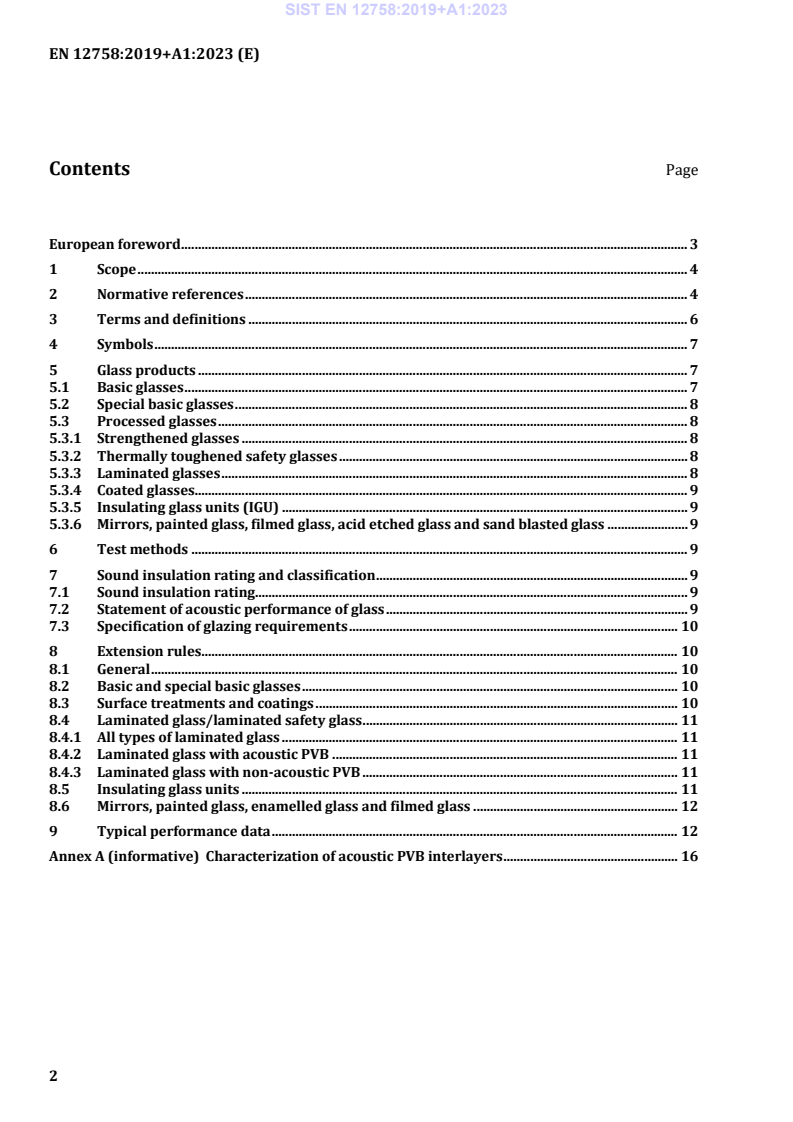
Contents Page
European foreword . 3
1 Scope . 4
2 Normative references . 4
3 Terms and definitions . 6
4 Symbols . 7
5 Glass products . 7
5.1 Basic glasses . 7
5.2 Special basic glasses . 8
5.3 Processed glasses . 8
5.3.1 Strengthened glasses . 8
5.3.2 Thermally toughened safety glasses . 8
5.3.3 Laminated glasses . 8
5.3.4 Coated glasses. 9
5.3.5 Insulating glass units (IGU) . 9
5.3.6 Mirrors, painted glass, filmed glass, acid etched glass and sand blasted glass . 9
6 Test methods . 9
7 Sound insulation rating and classification . 9
7.1 Sound insulation rating. 9
7.2 Statement of acoustic performance of glass . 9
7.3 Specification of glazing requirements . 10
8 Extension rules. 10
8.1 General . 10
8.2 Basic and special basic glasses . 10
8.3 Surface treatments and coatings . 10
8.4 Laminated glass/laminated safety glass . 11
8.4.1 All types of laminated glass . 11
8.4.2 Laminated glass with acoustic PVB . 11
8.4.3 Laminated glass with non-acoustic PVB . 11
8.5 Insulating glass units . 11
8.6 Mirrors, painted glass, enamelled glass and filmed glass . 12
9 Typical performance data . 12
Annex A (informative) Characterization of acoustic PVB interlayers . 16
European foreword
This document (EN 12758:2019+A1:2023) has been prepared by Technical Committee CEN/TC 129
“glass in building”, the secretariat of which is held by NBN.
This European Standard shall be given the status of a national standard, either by publication of an
identical text or by endorsement, at the latest by November 2023, and conflicting national standards
shall be withdrawn at the latest by November 2023.
Attention is drawn to the possibility that some of the elements of this document may be the subject of
patent rights. CEN shall not be held responsible for identifying any or all such patent rights.
This document includes Amendment 1 approved by CEN on 10 April 2023.
This document supersedes !EN 12758:2019".
The start and finish of text introduced or altered by amendment is indicated in the text by tags !".
Any feedback and questions on this document should be directed to the users’ national standards body.
A complete listing of these bodies can be found on the CEN website.
According to the CEN-CENELEC Internal Regulations, the national standards organisations of the
following countries are bound to implement this European Standard: Austria, Belgium, Bulgaria,
Croatia, Cyprus, Czech Republic, Denmark, Estonia, Finland, Former Yugoslav Republic of Macedonia,
France, Germany, Greece, Hungary, Iceland, Ireland, Italy, Latvia, Lithuania, Luxembourg, Malta,
Netherlands, Norway, Poland, Portugal, Romania, Serbia, Slovakia, Slovenia, Spain, Sweden, Switzerland,
Turkey and the United Kingdom.
1 Scope
This document deals with determination and assessment of sound insulation performances of all
transparent, translucent and opaque glass products, described in the European Standards for basic,
special basic or processed glass products, when intended to be used in glazed assemblies in buildings,
and which exhibit properties of acoustic protection, either as a prime intention or as a supplementary
characteristic.
This document refers to laboratory measurement method described in EN ISO 10140-1:2016, Annex D
and defines extension rules that can be applied without further testing. It also provides typical
performance data for a range of common glass products that can be used in the absence of measured
data.
All the considerations of this document relate to panes of glass/glass products alone. Incorporation of
them into windows may cause changes in acoustic performance as a result of other influences, e.g.
frame design, frame material, glazing material/method, mounting method, air tightness, etc.
Measurements of the sound insulation of complete windows (glass and frame) may be undertaken to
resolve such issues.
2 Normative references
The following documents are referred to in the text in such a way that some or all of their content
constitutes requirements of this document. For dated references, only the edition cited applies. For
undated references, the latest edition of the referenced document (including any amendments) applies.
EN 572-1, Glass in building — Basic soda lime silicate glass products — Part 1: Definitions and general
physical and mechanical properties
EN 572-2, Glass in building - Basic soda lime silicate glass products - Part 2: Float glass
EN 572-3, Glass in building - Basic soda lime silicate glass products - Part 3: Polished wired glass
EN 572-4, Glass in building - Basic soda lime silicate glass products - Part 4: Drawn sheet glass
EN 572-5, Glass in building - Basic soda lime silicate glass products - Part 5: Patterned glass
EN 572-6, Glass in building - Basic soda lime silicate glass products - Part 6: Wired patterned glass
EN 572-7, Glass in building - Basic soda lime silicate glass products - Part 7: Wired or unwired channel
shaped glass
EN 1036-1, Glass in building - Mirrors from silver-coated float glass for internal use - Part 1: Definitions,
requirements and test methods
EN 1051-1, Glass in building - Glass blocks and glass pavers - Part 1: Definitions and description
EN 1096-1, Glass in building - Coated glass - Part 1: Definitions and classification
EN 1279-1, Glass in Building - Insulating glass units - Part 1: Generalities, system description, rules for
substitution, tolerances and visual quality
EN 1748-1-1, Glass in building - Special basic products -Borosilicate glasses - Part 1-1: Definition and
general physical and mechanical properties
EN 1748-2-1, Glass in building - Special basic products - Glass ceramics - Part 2-1 Definitions and general
physical and mechanical properties
EN 1863-1, Glass in building - Heat strengthened soda lime silicate glass - Part 1: Definition and
description
EN 12150-1, Glass in building - Thermally toughened soda lime silicate safety glass - Part 1: Definition and
description
EN 12337-1, Glass in building - Chemically strengthened soda lime silicate glass - Part 1: Definition and
description
EN 13024-1, Glass in building - Thermally toughened borosilicate safety glass - Part 1: Definition and
description
EN 14178-1, Glass in building - Basic alkaline earth silicate glass products - Part 1: Float glass
EN 14179-1, Glass in building - Heat soaked thermally toughened soda lime silicate safety glass - Part 1:
Definition and description
EN 14321-1, Glass in building - Thermally toughened alkaline earth silicate safety glass - Part 1: Definition
and description
EN 15681-1, Glass in building - Basic alumino silicate glass products - Part 1: Definitions and general
physical and mechanical properties
EN 15682-1, Glass in building - Heat soaked thermally toughened alkaline earth silicate safety glass - Part
1: Definition and description
EN 15683-1, Glass in building - Thermally toughened soda lime silicate channel shaped safety glass - Part
1: Definition and description
EN 15755-1, Glass in building - Adhesive backed polymeric filmed glass - Part 1: Definitions and
requirements
EN 16477-1, Glass in building - Painted glass for internal use - Part 1: Requirements
EN 17257-1:2018, Glass in building - Acid etched glass - Part 1: Definitions and description
EN 17258-1:2018, Glass in building - Sand blasted glass - Part 1: Definition and description
EN ISO 10140 (all parts), Acoustics — Laboratory measurement of sound insulation of building elements
(ISO 10140, all parts)
EN ISO 717-1, Acoustics - Rating of sound insulation in buildings and of building elements - Part 1:
Airborne sound insulation (ISO 717-1)
EN ISO 12543-1, Glass in building - Laminated glass and laminated safety glass - Part 1: Definitions and
description of component parts (ISO 12543-1)
Under preparation. Stage at the time of publication: prEN 17257-1:2018
Under preparation. Stage at the time of publication: prEN 17258-1:2018
EN ISO 12543-2, Glass in building - Laminated glass and laminated safety glass - Part 2: Laminated safety
glass (ISO 12543-2)
EN ISO 12543-3, Glass in building - Laminated glass and laminated safety glass - Part 3: Laminated glass
(ISO 12543-3)
EN ISO 12543-5, Glass in building - Laminated glass and laminated safety glass - Part 5: Dimensions and
edge finishing (ISO 12543-5)
ISO 16940, Glass in building — Glazing and airborne sound insulation — Measurement of the mechanical
impedance of laminated glass
3 Terms and definitions
For the purposes of this document, the terms and definitions given in EN ISO 10140 (all parts),
EN ISO 717-1 and the following apply.
ISO and IEC maintain terminological databases for use in standardization at the following addresses:
• IEC Electropedia: available at http://www.electropedia.org/
• ISO Online browsing platform: available at https://www.iso.org/obp
3.1
glass product
product manufactured from glass, i.e. basic glass, special basic glass, processed glass, for use in
buildings/constructions
Note 1 to entry: See Clause 5.
3.2
monolithic glass
single pane of glass, that includes annealed, strengthened/toughened (by heat or chemical treatment),
and coated glasses
Note 1 to entry: The term “monolithic” excludes laminated glass and laminated safety glass
3.3
insulating glass unit
IGU
assembly consisting of at least two panes of glass, separated by one or more spacers, hermetically
sealed along the periphery, mechanically stable and durable
3.4
laminated glass/laminated safety glass
assembly consisting of one sheet of glass with one or more sheets of glass and/or plastics glazing sheet
material joined together with one or more interlayers
3.5
interlayer
one or more layer or material acting as an adhesive and separator between panes of glass and/or
plastics glazing sheet material
3.6
acoustic interlayer
interlayer that increases the Sound Reduction Index of the laminated glass
Note 1 to entry: The interlayer may be evaluated in accordance to ISO 16940.
3.7
loss factor
parameter used to describe the damping characteristic of a laminated glass
3.8
insert
const
...