


SIST EN 17641:2022
(Main)Foodstuffs - Multimethod for the determination of aflatoxins, deoxynivalenol, fumonisins, ochratoxin A, T-2 toxin, HT-2 toxin and zearalenone by LC-MS/MS
Foodstuffs - Multimethod for the determination of aflatoxins, deoxynivalenol, fumonisins, ochratoxin A, T-2 toxin, HT-2 toxin and zearalenone by LC-MS/MS
This document describes a method using isotopically labelled standards for the quantitative determination of aflatoxins B1, B2, G1, G2 and M1 (AFB1, AFB2, AFG1, AFG2 and AFM1), ochratoxin A (OTA), deoxynivalenol (DON), zearalenone (ZEN), T-2 and HT-2 toxins (T-2 and HT-2) and fumonisins B1 and B2 (FB1 and FB2) in foods by liquid chromatography (LC) coupled with tandem mass spectrometry (MS/MS).
A specific immunoaffinity column (IAC) clean-up is needed for aflatoxins (AFs) and OTA in food intended for infants and young children (e.g. infant cereals, milk-based powders), in spices, in dried fruits and in nuts.
The method has been validated through an intercollaborative study on different commodity groups: cereals and cereal-based products including food for infant and young children, nuts, spices, dried fruits and milk powder. The measuring range of each mycotoxin in these naturally contaminated and/or spiked food samples were:
- AFB1: 0,085 7 µg/kg - 11,4 µg/kg;
- AFB2: 0,079 2 µg/kg - 12,5 µg/kg;
- AFG1: 0,062 8 µg/kg - 20,9 µg/kg;
- AFG2: 0,052 0 µg/kg - 15,0 µg/kg;
- AFM1: 0,034 2 µg/kg - 0,110 µg/kg;
- OTA: 0,448 µg/kg - 17,2 µg/kg;
- DON: 45,2 µg/kg - 743 µg/kg;
- ZEN: 9,57 µg/kg - 131 µg/kg;
- T-2: 10,3 µg/kg - 57,9 µg/kg;
- HT-2: 9,50 µg/kg - 81,8 µg/kg;
- FB1: 31,1 µg/kg - 4 260 µg/kg;
- FB2: 44,2 µg/kg - 1 300 µg/kg.
The measuring ranges of the method for each mycotoxin/matrix combination are given in Table 8.
Lebensmittel - Multimethode für die Bestimmung von Aflatoxinen, Deoxynivalenol, Fumonisinen, Ochratoxin A, T-2-Toxin, HT-2-Toxin und Zearalenon mittels LC-MS/MS
Dieses Dokument beschreibt ein Verfahren, das isotopenmarkierte Standards verwendet für die quantitative Bestimmung der Aflatoxine B1, B2, G1, G2 und M1 (AFB1, AFB2, AFG1, AFG2 und AFM1), Ochratoxin A (OTA), Deoxynivalenol (DON), Zearalenon (ZEN), T 2 und HT 2-Toxine (T 2 und HT 2) und Fumonisine B1 und B2 (FB1 und FB2) in Lebensmitteln durch Flüssigchromatographie (LC, en.: liquid chromatography), gekoppelt mit Tandem-Massenspektrometrie (MS/MS).
Für Aflatoxine (AF) und OTA in für Säuglinge und Kleinkinder bestimmter Nahrung (z. B. Zerealien für Kleinkinder, Pulver auf Milchbasis), in Gewürzen, in Trockenfrüchten und in Nüssen ist eine spezifische Immunaffinitätssäulen (IAC, en.: immunoaffinity column)-Reinigung erforderlich.
Das Verfahren wurde durch eine Ringversuchstudie zu verschiedenen Lebensmittelgruppen validiert: Getreide und Produkte auf Getreidebasis einschließlich Nahrung für Säuglinge und Kleinkinder, Nüsse, Gewürze, Trockenfrüchte und Milchpulver. Die Messbereiche der einzelnen Mykotoxine in diesen natürlich kontaminierten und/oder aufgestockten Lebensmittelproben waren:
— AFB1: 0,085 7 µg/kg – 11,4 µg/kg;
— AFB2: 0,079 2 µg/kg – 12,5 µg/kg;
— AFG1: 0,062 8 µg/kg – 20,9 µg/kg;
— AFG2: 0,052 0 µg/kg – 15,0 µg/kg;
— AFM1: 0,034 2 µg/kg – 0,110 µg/kg;
— OTA: 0,448 µg/kg – 17,2 µg/kg;
— DON: 45,2 µg/kg – 743 µg/kg;
— ZEN: 9,57 µg/kg – 131 µg/kg;
— T 2: 10,3 µg/kg – 57,9 µg/kg;
— HT 2: 9,50 µg/kg – 81,8 µg/kg;
— FB1: 31,1 µg/kg – 4 260 µg/kg;
— FB2: 44,2 µg/kg – 1 300 µg/kg.
Die Messbereiche der Verfahren für jede Mykotoxin-/Matrix-Kombination sind in Tabelle 8 angegeben.
Produits alimentaires - Multiméthode de détermination de la teneur en aflatoxines, déoxynivalénol, fumonisines, ochratoxine A, toxine T-2, toxine HT-2 et zéaralénone par CL-SM/SM
Le présent document décrit une méthode utilisant des étalons marqués aux isotopes pour la détermination quantitative des teneurs en aflatoxines B1, B2, G1, G2 et M1 (AFB1, AFB2, AFG1, AFG2 et AFM1), ochratoxine A (OTA), déoxynivalénol (DON), zéaralénone (ZEN), toxines T-2 et HT-2 (T-2 et HT 2) et fumonisines B1 et B2 (FB1 et FB2) dans les aliments par chromatographie liquide (CL) couplée à une spectrométrie de masse en tandem (SM/SM).
Une purification spécifique sur colonne d’immuno-affinité (CIA) est nécessaire pour les aflatoxines (AF) et l’OTA présentes dans les aliments pour nourrissons et enfants en bas âge (par exemple, céréales infantiles, lait en poudre), les épices, les fruits secs et les fruits à coques.
La méthode a été validée lors d’un essai interlaboratoires portant sur différents groupes de denrées : céréales et produits à base de céréales, y compris aliments pour nourrissons et enfants en bas âge, fruits à coques, épices, fruits secs et lait en poudre. Les gammes de mesure de chaque mycotoxine dans ces échantillons d’aliments naturellement contaminés et/ou dopés étaient les suivantes :
- AFB1 : 0,085 7 µg/kg - 11,4 µg/kg ;
- AFB2 : 0,079 2 µg/kg - 12,5 µg/kg ;
- AFG1 : 0,062 8 µg/kg - 20,9 µg/kg ;
- AFG2 : 0,052 0 µg/kg - 15,0 µg/kg ;
- AFM1 : 0,034 2 µg/kg - 0 110 µg/kg ;
- OTA : 0,448 µg/kg - 17,2 µg/kg ;
- DON : 45,2 µg/kg - 743 µg/kg ;
- ZEN : 9,57 µg/kg - 131 µg/kg ;
- T-2 : 10,3 µg/kg - 57,9 µg/kg ;
- HT-2 : 9,50 µg/kg - 81,8 µg/kg ;
- FB1 : 31,1 µg/kg - 4 260 µg/kg ;
- FB2 : 44,2 µg/kg - 1 300 µg/kg.
Les gammes de mesure de la méthode pour chaque combinaison mycotoxine/matrice sont indiquées dans le Tableau 8.
Živila - Hkratna metoda za določevanje aflatoksina, deoksinivalenola, fumonizinov, ohratoksina A, toksinov T-2 in HT-2 ter zearalenona z LC-MS/MS
Ta dokument opisuje metodo redčenja izotopov za kvantitativno določanje aflatoksinov B1, B2, G1, G2 in M1 (AFB1, AFB2, AFG1, AFG2 in AFM1), okratoksina A (OTA), deoksinivalenola (DON), zearalenona (ZEN), toksinov T-2 in HT-2 (T-2 in HT-2) ter fumonizinov B1 in B2 (FB1 in FB2) v živilih z visokozmogljivo tekočinsko kromatografijo (LC) v povezavi s tandemsko masno spektrometrijo (MS/MS).
Za aflatoksine (AF) in OTA v hrani za dojenčke (npr. kosmiči za dojenčke, praški na osnovi mleka), v začimbah, suhem sadju in oreščkih je potrebno posebno čiščenje imunoafinitetne kolone (IAC).
Metoda je bila potrjena z medstrokovno študijo o različnih skupinah živil: žita in proizvodi na osnovi žit, vključno s hrano za dojenčke in majhne otroke, oreščki, začimbami, suhim sadjem in mlekom v prahu. Območja koncentracij vsakega mikotoksina v teh naravno kontaminiranih vzorcih hrane in/ali vzorcih hrane z dodatki so bila:
– aflatoksin B1: od 0,0857 µg/kg do 11,4 µg/kg;
– aflatoksin B2: od 0,0792 µg/kg do 12,5 µg/kg;
– aflatoksin G1: od 0,0628 µg/kg do 20,9 µg/kg;
– aflatoksin G2: od 0,0520 µg/kg do 15,0 µg/kg;
– aflatoksin M1: od 0,0342 µg/kg do 0,110 µg/kg;
– ohratoksin A: od 0,448 µg/kg do 17,2 µg/kg;
– deoksinivalenol: od 45,2 µg/kg do 743 µg/kg;
– zearalenon: od 9,57 µg/kg do 131 µg/kg;
– toksin T-2: od 10,3 µg/kg do 57,9 µg/kg;
– toksin HT-2: od 9,50 µg/kg do 81,8 µg/kg;
– fumonizin B1: od 31,1 µg/kg do 4262 µg/kg;
– fumonizin B2: od 44,2 µg/kg do 1299 µg/kg.
Merilna območja metode za vsako kombinacijo mikotoksin/matrika so navedena v preglednici 7.
General Information
- Status
- Published
- Public Enquiry End Date
- 24-Feb-2021
- Publication Date
- 09-Oct-2022
- Technical Committee
- KŽP - Agricultural food products
- Current Stage
- 6060 - National Implementation/Publication (Adopted Project)
- Start Date
- 03-Oct-2022
- Due Date
- 08-Dec-2022
- Completion Date
- 10-Oct-2022
Overview
EN 17641:2022 (CEN) defines a validated multimethod for the quantitative determination of major foodborne mycotoxins by liquid chromatography coupled with tandem mass spectrometry (LC‑MS/MS). The method uses isotopically labelled internal standards (ISTDs) and covers aflatoxins (AFB1, AFB2, AFG1, AFG2, AFM1), ochratoxin A (OTA), deoxynivalenol (DON), zearalenone (ZEN), T‑2 and HT‑2 toxins, and fumonisins (FB1, FB2). It was validated in an inter‑laboratory study across key commodity groups including cereals, cereal‑based foods (including infant foods), milk powder, nuts, spices and dried fruits.
Key Topics and Requirements
- Analytical principle: extraction with acidified acetonitrile, partitioning (MgSO4/NaCl), hexane defatting, followed by LC‑MS/MS analysis with isotopic dilution quantification using ISTDs.
- Clean‑up options:
- Generic protocol (no IAC) for cereals and cereal‑based matrices.
- Immunoaffinity column (IAC) clean‑up required for AFs and OTA in foods intended for infants/young children and recommended for spices, nuts and dried fruits to reduce matrix effects.
- Validation and performance: method validated via intercollaborative study. Measuring ranges (examples from study) include:
- AFB1: 0.0857–11.4 µg/kg; AFB2: 0.0792–12.5 µg/kg; AFG1: 0.0628–20.9 µg/kg; AFG2: 0.0520–15.0 µg/kg
- AFM1: 0.0342–0.110 µg/kg; OTA: 0.448–17.2 µg/kg
- DON: 45.2–743 µg/kg; ZEN: 9.57–131 µg/kg
- T‑2: 10.3–57.9 µg/kg; HT‑2: 9.50–81.8 µg/kg
- FB1: 31.1–4 260 µg/kg; FB2: 44.2–1 300 µg/kg
(The method gives matrix‑specific measuring ranges in Table 8.)
- Documentation: detailed requirements for reagents, apparatus, LC‑MS/MS operating conditions, injection sequence, data treatment, calculations, precision (repeatability/reproducibility) and the test report.
Applications and Users
- Practical for food testing laboratories, regulatory agencies, contract analytical labs and food industry quality control seeking robust multi‑mycotoxin screening and quantification.
- Supports compliance testing for food safety and maximum levels in cereals, infant foods, milk powder, nuts, spices and dried fruits.
- Useful in research and surveillance programs monitoring mycotoxin contamination across commodity groups.
Related Standards
- EN 17641:2022 references general analytical standards such as EN ISO 3696 (water for analytical laboratory use) and was prepared by CEN/TC 275 – Food analysis. Users should consult national implementations for official status and any endorsed national provisions.
Keywords: EN 17641:2022, LC‑MS/MS, mycotoxins, aflatoxins, ochratoxin A, deoxynivalenol, fumonisins, zearalenone, T‑2, HT‑2, isotopically labelled standards, immunoaffinity column, food analysis.



Frequently Asked Questions
SIST EN 17641:2022 is a standard published by the Slovenian Institute for Standardization (SIST). Its full title is "Foodstuffs - Multimethod for the determination of aflatoxins, deoxynivalenol, fumonisins, ochratoxin A, T-2 toxin, HT-2 toxin and zearalenone by LC-MS/MS". This standard covers: This document describes a method using isotopically labelled standards for the quantitative determination of aflatoxins B1, B2, G1, G2 and M1 (AFB1, AFB2, AFG1, AFG2 and AFM1), ochratoxin A (OTA), deoxynivalenol (DON), zearalenone (ZEN), T-2 and HT-2 toxins (T-2 and HT-2) and fumonisins B1 and B2 (FB1 and FB2) in foods by liquid chromatography (LC) coupled with tandem mass spectrometry (MS/MS). A specific immunoaffinity column (IAC) clean-up is needed for aflatoxins (AFs) and OTA in food intended for infants and young children (e.g. infant cereals, milk-based powders), in spices, in dried fruits and in nuts. The method has been validated through an intercollaborative study on different commodity groups: cereals and cereal-based products including food for infant and young children, nuts, spices, dried fruits and milk powder. The measuring range of each mycotoxin in these naturally contaminated and/or spiked food samples were: - AFB1: 0,085 7 µg/kg - 11,4 µg/kg; - AFB2: 0,079 2 µg/kg - 12,5 µg/kg; - AFG1: 0,062 8 µg/kg - 20,9 µg/kg; - AFG2: 0,052 0 µg/kg - 15,0 µg/kg; - AFM1: 0,034 2 µg/kg - 0,110 µg/kg; - OTA: 0,448 µg/kg - 17,2 µg/kg; - DON: 45,2 µg/kg - 743 µg/kg; - ZEN: 9,57 µg/kg - 131 µg/kg; - T-2: 10,3 µg/kg - 57,9 µg/kg; - HT-2: 9,50 µg/kg - 81,8 µg/kg; - FB1: 31,1 µg/kg - 4 260 µg/kg; - FB2: 44,2 µg/kg - 1 300 µg/kg. The measuring ranges of the method for each mycotoxin/matrix combination are given in Table 8.
This document describes a method using isotopically labelled standards for the quantitative determination of aflatoxins B1, B2, G1, G2 and M1 (AFB1, AFB2, AFG1, AFG2 and AFM1), ochratoxin A (OTA), deoxynivalenol (DON), zearalenone (ZEN), T-2 and HT-2 toxins (T-2 and HT-2) and fumonisins B1 and B2 (FB1 and FB2) in foods by liquid chromatography (LC) coupled with tandem mass spectrometry (MS/MS). A specific immunoaffinity column (IAC) clean-up is needed for aflatoxins (AFs) and OTA in food intended for infants and young children (e.g. infant cereals, milk-based powders), in spices, in dried fruits and in nuts. The method has been validated through an intercollaborative study on different commodity groups: cereals and cereal-based products including food for infant and young children, nuts, spices, dried fruits and milk powder. The measuring range of each mycotoxin in these naturally contaminated and/or spiked food samples were: - AFB1: 0,085 7 µg/kg - 11,4 µg/kg; - AFB2: 0,079 2 µg/kg - 12,5 µg/kg; - AFG1: 0,062 8 µg/kg - 20,9 µg/kg; - AFG2: 0,052 0 µg/kg - 15,0 µg/kg; - AFM1: 0,034 2 µg/kg - 0,110 µg/kg; - OTA: 0,448 µg/kg - 17,2 µg/kg; - DON: 45,2 µg/kg - 743 µg/kg; - ZEN: 9,57 µg/kg - 131 µg/kg; - T-2: 10,3 µg/kg - 57,9 µg/kg; - HT-2: 9,50 µg/kg - 81,8 µg/kg; - FB1: 31,1 µg/kg - 4 260 µg/kg; - FB2: 44,2 µg/kg - 1 300 µg/kg. The measuring ranges of the method for each mycotoxin/matrix combination are given in Table 8.
SIST EN 17641:2022 is classified under the following ICS (International Classification for Standards) categories: 67.050 - General methods of tests and analysis for food products. The ICS classification helps identify the subject area and facilitates finding related standards.
SIST EN 17641:2022 is available in PDF format for immediate download after purchase. The document can be added to your cart and obtained through the secure checkout process. Digital delivery ensures instant access to the complete standard document.
Standards Content (Sample)
SLOVENSKI STANDARD
01-november-2022
Živila - Hkratna metoda za določevanje aflatoksina, deoksinivalenola, fumonizinov,
ohratoksina A, toksinov T-2 in HT-2 ter zearalenona z LC-MS/MS
Foodstuffs - Multimethod for the determination of aflatoxins, deoxynivalenol, fumonisins,
ochratoxin A, T-2 toxin, HT-2 toxin and zearalenone by LC-MS/MS
Lebensmittel - Multimethode für die Bestimmung von Aflatoxinen, Deoxynivalenol,
Fumonisinen, Ochratoxin A, T-2-Toxin, HT-2-Toxin und Zearalenon mittels LC-MS/MS
Produits alimentaires - Multiméthode de détermination de la teneur en aflatoxines,
déoxynivalénol, fumonisines, ochratoxine A, toxine T-2, toxine HT-2 et zéaralénone par
CL-SM/SM
Ta slovenski standard je istoveten z: EN 17641:2022
ICS:
67.050 Splošne preskusne in General methods of tests and
analizne metode za živilske analysis for food products
proizvode
2003-01.Slovenski inštitut za standardizacijo. Razmnoževanje celote ali delov tega standarda ni dovoljeno.
EN 17641
EUROPEAN STANDARD
NORME EUROPÉENNE
September 2022
EUROPÄISCHE NORM
ICS 67.050
English Version
Foodstuffs - Multimethod for the determination of
aflatoxins, deoxynivalenol, fumonisins, ochratoxin A, T-2
toxin, HT-2 toxin and zearalenone by LC-MS/MS
Produits alimentaires - Multiméthode de Lebensmittel - Multimethode für die Bestimmung von
détermination de la teneur en aflatoxines, Aflatoxinen, Deoxynivalenol, Fumonisinen, Ochratoxin
déoxynivalénol, fumonisines, ochratoxine A, toxine T-2, A, T-2-Toxin, HT-2-Toxin und Zearalenon mittels LC-
toxine HT-2 et zéaralénone par CL-SM/SM MS/MS
This European Standard was approved by CEN on 24 July 2022.
CEN members are bound to comply with the CEN/CENELEC Internal Regulations which stipulate the conditions for giving this
European Standard the status of a national standard without any alteration. Up-to-date lists and bibliographical references
concerning such national standards may be obtained on application to the CEN-CENELEC Management Centre or to any CEN
member.
This European Standard exists in three official versions (English, French, German). A version in any other language made by
translation under the responsibility of a CEN member into its own language and notified to the CEN-CENELEC Management
Centre has the same status as the official versions.
CEN members are the national standards bodies of Austria, Belgium, Bulgaria, Croatia, Cyprus, Czech Republic, Denmark, Estonia,
Finland, France, Germany, Greece, Hungary, Iceland, Ireland, Italy, Latvia, Lithuania, Luxembourg, Malta, Netherlands, Norway,
Poland, Portugal, Republic of North Macedonia, Romania, Serbia, Slovakia, Slovenia, Spain, Sweden, Switzerland, Türkiye and
United Kingdom.
EUROPEAN COMMITTEE FOR STANDARDIZATION
COMITÉ EUROPÉEN DE NORMALISATION
EUROPÄISCHES KOMITEE FÜR NORMUNG
CEN-CENELEC Management Centre: Rue de la Science 23, B-1040 Brussels
© 2022 CEN All rights of exploitation in any form and by any means reserved Ref. No. EN 17641:2022 E
worldwide for CEN national Members.
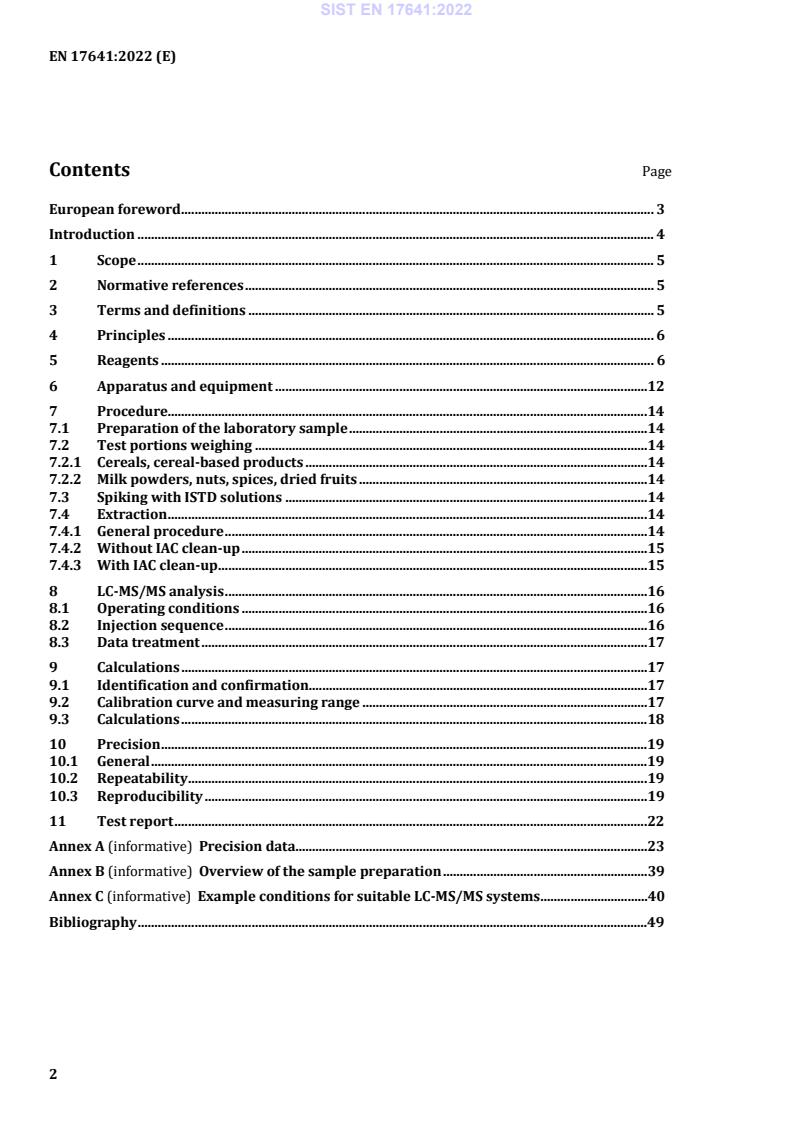
Contents Page
European foreword . 3
Introduction . 4
1 Scope . 5
2 Normative references . 5
3 Terms and definitions . 5
4 Principles . 6
5 Reagents . 6
6 Apparatus and equipment .12
7 Procedure.14
7.1 Preparation of the laboratory sample .14
7.2 Test portions weighing .14
7.2.1 Cereals, cereal-based products .14
7.2.2 Milk powders, nuts, spices, dried fruits .14
7.3 Spiking with ISTD solutions .14
7.4 Extraction .14
7.4.1 General procedure .14
7.4.2 Without IAC clean-up .15
7.4.3 With IAC clean-up .15
8 LC-MS/MS analysis .16
8.1 Operating conditions .16
8.2 Injection sequence .16
8.3 Data treatment .17
9 Calculations .17
9.1 Identification and confirmation.17
9.2 Calibration curve and measuring range .17
9.3 Calculations .18
10 Precision .19
10.1 General .19
10.2 Repeatability .19
10.3 Reproducibility .19
11 Test report .22
Annex A (informative) Precision data.23
Annex B (informative) Overview of the sample preparation .39
Annex C (informative) Example conditions for suitable LC-MS/MS systems .40
Bibliography .49
European foreword
This document (EN 17641:2022) has been prepared by Technical Committee CEN/TC 275 “Food
analysis - Horizontal methods”, the secretariat of which is held by DIN.
This European Standard shall be given the status of a national standard, either by publication of an
identical text or by endorsement, at the latest by March 2023, and conflicting national standards shall be
withdrawn at the latest by March 2023.
Attention is drawn to the possibility that some of the elements of this document may be the subject of
patent rights. CEN shall not be held responsible for identifying any or all such patent rights.
Any feedback and questions on this document should be directed to the users’ national standards body.
A complete listing of these bodies can be found on the CEN website.
According to the CEN-CENELEC Internal Regulations, the national standards organisations of the
following countries are bound to implement this European Standard: Austria, Belgium, Bulgaria, Croatia,
Cyprus, Czech Republic, Denmark, Estonia, Finland, France, Germany, Greece, Hungary, Iceland, Ireland,
Italy, Latvia, Lithuania, Luxembourg, Malta, Netherlands, Norway, Poland, Portugal, Republic of North
Macedonia, Romania, Serbia, Slovakia, Slovenia, Spain, Sweden, Switzerland, Türkiye and the United
Kingdom.
Introduction
Mycotoxins are fungal metabolites that may occur in various foodstuffs such as cereals, nuts, spices, fruits,
oil seeds, or coffee. Mycotoxins can be produced before harvest in the crop and even after harvest if
climate conditions are favourable for further fungal growth. Milk can be contaminated as well by
Aflatoxin M , the major metabolite of Aflatoxin B , when cows are fed with Aflatoxin B contaminated
1 1 1
feed. To protect consumer health, maximum levels for mycotoxins in foodstuffs have been established in
a broad range of food commodities including those intended for infants and young children consumption.
WARNING 1 — Suitable precaution and protection measures need to be taken when carrying out
working steps with harmful chemicals. The latest version of the hazardous substances ordinance,
Regulation (EC) No 1907/2006 [1], should be taken into account as well as appropriate national
statements.
WARNING 2 — The use of this document can involve hazardous materials, operations and
equipment. This document does not purport to address all the safety problems associated with its
use. It is the responsibility of the user of this document to establish appropriate safety and health
practices and determine the applicability of regulatory limitations prior to use.
WARNING 3 — Aflatoxins are known to have carcinogenic effects and to be both acutely and
chronically toxic. Aflatoxins B , B , G , G and M are classified as carcinogenic to humans
1 2 1 2 1
(Group 1) by the International Agency for Cancer Research (IARC). Fumonisin B , fumonisin B
1 2
and ochratoxin A have been classified as possibly carcinogenic to humans (Group 2B) and
zearalenone, deoxynivalenol and T-2 as not classifiable as to their carcinogenicity to humans
(Group 3) [2].
1 Scope
This document describes a method using isotopically labelled standards for the quantitative
determination of aflatoxins B , B , G , G and M (AFB1, AFB2, AFG1, AFG2 and AFM1), ochratoxin A
1 2 1 2 1
(OTA), deoxynivalenol (DON), zearalenone (ZEN), T-2 and HT-2 toxins (T-2 and HT-2) and fumonisins B
and B (FB1 and FB2) in foods by liquid chromatography (LC) coupled with tandem mass spectrometry
(MS/MS).
A specific immunoaffinity column (IAC) clean-up is needed for aflatoxins (AFs) and OTA in food intended
for infants and young children (e.g. infant cereals, milk-based powders), in spices, in dried fruits and in
nuts.
The method has been validated through an intercollaborative study on different commodity groups:
cereals and cereal-based products including food for infant and young children, nuts, spices, dried fruits
and milk powder. The measuring range of each mycotoxin in these naturally contaminated and/or spiked
food samples were:
— AFB1: 0,085 7 µg/kg – 11,4 µg/kg;
— AFB2: 0,079 2 µg/kg – 12,5 µg/kg;
— AFG1: 0,062 8 µg/kg – 20,9 µg/kg;
— AFG2: 0,052 0 µg/kg – 15,0 µg/kg;
— AFM1: 0,034 2 µg/kg – 0,110 µg/kg;
— OTA: 0,448 µg/kg – 17,2 µg/kg;
— DON: 45,2 µg/kg – 743 µg/kg;
— ZEN: 9,57 µg/kg – 131 µg/kg;
— T-2: 10,3 µg/kg – 57,9 µg/kg;
— HT-2: 9,50 µg/kg – 81,8 µg/kg;
— FB1: 31,1 µg/kg – 4 260 µg/kg;
— FB2: 44,2 µg/kg – 1 300 µg/kg.
The measuring ranges of the method for each mycotoxin/matrix combination are given in Table 8.
2 Normative references
The following documents are referred to in the text in such a way that some or all of their content
constitutes requirements of this document. For dated references, only the edition cited applies. For
undated references, the latest edition of the referenced document (including any amendments) applies.
EN ISO 3696, Water for analytical laboratory use - Specification and test methods (ISO 3696)
3 Terms and definitions
No terms and definitions are listed in this document.
ISO and IEC maintain terminological databases for use in standardization at the following addresses:
— IEC Electropedia: available at https://www.electropedia.org/
— ISO Online browsing platform: available at https://www.iso.org/obp
4 Principles
The mycotoxins are extracted from the test portion with water and acidified acetonitrile and a liquid-
liquid partition is initiated after addition of magnesium sulphate and sodium chloride salts. The resulting
acetonitrile supernatant is then defatted with hexane. Depending on the mycotoxin/matrix combination,
the sample extract is then submitted to two different protocols (a general scheme is given in Annex B):
— without IAC clean-up: generic procedure for the determination of all mycotoxins in cereals and cereal-
based products. An aliquot of the acetonitrile supernatant is evaporated to dryness, then
reconstituted in a methanol-water solution and subsequently analysed by LC-MS/MS;
— with IAC clean-up: specific procedure for AFs and OTA determination in food intended for infants and
young children (e.g. infant cereals, milk powder) for sensitivity purpose and in spices, nuts and dried
fruits to prevent matrix effects in the mass spectrometer instrument. An aliquot of the acetonitrile
supernatant is first diluted in a phosphate buffered saline (PBS) solution and the resulting mixture
is then applied onto an IAC containing antibodies specific to AFs and OTA. The IAC is washed with
water and the mycotoxins are eluted with methanol. The eluate is evaporated to dryness,
reconstituted in a methanol-water solution, and subsequently analysed by LC-MS/MS.
Quantification is performed by the isotopic dilution approach using C isotopically labelled mycotoxins
as internal standards (ISTDs).
5 Reagents
Use only reagents of recognized analytical grade and water complying with grade 1 of EN ISO 3696,
unless otherwise specified. Solvents shall be of LC-MS grade for LC-MS analysis, unless otherwise
specified. Commercially available solutions with equivalent properties to those listed may be used.
WARNING 4 — Decontamination procedures for laboratory wastes of AFs were developed by the
IARC [3], [4].
5.1 Nitrogen compressed gas, purity equivalent to 99,99 % or better.
5.2 Water, HPLC grade.
5.3 Water, LC-MS grade.
5.4 Methanol (MeOH), analytical grade.
5.5 Methanol (MeOH), LC-MS grade.
5.6 Acetonitrile (MeCN), analytical grade.
5.7 Formic acid, analytical grade.
5.8 Ammonium formate, LC-MS grade.
5.9 Acetic acid glacial, analytical grade.
5.10 n-Hexane, analytical grade.
5.11 Magnesium sulphate (MgSO ) anhydrous, analytical grade.
5.12 Sodium chloride (NaCl), analytical grade.
5.13 Partitioning salts mixture, MgSO -NaCl (4 + 1, m + m).
Weigh 4,0 g ± 0,01 g of MgSO (5.11) and 1,00 g ± 0,01 g of NaCl (5.12) into a 15 ml polypropylene tube.
Alternatively, a ready-to-use partitioning salt mixture may be supplied by commercial sources.
5.14 Potassium chloride, (KCl) analytical grade.
5.15 Potassium dihydrogen phosphate, (KH PO ) analytical grade.
2 4
5.16 Disodium hydrogen orthophosphate, (Na HPO ) analytical grade.
2 4
5.17 Sodium hydroxide, (NaOH) analytical grade.
5.18 Sodium hydroxide solution, (NaOH) molar concentration c = 0,1 mol/l.
Dissolve 0,4 g of sodium hydroxide (5.17) in 100 ml water (5.2).
5.19 Hydrochloric acid solution, (HCl) analytical grade, w(HCl) = 37 %.
5.20 Hydrochloric acid diluted solution, (HCl) c = 0,1 mol/l.
Add 8,4 ml of hydrochloric acid solution (5.19) into a 1 l volumetric flask and fill-up to the mark with
water (5.2).
5.21 Phosphate buffered saline (PBS) solution, pH 7,3 ± 0,2.
Weigh 0,20 g of KCl (5.14), 0,20 g of KH PO (5.15), 1,15 g of Na HPO (5.16) and 8,00 g of NaCl (5.12) to
2 4 2 4
the nearest 0,01 g and transfer into a 1 l volumetric flask. Dissolve with approximately 900 ml of water
(5.2).
After dissolution adjust the pH to 7,3 ± 0,2 with either HCl solution (5.20) or NaOH solution (5.18), then
fill up to the mark with water (5.2).
Alternatively, a PBS solution with equivalent properties may be prepared from commercially available
PBS material.
5.22 Extraction solution, acetic acid (87 mmol/l) in acetonitrile.
Mix 500 ml of acetonitrile (5.6) and 5 ml of acetic acid glacial (5.9) into a 1 l volumetric flask. Fill-up to
the mark with acetonitrile (5.6) and mix well. This solution can be used for 3 months if stored at room
temperature.
5.23 Diluting solution, methanol-water (15 + 85, V + V).
Mix 15 ml of methanol (5.4) with 85 ml of water (5.2) into a 100 ml volumetric flask. This solution can be
used for 3 months if stored at room temperature.
5.24 Mycotoxins analytical standard, e.g. crystalline, as a film or as a certified standard solution.
5.24.1 AFB1.
5.24.2 AFB2.
5.24.3 AFG1.
5.24.4 AFG2.
5.24.5 AFM1.
5.24.6 OTA.
5.24.7 DON.
5.24.8 ZEN.
5.24.9 T-2.
5.24.10 HT-2.
5.24.11 FB1.
5.24.12 FB2.
5.25 Mycotoxin stock standard solutions.
The individual stock standard solutions are either prepared by dissolving pure substance in an
appropriate solvent or prepared from dried-down films and subsequently reconstituted according to the
certificate of each individual standard or purchased as ready-to-use solutions (5.24).
The mycotoxins covered in this document dissolve well in acetonitrile, with the exception of fumonisins
for which acetonitrile/water solution (50 + 50, V + V) is recommended for the preparation.
5.26 Mycotoxin working standard solutions.
Prepare the working standard solutions as described hereafter by combining the appropriate volumes of
each individual stock standard solutions (5.25), using the appropriate pipettes (6.1) and the mentioned
solvents. These solutions are used to build the calibration curve (5.29) and for the preparation of positive
control samples (7.6).
5.26.1 AFs working standard solution 1, AFB1, AFB2, AFG1 and AFG2, each at mass concentration
ρ = 0,1 µg/ml in acetonitrile.
5.26.2 AFs working standard solution 2, AFB1, AFB2, AFG1 and AFG2, each at ρ = 0,01 µg/ml in
acetonitrile.
5.26.3 AFM1 working standard solution 1, ρ = 0,1 µg/ml in acetonitrile.
5.26.4 AFM1 working standard solution 2, ρ = 0,01 µg/ml in acetonitrile.
5.26.5 [DON, T-2, HT-2, ZEN]- working standard solution, in acetonitrile at mass concentrations given
in Table 1.
Table 1 — [DON, T-2, HT-2, ZEN]- working standard solution
Compound Mass concentration
µg/ml
DON 5,0
T-2 2,5
HT-2 2,5
ZEN 2,0
5.26.6 Fumonisins (FBs) working standard solution, FB1 and FB2, each at ρ = 5,0 µg/ml in
acetonitrile-water solution (50 + 50, V + V).
5.26.7 OTA working standard solution, ρ = 0,1 µg/ml in methanol-water solution (15 + 85, V + V).
5.27 C-isotopically labelled mycotoxin analytical standards, as a certified standard solution.
13 13 13
5.27.1 C-isotopically labelled AFB1( C-AFB1), e.g. ( C )-AFB1, ρ = 0,5 µg/ml in acetonitrile.
13 13 13
5.27.2 C-isotopically labelled AFB2 ( C-AFB2), e.g. ( C )-AFB2, ρ = 0,5 µg/ml in acetonitrile.
13 13 13
5.27.3 C-isotopically labelled AFG1 ( C-AFG1), e.g. ( C )-AFG1, ρ = 0,5 µg/ml in acetonitrile.
13 13 13
5.27.4 C-isotopically labelled AFG2 ( C-AFG2), e.g. ( C )-AFG2, ρ = 0,5 µg/ml in acetonitrile.
13 13 13
5.27.5 C-isotopically labelled AFM1 ( C-AFM1), e.g. ( C )-AFM1, ρ = 0,5 µg/ml in acetonitrile.
13 13 13
5.27.6 C-isotopically labelled OTA ( C-OTA), e.g. ( C )-OTA, ρ = 10 µg/ml in acetonitrile.
13 13 13
5.27.7 C-isotopically labelled DON ( C-DON), e.g. ( C )-DON, ρ = 25 µg/ml in acetonitrile.
13 13 13
5.27.8 C-isotopically labelled ZEN ( C-ZEN), e.g. ( C )-ZEN, ρ = 25 µg/ml in acetonitrile.
13 13 13
5.27.9 C-isotopically labelled T-2 ( C-T2), e.g. ( C )-T-2, ρ = 25 µg/ml in acetonitrile.
13 13 13
5.27.10 C-isotopically labelled HT-2 ( C-HT-2), e.g. ( C )-HT-2, ρ = 25 µg/ml in
acetonitrile.
13 13 13
5.27.11 C-isotopically labelled FB1 ( C-FB1), e.g. ( C )-FB1, ρ = 25 µg/ml in acetonitrile-
water solution (50 + 50, V + V).
13 13 13
5.27.12 C-isotopically labelled FB2 ( C-FB2), e.g. ( C )-FB2, ρ = 10 µg/ml in acetonitrile-
water solution (50 + 50, V + V).
5.28 ISTD working standard solutions.
Prepare the ISTD solutions as described hereafter by combining the appropriate volumes of individual
isotopically labelled mycotoxin solutions (5.27), using the appropriate pipettes (6.1) and the mentioned
solvent. These solutions are used to build the calibration curve (5.29) and to spike each test portion
before extraction (7.3).
13 13 13 13 13
5.28.1 C-AFs solution, C-AFB1, C-AFB2, C-AFG1, C-AFG2, each at ρ = 0,1 µg/ml in
acetonitrile.
5.28.2 C-AFM1 solution, ρ = 0,1 µg/ml in acetonitrile.
5.28.3 C-[DON, T-2, HT-2, ZEN] solution, in acetonitrile at concentrations given in Table 2.
Table 2 — C-[DON, T-2, HT-2, ZEN] ISTD solution
Compound Mass concentration
µg/ml
5,0
C-DON
2,5
C-T-2
2,5
C-HT-2
2,0
C-ZEN
13 13 13
5.28.4 C-FBs solution, C-FB1 and C-FB2, each at ρ = 10 µg/ml in acetonitrile-water solution
(50 + 50, V + V).
5.28.5 C-OTA solution, ρ = 0,1 µg/ml in methanol-water solution (15 + 85, V + V).
5.29 Standard solutions for external calibration curve.
Prepare the standard solutions for calibration into nine separate 15 ml polypropylene tubes, as described
in Table 3 for example. Evaporate to dryness under a stream of nitrogen at 40 °C then continue to prepare
the standard solutions for calibration as described in Table 4 for example.
Sonicate the calibrants CAL 0 to CAL 8 for about 1 min. Transfer these solutions into glass vials and store
them at approximately −20 °C protected from light for up to 3 months.
Mass concentration of each mycotoxin in each calibrant solution is given in Table 5.
Table 3 — Example of pipetting scheme for the preparation of the calibration solutions before
the evaporation step
a a
Mycotoxin CAL 0 CAL 1 CAL 2 CAL 3 CAL 4 CAL 5 CAL 6
CAL 7 CAL 8
µl µl µl µl µl µl µl µl µl
AFs (5.26.1) 0 - - - 20 40 160 320 640
AFs (5.26.2) - 5 20 40 - - - - -
AFM1 (5.26.3) 0 - - - 20 40 160 320 640
AFM1 (5.26.4) - 5 20 40 - - - - -
[DON, T-2, HT-2, ZEN]
0 5 10 20 40 80 160 320 640
(5.26.5)
FBs (5.26.6) 0 5 10 20 40 80 160 320 640
C-AFs (5.28.1) 20 20 20 20 20 20 20 20 20
20 20 20 20 20 20 20 20 20
C-AFM1(5.28.2)
C-[DON, T-2, HT-2,
20 20 20 20 20 20 20 20 20
ZEN] (5.28.3)
C-FBs (5.28.4) 20 20 20 20 20 20 20 20 20
a
The calibration range can be extended for quantification of highly contaminated samples (9.2). Typically, CAL 7 and
CAL 8 can be prepared as described in Table 3 to extend the range by a factor of 2 (CAL 7) and a factor of 4 (CAL 8).
NOTE Robustness of the method is not affected as long as the same ISTD solutions are used for both preparing calibration
standard solutions and spiking test portions (7.3).
Table 4 — Example of pipetting scheme for the preparation of the calibration solutions following
the evaporation step
a a
Compound CAL 0 CAL 1 CAL 2 CAL 3 CAL 4 CAL 5 CAL 6
CAL 8
CAL 7
µl µl µl µl µl µl µl µl µl
OTA (5.26.7) 0 2,5 5 10 20 40 160 320 640
20 20 20 20 20 20 20 20 20
C-OTA (5.28.5)
MeOH-H O (15 + 85,
1 980 1978 1 975 1 970 1 960 1 940 1 820 1 660 1 340
V + V) (5.23)
a
The calibration range can be extended for quantification of highly contaminated samples (9.2). Typically, CAL 7 and
CAL 8 can be prepared as described in Table 3 to extend the range by a factor of 2 (CAL 7) and a factor of 4 (CAL 8).
NOTE 1 Robustness of the method is not affected as long as the same ISTD solutions are used for both preparing calibration
standard solutions and spiking test portions (7.3).
NOTE 2 OTA solutions are added after the evaporation step to avoid unpredictable OTA losses upon evaporation.
Table 5 — Example mass concentrations of mycotoxins and ISTD in calibration solutions
Mycotoxin CAL 0 CAL 1 CAL 2 CAL 3 CAL 4 CAL 5 CAL 6 CAL 7 CAL 8
ng/ml ng/ml ng/ml ng/ml ng/ml ng/ml ng/ml ng/ml ng/ml
AFs 0 0,025 0,1 0,2 1 2 8 16 32
AFM1 0 0,025 0,1 0,2 1 2 8 16 32
DON 0 12,5 25 50 100 200 400 800 1600
T-2 and HT-2 0 6,25 12,5 25 50 100 200 400 800
ZEN 0 5 10 20 40 80 160 320 640
FBs 0 12,5 25 50 100 200 400 800 1600
OTA 0 0,125 0,25 0,5 1 2 8 16 32
1 1 1 1 1 1 1 1 1
C-AFs
1 1 1 1 1 1 1 1 1
C-AFM1
50 50 50 50 50 50 50 50 50
C-DON
13 13
25 25 25 25 25 25 25 25 25
C-T-2 & C-HT-2
20 20 20 20 20 20 20 20 20
C-ZEN
100 100 100 100 100 100 100 100 100
C-FBs
1 1 1 1 1 1 1 1 1
C-OTA
6 Apparatus and equipment
Glassware and equipment (graduated cylinders, glass funnels, beakers, pipettes, etc.) and, in particular,
the following.
6.1 Pipettes, suited for organic solvent in the range 1 μl to 1 ml.
6.2 Conical polypropylene screw cap centrifuge tube, 50 ml with cap.
6.3 Conical polypropylene screw cap centrifuge tube, 15 ml with cap.
6.4 Polypropylene microcentrifuge tube, 1,5 ml.
6.5 HPLC glass vial, 1,5 ml with screw cap.
-1
6.6 Adjustable mechanical vertical or horizontal shaker, capable to shake at 300 min .
6.7 Laboratory shaker.
6.8 Ultrasonic water bath.
6.9 Laboratory balance, accuracy of 0,01 g.
6.10 Analytical balance, accuracy of 0,1 mg.
6.11 Centrifuge, with rotors adapted for polypropylene tubes of 15 ml and 50 ml volume, capable of
generating a relative centrifugal force of 4 000 g.
6.12 Centrifuge, with rotors adapted for polypropylene tubes of 1,5 ml volume, capable of generating a
relative centrifugal force of 8 500 g.
6.13 Sample concentrator, with temperature control and nitrogen gas supply.
6.14 Vacuum manifold for SPE clean-up, with taps.
6.15 Polypropylene reservoirs (approx. 25 ml), adapted for SPE columns.
6.16 Disposable syringe, 5 ml.
6.17 Plastic Pasteur pipette, non-sterile, 7 ml.
6.18 IAC for AFB1, AFB2, AFG1, AFG2 and OTA.
The IAC contains antibodies raised against AFB1, AFB2, AFG1, AFG2 and OTA with a capacity greater than
100 ng .
6.19 IAC for AFM1.
The IAC contains antibodies raised against AFM1 with a capacity greater than 100 ng.
Alternatively, an IAC containing antibodies raised against AFB1, AFB2, AFG1, AFG2 with a cross-reactivity
to AFM1 might also suitable .
6.20 LC-MS/MS system, with the following components:
6.20.1 LC pump, capable of delivering a binary gradient at flow rates appropriate for the analytical
column in use with sufficient accuracy.
6.20.2 Degasser, optional, for degassing LC mobile phases.
6.20.3 Injection system, capable of injecting an appropriate volume of injection solution with sufficient
accuracy.
6.20.4 LC column, capable to retain the first eluting analyte at least twice the retention time
corresponding to the void volume of the column. Examples of suitable columns and gradients are given
in Annex C.
6.20.5 LC pre-column, optional, with the same stationary phase material as the LC column (6.20.4).
6.20.6 Column oven, capable to maintain a constant temperature.
6.20.7 Tandem mass spectrometer (e.g. triple quadrupole or quadrupole linear ion trap), equipped
with an electrospray ionization (ESI) interface and operated in multiple reaction monitoring (MRM)
mode. Any ionization mode (typically negative or positive) giving sufficient yield may be employed.
6.20.8 Computer-based instrument control and data evaluation system.
1 ®
AFLAOCHRA PREP column from R-biopharm is an example of a suitable product available commercially. This information is
given for the convenience of users of this document and does not constitute an endorsement by CEN of the product named.
Equivalent products may be used if they can be shown to lead to the same results.
7 Procedure
7.1 Preparation of the laboratory sample
Samples shall be stored in air-tight containers, protected from light and thoroughly mixed before analysis.
Finely grind and/or extensively homogenize the laboratory samples.
7.2 Test portions weighing
7.2.1 Cereals, cereal-based products
Weigh a test portion of 5,00 g of the homogeneous laboratory sample to the nearest 0,01 g into a 50 ml
polypropylene tube (6.2).
7.2.2 Milk powders, nuts, spices, dried fruits
Weigh a test portion of 2,00 g of the homogeneous laboratory sample to the nearest 0,01 g into a 50 ml
polypropylene tube (6.2).
7.3 Spiking with ISTD solutions
Spike each test portion with 50 µl of ISTD solutions (5.28) as shown in Table 6. Mix thoroughly and make
sure that the spiked volume is totally absorbed by the matrix.
NOTE Robustness of the method is not affected as long as the same ISTD solutions are used for both preparing
calibration standards (5.29) and spiking test portions.
Table 6 — Spiking of ISTD solutions on the test portion
ISTD solutions Spiking Amount of each
level ISTD added on test
portion
µl ng
50 5
C-AFs, ρ = 0,1 µg/ml (5.28.1)
50 5
C-AFM1, ρ = 0,1 µg/ml (5.28.2)
13 a
50 250, 125, 125, 100
C-[DON, T-2, HT-2, ZEN] (5.28.3)
50 500
C-FBs, ρ = 10 µg/ml (5.28.4)
50 5
C-OTA, ρ = 0,1 µg/ml (5.28.5)
a 13 13 13 13
Mass concentration for C-DON, C-T-2, C-HT-2 and C-ZEN are 5,0 µg/ml,
2,5 µg/ml, 2,5 µg/ml and 2,0 µg/ml, respectively.
7.4 Extraction
7.4.1 General procedure
Add 10 ml of water (5.2) to the polypropylene tube, close and shake vigorously by hand until the whole
sample is completely dispersed in solution.
Add 10 ml of extraction solution (5.22) to the polypropylene tube, close and shake vigorously by hand for
at least 5 s.
Shake the tube on a mechanical shaker (6.6) for approximatively 10 min. Add the partitioning salt mixture
(5.13) to the tube, close and immediately shake by hand for a few seconds to avoid formation of lumps of
magnesium sulphate.
Shake the tube on a mechanical shaker (6.6) for approximatively 1 min.
Centrifuge the polypropylene tube at 4 000 g at room temperature for approximately 10 min (6.11).
Transfer 5 ml of the supernatant acetonitrile phase into a 15 ml polypropylene tube (6.3) and add 5 ml
of n-hexane (5.10).
Shake the polypropylene tube on a mechanical shaker (6.6) for approximatively 10 min.
Centrifuge at 4 000 g at room temperature for approximately 1 min to allow an efficient phase separation.
Discard the n-hexane (upper phase) by using a plastic Pasteur pipette (6.17).
The sample extract can be submitted to two different protocols named “without IAC clean-up” and “with
IAC clean-up”, respectively, according to the Table 7.
Table 7 — Protocol to follow depending on mycotoxin/matrix combination
Commodity group Mycotoxins to be analysed Protocol
AFB1, AFB2, AFG1, AFG2, OTA,
Cereals and cereal-based products Without clean-up (7.4.2)
FB1, FB2, ZEN, DON, T-2, HT-2
Spices, nuts, dried fruits AFB1, AFB2, AFG1, AFG2, OTA With IAC clean-up (7.4.3)
Cereals and cereal-based products AFB1, AFB2, AFG1, AFG2, OTA With IAC clean-up (7.4.3)
intended for infant and young
FB1, FB2, ZEN, DON, T-2, HT-2 Without clean-up (7.4.2)
children
Milk powder AFM1 With IAC clean-up (7.4.3)
7.4.2 Without IAC clean-up
Transfer a 1 ml aliquot of the defatted acetonitrile phase (lower phase, 7.4.1) into another 15 ml
polypropylene tube (6.3).
Evaporate the extract to dryness (6.13) under a stream of nitrogen (5.1) at about 40 °C.
Reconstitute the dry residue with 75 µl of methanol (5.4) and sonicate for about 1 min to re-suspend the
residue. Add 425 µl of water (5.2) and mix for about 5 s using a laboratory shaker (6.7).
Transfer the resulting mixture into a 1,5 ml polypropylene microcentrifuge tube (6.4) and centrifuge at
8 500 g at room temperature for approximately 10 min.
Transfer the supernatant into a HPLC glass vial (6.5) and proceed with LC-MS/MS analysis.
7.4.3 With IAC clean-up
Protocol for using IAC can slightly vary between manufacturers. Adapt the procedure taking care of the
manufacturer’s instructions.
Transfer a 2 ml aliquot of the defatted acetonitrile phase (lower phase, 7.4.1) into another 50 ml
polypropylene tube (6.3).
Add the PBS solution (5.21) up to the 25 ml mark of the polypropylene tube. Mix well.
Allow the IAC (6.18 or 6.19) to reach room temperature prior to use. Connect the IAC to the vacuum
manifold (6.14) and attach a SPE tube adapter with a reservoir with a minimum capacity of 25 ml at the
top of the IAC (6.15).
Loading step:
Transfer the whole diluted extract (25 ml) into the IAC reservoir and pass it through the IAC at an
approximate flow rate of 1 drop/s to 2 drops/s. A gentle vacuum can be applied.
Washing step:
Wash the column with 20 ml of water (5.2) at an approximate flow rate of 1 drop/s to 2 drops/s. Remove
the reservoir and dry the column.
Elution step:
Place a 15 ml polypropylene tube beneath the column and apply at first 800 µl of methanol (5.4).
Slowly elute the first drop and stop the elution. Let the methanol diffuse for approximately 3 min.
Elute the remaining methanol by gravity. Pass two more 800 µl portions of methanol and elute by gravity.
Cap the 15 ml polypropylene tube and mix with a laboratory shaker (6.7) for about 10 s.
Final treatment:
Evaporate the extract to dryness (6.13) under a stream of nitrogen (5.1) at maximum 40 °C.
Reconstitute the dry residue with 30 µl of methanol (5.4) and sonicate for about 1 min to re-suspend the
residue. Add 170 µl of water (5.2) and mix using a laboratory shaker (6.7) for about 5 s.
Transfer the resulting mixture into a 1,5 ml polypropylene centrifuge tube (6.4) and centrifuge at 8 500 g
at room temperature for approximately 10 min (6.12).
Transfer the supernatant into a HPLC glass vial (6.5) and proceed with LC-MS/MS analysis.
8 LC-MS/MS analysis
8.1 Operating conditions
Optimize analytical parameters (selection of the ionization mode, selection of the masses of precursor
and product ions, optimization of source parameters and collision energies) by infusion of each individual
mycotoxin standard solution. At least two ion transition reactions should be measured for each
unlabelled mycotoxin. The ion transition reaction giving the largest signal-to-noise ratio shall be selected
as the quantifier one. Choose the MRM transition reaction of the internal standard that corresponds to it
taking in to account the degree of isotope labelling.
A combination of analytical column, mobile phase composition, gradient settings and injection volume
shall be selected so that it allows obtaining acceptable separation and reliable results at the required
levels, with sufficient selectivity. Annex C gives some suitable parameters.
8.2 Injection sequence
An example is as follows: Start a batch of measurements by injecting an aliquot of the diluting solution
(5.23) to prove non-contamination of the system. Then inject the calibration solutions from CAL 0 to
CAL 6 (5.29) and carefully check that all mycotoxins and their respective ISTDs are visible at the lowest
calibration level (CAL 1).
Inject an aliquot of the diluting solution (5.23) to check for possible carryover.
Inject the sample extracts (7.4.2 and/or 7.4.3) and inject regularly an aliquot of the diluting solution
(5.23) to check for possible carryover.
For each injection sequence, an extract of a sample free of the targeted mycotoxins (i.e. non-detectable
levels) or a procedural blank shall be injected.
For each injection sequence, a quality control sample may be included. A reference material known to
contain the targeted mycotoxins may be used. Alternatively, an extract of a sample free of the targeted
mycotoxins (i.e. non-detectable levels) spiked with the mycotoxins within the range of the measurements
may be used.
End the sequence by re-injecting the calibration solutions from CAL 0 to CAL 6 (5.29). CAL 7 and CAL 8
(5.29) may be injected at the end of the sequence.
8.3 Data treatment
Process the data using an appropriate integration software. Peak areas are used for subsequent
calculations. Check peak area assignment and integration for the measured transition reactions.
9 Calculations
9.1 Identification and confirmation
Mycotoxins are considered as positively identified in the sample when the following criteria are
fulfilled [5]:
— a peak with S/N (signal/noise) ratio ≥ 3 is visible for at least two ion transition reactions selected for
each mycotoxin;
— the retention time of the mycotoxin corresponds to that of its labelled internal standard with a
tolerance of ± 0,05 min;
— the peak area ratio from the two ion transition reactions measured for each mycotoxin is ± 30 % from
the average ion ratio of the calibration solutions.
9.2 Calibration curve and measuring range
Construct the calibration curve by plotting the quantifier peak area ratio of each mycotoxin and its ISTD
(= y-axis) against concentration ratio of each mycotoxin and its ISTD (= x-axis) using calibration solutions
from CAL 0 to CAL 6. In case of highly contaminated samples, when mycotoxin levels are out of the
calibration range, construct a calibration curve using CAL 4 to CAL 8 (5.29).
In order to improve the precision on the low calibration points, it is advisable to use a weighing factor
(e.g. 1/x or 1/x ) for the calibration curve. Alternatively, the regression curve might be forced to zero.
Calculate the slope and the intercept by linear regression. Check that the deviation of the back-calculated
concentration of the calibrants standards from the true concentration, using the calibration curve, is not
more than ± 20 %. If higher deviations or nonlinearity are observed, identify the cause and, if necessary,
re-run the analyses.
The corresponding measuring ranges (when using calibrants from 1 to 8) of each mycotoxin are given in
Table 8.
Table 8 — Example of measuring ranges of mycotoxins in food commodities
Cereals and cereal-based products
and Spices, nuts, Milk
Mycotoxin
a a
dried fruits powder
Cereals and cereal-based products intended
a
for infant and young children
µg/kg µg/kg µg/kg
AFs 0,025 0 – 32,0 0,062 5 – 80,0 n/a
OTA 0,125 – 32,0 0,312 – 80,0 n/a
DON 12,5 – 1 600 n/a n/a
T-2 and HT-2 6,25 – 800 n/a n/a
ZEN 5,00 – 640 n/a n/a
FBs 12,5 – 1 600 n/a n/a
AFM1 n/a n/a 0,062 5 –
80,0
n/a: not applicable
a
Food commodities for which an IAC clean-up is required.
9.3 Calculations
Calculate the mass fraction of each analyte, w (µg/kg) in the sample using the following formula:
a
A
a
− I
A
m
ISTD
ISTD
w ×
a
Sm
a
where
A is the peak area of a given mycotoxin (quantifier transition reaction);
a
A is the peak area of the corresponding ISTD (quantifier transition reaction);
ISTD
I is the intercept of the (weighted) regression line;
S is the slope of the (weighted) regression line;
m is the mass of the test portion, in g (either 2,0 g or 5,0 g);
a
m is the mass of ISTD added to the test portion, in ng (see Table 6).
ISTD
=
10 Precision
10.1 General
Details of the precision of the method, resulting from an interlaboratory test, are summarized in Annex A.
The values derived from the interlaboratory test may not be applicable to analyte concentration ranges
and matrices other than those given in Annex A.
10.2 Repeatability
The absolute difference between two single test results found on identical test material by one operator
using the same apparatus within the shortest feasible time interval will exceed the repeatability limit r in
not more than 5 % of the cases (Table 9 to Table 16).
10.3 Reproducibility
The absolute difference between two single test results found on identical test material reported by two
laboratories will exceed the reproducibility limit R in not more than 5 % of the cases (Table 9 to Table 16).
Table 9 — AFB1 and AFB2 precision data
Sample AFB1 AFB2
mean r R mean r R
µg/kg µg/kg µg/kg µg/kg µg/kg µg/kg
paprika 6,46 0,887 1,87 4,06 0,336 0,625
black pepper 8,42 2,00 3,43 6,52 1,28 2,36
hazelnuts 12,7 1,48 3,21 13,7 1,99 2,55
almonds powder 8,44 0,851 1,69 4,22 0,487 1,01
dried raisins 12,7 1,32 3,67 0,991 0,173 0,323
dried figs 2,89 0,406 0,840 1,09 0,131 0,244
maize 1 4,86 0,801 1,93 - - -
maize 2 2,33 1,26 1,52 2,07 0,406 0,690
wheat 4,97 1,09 1,61 2,10 0,722 0,669
wheat-based baby food 0,237 0,0359 0,0873 0,269 0,0620 0,0752
maize-based baby food 0,491 0,0773 0,100 0,483 0,0620 0,0868
rice-based baby food 0,0848 0,0283 0,0433 0,0778 0,0216 0,0339
Table 10 — AFG1 and AFG2 precision data
Sample AFG1 AFG2
mean r R mean r R
µg/kg µg/kg µg/kg µg/kg µg/kg µg/kg
paprika 2,06 0,263 0,432 2,32 0,270 0,540
black pepper 3,58 0,734 0,975 3,46 0,918 1,04
hazelnuts 21,6 2,10 4,45 16,4 2,83 5,18
almonds powder 1,79 0,261 0,406 0,814 0,165 0,372
dried raisins 10,2 1,37 2,21 11,3 1,81 2,71
dried figs 3,02 0,670 0,745 0,885 0,155 0,202
maize 1 - - - - - -
maize 2 1,71 0,482 0,661 3,13 1,35 1,84
wheat 8,42 1,82 3,09 6,14 1,57 2,93
wheat-based baby food 0,199 0,074 9 0,063 7 0,304 0,116 0,136
maize-based baby food 0,504 0,049 5 0,094 8 0,488 0,125 0,121
rice-based baby food 0,061 3 0,013 6 0,023 4 0,052 0 0,021 7 0,021 7
Table 11 — Total AFs and OTA precision data
Sample Total AFS OTA
mean r R mean r R
µg/kg µg/kg µg/kg µg/kg µg/kg µg/kg
paprika 15,0 1,89 3,40 17,7 1,78 7,64
black pepper 21,7 3,65 6,61 20,9 3,52 11,7
hazelnuts 65,4 8,50 14,6 8,30 0,597 3,55
almonds powder 15,3 2,13 3,22 1,05 0,160 0,435
dried raisins 35,6 5,85 8,85 14,5 2,16 5,33
dried figs 7,83 0,979 1,58 9,81 0,85
...
Questions, Comments and Discussion
Ask us and Technical Secretary will try to provide an answer. You can facilitate discussion about the standard in here.
Loading comments...