

SIST EN 12548:2000
(Main)Lead and lead alloys - Lead alloy ingots for electric cable sheathing and for sleeves
General Information
- Abstract
This European Standard specifies the designation, chemical composition, sampling and analysis, marking, labelling and other requirements for lead alloys in ingot form which are used for the manufacture of electric cable sheathing and sleeves.
- Status
- Published
- Publication Date
- 31-Oct-2000
- Technical Committee
- INEK - Nonferrous metals
- Current Stage
- 6060 - National Implementation/Publication (Adopted Project)
- Start Date
- 01-Nov-2000
- Due Date
- 01-Nov-2000
- Completion Date
- 01-Nov-2000



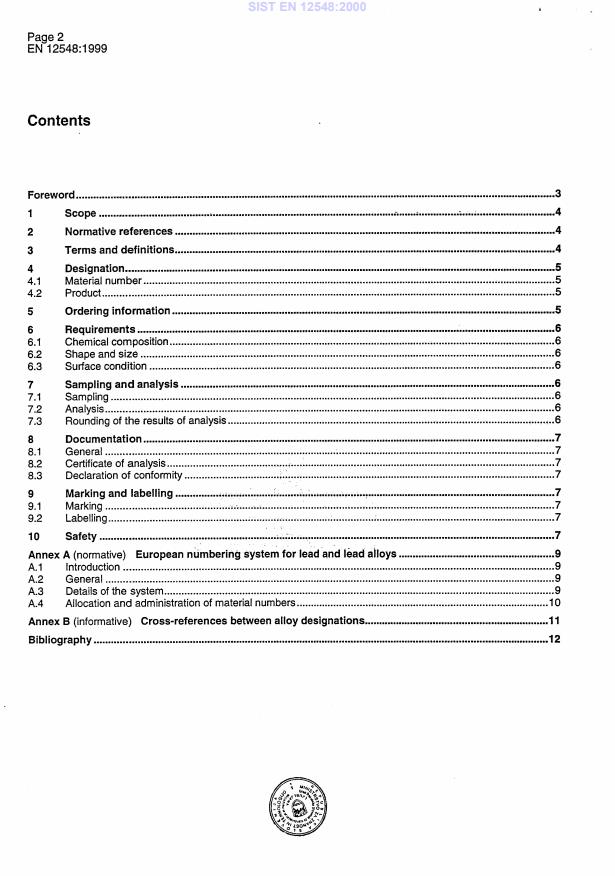
Overview
EN 12548:1999 is a European standard (CEN) that defines requirements for lead alloy ingots intended specifically for the manufacture of electric cable sheathing and sleeves. The standard sets out how these ingots are designated, what their chemical composition must be, and the procedures for sampling and analysis, marking, labelling and other production and quality requirements. EN 12548:1999 helps ensure material consistency, traceability and fitness for use in cable manufacturing.
Key topics and technical requirements
The standard covers the following main technical areas:
- Designation of lead and lead alloy ingots to ensure clear identification of grade and intended use.
- Chemical composition requirements specifying alloying elements and acceptable composition ranges for ingots used in cable sheathing and sleeves (as applicable to the specified alloy grades).
- Sampling and analysis procedures to determine compliance with composition and quality requirements, enabling reliable testing and acceptance.
- Marking and labelling rules for ingots to support traceability, including required product information on each ingot or package.
- Additional requirements such as packaging, documentation and any acceptance criteria or quality records needed to demonstrate conformity.
- Quality control and conformity practices to allow manufacturers, suppliers and purchasers to verify that ingots meet the standard.
Note: EN 12548:1999 specifies material and testing requirements for ingot form; it does not substitute for local health, safety or environmental regulations governing lead handling and disposal.
Applications and who uses this standard
EN 12548:1999 is practical for organizations and professionals involved in the production, procurement and testing of materials for electrical cable production:
- Cable manufacturers selecting lead alloy ingots for sheathing and joint sleeves to ensure consistent material properties.
- Metal alloy producers and foundries that cast and supply lead alloy ingots intended for cable industry use.
- Quality control and testing laboratories conducting sampling and chemical analysis to verify compliance.
- Purchasing and specification engineers who prepare procurement documents and material specifications for cable components.
- Standards and compliance officers ensuring products meet European material standards.
Related standards
EN 12548:1999 is part of the broader body of European standards for metals and cable materials. Users should also consult applicable standards and regulations for cable construction, material testing methods and local environmental and occupational safety requirements when specifying lead alloy ingots.
Keywords: EN 12548:1999, lead alloy ingots, electric cable sheathing, lead alloys, sampling and analysis, chemical composition, marking and labelling.
Relations
- Effective Date
- 28-Jan-2026
- Effective Date
- 28-Jan-2026
Get Certified
Connect with accredited certification bodies for this standard

Element Materials Technology
Materials testing and product certification.

Inštitut za kovinske materiale in tehnologije
Institute of Metals and Technology. Materials testing, metallurgical analysis, NDT.
Sponsored listings
Frequently Asked Questions
SIST EN 12548:2000 is a standard published by the Slovenian Institute for Standardization (SIST). Its full title is "Lead and lead alloys - Lead alloy ingots for electric cable sheathing and for sleeves". This standard covers: This European Standard specifies the designation, chemical composition, sampling and analysis, marking, labelling and other requirements for lead alloys in ingot form which are used for the manufacture of electric cable sheathing and sleeves.
This European Standard specifies the designation, chemical composition, sampling and analysis, marking, labelling and other requirements for lead alloys in ingot form which are used for the manufacture of electric cable sheathing and sleeves.
SIST EN 12548:2000 is classified under the following ICS (International Classification for Standards) categories: 77.150.60 - Lead, zinc and tin products. The ICS classification helps identify the subject area and facilitates finding related standards.
SIST EN 12548:2000 has the following relationships with other standards: It is inter standard links to SIST EN 12402:2000, SIST EN 14057:2004. Understanding these relationships helps ensure you are using the most current and applicable version of the standard.
SIST EN 12548:2000 is available in PDF format for immediate download after purchase. The document can be added to your cart and obtained through the secure checkout process. Digital delivery ensures instant access to the complete standard document.
Standards Content (Sample)
2003-01.Slovenski inštitut za standardizacijo. Razmnoževanje celote ali delov tega standarda ni dovoljeno.Blei und Bleilegierungen - Bleilegierungen in Blöcken für Kabelmäntel und MuffenPlomb et alliages de plomb - Lingots en alliages de plomb pour gaines et manchons de câbles électriquesLead and lead alloys - Lead alloy ingots for electric cable sheathing and for sleeves77.150.60L]GHONLLead, zinc and tin prod
...