

kSIST FprEN 15478:2026
(Main)Inorganic fertilizers - Determination of total nitrogen in urea, methylene-urea and urea formaldehyde
- Abstract
This document specifies a method for the determination of the content of total nitrogen in urea, methylene-urea and urea formaldehyde in their pure form in inorganic fertilizers.
- Status
- Not Published
- Public Enquiry End Date
- 01-May-2026
- Technical Committee
- KAT - Soil quality
- Current Stage
- 5020 - Formal vote (FV) (Adopted Project)
- Start Date
- 09-Oct-2026
- Due Date
- 27-Nov-2026

kSIST FprEN 15478:2026 is the Slovene draft adoption of prEN 15478 from CEN. It specifies a laboratory method for determining total nitrogen in urea, methylene-urea and urea formaldehyde in inorganic fertilizers, in their pure form. The document is aimed at laboratories and quality teams that need a defined reference method for these nitrogen products.
What does kSIST FprEN 15478:2026 specify?
kSIST FprEN 15478:2026 specifies one analytical method for total nitrogen in urea, methylene-urea and urea formaldehyde in inorganic fertilizers. The method is organized as a short standards document with clauses on scope, references, terms, principle, reagents, apparatus, sampling and sample preparation, procedure, calculation, precision and the test report.
| Annex | What it covers |
|---|---|
| Annex A | Results of the inter-laboratory tests for urea |
| Annex B | Results of the inter-laboratory study for methylene-urea and urea formaldehyde |
Clause 7 points readers to general sampling and sample preparation provisions, while Clauses 8 to 11 describe the test method, calculation, precision and reporting. In practice, this means the standard gives both the laboratory workflow and the documentation needed to report the result consistently.
What are the key requirements of kSIST FprEN 15478:2026?
kSIST FprEN 15478:2026 uses a Kjeldahl-type determination. Clause 4 states that nitrogen is converted to an ammoniacal salt by boiling with sulfuric acid, then distilled into excess standard sulfuric acid and back titrated with standard alkali. For the user, this means the result depends on controlled digestion, distillation and titration steps, not on a direct instrumental reading.
Clause 7 makes sampling and sample preparation important for the quality of the result. The laboratory should receive a representative sample, and sample preparation follows EN 1482-2. In practice, this is the point where many errors are avoided or introduced, so handling and preparation matter as much as the analysis itself.
Clause 5 sets the reagent quality and the key solutions. The standard requires analytical-grade reagents and water free from carbon dioxide and nitrogenous compounds, and it distinguishes the acid and alkali concentrations used for the urea procedure and for methylene-urea and urea formaldehyde. For routine work, this means the analyst must prepare the correct reagent set for the product group being tested.
Clause 6 gives the apparatus requirements, including distillation apparatus, a graduated Erlenmeyer flask and class AS burettes. Four distillation setups are illustrated, and automatic distillation and titration apparatus may be used if statistically equivalent results are obtained. That gives laboratories some flexibility, but they still need to show that the alternative setup performs comparably.
Clause 8 gives two separate procedures. Urea uses about 500 mg of sample, a digestion of about 1 h, a 150 ml distillate and a blank test with a lower-acidity setup. Methylene-urea and urea formaldehyde use about 300 mg of sample, a longer staged digestion, a 300 ml distillate and melamine for the control test. This separation matters because the two product groups behave differently in the method.
Clause 9 gives separate calculation paths and expresses the result as mass percent of total nitrogen in the fertilizer as received for analysis. Clause 10 then reports precision through repeatability and reproducibility data from inter-laboratory studies. Clause 11 requires the report to identify the sample, the method used, the result, the sampling date or procedure if known, and any optional details or incidents that could affect the result.
What terms does kSIST FprEN 15478:2026 define?
- Total nitrogen - the nitrogen content reported by this method as a percentage of the fertilizer as received for analysis.
- Blank test - a parallel determination made without the test portion to correct for reagent and procedural background.
- Control test - a check run used to confirm that the apparatus and method are working properly.
- Repeatability - the closeness of two results obtained under the same laboratory conditions, by the same operator and equipment, in a short time.
- Reproducibility - the closeness of results obtained in different laboratories with different operators and equipment.
- Methylene-urea - one of the fertilizer materials covered by the method, treated in the document as a separate product group from urea.
Who uses kSIST FprEN 15478:2026?
kSIST FprEN 15478:2026 is used by fertilizer testing laboratories, plant quality control teams, and contract labs that measure total nitrogen in these products. It is also relevant to manufacturers, purchasers and inspection bodies that need a common method for comparing batches, checking product declarations or verifying incoming material. The precision data and reporting clause are especially useful when results need to be compared between laboratories.
What changed in kSIST FprEN 15478:2026 from the previous edition?
kSIST FprEN 15478:2026 will supersede EN 15478:2009. The foreword states three significant changes:
- the scope has been broadened to include methylene-urea and urea formaldehyde
- the method has been technically revised for the broader scope
- statistical results for methylene-urea and urea formaldehyde have been added in Clause 10.2 and Annex B
Which standards are used with kSIST FprEN 15478:2026?
- EN 1482-2 - gives general sample preparation provisions used in Clause 7
- EN 12944-1 - supplies general fertilizer vocabulary used in Clause 3
- EN 12944-2 - supplies fertilizer-related terms used in Clause 3
- EN 1482-1 - gives a recommended sampling method mentioned in Clause 7 and the bibliography
- ISO 5725-1 - used for repeatability and reproducibility calculations in the precision work
- ISO 5725-2 - also used for the precision calculations reported for the broader study in Clause 10 and Annex B
What does the kSIST FprEN 15478:2026 document contain?
The document contains two worked analytical procedures, one for urea and one for methylene-urea and urea formaldehyde. It also includes four distillation apparatus figures, calculation formulas, precision tables, and inter-laboratory study results. Those elements support routine testing, method verification and comparison of results between laboratories.
Relations
- Effective Date
- 01-Apr-2026
Get Certified
Connect with accredited certification bodies for this standard

Control Union Certifications
Global certification for agriculture and sustainability.

ECOCERT
Organic and sustainability certification.

FSC International
Forest Stewardship Council certification.
Sponsored listings
Frequently Asked Questions
kSIST FprEN 15478:2026 is a draft published by the Slovenian Institute for Standardization (SIST). Its full title is "Inorganic fertilizers - Determination of total nitrogen in urea, methylene-urea and urea formaldehyde". This standard covers: This document specifies a method for the determination of the content of total nitrogen in urea, methylene-urea and urea formaldehyde in their pure form in inorganic fertilizers.
This document specifies a method for the determination of the content of total nitrogen in urea, methylene-urea and urea formaldehyde in their pure form in inorganic fertilizers.
kSIST FprEN 15478:2026 is classified under the following ICS (International Classification for Standards) categories: 65.080 - Fertilizers. The ICS classification helps identify the subject area and facilitates finding related standards.
kSIST FprEN 15478:2026 has the following relationships with other standards: It is inter standard links to SIST EN 15478:2009. Understanding these relationships helps ensure you are using the most current and applicable version of the standard.
kSIST FprEN 15478:2026 is associated with the following European legislation: EU Directives/Regulations: 2019/1009; Standardization Mandates: M/564, M/564 AMD 1, M/564 AMD 2. When a standard is cited in the Official Journal of the European Union, products manufactured in conformity with it benefit from a presumption of conformity with the essential requirements of the corresponding EU directive or regulation.
kSIST FprEN 15478:2026 is available in PDF format for immediate download after purchase. The document can be added to your cart and obtained through the secure checkout process. Digital delivery ensures instant access to the complete standard document.
Standards Content (Sample)
SLOVENSKI STANDARD
oSIST prEN 15478:2026
01-april-2026
Anorganska gnojila - Določanje celotnega dušika v sečnini, metilenurei in urea
formaldehidu
Inorganic fertilizers - Determination of total nitrogen in urea, methylene-urea and urea
formaldehyde
Anorganische Düngemittel - Bestimmung des Gesamtgehalts an Stickstoff in Methylen-
Harnstoff und Harnstoff-Formaldehyd
Engrais inorganiques - Dosage de l’azote total dans l’urée, le méthylène-urée et l’urée-
formaldéhyde
Ta slovenski standard je istoveten z: prEN 15478
ICS:
65.080 Gnojila Fertilizers
oSIST prEN 15478:2026 en,fr,de
2003-01.Slovenski inštitut za standardizacijo. Razmnoževanje celote ali delov tega standarda ni dovoljeno.
oSIST prEN 15478:2026
oSIST prEN 15478:2026
DRAFT
EUROPEAN STANDARD
prEN 15478
NORME EUROPÉENNE
EUROPÄISCHE NORM
February 2026
ICS 65.080 Will supersede EN 15478:2009
English Version
Inorganic fertilizers - Determination of total nitrogen in
urea, methylene-urea and urea formaldehyde
Engrais inorganiques - Dosage de l'azote total dans Anorganische Düngemittel - Bestimmung des
l'urée, le méthylène-urée et l'urée-formaldéhyde Gesamtgehalts an Stickstoff in Methylen-Harnstoff und
Harnstoff-Formaldehyd
This draft European Standard is submitted to CEN members for enquiry. It has been drawn up by the Technical Committee
CEN/TC 260.
If this draft becomes a European Standard, CEN members are bound to comply with the CEN/CENELEC Internal Regulations
which stipulate the conditions for giving this European Standard the status of a national standard without any alteration.
This draft European Standard was established by CEN in three official versions (English, French, German). A version in any other
language made by translation under the responsibility of a CEN member into its own language and notified to the CEN-CENELEC
Management Centre has the same status as the official versions.
CEN members are the national standards bodies of Austria, Belgium, Bulgaria, Croatia, Cyprus, Czech Republic, Denmark, Estonia,
Finland, France, Germany, Greece, Hungary, Iceland, Ireland, Italy, Latvia, Lithuania, Luxembourg, Malta, Netherlands, Norway,
Poland, Portugal, Republic of North Macedonia, Romania, Serbia, Slovakia, Slovenia, Spain, Sweden, Switzerland, Türkiye and
United Kingdom.
Recipients of this draft are invited to submit, with their comments, notification of any relevant patent rights of which they are
aware and to provide supporting documentation.
Warning : This document is not a European Standard. It is distributed for review and comments. It is subject to change without
notice and shall not be referred to as a European Standard.
EUROPEAN COMMITTEE FOR STANDARDIZATION
COMITÉ EUROPÉEN DE NORMALISATION
EUROPÄISCHES KOMITEE FÜR NORMUNG
CEN-CENELEC Management Centre: Rue de la Science 23, B-1040 Brussels
© 2026 CEN All rights of exploitation in any form and by any means reserved Ref. No. prEN 15478:2026 E
worldwide for CEN national Members.
oSIST prEN 15478:2026
prEN 15478:2026 (E)
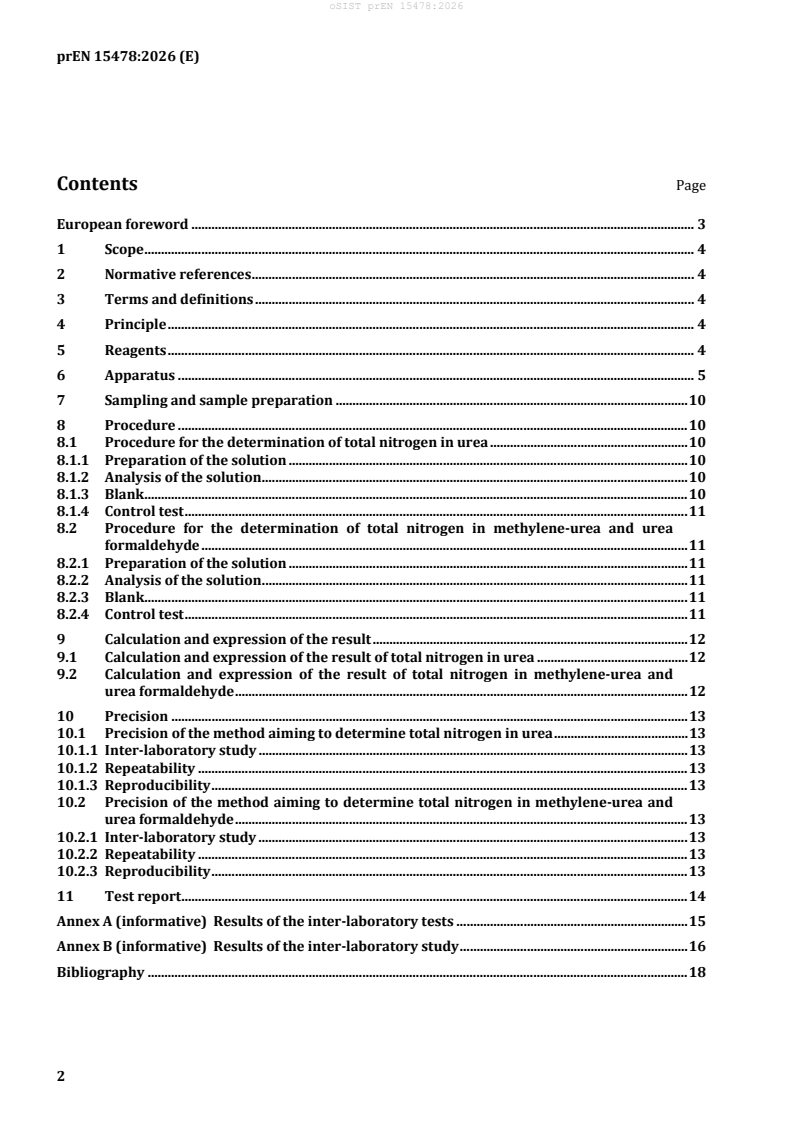
Contents Page
European foreword . 3
1 Scope . 4
2 Normative references . 4
3 Terms and definitions . 4
4 Principle . 4
5 Reagents . 4
6 Apparatus . 5
7 Sampling and sample preparation . 10
8 Procedure . 10
8.1 Procedure for the determination of total nitrogen in urea . 10
8.1.1 Preparation of the solution . 10
8.1.2 Analysis of the solution . 10
8.1.3 Blank . 10
8.1.4 Control test . 11
8.2 Procedure for the determination of total nitrogen in methylene-urea and urea
formaldehyde . 11
8.2.1 Preparation of the solution . 11
8.2.2 Analysis of the solution . 11
8.2.3 Blank . 11
8.2.4 Control test . 11
9 Calculation and expression of the result . 12
9.1 Calculation and expression of the result of total nitrogen in urea . 12
9.2 Calculation and expression of the result of total nitrogen in methylene-urea and
urea formaldehyde . 12
10 Precision . 13
10.1 Precision of the method aiming to determine total nitrogen in urea . 13
10.1.1 Inter-laboratory study . 13
10.1.2 Repeatability . 13
10.1.3 Reproducibility . 13
10.2 Precision of the method aiming to determine total nitrogen in methylene-urea and
urea formaldehyde . 13
10.2.1 Inter-laboratory study . 13
10.2.2 Repeatability . 13
10.2.3 Reproducibility . 13
11 Test report . 14
Annex A (informative) Results of the inter-laboratory tests . 15
Annex B (informative) Results of the inter-laboratory study . 16
Bibliography . 18
oSIST prEN 15478:2026
prEN 15478:2026 (E)
European foreword
This document (prEN 15478:2026) has been prepared by Technical Committee CEN/TC 260 “Fertilizers
and liming materials”, the secretariat of which is held by DIN.
This is currently submitted to CEN Enquiry.
This document will supersede EN 15478:2009.
prEN 15478:2026 includes the following significant technical changes with respect to EN 15478:2009:
— The scope has been broadened by adding the determination of the content of total nitrogen in
methylene-urea and urea formaldehyde and the title has been adjusted accordingly;
— The method has been technically revised according to the broader scope;
— The statistical results relating to the inter-laboratory study of the determination of total nitrogen in
methylene urea and urea formaldehyde have been added (10.2 and Annex B).
This document has been prepared under a standardization request addressed to CEN by the European
Commission. The Standing Committee of the EFTA States subsequently approves these requests for its
Member States.
oSIST prEN 15478:2026
prEN 15478:2026 (E)
1 Scope
This document specifies a method for the determination of the content of total nitrogen in urea,
methylene-urea and urea formaldehyde in their pure form in inorganic fertilizers.
2 Normative references
The following documents are referred to in the text in such a way that some or all of their content
constitutes requirements of this document. For dated references, only the edition cited applies. For
undated references, the latest edition of the referenced document (including any amendments) applies.
EN 1482-2, Fertilizers, liming materials and inhibitors — Sampling and sample preparation — Part 2:
General sample preparation provisions
EN 12944-1, Fertilizers, liming materials and inhibitors — Vocabulary — Part 1: General terms
EN 12944-2, Fertilizers, liming materials and inhibitors — Vocabulary — Part 2: Terms relating to
fertilizers
3 Terms and definitions
For the purposes of this document, the terms and definitions given in EN 12944-1 and EN 12944-2
apply.
ISO and IEC maintain terminology databases for use in standardization at the following addresses:
— ISO Online browsing platform: available at https://www.iso.org/obp/
— IEC Electropedia: available at https://www.electropedia.org/
4 Principle
The nitrogen is transformed quantitatively into ammoniacal salt by boiling in the presence of sulfuric
acid. The ammoniacal solution thus obtained is distilled through an alkaline medium, the distillate being
collected in an excess of standard sulfuric acid. The excess acid is titrated by means of a standard
alkaline solution.
5 Reagents
Use only reagents of recognized analytical grade and distilled or demineralized water, free from carbon
dioxide and all nitrogenous compounds, having an electrical conductivity of at least < 0,5 mS/m (at
25 °C).
5.1 Kjeldahl tablets.
5.1.1 5 g/tablet containing 100 parts K SO to 1 part selenium.
2 4
or, in alternative,
5.1.2 5 g of pure K SO in powder (recommended).
2 4
5.2 Sulfuric acid, concentrated (mass concentration ρ = 1,84 g/ml).
A revision is under preparation. Stage at the time of preparation: prEN 12944-1:2026
A revision is under preparation. Stage at the time of preparation: prEN 12944-2:2026
oSIST prEN 15478:2026
prEN 15478:2026 (E)
5.3 Sodium hydroxide solution, NaOH, mass fraction of 30 %.
5.4 Sulfuric acid standard solution, amount-of-substance concentration c = 0,05 mol/l (0,10 N/l), to
use for the blank test in the determination of total nitrogen in urea only.
5.5 Sulfuric acid standard solution, c = 0,25 mol/l (0,5 N/l).
5.6 Sulfuric acid standard solution, c = 0,5 mol/l (1,0 N/l).
5.7 Sodium or potassium hydroxide standard solution, carbonate free, c = 0,1 mol/l, to use for the
blank test in the determination of total nitrogen in urea only.
5.8 Sodium or potassium hydroxide standard solution, carbonate free, c = 0,5 mol/l.
5.9 Sodium or potassium hydroxide standard solution, carbonate free, c = 1,0 mol/l.
5.10 Indicator for ammonia nitrogen, ready for use.
5.11 Anti-bump granules, for example pumice stone, washed in hydrochloric acid and calcined.
5.12 Urea, analytical grade.
5.13 Melamine, analytical grade.
6 Apparatus
6.1 Distillation apparatus, consisting of a round-bottomed flask of suitable capacity connected to a
condenser by means of a splash head.
The equipment is made of borosilicate glass.
NOTE The different types of equipment recommended for this determination are reproduced showing all the
features of construction in Figures 1, 2, 3, and 4.
Automatic distillation and titration apparatus may be used as well provided that the results are
statistically equivalent.
oSIST prEN 15478:2026
prEN 15478:2026 (E)
Dimensions in millimetres
Key
1 round-bottomed, long-necked flask of 1 000 ml capacity
2 distillation tube with a splash head, connected to the condenser by means of a spherical joint (No 18) (the
spherical joint for the connection to the condenser may be replaced by an appropriate rubber connection)
3 funnel with a polytetrafluoroethylene (PTFE) tap (6) for the addition of sodium hydroxide
4 six-bulb condenser with spherical joint (No 18) at the entrance, and joined at the issue to a glass
extension tube by means of a small rubber connection (when the connection to the distillation tube is effected by
means of a rubber tube, the spherical joint may be replaced by a suitable rubber bung)
5 500 ml flask in which the distillate is collected
6 PTFE-tap (the tap may likewise be replaced by a rubber connection with a clip)
Figure 1 — Distillation apparatus 1
oSIST prEN 15478:2026
prEN 15478:2026 (E)
Dimensions in millimetres
Key
1 round-bottomed, short-necked flask of 1 000 ml capacity with a spherical joint (No 35)
2 distillation tube with a splash head, equipped with a spherical joint (No 35) at the entrance and a
spherical joint (No 18) at the issue, connected at the side to a funnel with a polytetrafluoroethylene (PTFE) tap (6)
for the addition of sodium hydroxide
3 six-bulb condenser with a spherical joint (No 18) at the entrance and joined at the issue to a glass
extension tube by means of a small rubber connection
4 500 ml flask in which the distillate is collected
5 PTFE-tap
a enlarged description
Figure 2 — Distillation apparatus 2
oSIST prEN 15478:2026
prEN 15478:2026 (E)
Dimensions in millimetres
Key
1 round-bottomed, long-necked flask of 750
...