

SIST EN ISO 16321-3:2022
(Main)Eye and face protection for occupational use - Part 3: Additional requirements for mesh protectors (ISO 16321-3:2021)
General Information
- Abstract
This document specifies additional performance and marking requirements for mesh protectors designed to provide protection for the eyes and faces of persons against mechanical hazards such as impacts from flying particles and fragments. The other applicable requirements for mesh protectors and the frames/mountings to which they are intended to be fitted are given in ISO 16321‑1.
This document also applies to mesh protectors used in educational establishments.
This document also applies to those eye and face protectors used for occupational-type tasks that are performed similarly to an occupation, e.g. "do‑it‑yourself".
This document is not applicable to protectors for use against liquid splash (including molten metal), hot solid risks, infrared and ultraviolet radiation. For protection against these hazards suitable additional or alternative protectors according ISO 16321‑1 will be needed.
This document does not apply to mesh protectors used in sports such as fencing.
- Status
- Published
- Public Enquiry End Date
- 19-Jul-2018
- Publication Date
- 12-May-2022
- Technical Committee
- OVP - Personal protecting equipment
- Current Stage
- 6060 - National Implementation/Publication (Adopted Project)
- Start Date
- 04-May-2022
- Due Date
- 09-Jul-2022
- Completion Date
- 13-May-2022
- Directive
- 2016/425 - Regulation (EU) 2016/425 of the European Parliament and of the Council of 9 March 2016 on personal protective equipment and repealing Council Directive 89/686/EECOJ Ref: L, 4.9.2026 OJ Date: 04-Sep-2026

Overview
EN ISO 16321-3:2022 (ISO 16321-3:2021) is the CEN-adopted international standard that defines additional performance and marking requirements for mesh protectors used for eye and face protection in occupational settings. It covers mesh-type guards intended to protect against mechanical hazards - primarily impacts from flying particles and fragments - and complements the general requirements in ISO 16321‑1. The standard applies to workplace use, educational establishments and occupational-style “do‑it‑yourself” tasks, but it excludes protection against liquid splash, molten metal, hot solids, infrared/ultraviolet radiation and sports applications (e.g., fencing).
Key topics and requirements
The document focuses on mesh-specific issues and references relevant test methods and definitions. Key technical topics include:
- Luminous transmittance of mesh protectors - visibility and light transmission considerations for safe use.
- Number and geometry of apertures - criteria that affect particle ingress and impact behaviour.
- Contact with metal parts - requirements to limit harmful contact or sharp edges.
- Reflection from mesh - minimising glare and distracting reflections that could impair vision.
- Additional or alternative lenses - rules for combinations of mesh with other lens types.
- Marking and labelling - mandatory and optional markings for both mesh and frames (detailed marking clauses and an example are included).
- Manufacturer information - instructions, limitations of use and safety data that must accompany products.
The standard cross-references ISO 18526 series for test methods and ISO 4007 for terms/definitions and provides conformity relevance under EU Regulation 2016/425 (Annex ZA), giving a presumption of conformity when cited in the Official Journal.
Applications
EN ISO 16321-3:2022 is intended for:
- Manufacturers and designers of mesh eye/face protectors, to ensure product design meets mesh-specific performance and marking rules.
- Procurement and safety professionals responsible for selecting PPE suitable for tasks with mechanical hazards (flying particles/fragments).
- Testing laboratories and conformity assessors using referenced ISO test methods to verify compliance.
- Educational institutions and DIY markets where mesh protectors are supplied for similar occupational tasks.
Typical use-cases include workshop operations, construction and manual trades where mechanical impact hazards are present but not where splash, heat or radiative hazards dominate.
Related standards
- ISO 16321-1 - General requirements for eye and face protectors (primary reference)
- ISO 18526 series - Test methods for eye and face protectors
- ISO 4007 - Terms and definitions for PPE eye/face products
Keywords: mesh protectors, eye and face protection, EN ISO 16321-3:2022, ISO 16321-3, PPE, occupational safety, marking requirements, luminous transmittance.
Relations
- Effective Date
- 01-Jun-2022
- Effective Date
- 01-Jun-2022
- Effective Date
- 28-Jan-2026
- Referred By
SIST CR 13464:2000 - Guide to selection, use and maintenance of occupational eye and face protectors - Effective Date
- 28-Jan-2026
- Effective Date
- 28-Jan-2026
- Effective Date
- 28-Jan-2026
- Effective Date
- 28-Jan-2026
- Effective Date
- 28-Jan-2026
- Effective Date
- 28-Jan-2026
- Effective Date
- 28-Jan-2026
- Effective Date
- 28-Jan-2026
- Effective Date
- 28-Jan-2026
- Effective Date
- 28-Jan-2026
- Effective Date
- 28-Jan-2026
- Effective Date
- 28-Jan-2026
Get Certified
Connect with accredited certification bodies for this standard

CIS Institut d.o.o.
Personal Protective Equipment (PPE) certification body. Notified Body NB-2890 for EU Regulation 2016/425 PPE.

Kiwa BDA Testing
Building and construction product certification.
Kmetijski inštitut Slovenije
Agricultural Institute of Slovenia. Soil testing, plant health, agricultural product analysis.
Sponsored listings
Frequently Asked Questions
SIST EN ISO 16321-3:2022 is a standard published by the Slovenian Institute for Standardization (SIST). Its full title is "Eye and face protection for occupational use - Part 3: Additional requirements for mesh protectors (ISO 16321-3:2021)". This standard covers: This document specifies additional performance and marking requirements for mesh protectors designed to provide protection for the eyes and faces of persons against mechanical hazards such as impacts from flying particles and fragments. The other applicable requirements for mesh protectors and the frames/mountings to which they are intended to be fitted are given in ISO 16321‑1. This document also applies to mesh protectors used in educational establishments. This document also applies to those eye and face protectors used for occupational-type tasks that are performed similarly to an occupation, e.g. "do‑it‑yourself". This document is not applicable to protectors for use against liquid splash (including molten metal), hot solid risks, infrared and ultraviolet radiation. For protection against these hazards suitable additional or alternative protectors according ISO 16321‑1 will be needed. This document does not apply to mesh protectors used in sports such as fencing.
This document specifies additional performance and marking requirements for mesh protectors designed to provide protection for the eyes and faces of persons against mechanical hazards such as impacts from flying particles and fragments. The other applicable requirements for mesh protectors and the frames/mountings to which they are intended to be fitted are given in ISO 16321‑1. This document also applies to mesh protectors used in educational establishments. This document also applies to those eye and face protectors used for occupational-type tasks that are performed similarly to an occupation, e.g. "do‑it‑yourself". This document is not applicable to protectors for use against liquid splash (including molten metal), hot solid risks, infrared and ultraviolet radiation. For protection against these hazards suitable additional or alternative protectors according ISO 16321‑1 will be needed. This document does not apply to mesh protectors used in sports such as fencing.
SIST EN ISO 16321-3:2022 is classified under the following ICS (International Classification for Standards) categories: 13.340.20 - Head protective equipment. The ICS classification helps identify the subject area and facilitates finding related standards.
SIST EN ISO 16321-3:2022 has the following relationships with other standards: It is inter standard links to SIST EN 166:2002, SIST EN 1731:2007, SIST EN 1501-3:2021, SIST CR 13464:2000, SIST EN 170:2003, SIST EN 746-8:2001, SIST EN 746-5:2001, SIST EN 12942:1999, SIST EN 12942:2024, SIST EN 746-4:2000, SIST EN 12307:1999, SIST EN 169:2003, SIST EN 12941:1999, SIST EN 171:2002, SIST EN 168:2002. Understanding these relationships helps ensure you are using the most current and applicable version of the standard.
SIST EN ISO 16321-3:2022 is associated with the following European legislation: EU Directives/Regulations: 2016/425; Standardization Mandates: M/571, M/571 Amd 1. When a standard is cited in the Official Journal of the European Union, products manufactured in conformity with it benefit from a presumption of conformity with the essential requirements of the corresponding EU directive or regulation.
SIST EN ISO 16321-3:2022 is available in PDF format for immediate download after purchase. The document can be added to your cart and obtained through the secure checkout process. Digital delivery ensures instant access to the complete standard document.
Standards Content (Sample)
SLOVENSKI STANDARD
01-junij-2022
Nadomešča:
SIST EN 166:2002
SIST EN 1731:2007
Zaščita za oči in obraz za poklicno uporabo - 3. del: Dodatne zahteve za mrežne
ščitnike za oči in obraz (ISO 16321-3:2021)
Eye and face protection for occupational use - Part 3: Additional requirements for mesh
protectors (ISO 16321-3:2021)
Augen- und Gesichtsschutz für berufliche Anwendungen - Teil 3: Zusätzliche
Anforderungen an Schutzgeräte aus Gewebe (ISO 16321-3:2021)
Protection des yeux et du visage à usage professionnel - Partie 3: Exigences
complémentaires relatives aux protecteurs grillagés (ISO 16321-3:2021)
Ta slovenski standard je istoveten z: EN ISO 16321-3:2022
ICS:
13.340.20 Varovalna oprema za glavo Head protective equipment
2003-01.Slovenski inštitut za standardizacijo. Razmnoževanje celote ali delov tega standarda ni dovoljeno.
EN ISO 16321-3
EUROPEAN STANDARD
NORME EUROPÉENNE
April 2022
EUROPÄISCHE NORM
ICS 13.340.20 Supersedes EN 166:2001, EN 1731:2006
English Version
Eye and face protection for occupational use - Part 3:
Additional requirements for mesh protectors (ISO 16321-
3:2021)
Protection des yeux et du visage à usage professionnel Augen- und Gesichtsschutz für berufliche
- Partie 3: Exigences complémentaires relatives aux Anwendungen - Teil 3: Zusätzliche Anforderungen an
protecteurs grillagés (ISO 16321-3:2021) Schutzgeräte aus Gewebe (ISO 16321-3:2021)
This European Standard was approved by CEN on 7 November 2020.
CEN members are bound to comply with the CEN/CENELEC Internal Regulations which stipulate the conditions for giving this
European Standard the status of a national standard without any alteration. Up-to-date lists and bibliographical references
concerning such national standards may be obtained on application to the CEN-CENELEC Management Centre or to any CEN
member.
This European Standard exists in three official versions (English, French, German). A version in any other language made by
translation under the responsibility of a CEN member into its own language and notified to the CEN-CENELEC Management
Centre has the same status as the official versions.
CEN members are the national standards bodies of Austria, Belgium, Bulgaria, Croatia, Cyprus, Czech Republic, Denmark, Estonia,
Finland, France, Germany, Greece, Hungary, Iceland, Ireland, Italy, Latvia, Lithuania, Luxembourg, Malta, Netherlands, Norway,
Poland, Portugal, Republic of North Macedonia, Romania, Serbia, Slovakia, Slovenia, Spain, Sweden, Switzerland, Turkey and
United Kingdom.
EUROPEAN COMMITTEE FOR STANDARDIZATION
COMITÉ EUROPÉEN DE NORMALISATION
EUROPÄISCHES KOMITEE FÜR NORMUNG
CEN-CENELEC Management Centre: Rue de la Science 23, B-1040 Brussels
© 2022 CEN All rights of exploitation in any form and by any means reserved Ref. No. EN ISO 16321-3:2022 E
worldwide for CEN national Members.
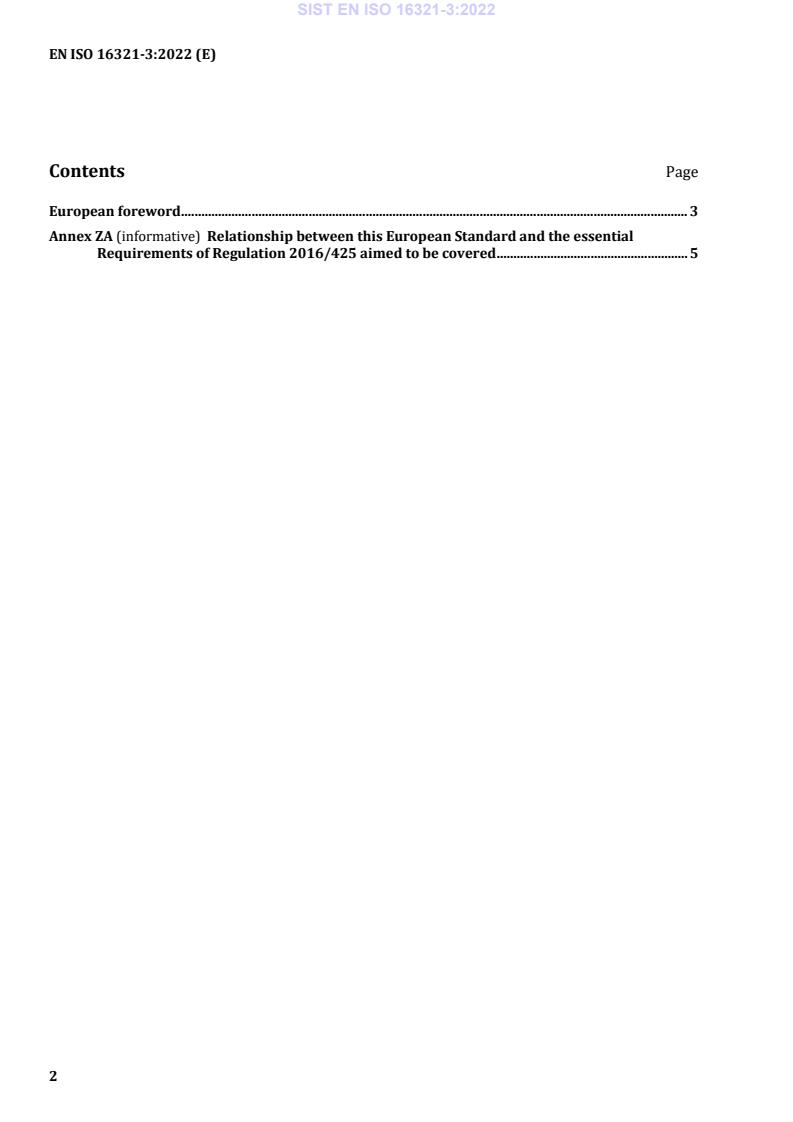
Contents Page
European foreword . 3
Annex ZA (informative) Relationship between this European Standard and the essential
Requirements of Regulation 2016/425 aimed to be covered . 5
European foreword
This document (EN ISO 16321-3:2022) has been prepared by Technical Committee ISO/TC 94
"Personal safety -- Personal protective equipment" in collaboration with Technical Committee CEN/TC
85 “Eye protective equipment” the secretariat of which is held by AFNOR.
This European Standard shall be given the status of a national standard, either by publication of an
identical text or by endorsement, at the latest by October 2022, and conflicting national standards shall
be withdrawn at the latest by October 2022.
Attention is drawn to the possibility that some of the elements of this document may be the subject of
patent rights. CEN shall not be held responsible for identifying any or all such patent rights.
This document supersedes EN 166:2001, EN 1731:2006.
This document has been prepared under a Standardization Request given to CEN by the European
Commission and the European Free Trade Association, and supports essential requirements of EU
Regulation(s) 2016/425.
For the relationship with EU Directive(s) / Regulation(s), see informative Annex ZA, which is an integral
part of this document.
Any feedback and questions on this document should be directed to the users’ national standards
body/national committee. A complete listing of these bodies can be found on the CEN website.
The following referenced documents are indispensable for the application of this document. For
undated references, the latest edition of the referenced document (including any amendments) applies.
For dated references, only the edition cited applies. However, for any use of this document ‘within the
meaning of Annex ZA, the user should always check that any referenced document has not been
superseded and that its relevant contents can still be considered the generally acknowledged state-of-
art.
When an IEC or ISO standard is referred to in the ISO standard text, this shall be understood as a
normative reference to the corresponding EN standard, if available, and otherwise to the dated version
of the ISO or IEC standard, as listed below.
NOTE The way in which these referenced documents are cited in normative requirements determines the
extent (in whole or in part) to which they apply.
Undated normative Clause(s) of the ISO Equivalent dated standard
references in the ISO standard
EN ISO or IEC
standard
ISO 4007 Clause 2 & 3 EN ISO 4007:2018 ISO 4007:2018
ISO 16321-1 Clause 1, 2, 4.1 & 4.6 EN ISO 16321-1:2020 ISO 16321-1:2020
ISO 18526-2 Clause 2 EN ISO 18526-2:2020 ISO 18526-2:2020
ISO 18526-3 Clause 2 EN ISO 18526-3 :2020 ISO 18526-3:2020
ISO 18526-4 Clause 2, 5.3 & 6 EN ISO 18526-4:2020 ISO 18526-4:2020
According to the CEN-CENELEC Internal Regulations, the national standards organizations of the
following countries are bound to implement this European Standard: Austria, Belgium, Bulgaria,
Croatia, Cyprus, Czech Republic, Denmark, Estonia, Finland, France, Germany, Greece, Hungary, Iceland,
Ireland, Italy, Latvia, Lithuania, Luxembourg, Malta, Netherlands, Norway, Poland, Portugal, Republic of
North Macedonia, Romania, Serbia, Slovakia, Slovenia, Spain, Sweden, Switzerland, Turkey and the
United Kingdom.
Endorsement notice
The text of ISO 16321-3:2021 has been approved by CEN as EN ISO 16321-3:2022 without any
modification.
Annex ZA
(informative)
Relationship between this European Standard and the essential
Requirements of Regulation 2016/425 aimed to be covered
This European Standard has been prepared under a Commission’s standardization request M/571 to
provide one voluntary means of conforming to requirements of Regulation 2016/425.
Once this standard is cited in the Official Journal of the European Union under that Regulation
2016/425 compliance with the normative clauses of this standard given in Table ZA.1 confers, within
the limits of the scope of this standard, a presumption of conformity with the corresponding [essential]
requirements of that Regulation 2016/425 and associated EFTA regulations.
Table ZA.1 — Correspondence between this European Standard and
Annex II of Regulation 2016/425
Essential Requirements Clause(s)/sub-clause(s) Remarks/Notes
of Regulation of this EN
Most Essential Requirements of
Regulation are wholly or partially
covered by reference to
EN ISO 16321-1:2020 as
described in Clause 4.1 of this
standard.
1.1.1 Ergonomics 4.1 By reference to EN ISO 16321-1:
1.1.2 Level and classes of protection 4.1 By reference to EN ISO 16321-1:
1.2.1 Absence of risks and other 4.4; 4.5; By reference to EN ISO 16321-1:
'inherent' nuisance factors 2020
1.2.1.1 Suitable constituent materials 4.1 By reference to EN ISO 16321-1:
1.2.1.2 Satisfactory surface condition 4.1 By reference to EN ISO 16321-1:
of all PPE parts in contact with the 2020
user.
1.2.1.3 Maximum permissible user 4.1 By reference to EN ISO 16321-1:
impediment 2020
1.3.1 Adaptation of PPE to user 4.1 By reference to EN ISO 16321-1:
morphology 2020
1.3.2 Lightness and design strength 4.1 By reference to EN ISO 16321-1:
1.3.3 Compatibility of different 4.1 By reference to EN ISO 16321-1:
classes or types of PPE designed for 2020
Essential Requirements Clause(s)/sub-clause(s) Remarks/Notes
of Regulation of this EN
simultaneous use
1.4 Manufacturer's instructions and 6
information
2.1 PPE incorporating adjustment 4.1 By reference to EN ISO 16321-1:
systems 2020
2.3 PPE for the face, eyes and 4.2; 4.3 By reference to EN ISO 16321-1:
respiratory 2020
system
2.9 PPE incorporating components 4.1 By reference to EN ISO 16321-1:
which can be adjusted or removed 2020
by the use
2.12 PPE bearing one or more 5
identification markings or
indicators directly or indirectly
relating to health and safety
3.1.1 Impact caused by falling or 4.1 By reference to EN ISO 16321-1:
ejected objects and collision of 2020
parts of the body with obstacle
Protection against collision of the
head with obstacles is not
covered by this ER.
WARNING 1 — Presumption of conformity stays valid only as long as a reference to this European
Standard is maintained in the list published in the Official Journal of the European Union. Users of this
standard should consult frequently the latest list published in the Official Journal of the European
Union.
WARNING 2 — Other Union legislation may be applicable to the product(s) falling within the scope of
this standard.
INTERNATIONAL ISO
STANDARD 16321-3
First edition
2021-03
Eye and face protection for
occupational use —
Part 3:
Additional requirements for mesh
protectors
Protection des yeux et du visage à usage professionnel —
Partie 3: Exigences complémentaires relatives aux protecteurs
grillagés
Reference number
ISO 16321-3:2021(E)
©
ISO 2021
ISO 16321-3:2021(E)
© ISO 2021
All rights reserved. Unless otherwise specified, or required in the context of its implementation, no part of this publication may
be reproduced or utilized otherwise in any form or by any means, electronic or mechanical, including photocopying, or posting
on the internet or an intranet, without prior written permission. Permission can be requested from either ISO at the address
below or ISO’s member body in the country of the requester.
ISO copyright office
CP 401 • Ch. de Blandonnet 8
CH-1214 Vernier, Geneva
Phone: +41 22 749 01 11
Email: copyright@iso.org
Website: www.iso.org
Published in Switzerland
ii © ISO 2021 – All rights reserved
ISO 16321-3:2021(E)
Contents Page
Foreword .iv
Introduction .v
1 Scope . 1
2 Normative references . 1
3 Terms and definitions . 1
4 Requirements . 2
4.1 General . 2
4.2 Luminous transmittance of mesh protectors . 2
4.3 Number of apertures in mesh protectors . 2
4.4 Contact with metal parts of mesh protectors . 2
4.5 Reflection from mesh protectors . 3
4.6 Additional or alternative lenses . 3
5 Marking of mesh protectors . 3
5.1 General . 3
5.2 Mandatory markings on mesh .
...