

kSIST FprEN 12697-17:2026
(Main)Bituminous mixtures - Test methods - Part 17: Particle loss of porous asphalt specimens
- Abstract
This document specifies a test method for determining the particle loss of porous asphalt mixtures. Particle loss is assessed by the loss of mass of porous asphalt samples after turns in the Los Angeles machine. This test enables the estimation of the abrasion resistance of porous asphalt. The test applies to laboratory compacted cylindrical specimens of porous asphalt mixtures, the upper sieve size of which does not exceed 22,4 mm. It does not reflect the abrasive effect by studded tyres.
- Status
- Not Published
- Public Enquiry End Date
- 28-May-2025
- Technical Committee
- CES - Roads
- Current Stage
- 5020 - Formal vote (FV) (Adopted Project)
- Start Date
- 03-Nov-2026
- Due Date
- 22-Dec-2026

kSIST FprEN 12697-17:2026 is the SIST version of the European draft prEN 12697-17 for bituminous mixtures. It specifies a laboratory test for particle loss of porous asphalt specimens by measuring mass loss after turns in a Los Angeles machine, so users can estimate abrasion resistance in a controlled way.
What does kSIST FprEN 12697-17:2026 specify?
kSIST FprEN 12697-17:2026 specifies a test method for porous asphalt mixtures, using loss of mass after drum turns as the measure of particle loss. The method applies to laboratory-compacted cylindrical specimens with an upper sieve size not exceeding 22,4 mm, and it is not intended to represent wear from studded tyres.
The document is organized into Scope, Normative references, Terms and definitions, Apparatus, Preparation of test specimens, Procedure, Calculation, Test report, Precision, and informative Annex A. Annex A gives a separate water-conditioning variant for comparing dry and wet specimens.
| Annex | What it covers |
|---|---|
| Annex A | Effect of water on particle loss of porous asphalt specimens, including dry and wet conditioning, separate calculations, and increase in particle loss |
What are the key requirements of kSIST FprEN 12697-17:2026?
The core method is in Clauses 4 to 9, with Annex A adding a water-conditioning comparison. In practice, the standard is about controlling specimen preparation, test temperature, drum rotation, and mass measurements so results can be compared between mixtures and laboratories.
Apparatus and specimen preparation
Clause 4 requires a Los-Angeles-machine as specified in EN 1097-2, a thermometer, a temperature-controlled chamber, an oven, and a balance with suitable readability and error limits. These controls matter because the test result is sensitive to temperature and weighing accuracy.
Clause 5 requires at least five specimens per sample and condition, prepared from the mixture in accordance with EN 12697-35. The specimens are cylindrical and made either by impact compaction or gyratory compaction, with dimensions measured to EN 12697-29 and with bulk density, maximum density, and void content determined using EN 12697-6, EN 12697-5, and EN 12697-8.
Test conditions and procedure
Clause 5 also requires storage of specimens on a flat surface at not more than 25 °C for between 48 h and 42 days before testing. Clause 6 then requires conditioning at the test temperature for at least 4 h, with a normal test range of 15 °C to 25 °C, and allows colder conditions for cold climate zones.
Clause 6 requires the specimen to be weighed, turned in the Los-Angeles-machine without the steel balls, and then cleaned of clearly loose particles before reweighing. The drum speed and number of turns are fixed, so the result reflects the specimen behavior rather than operator choice.
Calculation, reporting, and precision
Clause 7 calculates particle loss from the initial and final specimen masses and reports the average of five single values, rounded to the nearest 1 %. Clause 8 requires the test report to identify the samples, state the test temperature, compaction method, specimen characteristics, storage conditions, deviations, and unusual observations.
Clause 9 gives precision data for results below 40 % and for results at or above 40 %, with repeatability and reproducibility values stated for each range. That helps users judge whether two results are close enough to be considered comparable.
What terms does kSIST FprEN 12697-17:2026 use?
- Particle loss - the percentage mass loss of a porous asphalt specimen after the Los-Angeles-machine treatment.
- Porous asphalt - the mixture type tested in this document, with specimens made in cylindrical laboratory form.
- Los-Angeles-machine - the rotating drum apparatus used to abrade the specimen during the test.
- Bulk density - the density of the compacted specimen, used together with void content to describe specimen condition.
- Void content - the amount of air voids in the specimen, determined after compaction and density testing.
- PL - the calculated particle loss value for a specimen or an average set of specimens.
- IPL - the increase in particle loss caused by the accelerated water conditioning in Annex A.
- r and R - repeatability and reproducibility, used in Clause 9 to describe precision.
Who uses kSIST FprEN 12697-17:2026?
kSIST FprEN 12697-17:2026 is used by road materials laboratories, asphalt producers, test houses, and quality control teams working with porous asphalt. It is also relevant to specifiers and buyers who need a repeatable way to compare abrasion resistance between mixtures, production batches, or conditioning states.
What changed in kSIST FprEN 12697-17:2026 from the previous edition?
This draft will supersede EN 12697-17:2017. The stated changes include:
- the series title is no longer limited to hot mix asphalt
- EN 12697-29 was added and EN 12697-35 was removed from Clause 2
- temperature and balance accuracy wording was revised
- specimen requirements moved from mass-based wording to dimension-based wording
- the clause on larger aggregate size was deleted
- the mass symbol changed from W to m in Clauses 6 and 7
- the test report text was rewritten and renumbered
- informative Annex A was added for water conditioning
Which standards are used with kSIST FprEN 12697-17:2026?
The document relies on EN 1097-2 for the Los-Angeles-machine and on EN 12697-5, EN 12697-6, and EN 12697-8 for density and void-related measurements. It also uses EN 12697-29 for specimen dimensions and EN 12697-30 or EN 12697-31 for specimen preparation by impact compaction or gyratory compaction. Clause 5 additionally names EN 12697-35 for mixture preparation.
What does the kSIST FprEN 12697-17:2026 document contain?
The document contains one main calculation in Clause 7 for particle loss and two annex calculations in Annex A for dry and wet specimens and for the increase in particle loss. It also contains the test setup, specimen conditioning rules, drum speed and turn count, and a structured test report list. Annex A adds a water bath, split specimen groups, and comparison of air-dried and water-immersed results for durability assessment under moisture conditioning.
Relations
- Effective Date
- 21-Feb-2024
Get Certified
Connect with accredited certification bodies for this standard

Zavod za gradbeništvo Slovenije (ZAG) - Inšpekcija
ZAG inspection body for construction products, structures, and materials.
Sponsored listings
Frequently Asked Questions
kSIST FprEN 12697-17:2026 is a draft published by the Slovenian Institute for Standardization (SIST). Its full title is "Bituminous mixtures - Test methods - Part 17: Particle loss of porous asphalt specimens". This standard covers: This document specifies a test method for determining the particle loss of porous asphalt mixtures. Particle loss is assessed by the loss of mass of porous asphalt samples after turns in the Los Angeles machine. This test enables the estimation of the abrasion resistance of porous asphalt. The test applies to laboratory compacted cylindrical specimens of porous asphalt mixtures, the upper sieve size of which does not exceed 22,4 mm. It does not reflect the abrasive effect by studded tyres.
This document specifies a test method for determining the particle loss of porous asphalt mixtures. Particle loss is assessed by the loss of mass of porous asphalt samples after turns in the Los Angeles machine. This test enables the estimation of the abrasion resistance of porous asphalt. The test applies to laboratory compacted cylindrical specimens of porous asphalt mixtures, the upper sieve size of which does not exceed 22,4 mm. It does not reflect the abrasive effect by studded tyres.
kSIST FprEN 12697-17:2026 is classified under the following ICS (International Classification for Standards) categories: 93.080.20 - Road construction materials. The ICS classification helps identify the subject area and facilitates finding related standards.
kSIST FprEN 12697-17:2026 has the following relationships with other standards: It is inter standard links to SIST EN 12697-17:2017. Understanding these relationships helps ensure you are using the most current and applicable version of the standard.
kSIST FprEN 12697-17:2026 is associated with the following European legislation: EU Directives/Regulations: 305/2011; Standardization Mandates: M/124. When a standard is cited in the Official Journal of the European Union, products manufactured in conformity with it benefit from a presumption of conformity with the essential requirements of the corresponding EU directive or regulation.
kSIST FprEN 12697-17:2026 is available in PDF format for immediate download after purchase. The document can be added to your cart and obtained through the secure checkout process. Digital delivery ensures instant access to the complete standard document.
Standards Content (Sample)
SLOVENSKI STANDARD
oSIST prEN 12697-17:2025
01-maj-2025
Bitumenske zmesi - Preskusne metode - 17. del: Obraba delcev poroznih asfaltnih
preskušancev
Bituminous mixtures - Test methods - Part 17: Particle loss of porous asphalt specimens
Asphalt - Prüfverfahren - Teil 17: Kornverlust von Probekörpern aus offenporigem
Asphalt
Mélanges bitumineux - Méthodes d’essai - Partie 17 : Perte de matériau des éprouvettes
d’enrobé drainant
Ta slovenski standard je istoveten z: prEN 12697-17
ICS:
93.080.20 Materiali za gradnjo cest Road construction materials
oSIST prEN 12697-17:2025 en,fr,de
2003-01.Slovenski inštitut za standardizacijo. Razmnoževanje celote ali delov tega standarda ni dovoljeno.
oSIST prEN 12697-17:2025
oSIST prEN 12697-17:2025
DRAFT
EUROPEAN STANDARD
prEN 12697-17
NORME EUROPÉENNE
EUROPÄISCHE NORM
March 2025
ICS 93.080.20 Will supersede EN 12697-17:2017
English Version
Bituminous mixtures - Test methods - Part 17: Particle loss
of porous asphalt specimens
Mélanges bitumineux - Méthodes d'essai - Partie 17 : Asphalt - Prüfverfahren - Teil 17: Kornverlust von
Perte de matériau des éprouvettes d'enrobé drainant Probekörpern aus offenporigem Asphalt
This draft European Standard is submitted to CEN members for enquiry. It has been drawn up by the Technical Committee
CEN/TC 227.
If this draft becomes a European Standard, CEN members are bound to comply with the CEN/CENELEC Internal Regulations
which stipulate the conditions for giving this European Standard the status of a national standard without any alteration.
This draft European Standard was established by CEN in three official versions (English, French, German). A version in any other
language made by translation under the responsibility of a CEN member into its own language and notified to the CEN-CENELEC
Management Centre has the same status as the official versions.
CEN members are the national standards bodies of Austria, Belgium, Bulgaria, Croatia, Cyprus, Czech Republic, Denmark, Estonia,
Finland, France, Germany, Greece, Hungary, Iceland, Ireland, Italy, Latvia, Lithuania, Luxembourg, Malta, Netherlands, Norway,
Poland, Portugal, Republic of North Macedonia, Romania, Serbia, Slovakia, Slovenia, Spain, Sweden, Switzerland, Türkiye and
United Kingdom.
Recipients of this draft are invited to submit, with their comments, notification of any relevant patent rights of which they are
aware and to provide supporting documentation.
Warning : This document is not a European Standard. It is distributed for review and comments. It is subject to change without
notice and shall not be referred to as a European Standard.
EUROPEAN COMMITTEE FOR STANDARDIZATION
COMITÉ EUROPÉEN DE NORMALISATION
EUROPÄISCHES KOMITEE FÜR NORMUNG
CEN-CENELEC Management Centre: Rue de la Science 23, B-1040 Brussels
© 2025 CEN All rights of exploitation in any form and by any means reserved Ref. No. prEN 12697-17:2025 E
worldwide for CEN national Members.
oSIST prEN 12697-17:2025
prEN 12697-17:2025 (E)
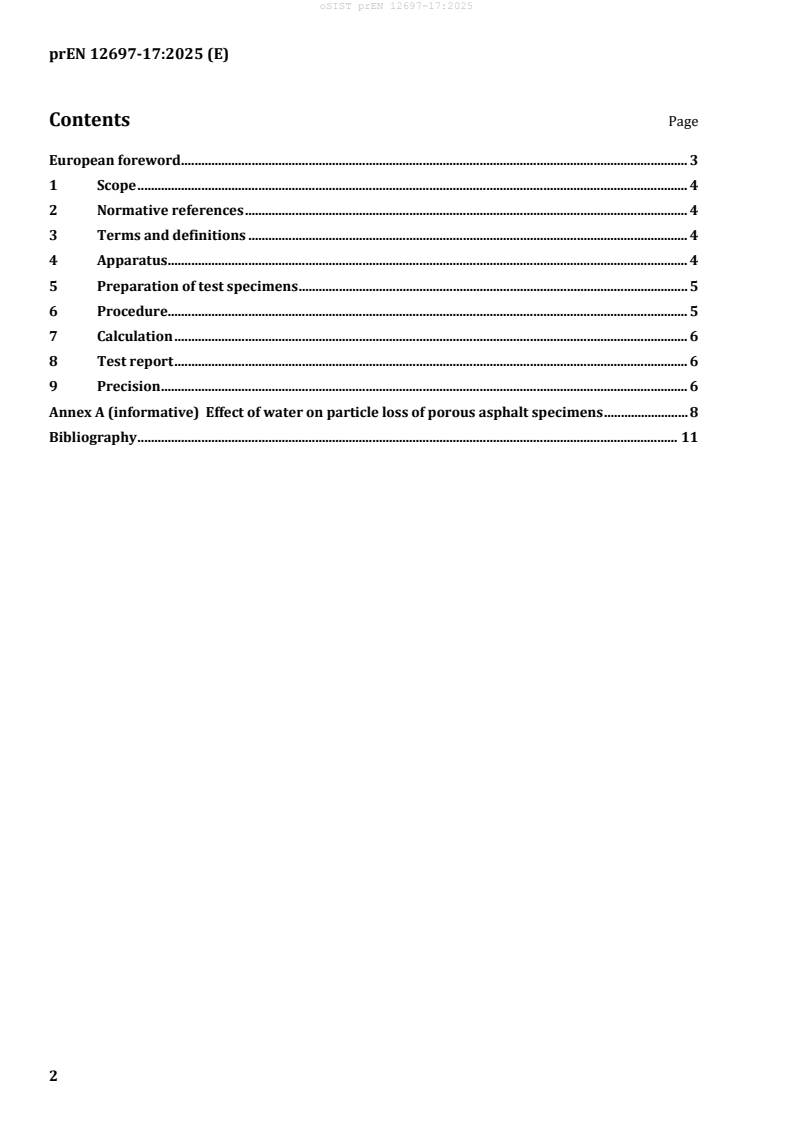
Contents Page
European foreword . 3
1 Scope . 4
2 Normative references . 4
3 Terms and definitions . 4
4 Apparatus . 4
5 Preparation of test specimens . 5
6 Procedure. 5
7 Calculation . 6
8 Test report . 6
9 Precision . 6
Annex A (informative) Effect of water on particle loss of porous asphalt specimens . 8
Bibliography . 11
oSIST prEN 12697-17:2025
prEN 12697-17:2025 (E)
European foreword
This document (prEN 12697-17:2025 has been prepared by Technical Committee CEN/TC 227 “Road
materials”, the secretariat of which is held by BSI.
This document is currently submitted to the CEN Enquiry.
This document will supersede EN 12697-17:2017.
prEN 12697-17:2025 includes the following significant technical changes with respect to
EN 12697-17:2017:
— [Clause 2] the series title no longer makes the method exclusive to hot mix asphalt. Addition of
EN 12697-29 and removal of EN 12697-35;
— [Subclause 4.2] “accuracy of ±0,5 °C” amended to read: maximum permissible error of 0,5 °C;
— [Subclause 4.5] “accuracy of ±0,1 %” amended to read: readable to 0,1 g and with a maximum
permissible error of 1 g;
— [Clause 5] rewording and renumbering of text. Test specimen requirements changed from mass to
dimensions. Deletion of Clause describing the use of asphalt with an aggregate size greater than
16 mm;
— [Clause 6] mass symbol changed from “W” to “m”. Deletion of text “3,1 rad/s to 3,5 rad/s”;
— [Clause 7] mass symbol changed from “W” to “m”;
— [Clause 8] rewording and renumbering of information for the test report;
— [Annex A]: addition of new informative Annex A on the effect of water on particle loss of porous
asphalt specimens.
oSIST prEN 12697-17:2025
prEN 12697-17:2025 (E)
1 Scope
This document specifies a test method for determining the particle loss of porous asphalt mixtures.
Particle loss is assessed by the loss of mass of porous asphalt samples after turns in the Los Angeles
machine. This test enables the estimation of the abrasion resistance of porous asphalt. The test applies to
laboratory compacted cylindrical specimens of porous asphalt mixtures, the upper sieve size of which
does not exceed 22,4 mm. It does not reflect the abrasive effect by studded tyres.
2 Normative references
The following documents are referred to in the text in such a way that some or all of their content
constitutes requirements of this document. For dated references, only the edition cited applies. For
undated references, the latest edition of the referenced document (including any amendments) applies.
EN 1097-2, Tests for mechanical and physical properties of aggregates - Part 2: Methods for the
determination of resistance to fragmentation
EN 12697-5, Bituminous mixtures - Test methods - Part 5: Determination of the maximum density
EN 12697-6, Bituminous mixtures - Test methods - Part 6: Determination of bulk density of bituminous
specimens
EN 12697-8, Bituminous mixtures - Test methods - Part 8: Determination of void characteristics of
bituminous specimens
EN 12697-29, Bituminous mixtures - Test methods - Part 29: Determination of the dimensions of a
bituminous specimen
EN 12697-30, Bituminous mixtures - Test methods - Part 30: Specimen preparation by impact compactor
EN 12697-31, Bituminous mixtures - Test methods - Part 31: Specimen preparation by gyratory compactor
3 Terms and definitions
No terms and definitions are listed in this document.
ISO and IEC maintain terminology databases for use in standardization at the following addresses:
— ISO Online browsing platform: available at https://www.iso.org/obp
— IEC Electropedia: available at https://www.electropedia.org/
4 Apparatus
4.1 Los-Angeles-machine, as specified in EN 1097-2.
4.2 Thermometer, capable of covering the test temperature range with a maximum permissible error
of 0,5 °C.
4.3 Chamber, room or enclosure, large enough to fit the Los-Angeles-machine and capable of
maintaining the test temperature ± 2 °C in the vicinity of the Los-Angeles-machine.
4.4 Oven, equipped with a closed ventilation system or a chamber fitted with a thermostatic control
to maintain the test temperature within ± 1 °C in the vicinity of the samples.
oSIST prEN 12697-17:2025
prEN 12697-17:2025 (E)
4.5 Balance, of suitable capacity for the mass to be weighed, readable to 0,1 g and with a maximum
permissible error of 1 g.
5 Preparation of test specimens
5.1 At least five specimens shall be prepared for each sample and condition tested.
5.2 The bituminous mixture for specimens shall be prepared in accordance with EN 12697-35.
5.3 The specimens shall be cylindrical moulded by laboratory compaction as specified in EN 12697-30
by applying 2 × 50 blows, or EN 12697-31 compacted by 40 gyrations.
NOTE The compaction method can have an influence on the result.
5.4 The cylindrical specimens shall have a diameter of (100 ± 3) mm and a height of (63,5 ± 2,5) mm.
Dimensions of each test specimen shall be measured in accordance with EN 12697-29.
For mixtures with a bulk density of approximately 2,0 Mg/m , specimens with a mass of (1,0 ± 0,2) kg
should comply.
5.5 After the specimens have been compacted and removed from the mould, their bulk density shall be
determined in accordance with EN 12697-6 (Procedure D: bulk density by dimensions). The maximum
density of the mixture shall be determined in accordance with EN 12697-5, and then the void content of
each specimen shall be determined in accordance with EN 12697-8.
NOTE The density of the specimens can affect the result because the mass of a specimen will influence the
impact force imparted on contact during the test, particu
...