

SIST EN 14212:2025/oprA1:2026
(Amendment)Ambient air - Standard method for the measurement of the concentration of sulphur dioxide by ultraviolet fluorescence
- Abstract
This document specifies a continuous measurement method for the determination of the concentration of sulfur dioxide present in ambient air based on the ultraviolet fluorescence measuring principle. This document describes the performance characteristics and sets the relevant minimum criteria required to select an appropriate ultraviolet fluorescence analyser by means of type testing. It also includes the evaluation of the suitability of an analyser for use in a specific fixed site so as to meet the data quality requirements as specified in Annex I of Directive 2008/50/EC [1] and requirements during sampling, calibration and quality assurance for use.
The method is applicable to the determination of the mass concentration of sulphur dioxide present in ambient air up to 1000 µg/m3. This concentration range represents the certification range for sulfur dioxide for type testing.
NOTE 1 It is possible to use other ranges depending on the levels present in ambient air.
NOTE 2 When this document is used for purposes other than for measurements required by Directive 2008/50/EC, the ranges and uncertainty requirements possibly do not apply.
The method covers the determination of ambient air concentrations of sulfur dioxide in locations classified as rural areas, urban-background areas, and for sampling influenced by traffic or industrial sources.
The results are expressed in µg/m3 (at 20 °C and 101,3 kPa).
NOTE 3 1 000 µg/m3 of SO2 corresponds to 376 nmol/mol of SO2.
This document contains information for different groups of users.
Clause 5 to Clause 7 and Annex C and Annex D contain general information about the principles of sulfur dioxide measurement by ultraviolet fluorescence analyser and sampling equipment.
Clause 8 and Annex E are specifically directed towards test houses and laboratories that perform type testing of sulfur dioxide analysers. These sections contain information about:
— type testing conditions, test procedures and test requirements;
— analyser performance requirements;
— evaluation of the type testing results;
— evaluation of the uncertainty of the measurement results of the sulfur dioxide analyser based on the type testing results.
Clause 9 to Clause 11 and Annex F and Annex G are directed towards monitoring networks performing the practical measurements of sulfur dioxide in ambient air. These sections contain information about:
— initial installation of the analyser in the monitoring network and acceptance testing;
— ongoing quality assurance/quality control;
— calculation and reporting of measurement results;
— evaluation of the uncertainty of the measurement results under practical monitoring conditions.
This document represents an evolution of earlier editions (EN 14212:2005 and EN 14212:2012). It is advisable that when equipment is procured it complies fully with this document.
NOTE 4 Type testing performed prior to the publication of this document for the purpose of demonstrating equivalence are still valid.
NOTE 5 Analysers type tested prior to the publication of this document remain valid for use for regulated monitoring purposes.
- Status
- Not Published
- Public Enquiry End Date
- 02-Jan-2027
- Technical Committee
- KAZ - Air quality
- Current Stage
- 4020 - Public enquire (PE) (Adopted Project)
- Start Date
- 03-Nov-2026
- Due Date
- 23-Mar-2027

SIST EN 14212:2025/oprA1:2026 is a draft amendment to EN 14212:2024 on measuring sulphur dioxide in ambient air by ultraviolet fluorescence. It updates the standard method used to select, type test, install, check and operate sulphur dioxide analysers for fixed-site ambient air monitoring.
What does SIST EN 14212:2025/oprA1:2026 specify?
SIST EN 14212:2025/oprA1:2026 specifies a continuous method for determining the concentration of sulphur dioxide in ambient air by the ultraviolet fluorescence measuring principle. It also sets the performance characteristics and minimum criteria used to select an analyser by type testing, and it covers suitability checks for use at a specific fixed site.
The method applies up to 1000 µg/m3, which is the certification range for type testing. Results are expressed in µg/m3 at 20 °C and 101,3 kPa, so users can compare data from different sites and systems on the same basis.
The document is organized for different users:
- Clauses 5 to 7 and Annex C and Annex D give general information on the measurement principle and sampling equipment.
- Clause 8 and Annex E are for test houses and laboratories that perform type testing.
- Clauses 9 to 11 and Annex F and Annex G are for monitoring networks that carry out practical measurements and data reporting.
| Annex | What it covers |
|---|---|
| A | Establishment of the regression line |
| C | General information on the principles of sulphur dioxide measurement |
| D | Procedure for applying test gas |
| E | Type testing requirements and evaluation |
| F | Combined standard uncertainty |
| G | Combined standard uncertainty under practical monitoring conditions |
| H | Electrical voltage contribution to uncertainty |
What are the key requirements of SIST EN 14212:2025/oprA1:2026?
SIST EN 14212:2025/oprA1:2026 mainly tightens and clarifies how analysers are qualified, checked and maintained. The amendment focuses on the parts that affect analyser selection, calibration behaviour, sampling integrity and uncertainty evaluation.
Updated performance and definition requirements
Clause 3 updates the definition of ambient air so it excludes workplaces as defined by Directive 89/654/EEC. In practice, this keeps the method aligned with ambient monitoring rather than occupational exposure assessment.
Clause 5.2 updates the formula used for the relevant performance characteristics and criteria. This matters because the analyser acceptance calculations must use the revised expression when checking compliance with the method.
Sampling path and filter details
Clause 6.3.2 updates the particle filter material to 316 L stainless steel, and Clause 6.5 updates the reference to the sampling pump to manifold section and tightens the leakage-related limit. In practice, this reduces ambiguity in the sampling train and helps users build and verify the same kind of sample path.
Clause 9.7.1 adds an action criterion for changing particle filters based on the analyser response to sulphur dioxide span gas passing the filter. This gives operators a clear trigger for maintenance when filter performance starts to affect the reading.
Type testing and calibration behaviour
Clause 8.2 updates several type-testing performance criteria, including residual at zero and drift limits at zero and span. Clause 8.4.6 also revises the linearity check sequence and requires the concentrations to be applied in a defined order, with a stable reading before each measurement. In practice, laboratories must follow the revised sequence and allow the analyser to settle before recording results.
Annex E updates type testing requirement tables and formulas, including the availability criterion and the uncertainty calculation items used for repeatability and reproducibility. This affects how test houses judge whether an analyser meets the type-testing standard.
Field use, checks and uncertainty
Clause 9.4.2 updates the frequency for testing sampling lines, Clause 9.6.1.2 updates the zero-drift action criteria, and Clause 9.5.5 removes one treatment step after performance exceedance. These changes matter for routine monitoring because they define when checks must be done and when corrective action is required.
Annex F, Annex G and Annex H update the combined standard uncertainty formulas, including the voltage-related term in Annex H. This is important for monitoring networks because uncertainty must be calculated with the revised component structure.
What terms does SIST EN 14212:2025/oprA1:2026 define?
- ambient air - outdoor air in the troposphere used for public environmental monitoring, excluding workplaces under the referenced workplace directive.
- sulphur dioxide (SO2) - the gas measured by the analyser method described in this standard.
- ultraviolet fluorescence - the measuring principle used to determine sulphur dioxide continuously in ambient air.
- type testing - the laboratory evaluation used to check whether an analyser meets the required performance criteria.
- fixed site - a specific monitoring location where the analyser is installed for routine ambient air measurements.
- quality assurance/quality control (QA/QC) - the checks and ongoing control steps used to keep monitoring data reliable.
- certification range - the concentration range up to 1000 µg/m3 used for type testing of sulphur dioxide analysers.
Who uses SIST EN 14212:2025/oprA1:2026?
SIST EN 14212:2025/oprA1:2026 is used by environmental monitoring networks, test laboratories, test houses, analyser suppliers, and public authorities responsible for ambient air quality. It is also relevant for buyers and technical staff who need to specify, procure, install, verify or audit sulphur dioxide monitoring equipment.
In practice, these users apply the document to type testing, acceptance testing, calibration, maintenance planning, uncertainty evaluation and reporting of sulphur dioxide data.
What changed in SIST EN 14212:2025/oprA1:2026 from the previous edition?
SIST EN 14212:2025/oprA1:2026 is an amendment to EN 14212:2024 and the change set focuses on critical errors. The stated updates include the revised definition of ambient air, corrected formulas, adjusted performance criteria, revised sampling and filter references, a new filter-change action criterion, and updated uncertainty expressions in Annex F, Annex G and Annex H.
It also revises the linearity test sequence, the maintenance and calibration references, and the type-testing tables in Annex E. The amendment keeps earlier type testing performed for equivalence valid and keeps earlier type-tested analysers valid for regulated monitoring use.
Which standards and legal references are used with SIST EN 14212:2025/oprA1:2026?
SIST EN 14212:2025/oprA1:2026 is used together with Directive 2008/50/EC, whose Annex I data quality requirements it supports. The document also uses Directive 89/654/EEC in the definition of ambient air to exclude workplaces.
EN 14212:2024 is the base European Standard that this amendment modifies. That means users should read the amendment together with the underlying standard when applying the method.
What does the SIST EN 14212:2025/oprA1:2026 document contain?
SIST EN 14212:2025/oprA1:2026 contains clause-level edits, revised tables, and updated formulas rather than a full reissue of the method. The modified parts cover the scope, terms and definitions, performance criteria, sampling details, calibration line checks, maintenance frequency, and data handling after performance exceedance.
It also includes revised annex material for regression-line establishment, test-gas application, type testing, and uncertainty calculation. For laboratory work and monitoring practice, the most useful parts are the updated tables in Clause 8 and Annex E, and the uncertainty formulas in Annex F, Annex G and Annex H.
Relations
- Effective Date
- 01-Dec-2026
Get Certified
Connect with accredited certification bodies for this standard

CIS Institut d.o.o.
Personal Protective Equipment (PPE) certification body. Notified Body NB-2890 for EU Regulation 2016/425 PPE.

Kiwa BDA Testing
Building and construction product certification.
Kmetijski inštitut Slovenije
Agricultural Institute of Slovenia. Soil testing, plant health, agricultural product analysis.
Sponsored listings
Frequently Asked Questions
SIST EN 14212:2025/oprA1:2026 is a draft published by the Slovenian Institute for Standardization (SIST). Its full title is "Ambient air - Standard method for the measurement of the concentration of sulphur dioxide by ultraviolet fluorescence". This standard covers: This document specifies a continuous measurement method for the determination of the concentration of sulfur dioxide present in ambient air based on the ultraviolet fluorescence measuring principle. This document describes the performance characteristics and sets the relevant minimum criteria required to select an appropriate ultraviolet fluorescence analyser by means of type testing. It also includes the evaluation of the suitability of an analyser for use in a specific fixed site so as to meet the data quality requirements as specified in Annex I of Directive 2008/50/EC [1] and requirements during sampling, calibration and quality assurance for use. The method is applicable to the determination of the mass concentration of sulphur dioxide present in ambient air up to 1000 µg/m3. This concentration range represents the certification range for sulfur dioxide for type testing. NOTE 1 It is possible to use other ranges depending on the levels present in ambient air. NOTE 2 When this document is used for purposes other than for measurements required by Directive 2008/50/EC, the ranges and uncertainty requirements possibly do not apply. The method covers the determination of ambient air concentrations of sulfur dioxide in locations classified as rural areas, urban-background areas, and for sampling influenced by traffic or industrial sources. The results are expressed in µg/m3 (at 20 °C and 101,3 kPa). NOTE 3 1 000 µg/m3 of SO2 corresponds to 376 nmol/mol of SO2. This document contains information for different groups of users. Clause 5 to Clause 7 and Annex C and Annex D contain general information about the principles of sulfur dioxide measurement by ultraviolet fluorescence analyser and sampling equipment. Clause 8 and Annex E are specifically directed towards test houses and laboratories that perform type testing of sulfur dioxide analysers. These sections contain information about: — type testing conditions, test procedures and test requirements; — analyser performance requirements; — evaluation of the type testing results; — evaluation of the uncertainty of the measurement results of the sulfur dioxide analyser based on the type testing results. Clause 9 to Clause 11 and Annex F and Annex G are directed towards monitoring networks performing the practical measurements of sulfur dioxide in ambient air. These sections contain information about: — initial installation of the analyser in the monitoring network and acceptance testing; — ongoing quality assurance/quality control; — calculation and reporting of measurement results; — evaluation of the uncertainty of the measurement results under practical monitoring conditions. This document represents an evolution of earlier editions (EN 14212:2005 and EN 14212:2012). It is advisable that when equipment is procured it complies fully with this document. NOTE 4 Type testing performed prior to the publication of this document for the purpose of demonstrating equivalence are still valid. NOTE 5 Analysers type tested prior to the publication of this document remain valid for use for regulated monitoring purposes.
This document specifies a continuous measurement method for the determination of the concentration of sulfur dioxide present in ambient air based on the ultraviolet fluorescence measuring principle. This document describes the performance characteristics and sets the relevant minimum criteria required to select an appropriate ultraviolet fluorescence analyser by means of type testing. It also includes the evaluation of the suitability of an analyser for use in a specific fixed site so as to meet the data quality requirements as specified in Annex I of Directive 2008/50/EC [1] and requirements during sampling, calibration and quality assurance for use. The method is applicable to the determination of the mass concentration of sulphur dioxide present in ambient air up to 1000 µg/m3. This concentration range represents the certification range for sulfur dioxide for type testing. NOTE 1 It is possible to use other ranges depending on the levels present in ambient air. NOTE 2 When this document is used for purposes other than for measurements required by Directive 2008/50/EC, the ranges and uncertainty requirements possibly do not apply. The method covers the determination of ambient air concentrations of sulfur dioxide in locations classified as rural areas, urban-background areas, and for sampling influenced by traffic or industrial sources. The results are expressed in µg/m3 (at 20 °C and 101,3 kPa). NOTE 3 1 000 µg/m3 of SO2 corresponds to 376 nmol/mol of SO2. This document contains information for different groups of users. Clause 5 to Clause 7 and Annex C and Annex D contain general information about the principles of sulfur dioxide measurement by ultraviolet fluorescence analyser and sampling equipment. Clause 8 and Annex E are specifically directed towards test houses and laboratories that perform type testing of sulfur dioxide analysers. These sections contain information about: — type testing conditions, test procedures and test requirements; — analyser performance requirements; — evaluation of the type testing results; — evaluation of the uncertainty of the measurement results of the sulfur dioxide analyser based on the type testing results. Clause 9 to Clause 11 and Annex F and Annex G are directed towards monitoring networks performing the practical measurements of sulfur dioxide in ambient air. These sections contain information about: — initial installation of the analyser in the monitoring network and acceptance testing; — ongoing quality assurance/quality control; — calculation and reporting of measurement results; — evaluation of the uncertainty of the measurement results under practical monitoring conditions. This document represents an evolution of earlier editions (EN 14212:2005 and EN 14212:2012). It is advisable that when equipment is procured it complies fully with this document. NOTE 4 Type testing performed prior to the publication of this document for the purpose of demonstrating equivalence are still valid. NOTE 5 Analysers type tested prior to the publication of this document remain valid for use for regulated monitoring purposes.
SIST EN 14212:2025/oprA1:2026 is classified under the following ICS (International Classification for Standards) categories: 13.040.20 - Ambient atmospheres. The ICS classification helps identify the subject area and facilitates finding related standards.
SIST EN 14212:2025/oprA1:2026 has the following relationships with other standards: It is inter standard links to SIST EN 14212:2025. Understanding these relationships helps ensure you are using the most current and applicable version of the standard.
SIST EN 14212:2025/oprA1:2026 is associated with the following European legislation: EU Directives/Regulations: 2008/50/EC. When a standard is cited in the Official Journal of the European Union, products manufactured in conformity with it benefit from a presumption of conformity with the essential requirements of the corresponding EU directive or regulation.
SIST EN 14212:2025/oprA1:2026 is available in PDF format for immediate download after purchase. The document can be added to your cart and obtained through the secure checkout process. Digital delivery ensures instant access to the complete standard document.
Standards Content (Sample)
SLOVENSKI STANDARD
01-december-2026
Zunanji zrak - Standardna metoda za določanje koncentracije žveplovega dioksida
z ultravijolično fluorescenco - Dopolnilo A1
Ambient air - Standard method for the measurement of the concentration of sulphur
dioxide by ultraviolet fluorescence
Außenluft - Messverfahren zur Bestimmung der Konzentration von Schwefeldioxid mit
Ultraviolett-Fluoreszenz Außenluft - Messverfahren zur Bestimmung der Konzentration
von Schwefeldioxid mit Ultraviolett-Fluoreszenz
Air ambiant - Méthode normalisée pour le mesurage de la concentration en dioxyde de
soufre par fluorescence U.V.
Ta slovenski standard je istoveten z: EN 14212:2024/prA1
ICS:
13.040.20 Kakovost okoljskega zraka Ambient atmospheres
2003-01.Slovenski inštitut za standardizacijo. Razmnoževanje celote ali delov tega standarda ni dovoljeno.
DRAFT
EUROPEAN STANDARD
EN 14212:2024
NORME EUROPÉENNE
EUROPÄISCHE NORM
prA1
October 2026
ICS 13.040.20
English Version
Ambient air - Standard method for the measurement of the
concentration of sulphur dioxide by ultraviolet
fluorescence
Air ambiant - Méthode normalisée pour le mesurage de Außenluft - Messverfahren zur Bestimmung der
la concentration en dioxyde de soufre par fluorescence Konzentration von Schwefeldioxid mit Ultraviolett-
U.V. Fluoreszenz Außenluft - Messverfahren zur
Bestimmung der Konzentration von Schwefeldioxid
mit Ultraviolett-Fluoreszenz
This draft amendment is submitted to CEN members for enquiry. It has been drawn up by the Technical Committee CEN/TC 264.
This draft amendment A1, if approved, will modify the European Standard EN 14212:2024. If this draft becomes an amendment,
CEN members are bound to comply with the CEN/CENELEC Internal Regulations which stipulate the conditions for inclusion of
this amendment into the relevant national standard without any alteration.
This draft amendment was established by CEN in three official versions (English, French, German). A version in any other
language made by translation under the responsibility of a CEN member into its own language and notified to the CEN-CENELEC
Management Centre has the same status as the official versions.
CEN members are the national standards bodies of Austria, Belgium, Bulgaria, Croatia, Cyprus, Czech Republic, Denmark, Estonia,
Finland, France, Germany, Greece, Hungary, Iceland, Ireland, Italy, Latvia, Lithuania, Luxembourg, Malta, Netherlands, Norway,
Poland, Portugal, Republic of North Macedonia, Romania, Serbia, Slovakia, Slovenia, Spain, Sweden, Switzerland, Türkiye and
United Kingdom.
Recipients of this draft are invited to submit, with their comments, notification of any relevant patent rights of which they are
aware and to provide supporting documentation.
Warning : This document is not a European Standard. It is distributed for review and comments. It is subject to change without
notice and shall not be referred to as a European Standard.
EUROPEAN COMMITTEE FOR STANDARDIZATION
COMITÉ EUROPÉEN DE NORMALISATION
EUROPÄISCHES KOMITEE FÜR NORMUNG
CEN-CENELEC Management Centre: Rue de la Science 23, B-1040 Brussels
© 2026 CEN All rights of exploitation in any form and by any means reserved Ref. No. EN 14212:2024/prA1:2026 E
worldwide for CEN national Members.
EN 14212/prA1:2026 (E)
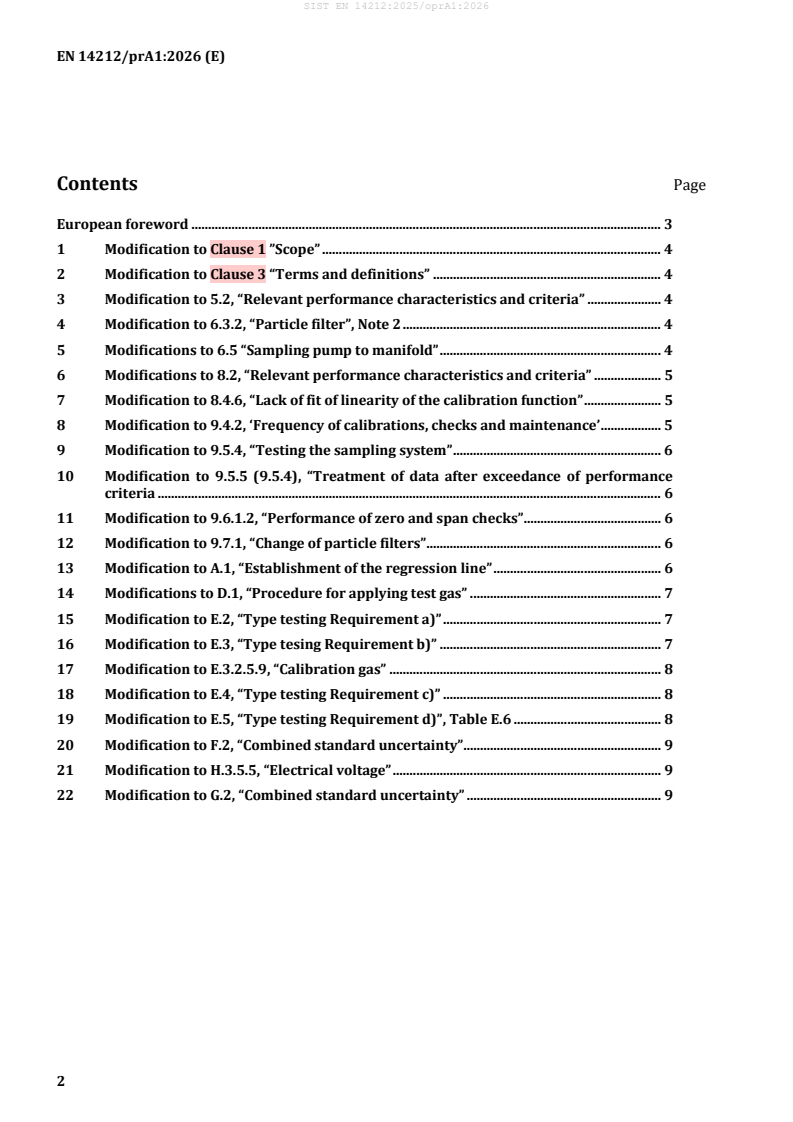
Contents Page
European foreword . 3
1 Modification to Clause 1 ”Scope” . 4
2 Modification to Clause 3 “Terms and definitions” . 4
3 Modification to 5.2, “Relevant performance characteristics and criteria” . 4
4 Modification to 6.3.2, “Particle filter”, Note 2 . 4
5 Modifications to 6.5 “Sampling pump to manifold” . 4
6 Modifications to 8.2, “Relevant performance characteristics and criteria” . 5
7 Modification to 8.4.6, “Lack of fit of linearity of the calibration function” . 5
8 Modification to 9.4.2, ‘Frequency of calibrations, checks and maintenance’ . 5
9 Modification to 9.5.4, “Testing the sampling system” . 6
10 Modification to 9.5.5 (9.5.4), “Treatment of data after exceedance of performance
criteria . 6
11 Modification to 9.6.1.2, “Performance of zero and span checks” . 6
12 Modification to 9.7.1, “Change of particle filters”. 6
13 Modification to A.1, “Establishment of the regression line” . 6
14 Modifications to D.1, “Procedure for applying test gas” . 7
15 Modification to E.2, “Type testing Requirement a)” . 7
16 Modification to E.3, “Type tesing Requirement b)” . 7
17 Modification to E.3.2.5.9, “Calibration gas” . 8
18 Modification to E.4, “Type testing Requirement c)” . 8
19 Modification to E.5, “Type testing Requirement d)”, Table E.6 . 8
20 Modification to F.2, “Combined standard uncertainty”. 9
21 Modification to H.3.5.5, “Electrical voltage” . 9
22 Modification to G.2, “Combined standard uncertainty” . 9
European foreword
This document (EN 14212:2024/prA1:2026) has been prepared by Technical Committee CEN/TC 264
“Air quality”, the secretariat of which is held by DIN.
This document is currently submitted to the CEN Enquiry.
This amendment addresses only the critical errors identified in the EN 14212:2024. Errors considered as
minor by CEN/TC 264/WG 12 will be addressed in the subsequent revision of EN 14212.
This document has been prepared under a Standardization Request given to CEN by the European
Commission and the European Free Trade Association, and supports essential requirements of
EU Directive(s) / Regulation(s).
1 Modification to Clause 1 ”Scope”
Remove the following sentence from NOTE 4:
“As newer versions of analysers tested under this document become available, discontinue the use of
older reference analysers.”.
2 Modification to Clause 3 “Terms and definitions”
Replace definition 3.2 ambient air:
“3.2
ambient air
outdoor
...