

SIST ES 204 085 V1.1.1:2026
(Main)Environmental Engineering (EE) - Guidance on simplified Life Cycle Assessments (LCA) of Information and Communication Technologies (ICT)
- Abstract
The present document provides guidance on how to perform, use and report simplified LCAs for ICT products and services. Moreover, it gives guidance on when the use of simplified approaches is applicable and what are the limitations.
- Status
- Not Published
- Technical Committee
- SPN - Services and Protocols for Networks
- Current Stage
- 6060 - National Implementation/Publication (Adopted Project)
- Start Date
- 22-Oct-2026
- Due Date
- 27-Dec-2026
Buy Documents
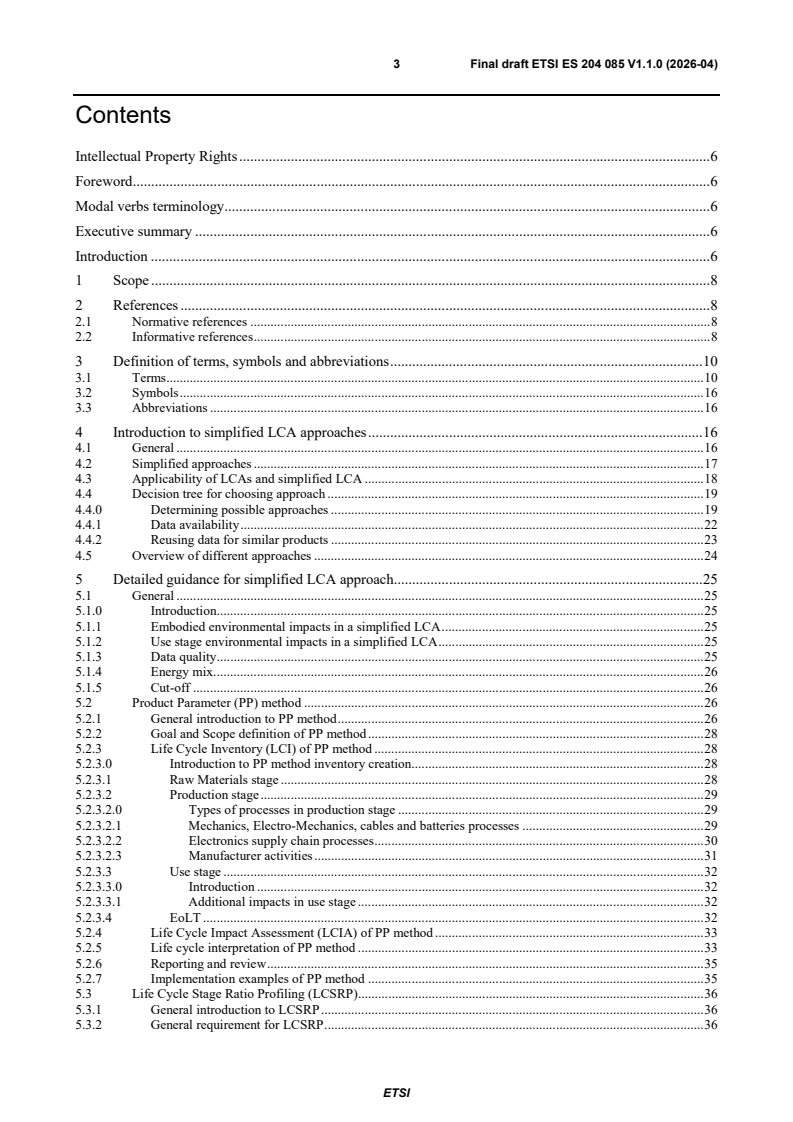
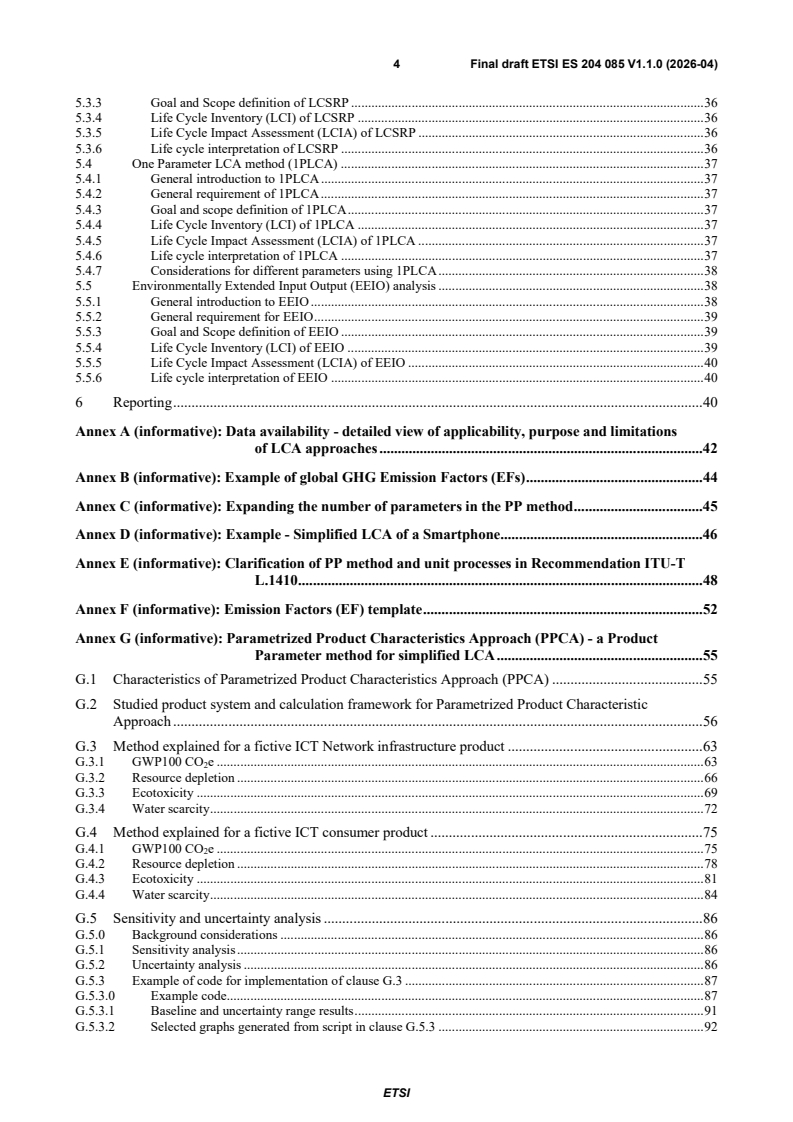
ETSI ES 204 085 V1.1.0 (2026-04) - Environmental Engineering (EE); Guidance on simplified Life Cycle Assessments (LCA) of Information and Communication Technologies (ICT)
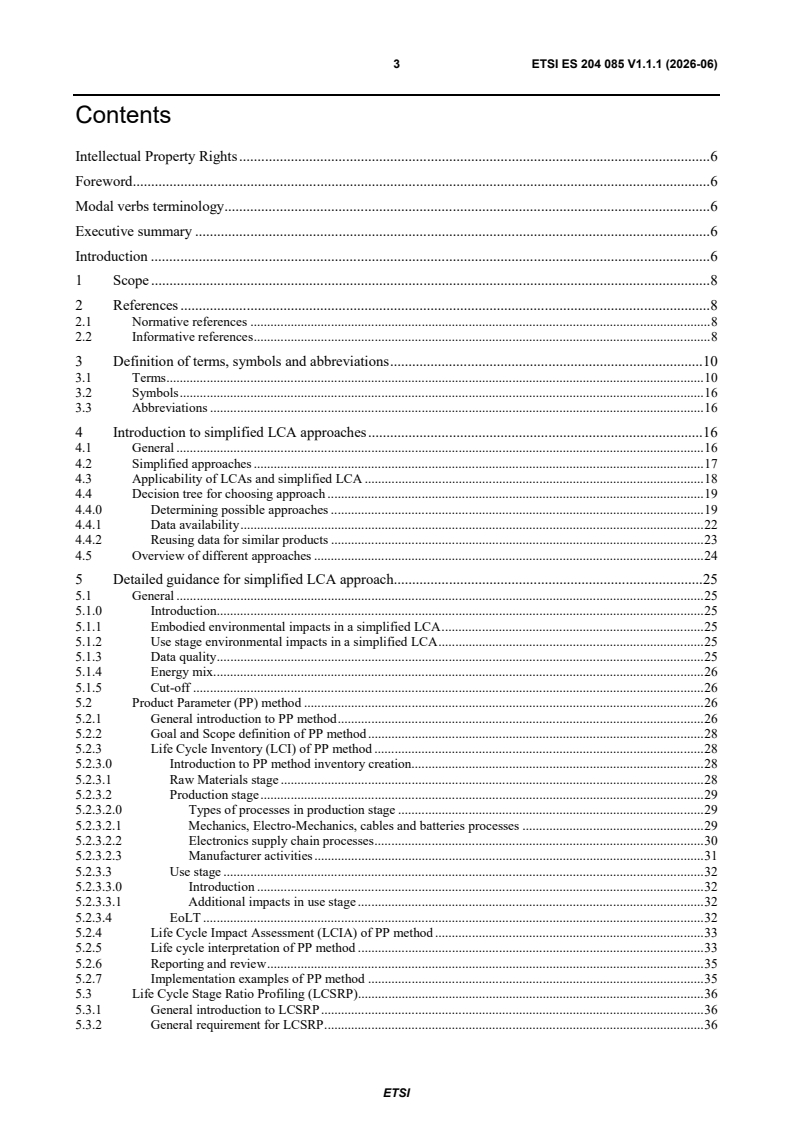
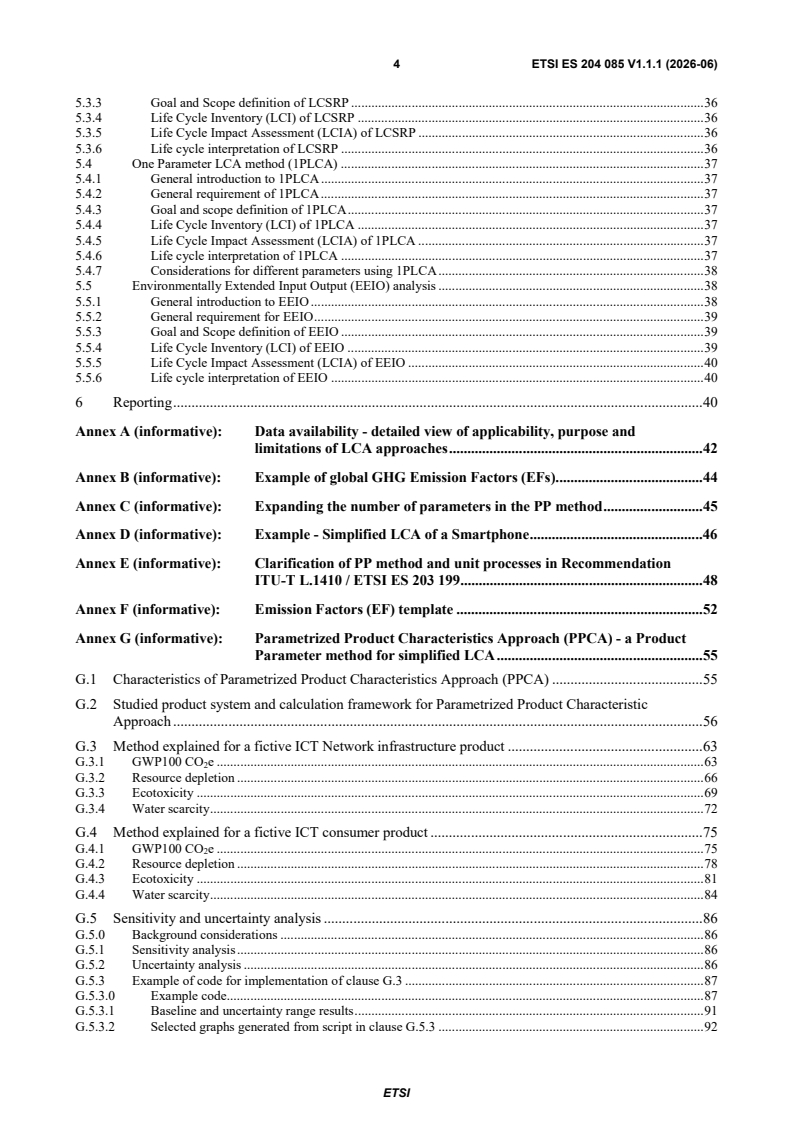
ETSI ES 204 085 V1.1.1 (2026-06) - Environmental Engineering (EE); Guidance on simplified Life Cycle Assessments (LCA) of Information and Communication Technologies (ICT)
SIST ES 204 085 V1.1.1:2026 is a SIST standard based on ETSI ES 204 085 that gives guidance on simplified life cycle assessments (LCA) for information and communication technologies (ICT). It explains how to perform, use and report simplified LCAs for ICT products and services, and when simplified approaches are suitable and where their limits matter in practice.
What does SIST ES 204 085 V1.1.1:2026 specify?
SIST ES 204 085 V1.1.1:2026 specifies guidance for simplified LCA studies of ICT products and services. It is written for cases where a full LCA in line with Recommendation ITU-T L.1410 / ETSI ES 203 199 would be too time-consuming or data-intensive, but a structured environmental estimate is still needed.
The document is organized around the life cycle view used in ICT LCA. Clause 3 gives terms and abbreviations, clause 4 introduces simplified approaches and how to choose among them, clause 5 gives detailed guidance for each simplified method, and clause 6 covers reporting. The annexes provide examples, emission factor material, recycling guidance, worked calculations and method illustrations.
| Annex | What it covers |
|---|---|
| Annex A | Data availability, and the applicability, purpose and limitations of different LCA approaches |
| Annex B | Example global greenhouse gas (GHG) emission factors |
| Annex C | Expanding the number of parameters in the Product Parameter (PP) method |
| Annex D | Simplified LCA example for a smartphone |
| Annex E | Clarification of the PP method and unit processes in Recommendation ITU-T L.1410 / ETSI ES 203 199 |
| Annex F | Emission factor (EF) template |
| Annex G | Parametrized Product Characteristics Approach (PPCA) example |
| Annex H | Simplified LCA example for a typical mobile network radio |
| Annex I | Input data and recycling approaches |
| Annex J | Component characterization example |
| Annex K | Example of GHG estimation using Life Cycle Stage Ratio Profiling (LCSRP) |
| Annex L | Similarity of products |
| Annex M | Example of GHG estimation for a display using One Parameter LCA (1PLCA) |
| Annex N | Example of Global Warming Potential (GWP) calculation using Environmentally Extended Input Output (EEIO) |
| Annex O | Bibliography |
| Annex P | Change history |
What are the key requirements of SIST ES 204 085 V1.1.1:2026?
SIST ES 204 085 V1.1.1:2026 is built around the idea that a simplified LCA must stay consistent with the ICT LCA framework in Recommendation ITU-T L.1410 / ETSI ES 203 199, even when it reduces detail. In practice, that means the study still needs a clear goal and scope, a defined product system, inventory data, impact assessment and interpretation.
Choosing the right approach matters
Clause 4 explains that simplified methods are useful when you need a faster, lower-effort estimate of environmental impact. The document points to uses such as hotspot identification, decision support, monitoring indicators, understanding new services, and comparing improvements between generations. That matters because the method should match the decision you are trying to support, not just the data you happen to have.
Clause 4 also warns that a general LCA is less suitable for benchmarking across unrelated studies, for product performance legislation, and for labelling based only on LCA results. For those uses, the document points readers toward more detailed or better-defined assessment conditions.
The simplified methods must still follow the ICT LCA structure
Clause 4 states that a simplified method shall explicitly show how it simplifies the requirements of Recommendation ITU-T L.1410 / ETSI ES 203 199. It shall also use the same terminology and nomenclature, and its life cycle stages shall have the same start and end as the main ICT LCA framework.
That matters in practice because a simplified study is only comparable if it uses the same stage boundaries and definitions. If a company changes the boundary, it can easily understate or overstate embodied impacts, use-stage impacts or end-of-life treatment (EoLT) effects.
Data quality and emission factors are central
Clause 5.1 says the document provides examples of emission factors that can be used when primary data or supply-chain data are unavailable. It also says the LCA practitioner shall justify data choices, especially when using non-public sources, third-party databases or other secondary data. For a reader, this means the study must record where the data came from and why it was selected.
The same part of the document links data quality to intended use. If the result will support a higher-stakes decision, the practitioner needs stronger data and clearer assumptions. Annex B and Annex F support this by giving example factors and a template for structuring them.
The PP method is the main simplified hardware approach
Clause 5.2 describes the Product Parameter (PP) method. It simplifies an ICT product by grouping similar parts and materials into a limited set of parameters rather than modelling every component separately. This matters because complex electronics often contain thousands of parts, and the PP method keeps the model manageable while still focusing on the main contributors.
The PP method still covers raw materials, production, use and EoLT. Clause 5.2.3 shows that black-box treatment is allowed for some parts, but key contributors should still be understood well enough to avoid double counting or hidden omissions. The document also distinguishes standard components, key electronic components, manufacturer assembly and support activities, use-stage electricity, and EoLT collection and recycling.
Similarity-based methods are for reuse and screening
Clause 5.3 introduces Life Cycle Stage Ratio Profiling (LCSRP), and clause 5.4 introduces One Parameter LCA (1PLCA). These methods are aimed at reuse of existing LCA knowledge, especially when products are similar or when only one or a few characteristics are available. That matters for product families, quick screening and internal comparison of design options.
Clause 5.4 says more than one parameter can be combined, but when the number of parameters grows, the approach starts to resemble the PP method. Annex L and Annex M provide examples of how similarity and parameter choice affect the result.
EEIO is useful, but only for the right kind of problem
Clause 5.5 says Environmentally Extended Input Output (EEIO) analysis is useful for basic commodities and upstream supply-chain activities. At the same time, it notes that EEIO is less representative for complex high-tech ICT products and may miss important use-stage and EoLT effects.
In practice, that means EEIO can work well for a screening estimate or upstream material view, but it should not be treated as a full substitute for a product LCA where the product use phase is significant.
Reporting must be transparent enough to reuse
Clause 6 requires reporting to follow both Recommendation ITU-T L.1410 / ETSI ES 203 199 and this document. The report shall identify the product system, inventory type, goal and scope, simplified method used, data sources and age, impact categories, results, cut-offs, limitations, and sensitivity and uncertainty where relevant.
The report shall also state whether location-based or market-based data were used. For comparative work, results may be shown as absolute values or relative differences, but the report should also include absolute values when percentages are extreme. That helps readers judge whether the comparison is meaningful.
What terms does SIST ES 204 085 V1.1.1:2026 define?
- Simplified Life Cycle Assessment - A streamlined method for assessing environmental impact of a product or service, designed to be faster and less resource-intensive than a full ICT LCA.
- Product Parameter (PP) - A limited set of product characteristics used to represent grouped materials, components and processes in a simplified LCA.
- Life Cycle Stage Ratio Profiling (LCSRP) - A simplified approach that uses stage-level ratios from an existing LCA to profile a similar product or service.
- One Parameter LCA (1PLCA) - A simplified method that estimates impact from one main product parameter, sometimes with an additional adjustment parameter.
- Environmentally Extended Input Output (EEIO) analysis - A method that links economic activity or purchased inputs to environmental impacts using input-output relationships.
- Emission factor (EF) - A factor used to estimate GHG emissions from activity data such as mass, energy use or transport work.
- Functional unit - The reference unit used to compare LCA results on the same basis.
- End of Life Treatment (EoLT) - The stage covering collection and processing of waste products at the end of their life.
Who uses SIST ES 204 085 V1.1.1:2026?
SIST ES 204 085 V1.1.1:2026 is used by LCA practitioners, product engineers, manufacturers, suppliers, service providers and ICT organizations that need a practical environmental estimate. It is especially relevant for people working on smartphones, network equipment, displays, printed wiring boards, integrated circuits and other ICT products mentioned in the annex examples.
It also serves quality managers, buyers and decision-makers who need results for hotspot analysis, product development, supplier comparison, Scope 3 reporting, and internal environmental planning. The document is written for professional users who can interpret assumptions, data quality and uncertainty.
Which standards are used with SIST ES 204 085 V1.1.1:2026?
- Recommendation ITU-T L.1410 - The main ICT LCA methodology that this document simplifies and keeps as its baseline reference.
- ETSI ES 203 199 - Technically equivalent to Recommendation ITU-T L.1410 and used as the ETSI ICT LCA framework.
- ISO 14040:2006 - Provides the principles and framework for LCA.
- ISO 14044:2006 - Provides LCA requirements and guidelines.
Related references used in the document for context include Recommendation ITU-T L.1420 for Scope 3 guidance, Recommendation ITU-T L.1451 for aggregated positive sector-level impacts, Recommendation ITU-T L.1450 for ICT-sector environmental impact assessment, and ITU-T L. Suppl. 57 for Scope 3 guidance for telecommunication operators.
What does the SIST ES 204 085 V1.1.1:2026 document contain?
The document contains decision-tree figures for selecting between a full LCA and simplified alternatives, plus a high-level comparison of approach choices. It also contains method descriptions for PP, LCSRP, 1PLCA and EEIO, each with goal and scope, inventory, impact assessment and interpretation sections.
Several annexes provide practical material for implementation. Annex B and Annex F support factor-based calculations, Annex C explains how to extend the PP method, and Annex I explains recycling treatment, including the 50/50 method.
The worked examples are a major part of the document. Annex D covers a smartphone, Annex H covers a mobile network radio, Annex G gives a PPCA example with uncertainty and sensitivity analysis, Annex K shows LCSRP use, Annex M shows 1PLCA for a display, and Annex N shows an EEIO calculation. These examples help users translate the guidance into spreadsheets, screening studies and reporting outputs.
Buy Documents
ETSI ES 204 085 V1.1.0 (2026-04) - Environmental Engineering (EE); Guidance on simplified Life Cycle Assessments (LCA) of Information and Communication Technologies (ICT)
ETSI ES 204 085 V1.1.1 (2026-06) - Environmental Engineering (EE); Guidance on simplified Life Cycle Assessments (LCA) of Information and Communication Technologies (ICT)
Get Certified
Connect with accredited certification bodies for this standard

BSI Group
BSI (British Standards Institution) is the business standards company that helps organizations make excellence a habit.

NYCE
Mexican standards and certification body.
Sponsored listings
Frequently Asked Questions
SIST ES 204 085 V1.1.1:2026 is a standard published by the Slovenian Institute for Standardization (SIST). Its full title is "Environmental Engineering (EE) - Guidance on simplified Life Cycle Assessments (LCA) of Information and Communication Technologies (ICT)". This standard covers: The present document provides guidance on how to perform, use and report simplified LCAs for ICT products and services. Moreover, it gives guidance on when the use of simplified approaches is applicable and what are the limitations.
The present document provides guidance on how to perform, use and report simplified LCAs for ICT products and services. Moreover, it gives guidance on when the use of simplified approaches is applicable and what are the limitations.
SIST ES 204 085 V1.1.1:2026 is classified under the following ICS (International Classification for Standards) categories: 35.020 - Information technology (IT) in general. The ICS classification helps identify the subject area and facilitates finding related standards.
SIST ES 204 085 V1.1.1:2026 is available in PDF format for immediate download after purchase. The document can be added to your cart and obtained through the secure checkout process. Digital delivery ensures instant access to the complete standard document.
Standards Content (Sample)
Final draft ETSI ES 204 085 V1.1.0 (2026-04)
ETSI STANDARD
Environmental Engineering (EE);
Guidance on simplified Life Cycle Assessments (LCA) of
Information and Communication Technologies (ICT)
2 Final draft ETSI ES 204 085 V1.1.0 (2026-04)
Reference
DES/EE-EEPS62
Keywords
energy consumption, environment, environmental
impact, green-house gas emission, ICT, LCA,
smartphone
ETSI
650 Route des Lucioles
F-06921 Sophia Antipolis Cedex - FRANCE
Tel.: +33 4 92 94 42 00 Fax: +33 4 93 65 47 16
Siret N° 348 623 562 00017 - APE 7112B
Association à but non lucratif enregistrée à la
Sous-Préfecture de Grasse (06) N° w061004871
Important notice
The present document can be downloaded from the
ETSI Search & Browse Standards application.
The present document may be made available in electronic versions and/or in print. The content of any electronic and/or
print versions of the present document shall not be modified without the prior written authorization of ETSI. In case of any
existing or perceived difference in contents between such versions and/or in print, the prevailing version of an ETSI
deliverable is the one made publicly available in PDF format on ETSI deliver repository.
Users should be aware that the present document may be revised or have its status changed,
this information is available in the Milestones listing.
If you find errors in the present document, please send your comments to
the relevant service listed under Committee Support Staff.
If you find a security vulnerability in the present document, please report it through our
Coordinated Vulnerability Disclosure (CVD) program.
Notice of disclaimer & limitation of liability
The information provided in the present deliverable is directed solely to professionals who have the appropriate degree of
experience to understand and interpret its content in accordance with generally accepted engineering or
other professional standard and applicable regulations.
No recommendation as to products and services or vendors is made or should be implied.
No representation or warranty is made that this deliverable is technically accurate or sufficient or conforms to any law
and/or governmental rule and/or regulation and further, no representation or warranty is made of merchantability or fitness
for any particular purpose or against infringement of intellectual property rights.
In no event shall ETSI be held liable for loss of profits or any other incidental or consequential damages.
Any software contained in this deliverable is provided "AS IS" with no warranties, express or implied, including but not
limited to, the warranties of merchantability, fitness for a particular purpose and non-infringement of intellectual property
rights and ETSI shall not be held liable in any event for any damages whatsoever (including, without limitation, damages
for loss of profits, business interruption, loss of information, or any other pecuniary loss) arising out of or related to the use
of or inability to use the software.
Copyright Notification
No part may be reproduced or utilized in any form or by any means, electronic or mechanical, including photocopying and
microfilm except as authorized by written permission of ETSI.
The content of the PDF version shall not be modified without the written authorization of ETSI.
The copyright and the foregoing restriction extend to reproduction in all media.
© ETSI 2026.
All rights reserved.
ETSI
3 Final draft ETSI ES 204 085 V1.1.0 (2026-04)
Contents
Intellectual Property Rights . 6
Foreword . 6
Modal verbs terminology . 6
Executive summary . 6
Introduction . 6
1 Scope . 8
2 References . 8
2.1 Normative references . 8
2.2 Informative references . 8
3 Definition of terms, symbols and abbreviations . 10
3.1 Terms . 10
3.2 Symbols . 16
3.3 Abbreviations . 16
4 Introduction to simplified LCA approaches . 16
4.1 General . 16
4.2 Simplified approaches . 17
4.3 Applicability of LCAs and simplified LCA . 18
4.4 Decision tree for choosing approach . 19
4.4.0 Determining possible approaches . 19
4.4.1 Data availability . 22
4.4.2 Reusing data for similar products . 23
4.5 Overview of different approaches . 24
5 Detailed guidance for simplified LCA approach . 25
5.1 General . 25
5.1.0 Introduction. 25
5.1.1 Embodied environmental impacts in a simplified LCA . 25
5.1.2 Use stage environmental impacts in a simplified LCA . 25
5.1.3 Data quality . 25
5.1.4 Energy mix. 26
5.1.5 Cut-off . 26
5.2 Product Parameter (PP) method . 26
5.2.1 General introduction to PP method . 26
5.2.2 Goal and Scope definition of PP method . 28
5.2.3 Life Cycle Inventory (LCI) of PP method . 28
5.2.3.0 Introduction to PP method inventory creation. 28
5.2.3.1 Raw Materials stage . 28
5.2.3.2 Production stage . 29
5.2.3.2.0 Types of processes in production stage . 29
5.2.3.2.1 Mechanics, Electro-Mechanics, cables and batteries processes . 29
5.2.3.2.2 Electronics supply chain processes . 30
5.2.3.2.3 Manufacturer activities . 31
5.2.3.3 Use stage . 32
5.2.3.3.0 Introduction . 32
5.2.3.3.1 Additional impacts in use stage . 32
5.2.3.4 EoLT . 32
5.2.4 Life Cycle Impact Assessment (LCIA) of PP method . 33
5.2.5 Life cycle interpretation of PP method . 33
5.2.6 Reporting and review . 35
5.2.7 Implementation examples of PP method . 35
5.3 Life Cycle Stage Ratio Profiling (LCSRP) . 36
5.3.1 General introduction to LCSRP . 36
5.3.2 General requirement for LCSRP . 36
ETSI
4 Final draft ETSI ES 204 085 V1.1.0 (2026-04)
5.3.3 Goal and Scope definition of LCSRP . 36
5.3.4 Life Cycle Inventory (LCI) of LCSRP . 36
5.3.5 Life Cycle Impact Assessment (LCIA) of LCSRP . 36
5.3.6 Life cycle interpretation of LCSRP . 36
5.4 One Parameter LCA method (1PLCA) . 37
5.4.1 General introduction to 1PLCA . 37
5.4.2 General requirement of 1PLCA . 37
5.4.3 Goal and scope definition of 1PLCA . 37
5.4.4 Life Cycle Inventory (LCI) of 1PLCA . 37
5.4.5 Life Cycle Impact Assessment (LCIA) of 1PLCA . 37
5.4.6 Life cycle interpretation of 1PLCA . 37
5.4.7 Considerations for different parameters using 1PLCA . 38
5.5 Environmentally Extended Input Output (EEIO) analysis . 38
5.5.1 General introduction to EEIO . 38
5.5.2 General requirement for EEIO . 39
5.5.3 Goal and Scope definition of EEIO . 39
5.5.4 Life Cycle Inventory (LCI) of EEIO . 39
5.5.5 Life Cycle Impact Assessment (LCIA) of EEIO . 40
5.5.6 Life cycle interpretation of EEIO . 40
6 Reporting . 40
Annex A (informative): Data availability - detailed view of applicability, purpose and limitations
of LCA approaches . 42
Annex B (informative): Example of global GHG Emission Factors (EFs) . 44
Annex C (informative): Expanding the number of parameters in the PP method . 45
Annex D (informative): Example - Simplified LCA of a Smartphone . 46
Annex E (informative): Clarification of PP method and unit processes in Recommendation ITU-T
L.1410 . 48
Annex F (informative): Emission Factors (EF) template . 52
Annex G (informative): Parametrized Product Characteristics Approach (PPCA) - a Product
Parameter method for simplified LCA . 55
G.1 Characteristics of Parametrized Product Characteristics Approach (PPCA) . 55
G.2 Studied product system and calculation framework for Parametrized Product Characteristic
Approach . 56
G.3 Method explained for a fictive ICT Network infrastructure product . 63
G.3.1 GWP100 CO e . 63
G.3.2 Resource depletion . 66
G.3.3 Ecotoxicity . 69
G.3.4 Water scarcity . 72
G.4 Method explained for a fictive ICT consumer product . 75
G.4.1 GWP100 CO e . 75
G.4.2 Resource depletion . 78
G.4.3 Ecotoxicity . 81
G.4.4 Water scarcity . 84
G.5 Sensitivity and uncertainty analysis . 86
G.5.0 Background considerations . 86
G.5.1 Sensitivity analysis . 86
G.5.2 Uncertainty analysis . 86
G.5.3 Example of code for implementation of clause G.3 . 87
G.5.3.0 Example code . 87
G.5.3.1 Baseline and uncertainty range results . 91
G.5.3.2 Selected graphs generated from script in clause G.5.3 . 92
ETSI
5 Final draft ETSI ES 204 085 V1.1.0 (2026-04)
Annex H (informative): Example - Simplified LCA of a typical mobile network radio . 94
Annex I (informative): Example of approaches for input data and recycling . 97
I.0 Primary and secondary raw materials . 97
I.1 Taking recycling into account in the raw material stage . 97
I.2 EoLT stage, metal recycling, and connecting it to the raw material stage . 98
I.3 The 50/50 method . 98
Annex J (informative): Component Characterization . 101
J.1 General about component characterization . 101
J.2 Example case of using iNEMI's estimator tool: Printed wiring boards . 101
Annex K (informative): Example of GHG estimation using LCSRP . 103
Annex L (informative): Additional information with examples regarding the similarity of
products . 104
Annex M (informative): Example of GHG estimation for a display applying different parameters
using the 1PLCA method . 107
Annex N (informative): Example of GWP calculation using EEIO . 109
Annex O (informative): Bibliography . 110
Annex P (informative): Change history . 111
History . 112
ETSI
6 Final draft ETSI ES 204 085 V1.1.0 (2026-04)
Intellectual Property Rights
Essential patents
IPRs essential or potentially essential to normative deliverables may have been declared to ETSI. The declarations
pertaining to these essential IPRs, if any, are publicly available for ETSI members and non-members, and can be
found in ETSI SR 000 314: "Intellectual Property Rights (IPRs); Essential, or potentially Essential, IPRs notified to
ETSI in respect of ETSI standards", which is available from the ETSI Secretariat. Latest updates are available on the
ETSI IPR online database.
Pursuant to the ETSI Directives including the ETSI IPR Policy, no investigation regarding the essentiality of IPRs,
including IPR searches, has been carried out by ETSI. No guarantee can be given as to the existence of other IPRs not
referenced in ETSI SR 000 314 (or the updates on the ETSI Web server) which are, or may be, or may become,
essential to the present document.
Trademarks
The present document may include trademarks and/or tradenames which are asserted and/or registered by their owners.
ETSI claims no ownership of these except for any which are indicated as being the property of ETSI, and conveys no
right to use or reproduce any trademark and/or tradename. Mention of those trademarks in the present document does
not constitute an endorsement by ETSI of products, services or organizations associated with those trademarks.
DECT™, PLUGTESTS™, UMTS™ and the ETSI logo are trademarks of ETSI registered for the benefit of its
Members. 3GPP™, LTE™ and 5G™ logo are trademarks of ETSI registered for the benefit of its Members and of the
3GPP Organizational Partners. oneM2M™ logo is a trademark of ETSI registered for the benefit of its Members and of ®
the oneM2M Partners. GSM and the GSM logo are trademarks registered and owned by the GSM Association.
Foreword
This final draft ETSI Standard (ES) has been produced by ETSI Technical Committee Environmental Engineering (EE),
and is now submitted for the ETSI Vote phase of the ETSI Membership Approval Procedure (MAP).
Modal verbs terminology
In the present document "shall", "shall not", "should", "should not", "may", "need not", "will", "will not", "can" and
"cannot" are to be interpreted as described in clause 3.2 of the ETSI Drafting Rules (Verbal forms for the expression of
provisions).
"must" and "must not" are NOT allowed in ETSI deliverables except when used in direct citation.
Executive summary
The present document provides guidance on how to perform, use and report simplified LCAs.
Moreover, it gives guidance on when the use of simplified approaches is relevant and recommended.
Introduction
A Life Cycle Assessment (LCA) is a systematic methodology which gives an understanding of the relative importance
of the different life cycle stages/activities. LCAs assist companies in determining where to put their efforts to improve
life cycle environmental performance and also to monitor how this performance changes over time. However, it is
important to keep in mind that the results of an LCA are always model-based representations of real environmental
impact, and the absolute impact of a certain product, network, service or organization is beyond reach. This is true for
all kinds of product systems, but especially so for the complex product systems of the ICT sector.
ETSI
7 Final draft ETSI ES 204 085 V1.1.0 (2026-04)
An LCA addresses potential environmental impact; an LCA does not predict absolute or precise environmental impact
due to the relative expression of potential impacts to a reference unit, the integration of environmental data over space
and time, the inherent uncertainty in modelling environmental impact, and the fact that some possible environmental
impacts are clearly future impacts (ISO 14040 [3], clause 4.3).
In practice, it is virtually impossible to collect enough data for an assessment to give the absolute performance of a
product system. Even then, the results would still have model and scenario uncertainty.
Consequently, any LCA result is only valid under the assumptions of the study and is still associated with substantial
uncertainty, which needs to be considered so the outcome of the assessment is interpreted in a correct way. This goes
for detailed LCA assessment approaches described in Recommendation ITU-T L.1410 [1] / ETSI ES 203 199 [2], and
even more so if further simplifications are needed.
Yet, simplified approaches are needed in different situation to give an approximation of the environmental impacts of
products. The present document will outline when such approaches are relevant and how they could be performed, used
and reported.
Providing a LCA fully respecting Recommendation ITU-T L.1410 [1] / ETSI ES 203 199 [2] is a very complex and
time-consuming task. Not all companies and organizations have the financial and human resources to meet the
requirements demanded. Hence, to onboard a large community across the industry and monitor the achievements of
environmental targets it seems useful to provide relevant parties (operators, OEMs, integrators, service providers and
software developer) with simplified approaches to assess environmental impacts of ICT goods and services. This can be
viewed as a "Minimal Viable" approach that encourage parties to deliver life cycle impact estimates with limited
investment, time and costs.
As for detailed LCA in line with Recommendation ITU-T L.1410 [1] / ETSI ES 203 199 [2], techniques such as
uncertainty analysis and sensitivity analysis are important to understand the results of a study and what conclusions can
be made.
Quantitative results of detailed LCA's by different LCA practitioners cannot be compared without considerations of
assumptions, limitations in data, differences in data sets and scenarios as described in Recommendation
ITU-T L.1410 [1] / ETSI ES 203 199 [2]. This is even more true for simplified approaches which are to a larger extent
based on generic data, simplifying assumptions etc. To allow for comparability of results, whether based on detailed or
simplified approaches, product category rules would need to be developed at product category level that allows for
developing common detailed scenarios and assumptions. Results based on such Product Category Rules would be
comparable but at the expense of being less representative to the actual conditions of the individual product.
ETSI
8 Final draft ETSI ES 204 085 V1.1.0 (2026-04)
1 Scope
The present document provides guidance on how to perform, use and report simplified LCAs for ICT products and
services.
Moreover, it gives guidance on when the use of simplified approaches is applicable and what are the limitations.
2 References
2.1 Normative references
References are either specific (identified by date of publication and/or edition number or version number) or
non-specific. For specific references, only the cited version applies. For non-specific references, the latest version of the
referenced document (including any amendments) applies.
Referenced documents which are not found to be publicly available in the expected location might be found in the
ETSI docbox.
NOTE: While any hyperlinks included in this clause were valid at the time of publication, ETSI cannot guarantee
their long-term validity.
The following referenced documents are necessary for the application of the present document.
[1] Recommendation ITU-T L.1410 (11/24): "Methodology for environmental life cycle assessments
of information and communication technology goods, networks and services".
[2] ETSI ES 203 199 (V1.4.1): "Environmental Engineering (EE); Methodology for environmental
Life Cycle Assessment (LCA) of Information and Communication Technology (ICT) goods,
networks and services".
NOTE: References [1] and [2] are technically equivalent.
[3] ISO 14040:2006: "Environmental management — Life cycle assessment — Principles and
framework".
[4] ISO 14044:2006: "Environmental management — Life cycle assessment — Requirements and
guidelines".
2.2 Informative references
References are either specific (identified by date of publication and/or edition number or version number) or
non-specific. For specific references, only the cited version applies. For non-specific references, the latest version of the
referenced document (including any amendments) applies.
NOTE: While any hyperlinks included in this clause were valid at the time of publication, ETSI cannot guarantee
their long-term validity.
The following referenced documents may be useful in implementing an ETSI deliverable or add to the reader's
understanding, but are not required for conformance to the present document.
[i.1] Recommendation ITU-T L.1420 (2012): "Methodology for energy consumption and greenhouse
gas emissions impact assessment of information and communication technologies in
organizations".
[i.2] Void.
[i.3] Recommendation ITU-T L.1451 (2019): "Methodology for assessing the aggregated positive
sector-level impacts of ICT in other sectors".
[i.4] Void.
ETSI
9 Final draft ETSI ES 204 085 V1.1.0 (2026-04)
[i.5] Recommendation ITU-T L.1450 (2018): "Methodologies for the assessment of the environmental
impact of the information and communication technology sector".
[i.6] Supplement ITU-T L. Suppl. 57 (2023) - Recommendation ITU-T L.1420: "Scope 3 guidance for
telecommunication operators".
[i.7] J. Malmodin, N. Lövehagen (2024): "A methodology for simplified LCAs of electronic products".
In proceedings of Electronics Goes Green, Berlin, 18-20 June 2024. DOI:
10.23919/EGG62010.2024.10631258.
[i.8] N. Lövehagen, J. Malmodin, P. Bergmark, S. Matinfar: "Assessing embodied carbon emissions of
communication user devices by combining approaches". Renewable and Sustainable Energy
Reviews. 2023 September 1;183:113422. DOI: 10.1016/j.rser.2023.113422.
[i.9] Zhabura, Y. (2024): "Environmental Impact Assessment Tool for Electronics".
[i.10] Abhishek Kumar Rajesh Jha, Anders S.G. Andrae, Brijesh Mainali: "Comparison of Methods for
Calculating Indirect Upstream Carbon Emissions from Information and Communication
Technology Manufacturing". WSEAS Trans. Env. Dev. 2023, 19, pp. 1045-1097. DOI:
10.37394/232015.2023.19.99.
[i.11] GSMA™: "Scope 3 Guidance for Telecommunication Operators".
[i.12] M. Ercan, J. Malmodin, P. Bergmark, E. Kimfalk, E. Nilsson: "Life cycle assessment of a
smartphone". In: Proceedings of the ICT for sustainability (ICT4S), 2016. Amsterdam, The
Netherlands.
[i.13] ETSI TS 104 134 (V1.1.1): "Environmental Engineering (EE); Simplified Method for including
Uncertainty and Sensitivity Aspects in Calculations of the Avoided Environmental Impact of
Information and Communication Technology Solutions".
[i.14] A.S.G. Andrae: "Year 2025 global average midpoint proxy intensities for GWP100, ADP
(minerals), Ecotoxicity (CTUe) and water scarcity (m 3 ) for use in simplified LCA of ICT
products", 2025. DOI: 10.13140/RG.2.2.10765.45288.
[i.15] Andrae A.S.G. and Vaija M. S. (2017): "Precision of a Streamlined Life Cycle Assessment
Approach Used in Eco-Rating of Mobile Phones".
[i.16] Yang Y.,, Guo Y. Q., Zhu W. S., & Huang, J. B. (2019): "Environmental impact assessment of
China's primary aluminium based on life cycle assessment". Transactions of Nonferrous Metals
Society of China, 29(8), pp. 1784-1792.
[i.17] Ding N., Gao F., Wang Z., Gong X. & Nie Z. (2012): "Environment impact analysis of primary
aluminium and recycled aluminium". Procedia Engineering, 27, pp. 465-474.
[i.18] Backes J. G., Suer J., Pauliks N., Neugebauer S. & Traverso M. (2021): "Life Cycle Assessment of
an Integrated Steel Mill Using Primary Manufacturing Data: Actual Environmental Profile".
Sustainability, 13(6), 3443.
[i.19] Suer J., Traverso M. & Jäger N. (2022): "Review of Life Cycle Assessments for Steel and
Environmental Analysis of Future Steel Production Scenarios". Sustainability 2022, 14, 14131.
[i.20] Andrae A. S. G, & Vaija M. S. (2014): "To Which Degree Does Sector Specific Standardization
Make Life Cycle Assessments Comparable?—The Case of Global Warming Potential of
Smartphones". Challenges, 5(2), pp. 409-429.
[i.21] Abbate E., Rovelli D., Andreotti M., Brondi C. & Ballarino A. (2022): "Plastic packaging
substitution in industry: Variability of LCA due to manufacturing countries". Procedia CIRP, 105,
pp. 392-397.
[i.22] Okrasinski T. A., & Benowitz M. S. (2020, February): "Quantifying Environmental Life Cycle
Impacts for ICT Products-A Simpler Approach". In 2020 Pan Pacific Microelectronics Symposium
(Pan Pacific) (pp. 1-4), IEEE™.
[i.23] Andrae A. S. G, & Andersen, O. (2011): "Life cycle assessment of integrated circuit packaging
technologies". The International Journal of Life Cycle Assessment, 16, pp. 258-267.
ETSI
10 Final draft ETSI ES 204 085 V1.1.0 (2026-04)
[i.24] Grobe K. (2021, May): "Generalization of Lifecycle Assessment in the case of Photonic Products".
nd
In Photonic Networks; 22 ITG Symposium (pp. 1-4). VDE.
[i.25] Teehan P., & Kandlikar M. (2013): "Comparing Embodied Greenhouse Gas Emissions of Modern
Computing and Electronics Products". Environmental science & technology, 47(9):3997-4003.
[i.26] Grobe K. (2022, May): "Energy Efficiency Limits to ICT Equipment Lifetime". In Photonic
rd
Networks; 23 ITG-Symposium (pp. 1-8). VDE.
[i.27] Andrae, A. S. G., Itsubo N., Yamaguchi H., & Inaba A. (2008): "Life Cycle Assessment of
Japanese High-Temperature Conductive Adhesives". Environmental science & technology, 42(8),
pp. 3084-3089.
[i.28] Andrae, A. S. G. (2020): "Hypotheses for primary energy use, electricity use and CO emissions of
global computing and its shares of the total between 2020 and 2030". WSEAS Transactions on
Power Systems, 15(50-59), 4.
[i.29] Kristanto G. A. & Koven W. (2019): "Estimating greenhouse gas emissions from municipal solid
waste management in Depok, Indonesia". City and environment interactions, 4, 100027.
[i.30] INEMI: "Eco-Impact Estimator, Phase 3".
[i.31] Carbon Trust/GESI: "ICT Sector Guidance built on the GHG Protocol Product Life Cycle
Accounting and Reporting Standard", July 2017.
[i.32] Y. Yang, Y. Park, T. M. Smith, T. Kim, H.-S. Park: "High-Resolution Environmentally Extended
Input-Output Model to Assess the Greenhouse Gas Impact of Electronics in South Korea".
[i.33] Greenhouse Gas Protocol: "Corporate Value Chain (Scope 3) Standard".
[i.34] Greenhouse Gas Protocol: "Corporate Standard".
[i.35] ETSI EN 303 808: "Environmental Engineering (EE); Applicability of EN 45552 to EN 45559
methods for assessment of material efficiency aspects of ICT network infrastructure goods in the
context of circular economy".
[i.36] CLC/TR 45550:2020: "Definitions related to material efficiency", (produced by CEN).
[i.37] ISO 14046:2014: "Environmental management — Water footprint — Principles, requirements and
guidelines".
[i.38] ETSI ES 202 336-1: "Environmental Engineering (EE); Monitoring and Control Interface for
Infrastructure Equipment (Power, Cooling and Building Environment Systems used in
Telecommunication Networks) Part 1: Generic Interface".
[i.39] Greenhouse Gas Protocol: "Product Life Cycle Accounting and Reporting Standard".
3 Definition of terms, symbols and abbreviations
3.1 Terms
For the purposes of the present document, the following terms apply:
activity data: quantitative measure of a level of activity that results in GHG emissions
NOTE: See Corporate Value Chain (Scope 3) Standard [i.33], clause 7.2.
black box module: device, system or object which can be viewed solely in terms of its input, output and transfer
characteristics without any knowledge of its internal workings
NOTE 1: In this context the black box module may consist of several part categories such as integrated circuits,
mechanics, cables, etc., e.g. a power module on a PCBA.
ETSI
11 Final draft ETSI ES 204 085 V1.1.0 (2026-04)
NOTE 2: See ETSI ES 203 199 [2], clause 3.1.
CO2 equivalent (CO2 e): universal unit of measurement to indicate the Global Warming Potential (GWP) of each of
the seven greenhouse gases, expressed in terms of the GWP of one unit of carbon dioxide
NOTE 1: It can be used to evaluate releasing (or avoiding releasing) different greenhouse gases against a common
basis.
NOTE 2: See Corporate Standard [i.34], glossary.
commercial lifetime: length of time that a good is owned for before a new one is bought to replace it
NOTE 1: This term may be used to estimate the lifetime of consumer products.
NOTE 2: See ETSI ES 203 199 [2], clause 3.1.
comparative analysis: analysis aiming to compare two different product systems based on the same functional unit
NOTE: This definition comes from ETSI ES 203 199 [2].
cradle-to-gate: partial life cycle of ICT goods or parts, from material acquisition through to when they leave the factory
gate (e.g. immediately following the production)
NOTE 1: See ETSI ES 203 199 [2], clause 3.1. This definition has been amended from GHG Protocol Product
Standard [i.39].
NOTE 2: E.g. ICT goods ready to be put on the market/sales with no need for further processing.
cut-off: amount of energy or material flow, or the level of environmental significance associated with unit processes or
product systems excluded from the study
NOTE: Unit processes excluded from the studied product system in an LCA.
data gap: LCI flows excluded from a unit process within the studied product system
NOTE: See ETSI ES 203 199 [2], clause 3.1.
depreciation time: time during which a (new) revenue-generating asset reaches its residual economic value
NOTE: The depreciation time is sometimes referred to as the legal lifetime.
Economic Input-Output approach (EIO): method using tables, called Input-Output (IO) tables, that describe financial
transactions between economic sectors in a national economy, to approximate environmental impacts
embodied emissions: life cycle(s) emissions from the following life cycle stages:
• raw material acquisition;
• production; and
• end-of-life treatment.
EXAMPLE: All life cycle stages other than the use stage.
NOTE 1: See ETSI ES 203 199 [2], clause 3.1.
NOTE 2: Each life cycle includes transportation as generic process as described in ETSI ES 203 199 [2].
embodied environmental impact: life cycle(s) environmental impact from the following life cycle stages:
• raw material acquisition;
• production; and
• end-of-life treatment.
EXAMPLE: All life cycle stages other than the use stage.
ETSI
12 Final draft ETSI ES 204 085 V1.1.0 (2026-04)
NOTE 1: See ETSI ES 203 199 [2], clause 3.1.
NOTE 2: Each life cycle includes transportation as generic process as described in ETSI ES 203 199 [2].
emission factor: factor allowing GHG emissions to be estimated from a unit of available activity data (e.g. tonnes of
fuel consumed, tonnes of product produced) and absolute GHG emissions
NOTE 1: See Corporate Standard [i.34], glossary and Recommendation ITU-T L.1451 [i.3].
NOTE 2: Another example is: kgCO e/kWh electricity, kgCO e/(tonne × km).
2 2
environmental impact: impact including positive and negative aspects on the environment
NOTE: See ETSI ES 203 199 [2], clause 3.1.
extended operating lifetime: aggregated duration of the actual use periods of the first user and consecutive use periods
associated with reuse
NOTE 1: The user in different life cycles can be the same or different user.
NOTE 2: Reuse and refurbishment, enable several use periods and consecutive life cycles.
NOTE 3: ETSI EN 303 808 [i.35] definition is aligned with TR 45550:2020 [i.36].
NOTE 4: See ETSI ES 203 199 [2], clause 3.1.
functional unit: See ISO 14040 [3], clause 3.20.
GHG emission intensity: numerical value of Greenhouse Gas (GHG) emissions per unit
Global Warming Potential (GWP): ratio of the warming of the atmosphere caused by one greenhouse gas to that
caused by a similar mass of carbon dioxide
NOTE 1: GWP is calculated over a specific time frame generally 100 years.
NOTE 2: See ETSI ES 203 199 [2], clause 3.1.
ICT goods: tangible goods deriving from or making use of technologies devoted to or concerned with:
• the acquisition, storage, manipulation (including transformation), management, movement, control, display,
switching, interchange, transmission or reception of a diversity of data;
• the development and use of the hardware, software, and procedures associated with this delivery; and
• the representation, transfer, interpretation, and processing of data among persons, places, and machines, noting
that the meaning assigned to the data is preserved during these operations.
NOTE: See ETSI ES 203 199 [2], clause 3.1.
ICT network: set of nodes and links that provide physical or over the air information and communication connections
between two or more defined points
EXAMPLE: Wireless network, fixed network, Local Area Network (LAN), home network and server network,
access networks, core networks, cloud computing networks.
NOTE: See ETSI ES 203 199 [2], clause 3.1.
ICT service (application): use of ICT goods and/or networks to provide value to one or more users
EXAMPLE: Teleconferencing, teleworking, e-ticketing, e-learning, e-healthcare, smart transport and logistics,
procurement systems, supply chain management systems, music/film distribution over the Internet
or voice over IP, machine-to-machine systems.
NOTE: See ETSI ES 203 199 [2], clause 3.1.
ETSI
13 Final draft ETSI ES 204 085 V1.1.0 (2026-04)
ICT-specific EoLT: any disassembly/dismantling/shredding/recycling process which needs special adaptation for
handling of ICT goods
NOTE: See ETSI ES 203 199 [2], clause 3.1.
ICT-specific infrastructure: basic structures needed for the operation of the goods, network or service
EXAMPLE: Antenna towers, cabling systems.
infrastructure: basic structures needed for the operation of the society
EXAMPLE: Transportation systems, buildings and power plants.
NOTE: See ETSI ES 203 199 [2], clause 3.1.
LCA practitioner: person(s) or organization(s) performing an LCA
NOTE: See ETSI ES 203 199 [2], clause 3.1.
life cycle: See ISO 14040 [3], clause 3.1.
life cycle stage: one of several consecutive and interlinked stages of a product system
NOTE: See ETSI ES 203 199 [2], clause 3.1.
lifetime: duration which may correspond to commercial lifetime, operating lifetime, extended operating lifetime or
depreciation lifetime
NOTE: See ETSI ES 203 199 [2], clause 3.1.
location-based data: average grid emission factor data for the given locality or region
NOTE: Description is from Recommendation ITU-T L.1410 [1] / ETSI ES
...
ETSI STANDARD
Environmental Engineering (EE);
Guidance on simplified Life Cycle Assessments (LCA) of
Information and Communication Technologies (ICT)
2 ETSI ES 204 085 V1.1.1 (2026-06)
Reference
DES/EE-EEPS62
Keywords
energy consumption, environment, environmental
impact, green-house gas emission, ICT, LCA,
smartphone
ETSI
650 Route des Lucioles
F-06921 Sophia Antipolis Cedex - FRANCE
Tel.: +33 4 92 94 42 00 Fax: +33 4 93 65 47 16
Siret N° 348 623 562 00017 - APE 7112B
Association à but non lucratif enregistrée à la
Sous-Préfecture de Grasse (06) N° w061004871
Important notice
The present document can be downloaded from the
ETSI Search & Browse Standards application.
The present document may be made available in electronic versions and/or in print. The content of any electronic and/or
print versions of the present document shall not be modified without the prior written authorization of ETSI. In case of any
existing or perceived difference in contents between such versions and/or in print, the prevailing version of an ETSI
deliverable is the one made publicly available in PDF format on ETSI deliver repository.
Users should be aware that the present document may be revised or have its status changed,
this information is available in the Milestones listing.
If you find errors in the present document, please send your comments to
the relevant service listed under Committee Support Staff.
If you find a security vulnerability in the present document, please report it through our
Coordinated Vulnerability Disclosure (CVD) program.
Notice of disclaimer & limitation of liability
The information provided in the present deliverable is directed solely to professionals who have the appropriate degree of
experience to understand and interpret its content in accordance with generally accepted engineering or
other professional standard and applicable regulations.
No recommendation as to products and services or vendors is made or should be implied.
No representation or warranty is made that this deliverable is technically accurate or sufficient or conforms to any law
and/or governmental rule and/or regulation and further, no representation or warranty is made of merchantability or fitness
for any particular purpose or against infringement of intellectual property rights.
In no event shall ETSI be held liable for loss of profits or any other incidental or consequential damages.
Any software contained in this deliverable is provided "AS IS" with no warranties, express or implied, including but not
limited to, the warranties of merchantability, fitness for a particular purpose and non-infringement of intellectual property
rights and ETSI shall not be held liable in any event for any damages whatsoever (including, without limitation, damages
for loss of profits, business interruption, loss of information, or any other pecuniary loss) arising out of or related to the use
of or inability to use the software.
Copyright Notification
No part may be reproduced or utilized in any form or by any means, electronic or mechanical, including photocopying and
microfilm except as authorized by written permission of ETSI.
The content of the PDF version shall not be modified without the written authorization of ETSI.
The copyright and the foregoing restriction extend to reproduction in all media.
© ETSI 2026.
All rights reserved.
ETSI
3 ETSI ES 204 085 V1.1.1 (2026-06)
Contents
Intellectual Property Rights . 6
Foreword . 6
Modal verbs terminology . 6
Executive summary . 6
Introduction . 6
1 Scope . 8
2 References . 8
2.1 Normative references . 8
2.2 Informative references . 8
3 Definition of terms, symbols and abbreviations . 10
3.1 Terms . 10
3.2 Symbols . 16
3.3 Abbreviations . 16
4 Introduction to simplified LCA approaches . 16
4.1 General . 16
4.2 Simplified approaches . 17
4.3 Applicability of LCAs and simplified LCA . 18
4.4 Decision tree for choosing approach . 19
4.4.0 Determining possible approaches . 19
4.4.1 Data availability . 22
4.4.2 Reusing data for similar products . 23
4.5 Overview of different approaches . 24
5 Detailed guidance for simplified LCA approach . 25
5.1 General . 25
5.1.0 Introduction. 25
5.1.1 Embodied environmental impacts in a simplified LCA . 25
5.1.2 Use stage environmental impacts in a simplified LCA . 25
5.1.3 Data quality . 25
5.1.4 Energy mix. 26
5.1.5 Cut-off . 26
5.2 Product Parameter (PP) method . 26
5.2.1 General introduction to PP method . 26
5.2.2 Goal and Scope definition of PP method . 28
5.2.3 Life Cycle Inventory (LCI) of PP method . 28
5.2.3.0 Introduction to PP method inventory creation. 28
5.2.3.1 Raw Materials stage . 28
5.2.3.2 Production stage . 29
5.2.3.2.0 Types of processes in production stage . 29
5.2.3.2.1 Mechanics, Electro-Mechanics, cables and batteries processes . 29
5.2.3.2.2 Electronics supply chain processes . 30
5.2.3.2.3 Manufacturer activities . 31
5.2.3.3 Use stage . 32
5.2.3.3.0 Introduction . 32
5.2.3.3.1 Additional impacts in use stage . 32
5.2.3.4 EoLT . 32
5.2.4 Life Cycle Impact Assessment (LCIA) of PP method . 33
5.2.5 Life cycle interpretation of PP method . 33
5.2.6 Reporting and review . 35
5.2.7 Implementation examples of PP method . 35
5.3 Life Cycle Stage Ratio Profiling (LCSRP) . 36
5.3.1 General introduction to LCSRP . 36
5.3.2 General requirement for LCSRP . 36
ETSI
4 ETSI ES 204 085 V1.1.1 (2026-06)
5.3.3 Goal and Scope definition of LCSRP . 36
5.3.4 Life Cycle Inventory (LCI) of LCSRP . 36
5.3.5 Life Cycle Impact Assessment (LCIA) of LCSRP . 36
5.3.6 Life cycle interpretation of LCSRP . 36
5.4 One Parameter LCA method (1PLCA) . 37
5.4.1 General introduction to 1PLCA . 37
5.4.2 General requirement of 1PLCA . 37
5.4.3 Goal and scope definition of 1PLCA . 37
5.4.4 Life Cycle Inventory (LCI) of 1PLCA . 37
5.4.5 Life Cycle Impact Assessment (LCIA) of 1PLCA . 37
5.4.6 Life cycle interpretation of 1PLCA . 37
5.4.7 Considerations for different parameters using 1PLCA . 38
5.5 Environmentally Extended Input Output (EEIO) analysis . 38
5.5.1 General introduction to EEIO . 38
5.5.2 General requirement for EEIO . 39
5.5.3 Goal and Scope definition of EEIO . 39
5.5.4 Life Cycle Inventory (LCI) of EEIO . 39
5.5.5 Life Cycle Impact Assessment (LCIA) of EEIO . 40
5.5.6 Life cycle interpretation of EEIO . 40
6 Reporting . 40
Annex A (informative): Data availability - detailed view of applicability, purpose and
limitations of LCA approaches . 42
Annex B (informative): Example of global GHG Emission Factors (EF s) . 44
Annex C (informative): Expanding the number of parameters in the PP method . 45
Annex D (informative): Example - Simplified LCA of a Smartphone . 46
Annex E (informative): Clarification of PP method and unit processes in Recommendation
ITU-T L.1410 / ETSI ES 203 199 . 48
Annex F (informative): Emission Factors (EF) template . 52
Annex G (informative): Parametrized Product Characteristics Approach (PPCA) - a Product
Parameter method for simplified LCA . 55
G.1 Characteristics of Parametrized Product Characteristics Approach (PPCA) . 55
G.2 Studied product system and calculation framework for Parametrized Product Characteristic
Approach . 56
G.3 Method explained for a fictive ICT Network infrastructure product . 63
G.3.1 GWP100 CO e . 63
G.3.2 Resource depletion . 66
G.3.3 Ecotoxicity . 69
G.3.4 Water scarcity . 72
G.4 Method explained for a fictive ICT consumer product . 75
G.4.1 GWP100 CO e . 75
G.4.2 Resource depletion . 78
G.4.3 Ecotoxicity . 81
G.4.4 Water scarcity . 84
G.5 Sensitivity and uncertainty analysis . 86
G.5.0 Background considerations . 86
G.5.1 Sensitivity analysis . 86
G.5.2 Uncertainty analysis . 86
G.5.3 Example of code for implementation of clause G.3 . 87
G.5.3.0 Example code . 87
G.5.3.1 Baseline and uncertainty range results . 91
G.5.3.2 Selected graphs generated from script in clause G.5.3 . 92
ETSI
5 ETSI ES 204 085 V1.1.1 (2026-06)
Annex H (informative): Example - Simplified LCA of a typical mobile network radio . 94
Annex I (informative): Example of approaches for input data and recycling . 97
I.0 Primary and secondary raw materials . 97
I.1 Taking recycling into account in the raw material stage . 97
I.2 EoLT stage, metal recycling, and connecting it to the raw material stage . 98
I.3 The 50/50 method . 98
Annex J (informative): Component Characterization . 101
J.1 General about component characterization . 101
J.2 Example case of using iNEMI's estimator tool: Printed wiring boards . 101
Annex K (informative): Example of GHG estimation using LCSRP . 103
Annex L (informative): Additional information with examples regarding the similarity of
products . 104
Annex M (informative): Example of GHG estimation for a display applying different
parameters using the 1PLCA method . 107
Annex N (informative): Example of GWP calculation using EEIO . 109
Annex O (informative): Bibliography . 110
Annex P (informative): Change history . 111
History . 112
ETSI
6 ETSI ES 204 085 V1.1.1 (2026-06)
Intellectual Property Rights
Essential patents
IPRs essential or potentially essential to normative deliverables may have been declared to ETSI. The declarations
pertaining to these essential IPRs, if any, are publicly available for ETSI members and non-members, and can be
found in ETSI SR 000 314: "Intellectual Property Rights (IPRs); Essential, or potentially Essential, IPRs notified to
ETSI in respect of ETSI standards", which is available from the ETSI Secretariat. Latest updates are available on the
ETSI IPR online database.
Pursuant to the ETSI Directives including the ETSI IPR Policy, no investigation regarding the essentiality of IPRs,
including IPR searches, has been carried out by ETSI. No guarantee can be given as to the existence of other IPRs not
referenced in ETSI SR 000 314 (or the updates on the ETSI Web server) which are, or may be, or may become,
essential to the present document.
Trademarks
The present document may include trademarks and/or tradenames which are asserted and/or registered by their owners.
ETSI claims no ownership of these except for any which are indicated as being the property of ETSI, and conveys no
right to use or reproduce any trademark and/or tradename. Mention of those trademarks in the present document does
not constitute an endorsement by ETSI of products, services or organizations associated with those trademarks.
DECT™, PLUGTESTS™, UMTS™ and the ETSI logo are trademarks of ETSI registered for the benefit of its
Members. 3GPP™, LTE™ and 5G™ logo are trademarks of ETSI registered for the benefit of its Members and of the
3GPP Organizational Partners. oneM2M™ logo is a trademark of ETSI registered for the benefit of its Members and of ®
the oneM2M Partners. GSM and the GSM logo are trademarks registered and owned by the GSM Association.
Foreword
This ETSI Standard (ES) has been produced by ETSI Technical Committee Environmental Engineering (EE).
Modal verbs terminology
In the present document "shall", "shall not", "should", "should not", "may", "need not", "will", "will not", "can" and
"cannot" are to be interpreted as described in clause 3.2 of the ETSI Drafting Rules (Verbal forms for the expression of
provisions).
"must" and "must not" are NOT allowed in ETSI deliverables except when used in direct citation.
Executive summary
The present document provides guidance on how to perform, use and report simplified LCAs.
Moreover, it gives guidance on when the use of simplified approaches is relevant and recommended.
Introduction
A Life Cycle Assessment (LCA) is a systematic methodology which gives an understanding of the relative importance
of the different life cycle stages/activities. LCAs assist companies in determining where to put their efforts to improve
life cycle environmental performance and also to monitor how this performance changes over time. However, it is
important to keep in mind that the results of an LCA are always model-based representations of real environmental
impact, and the absolute impact of a certain product, network, service or organization is beyond reach. This is true for
all kinds of product systems, but especially so for the complex product systems of the ICT sector.
ETSI
7 ETSI ES 204 085 V1.1.1 (2026-06)
An LCA addresses potential environmental impact; an LCA does not predict absolute or precise environmental impact
due to the relative expression of potential impacts to a reference unit, the integration of environmental data over space
and time, the inherent uncertainty in modelling environmental impact, and the fact that some possible environmental
impacts are clearly future impacts (ISO 14040 [3], clause 4.3).
In practice, it is virtually impossible to collect enough data for an assessment to give the absolute performance of a
product system. Even then, the results would still have model and scenario uncertainty.
Consequently, any LCA result is only valid under the assumptions of the study and is still associated with substantial
uncertainty, which needs to be considered so the outcome of the assessment is interpreted in a correct way. This goes
for detailed LCA assessment approaches described in Recommendation ITU-T L.1410 [1] / ETSI ES 203 199 [2], and
even more so if further simplifications are needed.
Yet, simplified approaches are needed in different situation to give an approximation of the environmental impacts of
products. The present document will outline when such approaches are relevant and how they could be performed, used
and reported.
Providing a LCA fully respecting Recommendation ITU-T L.1410 [1] / ETSI ES 203 199 [2] is a very complex and
time-consuming task. Not all companies and organizations have the financial and human resources to meet the
requirements demanded. Hence, to onboard a large community across the industry and monitor the achievements of
environmental targets it seems useful to provide relevant parties (operators, OEMs, integrators, service providers and
software developer) with simplified approaches to assess environmental impacts of ICT goods and services. This can be
viewed as a "Minimal Viable" approach that encourage parties to deliver life cycle impact estimates with limited
investment, time and costs.
As for detailed LCA in line with Recommendation ITU-T L.1410 [1] / ETSI ES 203 199 [2], techniques such as
uncertainty analysis and sensitivity analysis are important to understand the results of a study and what conclusions can
be made.
Quantitative results of detailed LCA's by different LCA practitioners cannot be compared without considerations of
assumptions, limitations in data, differences in data sets and scenarios as described in Recommendation
ITU-T L.1410 [1] / ETSI ES 203 199 [2]. This is even more true for simplified approaches which are to a larger extent
based on generic data, simplifying assumptions etc. To allow for comparability of results, whether based on detailed or
simplified approaches, product category rules would need to be developed at product category level that allows for
developing common detailed scenarios and assumptions. Results based on such Product Category Rules would be
comparable but at the expense of being less representative to the actual conditions of the individual product.
ETSI
8 ETSI ES 204 085 V1.1.1 (2026-06)
1 Scope
The present document provides guidance on how to perform, use and report simplified LCAs for ICT products and
services.
Moreover, it gives guidance on when the use of simplified approaches is applicable and what are the limitations.
2 References
2.1 Normative references
References are either specific (identified by date of publication and/or edition number or version number) or
non-specific. For specific references, only the cited version applies. For non-specific references, the latest version of the
referenced document (including any amendments) applies.
Referenced documents which are not found to be publicly available in the expected location might be found in the
ETSI docbox.
NOTE: While any hyperlinks included in this clause were valid at the time of publication, ETSI cannot guarantee
their long-term validity.
The following referenced documents are necessary for the application of the present document.
[1] Recommendation ITU-T L.1410 (11/24): "Methodology for environmental life cycle assessments
of information and communication technology goods, networks and services".
[2] ETSI ES 203 199 (V1.4.1): "Environmental Engineering (EE); Methodology for environmental
Life Cycle Assessment (LCA) of Information and Communication Technology (ICT) goods,
networks and services".
NOTE: References [1] and [2] are technically equivalent.
[3] ISO 14040:2006: "Environmental management — Life cycle assessment — Principles and
framework".
[4] ISO 14044:2006: "Environmental management — Life cycle assessment — Requirements and
guidelines".
2.2 Informative references
References are either specific (identified by date of publication and/or edition number or version number) or
non-specific. For specific references, only the cited version applies. For non-specific references, the latest version of the
referenced document (including any amendments) applies.
NOTE: While any hyperlinks included in this clause were valid at the time of publication, ETSI cannot guarantee
their long-term validity.
The following referenced documents may be useful in implementing an ETSI deliverable or add to the reader's
understanding, but are not required for conformance to the present document.
[i.1] Recommendation ITU-T L.1420 (2012): "Methodology for energy consumption and greenhouse
gas emissions impact assessment of information and communication technologies in
organizations".
[i.2] Void.
[i.3] Recommendation ITU-T L.1451 (2019): "Methodology for assessing the aggregated positive
sector-level impacts of ICT in other sectors".
[i.4] Void.
ETSI
9 ETSI ES 204 085 V1.1.1 (2026-06)
[i.5] Recommendation ITU-T L.1450 (2018): "Methodologies for the assessment of the environmental
impact of the information and communication technology sector".
[i.6] Supplement ITU-T L. Suppl. 57 (2023) - Recommendation ITU-T L.1420: "Scope 3 guidance for
telecommunication operators".
[i.7] J. Malmodin, N. Lövehagen (2024): "A methodology for simplified LCAs of electronic products".
In proceedings of Electronics Goes Green, Berlin, 18-20 June 2024. DOI:
10.23919/EGG62010.2024.10631258.
[i.8] N. Lövehagen, J. Malmodin, P. Bergmark, S. Matinfar: "Assessing embodied carbon emissions of
communication user devices by combining approaches". Renewable and Sustainable Energy
Reviews. 2023 September 1;183:113422. DOI: 10.1016/j.rser.2023.113422.
[i.9] Zhabura, Y. (2024): "Environmental Impact Assessment Tool for Electronics".
[i.10] Abhishek Kumar Rajesh Jha, Anders S.G. Andrae, Brijesh Mainali: "Comparison of Methods for
Calculating Indirect Upstream Carbon Emissions from Information and Communication
Technology Manufacturing". WSEAS Trans. Env. Dev. 2023, 19, pp. 1045-1097. DOI:
10.37394/232015.2023.19.99.
[i.11] GSMA™: "Scope 3 Guidance for Telecommunication Operators".
[i.12] M. Ercan, J. Malmodin, P. Bergmark, E. Kimfalk, E. Nilsson: "Life cycle assessment of a
smartphone". In: Proceedings of the ICT for sustainability (ICT4S), 2016. Amsterdam, The
Netherlands.
[i.13] ETSI TS 104 134 (V1.1.1): "Environmental Engineering (EE); Simplified Method for including
Uncertainty and Sensitivity Aspects in Calculations of the Avoided Environmental Impact of
Information and Communication Technology Solutions".
[i.14] A.S.G. Andrae: "Year 2025 global average midpoint proxy intensities for GWP100, ADP
(minerals), Ecotoxicity (CTUe) and water scarcity (m 3 ) for use in simplified LCA of ICT
products", 2025. DOI: 10.13140/RG.2.2.10765.45288.
[i.15] Andrae A.S.G. and Vaija M. S. (2017): "Precision of a Streamlined Life Cycle Assessment
Approach Used in Eco-Rating of Mobile Phones".
[i.16] Yang Y.,, Guo Y. Q., Zhu W. S., & Huang, J. B. (2019): "Environmental impact assessment of
China's primary aluminium based on life cycle assessment". Transactions of Nonferrous Metals
Society of China, 29(8), pp. 1784-1792.
[i.17] Ding N., Gao F., Wang Z., Gong X. & Nie Z. (2012): "Environment impact analysis of primary
aluminium and recycled aluminium". Procedia Engineering, 27, pp. 465-474.
[i.18] Backes J. G., Suer J., Pauliks N., Neugebauer S. & Traverso M. (2021): "Life Cycle Assessment of
an Integrated Steel Mill Using Primary Manufacturing Data: Actual Environmental Profile".
Sustainability, 13(6), 3443.
[i.19] Suer J., Traverso M. & Jäger N. (2022): "Review of Life Cycle Assessments for Steel and
Environmental Analysis of Future Steel Production Scenarios". Sustainability 2022, 14, 14131.
[i.20] Andrae A. S. G, & Vaija M. S. (2014): "To Which Degree Does Sector Specific Standardization
Make Life Cycle Assessments Comparable?—The Case of Global Warming Potential of
Smartphones". Challenges, 5(2), pp. 409-429.
[i.21] Abbate E., Rovelli D., Andreotti M., Brondi C. & Ballarino A. (2022): "Plastic packaging
substitution in industry: Variability of LCA due to manufacturing countries". Procedia CIRP, 105,
pp. 392-397.
[i.22] Okrasinski T. A., & Benowitz M. S. (2020, February): "Quantifying Environmental Life Cycle
Impacts for ICT Products-A Simpler Approach". In 2020 Pan Pacific Microelectronics Symposium
(Pan Pacific) (pp. 1-4), IEEE™.
[i.23] Andrae A. S. G, & Andersen, O. (2011): "Life cycle assessment of integrated circuit packaging
technologies". The International Journal of Life Cycle Assessment, 16, pp. 258-267.
ETSI
10 ETSI ES 204 085 V1.1.1 (2026-06)
[i.24] Grobe K. (2021, May): "Generalization of Lifecycle Assessment in the case of Photonic Products".
nd
In Photonic Networks; 22 ITG Symposium (pp. 1-4). VDE.
[i.25] Teehan P., & Kandlikar M. (2013): "Comparing Embodied Greenhouse Gas Emissions of Modern
Computing and Electronics Products". Environmental science & technology, 47(9):3997-4003.
[i.26] Grobe K. (2022, May): "Energy Efficiency Limits to ICT Equipment Lifetime". In Photonic
rd
Networks; 23 ITG-Symposium (pp. 1-8). VDE.
[i.27] Andrae, A. S. G., Itsubo N., Yamaguchi H., & Inaba A. (2008): "Life Cycle Assessment of
Japanese High-Temperature Conductive Adhesives". Environmental science & technology, 42(8),
pp. 3084-3089.
[i.28] Andrae, A. S. G. (2020): "Hypotheses for primary energy use, electricity use and CO emissions of
global computing and its shares of the total between 2020 and 2030". WSEAS Transactions on
Power Systems, 15(50-59), 4.
[i.29] Kristanto G. A. & Koven W. (2019): "Estimating greenhouse gas emissions from municipal solid
waste management in Depok, Indonesia". City and environment interactions, 4, 100027.
[i.30] INEMI: "Eco-Impact Estimator, Phase 3".
[i.31] Carbon Trust/GESI: "ICT Sector Guidance built on the GHG Protocol Product Life Cycle
Accounting and Reporting Standard", July 2017.
[i.32] Y. Yang, Y. Park, T. M. Smith, T. Kim, H.-S. Park: "High-Resolution Environmentally Extended
Input-Output Model to Assess the Greenhouse Gas Impact of Electronics in South Korea".
[i.33] Greenhouse Gas Protocol: "Corporate Value Chain (Scope 3) Standard".
[i.34] Greenhouse Gas Protocol: "Corporate Standard".
[i.35] ETSI EN 303 808: "Environmental Engineering (EE); Applicability of EN 45552 to EN 45559
methods for assessment of material efficiency aspects of ICT network infrastructure goods in the
context of circular economy".
[i.36] CLC/TR 45550:2020: "Definitions related to material efficiency", (produced by CEN).
[i.37] ISO 14046:2014: "Environmental management — Water footprint — Principles, requirements and
guidelines".
[i.38] ETSI ES 202 336-1: "Environmental Engineering (EE); Monitoring and Control Interface for
Infrastructure Equipment (Power, Cooling and Building Environment Systems used in
Telecommunication Networks) Part 1: Generic Interface".
[i.39] Greenhouse Gas Protocol: "Product Life Cycle Accounting and Reporting Standard".
3 Definition of terms, symbols and abbreviations
3.1 Terms
For the purposes of the present document, the following terms apply:
activity data: quantitative measure of a level of activity that results in GHG emissions
NOTE: See Corporate Value Chain (Scope 3) Standard [i.33], clause 7.2.
black box module: device, system or object which can be viewed solely in terms of its input, output and transfer
characteristics without any knowledge of its internal workings
NOTE 1: In this context the black box module may consist of several part categories such as integrated circuits,
mechanics, cables, etc., e.g. a power module on a PCBA.
ETSI
11 ETSI ES 204 085 V1.1.1 (2026-06)
NOTE 2: See ETSI ES 203 199 [2], clause 3.1.
CO2 equivalent (CO2 e): universal unit of measurement to indicate the Global Warming Potential (GWP) of each of
the seven greenhouse gases, expressed in terms of the GWP of one unit of carbon dioxide
NOTE 1: It can be used to evaluate releasing (or avoiding releasing) different greenhouse gases against a common
basis.
NOTE 2: See Corporate Standard [i.34], glossary.
commercial lifetime: length of time that a good is owned for before a new one is bought to replace it
NOTE 1: This term may be used to estimate the lifetime of consumer products.
NOTE 2: See ETSI ES 203 199 [2], clause 3.1.
comparative analysis: analysis aiming to compare two different product systems based on the same functional unit
NOTE: This definition comes from ETSI ES 203 199 [2].
cradle-to-gate: partial life cycle of ICT goods or parts, from material acquisition through to when they leave the factory
gate (e.g. immediately following the production)
NOTE 1: See ETSI ES 203 199 [2], clause 3.1. This definition has been amended from GHG Protocol Product
Standard [i.39].
NOTE 2: E.g. ICT goods ready to be put on the market/sales with no need for further processing.
cut-off: amount of energy or material flow, or the level of environmental significance associated with unit processes or
product systems excluded from the study
NOTE: Unit processes excluded from the studied product system in an LCA.
data gap: LCI flows excluded from a unit process within the studied product system
NOTE: See ETSI ES 203 199 [2], clause 3.1.
depreciation time: time during which a (new) revenue-generating asset reaches its residual economic value
NOTE: The depreciation time is sometimes referred to as the legal lifetime.
Economic Input-Output approach (EIO): method using tables, called Input-Output (IO) tables, that describe financial
transactions between economic sectors in a national economy, to approximate environmental impacts
embodied emissions: life cycle(s) emissions from the following life cycle stages:
• raw material acquisition;
• production; and
• end-of-life treatment.
EXAMPLE: All life cycle stages other than the use stage.
NOTE 1: See ETSI ES 203 199 [2], clause 3.1.
NOTE 2: Each life cycle includes transportation as generic process as described in ETSI ES 203 199 [2].
embodied environmental impact: life cycle(s) environmental impact from the following life cycle stages:
• raw material acquisition;
• production; and
• end-of-life treatment.
EXAMPLE: All life cycle stages other than the use stage.
ETSI
12 ETSI ES 204 085 V1.1.1 (2026-06)
NOTE 1: See ETSI ES 203 199 [2], clause 3.1.
NOTE 2: Each life cycle includes transportation as generic process as described in ETSI ES 203 199 [2].
emission factor: factor allowing GHG emissions to be estimated from a unit of available activity data (e.g. tonnes of
fuel consumed, tonnes of product produced) and absolute GHG emissions
NOTE 1: See Corporate Standard [i.34], glossary and Recommendation ITU-T L.1451 [i.3].
NOTE 2: Another example is: kgCO e/kWh electricity, kgCO e/(tonne × km).
2 2
environmental impact: impact including positive and negative aspects on the environment
NOTE: See ETSI ES 203 199 [2], clause 3.1.
extended operating lifetime: aggregated duration of the actual use periods of the first user and consecutive use periods
associated with reuse
NOTE 1: The user in different life cycles can be the same or different user.
NOTE 2: Reuse and refurbishment, enable several use periods and consecutive life cycles.
NOTE 3: ETSI EN 303 808 [i.35] definition is aligned with TR 45550:2020 [i.36].
NOTE 4: See ETSI ES 203 199 [2], clause 3.1.
functional unit: See ISO 14040 [3], clause 3.20.
GHG emission intensity: numerical value of Greenhouse Gas (GHG) emissions per unit
Global Warming Potential (GWP): ratio of the warming of the atmosphere caused by one greenhouse gas to that
caused by a similar mass of carbon dioxide
NOTE 1: GWP is calculated over a specific time frame generally 100 years.
NOTE 2: See ETSI ES 203 199 [2], clause 3.1.
ICT goods: tangible goods deriving from or making use of technologies devoted to or concerned with:
• the acquisition, storage, manipulation (including transformation), management, movement, control, display,
switching, interchange, transmission or reception of a diversity of data;
• the development and use of the hardware, software, and procedures associated with this delivery; and
• the representation, transfer, interpretation, and processing of data among persons, places, and machines, noting
that the meaning assigned to the data is preserved during these operations.
NOTE: See ETSI ES 203 199 [2], clause 3.1.
ICT network: set of nodes and links that provide physical or over the air information and communication connections
between two or more defined points
EXAMPLE: Wireless network, fixed network, Local Area Network (LAN), home network and server network,
access networks, core networks, cloud computing networks.
NOTE: See ETSI ES 203 199 [2], clause 3.1.
ICT service (application): use of ICT goods and/or networks to provide value to one or more users
EXAMPLE: Teleconferencing, teleworking, e-ticketing, e-learning, e-healthcare, smart transport and logistics,
procurement systems, supply chain management systems, music/film distribution over the Internet
or voice over IP, machine-to-machine systems.
NOTE: See ETSI ES 203 199 [2], clause 3.1.
ETSI
13 ETSI ES 204 085 V1.1.1 (2026-06)
ICT-specific EoLT: any disassembly/dismantling/shredding/recycling process which needs special adaptation for
handling of ICT goods
NOTE: See ETSI ES 203 199 [2], clause 3.1.
ICT-specific infrastructure: basic structures needed for the operation of the goods, network or service
EXAMPLE: Antenna towers, cabling systems.
infrastructure: basic structures needed for the operation of the society
EXAMPLE: Transportation systems, buildings and power plants.
NOTE: See ETSI ES 203 199 [2], clause 3.1.
LCA practitioner: person(s) or organization(s) performing an LCA
NOTE: See ETSI ES 203 199 [2], clause 3.1.
life cycle: See ISO 14040 [3], clause 3.1.
life cycle stage: one of several consecutive and interlinked stages of a product system
NOTE: See ETSI ES 203 199 [2], clause 3.1.
lifetime: duration which may correspond to commercial lifetime, operating lifetime, extended operating lifetime or
depreciation lifetime
NOTE: See ETSI ES 203 199 [2], clause 3.1.
location-based data: average grid emission factor data for the given locality or region
NOTE: Description is from Recommendation ITU-T L.1410 [1] / ETSI ES 203 199 [2] main text.
market-based data: emissions from electricity that a company have purposefully chosen, e.g. derived from contractual
instruments
NOTE: Description is from Recommendation ITU-T L.1410 [1] / ETSI ES 203 199 [2] main text.
modelled data: assumption-driven estimates, such as estimates resulting from scenarios, which are forward looking or
scaled up from smaller pilot studies
N
...