

SIST EN ISO 14889:2025
(Main)Ophthalmic optics - Spectacle lenses - Fundamental requirements for uncut finished lenses (ISO 14889:2025)
General Information
- Abstract
This document specifies fundamental requirements for uncut finished spectacle lenses. This document is not applicable to protective spectacle lenses.
This document takes precedence over the corresponding requirements of other standards, if differences exist.
- Status
- Published
- Public Enquiry End Date
- 12-Dec-2023
- Publication Date
- 18-Jun-2025
- Technical Committee
- VAZ - Healthcare
- Current Stage
- 6060 - National Implementation/Publication (Adopted Project)
- Start Date
- 13-Jun-2025
- Due Date
- 18-Aug-2025
- Completion Date
- 19-Jun-2025
- Directive
- 2017/745 - Regulation (EU) 2017/745 of the European Parliament and of the Council of 5 April 2017 on medical devices, amending Directive 2001/83/EC, Regulation (EC) No 178/2002 and Regulation (EC) No 1223/2009 and repealing Council Directives 90/385/EEC and 93/42/EECOJ Ref: L, 17.6.2026 OJ Date: 17-Jun-2026


Overview - EN ISO 14889:2025 (Ophthalmic optics)
EN ISO 14889:2025, titled Ophthalmic optics - Spectacle lenses - Fundamental requirements for uncut finished lenses, defines the core requirements for uncut finished spectacle lenses (non-protective). Published by CEN as the European adoption of ISO 14889:2025, this standard replaces earlier editions (2013 / A1:2017) and takes precedence over corresponding requirements in other standards where differences exist. It is intended to support conformity with regulatory frameworks (for example EU Medical Device Regulation (EU) 2017/745) for corrective spectacle lenses.
Key topics and requirements
The standard establishes fundamental provisions across design, materials and performance for uncut finished spectacle lenses. Major technical topics include:
- Scope and applicability
- Applies to uncut finished spectacle lenses; not applicable to protective spectacle lenses intended primarily for personal eye protection.
- Performance and design
- Requirements for optical performance and design features relevant to single-vision, multifocal and power-variation lenses.
- Materials
- Physiological compatibility (biocompatibility aspects relevant to lens materials).
- Resistance to ignition / flammability of lens materials.
- Mechanical strength
- Fundamental mechanical strength expectations for uncut lenses and resistance to mechanical damage during edging and fitting.
- Transmittance
- General transmittance requirements for visible light and filter properties where applicable.
- Marking and identification
- Requirements for permanent or non-permanent marking to support traceability and regulatory conformity.
- Normative references
- Cross-references to related ISO standards such as ISO 8980‑1, ISO 8980‑2, ISO 8980‑3, ISO 8980‑4 and ISO 13666 (vocabulary).
Note: EN ISO 14889:2025 includes an Annex ZA describing relationships with EU regulations (MDR 2017/745) and indicates which clauses confer presumption of conformity for specific General Safety and Performance Requirements.
Practical applications and who uses it
This standard is essential for:
- Spectacle lens manufacturers - to define product specifications, material selection and fundamental safety/performance criteria.
- Optical laboratories and lens processors - to ensure uncut lenses meet mechanical and optical requirements prior to edging and fitting.
- Regulatory and quality teams - to demonstrate conformity with EU MDR requirements and support technical documentation and risk management.
- Test laboratories and certification bodies - to apply referenced test methods and assess compliance.
- Purchasers and specifiers (opticians, distributors) - to set procurement requirements and verify supplier compliance.
EN ISO 14889:2025 is practical for quality control, product development, regulatory compliance and supplier assessment within the ophthalmic optics supply chain.
Related standards
- ISO/EN 8980 series (Parts 1–4) - detailed specifications and test methods for uncut finished spectacle lenses
- ISO 13666 / EN ISO 13666 - ophthalmic vocabulary
- EU Regulations: MDR (EU) 2017/745 and, for dual-use protective lenses, PPE Regulation (EU) 2016/425 (see Annex ZA guidance)
Keywords: EN ISO 14889:2025, spectacle lenses, uncut finished lenses, ophthalmic optics, transmittance, mechanical strength, physiological compatibility, flammability, EU MDR.
Relations
- Effective Date
- 01-Sep-2025
- Effective Date
- 01-Sep-2025
- Effective Date
- 28-Jan-2026
- Effective Date
- 28-Jan-2026
- Effective Date
- 28-Jan-2026
- Effective Date
- 28-Jan-2026
- Effective Date
- 28-Jan-2026
- Effective Date
- 28-Jan-2026
Get Certified
Connect with accredited certification bodies for this standard

BSI Group
BSI (British Standards Institution) is the business standards company that helps organizations make excellence a habit.

TÜV Rheinland
TÜV Rheinland is a leading international provider of technical services.

TÜV SÜD
TÜV SÜD is a trusted partner of choice for safety, security and sustainability solutions.
Sponsored listings
Frequently Asked Questions
SIST EN ISO 14889:2025 is a standard published by the Slovenian Institute for Standardization (SIST). Its full title is "Ophthalmic optics - Spectacle lenses - Fundamental requirements for uncut finished lenses (ISO 14889:2025)". This standard covers: This document specifies fundamental requirements for uncut finished spectacle lenses. This document is not applicable to protective spectacle lenses. This document takes precedence over the corresponding requirements of other standards, if differences exist.
This document specifies fundamental requirements for uncut finished spectacle lenses. This document is not applicable to protective spectacle lenses. This document takes precedence over the corresponding requirements of other standards, if differences exist.
SIST EN ISO 14889:2025 is classified under the following ICS (International Classification for Standards) categories: 11.040.70 - Ophthalmic equipment. The ICS classification helps identify the subject area and facilitates finding related standards.
SIST EN ISO 14889:2025 has the following relationships with other standards: It is inter standard links to SIST EN ISO 14889:2014, SIST EN ISO 14889:2014/A1:2018, SIST EN 3818:2019, SIST EN 3299:2019, SIST EN 14988:2017/kFprA1:2019, oSIST prEN ISO 16757:2014, SIST EN 1175:2026, SIST EN 14139:2010. Understanding these relationships helps ensure you are using the most current and applicable version of the standard.
SIST EN ISO 14889:2025 is associated with the following European legislation: EU Directives/Regulations: 2017/745; Standardization Mandates: M/575, M/575 Amd 2. When a standard is cited in the Official Journal of the European Union, products manufactured in conformity with it benefit from a presumption of conformity with the essential requirements of the corresponding EU directive or regulation.
SIST EN ISO 14889:2025 is available in PDF format for immediate download after purchase. The document can be added to your cart and obtained through the secure checkout process. Digital delivery ensures instant access to the complete standard document.
Standards Content (Sample)
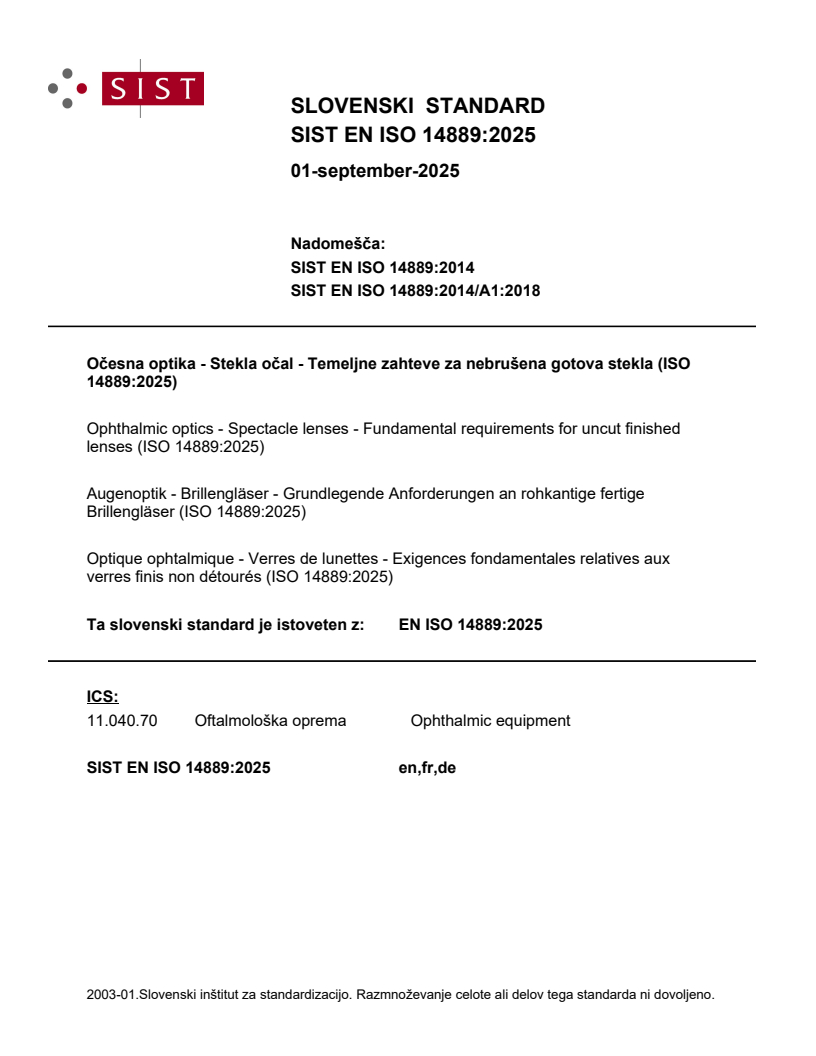
SLOVENSKI STANDARD
01-september-2025
Nadomešča:
SIST EN ISO 14889:2014
SIST EN ISO 14889:2014/A1:2018
Očesna optika - Stekla očal - Temeljne zahteve za nebrušena gotova stekla (ISO
14889:2025)
Ophthalmic optics - Spectacle lenses - Fundamental requirements for uncut finished
lenses (ISO 14889:2025)
Augenoptik - Brillengläser - Grundlegende Anforderungen an rohkantige fertige
Brillengläser (ISO 14889:2025)
Optique ophtalmique - Verres de lunettes - Exigences fondamentales relatives aux
verres finis non détourés (ISO 14889:2025)
Ta slovenski standard je istoveten z: EN ISO 14889:2025
ICS:
11.040.70 Oftalmološka oprema Ophthalmic equipment
2003-01.Slovenski inštitut za standardizacijo. Razmnoževanje celote ali delov tega standarda ni dovoljeno.
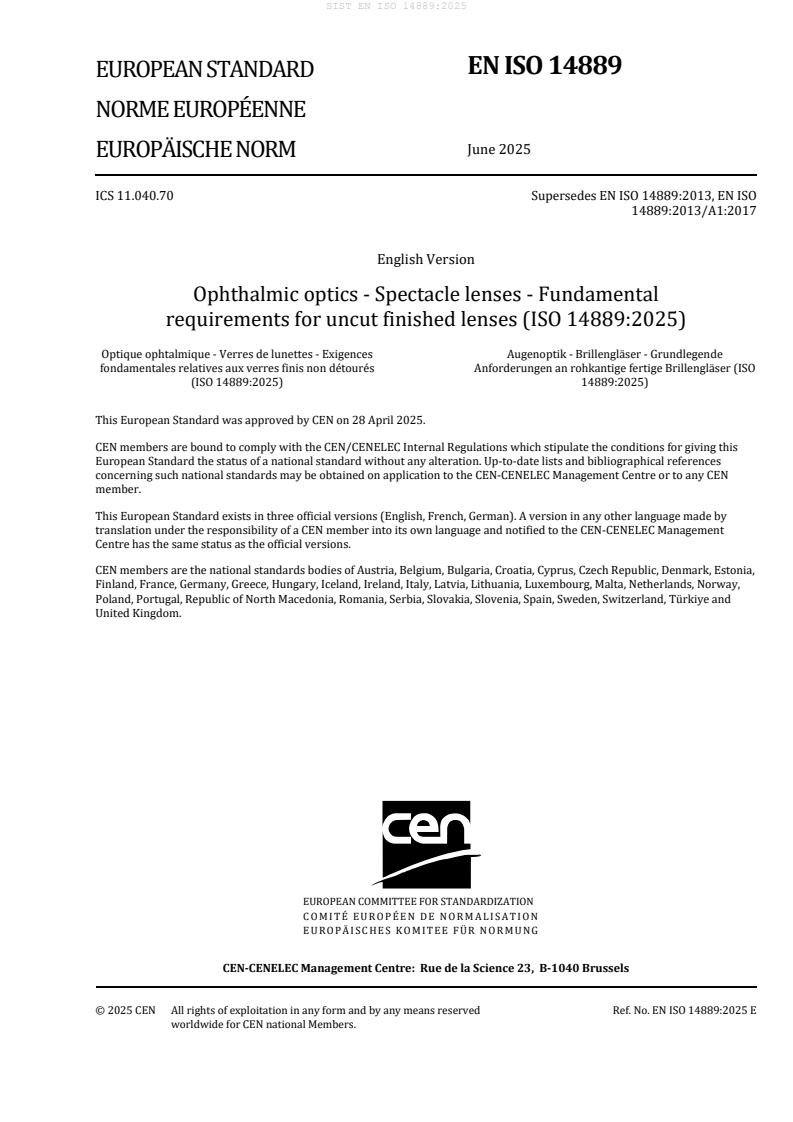
EN ISO 14889
EUROPEAN STANDARD
NORME EUROPÉENNE
June 2025
EUROPÄISCHE NORM
ICS 11.040.70 Supersedes EN ISO 14889:2013, EN ISO
14889:2013/A1:2017
English Version
Ophthalmic optics - Spectacle lenses - Fundamental
requirements for uncut finished lenses (ISO 14889:2025)
Optique ophtalmique - Verres de lunettes - Exigences Augenoptik - Brillengläser - Grundlegende
fondamentales relatives aux verres finis non détourés Anforderungen an rohkantige fertige Brillengläser (ISO
(ISO 14889:2025) 14889:2025)
This European Standard was approved by CEN on 28 April 2025.
CEN members are bound to comply with the CEN/CENELEC Internal Regulations which stipulate the conditions for giving this
European Standard the status of a national standard without any alteration. Up-to-date lists and bibliographical references
concerning such national standards may be obtained on application to the CEN-CENELEC Management Centre or to any CEN
member.
This European Standard exists in three official versions (English, French, German). A version in any other language made by
translation under the responsibility of a CEN member into its own language and notified to the CEN-CENELEC Management
Centre has the same status as the official versions.
CEN members are the national standards bodies of Austria, Belgium, Bulgaria, Croatia, Cyprus, Czech Republic, Denmark, Estonia,
Finland, France, Germany, Greece, Hungary, Iceland, Ireland, Italy, Latvia, Lithuania, Luxembourg, Malta, Netherlands, Norway,
Poland, Portugal, Republic of North Macedonia, Romania, Serbia, Slovakia, Slovenia, Spain, Sweden, Switzerland, Türkiye and
United Kingdom.
EUROPEAN COMMITTEE FOR STANDARDIZATION
COMITÉ EUROPÉEN DE NORMALISATION
EUROPÄISCHES KOMITEE FÜR NORMUNG
CEN-CENELEC Management Centre: Rue de la Science 23, B-1040 Brussels
© 2025 CEN All rights of exploitation in any form and by any means reserved Ref. No. EN ISO 14889:2025 E
worldwide for CEN national Members.
Contents Page
European foreword . 3
Annex ZA (informative) Relationship between this European standard and the General
Safety and Performance Requirements of Regulation (EU) 2017/745 aimed to be
covered. 4
European foreword
This document (EN ISO 14889:2025) has been prepared by Technical Committee ISO/TC 172 "Optics
and photonics" in collaboration with Technical Committee CEN/TC 170 “Ophthalmic optics” the
secretariat of which is held by DIN.
This European Standard shall be given the status of a national standard, either by publication of an
identical text or by endorsement, at the latest by December 2025, and conflicting national standards
shall be withdrawn at the latest by December 2025.
Attention is drawn to the possibility that some of the elements of this document may be the subject of
patent rights. CEN shall not be held responsible for identifying any or all such patent rights.
This document supersedes EN ISO 14889:2013 and EN ISO 14889:2013/A1:2017.
This document has been prepared under a standardization request addressed to CEN by the European
Commission. The Standing Committee of the EFTA States subsequently approves these requests for its
Member States.
For the relationship with EU Legislation, see informative Annex ZA, which is an integral part of this
document.
Any feedback and questions on this document should be directed to the users’ national standards
body/national committee. A complete listing of these bodies can be found on the CEN website.
According to the CEN-CENELEC Internal Regulations, the national standards organizations of the
following countries are bound to implement this European Standard: Austria, Belgium, Bulgaria,
Croatia, Cyprus, Czech Republic, Denmark, Estonia, Finland, France, Germany, Greece, Hungary, Iceland,
Ireland, Italy, Latvia, Lithuania, Luxembourg, Malta, Netherlands, Norway, Poland, Portugal, Republic of
North Macedonia, Romania, Serbia, Slovakia, Slovenia, Spain, Sweden, Switzerland, Türkiye and the
United Kingdom.
Endorsement notice
The text of ISO 14889:2025 has been approved by CEN as EN ISO 14889:2025 without any modification.
Annex ZA
(informative)
Relationship between this European standard and the General Safety and
Performance Requirements of Regulation (EU) 2017/745 aimed to be
covered
This European standard has been prepared under M/575 to provide one voluntary means of
conforming to the General Safety and Performance Requirements of Regulation (EU) 2017/745 of 5
April 2017 concerning medical devices [OJ L 117] and to system or process requirements including
those relating to quality management systems, risk management, post-market surveillance systems,
clinical investigations, clinical evaluation or post-market clinical follow-up.
Once this standard is cited in the Official Journal of the European Union under that Regulation,
compliance with the normative clauses of this standard given in Table ZA.1 confers, within the limits of
the scope of this standard, a presumption of conformity with the corresponding General Safety and
Performance Requirements of that Regulation, and associated EFTA Regulations.
Where a definition in this standard differs from a definition of the same term set out in Regulation (EU)
2017/745, the differences shall be indicated in this Annex Z. For the purpose of using this standard in
support of the requirements set out in Regulation (EU) 2017/745, the definitions set out in this
Regulation prevail.
Where the European standard is an adoption of an International Standard, the scope of this standard
can differ from the scope of the European Regulation that it supports. As the scope of the applicable
regulatory requirements differ from nation to nation and region to region, the standard can only
support European regulatory requirements to the extent of the scope of the European regulation for
medical devices (EU) 2017/745).
NOTE 1 Where a reference from a clause of this standard to the risk management process is made, the risk
management process needs to be in compliance with Regulation (EU) 2017/745. This means that risks have to be
‘reduced as far as possible’, ‘reduced to the lowest possible level’, ‘reduced as far as possible and appropriate’,
‘removed or reduced as far as possible’, ‘eliminated or reduced as far as possible’, ’removed or minimized as far as
possible’, or ‘minimized’, according to the wording of the corresponding General Safety and Performance
Requirement.
NOTE 2 The manufacturer’s policy for determining acceptable risk must be in compliance with General Safety
and Performance Requirements 1, 2, 3, 4, 5, 8, 9, 10, 11, 14, 16, 17, 18, 19, 20, 21 and 22 of the Regulation.
NOTE 3 When a General Safety and Performance Requirement does not appear in Table ZA.1, it means that it is
not addressed by this European Standard.
Table ZA.1 — Correspondence between this European standard and Annex I of Regulation (EU)
2017/745 [OJ L 117] and to system or process requirements including those relating to quality
management systems, risk management, post-market surveillance systems, clinical
investigations, clinical evaluation or post-market clinical follow-up
General Safety and
Clause(s)/Subclause(s) of this
Performance Requirements of Remarks/Notes
EN
Regulation (EU) 2017/745
10.1 (a) 4.3.2, 5.2 4.3.2 and 5.2 of the standard
only meet the requirements of
Annex I, GSPR 10.1 (a) of the
Regulation in respect of
flammability.
10.1 (b) 4.3.1 4.3.1 of the standard only meets
the requirements of Annex I,
GSPR 10.1 (b) of the Regulation
in respect of physiological
compatibility.
10.1 (f) 4.4, 5.3 4.4 and 5.3 of the standard only
meet the requirements of
Annex I, GSPR 10.1 (f) of the
Regulation in respect of
mechanical strength.
14.2 (a) 4.4, 5.3 4.4 and 5.3 of the standard only
meet the requirements of
Annex I, GSPR 14.2 (a) of the
Regulation in respect of
mechanical strength.
14.3 4.3.2, 5.2 4.3.2 and 5.2 of the standard
only meet the requirements of
Annex I, GSPR 14.3 of the
Regulation in respect of
flammability.
23.1 (a) 6 Clause 6 of the standard only
meets the requirements of
Annex I, GSPR 23.1 (a) of the
Regulation in respect of
permanent or non-permanent
marking and product
identification.
23.1 (b) 6 Clause 6 of the standard only
meets the requirements of
Annex I, GSPR 23.1 (b) of the
Regulation in respect of
permanent or non-permanent
marking and product
identification.
23.2 (c) 6.1.1 6.1.1 of the standard only meets
the requirements of Annex I,
General Safety and
Clause(s)/Subclause(s) of this
Performance Requirements of Remarks/Notes
EN
Regulation (EU) 2017/745
GSPR 23.2 (c) of the Regulation
in respect of manufacturer’s
name.
WARNING 1 Presumption of conformity stays valid only as long as a reference to this European
standard is maintained in the list published in the Official Journal of the European Union. Users of this
standard should consult frequently the latest list published in the Official Journal of the European
Union.
WARNING 2 Other Union legislation may be applicable to the product(s) falling within the scope of
this standard.
Table ZA.2 — Normative references from Clause 2 of this document and their corresponding
European publications
Reference in International Title Corresponding European
Clause 2 Standard edition Standard Edition
Ophthalmic optics — Uncut
finished spectacle lenses — Part
ISO 8980-1 ISO 8980-1:2017 EN ISO 8980-1:2017
1: Specifications for single-vision
and multifocal lenses
Ophthalmic optics — Uncut
finished spectacle lenses — Part
ISO 8980-2 ISO 8980-2:2017 EN ISO 8980-2:2017
2: Specifications for power-
variation lenses
Ophthalmic optics — Uncut
finished spectacle lenses — Part
ISO 8980-3 ISO 8980-3:2022 EN ISO 8980-3:2022
3: Transmittance specifications
and test methods
Ophthalmic optics — Uncut
finished spectacle lenses — Part
ISO 8980-4 ISO 8980-4:2006 4: Specifications and test EN ISO 8980-4:2006
methods for anti-reflective
coatings
Ophthalmic optics – Spectacle
ISO 13666 ISO 13666:2019 EN ISO 13666:2019
lenses - Vocabulary
Table ZA.3 — Prevailing terms of regulation (EU) 2017/745 for the use of this European
standard under that regulation
Term used in this Regulation (EU) Clause(s)/Subclause(s)
Remarks/Notes
EN 2017/745 of this EN
This definition is
consistent with EU
regulation 2017/745.
Nevertheless, this
definition differs from the
Manufacturer Article 2 (30) 3.1 definition set in Article 2
(30) of MDR 2017/745.
This definition was
condensed to match
ophthalmic industry
practice.
For devices intended by the manufacturer to be for dual use in accordance with Chapter I, Article I,
item 3 of Regulation (EU) 2017/745 the following Table ZA.4 details the relevant essential
requirements of Regulation (EU) 2016/425 on Personal Protective Equipment and their corresponding
clauses of this European Standard. Table ZA.4 however, does not imply any citation in the OJEU under
the PPE Regulation and thus does not provide presumption of conformity for the PPE Regulation.
Table ZA.4 — Relevant Essential Health and Safety Requirements from Regulation (EU)
2016/425 Personal Protective Equipment that are addressed by this European Standard
(Chapter I, Article I, item 3) of Regulation (EU) 2017/745
Essential Health and Safety
Clause(s)/Subclause(s) of this
from Regulation (EU) Remarks/Notes
EN
2016/425
General
A manufacturer may claim that
his lenses in addition of being
corrective lenses be protective
lenses that provide personal eye
protection to the user.
As a matter of fact, personal eye
protection can relate to various
kinds of risk, e.g. sunglare
a
— —
(indirect solar radiation ),
radiation other than indirect
solar radiation, mechanical
impact, etc.
Some of those risks call for
requirements that go beyond
those for lenses the primary
function of which is correction of
vision. For the purposes of EN
ISO 14889, the following applies.
Essential Health and Safety
Clause(s)/Subclause(s) of this
from Regulation (EU) Remarks/Notes
EN
2016/425
Corrective lenses with filter
properties against sunglare
a
)
(indirect solar radiation
In accordance with the European
Commission’s “Guide to
Application of Regulation (EU)
2016/425 of the European
Parliament and of the Council of
9 March 2016 on Personal
Protective Equipment and
— —
repealing Council Directive
89/686/EEC” such lenses are
categorized as medical devices,
thus falling under Regulation
(EU) 2017/745. Compliance
with the GSPRs of Regulation
(EU) 2017/745, and of EN ISO
14889 as detailed by the above
Table ZA.1 implies that the
relevant requirements are met.
Corrective lenses designed to
provide protection other than
protection against sunglare
a
(indirect solar radiation )
Where corrective lenses are
designed to provide protection
other than protection against
sunglare (indirect solar
radiation), the relevant basic
— —
health and safety requirements
of Regulation (EU) 2016/425
apply.
These are not addressed in
EN ISO 14889.
Refer to Regulation (EU)
2016/425 and the relevant
European Standard(s) on
personal eye protection.
a
Indirect solar radiation implies general use for protection against solar radiation but not for direct observation
of the sun.
International
Standard
ISO 14889
Fourth edition
Ophthalmic optics — Spectacle
2025-04
lenses — Fundamental requirements
for uncut finished lenses
Optique ophtalmique — Verres de lunettes — Exigences
fondamentales relatives aux verres finis non détourés
Reference number
ISO 14889:2025(en) © ISO 2025
ISO 14889:2025(en)
All rights reserved.
ISO publications, in their entirety or in fragments, are owned by ISO. They are licensed, not sold, and are subject to the terms and
conditions set forth in the ISO End Customer License Agreement, the License Agreement of the relevant ISO member body, or
those of authorized third-party distributors.
Unless otherwise specified or required for its implementation, no part of this ISO publication may be reproduced, distributed,
modified, or used in any form or by any means, electronic or mechanical, including photocopying, scanning, recording, or posting
on any intranet, internet, or other digital platforms, without the prior written permission of ISO, the relevant ISO member body
or an authorized third-party distributor.
This publication shall not be disclosed to third parties, and its use is strictly limited to the license type and purpose specified in
the applicable license grant. Unauthorized reproduction, distribution, or use beyond the granted license is prohibited and may
result in legal action.
ISO copyright office
CP 401 • Ch. de Blandonnet 8
CH-1214 Vernier, Geneva
Phone: +41 22 749 01 11
Email: copyright@iso.org
Website: www.iso.org
Published in Switzerland
ii
ISO 14889:2025(en)
Contents Page
Foreword .iv
1 Scope . 1
2 Normative references . 1
3 Terms and definitions . 1
4 Fundamental requirements for spectacle lenses . 1
4.1 Performance .1
4.2 Design .2
4.3 Materials .2
4.3.1 Physiological compatibility .2
4.3.2 Resistance to ignition .2
4.4 Mechanical strength .2
4.5 Transmittance .2
4.5.1 General requirements .2
4.5.2 Additional requirements for lenses intended for road use and driving .2
5 Test methods . 3
5.1 General .3
5.2 Resistance to ignition .3
5.2.1 Apparatus .3
5.2.2 Procedure .3
5.3 Test for mechanical strength .4
5.3.1 Apparatus .4
5.3.2 Procedure .4
6 Identification . 5
6.1 Identification of the spectacle lens to be stated on the package of each individual
spectacle lens or in an accompanying document .5
6.2 Information to be made available .6
Bibliography .
...