

SIST EN 4912:2025
(Main)Aerospace series - ECO efficiency of seats
General Information
- Abstract
This document specifies the determination of the ECO efficiency of passenger seats installed in large airplanes.
This document is only applicable to the weight aspects of ECO efficiency, but this document does not apply to other aspects of sustainability.
- Status
- Published
- Public Enquiry End Date
- 15-Oct-2024
- Publication Date
- 30-Sep-2025
- Technical Committee
- I13 - Imaginarni 13
- Current Stage
- 6060 - National Implementation/Publication (Adopted Project)
- Start Date
- 29-Sep-2025
- Due Date
- 04-Dec-2025
- Completion Date
- 01-Oct-2025

Overview
EN 4912:2025 - "Aerospace series - ECO efficiency of seats" (CEN) specifies how to determine the ECO efficiency of passenger seats installed in large airplanes with a focus only on the weight aspects of ECO efficiency. It defines seat categorization, a benchmark seat weight (BSW) methodology based on base and feature weights, and the calculation of the eco efficiency index (EEI). This standard is intended for the aerospace sector and complements seat-weight information requirements in EN 4727:2025.
Key topics and requirements
- Scope limitation: Applies solely to weight-related ECO efficiency of passenger seats; it does not cover other sustainability factors.
- Seat categories (I–VI): Seats are classified by included features (Table 1). Categories determine how BSW is calculated and what eco-efficiency penalties apply. A seat must include all features marked “mandatory” to be assigned a category.
- Benchmark Seat Weight (BSW): BSW is a theoretical weight calculated from:
- a benchmark base weight per passenger (B) and
- benchmark feature weights per passenger (b_c) listed in Table 2.
- BSW calculation is scaled by seat configuration: triple seats for categories I–III, double for IV, single for V–VI.
- Eco Efficiency Index (EEI): EEI = (ESW / BSW) × 100
- ESW (eco efficiency index seat weight) is determined per EN 4727:2025 (see clause 5.8 of EN 4727).
- EEI is a dimensionless percentage indicating seat weight performance relative to the benchmark.
- Feature weighting: Table 2 provides benchmark weights per pax for features (e.g., recline, headrest, in-seat power, IFE). Some features are included within the benchmark base weight for certain categories; others carry explicit per‑feature weights.
Practical applications and users
Who uses EN 4912:2025:
- Aircraft manufacturers and integrators assessing cabin weight budgets and ECO performance
- Aircraft seat designers and suppliers for product development and competitive benchmarking
- Airlines and lessors evaluating seat options for fleet sustainability and operating efficiency
- Procurement and sustainability teams quantifying weight-driven eco impacts
- Certification bodies and regulatory stakeholders referencing standard weight-based ECO metrics
Practical uses:
- Compare seat designs by EEI to inform procurement and retrofit decisions
- Quantify the weight contribution of seat features for fuel/efficiency trade-offs
- Standardize reporting of seat weight performance across suppliers and fleets
Related standards
- EN 4727:2025 - Aerospace series - Standardized passenger seat weight information (normative reference used to determine ESW)
- ISO and IEC terminology resources (for consistent term usage)
Keywords: EN 4912:2025, ECO efficiency of seats, eco efficiency index (EEI), benchmark seat weight (BSW), aircraft seat weight, passenger seats, large airplanes, CEN, EN 4727:2025.
Relations
- Effective Date
- 28-Jan-2026
Get Certified
Connect with accredited certification bodies for this standard

BUREAU VERITAS Certification Germany
Bureau Veritas certification in Germany.

Element Materials Technology
Materials testing and product certification.

AQMS Ltd.
AQMS provides ISO certification to SMEs across the UK.
Sponsored listings
Frequently Asked Questions
SIST EN 4912:2025 is a standard published by the Slovenian Institute for Standardization (SIST). Its full title is "Aerospace series - ECO efficiency of seats". This standard covers: This document specifies the determination of the ECO efficiency of passenger seats installed in large airplanes. This document is only applicable to the weight aspects of ECO efficiency, but this document does not apply to other aspects of sustainability.
This document specifies the determination of the ECO efficiency of passenger seats installed in large airplanes. This document is only applicable to the weight aspects of ECO efficiency, but this document does not apply to other aspects of sustainability.
SIST EN 4912:2025 is classified under the following ICS (International Classification for Standards) categories: 49.095 - Passenger and cabin equipment. The ICS classification helps identify the subject area and facilitates finding related standards.
SIST EN 4912:2025 has the following relationships with other standards: It is inter standard links to SIST EN 4727:2025. Understanding these relationships helps ensure you are using the most current and applicable version of the standard.
SIST EN 4912:2025 is available in PDF format for immediate download after purchase. The document can be added to your cart and obtained through the secure checkout process. Digital delivery ensures instant access to the complete standard document.
Standards Content (Sample)
SLOVENSKI STANDARD
01-november-2025
Aeronavtika - Energetska učinkovitost sedežev
Aerospace series - ECO efficiency of seats
Luft- und Raumfahrt - ECO Effizienz von Sitzen
Série aérospatiale - Écoefficacité des sièges
Ta slovenski standard je istoveten z: EN 4912:2025
ICS:
49.095 Oprema za potnike in Passenger and cabin
oprema kabin equipment
2003-01.Slovenski inštitut za standardizacijo. Razmnoževanje celote ali delov tega standarda ni dovoljeno.
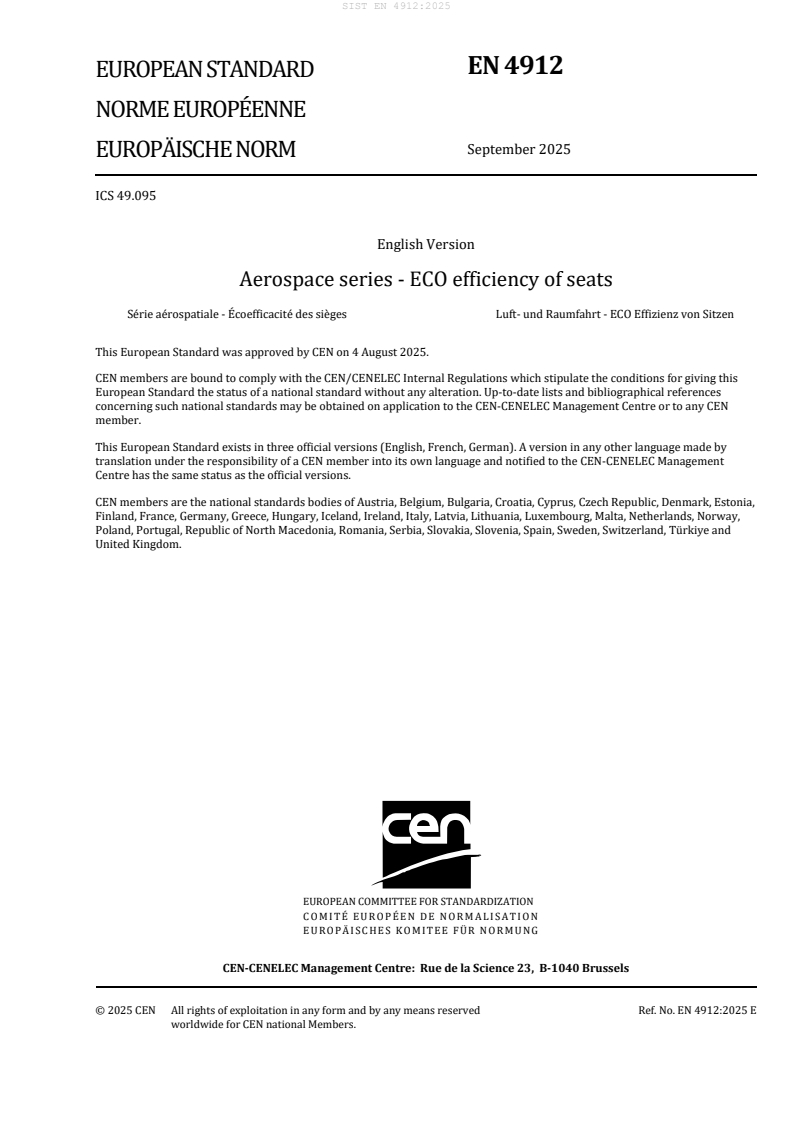
EN 4912
EUROPEAN STANDARD
NORME EUROPÉENNE
September 2025
EUROPÄISCHE NORM
ICS 49.095
English Version
Aerospace series - ECO efficiency of seats
Série aérospatiale - Écoefficacité des sièges Luft- und Raumfahrt - ECO Effizienz von Sitzen
This European Standard was approved by CEN on 4 August 2025.
CEN members are bound to comply with the CEN/CENELEC Internal Regulations which stipulate the conditions for giving this
European Standard the status of a national standard without any alteration. Up-to-date lists and bibliographical references
concerning such national standards may be obtained on application to the CEN-CENELEC Management Centre or to any CEN
member.
This European Standard exists in three official versions (English, French, German). A version in any other language made by
translation under the responsibility of a CEN member into its own language and notified to the CEN-CENELEC Management
Centre has the same status as the official versions.
CEN members are the national standards bodies of Austria, Belgium, Bulgaria, Croatia, Cyprus, Czech Republic, Denmark, Estonia,
Finland, France, Germany, Greece, Hungary, Iceland, Ireland, Italy, Latvia, Lithuania, Luxembourg, Malta, Netherlands, Norway,
Poland, Portugal, Republic of North Macedonia, Romania, Serbia, Slovakia, Slovenia, Spain, Sweden, Switzerland, Türkiye and
United Kingdom.
EUROPEAN COMMITTEE FOR STANDARDIZATION
COMITÉ EUROPÉEN DE NORMALISATION
EUROPÄISCHES KOMITEE FÜR NORMUNG
CEN-CENELEC Management Centre: Rue de la Science 23, B-1040 Brussels
© 2025 CEN All rights of exploitation in any form and by any means reserved Ref. No. EN 4912:2025 E
worldwide for CEN national Members.
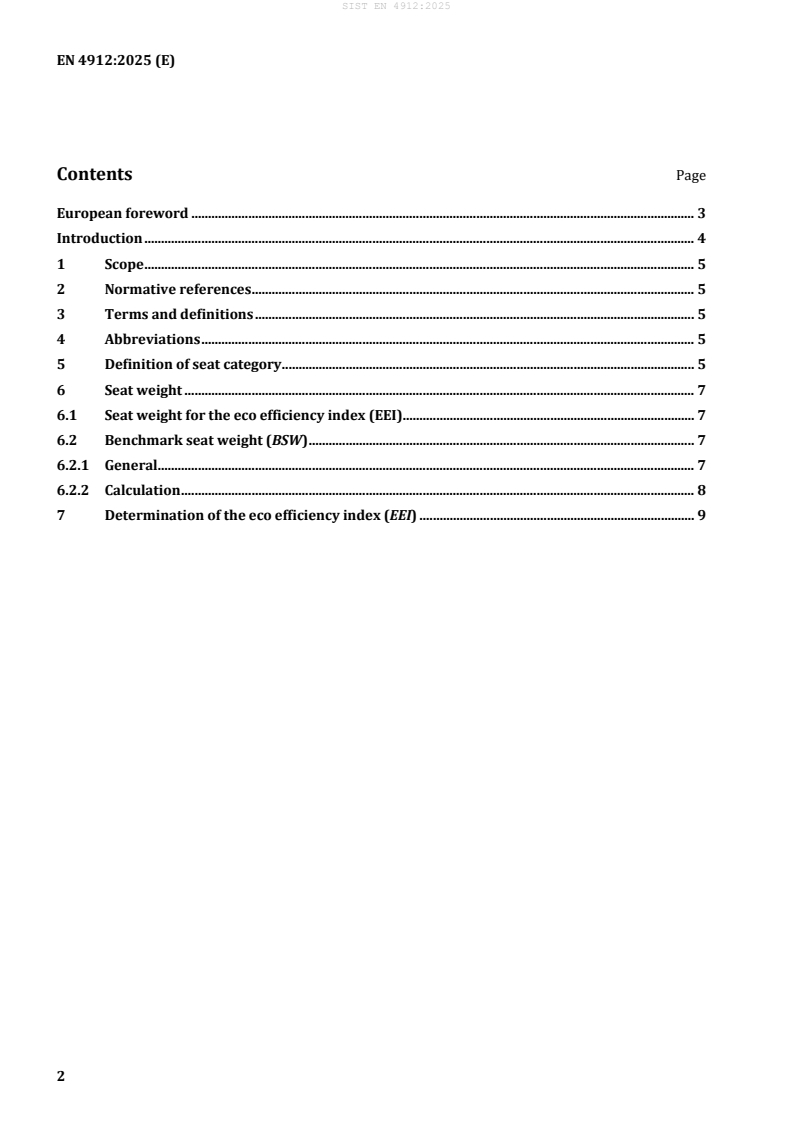
Contents Page
European foreword . 3
Introduction . 4
1 Scope . 5
2 Normative references . 5
3 Terms and definitions . 5
4 Abbreviations . 5
5 Definition of seat category . 5
6 Seat weight . 7
6.1 Seat weight for the eco efficiency index (EEI) . 7
6.2 Benchmark seat weight (BSW) . 7
6.2.1 General. 7
6.2.2 Calculation . 8
7 Determination of the eco efficiency index (EEI) . 9
European foreword
This document (EN 4912:2025) has been prepared by ASD-STAN.
After enquiries and votes carried out in accordance with the rules of this Association, this
document has received the approval of the National Associations and the Official Services of the
member countries of ASD-STAN, prior to its presentation to CEN.
This European Standard shall be given the status of a national standard, either by publication of an
identical text or by endorsement, at the latest by March 2026, and conflicting national standards
shall be withdrawn at the latest by March 2026.
Attention is drawn to the possibility that some of the elements of this document may be the subject
of patent rights. CEN shall not be held responsible for identifying any or all such patent rights.
Any feedback and questions on this document should be directed to the users’ national standards
body. A complete listing of these bodies can be found on the CEN website.
According to the CEN-CENELEC Internal Regulations, the national standards organizations of the
following countries are bound to implement this European Standard: Austria, Belgium, Bulgaria,
Croatia, Cyprus, Czech Republic, Denmark, Estonia, Finland, France, Germany, Greece, Hungary,
Iceland, Ireland, Italy, Latvia, Lithuania, Luxembourg, Malta, Netherlands, Norway, Poland,
Portugal, Republic of North Macedonia, Romania, Serbia, Slovakia, Slovenia, Spain, Sweden,
Switzerland, Türkiye and the United Kingdom.
Introduction
In
...