

SIST EN 14290:2004
(Main)Zinc and zinc alloys - Secondary raw material
General Information
- Abstract
This document specifies the requirements for the properties and condition of a specific range of tradeable secondary raw materials with a predominant zinc content.
This document defines these materials uniformly at the European level so that they can be traded within the economic cycle as raw materials with product character and their recycling is carried out specific to the material.
- Status
- Published
- Publication Date
- 31-Oct-2004
- Technical Committee
- INEK - Nonferrous metals
- Current Stage
- 6060 - National Implementation/Publication (Adopted Project)
- Start Date
- 01-Nov-2004
- Due Date
- 01-Nov-2004
- Completion Date
- 01-Nov-2004

Overview
EN 14290:2004 - published by CEN - specifies uniform European requirements for tradeable secondary raw materials with predominant zinc content. The standard defines types of zinc and zinc‑alloy scrap, drosses and skimmings, their required condition, composition, inspection and acceptance rules so these materials can be recycled and traded as product‑grade raw materials across the economic cycle.
Key Topics and Requirements
- Scope and designation
- Applies to metallic scrap (new and old zinc/zinc‑alloy scrap) and drosses/skimmings.
- Standardized product designation format (e.g. “Secondary raw material EN 14290 – S‑ZnA.1.1”) to simplify ordering and trade.
- Material types (annexes A & B)
- Annex A: New zinc scrap, new coated alloys, new alloy scrap with foreign substances, zinc blowings/metallizing scrap, old scrap categories and crushed sorted alloy scrap.
- Annex B: Drosses (top dross, bottom dross/hardspelter) and skimmings from galvanizing and other zinc processes.
- Composition and purity
- Requirements specify minimum zinc content for material types (e.g., new zinc scrap min. 98% Zn; metallizing scrap typically min. 95% Zn with limits for Pb and Fe).
- Limits for foreign materials and reporting requirements when foreign matter exceeds thresholds.
- Condition and exclusions
- Materials must meet moisture, corrosion and contamination limits (metallic materials: moisture typically < 0.2% at point of delivery).
- Prohibits mica, asbestos, plastics impregnated with oil, ozone‑depleting substances, explosives and radioactively contaminated materials.
- Inspection, testing and sampling
- Defines inspection lot, representative sampling, test procedures (moisture, free iron, composition, zinc content, metal yield, unmeltables), retest rules and rounding of analytical results (per ISO guidance).
- Packaging & ordering
- Packaging and additional delivery details to be agreed between purchaser and supplier. Ordering information to include quantity, document number and material type.
Applications and Users
- Primary users: metal recyclers, zinc refineries, foundries, galvanizers, metal traders and brokers.
- Other stakeholders: procurement officers, environmental compliance teams, and waste‑management operators involved in zinc recovery and circular economy logistics.
- Practical uses: standardizing purchase contracts, quality control of incoming scrap, facilitating cross‑border trade in secondary zinc materials, and ensuring material suitability for remelting and alloy production.
Related Standards
- EN 12844 - referenced for composition requirements of cast zinc alloys.
- ISO guidance on numerical rounding referenced for conformity assessment.
Keywords: EN 14290:2004, zinc and zinc alloys, secondary raw material, zinc scrap, drosses and skimmings, zinc recycling, metallic scrap, zinc content.
Relations
- Effective Date
- 28-Jan-2026
Get Certified
Connect with accredited certification bodies for this standard

Element Materials Technology
Materials testing and product certification.

Inštitut za kovinske materiale in tehnologije
Institute of Metals and Technology. Materials testing, metallurgical analysis, NDT.
Sponsored listings
Frequently Asked Questions
SIST EN 14290:2004 is a standard published by the Slovenian Institute for Standardization (SIST). Its full title is "Zinc and zinc alloys - Secondary raw material". This standard covers: This document specifies the requirements for the properties and condition of a specific range of tradeable secondary raw materials with a predominant zinc content. This document defines these materials uniformly at the European level so that they can be traded within the economic cycle as raw materials with product character and their recycling is carried out specific to the material.
This document specifies the requirements for the properties and condition of a specific range of tradeable secondary raw materials with a predominant zinc content. This document defines these materials uniformly at the European level so that they can be traded within the economic cycle as raw materials with product character and their recycling is carried out specific to the material.
SIST EN 14290:2004 is classified under the following ICS (International Classification for Standards) categories: 77.120.60 - Lead, zinc, tin and their alloys. The ICS classification helps identify the subject area and facilitates finding related standards.
SIST EN 14290:2004 has the following relationships with other standards: It is inter standard links to SIST EN 12844:1999. Understanding these relationships helps ensure you are using the most current and applicable version of the standard.
SIST EN 14290:2004 is available in PDF format for immediate download after purchase. The document can be added to your cart and obtained through the secure checkout process. Digital delivery ensures instant access to the complete standard document.
Standards Content (Sample)
2003-01.Slovenski inštitut za standardizacijo. Razmnoževanje celote ali delov tega standarda ni dovoljeno.Cink in cinkove zlitine – Sekundarne surovineZink und Zinklegierungen - SekundärrohstoffeZinc et alliages de zinc - Matieres premieres secondairesZinc and zinc alloys - Secondary raw material77.120.60Svinec, cink, kositer in njihove zlitineLead, zinc, tin and their alloysICS:Ta slovenski standard je istoveten z:EN 14290:2004SIST EN 14290:2004en01-november-2004SIST EN 14290:2004SLOVENSKI
STANDARD
EUROPEAN STANDARDNORME EUROPÉENNEEUROPÄISCHE NORMEN 14290July 2004ICS 77.120.60English versionZinc and zinc alloys - Secondary raw materialZinc et alliages de zinc - Matières premières secondairesZink und Zinklegierungen - SekundärrohstoffeThis European Standard was approved by CEN on 16 January 2004.CEN members are bound to comply with the CEN/CENELEC Internal Regulations which stipulate the conditions for giving this EuropeanStandard the status of a national standard without any alteration. Up-to-date lists and bibliographical references concerning such nationalstandards may be obtained on application to the Central Secretariat or to any CEN member.This European Standard exists in three official versions (English, French, German). A version in any other language made by translationunder the responsibility of a CEN member into its own language and notified to the Central Secretariat has the same status as the officialversions.CEN members are the national standards bodies of Austria, Belgium, Cyprus, Czech Republic, Denmark, Estonia, Finland, France,Germany, Greece, Hungary, Iceland, Ireland, Italy, Latvia, Lithuania, Luxembourg, Malta, Netherlands, Norway, Poland, Portugal, Slovakia,Slovenia, Spain, Sweden, Switzerland and United Kingdom.EUROPEAN COMMITTEE FOR STANDARDIZATIONCOMITÉ EUROPÉEN DE NORMALISATIONEUROPÄISCHES KOMITEE FÜR NORMUNGManagement Centre: rue de Stassart, 36
B-1050 Brussels© 2004 CENAll rights of exploitation in any form and by any means reservedworldwide for CEN national Members.Ref. No. EN 14290:2004: ESIST EN 14290:2004
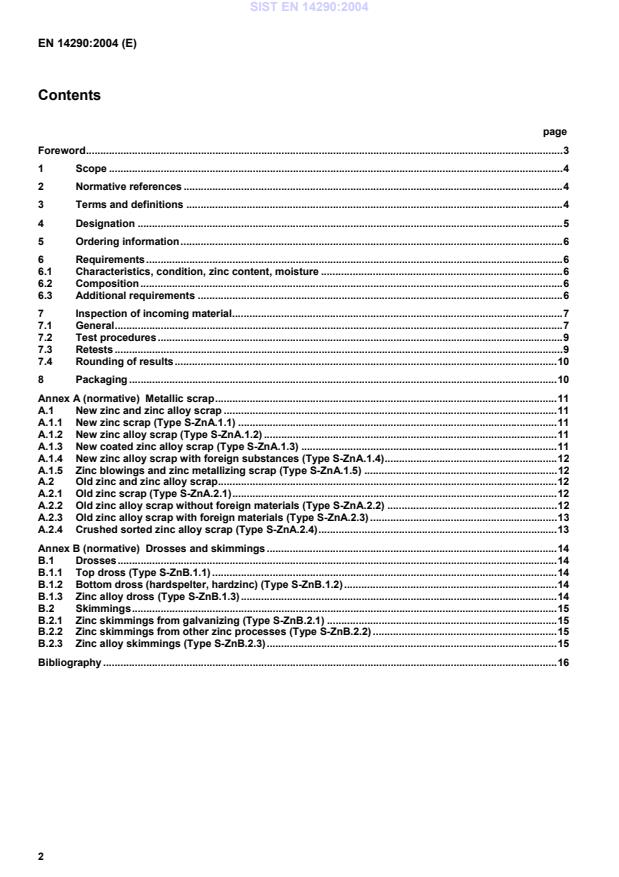
Contents page Foreword.3 1 Scope.4 2 Normative references.4 3 Terms and definitions.4 4 Designation.5 5 Ordering information.6 6 Requirements.6 6.1 Characteristics, condition, zinc content, moisture.6 6.2 Composition.6 6.3 Additional requirements.6 7 Inspection of incoming material.7 7.1 General.7 7.2 Test procedures.9 7.3 Retests.9 7.4 Rounding of results.10 8 Packaging.10 Annex A (normative)
Metallic scrap.11 A.1 New zinc and zinc alloy scrap.11 A.1.1 New zinc scrap (Type S-ZnA.1.1).11 A.1.2 New zinc alloy scrap (Type S-ZnA.1.2).11 A.1.3 New coated zinc alloy scrap (Type S-ZnA.1.3).11 A.1.4 New zinc alloy scrap with foreign substances (Type S-ZnA.1.4).12 A.1.5 Zinc blowings and zinc metallizing scrap (Type S-ZnA.1.5).12 A.2 Old zinc and zinc alloy scrap.12 A.2.1 Old zinc scrap (Type S-ZnA.2.1).12 A.2.2 Old zinc alloy scrap without foreign materials (Type S-ZnA.2.2).12 A.2.3 Old zinc alloy scrap with foreign materials (Type S-ZnA.2.3).13 A.2.4 Crushed sorted zinc alloy scrap (Type S-ZnA.2.4).13 Annex B (normative)
Drosses and skimmings.14 B.1 Drosses.14 B.1.1 Top dross (Type S-ZnB.1.1).14 B.1.2 Bottom dross (hardspelter, hardzinc) (Type S-ZnB.1.2).14 B.1.3 Zinc alloy dross (Type S-ZnB.1.3).14 B.2 Skimmings.15 B.2.1 Zinc skimmings from galvanizing (Type S-ZnB.2.1).15 B.2.2 Zinc skimmings from other zinc processes (Type S-ZnB.2.2).15 B.2.3 Zinc alloy skimmings (Type S-ZnB.2.3).15 Bibliography.16
3 Foreword This document (EN 14290:2004) has been prepared by Technical Committee CEN/TC 209 “Zinc and alloys”, the secretariat of which is held by AFNOR. This European Standard shall be given the status of a national standard, either by publication of an identical text or by endorsement, at the latest by January 2005, and conflicting national standards shall be withdrawn at the latest by January 2005. According to the CEN/CENELEC Internal Regulations, the national standards organizations of the following coun-tries are bound to implement this European Standard : Austria, Belgium, Cyprus, Czech Republic, Denmark, Esto-nia, Finland, France, Germany, Greece, Hungary, Iceland, Ireland, Italy, Latvia, Lithuania, Luxembourg, Malta, Netherlands, Norway, Poland, Portugal, Slovakia, Slovenia, Spain, Sweden, Switzerland and United Kingdom. SIST EN 14290:2004
1 Scope This document specifies the requirements for the properties and condition of a specific range of tradeable secondary raw materials with a predominant zinc content. This document defines these materials uniformly at the European level so that they can be traded within the economic cycle as raw materials with product character and their recycling is carried out specific to the material. 2 Normative references The following referenced document is indispensable for the application of this document. For dated references, only the edition cited applies. For undated references, the latest edition of the referenced document (including any amendments) applies. EN 12844,
Zinc and zinc alloys — Castings — Specifications.
3 Terms and definitions For the purposes of this document, the following terms and definitions apply: 3.1 groups of secondary raw materials
3.1.1 metallic scrap
3.1.1.1 new zinc and zinc alloy scrap zinc and zinc alloy new or unused such as rejected parts, stampings and/or other by-products from processing 3.1.1.2 old zinc and zinc alloy scrap zinc and zinc alloy-based used or end of life material with or without foreign attachments and/or foreign materials 3.1.2 Drosses and skimmings
3.1.2.1 drosses by-products from melting and/or galvanizing operations consisting of mainly metallic materials predominantly of zinc and iron 3.1.2.2 skimmings by-products from melting and/or galvanizing operations consisting of a mixture of predominantly zinc and zinc ox-ide, untreated or treated 3.2 foreign materials material, other than as specified in this standard, whether metallic or non-metallic including free iron SIST EN 14290:2004
5 3.3 coated, plated or enamelled material material with any kind of coating or plating, independent of the process of coating or plating, e.g. paint, varnish, print, plastics or metals (e.g. aluminium, chromium, nickel, tin) 3.4 free iron ferrous materials (e.g. steels) either magnetic or non-magnetic 3.5 moisture any liquid that adheres to the material
(less than 0,2% for metallic material) when it reaches the point of delivery due to fabrication, usage or pick-up during storage 3.6 inspection lot consignment or a part thereof submitted for inspection by the purchaser 3.7 representative sample sample, fully representing the range of scrap in an inspection lot 3.8 zinc content total elemental zinc content, either in metallic or compound form 3.9 metal yield mass of gained metal after drying and melting with a temperature up to 500 °C, using flux if necessary 3.10 unmeltables fraction of the consignment not molten at a temperature up to 500 °C 4 Designation The product designation provides a standardized pattern of designation from which a rapid and unequivocal description of a product is conveyed in communication. It provides mutual comprehension at the international level with regard to products which meet the requirements of the relevant document. The product designation is no substitute for the full content of the standard. The product designation for products to this standard shall consist of: denomination (Secondary raw material); number of this document (EN 14290); material type (see annexes A and B). SIST EN 14290:2004
The derivation of a product designation is shown in the following example. EXAMPLE Secondary raw material conforming to this standard, material type S-ZnA.1.1, shall be designated as follows: Secondary raw material EN 14290 – S-ZnA.1.1 Denomination
Number of this document Material type 5 Ordering information In order to facilitate the enquiry, order and confirmation of order procedures between the purchaser and the supplier, the purchaser shall state on his enquiry and order the following information: a) quantity of material required (mass); b) denomination (Secondary raw material); c) number of this document (EN 14290); d) material type (see annexes A and B). NOTE It is recommended that the product designation, as described in clause 4, is used for items b) to d). In addition, the purchaser shall also state on the enquiry and order any of the following, if required: e) form of packaging. EXAMPLE Ordering details for 20 t secondary raw material conforming to EN 14290, material type S-ZnA.
...