

SIST EN 2867:2010
(Main)Aerospace series - Nuts, anchor, self-locking, floating, one lug, with counterbore, in heat resisting steel, MoS2 lubricated - Classification: 1100 MPa (at ambient temperature)/315 °C
- Abstract
This European Standard specifies the characteristics of one lug, floating anchor nuts, with counterbore and self-locking feature achieved by forming the upper portion out-of-round, in heat resisting steel, MoS2 lubricated.
Classification: 1 100 MPa / 315 °C.
- Status
- Published
- Publication Date
- 30-Nov-2009
- Technical Committee
- I13 - Imaginarni 13
- Current Stage
- 6060 - National Implementation/Publication (Adopted Project)
- Start Date
- 16-Nov-2009
- Due Date
- 21-Jan-2010
- Completion Date
- 01-Dec-2009



SIST EN 2867:2010 is the Slovenian adoption of EN 2867:2009 for aerospace anchor nuts. It specifies one lug, floating, self-locking nuts with a counterbore, made in heat resisting steel and MoS2 lubricated, for the classification 1 100 MPa at ambient temperature and 315 °C. Engineers, buyers and quality teams use it to select, identify and inspect the correct nut type for aerospace fastening applications.
What does SIST EN 2867:2010 specify?
SIST EN 2867:2010 specifies the characteristics of one lug, floating anchor nuts with counterbore and a self-locking feature achieved by forming the upper portion out-of-round. The standard is written for heat resisting steel parts with MoS2 lubrication, so it matters when the fastening must keep its characteristics at elevated temperature.
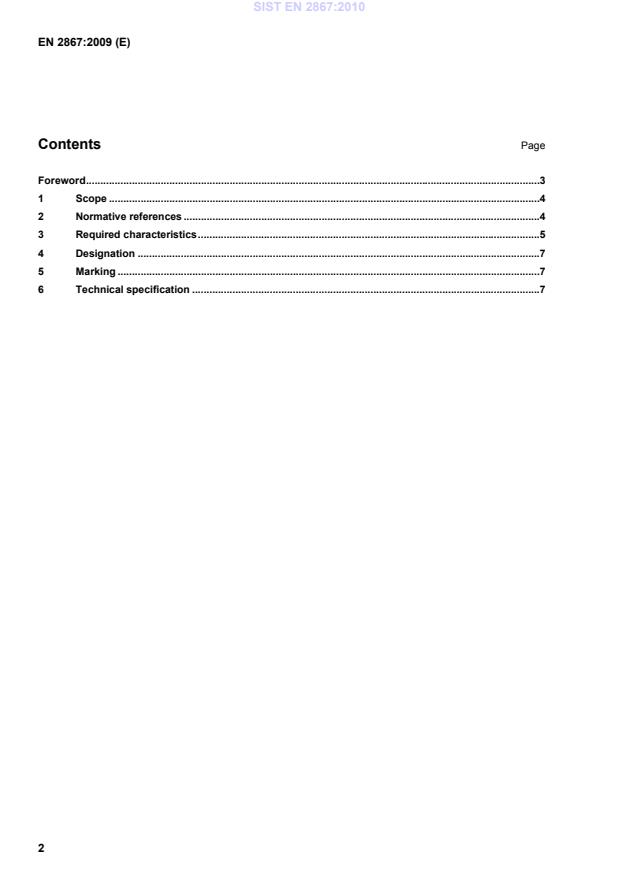
The document is organized into six clauses:
- Clause 1 Scope
- Clause 2 Normative references
- Clause 3 Required characteristics
- Clause 4 Designation
- Clause 5 Marking
- Clause 6 Technical specification
Clause 3 contains the dimensional, material, surface treatment and form requirements. Clauses 4 to 6 cover how to identify the part, how to mark it, and which procurement specification applies.
What are the key requirements of SIST EN 2867:2010?
Scope and class - Clause 1 fixes the product type and class as 1 100 MPa / 315 °C. In practice, this tells the user what load level and temperature capability the nut is intended to match.
Strength class note - The 1 100 MPa class corresponds to the strength class of the associated bolt, and the nut is able to withstand the 100 % load of that bolt when tested at ambient temperature without breaking or cracking. This is important when pairing the nut with the correct fastener and checking test expectations.
Temperature note - The 315 °C figure is the maximum temperature the nut can withstand without permanent change to its original characteristics after ambient temperature is restored. The note also says this limit is conditioned by the surface treatment, so the coating choice affects suitability.
Configuration, dimensions and masses - Clause 3.1 points to Figure 1 and Table 1 for the geometry and mass data. Dimensions and tolerances follow ISO 3224 and apply before MoS2 lubrication, which matters when comparing manufactured parts to the standard.
Materials and surface treatment - Clause 3.2 allows the listed heat resisting steel references, and Clause 3.3 requires EN 2491 surface treatment with thickness not specified. That means procurement and inspection need to check the approved material form and the prescribed dry lubricant coating.
Form, edges and position tolerances - Clause 3 states that details of form not stated are at the manufacturer's option, sharp edges are broken to 0,1 to 0,4, and tolerances of form and position follow ISO 8788. This keeps manufacturing freedom where the standard is silent, while controlling fit and interchangeability.
Designation and options - Clause 4 gives the designation structure using a description block, the identity block EN2867 and a diameter code from Table 1. Table 2 adds the option code K for countersunk or dimpled rivet holes, while plain rivet holes use the hyphen. This is what buyers use to specify the exact part on a purchase order.
Marking and technical specification - Clause 5 calls for marking to EN 2424:2008, style N, and Clause 6 refers to ISO 5858 except for manufacturer approval under EN 9100 and nut qualification under EN 9133. In practice, marking and quality system requirements support traceability and aerospace approval.
What terms does SIST EN 2867:2010 define?
Classification - The standard uses classification to state the load and temperature category of the nut: 1 100 MPa at ambient temperature and 315 °C.
Radial float - Radial float is the allowed side movement of the floating nut element, given in Table 1 and relevant to assembly alignment.
Diameter code - The diameter code is the size identifier used in Table 1 and in the designation, such as the code that follows EN2867.
Self-locking feature - The self-locking feature is created by forming the upper portion out-of-round, which provides resistance to loosening.
Counterbore - The counterbore is the recessed feature described in the product title and figure, and it is part of the geometry covered by the standard.
MoS2 - MoS2 is the dry lubricant specified for the surface treatment and is part of the environmental and friction control of the nut.
Who uses SIST EN 2867:2010?
SIST EN 2867:2010 is used by aerospace fastener designers, procurement teams, manufacturers and quality inspectors. It supports part selection, drawing definition, supplier specification, incoming inspection and product marking in aerospace and defense supply chains. It is also relevant for organizations working to EN 9100 and EN 9133 in aerospace parts approval and qualification.
Which standards are used with SIST EN 2867:2010?
- EN 2398 / EN 2399 - heat resisting steel bar materials for machined or forged bolts
- EN 2424 - marking of aerospace products
- EN 2491 - molybdenum disulphide dry lubricant coating methods
- EN 3638 / EN 3639 - heat resisting alloy forms for fastener materials
- EN 9100 - quality management systems for aviation, space and defense organizations
- EN 9133 - qualification procedure for aerospace standard parts
- ISO 3224 - dimensions for anchor nuts of the related MJ thread class
- ISO 5855-2 - MJ thread limit dimensions
- ISO 5858 - procurement specification for self-locking nuts up to 425 °C
- ISO 8788 - tolerances of form and position for metric nuts
- TR 3791 - material guidance for self-locking nuts and related inserts
What does the SIST EN 2867:2010 document contain?
The document contains Figure 1, Table 1 and Table 2, which together define the nut geometry, size codes, options and mass-related data. Figure 1 identifies the main parts of the nut, including the threaded element, cage, bearing face, out-of-round locking area and the float arrangement. Table 1 links diameter codes to thread sizes and dimensional limits, while Table 2 gives the option coding for rivet holes.
It also contains two practical notes in the scope section that explain how to interpret the class and temperature rating. Clause 4 shows the designation format used for ordering and identification, and Clause 5 gives the marking style to apply. Clause 6 ties the part back to the broader aerospace procurement framework through ISO 5858, EN 9100 and EN 9133.
Relations
- Effective Date
- 28-Jan-2026
- Effective Date
- 28-Jan-2026
- Effective Date
- 28-Jan-2026
- Effective Date
- 28-Jan-2026
- Effective Date
- 28-Jan-2026
- Effective Date
- 28-Jan-2026
- Effective Date
- 28-Jan-2026
- Effective Date
- 28-Jan-2026
- Effective Date
- 28-Jan-2026
- Effective Date
- 28-Jan-2026
Get Certified
Connect with accredited certification bodies for this standard

BUREAU VERITAS Certification Germany
Bureau Veritas certification in Germany.

Element Materials Technology
Materials testing and product certification.

AQMS Ltd.
AQMS provides ISO certification to SMEs across the UK.
Sponsored listings
Frequently Asked Questions
SIST EN 2867:2010 is a standard published by the Slovenian Institute for Standardization (SIST). Its full title is "Aerospace series - Nuts, anchor, self-locking, floating, one lug, with counterbore, in heat resisting steel, MoS2 lubricated - Classification: 1100 MPa (at ambient temperature)/315 °C". This standard covers: This European Standard specifies the characteristics of one lug, floating anchor nuts, with counterbore and self-locking feature achieved by forming the upper portion out-of-round, in heat resisting steel, MoS2 lubricated. Classification: 1 100 MPa / 315 °C.
This European Standard specifies the characteristics of one lug, floating anchor nuts, with counterbore and self-locking feature achieved by forming the upper portion out-of-round, in heat resisting steel, MoS2 lubricated. Classification: 1 100 MPa / 315 °C.
SIST EN 2867:2010 is classified under the following ICS (International Classification for Standards) categories: 49.030.30 - Nuts. The ICS classification helps identify the subject area and facilitates finding related standards.
SIST EN 2867:2010 has the following relationships with other standards: It is inter standard links to SIST EN 9100:2018, SIST EN 9133:2018, SIST EN ISO 15792-1:2008, SIST EN ISO 16433:2007, SIST EN 2398:2008, SIST EN 2491:2011, SIST EN 2399:2008, SIST EN 840-6:2004+A1:2008, SIST EN 2424:2008, SIST EN 3638:2026. Understanding these relationships helps ensure you are using the most current and applicable version of the standard.
SIST EN 2867:2010 is available in PDF format for immediate download after purchase. The document can be added to your cart and obtained through the secure checkout process. Digital delivery ensures instant access to the complete standard document.
Standards Content (Sample)
2003-01.Slovenski inštitut za standardizacijo. Razmnoževanje celote ali delov tega standarda ni dovoljeno.Luft- und Raumfahrt - Gehause-Annietmuttern, selbstsichernd, beweglich, einseitiger Flansch, mit zylindrischer Aussenkung, aus hochwarmfestem Stahl, MoS2 geschmiert - Klasse: 1100 MPa (bei Raumtemperatur)/315 °CSérie aérospatiale - Écrous à river, à freinage interne, flottants, simple patte, avec chambrage, en acier résistant à chaud, lubrifiés MoS2 - Classification: 1100 MPa (à température ambiante)/315 °CAerospace series - Nuts, anchor, self-locking, floating, one lug, with counterbore, in heat resisting steel, MoS2 lubricated - Classification: 1100 MPa (at ambient temperature)/315 °C49.030.30MaticeNutsICS:Ta slovenski standard je istoveten z:EN 2867:2009SIST EN 2867:2010en01-januar-2010SIST EN 2867:2010SLOVENSKI
STANDARD
EUROPEAN STANDARD NORME EUROPÉENNE EUROPÄISCHE NORM
EN 2867
November 2009 ICS 49.030.30 English Version
Aerospace series - Nuts, anchor, self-locking, floating, one lug, with counterbore, in heat resisting steel, MoS2 lubricated - Classification: 1 100 MPa (at ambient temperature) / 315 °C
Série aérospatiale - Écrous à river, à freinage interne, flottants, simple patte, avec chambrage, en acier résistant à chaud, lubrifiés MoS2 - Classification : 1 100 MPa (à température ambiante) / 315 °C
Luft- und Raumfahrt - Gehause-Annietmuttern, selbstsichernd, beweglich, einseitiger Flansch, mit zylindrischer Aussenkung, aus hochwarmfestem Stahl,
MoS2 geschmiert - Klasse: 1 100 MPa (bei Raumtemperatur) / 315 °C This European Standard was approved by CEN on 17 October 2009.
CEN members are bound to comply with the CEN/CENELEC Internal Regulations which stipulate the conditions for giving this European Standard the status of a national standard without any alteration. Up-to-date lists and bibliographical references concerning such national standards may be obtained on application to the CEN Management Centre or to any CEN member.
This European Standard exists in three official versions (English, French, German). A version in any other language made by translation under the responsibility of a CEN member into its own language and notified to the CEN Management Centre has the same status as the official versions.
CEN members are the national standards bodies of Austria, Belgium, Bulgaria, Cyprus, Czech Republic, Denmark, Estonia, Finland, France, Germany, Greece, Hungary, Iceland, Ireland, Italy, Latvia, Lithuania, Luxembourg, Malta, Netherlands, Norway, Poland, Portugal, Romania, Slovakia, Slovenia, Spain, Sweden, Switzerland and United Kingdom.
EUROPEAN COMMITTEE FOR STANDARDIZATION
COMITÉ EUROPÉEN DE NORMALISATION EUROPÄISCHES KOMITEE FÜR NORMUNG
Management Centre:
Avenue Marnix 17,
B-1000 Brussels © 2009 CEN All rights of exploitation in any form and by any means reserved worldwide for CEN national Members. Ref. No. EN 2867:2009: ESIST EN 2867:2010
...