

SIST EN 2997-011:2020
(Main)Aerospace series - Connectors, electrical, circular, coupled by threaded ring, fire-resistant or non fire-resistant, operating temperatures - 65 °C to 175 °C continuous, 200 °C continuous, 260 °C peak - Part 011: Dummy receptacle - Product standard
General Information
- Abstract
This document specifies the characteristics of dummy receptacles in the family of circular electrical connectors coupled by threaded ring.
It applies to the class defined in Table 3.
For plugs associated with these dummy receptacles, see EN 2997-008.
- Status
- Published
- Publication Date
- 16-Dec-2019
- Technical Committee
- I13 - Imaginarni 13
- Current Stage
- 6060 - National Implementation/Publication (Adopted Project)
- Start Date
- 12-Dec-2019
- Due Date
- 16-Feb-2020
- Completion Date
- 17-Dec-2019


Overview - EN 2997-011:2019 (Dummy receptacle product standard)
EN 2997-011:2019 is a CEN aerospace product standard that specifies the characteristics of dummy receptacles in the family of circular electrical connectors coupled by a threaded ring. It covers both fire‑resistant and non fire‑resistant variants and the defined operating temperature ranges (‑65 °C to 175 °C continuous, 200 °C continuous, 260 °C peak). The document defines mechanical dimensions, mounting, material/surface treatments, marking, qualification and quality assurance requirements for these panel‑mounted blanking receptacles.
Key topics and requirements
- Scope and applicability: Applies to dummy receptacle class(es) listed in Table 3; associated plugs are specified in EN 2997-008.
- Mechanical dimensions & mass: Detailed dimensions, tolerances and mass values are given (figures and tables referenced), with dimensions in millimetres and tolerances applying after surface treatment.
- Panel cut‑out and mounting: Panel cut‑out, front and rear mounting arrangements and minimum clearances are specified to ensure mechanical compatibility.
- Materials & surface treatments: Classes in Table 3 define material and finish combinations with specified salt‑mist resistance and maximum operating temperatures (examples: passivated stainless steel, nickel‑plated aluminium alloy, cadmium‑plated aluminium alloy).
- Environmental and performance characteristics: Main general characteristics (electrical, environmental and mechanical) reference EN 2997-002; test methods such as EN 2591‑408 (mating/unmating forces) are normatively referenced.
- Qualification & sampling: Qualification test regime, specimen sampling across size ranges (small/medium/large), and acceptance via specified test groups are described.
- Designation & marking: Required identity block, date of manufacture and manufacturer marking are defined for traceability.
- Related technical details: Technical specification links to EN 2997-001 and EN 2997-002 for broader connector requirements.
Practical applications and users
- Typical users: aerospace OEMs, connector manufacturers, design and production engineers, procurement teams, maintenance organizations and certification bodies.
- Practical uses: providing standardized, panel‑mounted blanking receptacles for unused connector positions, ensuring mechanical compatibility with EN 2997-series plugs, protecting contacts and panels from environmental exposure, and meeting aerospace qualification and traceability requirements.
Related standards
- EN 2997-001 (Technical specification)
- EN 2997-002 (Performance and contact arrangements)
- EN 2997-008 (Plug)
- EN 2591-408 (Mating/unmating forces)
- ISO 263 (ISO inch screw threads)
For detailed drawings, dimension tables and full test/qualification procedures consult the full EN 2997-011:2019 standard.
Relations
- Effective Date
- 11-Dec-2019
- Effective Date
- 09-Feb-2026
- Effective Date
- 28-Jan-2026
- Effective Date
- 28-Jan-2026
- Effective Date
- 28-Jan-2026
- Effective Date
- 28-Jan-2026
- Effective Date
- 28-Jan-2026
- Effective Date
- 28-Jan-2026
- Effective Date
- 28-Jan-2026
- Effective Date
- 28-Jan-2026
- Effective Date
- 28-Jan-2026
- Effective Date
- 28-Jan-2026
- Effective Date
- 28-Jan-2026
- Effective Date
- 28-Jan-2026
- Effective Date
- 28-Jan-2026
Get Certified
Connect with accredited certification bodies for this standard

BUREAU VERITAS Certification Germany
Bureau Veritas certification in Germany.

Element Materials Technology
Materials testing and product certification.

AQMS Ltd.
AQMS provides ISO certification to SMEs across the UK.
Sponsored listings
Frequently Asked Questions
SIST EN 2997-011:2020 is a standard published by the Slovenian Institute for Standardization (SIST). Its full title is "Aerospace series - Connectors, electrical, circular, coupled by threaded ring, fire-resistant or non fire-resistant, operating temperatures - 65 °C to 175 °C continuous, 200 °C continuous, 260 °C peak - Part 011: Dummy receptacle - Product standard". This standard covers: This document specifies the characteristics of dummy receptacles in the family of circular electrical connectors coupled by threaded ring. It applies to the class defined in Table 3. For plugs associated with these dummy receptacles, see EN 2997-008.
This document specifies the characteristics of dummy receptacles in the family of circular electrical connectors coupled by threaded ring. It applies to the class defined in Table 3. For plugs associated with these dummy receptacles, see EN 2997-008.
SIST EN 2997-011:2020 is classified under the following ICS (International Classification for Standards) categories: 31.220.10 - Plug-and-socket devices. Connectors; 49.060 - Aerospace electric equipment and systems. The ICS classification helps identify the subject area and facilitates finding related standards.
SIST EN 2997-011:2020 has the following relationships with other standards: It is inter standard links to SIST EN 2997-011:2010, SIST ISO 263:1998, SIST EN 2997-002:2023, SIST EN 2591-408:2001, SIST EN 2997-008:2009, SIST EN 2997-001:2017, SIST EN 3155-081:2015, SIST EN 3660-004:2019+AC:2019, SIST EN 3155-080:2015, SIST EN 3660-005:2019, SIST EN 3660-064:2016, SIST EN 3155-078:2015, SIST EN 3155-081:2019, SIST EN 3155-079:2019, SIST EN 3155-079:2015. Understanding these relationships helps ensure you are using the most current and applicable version of the standard.
SIST EN 2997-011:2020 is available in PDF format for immediate download after purchase. The document can be added to your cart and obtained through the secure checkout process. Digital delivery ensures instant access to the complete standard document.
Standards Content (Sample)
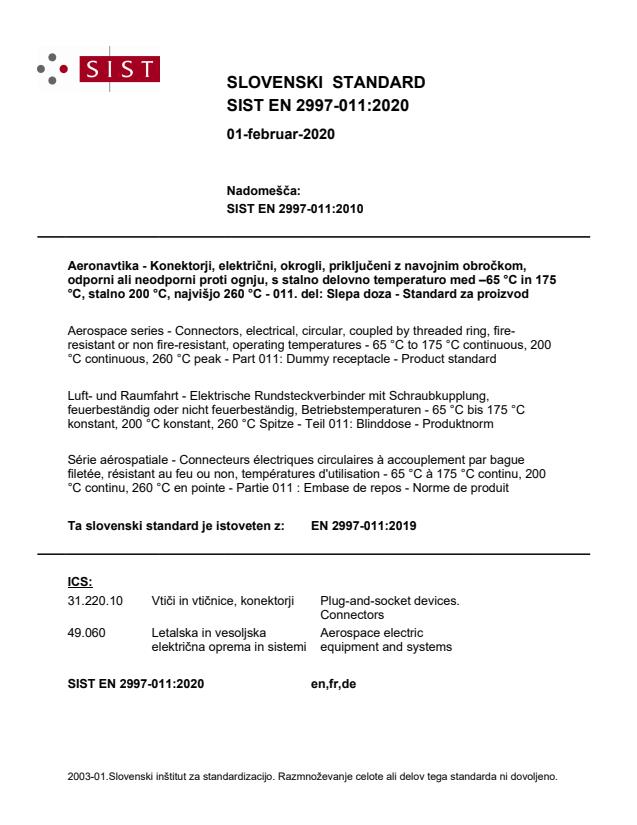
SLOVENSKI STANDARD
01-februar-2020
Nadomešča:
SIST EN 2997-011:2010
Aeronavtika - Konektorji, električni, okrogli, priključeni z navojnim obročkom,
odporni ali neodporni proti ognju, s stalno delovno temperaturo med –65 °C in 175
°C, stalno 200 °C, najvišjo 260 °C - 011. del: Slepa doza - Standard za proizvod
Aerospace series - Connectors, electrical, circular, coupled by threaded ring, fire-
resistant or non fire-resistant, operating temperatures - 65 °C to 175 °C continuous, 200
°C continuous, 260 °C peak - Part 011: Dummy receptacle - Product standard
Luft- und Raumfahrt - Elektrische Rundsteckverbinder mit Schraubkupplung,
feuerbeständig oder nicht feuerbeständig, Betriebstemperaturen - 65 °C bis 175 °C
konstant, 200 °C konstant, 260 °C Spitze - Teil 011: Blinddose - Produktnorm
Série aérospatiale - Connecteurs électriques circulaires à accouplement par bague
filetée, résistant au feu ou non, températures d'utilisation - 65 °C à 175 °C continu, 200
°C continu, 260 °C en pointe - Partie 011 : Embase de repos - Norme de produit
Ta slovenski standard je istoveten z: EN 2997-011:2019
ICS:
31.220.10 Vtiči in vtičnice, konektorji Plug-and-socket devices.
Connectors
49.060 Letalska in vesoljska Aerospace electric
električna oprema in sistemi equipment and systems
2003-01.Slovenski inštitut za standardizacijo. Razmnoževanje celote ali delov tega standarda ni dovoljeno.
EN 2997-011
EUROPEAN STANDARD
NORME EUROPÉENNE
December 2019
EUROPÄISCHE NORM
ICS 49.060 Supersedes EN 2997-011:2010
English Version
Aerospace series - Connectors, electrical, circular, coupled
by threaded ring, fire resistant or non fire resistant,
operating temperatures -65 °C to 175 °C continuous, 200
°C continuous, 260 °C peak - Part 011: Dummy receptacle -
Product standard
Série aérospatiale - Connecteurs électriques circulaires Luft- und Raumfahrt - Elektrische Rundsteckverbinder
à accouplement par bague filetée, résistant au feu ou mit Schraubkupplung, feuerbeständig oder nicht
non, températures d'utilisation - 65 °C à 175 °C feuerbeständig, Betriebstemperaturen - 65 °C bis 175
continu, 200 °C continu, 260 °C en pointe - Partie 011 : °C konstant, 200 °C konstant, 260 °C Spitze - Teil 011:
Embase de repos - Norme de produit Blinddose - Produktnorm
This European Standard was approved by CEN on 13 October 2019.
CEN members are bound to comply with the CEN/CENELEC Internal Regulations which stipulate the conditions for giving this
European Standard the status of a national standard without any alteration. Up-to-date lists and bibliographical references
concerning such national standards may be obtained on application to the CEN-CENELEC Management Centre or to any CEN
member.
This European Standard exists in three official versions (English, French, German). A version in any other language made by
translation under the responsibility of a CEN member into its own language and notified to the CEN-CENELEC Management
Centre has the same status as the official versions.
CEN members are the national standards bodies of Austria, Belgium, Bulgaria, Croatia, Cyprus, Czech Republic, Denmark, Estonia,
Finland, France, Germany, Greece, Hungary, Iceland, Ireland, Italy, Latvia, Lithuania, Luxembourg, Malta, Netherlands, Norway,
Poland, Portugal, Republic of North Macedonia, Romania, Serbia, Slovakia, Slovenia, Spain, Sweden, Switzerland, Turkey and
United Kingdom.
EUROPEAN COMMITTEE FOR STANDARDIZATION
COMITÉ EUROPÉEN DE NORMALISATION
EUROPÄISCHES KOMITEE FÜR NORMUNG
CEN-CENELEC Management Centre: Rue de la Science 23, B-1040 Brussels
© 2019 CEN All rights of exploitation in any form and by any means reserved Ref. No. EN 2997-011:2019 E
worldwide for CEN national Members.
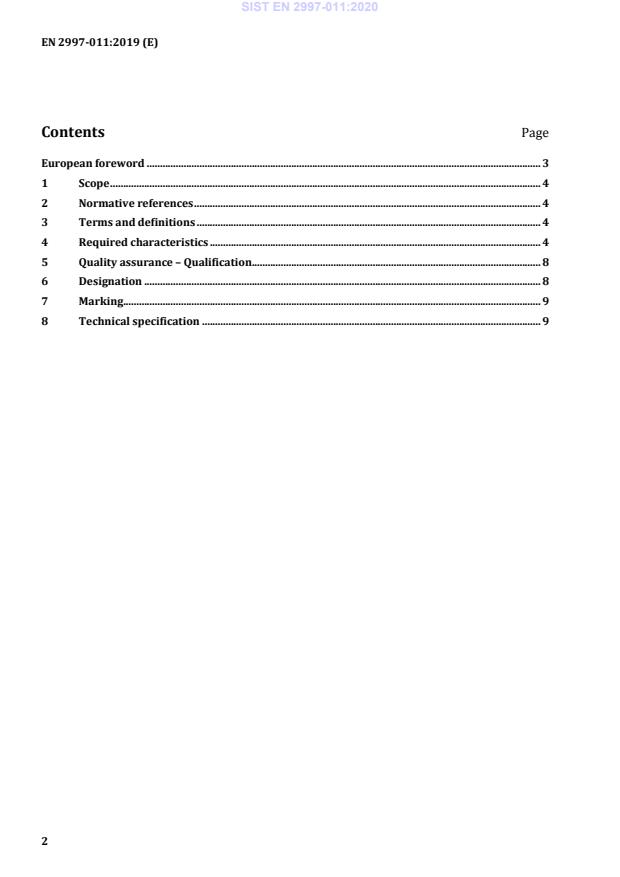
Contents Page
European foreword . 3
1 Scope . 4
2 Normative references . 4
3 Terms and definitions . 4
4 Required characteristics . 4
5 Quality assurance – Qualification. 8
6 Designation . 8
7 Marking . 9
8 Technical specification . 9
European foreword
This document (EN 2997-011:2019) has been prepared by the Aerospace and Defence Industries
Association of Europe — Standardization (ASD-STAN).
After enquiries and votes carried out in accordance with the rules of this Association, this Standard has
received the approval of the National Associations and the Official Services of the member countries of
ASD, prior to its presentation to CEN.
This document shall be given the status of a national standard, either by publication of an identical text
or by endorsement, at the latest by June 2020, and conflicting national standards shall be withdrawn at
the latest by June 2020.
Attention is drawn to the possibility that some of the elements of this document may be the subject of
patent rights. CEN shall not be held responsible for identifying any or all such patent rights.
This document supersedes EN 2997-011:2010.
According to the CEN-CENELEC Internal Regulations, the national standards organisations of the
following countries are bound to implement this European Standard: Aust
...