

oSIST prEN 1143-1:2026
(Main)Secure storage units - Requirements, classification and methods of test for resistance to burglary - Part 1: Safes, ATM safes, strongroom doors and strongrooms
- Abstract
This document establishes the basis for testing and classifying free-standing safes, safe plinths, built-in safes (floor and wall), ATM safes and ATM bases, strongroom doors and strongrooms (with or without a door) according to their burglary resistance.
This document does not cover testing and classifying Deposit Systems and ATM systems.
- Status
- Not Published
- Public Enquiry End Date
- 28-Oct-2026
- Technical Committee
- PPV - Secure storage units and door locks
- Current Stage
- 4020 - Public enquire (PE) (Adopted Project)
- Start Date
- 17-Aug-2026
- Due Date
- 04-Jan-2027

oSIST prEN 1143-1:2026 is the SIST publication of the draft European Standard prEN 1143-1 from CEN. It specifies requirements, classification and test methods for burglary resistance of secure storage units, including safes, automatic-teller-machine (ATM) safes, strongroom doors and strongrooms, so manufacturers, testing laboratories, installers and buyers can compare products on the same basis. It also covers the extra designations EX, GAS, CD, T2 and HYD where those claims are made.
What does oSIST prEN 1143-1:2026 specify?
oSIST prEN 1143-1:2026 establishes the basis for testing and classifying free-standing safes, safe plinths, built-in safes, ATM safes and ATM bases, strongroom doors and strongrooms, with or without a door, according to burglary resistance. It does not cover Deposit Systems or ATM systems.
The document is organized into clauses 1 to 15, followed by three annexes. Clause 4 gives classification and product requirements, clauses 5 to 6 cover technical documentation and test specimens, clauses 7 to 13 set out the different test methods, and clauses 14 to 15 cover the test report and marking.
| Annex | What it covers |
|---|---|
| Annex A | Normative attack tools, tool categories, coefficients and basic values for the standard tool attack test |
| Annex B | Normative additional attack tools for the T2 designation |
| Annex C | Informative examples of ATM systems and non-ATM systems |
What are the key requirements of oSIST prEN 1143-1:2026?
Clause 4 classifies products into resistance grades using Tables 1 to 3, depending on whether the product is a safe, an ATM safe, or a strongroom door/strongroom. In practice, the grade is the main comparison point for buyers and specifiers, because it tells them what level of burglary resistance the tested design achieved.
General construction requirements
Clause 4.2 requires the protection material to avoid unnecessary holes, with openings allowed only where they serve locks, cables, anchoring or accessories. Unused cable entries must be blocked so they cannot be removed from the outside without visible traces, and boltwork cover plates must stop unauthorized viewing or access to locks and boltwork when the door is open.
Clause 4.2 also requires fixing systems or anchoring holes for certain products below 1 000 kg. For free-standing safes and ATM safes, the installation concept and anchoring method matter because the product is not just judged as a box, but as an installed security unit.
Documentation and specimen preparation
Clause 5 requires technical documentation with drawings, dimensions, tolerances, lock details, materials, anchoring details, optional features and installation instructions. This matters because the test laboratory must know exactly what is being tested and how it is meant to be installed.
Clause 6 says the test specimen must match the product type under test and must include relevant optional features and cable entrances. For built-in safes and cast in situ strongrooms, the specimen is built from the supplied components and according to the installation instructions.
Tool attack testing and resistance values
Clause 7 is the core burglary test. A testing team attacks the specimen using tools from Annex A, measures operating time, and checks whether partial access or complete access has been achieved using the prescribed test blocks. The resulting resistance value is calculated in resistance units (RU) from operating time, tool coefficient and basic value.
This matters in practice because the standard does not rely on a simple pass/fail impression. It turns attack effort into a recorded resistance value that can be compared with the grade tables.
Anchoring tests
Clause 8 checks anchoring strength. Free-standing safes, safes with safe plinths, and ATM safes are loaded so the laboratory can see whether the fixing system, bolts and surrounding construction can withstand the required force. For ATM safes, the test also examines post-anchoring forcing after the load test.
This is important because many burglary attempts start with moving or tearing out the product rather than opening it.
Special designations
Clauses 9 to 13 add extra claims where requested:
- EX - explosive attack resistance after a detonation and a post-detonation tool attack
- GAS - gas attack resistance for ATM safes
- CD - core drilling resistance for safes, strongroom doors and strongrooms
- T2 - a higher tool set for tougher attack conditions using Annex B tools
- HYD - resistance to hydraulic or electric spreaders and door openers for ATM safes
These designations matter because they tell users which attack methods were considered beyond the standard tool attack.
Marking and reporting
Clauses 14 and 15 require a detailed test report and a permanent marking on the product. The marking states the manufacturer, standard designation, resistance grade and any applicable designations such as T2, EX, GAS, CD or HYD.
What terms does oSIST prEN 1143-1:2026 define?
- Safe - A storage unit that protects contents against burglary and, when closed, has at least one internal side of 1 m or less.
- Free-standing safe - A safe whose burglary resistance depends only on its own manufacture, not on materials added during installation.
- Safe plinth - An integral part between a free-standing safe and the anchoring surface, used to anchor the safe more effectively or raise it to a usable height.
- Built-in safe - A safe whose burglary resistance partly depends on materials incorporated or attached during installation.
- Strongroom - A storage unit with internal side lengths greater than 1 m in every direction when closed.
- ATM safe - A safe that forms part of an ATM system.
- Resistance value - The numerical burglary resistance result for a test, expressed in resistance units (RU).
Who uses oSIST prEN 1143-1:2026?
Manufacturers use oSIST prEN 1143-1:2026 to design products, prepare technical files, and choose which grades and designations to claim. Testing laboratories use it to run tool attack, anchoring, explosive, gas, drilling and hydraulic tests in a repeatable way.
Certification bodies and compliance teams use it to review test reports and product marking. Installers use the anchoring and installation instructions, especially for free-standing safes, safe plinths, ATM bases, built-in safes and strongrooms. Buyers, insurers, security engineers and quality managers use the grade and designation to compare burglary resistance for the intended application.
What changed in oSIST prEN 1143-1:2026 from the previous edition?
oSIST prEN 1143-1:2026 will supersede EN 1143-1:2019. The European foreword states these significant changes:
- testing for ATM safes against hydraulic and electric spreaders and door openers has been added, with the new HYD designation
- safe plinth has been integrated as a product type
- the possibility to include locks according to EN 17646 has been added
- the meaning of complete access and partial access has changed, including removal of a wall within certain tolerances as complete access
- new requirements for cable holes have been set
- strongrooms below 1 000 kg now need a fixing system, and strongroom accessories must not permit a direct view inside
- anchoring instruction requirements have been added
- explosive heat tolerances have been adapted
- several clauses and tables have been clarified
Which standards are used with oSIST prEN 1143-1:2026?
- EN 1300 - used for high security locks and lock classification.
- EN 10051 - gives steel strip and sheet tolerances used where steel wall thickness and cutting conditions matter.
- EN 17646 - used for distributed systems high security lock classification, and linked to locking requirements for some products.
- EN 13204 - provides the spreading force reference for hydraulic spreaders and door openers in the HYD test.
- EN ISO/IEC 17025 - cited as the competence framework for testing laboratories.
- EN 1143-2 - the companion part for deposit systems, mentioned in the bibliography.
What does the oSIST prEN 1143-1:2026 document contain?
The document contains classification tables for safes, ATM safes and strongrooms, plus separate requirements for EX, GAS, CD, T2 and HYD designations. It also contains the test methods, apparatus, procedures and end conditions for tool attack, anchoring strength, explosive attack, gas attack, core drilling and hydraulic resistance.
Figures support the test setups, including the ATM safe internal space restriction and the hydraulic tool arrangement. Annex A lists attack tools and their categories, coefficients and basic values, Annex B adds the higher-efficiency T2 tools, and Annex C gives example ATM system layouts.
Relations
- Effective Date
- 25-Mar-2026
Get Certified
Connect with accredited certification bodies for this standard

BSI Group
BSI (British Standards Institution) is the business standards company that helps organizations make excellence a habit.

CIS Institut d.o.o.
Personal Protective Equipment (PPE) certification body. Notified Body NB-2890 for EU Regulation 2016/425 PPE.

Kiwa BDA Testing
Building and construction product certification.
Sponsored listings
Frequently Asked Questions
oSIST prEN 1143-1:2026 is a draft published by the Slovenian Institute for Standardization (SIST). Its full title is "Secure storage units - Requirements, classification and methods of test for resistance to burglary - Part 1: Safes, ATM safes, strongroom doors and strongrooms". This standard covers: This document establishes the basis for testing and classifying free-standing safes, safe plinths, built-in safes (floor and wall), ATM safes and ATM bases, strongroom doors and strongrooms (with or without a door) according to their burglary resistance. This document does not cover testing and classifying Deposit Systems and ATM systems.
This document establishes the basis for testing and classifying free-standing safes, safe plinths, built-in safes (floor and wall), ATM safes and ATM bases, strongroom doors and strongrooms (with or without a door) according to their burglary resistance. This document does not cover testing and classifying Deposit Systems and ATM systems.
oSIST prEN 1143-1:2026 is classified under the following ICS (International Classification for Standards) categories: 13.310 - Protection against crime; 35.220.99 - Other data storage devices. The ICS classification helps identify the subject area and facilitates finding related standards.
oSIST prEN 1143-1:2026 has the following relationships with other standards: It is inter standard links to SIST EN 1143-1:2019. Understanding these relationships helps ensure you are using the most current and applicable version of the standard.
oSIST prEN 1143-1:2026 is available in PDF format for immediate download after purchase. The document can be added to your cart and obtained through the secure checkout process. Digital delivery ensures instant access to the complete standard document.
Standards Content (Sample)
SLOVENSKI STANDARD
01-oktober-2026
Varnostne shranjevalne enote - Zahteve, klasifikacija in metode preskušanja
protivlomne odpornosti - 1. del: Jeklene blagajne (sefi), bankomatne blagajne
(sefi), vrata trezorskih prostorov in trezorski prostori
Secure storage units - Requirements, classification and methods of test for resistance to
burglary - Part 1: Safes, ATM safes, strongroom doors and strongrooms
Wertbehältnisse - Anforderungen, Klassifizierung und Methoden zur Prüfung des
Widerstandes gegen Einbruchdiebstahl - Teil 1: Wertschutzschränke,
Wertschutzschränke für Geldautomaten, Wertschutzraumtüren und Wertschutzräume
Unités de stockage en lieux sûrs - Exigences, classification et méthodes d’essai pour la
résistance à l’effraction - Partie 1: Coffres-forts, distributeurs automatiques de billets
(DAB), portes fortes et chambres fortes
Ta slovenski standard je istoveten z: prEN 1143-1
ICS:
13.310 Varstvo pred kriminalom Protection against crime
35.220.99 Druge naprave za Other data storage devices
shranjevanje podatkov
2003-01.Slovenski inštitut za standardizacijo. Razmnoževanje celote ali delov tega standarda ni dovoljeno.
DRAFT
EUROPEAN STANDARD
NORME EUROPÉENNE
EUROPÄISCHE NORM
August 2026
ICS 13.310 Will supersede EN 1143-1:2019
English Version
Secure storage units - Requirements, classification and
methods of test for resistance to burglary - Part 1: Safes,
ATM safes, strongroom doors and strongrooms
Unités de stockage en lieux sûrs - Exigences, Wertbehältnisse - Anforderungen, Klassifizierung und
classification et méthodes d'essai pour la résistance à Methoden zur Prüfung des Widerstandes gegen
l'effraction - Partie 1: Coffres-forts, distributeurs Einbruchdiebstahl - Teil 1: Wertschutzschränke,
automatiques de billets (DAB), portes fortes et Wertschutzschränke für Geldautomaten,
chambres fortes Wertschutzraumtüren und Wertschutzräume
This draft European Standard is submitted to CEN members for enquiry. It has been drawn up by the Technical Committee
CEN/TC 263.
If this draft becomes a European Standard, CEN members are bound to comply with the CEN/CENELEC Internal Regulations
which stipulate the conditions for giving this European Standard the status of a national standard without any alteration.
This draft European Standard was established by CEN in three official versions (English, French, German). A version in any other
language made by translation under the responsibility of a CEN member into its own language and notified to the CEN-CENELEC
Management Centre has the same status as the official versions.
CEN members are the national standards bodies of Austria, Belgium, Bulgaria, Croatia, Cyprus, Czech Republic, Denmark, Estonia,
Finland, France, Germany, Greece, Hungary, Iceland, Ireland, Italy, Latvia, Lithuania, Luxembourg, Malta, Netherlands, Norway,
Poland, Portugal, Republic of North Macedonia, Romania, Serbia, Slovakia, Slovenia, Spain, Sweden, Switzerland, Türkiye and
United Kingdom.
Recipients of this draft are invited to submit, with their comments, notification of any relevant patent rights of which they are
aware and to provide supporting documentation.
Warning : This document is not a European Standard. It is distributed for review and comments. It is subject to change without
notice and shall not be referred to as a European Standard.
EUROPEAN COMMITTEE FOR STANDARDIZATION
COMITÉ EUROPÉEN DE NORMALISATION
EUROPÄISCHES KOMITEE FÜR NORMUNG
CEN-CENELEC Management Centre: Rue de la Science 23, B-1040 Brussels
© 2026 CEN All rights of exploitation in any form and by any means reserved Ref. No. prEN 1143-1:2026 E
worldwide for CEN national Members.
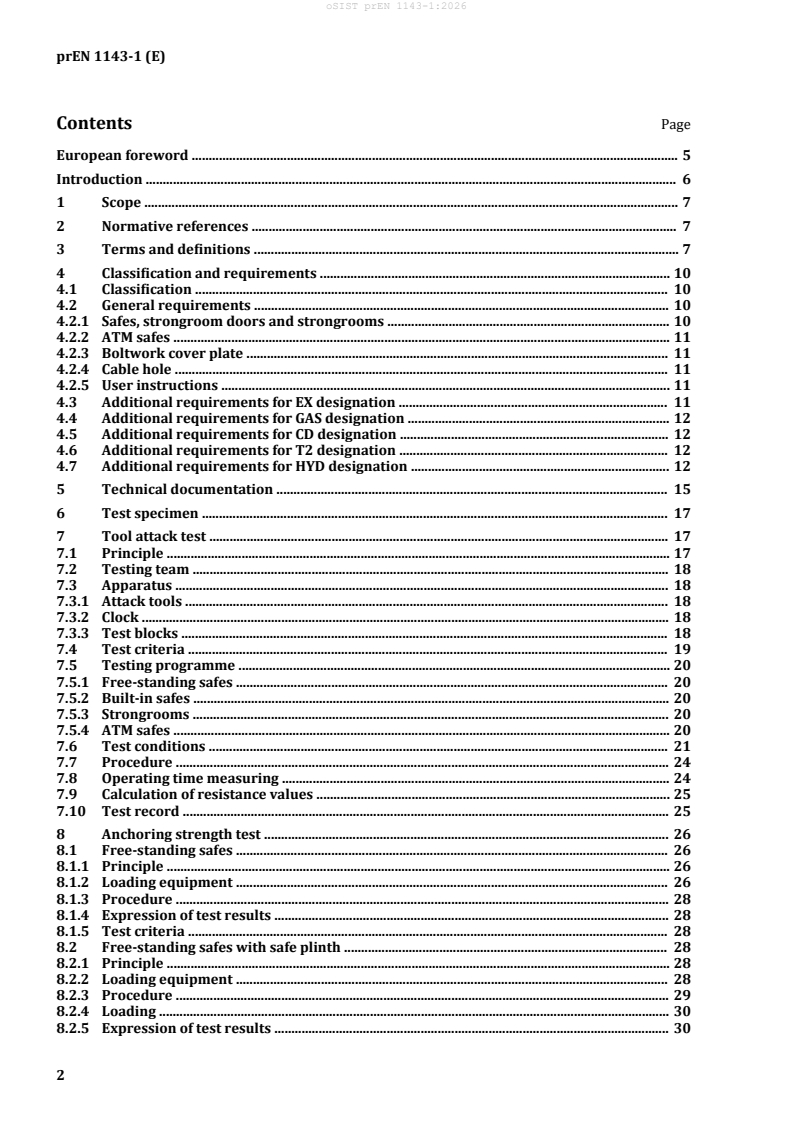
Contents Page
European foreword . 5
Introduction . 6
1 Scope . 7
2 Normative references . 7
3 Terms and definitions . 7
4 Classification and requirements . 10
4.1 Classification . 10
4.2 General requirements . 10
4.2.1 Safes, strongroom doors and strongrooms . 10
4.2.2 ATM safes . 11
4.2.3 Boltwork cover plate . 11
4.2.4 Cable hole . 11
4.2.5 User instructions . 11
4.3 Additional requirements for EX designation . 11
4.4 Additional requirements for GAS designation . 12
4.5 Additional requirements for CD designation . 12
4.6 Additional requirements for T2 designation . 12
4.7 Additional requirements for HYD designation . 12
5 Technical documentation . 15
6 Test specimen . 17
7 Tool attack test . 17
7.1 Principle . 17
7.2 Testing team . 18
7.3 Apparatus . 18
7.3.1 Attack tools . 18
7.3.2 Clock . 18
7.3.3 Test blocks . 18
7.4 Test criteria . 19
7.5 Testing programme . 20
7.5.1 Free-standing safes . 20
7.5.2 Built-in safes . 20
7.5.3 Strongrooms . 20
7.5.4 ATM safes . 20
7.6 Test conditions . 21
7.7 Procedure . 24
7.8 Operating time measuring . 24
7.9 Calculation of resistance values . 25
7.10 Test record . 25
8 Anchoring strength test . 26
8.1 Free-standing safes . 26
8.1.1 Principle . 26
8.1.2 Loading equipment . 26
8.1.3 Procedure . 28
8.1.4 Expression of test results . 28
8.1.5 Test criteria . 28
8.2 Free-standing safes with safe plinth . 28
8.2.1 Principle . 28
8.2.2 Loading equipment . 28
8.2.3 Procedure . 29
8.2.4 Loading . 30
8.2.5 Expression of test results . 30
8.2.6 Test criteria . 30
8.3 ATM safes . 30
8.3.1 Principle . 30
8.3.2 Loading equipment . 30
8.3.3 Procedure . 30
8.3.4 Expression of results . 33
8.3.5 Test criteria . 33
9 EX explosive test . 33
9.1 Principle . 33
9.2 Test specimen . 33
9.3 Explosives . 33
9.4 Determination of active explosive charge mass . 34
9.5 Conditions for explosive attack test . 34
9.5.1 Safes and ATM safes . 34
9.5.2 Strongroom doors and strongrooms . 34
9.6 Calculation of resistance values for the post-detonation tool attack . 34
9.7 Test record . 35
10 GAS explosive test . 35
10.1 Principle . 35
10.2 Test specimen . 35
10.3 Gas . 35
10.4 Determination of gas charge volume . 36
10.5 Test equipment for gas attack testing . 36
10.6 Procedure for gas attack testing . 36
10.7 Calculation of resistance values for the post-detonation tool attack . 37
10.8 Test record . 37
10.9 Marking . 38
11 Core drilling test . 38
11.1 Principle . 38
11.2 Test specimen . 38
11.3 Apparatus . 38
11.3.1 Safes . 38
11.3.2 Strongroom doors and strongrooms . 38
11.4 Test method . 38
11.5 Calculation of resistance value . 39
11.6 Marking . 39
12 Tool attack test T2 . 39
12.1 Principle . 39
12.2 Marking . 39
13 Hydraulic resistance test . 39
13.1 Principle . 39
13.2 Test specimen . 40
13.3 Apparatus . 40
13.4 Test method . 41
13.4.1 Principle . 41
13.4.2 End of the test . 42
13.5 Test record . 42
13.6 Marking . 43
14 Test report . 43
15 Marking . 44
Annex A (normative) Attack tools . 46
Annex B (normative) Attack tools T2 . 52
Annex C (informative) Examples for ATM systems and non-ATM systems . 56
Bibliography . 58
European foreword
This document (prEN 1143-1:2026) has been prepared by Technical Committee CEN/TC 263, the
secretariat of which is held by BSI.
This document is currently submitted to the CEN Enquiry.
This document will supersede EN 1143-1:2019.
a) Requirements for testing ATM safes against hydraulic and electric spreaders and door openers
have been added (Clause 2 , 3.26 , 4.1, 4.7, Clause 13 and Table 2) Products tested with these new
tools have a 'HYD' designation behind the resistance grade.
b) a new product "safe plinth" has been integrated (clause safe plinth , 4.2.1 , 5.8, list item a), 7.4, list
item c) , 7.5.1, 7.5.4.4, 7.6.14 and Table 1).
c) The possibility to include locks according to EN 17646 [1] has been included (Table 1, Table 2 ,
Table 3).
d) The requirement for "complete access" and partial access has changed – a removal of a wall (in
certain tolerances) is now also counted as complete access (safe and 7.4 ).
e) New requirements for the cable holes have been set (4.2.1 and 4.2.4)
f) Strongrooms weighing less than 1.000 kg shall now have a fixing system. Additionally, strongroom
accessories shall not permit a direct view inside (4.2.1)
g) Requirements for the anchoring instruction have been included (5.8, list item a))
h) The tolerances of the explosive heat have been adapted (9.3).
i) Clarifications have been included in 7.5.3.2 ,7.6.7, 7.9, 8.1.2, 8.2, 8.3.2.1, 11.4, Table A.5, Table
A.12, Table A.13 and Table A.14.
This document is one of a series of product standards for secure storage units of different types.
Introduction
Tests are made, the results of which are used to classify the resistance to burglary. The resistance
classification can also be used for designing security systems with the provision that, depending on the
criminal, the conditions at the place of the crime and the availability of tools, considerably longer times
are likely to occur in real burglary attacks than in a test.
Manual tests are included, whose results and repeatability are dependent on the skill of the testing team.
Machine-related tests are under development and may be included when this document is revised.
For ATM systems the tests and requirements in this document are based on the following assumptions
(conditions) of use:
— ATM system: assembly of sub-units which provides an ATM function and affords security to cash
and/or valuables (e.g. checks) stored within the ATM safe.
— For using of an ATM safe the ATM manufacturer is responsible for the secure storage of the cash
and/or valuables (e.g. checks).
Examples of different designs of ATM systems are given in Annex C.
1 Scope
This document establishes the basis for testing and classifying free-standing safes, safe plinths, built-in
safes (floor and wall), ATM safes and ATM bases, strongroom doors and strongrooms (with or without
a door) according to their burglary resistance.
This document does not cover testing and classifying Deposit Systems and ATM systems.
2 Normative references
The following documents are referred to in the text in such a way that some or all of their content
constitutes requirements of this document. For dated references, only the edition cited applies. For
undated references, the latest edition of the referenced document (including any amendments) applies.
EN 1300, Secure storage units - Classification for high security locks according to their resistance to
unauthorized opening
EN 10051, Continuously hot-rolled strip and plate/sheet cut from wide strip of non-alloy and alloy steels
- Tolerances on dimensions and shape
EN 17646, Secure storage units - Classification for high security locks according to their resistance to
unauthorized opening - Distributed systems
3 Terms and definitions
For the purposes of this document, the following terms and définitions apply.
— ISO Online browsing platform: available at http://www.iso.org/obp
— IEC Electropedia: available at http://www.electropedia.org/
3.1
safe
storage unit which protects its contents against burglary and when closed has at least one internal side
≤ 1 m length and at least one body wall with an inside face larger than all partial access test blocks
according to 7.3.3.2
3.2
free-standing safe
safe whose protection against burglary depends only upon the materials and construction of its primary
manufacture and not upon materials added or attached during installation
3.3
safe plinth
integral part which is located between a spécific free-standing safe and the surface to which the safe is
to be anchored
Note 1 to entry: A safe plinth may be a solid construction aimed to anchor the product in a more éfficiént way or
a hollow construction to position a safe to a more reachable height. Other constructions are also possible.
Note 2 to entry: A safe plinth can be an integral part of the free-standing safe (permanently connected) or a separate
part delivered with the free-standing safe or both. Solution where the plinth is an in-situ part of the building /
floor are not meant by the safe plinth.
3.4
built-in safe
safe whose protection against burglary is partly dependent upon materials incorporated into it, or
attached to it, during installation
Note 1 to entry: Under floor safes and wall safes are special types of built-in safes.
3.5
strongroom
storage unit which protects against burglary and when closed has internal side lengths in all directions
> 1 m
Note 1 to entry: Strongrooms may be cast in situ, constructed from pre-fabricated elements or a combination of
both.
3.6
strongroom door
door with lock(s), boltwork and frame intended for giving access to a strongroom
3.7
ATM safe
safe forming part of an ATM system
3.8
ATM base
integral part of an ATM system located between the ATM safe and the surface to which the ATM safe is
to be anchored
3.9
internal space
part of the interior of an ATM safe which is bounded by the inside surfaces of the ATM safe and the
boltwork cover plate(s) of the door of the ATM safe body
3.10
ATM
automatic-teller-machine
means for holding and processing cash and/or valuables
Note 1 to entry: For the purpose of this document, automated teller machines, currency exchange machines,
currency recycling machines and machines such as teller assist machines are all considered types of ATM.
3.11
ATM-System
assembly of sub-units which provides an ATM function and affords security to cash and/or valuables
stored within the ATM safe
Note 1 to entry: An example of an ATM system is shown in Annex C.
Note 2 to entry: Of the sub-units shown in Annex C, the ATM mechanism and the ATM control unit are not tested
according to this document.
3.12
accessories
installations/devices which are part of the structure or which pass through the structure of the
strongroom or strongroom door(s) for ventilation or for deposit of cash and valuables
Note 1 to entry: Accessories may be always open, usually open (but can be closed in case of emergency), or closed
(but can be opened if necessary).
3.13
operating time
time during which a tool is used attempting to create a change in the test specimen
Note 1 to entry: In the context of this document, there are also operating times considered during which no visible
modifications/changés are caused to the test specimen.
3.14
resistance unit
RU
burglary resistance which results from one minute's use of a tool carrying the coéfficiént 1 and the basic
value 0
3.15
resistance grade
classification designation for burglary resistance
3.16
resistance value
numerical value in resistance units calculated for each test
3.17
basic value
BV
number in resistance units allocated to a particular tool
3.18
tool coefficient
number in resistance units per minute allocated to a group of tools
Note 1 to entry: For Annex A: The tool coéfficiént represents factors such as noise, smoke, fumes and other effects,
which increase the likelihood of a burglary attack being detected.
Note 2 to entry: For Annex B: The tool coéfficiént represents tool éfficiéncy and factors such as noise, smoke, fumes
and other effects, which increase the likelihood of a burglary attack being detected.
3.19
boltwork
mechanism by which a closed door is held such that, until it is in the withdrawn position, the door cannot
be opened
3.20
lock
device able to recognize a coded input and which performs a blocking function on the boltwork or the
door
3.21
relocking device
system comprising blocking and detecting elements which will prevent the boltwork from being
withdrawn if a burglary attack is detected
Note 1 to entry: A relocking device can be part of the locking mechanism (e.g. active or live relocker) or an
independent unit (e.g. passive relocker).
3.22
to close
to move the door so it becomes possible to bolt it
3.23
to bolt
to throw the boltwork or the bolt of the lock (if there is no boltwork) to a position where it fixés the
door in closed position
3.24
to lock
to block a thrown boltwork by action of a lock
3.25
active explosive charge mass
part of the solid explosive mass, which is pure PETN without any additives
3.26
spreading force
minimum spreading for 25 mm from the tip as définéd in EN 13204
4 Classification and requirements
4.1 Classification
Safes (3.1) are classifiéd to a resistance grade (3.15) according to Table 1.
ATM safes (3.7) are classifiéd to a resistance grade according to Table 2.
Strongroom doors (3.6) and strongrooms (3.5) (with or without a door) are classifiéd to a resistance
grade according to Table 3.
All products shall meet general requirements (4.2), products with EX, GAS, CD, HYD and T2 designation
shall meet additional requirements (4.3, 4.4, 4.5, 4.6 and 4.7).
4.2 General requirements
4.2.1 Safes, strongroom doors and strongrooms
There shall be no holes through the protection material other than those necessary for locks, cables,
anchoring or for the fitting of accessories (3.12) to strongroom doors and strongrooms. Accessories shall
not be designed in such a way that a direct view inside is possible.
Cable openings in safes, strongroom doors and strongrooms (with or without a door) shall not exceed
100 mm each without additional measures. Unused cable entry openings shall be obstructed or plugged
by the manufacturer in such a way it cannot be removed from the outside without leaving visible traces.
To allow the passage of certain types of cables, cable openings in safes and strongrooms can exceed 100
mm² but shall not exceed 150 mm² provided they are not designed or positioned such that they permit
a direct access to a vulnerable or crucial component.
The testing laboratory decides if the cable opening is vulnerable. To be permitted all cable openings
shall have been tested or assessed by the testing laboratory according to the 7.5.
Free-standing safes with a mass of less than 1 000 kg shall have at least one hole by which they can be
anchored according to the installation instruction. The anchoring assembly for each anchoring hole shall
sustain the force given in Table 1.
Free-standing safes with a mass of less than 1 000 kg including a connected or integrated safe plinth (if
available) shall have a fixing system by which they can be anchored according to the installation
instruction. When tested in accordance with 8.2, the fixing system shall achieve the criteria in Table 1.
The anchoring assembly for each anchoring hole and/or connection point shall sustain the force given
in Table 1. In case that the safe plinth has a door or lid which can be opened without opening of the free-
standing safe door, this door or lid shall be equipped and locked with a high security lock according to
EN 1300 according to EN 17646.
Strongrooms including a strongroom door with a combined mass of less than 1 000 kg shall have a
fixing system by which they can be anchored in one of the panels according to the installation
instructions. The requirements for testing the anchoring of a strongroom are identical to those of free-
standing safes.
4.2.2 ATM safes
ATM safes shall have means for plugging unused openings. These means shall be impossible to remove
from the outside without leaving visible traces.
Openings through the protection material for ATM functioning are permitted in ATM safes.
NOTE Cable entry openings in ATM safes can be larger than 100 mm .
ATM safes, including optional ATM bases, shall have a fixing system by which they can be anchored.
When tested in accordance with Clause 7 and Clause 8, the fixing system shall achieve the criteria in
Table 2.
4.2.3 Boltwork cover plate
Safes, ATM safes and strongroom doors shall have an internal boltwork cover plate that prevents
unauthorized viewing of the locks (3.20) and boltwork (3.19) and access to them, when the door is open.
Boltwork cover plates shall be secured so that they cannot be opened or removed by an unauthorized
person without leaving visible traces.
4.2.4 Cable hole
Safes, strongroom doors and strongrooms of grade III and higher shall either have a hole for a cable or
a preparation enabling a cable hole to be used for a connection to be made to an alarm system after the
secure storage unit has been installed.
The position and dimension of the cable holes shall follow the requirements for cable openings of 4.2.1.
4.2.5 User instructions
Safes, strongrooms and ATM safes shall be provided with operating and maintenance instructions,
including instructions regarding the locks. Free-standing safes and ATM safes shall have instructions
for anchoring. For built-in safes, strongroom doors and strongrooms, installation instructions shall be
provided.
4.3 Additional requirements for EX designation
When tested in accordance with Clause 9, safes of resistance grades II to X designated 'EX' shall achieve
the minimum post-detonation resistance values given in Table 1. EX designation is not applicable to
safes of resistance grade 0 and I.
When tested in accordance with Clause 9, ATM safes of resistance grades II to VIII designated 'EX' shall
achieve the minimum post-detonation resistance values given in Table 2. EX designation is not
applicable to ATM safes of resistance grades L and I.
When tested in accordance with Clause 9, strongroom doors and strongrooms (with or without doors)
of resistance grades II to XIII designated 'EX' shall achieve the minimum post-detonation resistance
values given in Table 3. EX designation is not applicable to strongroom doors and strongrooms of
resistance grades 0 and I.
4.4 Additional requirements for GAS designation
When tested in accordance with Clause 10, ATM safes of resistance grades II to VIII designated 'GAS'
shall achieve the minimum post-detonation resistance values given in Table 2. 'GAS' designation is not
applicable to ATM safes of resistance grades L and I.
4.5 Additional requirements for CD designation
When tested in accordance with Clause 11, safes of resistance grades IV to X designated ‘CD’ shall achieve
the minimum resistance values given in Table 1. 'CD' designation is not applicable to safes of resistance
grades 0 to III and ATM safes.
When tested in accordance with Clause 11, strongroom doors and strongrooms (with or without a door)
of resistance grades VIII to XIII designated 'CD' shall achieve the minimum resistance values given in
Table 3. 'CD' designation is not applicable to strongroom doors and strongrooms of resistance grades
0 to VII.
4.6 Additional requirements for T2 designation
When tested in accordance with Clause 12, safes of resistance grades 0 to X (including EX and CD
designation, if applicable) designated 'T2' shall achieve the minimum resistance values and
requirements given in Table 1.
When tested in accordance with Clause 12, ATM safes of resistance grades L to VIII (including EX and
GAS designation, if applicable) designated 'T2' shall achieve the minimum resistance values and
requirements given in Table 2.
When tested in accordance with Clause 12 strongroom doors and strongrooms (with or without doors)
of resistance grades 0 to XIII (including EX and CD designation, if applicable) designated 'T2' shall
achieve the minimum resistance values and requirements given in Table 3.
4.7 Additional requirements for HYD designation
When tested in accordance with Clause 13, ATM safes of resistance grades III to VIII designated ‘HYD’
shall achieve the resistance test criteria stated given in Clause 13.
'HYD' designation is not applicable to ATM safes of resistance grade L to II, safes, strongrooms and
strongroom doors.
Table 1
Minimum requirements for classification of safes (excluding ATM safes) into resistance grades
Resistan Tool attack test Anchorin Tool Locks Additional Additional
ce grade (Clause 7) g attack requirements requirements
strength test on for EX for CD
Tool attack test T2 a
safe designation designation
(Clause
(Clause 12)
plinths (optional) (optional)
8)
(Clause (Clause 9) (Clause 11)
7)
Resistance value for Required Resistan Quantit Class Post- Resistance
c bc
force y accordin detonation
ce value value
Partial Complet
g to resistance
access e access
bc
EN
valued e
1300/
RU RU kN RU RU RU
EN
d e
0 30 30 50 20 1 A
d e
I 30 50 50 20 1 A
e
II 50 80 50 30 1 A 4
Minimum requirements for classification of safes (excluding ATM safes) into resistance grades
Resistan Tool attack test Anchorin Tool Locks Additional Additional
ce grade (Clause 7) g attack requirements requirements
strength test on for EX for CD
Tool attack test T2 a
safe designation designation
(Clause
(Clause 12)
plinths (optional) (optional)
8)
(Clause (Clause 9) (Clause 11)
7)
Resistance value for Required Resistan Quantit Class Post- Resistance
c bc
force y accordin detonation
ce value value
Partial Complet
g to resistance
access e access
bc
EN
valued e
1300/
RU RU kN RU RU RU
EN
e
III 80 120 50 50 1 B 6
IV 120 180 100 80 2 B 9 1 000
V 180 270 100 120 2 B 14 1 000
VI 270 400 100 180 2 C 20 1 000
VII 400 600 100 270 2 C 30 1 000
VIII 550 825 100 400 2 C 41 1 000
IX 700 1 050 100 550 2 C 53 1 000
X 900 1 350 100 700 2 C 68 1 000
a
Applicable only to free-standing safes with a mass less than 1 000 kg.
b
Resistance value for partial access.
c
If the tool test is performed according Clause 12 (T2), the resistance value shall be achieved according
Clause 12 (T2).
d
EX designation is not permitted for resistance grades 0 and I.
e
CD designation is not permitted for resistance grades 0 to III.
Table 2
Minimum requirements for classification of ATM safes into resistance grades
Resista Tool attack test (Clause Ancho Tool Addition Locks Additional Additional
nce 7) ring attack al requireme requirements
grade strengt test on require nts for EX for HYD
Tool attack test T2
h (8.3) fixing ments and GAS designation
(Clause 12)
attachm for post- designatio (optional)
b
ent anchorin n
(Clause 12)
Resistance value for
(Clause g forcing (optional)
7) test (Clause 9
(Clause and Clause
8) 10)
Partial access Comple Requir Resista Post- Qua Class Post- Max. Max.
te ed nce anchorin ntity accord detonation active resista
genera used
a
access force g ing to resistance attack nce of
value
l apertu
ba
resistanc EN time other
value
c
res
a
1300/ tools
e value
a
EN
used
RU RU RU kN RU RU RU min RU
L bod 20 20 30
y
d e e
50 30 18 1 A
doo 30 30 50
r
d e e
I 30 30 50 50 30 18 1 A
e e
II 50 35 80 50 50 22 1 A 4
III 80 65 120 50 50 22 1 B 6 20 50
IV 120 100 180 100 50 22 2 B 9 30 80
V 180 145 270 100 50 22 2 B 14 45 120
VI 270 220 400 100 70 22 2 C 20 60 180
VII 400 350 600 100 120 22 2 C 30 75 270
VIII 550 500 825 100 160 22 2 C 41 90 400
a
If the tool test is performed according Clause 12 (T2), the resistance value shall be achieved according Clause
12 (T2).
b
Resistance value for partial access.
c
Applies only to apertures actually used; plugged and unused apertures shall satisfy the general values.
d
EX and GAS designation are not permitted for resistance grades L and I.
e
HYD designation are not permitted for resistance grades L, I and II.
Table 3
a
Resistance Tool attack test Additional Additional
Locks
grade (Clause 7) requirements requirements
for EX for CD
Tool attack test
designation designation
T2 (Clause 12)
(optional) (optional)
(Clause 9) (Clause 11)
Resistance Quantity Class according Post-detonation Resistance
bc
value for to EN 1300/ resistance
value
b c
complete access EN 17646
value
RU RU RU
d e
0 30 1 A
d e
I 50 1 A
e
II 80 1 A 4
e
III 120 1 B 6
e
IV 180 2 B 9
e
V 270 2 B 14
e
VI 400 2 C 20
e
VII 600 2 C 30
VIII 825 2 C 41 10 000
IX 1 050 2 C 53 10 000
X 1 350 2 C 68 10 000
3 C or 10 000
XI 2 000 100
2 D
3 C or 10 000
XII 3 000 150
2 D
XIII 4 500 2 D 225 10 000
a
Not applicable for classification of strongrooms without a door.
b
Resistance value for complete access.
c
If the tool test is performed according Clause 12 (T2), the resistance value shall be achieved according Clause
12 (T2).
d
EX designation is not permitted for resistance grades 0 and I.
e
CD designation is not permitted for resistance grades 0 to VII.
5 Technical documentation
The technical documentation shall contain the following information:
5.1 The date of issue, the name of the manufacturer or the name of the applicant requesting the
testing shall be on each page.
5.2 Statement of the type of product: free-standing safe (3.2), built-in safe (3.4) (floor and wall), ATM
safe (3.7) , strongroom door (3.6) or strongroom (3.5) (with or without a door), together with a list of
sizes covered by the same design.
5.3 Drawings of the test specimen showing the following:
a) weight, outside and inside dimensions, and the manufacturing tolerances;
b) horizontal and vertical cross sections;
c) quantity, layout and features of locks, boltwork and relocking devices;
d) quantity, pitch and position of door bolts, their dimensions (e.g. cross section), throw and
engagements and their type (e.g. moving or fixéd);
e) location and design of any local areas of special protection materials;
f) details of the fastening and/or fitting or anchoring of all elements relevant to physical security; e.g.
construction and position of joints and connections, the means by which door and/or frames are
joined to walls, the means by which prefabricated panels are joined;
g) marking, position and dimensions of any holes which pass through the protection material with a
detailed representation of specially protected areas;
h) details of optional features, e.g. features for time locking and time delay locking;
i) for ATM safes, the ATM base (3.8) , if any, will be idéntifiéd by the manufacturer.
5.4 List of all the locks that may be fittéd, including the manufacturer and model number.
5.5 Spécification of the materials of construction (if not contained in the drawings).
5.6 Statements of details of any materials or device(s) intended to generate gas, smoke, soot, etc. in
the event of physical attack, or which could generate harmful substances during testing.
5.7 Statements of the nature and position of any cables and/or facilities for penetration of detection
systems, for the mounting of el
...