

SIST EN 300 422-2 V1.3.1:2011
(Main)Electromagnetic compatibility and Radio spectrum Matters (ERM) - Wireless microphones in the 25 MHz to 3 GHz frequency range - Part 2: Harmonized EN covering essential requirements of article 3.2 of the R&TTE Directive
- Abstract
The present document applies to equipment operating on radio frequencies between 25 MHz and 3 GHz, using analogue, digital and hybrid (using both analogue and digital modulation) modulation.
The present document applies to the following radio equipment types:
• Professional Wireless Microphone Systems (PWMS);
• in ear monitoring systems;
• consumer radio microphones;
• tour guide systems; and
• Assistive Listening Devices (Aids for the handicapped) comprising personal and public hearing aid systems.
The maximum power recommended for equipment covered by the present document is 250 mW for radio microphones and 500 mW for public hearing aids in the 169,4 MHz to 169,8125 MHz band (erp below 1 GHz and eirp above 1 GHz).
The present document also covers radio microphones used in the 863 MHz to 865 MHz band, with a maximum power of 10 mW.
The present document is intended to cover the provisions of Directive 1999/5/EC [i.1] (R&TTE Directive): Article 3.2, which states that "….. radio equipment shall be so constructed that it effectively uses the spectrum allocated to terrestrial/space radio communications and orbital resources so as to avoid harmful interference".
In addition to the present document, other ENs that specify technical requirements in respect of essential requirements under other parts of Article 3 of the R&TTE Directive may apply to equipment within the scope of the present document.
- Status
- Published
- Public Enquiry End Date
- 31-Mar-2011
- Publication Date
- 19-Sep-2011
- Technical Committee
- MOC - Mobile Communications
- Current Stage
- 6060 - National Implementation/Publication (Adopted Project)
- Start Date
- 05-Sep-2011
- Due Date
- 10-Nov-2011
- Completion Date
- 20-Sep-2011
- Mandate
- M/284
Buy Documents
en_30042202v010300c - Electromagnetic compatibility and Radio spectrum Matters (ERM); Wireless microphones in the 25 MHz to 3 GHz frequency range; Part 2: Harmonized EN covering the essential requirements of article 3.2 of the R&TTE Directive
en_30042202v010300v - Electromagnetic compatibility and Radio spectrum Matters (ERM); Wireless microphones in the 25 MHz to 3 GHz frequency range; Part 2: Harmonized EN covering the essential requirements of article 3.2 of the R&TTE Directive
en_30042202v010301p - Electromagnetic compatibility and Radio spectrum Matters (ERM); Wireless microphones in the 25 MHz to 3 GHz frequency range; Part 2: Harmonized EN covering the essential requirements of article 3.2 of the R&TTE Directive

SIST EN 300 422-2 V1.3.1:2011 is the Slovenian adoption of ETSI EN 300 422-2 V1.3.1, a Harmonized European Standard for wireless microphones and related assistive listening equipment in the 25 MHz to 3 GHz range. It specifies the essential radio requirements and the compliance tests used for Article 3.2 of the R&TTE Directive, so manufacturers, test labs and regulators can check spectrum use, transmitter performance and unwanted emissions.
The standard covers both analogue and digital equipment, including hybrid systems that use both modulation types. In practice, it tells a supplier what has to be declared, measured and recorded to show that the equipment uses spectrum efficiently and avoids harmful interference.
What does SIST EN 300 422-2 V1.3.1:2011 specify?
SIST EN 300 422-2 V1.3.1:2011 specifies the essential radio requirements for listed wireless microphone and assistive listening device types operating between 25 MHz and 3 GHz. It also sets out the test approach for demonstrating conformity with those requirements.
The scope includes:
- Professional Wireless Microphone Systems (PWMS)
- in ear monitoring systems
- consumer radio microphones
- tour guide systems
- Assistive Listening Devices, including personal and public hearing aid systems
The standard also states practical power limits for some applications, including 250 mW for radio microphones, 500 mW for public hearing aids in the 169,4 MHz to 169,8125 MHz band, and 10 mW for radio microphones in the 863 MHz to 865 MHz band. These limits matter because they define the power levels that the equipment is expected to stay within during design and testing.
| Annex | What it covers |
|---|---|
| Annex A | HS Requirements and conformance Test specifications Table (HS-RTT) for Article 3.2 conformity work |
| Annex B | EN title in the official languages |
The document is organized into two main technical parts:
- Part I - Radio microphones
- Part II - Assistive listening devices
Each part follows the same pattern: technical requirements, then testing for compliance, followed by the harmonized standard test table in Annex A.
What are the key requirements of SIST EN 300 422-2 V1.3.1:2011?
SIST EN 300 422-2 V1.3.1:2011 requires equipment to meet specific transmitter and receiver limits under a declared operational environmental profile, and to prove that compliance by the named tests. The same structure is used for radio microphones and assistive listening devices, which makes it easier to apply the standard across product families.
Environmental profile and test conditions
The supplier has to declare the operational environmental profile, and the equipment has to comply within its boundary limits. Tests are to be run at representative points within that profile, and over enough environmental variation to build confidence where performance changes with conditions.
In practice, this means the compliance file should say under what operating conditions the product was checked, not just that it passed once in a laboratory setting.
Transmitter requirements
For both product groups, the standard covers:
- frequency stability
- rated output power
- necessary bandwidth
- spurious emissions
The limits are taken from EN 300 422-1, with separate references for analogue and digital systems where needed. This matters because the design team must verify channel accuracy, output level, occupied spectrum and unwanted emissions against the correct limit set for the product type.
Receiver requirements
The receiver requirement in both parts is spurious emissions. The tests check unwanted emissions from the receiver side, which matters because receivers can also create interference and must be assessed as part of the whole radio system.
Measurement reporting
The test report has to include measurement uncertainty, and the uncertainty figures have to stay within the stated maxima. The standard also says the measured value, not the uncertainty alone, is used to decide whether the requirement is met. That is important for labs and buyers reviewing reports because it defines how pass or fail is judged.
Essential radio test suites
The compliance tests are grouped into essential radio test suites for transmitters and receivers. Annex A links each requirement to its test specification and marks which tests are essential for presumption of conformity. In practice, this is the checklist most conformity assessments will follow.
What terms does SIST EN 300 422-2 V1.3.1:2011 define?
SIST EN 300 422-2 V1.3.1:2011 uses the definitions, symbols and abbreviations from EN 300 422-1. The following terms are the ones readers usually need first:
- Environmental profile - the declared operating conditions within which the equipment has to meet the technical requirements.
- Frequency stability - the transmitter’s ability to stay close to its intended frequency under the stated conditions.
- Rated output power - the output power level that is tested against the applicable limit.
- Necessary bandwidth - the bandwidth the transmission needs, which is checked separately for analogue and digital systems.
- Spurious emissions - unwanted emissions from transmitter or receiver that must stay below the stated limits.
- Essential radio test suite - the set of tests in Annex A that supports presumption of conformity.
Who uses SIST EN 300 422-2 V1.3.1:2011?
SIST EN 300 422-2 V1.3.1:2011 is used by radio product manufacturers, test laboratories, conformity assessment teams, quality managers and regulatory staff. It is especially relevant for PWMS, in ear monitoring systems, consumer radio microphones, tour guide systems and Assistive Listening Devices.
These users apply it during product design, pre-compliance testing, type testing and technical file preparation. Buyers and specifiers also use it to compare radio equipment on a clear technical basis.
Which standards are used with SIST EN 300 422-2 V1.3.1:2011?
SIST EN 300 422-2 V1.3.1:2011 depends on EN 300 422-1, which supplies the technical characteristics, definitions, limits and measurement methods it references throughout. The document also points to EG 201 399 for the modular structure of harmonized standards.
For measurement uncertainty, the standard refers users to TR 100 028 and TR 102 215. Those documents support the uncertainty values that have to be reported with test results.
What does the SIST EN 300 422-2 V1.3.1:2011 document contain?
The document contains the scope, references, definitions, two mirrored technical parts, testing clauses and the harmonized requirements-and-test table in Annex A. It also includes the measurement uncertainty table used when reporting results.
For radio microphones and assistive listening devices, it sets out transmitter frequency stability, rated output power, necessary bandwidth and spurious emissions, plus receiver spurious emissions. It then ties those requirements to the corresponding test clauses, so a test report can show exactly which checks were applied.
Annex A is the practical bridge between the requirement text and the compliance test plan. Annex B gives the EN title in the official languages.
Buy Documents
en_30042202v010300c - Electromagnetic compatibility and Radio spectrum Matters (ERM); Wireless microphones in the 25 MHz to 3 GHz frequency range; Part 2: Harmonized EN covering the essential requirements of article 3.2 of the R&TTE Directive
en_30042202v010300v - Electromagnetic compatibility and Radio spectrum Matters (ERM); Wireless microphones in the 25 MHz to 3 GHz frequency range; Part 2: Harmonized EN covering the essential requirements of article 3.2 of the R&TTE Directive
en_30042202v010301p - Electromagnetic compatibility and Radio spectrum Matters (ERM); Wireless microphones in the 25 MHz to 3 GHz frequency range; Part 2: Harmonized EN covering the essential requirements of article 3.2 of the R&TTE Directive
Get Certified
Connect with accredited certification bodies for this standard

ANCE
Mexican certification and testing association.

Intertek Slovenia
Intertek testing, inspection, and certification services in Slovenia.

LNE (Laboratoire National de Métrologie et d'Essais)
French national laboratory for metrology and testing.
Sponsored listings
Frequently Asked Questions
SIST EN 300 422-2 V1.3.1:2011 is a standard published by the Slovenian Institute for Standardization (SIST). Its full title is "Electromagnetic compatibility and Radio spectrum Matters (ERM) - Wireless microphones in the 25 MHz to 3 GHz frequency range - Part 2: Harmonized EN covering essential requirements of article 3.2 of the R&TTE Directive". This standard covers: The present document applies to equipment operating on radio frequencies between 25 MHz and 3 GHz, using analogue, digital and hybrid (using both analogue and digital modulation) modulation. The present document applies to the following radio equipment types: • Professional Wireless Microphone Systems (PWMS); • in ear monitoring systems; • consumer radio microphones; • tour guide systems; and • Assistive Listening Devices (Aids for the handicapped) comprising personal and public hearing aid systems. The maximum power recommended for equipment covered by the present document is 250 mW for radio microphones and 500 mW for public hearing aids in the 169,4 MHz to 169,8125 MHz band (erp below 1 GHz and eirp above 1 GHz). The present document also covers radio microphones used in the 863 MHz to 865 MHz band, with a maximum power of 10 mW. The present document is intended to cover the provisions of Directive 1999/5/EC [i.1] (R&TTE Directive): Article 3.2, which states that "….. radio equipment shall be so constructed that it effectively uses the spectrum allocated to terrestrial/space radio communications and orbital resources so as to avoid harmful interference". In addition to the present document, other ENs that specify technical requirements in respect of essential requirements under other parts of Article 3 of the R&TTE Directive may apply to equipment within the scope of the present document.
The present document applies to equipment operating on radio frequencies between 25 MHz and 3 GHz, using analogue, digital and hybrid (using both analogue and digital modulation) modulation. The present document applies to the following radio equipment types: • Professional Wireless Microphone Systems (PWMS); • in ear monitoring systems; • consumer radio microphones; • tour guide systems; and • Assistive Listening Devices (Aids for the handicapped) comprising personal and public hearing aid systems. The maximum power recommended for equipment covered by the present document is 250 mW for radio microphones and 500 mW for public hearing aids in the 169,4 MHz to 169,8125 MHz band (erp below 1 GHz and eirp above 1 GHz). The present document also covers radio microphones used in the 863 MHz to 865 MHz band, with a maximum power of 10 mW. The present document is intended to cover the provisions of Directive 1999/5/EC [i.1] (R&TTE Directive): Article 3.2, which states that "….. radio equipment shall be so constructed that it effectively uses the spectrum allocated to terrestrial/space radio communications and orbital resources so as to avoid harmful interference". In addition to the present document, other ENs that specify technical requirements in respect of essential requirements under other parts of Article 3 of the R&TTE Directive may apply to equipment within the scope of the present document.
SIST EN 300 422-2 V1.3.1:2011 is classified under the following ICS (International Classification for Standards) categories: 33.060.99 - Other equipment for radiocommunications; 33.100.01 - Electromagnetic compatibility in general; 33.160.50 - Accessories. The ICS classification helps identify the subject area and facilitates finding related standards.
SIST EN 300 422-2 V1.3.1:2011 is associated with the following European legislation: EU Directives/Regulations: 1999/5/EC, 2005-01-1864, TRRTP124; Standardization Mandates: M/284. When a standard is cited in the Official Journal of the European Union, products manufactured in conformity with it benefit from a presumption of conformity with the essential requirements of the corresponding EU directive or regulation.
SIST EN 300 422-2 V1.3.1:2011 is available in PDF format for immediate download after purchase. The document can be added to your cart and obtained through the secure checkout process. Digital delivery ensures instant access to the complete standard document.
Standards Content (Sample)
Draft ETSI EN 300 422-2 V1.3.0 (2011-01)
Harmonized European Standard (EN)
Electromagnetic compatibility
and Radio spectrum Matters (ERM);
Wireless microphones
in the 25 MHz to 3 GHz frequency range;
Part 2: Harmonized EN covering the essential requirements
of article 3.2 of the R&TTE Directive
2 Draft ETSI EN 300 422-2 V1.3.0 (2011-01)
Reference
REN/ERM-TG17WG3-014-2
Keywords
audio, radio, radio MIC, testing
ETSI
650 Route des Lucioles
F-06921 Sophia Antipolis Cedex - FRANCE
Tel.: +33 4 92 94 42 00 Fax: +33 4 93 65 47 16
Siret N° 348 623 562 00017 - NAF 742 C
Association à but non lucratif enregistrée à la
Sous-Préfecture de Grasse (06) N° 7803/88
Important notice
Individual copies of the present document can be downloaded from:
http://www.etsi.org
The present document may be made available in more than one electronic version or in print. In any case of existing or
perceived difference in contents between such versions, the reference version is the Portable Document Format (PDF).
In case of dispute, the reference shall be the printing on ETSI printers of the PDF version kept on a specific network drive
within ETSI Secretariat.
Users of the present document should be aware that the document may be subject to revision or change of status.
Information on the current status of this and other ETSI documents is available at
http://portal.etsi.org/tb/status/status.asp
If you find errors in the present document, please send your comment to one of the following services:
http://portal.etsi.org/chaircor/ETSI_support.asp
Copyright Notification
No part may be reproduced except as authorized by written permission.
The copyright and the foregoing restriction extend to reproduction in all media.
© European Telecommunications Standards Institute 2011.
All rights reserved.
TM TM TM TM
DECT , PLUGTESTS , UMTS , TIPHON , the TIPHON logo and the ETSI logo are Trade Marks of ETSI registered
for the benefit of its Members.
TM
3GPP is a Trade Mark of ETSI registered for the benefit of its Members and of the 3GPP Organizational Partners.
LTE™ is a Trade Mark of ETSI currently being registered
for the benefit of its Members and of the 3GPP Organizational Partners.
GSM® and the GSM logo are Trade Marks registered and owned by the GSM Association.
ETSI
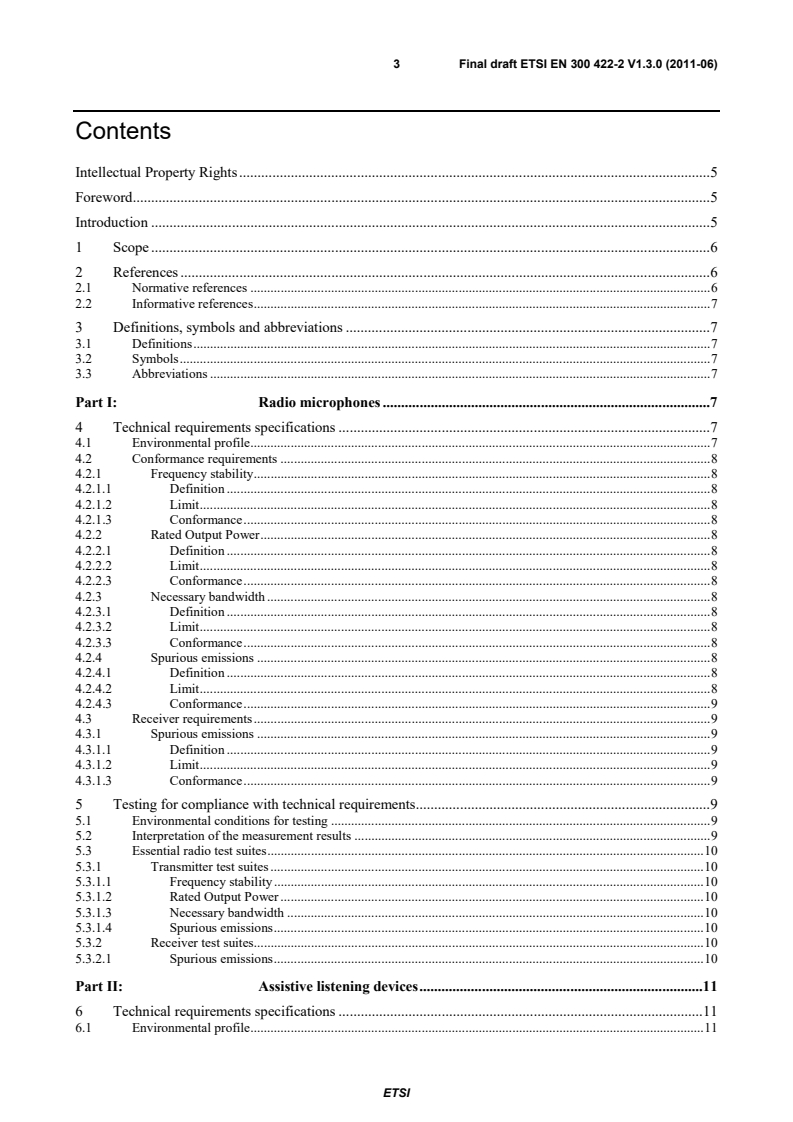
3 Draft ETSI EN 300 422-2 V1.3.0 (2011-01)
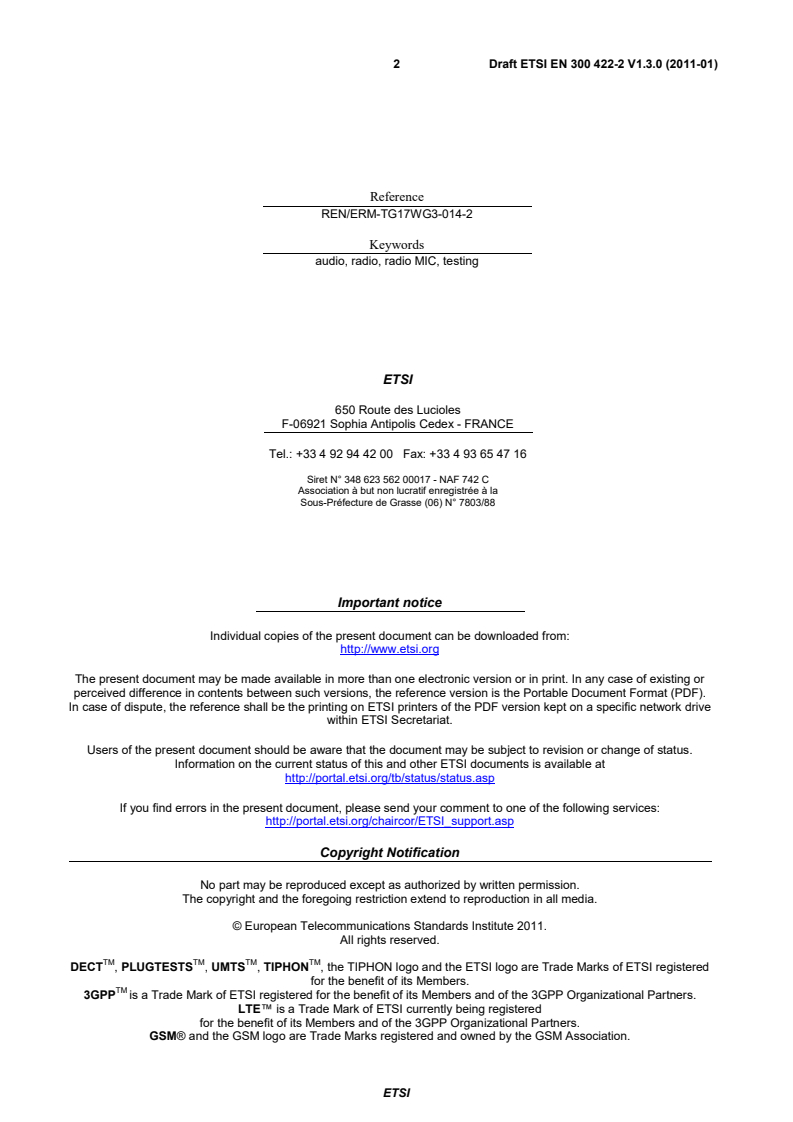
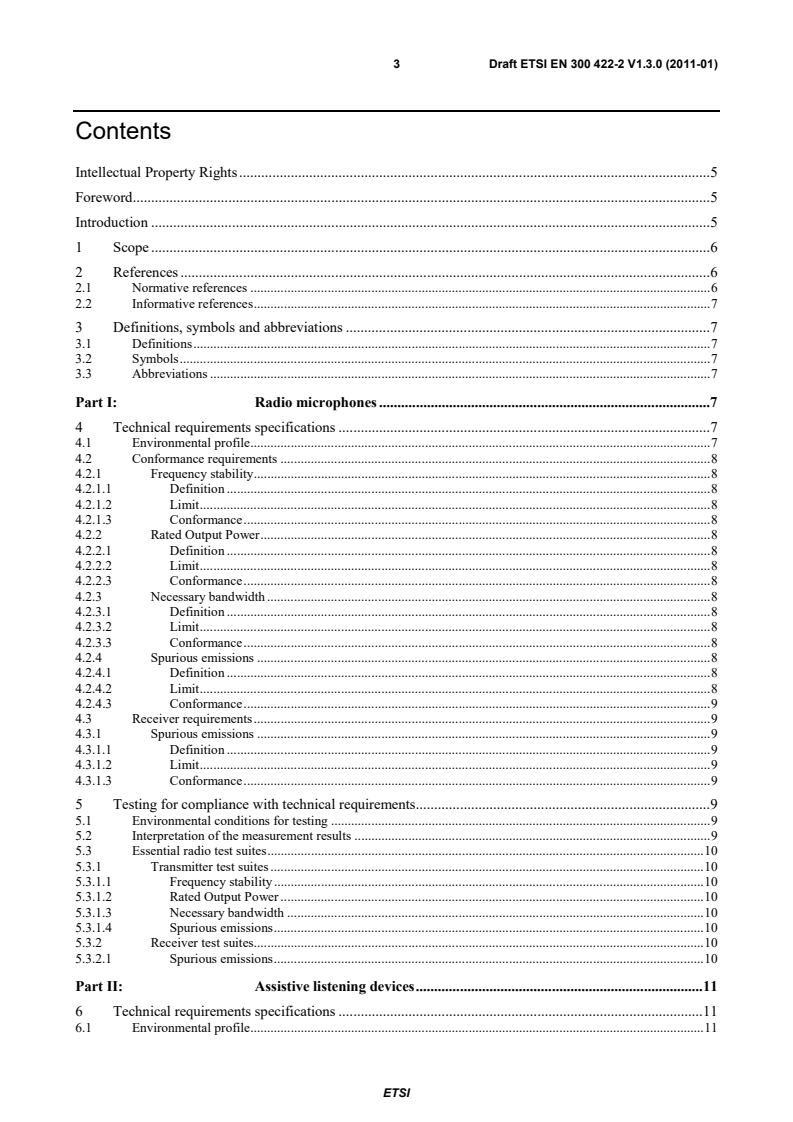
Contents
Intellectual Property Rights . 5
Foreword . 5
Introduction . 5
1 Scope . 6
2 References . 6
2.1 Normative references . 6
2.2 Informative references . 7
3 Definitions, symbols and abbreviations . 7
3.1 Definitions . 7
3.2 Symbols . 7
3.3 Abbreviations . 7
Part I: Radio microphones . 7
4 Technical requirements specifications . 7
4.1 Environmental profile . 7
4.2 Conformance requirements . 8
4.2.1 Frequency stability . 8
4.2.1.1 Definition . 8
4.2.1.2 Limit . 8
4.2.1.3 Conformance . 8
4.2.2 Rated Output Power . 8
4.2.2.1 Definition . 8
4.2.2.2 Limit . 8
4.2.2.3 Conformance . 8
4.2.3 Necessary bandwidth . 8
4.2.3.1 Definition . 8
4.2.3.2 Limit . 8
4.2.3.3 Conformance . 8
4.2.4 Spurious emissions . 8
4.2.4.1 Definition . 8
4.2.4.2 Limit . 8
4.2.4.3 Conformance . 9
4.3 Receiver requirements . 9
4.3.1 Spurious emissions . 9
4.3.1.1 Definition . 9
4.3.1.2 Limit . 9
4.3.1.3 Conformance . 9
5 Testing for compliance with technical requirements . 9
5.1 Environmental conditions for testing . 9
5.2 Interpretation of the measurement results . 9
5.3 Essential radio test suites . 10
5.3.1 Transmitter test suites . 10
5.3.1.1 Frequency stability . 10
5.3.1.2 Rated Output Power . 10
5.3.1.3 Necessary bandwidth . 10
5.3.1.4 Spurious emissions . 10
5.3.2 Receiver test suites. 10
5.3.2.1 Spurious emissions . 10
Part II: Assistive listening devices . 11
6 Technical requirements specifications . 11
6.1 Environmental profile . 11
ETSI
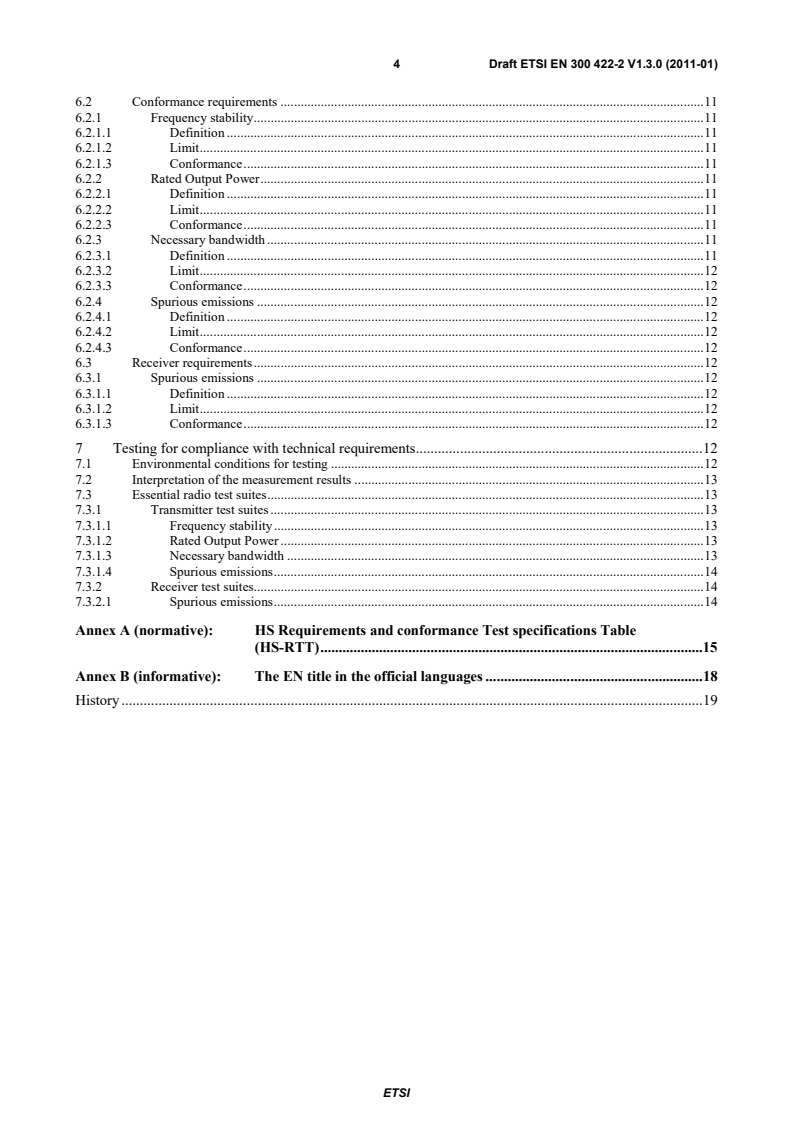
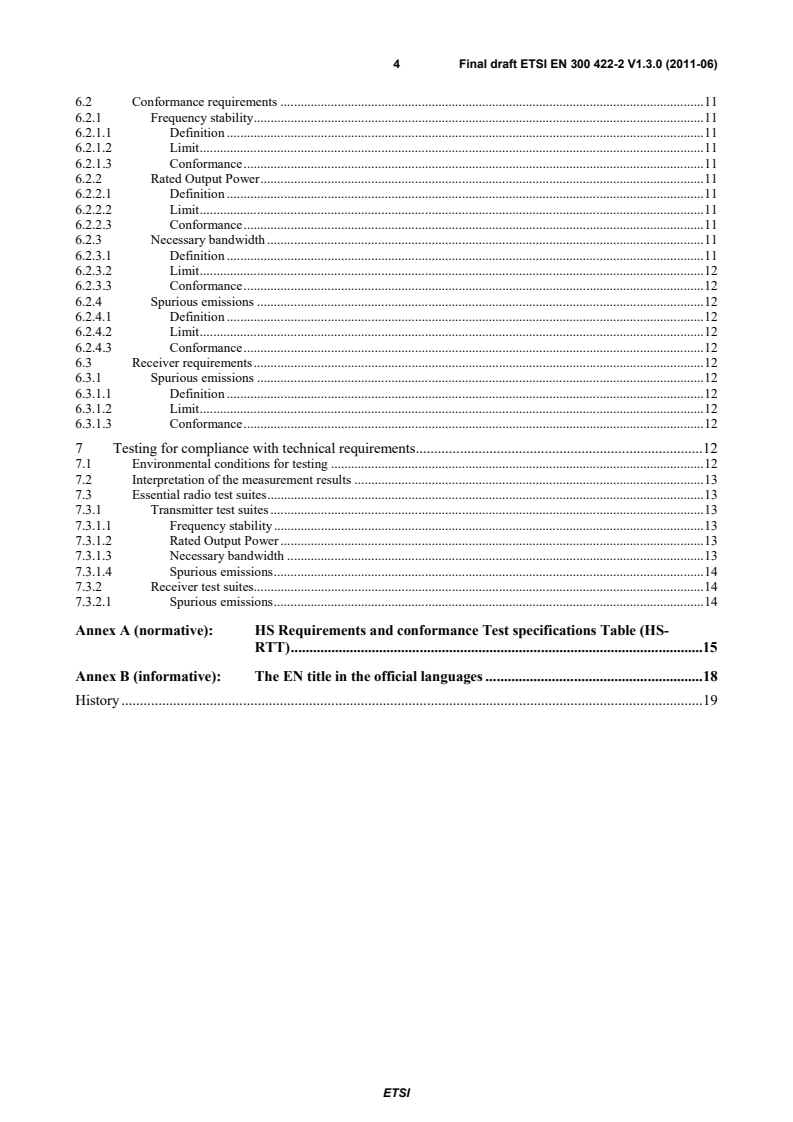
4 Draft ETSI EN 300 422-2 V1.3.0 (2011-01)
6.2 Conformance requirements . 11
6.2.1 Frequency stability . 11
6.2.1.1 Definition . 11
6.2.1.2 Limit . 11
6.2.1.3 Conformance . 11
6.2.2 Rated Output Power . 11
6.2.2.1 Definition . 11
6.2.2.2 Limit . 11
6.2.2.3 Conformance . 11
6.2.3 Necessary bandwidth . 11
6.2.3.1 Definition . 11
6.2.3.2 Limit . 12
6.2.3.3 Conformance . 12
6.2.4 Spurious emissions . 12
6.2.4.1 Definition . 12
6.2.4.2 Limit . 12
6.2.4.3 Conformance . 12
6.3 Receiver requirements . 12
6.3.1 Spurious emissions . 12
6.3.1.1 Definition . 12
6.3.1.2 Limit . 12
6.3.1.3 Conformance . 12
7 Testing for compliance with technical requirements . 12
7.1 Environmental conditions for testing . 12
7.2 Interpretation of the measurement results . 13
7.3 Essential radio test suites . 13
7.3.1 Transmitter test suites . 13
7.3.1.1 Frequency stability . 13
7.3.1.2 Rated Output Power . 13
7.3.1.3 Necessary bandwidth . 13
7.3.1.4 Spurious emissions . 14
7.3.2 Receiver test suites. 14
7.3.2.1 Spurious emissions . 14
Annex A (normative): HS Requirements and conformance Test specifications Table
(HS-RTT) . 15
Annex B (informative): The EN title in the official languages . 18
History . 19
ETSI
5 Draft ETSI EN 300 422-2 V1.3.0 (2011-01)
Intellectual Property Rights
IPRs essential or potentially essential to the present document may have been declared to ETSI. The information
pertaining to these essential IPRs, if any, is publicly available for ETSI members and non-members, and can be found
in ETSI SR 000 314: "Intellectual Property Rights (IPRs); Essential, or potentially Essential, IPRs notified to ETSI in
respect of ETSI standards", which is available from the ETSI Secretariat. Latest updates are available on the ETSI Web
server (http://webapp.etsi.org/IPR/home.asp).
Pursuant to the ETSI IPR Policy, no investigation, including IPR searches, has been carried out by ETSI. No guarantee
can be given as to the existence of other IPRs not referenced in ETSI SR 000 314 (or the updates on the ETSI Web
server) which are, or may be, or may become, essential to the present document.
Foreword
This Harmonized European Standard (EN) has been produced by ETSI Technical Committee Electromagnetic
compatibility and Radio spectrum Matters (ERM), and is now submitted for the Public Enquiry phase of the ETSI
standards Two-step Approval Procedure.
The present document has been produced by ETSI in response to a mandate from the European Commission issued
under Council Directive 98/34/EC [i.2] (as amended) laying down a procedure for the provision of information in the
field of technical standards and regulations.
The present document is intended to become a Harmonized Standard, the reference of which will be published in the
Official Journal of the European Communities referencing the Directive 1999/5/EC [i.1] of the European Parliament
and of the Council of 9 March 1999 on radio equipment and telecommunications terminal equipment and the mutual
recognition of their conformity ("the R&TTE Directive").
The requirements relevant to Directive 1999/5/EC [i.1] are summarised in annex A.
The present document is part 2 of a multi-part deliverable. Full details of the entire series can be found in part 1 [1].
National regulations on maximum power output will apply.
Proposed national transposition dates
Date of latest announcement of this EN (doa): 3 months after ETSI publication
Date of latest publication of new National Standard
or endorsement of this EN (dop/e): 6 months after doa
Date of withdrawal of any conflicting National Standard (dow): 18 months after doa
Introduction
The present document is part of a set of standards developed by ETSI and is designed to fit in a modular structure to
cover all radio and telecommunications terminal equipment within the scope of the R&TTE Directive [i.1]. The
modular structure is shown in EG 201 399 [i.3].
ETSI
6 Draft ETSI EN 300 422-2 V1.3.0 (2011-01)
1 Scope
The present document applies to equipment operating on radio frequencies between 25 MHz and 3 GHz, using
analogue, digital and hybrid (using both analogue and digital modulation) modulation.
The present document applies to the following radio equipment types:
• Professional Wireless Microphone Systems (PWMS);
• in ear monitoring systems;
• consumer radio microphones;
• tour guide systems; and
• Assistive Listening Devices (Aids for the handicapped) comprising personal and public hearing aid systems.
The maximum power recommended for equipment covered by the present document is 250 mW for radio microphones
and 500 mW for public hearing aids in the 169,4 MHz to 169,8125 MHz band (erp below 1 GHz and eirp above
1 GHz).
The present document also covers radio microphones used in the 863 MHz to 865 MHz band, with a maximum power
of 10 mW.
The present document is intended to cover the provisions of Directive 1999/5/EC [i.1] (R&TTE Directive):
Article 3.2, which states that "…. radio equipment shall be so constructed that it effectively uses the spectrum allocated
to terrestrial/space radio communications and orbital resources so as to avoid harmful
...
Final draft ETSI EN 300 422-2 V1.3.0 (2011-06)
Harmonized European Standard
Electromagnetic compatibility
and Radio spectrum Matters (ERM);
Wireless microphones
in the 25 MHz to 3 GHz frequency range;
Part 2: Harmonized EN covering the essential requirements
of article 3.2 of the R&TTE Directive
2 Final draft ETSI EN 300 422-2 V1.3.0 (2011-06)
Reference
REN/ERM-TG17WG3-014-2
Keywords
audio, radio, radio MIC, testing
ETSI
650 Route des Lucioles
F-06921 Sophia Antipolis Cedex - FRANCE
Tel.: +33 4 92 94 42 00 Fax: +33 4 93 65 47 16
Siret N° 348 623 562 00017 - NAF 742 C
Association à but non lucratif enregistrée à la
Sous-Préfecture de Grasse (06) N° 7803/88
Important notice
Individual copies of the present document can be downloaded from:
http://www.etsi.org
The present document may be made available in more than one electronic version or in print. In any case of existing or
perceived difference in contents between such versions, the reference version is the Portable Document Format (PDF).
In case of dispute, the reference shall be the printing on ETSI printers of the PDF version kept on a specific network drive
within ETSI Secretariat.
Users of the present document should be aware that the document may be subject to revision or change of status.
Information on the current status of this and other ETSI documents is available at
http://portal.etsi.org/tb/status/status.asp
If you find errors in the present document, please send your comment to one of the following services:
http://portal.etsi.org/chaircor/ETSI_support.asp
Copyright Notification
No part may be reproduced except as authorized by written permission.
The copyright and the foregoing restriction extend to reproduction in all media.
© European Telecommunications Standards Institute 2011.
All rights reserved.
TM TM TM TM
DECT , PLUGTESTS , UMTS , TIPHON , the TIPHON logo and the ETSI logo are Trade Marks of ETSI registered
for the benefit of its Members.
TM
3GPP is a Trade Mark of ETSI registered for the benefit of its Members and of the 3GPP Organizational Partners.
LTE™ is a Trade Mark of ETSI currently being registered
for the benefit of its Members and of the 3GPP Organizational Partners.
GSM® and the GSM logo are Trade Marks registered and owned by the GSM Association.
ETSI
3 Final draft ETSI EN 300 422-2 V1.3.0 (2011-06)
Contents
Intellectual Property Rights . 5
Foreword . 5
Introduction . 5
1 Scope . 6
2 References . 6
2.1 Normative references . 6
2.2 Informative references . 7
3 Definitions, symbols and abbreviations . 7
3.1 Definitions . 7
3.2 Symbols . 7
3.3 Abbreviations . 7
Part I: Radio microphones . 7
4 Technical requirements specifications . 7
4.1 Environmental profile . 7
4.2 Conformance requirements . 8
4.2.1 Frequency stability . 8
4.2.1.1 Definition . 8
4.2.1.2 Limit . 8
4.2.1.3 Conformance . 8
4.2.2 Rated Output Power . 8
4.2.2.1 Definition . 8
4.2.2.2 Limit . 8
4.2.2.3 Conformance . 8
4.2.3 Necessary bandwidth . 8
4.2.3.1 Definition . 8
4.2.3.2 Limit . 8
4.2.3.3 Conformance . 8
4.2.4 Spurious emissions . 8
4.2.4.1 Definition . 8
4.2.4.2 Limit . 8
4.2.4.3 Conformance . 9
4.3 Receiver requirements . 9
4.3.1 Spurious emissions . 9
4.3.1.1 Definition . 9
4.3.1.2 Limit . 9
4.3.1.3 Conformance . 9
5 Testing for compliance with technical requirements . 9
5.1 Environmental conditions for testing . 9
5.2 Interpretation of the measurement results . 9
5.3 Essential radio test suites . 10
5.3.1 Transmitter test suites . 10
5.3.1.1 Frequency stability . 10
5.3.1.2 Rated Output Power . 10
5.3.1.3 Necessary bandwidth . 10
5.3.1.4 Spurious emissions . 10
5.3.2 Receiver test suites. 10
5.3.2.1 Spurious emissions . 10
Part II: Assistive listening devices . 11
6 Technical requirements specifications . 11
6.1 Environmental profile . 11
ETSI
4 Final draft ETSI EN 300 422-2 V1.3.0 (2011-06)
6.2 Conformance requirements . 11
6.2.1 Frequency stability . 11
6.2.1.1 Definition . 11
6.2.1.2 Limit . 11
6.2.1.3 Conformance . 11
6.2.2 Rated Output Power . 11
6.2.2.1 Definition . 11
6.2.2.2 Limit . 11
6.2.2.3 Conformance . 11
6.2.3 Necessary bandwidth . 11
6.2.3.1 Definition . 11
6.2.3.2 Limit . 12
6.2.3.3 Conformance . 12
6.2.4 Spurious emissions . 12
6.2.4.1 Definition . 12
6.2.4.2 Limit . 12
6.2.4.3 Conformance . 12
6.3 Receiver requirements . 12
6.3.1 Spurious emissions . 12
6.3.1.1 Definition . 12
6.3.1.2 Limit . 12
6.3.1.3 Conformance . 12
7 Testing for compliance with technical requirements . 12
7.1 Environmental conditions for testing . 12
7.2 Interpretation of the measurement results . 13
7.3 Essential radio test suites . 13
7.3.1 Transmitter test suites . 13
7.3.1.1 Frequency stability . 13
7.3.1.2 Rated Output Power . 13
7.3.1.3 Necessary bandwidth . 13
7.3.1.4 Spurious emissions . 14
7.3.2 Receiver test suites. 14
7.3.2.1 Spurious emissions . 14
Annex A (normative): HS Requirements and conformance Test specifications Table (HS-
RTT) . 15
Annex B (informative): The EN title in the official languages . 18
History . 19
ETSI
5 Final draft ETSI EN 300 422-2 V1.3.0 (2011-06)
Intellectual Property Rights
IPRs essential or potentially essential to the present document may have been declared to ETSI. The information
pertaining to these essential IPRs, if any, is publicly available for ETSI members and non-members, and can be found
in ETSI SR 000 314: "Intellectual Property Rights (IPRs); Essential, or potentially Essential, IPRs notified to ETSI in
respect of ETSI standards", which is available from the ETSI Secretariat. Latest updates are available on the ETSI Web
server (http://webapp.etsi.org/IPR/home.asp).
Pursuant to the ETSI IPR Policy, no investigation, including IPR searches, has been carried out by ETSI. No guarantee
can be given as to the existence of other IPRs not referenced in ETSI SR 000 314 (or the updates on the ETSI Web
server) which are, or may be, or may become, essential to the present document.
Foreword
This final draft Harmonized European Standard (EN) has been produced by ETSI Technical Committee
Electromagnetic compatibility and Radio spectrum Matters (ERM), and is now submitted for the Vote phase of the
ETSI standards Two-step Approval Procedure.
The present document has been produced by ETSI in response to a mandate from the European Commission issued
under Council Directive 98/34/EC [i.2] (as amended) laying down a procedure for the provision of information in the
field of technical standards and regulations.
The title and reference to the present document are intended to be included in the publication in the Official Journal of
the European Union of titles and references of Harmonized Standard under the Directive 1999/5/EC [i.1].
See article 5.1 of Directive 1999/5/EC [i.1] for information on presumption of conformity and Harmonised Standards or
parts thereof the references of which have been published in the Official Journal of the European Union.
The requirements relevant to Directive 1999/5/EC [i.1] are summarised in annex A.
The present document is part 2 of a multi-part deliverable. Full details of the entire series can be found in part 1 [1].
National regulations on maximum power output will apply.
Proposed national transposition dates
Date of latest announcement of this EN (doa): 3 months after ETSI publication
Date of latest publication of new National Standard
or endorsement of this EN (dop/e): 6 months after doa
Date of withdrawal of any conflicting National Standard (dow): 18 months after doa
Introduction
The present document is part of a set of standards developed by ETSI and is designed to fit in a modular structure to
cover all radio and telecommunications terminal equipment within the scope of the R&TTE Directive [i.1]. The
modular structure is shown in EG 201 399 [i.3].
ETSI
6 Final draft ETSI EN 300 422-2 V1.3.0 (2011-06)
1 Scope
The present document applies to equipment operating on radio frequencies between 25 MHz and 3 GHz, using
analogue, digital and hybrid (using both analogue and digital modulation) modulation.
The present document applies to the following radio equipment types:
• Professional Wireless Microphone Systems (PWMS);
• in ear monitoring systems;
• consumer radio microphones;
• tour guide systems; and
• Assistive Listening Devices (Aids for the handicapped) comprising personal and public hearing aid systems.
The maximum power recommended for equipment covered by the present document is 250 mW for radio microphones
and 500 mW for public hearing aids in the 169,4 MHz to 169,8125 MHz band (erp below 1 GHz and eirp above
1 GHz).
The present document also covers radio microphones used in the 863 MHz to 865 MHz band, with a maximum power
of 10 mW.
The present document is intended to cover the provisions of Directive 1999/5/EC [i.1] (R&TTE Directive):
Article 3.2, which states that "…. radio equipment shall be so constructed that it effectively uses the spectrum allocated
to terrestrial/space radio communications and orbital resources so as to avoid harmful interference".
In addition t
...
Harmonized European Standard
Electromagnetic compatibility
and Radio spectrum Matters (ERM);
Wireless microphones
in the 25 MHz to 3 GHz frequency range;
Part 2: Harmonized EN covering the essential requirements
of article 3.2 of the R&TTE Directive
2 ETSI EN 300 422-2 V1.3.1 (2011-08)
Reference
REN/ERM-TG17WG3-014-2
Keywords
audio, radio, radio MIC, testing
ETSI
650 Route des Lucioles
F-06921 Sophia Antipolis Cedex - FRANCE
Tel.: +33 4 92 94 42 00 Fax: +33 4 93 65 47 16
Siret N° 348 623 562 00017 - NAF 742 C
Association à but non lucratif enregistrée à la
Sous-Préfecture de Grasse (06) N° 7803/88
Important notice
Individual copies of the present document can be downloaded from:
http://www.etsi.org
The present document may be made available in more than one electronic version or in print. In any case of existing or
perceived difference in contents between such versions, the reference version is the Portable Document Format (PDF).
In case of dispute, the reference shall be the printing on ETSI printers of the PDF version kept on a specific network drive
within ETSI Secretariat.
Users of the present document should be aware that the document may be subject to revision or change of status.
Information on the current status of this and other ETSI documents is available at
http://portal.etsi.org/tb/status/status.asp
If you find errors in the present document, please send your comment to one of the following services:
http://portal.etsi.org/chaircor/ETSI_support.asp
Copyright Notification
No part may be reproduced except as authorized by written permission.
The copyright and the foregoing restriction extend to reproduction in all media.
© European Telecommunications Standards Institute 2011.
All rights reserved.
TM TM TM
DECT , PLUGTESTS , UMTS and the ETSI logo are Trade Marks of ETSI registered for the benefit of its Members.
TM
3GPP and LTE™ are Trade Marks of ETSI registered for the benefit of its Members and
of the 3GPP Organizational Partners.
GSM® and the GSM logo are Trade Marks registered and owned by the GSM Association.
ETSI
3 ETSI EN 300 422-2 V1.3.1 (2011-08)
Contents
Intellectual Property Rights . 5
Foreword . 5
Introduction . 5
1 Scope . 6
2 References . 6
2.1 Normative references . 6
2.2 Informative references . 7
3 Definitions, symbols and abbreviations . 7
3.1 Definitions . 7
3.2 Symbols . 7
3.3 Abbreviations . 7
Part I: Radio microphones . 7
4 Technical requirements specifications . 7
4.1 Environmental profile . 7
4.2 Conformance requirements . 8
4.2.1 Frequency stability . 8
4.2.1.1 Definition . 8
4.2.1.2 Limit . 8
4.2.1.3 Conformance . 8
4.2.2 Rated Output Power . 8
4.2.2.1 Definition . 8
4.2.2.2 Limit . 8
4.2.2.3 Conformance . 8
4.2.3 Necessary bandwidth . 8
4.2.3.1 Definition . 8
4.2.3.2 Limit . 8
4.2.3.3 Conformance . 8
4.2.4 Spurious emissions . 8
4.2.4.1 Definition . 8
4.2.4.2 Limit . 8
4.2.4.3 Conformance . 9
4.3 Receiver requirements . 9
4.3.1 Spurious emissions . 9
4.3.1.1 Definition . 9
4.3.1.2 Limit . 9
4.3.1.3 Conformance . 9
5 Testing for compliance with technical requirements . 9
5.1 Environmental conditions for testing . 9
5.2 Interpretation of the measurement results . 9
5.3 Essential radio test suites . 10
5.3.1 Transmitter test suites . 10
5.3.1.1 Frequency stability . 10
5.3.1.2 Rated Output Power . 10
5.3.1.3 Necessary bandwidth . 10
5.3.1.4 Spurious emissions . 10
5.3.2 Receiver test suites. 10
5.3.2.1 Spurious emissions . 10
Part II: Assistive listening devices . 11
6 Technical requirements specifications . 11
6.1 Environmental profile . 11
ETSI
4 ETSI EN 300 422-2 V1.3.1 (2011-08)
6.2 Conformance requirements . 11
6.2.1 Frequency stability . 11
6.2.1.1 Definition . 11
6.2.1.2 Limit . 11
6.2.1.3 Conformance . 11
6.2.2 Rated Output Power . 11
6.2.2.1 Definition . 11
6.2.2.2 Limit . 11
6.2.2.3 Conformance . 11
6.2.3 Necessary bandwidth . 11
6.2.3.1 Definition . 11
6.2.3.2 Limit . 12
6.2.3.3 Conformance . 12
6.2.4 Spurious emissions . 12
6.2.4.1 Definition . 12
6.2.4.2 Limit . 12
6.2.4.3 Conformance . 12
6.3 Receiver requirements . 12
6.3.1 Spurious emissions . 12
6.3.1.1 Definition . 12
6.3.1.2 Limit . 12
6.3.1.3 Conformance . 12
7 Testing for compliance with technical requirements . 12
7.1 Environmental conditions for testing . 12
7.2 Interpretation of the measurement results . 13
7.3 Essential radio test suites . 13
7.3.1 Transmitter test suites . 13
7.3.1.1 Frequency stability . 13
7.3.1.2 Rated Output Power . 13
7.3.1.3 Necessary bandwidth . 13
7.3.1.4 Spurious emissions . 14
7.3.2 Receiver test suites. 14
7.3.2.1 Spurious emissions . 14
Annex A (normative): HS Requirements and conformance Test specifications Table
(HS-RTT) . 15
Annex B (informative): The EN title in the official languages . 17
History . 18
ETSI
5 ETSI EN 300 422-2 V1.3.1 (2011-08)
Intellectual Property Rights
IPRs essential or potentially essential to the present document may have been declared to ETSI. The information
pertaining to these essential IPRs, if any, is publicly available for ETSI members and non-members, and can be found
in ETSI SR 000 314: "Intellectual Property Rights (IPRs); Essential, or potentially Essential, IPRs notified to ETSI in
respect of ETSI standards", which is available from the ETSI Secretariat. Latest updates are available on the ETSI Web
server (http://ipr.etsi.org).
Pursuant to the ETSI IPR Policy, no investigation, including IPR searches, has been carried out by ETSI. No guarantee
can be given as to the existence of other IPRs not referenced in ETSI SR 000 314 (or the updates on the ETSI Web
server) which are, or may be, or may become, essential to the present document.
Foreword
This Harmonized European Standard (EN) has been produced by ETSI Technical Committee Electromagnetic
compatibility and Radio spectrum Matters (ERM).
The present document has been produced by ETSI in response to a mandate from the European Commission issued
under Council Directive 98/34/EC [i.2] (as amended) laying down a procedure for the provision of information in the
field of technical standards and regulations.
The title and reference to the present document are intended to be included in the publication in the Official Journal of
the European Union of titles and references of Harmonized Standard under the Directive 1999/5/EC [i.1].
See article 5.1 of Directive 1999/5/EC [i.1] for information on presumption of conformity and Harmonised Standards or
parts thereof the references of which have been published in the Official Journal of the European Union.
The requirements relevant to Directive 1999/5/EC [i.1] are summarised in annex A.
The present document is part 2 of a multi-part deliverable. Full details of the entire series can be found in part 1 [1].
National regulations on maximum power output will apply.
National transposition dates
Date of adoption of this EN: 8 August 2011
Date of latest announcement of this EN (doa): 30 November 2011
Date of latest publication of new National Standard
or endorsement of this EN (dop/e): 31 May 2012
Date of withdrawal of any conflicting National Standard (dow): 31 May 2013
Introduction
The present document is part of a set of standards developed by ETSI and is designed to fit in a modular structure to
cover all radio and telecommunications terminal equipment within the scope of the R&TTE Directive [i.1]. The
modular structure is shown in EG 201 399 [i.3].
ETSI
6 ETSI EN 300 422-2 V1.3.1 (2011-08)
1 Scope
The present document applies to equipment operating on radio frequencies between 25 MHz and 3 GHz, using
analogue, digital and hybrid (using both analogue and digital modulation) modulation.
The present document applies to the following radio equipment types:
• Professional Wireless Microphone Systems (PWMS);
• in ear monitoring systems;
• consumer radio microphones;
• tour guide systems; and
• Assistive Listening Devices (Aids for the handicapped) comprising personal and public hearing aid systems.
The maximum power recommended for equipment covered by the present document is 250 mW for radio microphones
and 500 mW for public hearing aids in the 169,4 MHz to 169,8125 MHz band (erp below 1 GHz and eirp above
1 GHz).
The present document also covers radio microphones used in the 863 MHz to 865 MHz band, with a maximum power
of 10 mW.
The present document is intended to cover the provisions of Directive 1999/5/EC [i.1] (R&TTE Directive):
Article 3.2, which states that "…. radio equipment shall be so constructed that it effectively uses the spectrum allocated
to terrestrial/space radio communications and orbital resources so as to avoid harmful interference".
In addition to the present
...
2003-01.Slovenski inštitut za standardizacijo. Razmnoževanje celote ali delov tega standarda ni dovoljeno.577(Electromagnetic compatibility and Radio spectrum Matters (ERM) - Wireless microphones in the 25 MHz to 3 GHz frequency range - Part 2: Harmonized EN covering essential requirements of article 3.2 of the R&TTE Directive33.160.50PriborAccessories33.100.01Elektromagnetna združljivost na splošnoElectromagnetic compatibility in general33.060.99Druga oprema za radijske komunikacijeOther equipment for radiocommunicationsICS:Ta slovenski standard je istoveten z:EN 300 422-2 Version 1.3.1SIST EN 300 422-2 V1.3.1:2011en01-oktober-2011SIST EN 300 422-2 V1.3.1:2011SLOVENSKI
STANDARD
Harmonized European Standard SIST EN 300 422-2 V1.3.1:2011
ETSI ETSI EN 300 422-2 V1.3.1 (2011-08) 2
Reference REN/ERM-TG17WG3-014-2 Keywords audio, radio, radio MIC, testing ETSI 650 Route des Lucioles F-06921 Sophia Antipolis Cedex - FRANCE
Tel.: +33 4 92 94 42 00
Fax: +33 4 93 65 47 16
Siret N° 348 623 562 00017 - NAF 742 C Association à but non lucratif enregistrée à la Sous-Préfecture de Grasse (06) N° 7803/88
Important notice Individual copies of the present document can be downloaded from: http://www.etsi.org The present document may be made available in more than one electronic version or in print. In any case of existing or perceived difference in contents between such versions, the reference version is the Portable Document Format (PDF). In case of dispute, the reference shall be the printing on ETSI printers of the PDF version kept on a specific network drive within ETSI Secretariat. Users of the present document should be aware that the document may be subject to revision or change of status. Information on the current status of this and other ETSI documents is available at http://portal.etsi.org/tb/status/status.asp If you find errors in the present document, please send your comment to one of the following services: http://portal.etsi.org/chaircor/ETSI_support.asp Copyright Notification No part may be reproduced except as authorized by written permission. The copyright and the foregoing restriction extend to reproduction in all media.
© European Telecommunications Standards Institute 2011. All rights reserved.
DECTTM, PLUGTESTSTM, UMTSTM and the ETSI logo are Trade Marks of ETSI registered for the benefit of its Members. 3GPPTM and LTE™ are Trade Marks of ETSI registered for the benefit of its Members and of the 3GPP Organizational Partners. GSM® and the GSM logo are Trade Marks registered and owned by the GSM Association. SIST EN 300 422-2 V1.3.1:2011
ETSI ETSI EN 300 422-2 V1.3.1 (2011-08) 3 Contents Intellectual Property Rights . 5 Foreword . 5 Introduction . 5 1 Scope . 6 2 References . 6 2.1 Normative references . 6 2.2 Informative references . 7 3 Definitions, symbols and abbreviations . 7 3.1 Definitions . 7 3.2 Symbols . 7 3.3 Abbreviations . 7 Part I: Radio microphones
........................................................................................................................... 7 4 Technical requirements specifications ..................................................................................................... 7 4.1 Environmental profile ......................................................................................................................................... 7 4.2 Conformance requirements ................................................................................................................................ 8 4.2.1 Frequency stability ........................................................................................................................................ 8 4.2.1.1 Definition ................................................................................................................................................ 8 4.2.1.2 Limit ........................................................................................................................................................ 8 4.2.1.3 Conformance ........................................................................................................................................... 8 4.2.2 Rated Output Power ...................................................................................................................................... 8 4.2.2.1 Definition ................................................................................................................................................ 8 4.2.2.2 Limit ........................................................................................................................................................ 8 4.2.2.3 Conformance ........................................................................................................................................... 8 4.2.3 Necessary bandwidth .................................................................................................................................... 8 4.2.3.1 Definition ................................................................................................................................................ 8 4.2.3.2 Limit ........................................................................................................................................................ 8 4.2.3.3 Conformance ........................................................................................................................................... 8 4.2.4 Spurious emissions ....................................................................................................................................... 8 4.2.4.1 Definition ................................................................................................................................................ 8 4.2.4.2 Limit ........................................................................................................................................................ 8 4.2.4.3 Conformance ........................................................................................................................................... 9 4.3 Receiver requirements ........................................................................................................................................ 9 4.3.1 Spurious emissions ....................................................................................................................................... 9 4.3.1.1 Definition ................................................................................................................................................ 9 4.3.1.2 Limit ........................................................................................................................................................ 9 4.3.1.3 Conformance ........................................................................................................................................... 9 5 Testing for compliance with technical requirements ................................................................................ 9 5.1 Environmental conditions for testing ................................................................................................................. 9 5.2 Interpretation of the measurement results .......................................................................................................... 9 5.3 Essential radio test suites .................................................................................................................................. 10 5.3.1 Transmitter test suites ................................................................................................................................. 10 5.3.1.1 Frequency stability ................................................................................................................................ 10 5.3.1.2 Rated Output Power .............................................................................................................................. 10 5.3.1.3 Necessary bandwidth ............................................................................................................................ 10 5.3.1.4 Spurious emissions ................................................................................................................................ 10 5.3.2 Receiver test suites...................................................................................................................................... 10 5.3.2.1 Spurious emissions ................................................................................................................................ 10 Part II: Assistive listening devices ................................................................................................................. 11 6 Technical requirements specifications ................................................................................................... 11 6.1 Environmental profile ....................................................................................................................................... 11 SIST EN 300 422-2 V1.3.1:2011
ETSI ETSI EN 300 422-2 V1.3.1 (2011-08) 4 6.2 Conformance requirements . 11 6.2.1 Frequency stability . 11 6.2.1.1 Definition . 11 6.2.1.2 Limit . 11 6.2.1.3 Conformance . 11 6.2.2 Rated Output Power . 11 6.2.2.1 Definition . 11 6.2.2.2 Limit . 11 6.2.2.3 Conformance . 11 6.2.3 Necessary bandwidth . 11 6.2.3.1 Definition . 11 6.2.3.2 Limit . 12 6.2.3.3 Conformance . 12 6.2.4 Spurious emissions . 12 6.2.4.1 Definition . 12 6.2.4.2 Limit . 12 6.2.4.3 Conformance . 12 6.3 Receiver requirements . 12 6.3.1 Spurious emissions . 12 6.3.1.1 Definition . 12 6.3.1.2 Limit . 12 6.3.1.3 Conformance . 12 7 Testing for compliance with technical requirements . 12 7.1 Environmental conditions for testing . 12 7.2 Interpretation of the measurement results . 13 7.3 Essential radio test suites . 13 7.3.1 Transmitter test suites . 13 7.3.1.1 Frequency stability . 13 7.3.1.2 Rated Output Power . 13 7.3.1.3 Necessary bandwidth . 13 7.3.1.4 Spurious emissions . 14 7.3.2 Receiver test suites. 14 7.3.2.1 Spurious emissions . 14 Annex A (normative): HS Requirements and conformance Test specifications Table (HS-RTT) . 15 Annex B (informative): The EN title in the official languages . 17 History . 18
ETSI ETSI EN 300 422-2 V1.3.1 (2011-08) 5 Intellectual Property Rights IPRs essential or potentially essential to the present document may have been declared to ETSI. The information pertaining to these essential IPRs, if any, is publicly available for ETSI members and non-members, and can be found in ETSI SR 000 314: "Intellectual Property Rights (IPRs); Essential, or potentially Essential, IPRs notified to ETSI in respect of ETSI standards", which is available from the ETSI Secretariat. Latest updates are available on the ETSI Web server (http://ipr.etsi.org). Pursuant to the ETSI IPR Policy, no investigation, including IPR searches, has been carried out by ETSI. No guarantee can be given as to the existence of other IPRs not referenced in ETSI SR 000 314 (or the updates on the ETSI Web server) which are, or may be, or may become, essential to the present document. Foreword This Harmonized European Standard (EN) has been produced by ETSI Technical Committee Electromagnetic compatibility and Radio spectrum Matters (ERM). The present document has been produced by ETSI in response to a mandate from the European Commission issued under Council Directive 98/34/EC [i.2] (as amended) laying down a procedure for the provision of information in the field of technical standards and regulations. The title and reference to the present document are intended to be included in the publication in the Official Journal of the European Union of titles and references of Harmonized Standard under the Directive 1999/5/EC [i.1]. See article 5.1 of Directive 1999/5/EC [i.1] for information on presumption of conformity and Harmonised Standards or parts thereof the references of which have been published in the Official Journal of the European Union. The requirements relevant to Directive 1999/5/EC [i.1] are summarised in annex A. The present document is part 2 of a multi-part deliverable. Full details of the entire series can be found in part 1 [1]. National regulations on maximum power output will apply.
National transposition dates Date of adoption of this EN: 8 August 2011 Date of latest announcement of this EN (doa): 30 November 2011 Date of latest publication of new National Standard or endorsement of this EN (dop/e):
31 May 2012 Date of withdrawal of any conflicting National Standard (dow): 31 May 2013
Introduction The present document is part of a set of standards developed by ETSI and is designed to fit in a modular structure to cover all radio and telecommunications terminal equipment within the scope of the R&TTE Directive [i.1]. The modular structure is shown in EG 201 399 [i.3]. SIST EN 300 422-2 V1.3.1:2011
ETSI ETSI EN 300 422-2 V1.3.1 (2011-08) 6 1 Scope The present document applies to equipment operating on radio frequencies between 25 MHz and 3 GHz, using analogue, digital and hybrid (using both analogue and digital modulation) modulation.
The present document applies to the following radio equipment types: • Professional Wireless Microphone Systems (PWMS); • in ear monitoring systems; • consumer radio microphones; • tour guide systems; and • Assistive Listening Devices (Aids for the handicapped) comprising personal and public hearing aid systems.
The maximum power recommended for equipment covered by the present document is 250 mW for radio microphones and 500 mW for public hearing aids in the 16
...