

SIST EN 2349-318:2009
(Main)Aerospace series - Requirements and test procedures for relays and contactors - Part 318: Pick-up voltage at high temperature and drop-out voltage at low temperature
- Abstract
This standard specifies a method for testing the pick-up voltage at high temperature and release voltage at low temperature of relays and contactors. It shall be used together with EN 2349-100.
- Status
- Published
- Publication Date
- 31-Mar-2009
- Technical Committee
- I13 - Imaginarni 13
- Current Stage
- 6060 - National Implementation/Publication (Adopted Project)
- Start Date
- 20-Mar-2009
- Due Date
- 25-May-2009
- Completion Date
- 01-Apr-2009

SIST EN 2349-318:2009 is the Slovenian adoption of EN 2349-318:2006 for aerospace relays and contactors. It specifies a test method for pick-up voltage at high temperature and release voltage at low temperature, so manufacturers and test laboratories can check how these devices behave under thermal conditions.
What does SIST EN 2349-318:2009 specify?
SIST EN 2349-318:2009 specifies one test method for relays and contactors used in aerospace applications. The method covers pick-up voltage at high temperature and release voltage at low temperature, and it is intended to be used together with EN 2349-100.
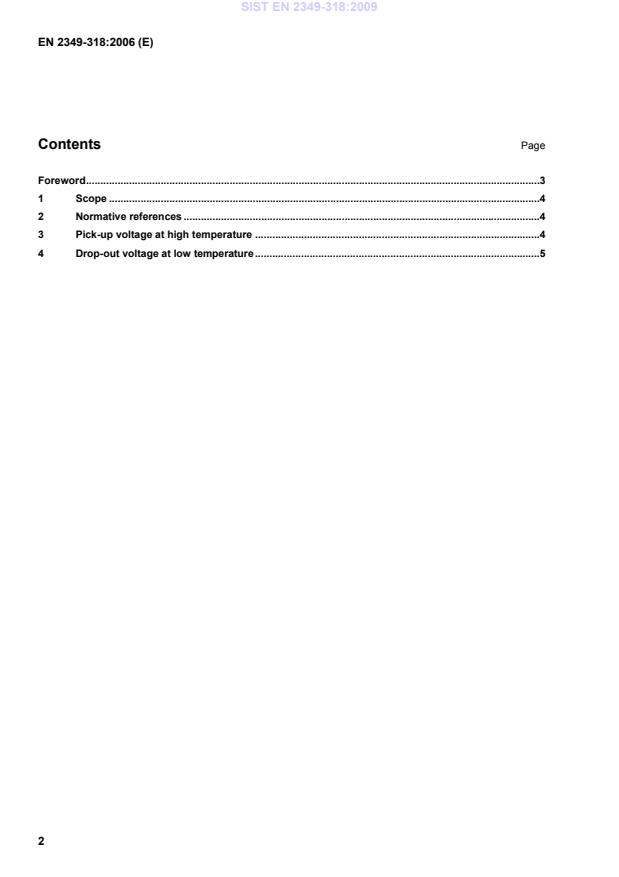
The document is organised into four main clauses:
- Scope
- Normative references
- Pick-up voltage at high temperature
- Drop-out voltage at low temperature
In practice, that structure tells the reader where to find the general application, the companion documents, and the two test procedures.
What are the key requirements of SIST EN 2349-318:2009?
SIST EN 2349-318:2009 ties both tests to EN 2349-100 for wiring and general setup. That matters because the relay or contactor is not tested as a loose part - it is installed and connected as required for the aerospace series.
High-temperature pick-up test
For the high-temperature test, SIST EN 2349-318:2009 requires the relay or contactor to be wired, placed in a heating cabinet, and held at the temperature specified in the product standard. After the temperature stabilises, the device is stored for 1 h before the pick-up voltage is measured.
The pick-up voltage is measured in all three perpendicularly opposed planes. This makes the result more representative of the device orientation during use, which matters when the contact position can depend on gravity or mounting attitude.
The standard also separates two cases:
- previously de-energized coil
- previously energized coil
Each case is held for 1 h under the stated conditions before measurement, and the samples are then kept for at least 1 h at (23 ± 3) °C before further tests. In practice, this checks both a cold-start condition and a hot-start condition.
The contacts must not change switching position when the voltage is increased from the measured actuating voltage to the maximum level. The measured pick-up voltage must also stay within the limits given in the product standard.
Low-temperature drop-out test
For the low-temperature test, SIST EN 2349-318:2009 requires the relay or contactor to be wired, placed in a cooling cabinet, and brought to the temperature specified in the product standard. The coil is de-energized and the contacts are unloaded before the 48 h storage period begins.
At the end of that period, the release voltage and the voltage drop on the contacts are measured in all three perpendicularly opposed planes. The coil may be energized for no longer than 30 s during the test to keep temperature rise as low as possible.
The contacts must not change switching position when the voltage is reduced from the measured release voltage to zero. The measured release voltage must stay within the limits given in the product standard.
Verification tests
SIST EN 2349-318:2009 also points to additional verification tests in EN 2349-201, EN 2349-301, EN 2349-303, EN 2349-307, and EN 2349-412. In practice, this means the voltage test is part of a wider assessment package, not a stand-alone check.
What terms does SIST EN 2349-318:2009 define?
- Pick-up voltage - the voltage at which the relay or contactor actuates and changes to its operated state.
- Release voltage - the voltage at which the relay or contactor drops out and returns to its released state.
- Contact drop - the voltage drop on the contacts measured during the low-temperature test.
- Energized coil - a coil connected to the power source and carrying current.
- De-energized coil - a coil not supplied with current during the test period.
- Heating cabinet - the enclosure used to hold the device at the elevated test temperature.
- Cooling cabinet - the enclosure used to hold the device at the low test temperature.
- Product standard - the separate standard that gives the temperature level and acceptance limits for the device under test.
Who uses SIST EN 2349-318:2009?
SIST EN 2349-318:2009 is used by manufacturers of aerospace relays and contactors, test laboratories, and quality assurance teams. It is also relevant to buyers and approval or conformity personnel who need a defined method for checking thermal operating behaviour.
The standard is aimed at aerospace electric equipment and systems work. In practice, it helps people set up the test, measure the voltages, and compare the results with the product standard.
Which standards are used with SIST EN 2349-318:2009?
SIST EN 2349-318:2009 names these companion documents:
- EN 2349-100 - general requirements and the wiring arrangement used for the test
- EN 2349-201 - visual inspection as part of verification testing
- EN 2349-301 - pick-up and drop-out voltage testing
- EN 2349-303 - dielectric strength testing
- EN 2349-307 - an additional verification test referenced by the document
- EN 2349-412 - seal testing
These references show that the test method belongs to the broader EN 2349 series for relays and contactors.
What does the SIST EN 2349-318:2009 document contain?
SIST EN 2349-318:2009 contains the mounting methods, test procedures, acceptance criteria, and verification-test references needed to measure pick-up voltage at high temperature and release voltage at low temperature. It also describes how the device is oriented during measurement, how long it is held at temperature, and how long the coil may be energised during the low-temperature test.
The document is procedural rather than descriptive. It tells the user how to prepare the relay or contactor, what to observe during the test, and where to find related checks in the EN 2349 series.
Relations
- Effective Date
- 28-Jan-2026
- Effective Date
- 28-Jan-2026
- Effective Date
- 28-Jan-2026
- Effective Date
- 28-Jan-2026
- Effective Date
- 28-Jan-2026
- Effective Date
- 28-Jan-2026
Get Certified
Connect with accredited certification bodies for this standard

BUREAU VERITAS Certification Germany
Bureau Veritas certification in Germany.

Element Materials Technology
Materials testing and product certification.

AQMS Ltd.
AQMS provides ISO certification to SMEs across the UK.
Sponsored listings
Frequently Asked Questions
SIST EN 2349-318:2009 is a standard published by the Slovenian Institute for Standardization (SIST). Its full title is "Aerospace series - Requirements and test procedures for relays and contactors - Part 318: Pick-up voltage at high temperature and drop-out voltage at low temperature". This standard covers: This standard specifies a method for testing the pick-up voltage at high temperature and release voltage at low temperature of relays and contactors. It shall be used together with EN 2349-100.
This standard specifies a method for testing the pick-up voltage at high temperature and release voltage at low temperature of relays and contactors. It shall be used together with EN 2349-100.
SIST EN 2349-318:2009 is classified under the following ICS (International Classification for Standards) categories: 49.060 - Aerospace electric equipment and systems. The ICS classification helps identify the subject area and facilitates finding related standards.
SIST EN 2349-318:2009 has the following relationships with other standards: It is inter standard links to SIST EN 2349-303:2009, SIST EN 2349-201:2009, SIST EN 2349-301:2009, SIST EN 2349-412:2009, SIST EN ISO 22435:2009, SIST EN 2593-001:2015. Understanding these relationships helps ensure you are using the most current and applicable version of the standard.
SIST EN 2349-318:2009 is available in PDF format for immediate download after purchase. The document can be added to your cart and obtained through the secure checkout process. Digital delivery ensures instant access to the complete standard document.
Standards Content (Sample)
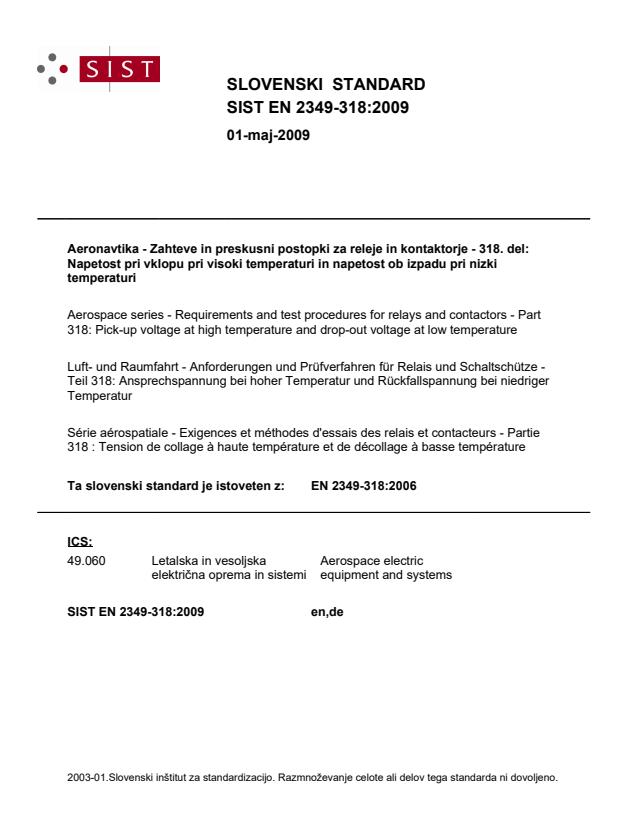
2003-01.Slovenski inštitut za standardizacijo. Razmnoževanje celote ali delov tega standarda ni dovoljeno.Aeronavtika - Zahteve in preskusni postopki za releje in kontaktorje - 318. del: Napetost pri vklopu pri visoki temperaturi in napetost ob izpadu pri nizki temperaturiLuft- und Raumfahrt - Anforderungen und Prüfverfahren für Relais und Schaltschütze - Teil 318: Ansprechspannung bei hoher Temperatur und Rückfallspannung bei niedriger TemperaturSérie aérospatiale - Exigences et méthodes d'essais des relais et contacteurs - Partie 318 : Tension de collage à haute température et de décollage à basse températureAerospace series - Requirements and test procedures for relays and contactors - Part 318: Pick-up voltage at high temperature and drop-out voltage at low temperature49.060Aerospace electric equipment and systemsICS:Ta slovenski standard je istoveten z:EN 2349-318:2006SIST EN 2349-318:2009en,de01-maj-2009SIST EN 2349-318:2009SLOVENSKI
STANDARD
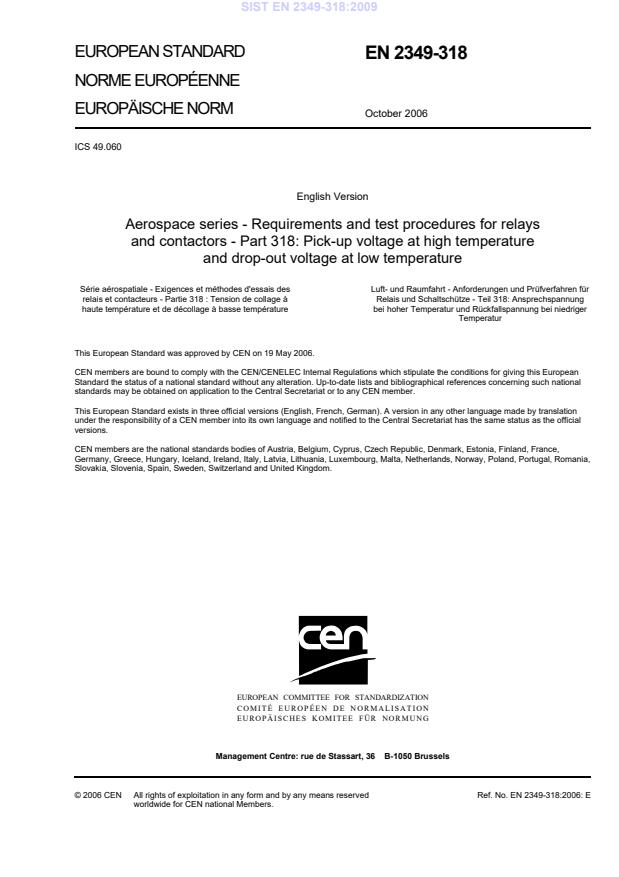
EUROPEAN STANDARDNORME EUROPÉENNEEUROPÄISCHE NORMEN 2349-318October 2006ICS 49.060 English VersionAerospace series - Requirements and test procedures for relaysand contactors - Part 318: Pick-up voltage at high temperatureand drop-out voltage at low temperatureSérie aérospatiale - Exigences et méthodes d'essais desrelais et contacteurs - Partie 318 : Tension de collage àhaute température et de décollage à basse températureLuft- und Raumfahrt - Anforderungen und Prüfverfahren fürRelais und Schaltschütze - Teil 318: Ansprechspannungbei hoher Temperatur und Rückfallspannung bei niedrigerTemperaturThis European Standard was approved by CEN on 19 May 2006.CEN members are bound to comply with the CEN/CENELEC Internal Regulations which stipulate the conditions for giving this EuropeanStandard the status of a national standard without any alteration. Up-to-date lists and bibliographical references concerning such nationalstandards may be obtained on application to the Central Secretariat or to any CEN member.This European Standard exists in three official versions (English, French, German). A version in any other language made by translationunder the responsibility of a CEN member into its own language and notified to the Central Secretariat has the same status as the officialversions.CEN members are the national standards bodies of Austria, Belgium, Cyprus, Czech Republic, Denmark, Estonia, Finland, France,Germany, Greece, Hungary, Iceland, Ireland, Italy, Latvia, Lithuania, Luxembourg, Malta, Netherlands, Norway, Poland, Portugal, Romania,Slovakia, Slovenia, Spain, Sweden, Switzerland and United Kingdom.EUROPEAN COMMITTEE FOR STANDARDIZATIONCOMITÉ EUROPÉEN DE NORMALISATIONEUROPÄISCHES KOMITEE FÜR NORMUNGManagement Centre: rue de Stassart, 36
B-1050 Brussels© 2006 CENAll rights of exploitation in any form and by any means reservedworldwide for CEN national Members.Ref. No. EN 2349-318:2006: ESIST EN 2349-318:2009
...