


oSIST prEN IEC 62955:2025
(Main)Residual direct current detecting device (RDC-DD) to be used for mode 3 charging of electric vehicles
Residual direct current detecting device (RDC-DD) to be used for mode 3 charging of electric vehicles
Fehlergleichstrom-Nachweiseinrichtung (RDC-DD) zur Verwendung mit der Ladebetriebsart 3 von Elektrofahrzeugen
Dispositif de détection à courant différentiel résiduel continu (DD-CDC) à utiliser pour la charge en mode 3 des véhicules électriques
Naprava za zaznavanje preostalega enosmernega toka (RDC-DD) za uporabo pri polnjenju električnih vozil v načinu 3
General Information
- Status
- Not Published
- Public Enquiry End Date
- 20-Nov-2025
- Technical Committee
- EPR - Electrical accessories
- Current Stage
- 4020 - Public enquire (PE) (Adopted Project)
- Start Date
- 09-Sep-2025
- Due Date
- 27-Jan-2026
- Completion Date
- 03-Dec-2025
Overview
The oSIST prEN IEC 62955:2025 standard, developed by the CLC (European Committee for Electrotechnical Standardization), specifies requirements for residual direct current detecting devices (RDC-DD) used in Mode 3 charging of electric vehicles (EVs). This standard is critical for ensuring the safety and reliability of electric vehicle supply equipment (EVSE) by detecting residual direct currents that could pose risks during EV charging.
RDC-DDs are designed to monitor and detect residual DC currents that may cause malfunctions or safety hazards such as insulation degradation and fire risks. By conforming to this standard, manufacturers and service providers can guarantee that RDC-DD devices meet essential safety, performance, and operational criteria, promoting enhanced protection in EV charging systems.
Key Topics
Device Classification
RDC-DDs are classified by construction type, number of poles, connection methods, and terminal types. Key device types include modules integrated with switching devices and standalone RDC-DD devices.Rated Characteristics
Essential rated parameters covered include rated voltage, current, DC residual operating and non-operating currents, frequency, and making and breaking capacities. These parameters ensure RDC-DDs operate effectively under expected electrical conditions during EV charging.Safety and Operation Requirements
The standard outlines stringent design demands including clearances, creepage distances, protection against electric shock, dielectric properties, temperature rise limits, and electromagnetic compatibility (EMC). This safeguards the device performance against electrical hazards.Testing Procedures
Comprehensive testing rules ensure product reliability and safety, including type tests, routine tests, temperature rise verification, mechanical shock resistance, dielectric strength tests, and verification of the trip-free and test functions. EMC and response to current surges induced by impulse voltages are also crucial evaluation points.Marking and Documentation
Proper marking guidelines and product information requirements ensure traceability and conformity of RDC-DD devices within EV charging infrastructures.
Applications
Electric Vehicle Supply Equipment (EVSE)
RDC-DDs compliant with oSIST prEN IEC 62955:2025 are essential components in Mode 3 charging stations for electric vehicles. They provide safety by detecting potentially hazardous residual DC currents and triggering protective disconnection.Residential and Commercial Charging Stations
Ensuring safe charging environments in both private homes and public or commercial facilities by integrating RDC-DD devices that meet international safety standards.Smart Grid and Energy Management Systems
Integration of RDC-DD devices contributes to safer grid operations where electric vehicle charging intersects with renewable energy sources and advanced electric networks.Manufacturing of Charging Hardware
Producers of EVSE can leverage this standard to design and manufacture compliant RDC-DD components enhancing product quality and market acceptance.
Related Standards
IEC 61851-1
Provides requirements for EV charging equipment including switching devices that RDC-DD modules may interface with.IEC SC 23E
Covers circuit breakers and similar devices, providing foundational testing and safety requirements relevant to RDC-DD devices.EMC Standards
Ensures residual current detection devices meet electromagnetic compatibility regulations, essential to avoid interference in complex electrical environments.Overcurrent Protection Device Standards
Such as those governing fuses and circuit breakers that work in conjunction with RDC-DDs to provide comprehensive electrical protection during EV charging.
Keywords: Residual direct current detection, RDC-DD, electric vehicle charging, Mode 3 charging, EVSE safety, DC residual current detection, IEC 62955 standard, electric vehicle supply equipment, electromagnetic compatibility, EV charging station safety.

Frequently Asked Questions
oSIST prEN IEC 62955:2025 is a draft published by the Slovenian Institute for Standardization (SIST). Its full title is "Residual direct current detecting device (RDC-DD) to be used for mode 3 charging of electric vehicles". This standard covers: Residual direct current detecting device (RDC-DD) to be used for mode 3 charging of electric vehicles
Residual direct current detecting device (RDC-DD) to be used for mode 3 charging of electric vehicles
oSIST prEN IEC 62955:2025 is classified under the following ICS (International Classification for Standards) categories: 29.120.50 - Fuses and other overcurrent protection devices. The ICS classification helps identify the subject area and facilitates finding related standards.
oSIST prEN IEC 62955:2025 is available in PDF format for immediate download after purchase. The document can be added to your cart and obtained through the secure checkout process. Digital delivery ensures instant access to the complete standard document.
Standards Content (Sample)
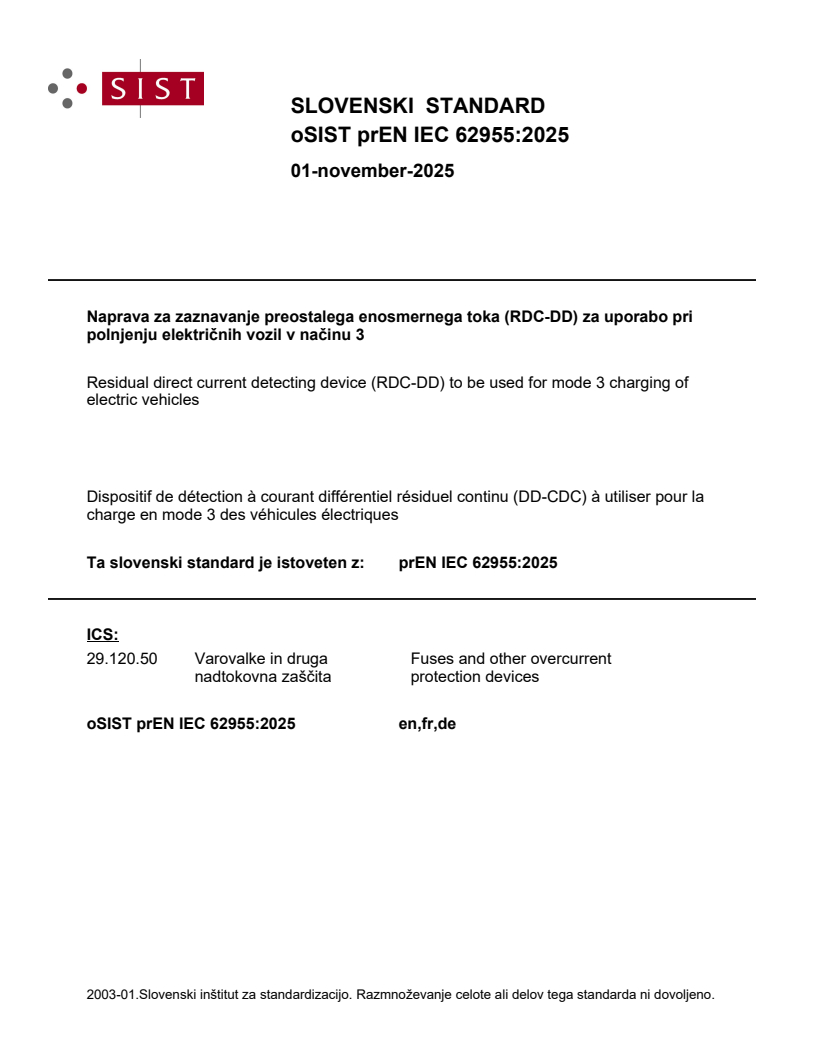
SLOVENSKI STANDARD
01-november-2025
Naprava za zaznavanje preostalega enosmernega toka (RDC-DD) za uporabo pri
polnjenju električnih vozil v načinu 3
Residual direct current detecting device (RDC-DD) to be used for mode 3 charging of
electric vehicles
Dispositif de détection à courant différentiel résiduel continu (DD-CDC) à utiliser pour la
charge en mode 3 des véhicules électriques
Ta slovenski standard je istoveten z: prEN IEC 62955:2025
ICS:
29.120.50 Varovalke in druga Fuses and other overcurrent
nadtokovna zaščita protection devices
2003-01.Slovenski inštitut za standardizacijo. Razmnoževanje celote ali delov tega standarda ni dovoljeno.
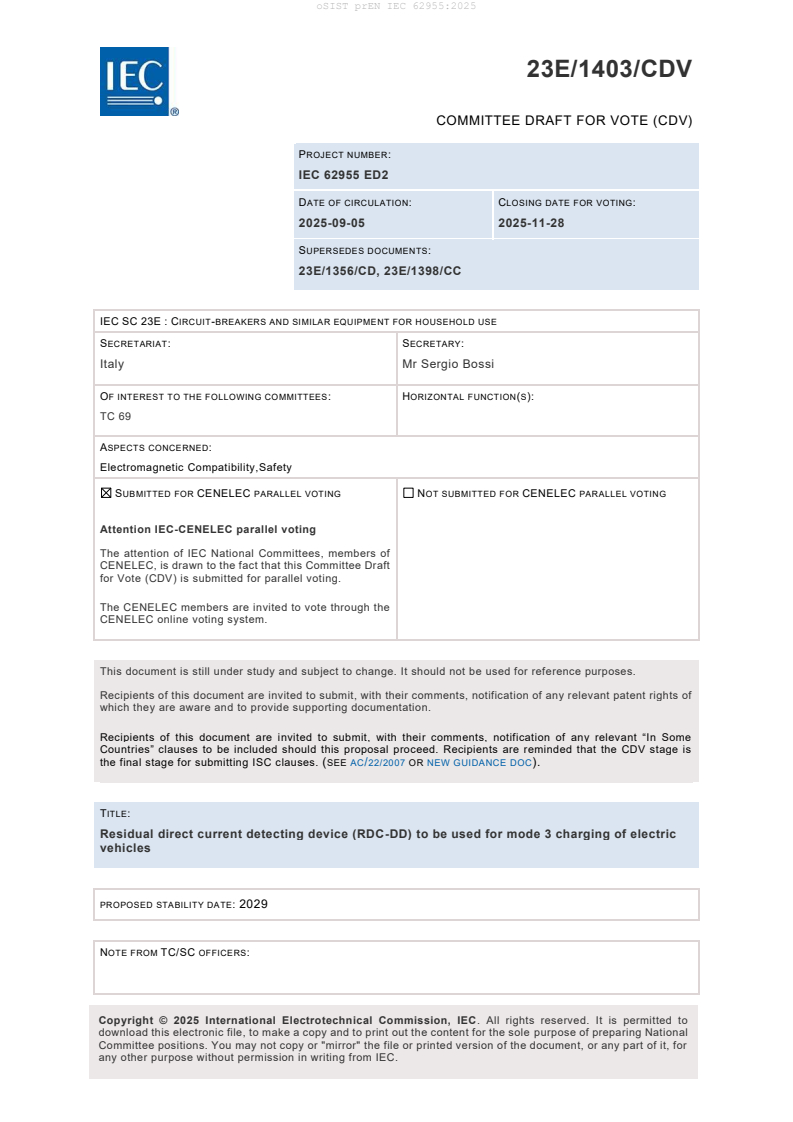
23E/1403/CDV
COMMITTEE DRAFT FOR VOTE (CDV)
PROJECT NUMBER:
IEC 62955 ED2
DATE OF CIRCULATION: CLOSING DATE FOR VOTING:
2025-09-05 2025-11-28
SUPERSEDES DOCUMENTS:
23E/1356/CD, 23E/1398/CC
IEC SC 23E : CIRCUIT-BREAKERS AND SIMILAR EQUIPMENT FOR HOUSEHOLD USE
SECRETARIAT: SECRETARY:
Italy Mr Sergio Bossi
OF INTEREST TO THE FOLLOWING COMMITTEES: HORIZONTAL FUNCTION(S):
TC 69
ASPECTS CONCERNED:
Electromagnetic Compatibility,Safety
SUBMITTED FOR CENELEC PARALLEL VOTING NOT SUBMITTED FOR CENELEC PARALLEL VOTING
Attention IEC-CENELEC parallel voting
The attention of IEC National Committees, members of
CENELEC, is drawn to the fact that this Committee Draft
for Vote (CDV) is submitted for parallel voting.
The CENELEC members are invited to vote through the
CENELEC online voting system.
This document is still under study and subject to change. It should not be used for reference purposes.
Recipients of this document are invited to submit, with their comments, notification of any relevant patent rights of
which they are aware and to provide supporting documentation.
Recipients of this document are invited to submit, with their comments, notification of any relevant “In Some
Countries” clauses to be included should this proposal proceed. Recipients are reminded that the CDV stage is
the final stage for submitting ISC clauses. (SEE AC/22/2007 OR NEW GUIDANCE DOC).
TITLE:
Residual direct current detecting device (RDC-DD) to be used for mode 3 charging of electric
vehicles
PROPOSED STABILITY DATE: 2029
NOTE FROM TC/SC OFFICERS:
download this electronic file, to make a copy and to print out the content for the sole purpose of preparing National
Committee positions. You may not copy or "mirror" the file or printed version of the document, or any part of it, for
any other purpose without permission in writing from IEC.
IEC CDV 62955 Ed2 © IEC 2025
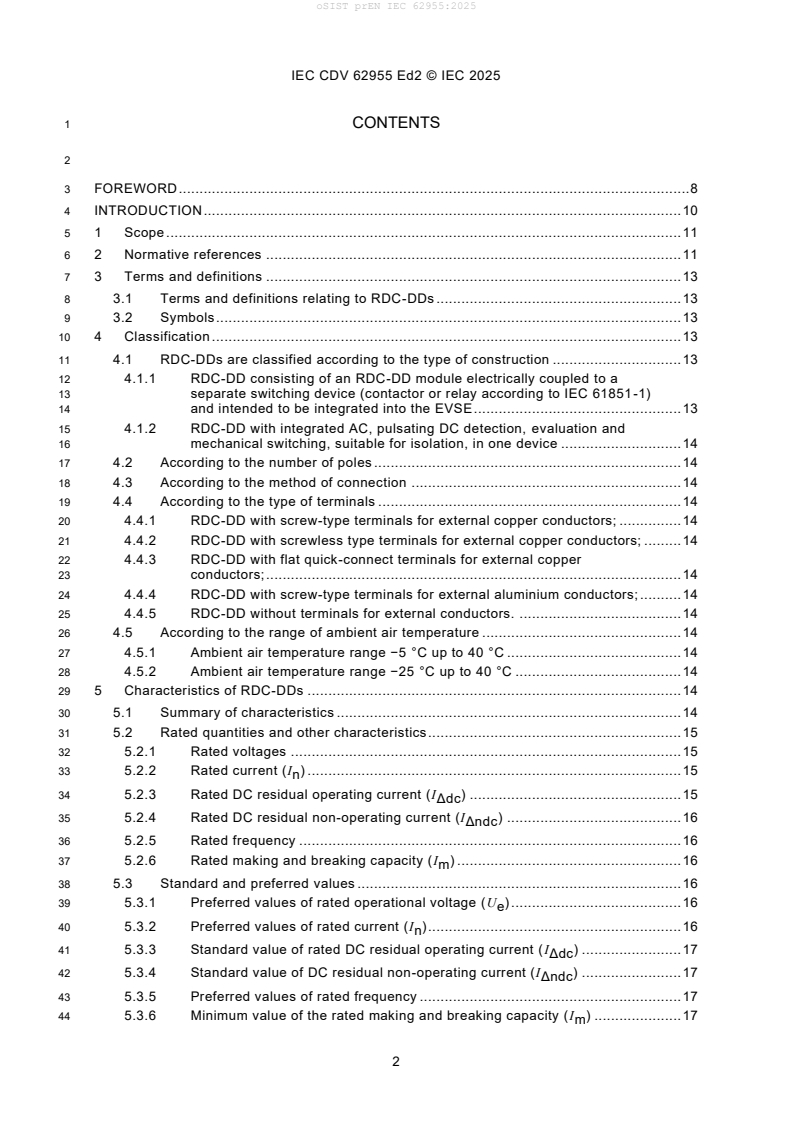
1 CONTENTS
3 FOREWORD . 8
4 INTRODUCTION . 10
5 1 Scope . 11
6 2 Normative references . 11
7 3 Terms and definitions . 13
8 3.1 Terms and definitions relating to RDC-DDs . 13
9 3.2 Symbols . 13
10 4 Classification . 13
11 4.1 RDC-DDs are classified according to the type of construction . 13
12 4.1.1 RDC-DD consisting of an RDC-DD module electrically coupled to a
13 separate switching device (contactor or relay according to IEC 61851-1)
14 and intended to be integrated into the EVSE . 13
15 4.1.2 RDC-DD with integrated AC, pulsating DC detection, evaluation and
16 mechanical switching, suitable for isolation, in one device . 14
17 4.2 According to the number of poles . 14
18 4.3 According to the method of connection . 14
19 4.4 According to the type of terminals . 14
20 4.4.1 RDC-DD with screw-type terminals for external copper conductors; . 14
21 4.4.2 RDC-DD with screwless type terminals for external copper conductors; . 14
22 4.4.3 RDC-DD with flat quick-connect terminals for external copper
23 conductors; . 14
24 4.4.4 RDC-DD with screw-type terminals for external aluminium conductors; . 14
25 4.4.5 RDC-DD without terminals for external conductors. . 14
26 4.5 According to the range of ambient air temperature . 14
27 4.5.1 Ambient air temperature range −5 °C up to 40 °C . 14
28 4.5.2 Ambient air temperature range −25 °C up to 40 °C . 14
29 5 Characteristics of RDC-DDs . 14
30 5.1 Summary of characteristics . 14
31 5.2 Rated quantities and other characteristics . 15
32 5.2.1 Rated voltages . 15
33 5.2.2 Rated current (I ) . 15
n
34 5.2.3 Rated DC residual operating current (I ) . 15
Δdc
35 5.2.4 Rated DC residual non-operating current (I ) . 16
Δndc
36 5.2.5 Rated frequency . 16
37 5.2.6 Rated making and breaking capacity (I ) . 16
m
38 5.3 Standard and preferred values . 16
39 5.3.1 Preferred values of rated operational voltage (U ) . 16
e
40 5.3.2 Preferred values of rated current (I ) . 16
n
41 5.3.3 Standard value of rated DC residual operating current (I ) . 17
Δdc
42 5.3.4 Standard value of DC residual non-operating current (I ) . 17
Δndc
43 5.3.5 Preferred values of rated frequency . 17
44 5.3.6 Minimum value of the rated making and breaking capacity (I ) . 17
m
IEC CDV 62955 Ed2 © IEC 2025
45 5.3.7 Standard and preferred values of the rated conditional short-circuit
46 current (I ). 17
nc
47 5.3.8 Standard and preferred values of the rated conditional residual short-
48 circuit current (I ) . 17
Δc
49 5.3.9 Limiting values of break time . 18
50 5.3.10 Standard value of rated impulse withstand voltage (U ) . 18
imp
51 5.4 Coordination with short-circuit protective devices (SCPDs) . 19
52 5.4.1 General . 19
53 5.4.2 Rated conditional short-circuit current (I ) . 19
nc
54 5.4.3 Rated conditional residual short-circuit current (I ) . 19
Δc
55 6 Marking and other product information . 19
56 7 Standard conditions for operation in service and for installation . 20
57 7.1 Standard conditions . 20
58 7.2 Conditions for installations . 21
59 7.3 Pollution degree . 21
60 8 Requirements for construction and operation . 21
61 8.1 Design requirements . 21
62 8.1.1 General . 21
63 8.1.2 Mechanism . 22
64 8.1.3 Clearances and creepage distances . 23
65 8.1.4 Screws, current-carrying parts and connections . 26
66 8.1.5 RDC-DD provided with terminals for external conductors . 27
67 8.1.6 Requirements for electrical circuits and connections for RDC-DD
68 according 4.1.1 . 30
69 8.2 Protection against electric shock . 30
70 8.3 Dielectric properties . 30
71 8.4 Temperature rise . 31
72 8.4.1 Temperature rise limits . 31
73 8.4.2 Ambient air temperature . 31
74 8.5 Operating characteristics . 31
75 8.6 Electrical endurance . 31
76 8.7 Performance at short-circuit currents . 32
77 8.8 Resistance to mechanical shock and impact . 32
78 8.9 Resistance to heat . 32
79 8.10 Resistance to abnormal heat and to fire . 32
80 8.11 Performance of the test function . 32
81 8.12 Behaviour of RDC-DD in the case of current surges caused by impulse
82 voltages . 33
83 8.13 Reliability . 33
84 8.14 Electromagnetic compatibility (EMC) . 33
85 9 Tests . 33
86 9.1 General . 33
87 9.1.1 Type Tests . 33
88 9.1.2 Testing procedure for the different type of RDC-DDs . 33
89 9.1.3 Routine tests . 34
90 9.2 Test conditions . 34
91 9.2.1 General test conditions . 34
92 9.2.2 RDC-DD classified according to 4.1.1 . 34
IEC CDV 62955 Ed2 © IEC 2025
93 9.2.3 RDC-DD classified according to 4.1.2 . 34
94 9.3 Test of indelibility of marking . 35
95 9.4 Test of reliability of screws, current-carrying parts and connections . 35
96 9.5 Tests of reliability of screw-type terminals for external copper conductors. 37
97 9.6 Verification of protection against electric shock . 38
98 9.7 Test of dielectric properties . 39
99 9.7.1 Resistance to humidity . 39
100 9.7.2 Insulation resistance of the main circuit . 39
101 9.7.3 Dielectric strength of the main circuit . 40
102 9.7.4 Insulation resistance and dielectric strength of secondary circuits and
103 control circuits . 41
104 9.7.5 Secondary circuit of detection transformers . 42
105 9.7.6 Capability of control circuits connected to the main circuit withstanding
106 high DC voltages due to insulation measurements . 42
107 9.7.7 Verification of impulse withstand voltages (across clearances and
108 across solid insulation) . 42
109 9.8 Test of temperature-rise . 45
110 9.8.1 Ambient air temperature . 45
111 9.8.2 Test procedure . 46
112 9.8.3 Measurement of the temperature of parts . 46
113 9.8.4 Temperature rise of a part . 46
114 9.9 Verification of the operating characteristics . 46
115 9.9.1 Test circuit and test procedure . 46
116 9.9.2 Verification of correct operation of RDC-DD with smooth DC residual
117 current . 47
118 9.9.3 Verification of non-operating time for alternating residual currents . 49
119 9.10 Verification of mechanical and electrical endurance . 49
120 9.10.1 General test conditions . 49
121 9.10.2 Test procedure . 50
122 9.10.3 Condition of the RDC-DD after test . 51
123 9.11 Verification of the behaviour of the RDC-DD under short-circuit conditions . 51
124 9.11.1 List of the short-circuit tests . 51
125 9.11.2 Short-circuit tests . 51
126 9.12 Verification of resistance to mechanical shock and impact . 59
127 9.12.1 General . 59
128 9.12.2 Mechanical shock . 59
129 9.12.3 Mechanical impact . 60
130 9.13 Test of resistance to heat . 62
131 9.13.1 Resistance to high temperature . 62
132 9.13.2 Ball pressure test at 125 °C . 62
133 9.13.3 Ball pressure test at temperature lower than 125 °C . 63
134 9.14 Test of resistance to abnormal heat and to fire . 63
135 9.15 Verification of the trip-free function . 64
136 9.15.1 General test conditions . 64
137 9.15.2 Test procedure . 64
138 9.16 Verification of the operation of the test function at the limits of rated
139 operational voltage . 64
140 9.17 Verification of behaviour of RDC-DD in case of current surges caused by
141 impulse voltages . 65
142 9.17.1 General . 65
IEC CDV 62955 Ed2 © IEC 2025
143 9.17.2 Current surge test for all RDC-DD (0,5 µs/100 kHz ring wave test) . 65
144 9.17.3 Verification of behaviour at surge currents up to 3 000 A (8/20 µs surge
145 current test) . 65
146 9.18 Verification of reliability . 66
147 9.18.1 General . 66
148 9.18.2 Climatic test. 66
149 9.18.3 Test with temperature of 40 °C . 68
150 9.19 Verification of withstand against ageing . 68
151 9.20 Electromagnetic compatibility (EMC) . 69
152 9.20.1 General . 69
153 9.20.2 Electromagnetic emission of RDC-DD . 69
154 9.20.3 Electromagnetic immunity of RDC-DD . 69
155 9.21 Test of resistance to rusting . 70
156 9.22 Verification of behaviour in case of disconnection of the current transformer . 71
157 Annex A (normative) Test sequences and number of samples to be submitted for
158 certification purposes . 94
159 A.1 Test sequences . 94
160 A.2 Number of samples to be submitted for full test procedure . 95
161 A.3 Number of samples to be submitted for simplified test procedures in the
162 case of submitting simultaneously a range of RDC-DDs of the same
163 fundamental design . 96
164 Annex B (normative) Determination of clearances and creepage distances . 99
165 B.1 General . 99
166 B.2 Orientation and location of a creepage distance . 99
167 B.3 Creepage distances where more than one material is used . 99
168 B.4 Creepage distances split by floating conductive part . 99
169 B.5 Measurement of creepage distances and clearances . 99
170 Annex C (normative) Arrangement for the detection of the emission of ionized gases
171 during short-circuit tests . 104
172 Annex D (normative) Routine tests . 107
173 D.1 General . 107
174 D.2 Tripping test . 107
175 D.3 Electric strength test . 107
176 D.4 Performance of the test device . 107
177 Annex E (informative) Methods for determination of short-circuit power factor . 108
178 E.1 General . 108
179 E.2 Method I – Determination from DC components . 108
180 E.3 Method II – Determination with pilot generator . 108
181 Annex F (informative) Examples of terminal designs . 110
182 Annex G (informative) Correspondence between ISO and AWG copper conductors . 113
183 Annex H (informative) SCPDs for short-circuit tests . 114
184 H.1 Introductory remark . 114
185 H.2 Silver wires . 114
186 H.3 Fuses. 114
187 H.4 Other means . 115
188 Annex I (normative) RDC-DD with integrated AC, pulsating DC detection, evaluation
189 and mechanical switching, suitable for isolation, in one device according to
190 classification 4.1.2 . 116
191 I.1 Scope . 116
IEC CDV 62955 Ed2 © IEC 2025
192 I.2 Characteristics . 116
193 I.3 Marking and other product information . 116
194 I.4 Requirements for construction and operation . 116
195 I.4.1 General . 116
196 I.4.2 Operating characteristic . 116
197 I.5 Tests . 117
198 I.5.1 Applicability of the tests according to this document . 117
199 I.5.2 Verification of the operating characteristics according to the main part
200 of this document . 117
201 I.5.3 Testing according to the RCD standard . 118
202 I.5.4 Verification of the correct operation in case of three- and four- pole
203 RDC-DDs powered on two poles only . 118
204 Bibliography . 119
206 Figure 1 – RDC-DD according to classification 4.1.1 . 72
207 Figure 2 – RDC-DD according to classification 4.1.2 . 72
208 Figure 3 – Standard test finger . 74
209 Figure 4 – Test circuit for the verification of operating characteristics (9.9.3) . 74
210 Figure 5 – Test circuit for the verification of the correct operation in case of smooth
211 direct current . 75
212 Figure 6 – Test circuit for 2-pole RDC-DD to verify the correct operation in case of
213 residual pulsating direct currents which may result from rectifying circuits supplied from
214 two phases . 76
215 Figure 7 – Tests circuit for 3-pole and 4-pole RDC-DD to verify the correct operation in
216 case of residual pulsating direct currents which may result from rectifying circuits
217 supplied from three phases . 76
218 Figure 8 – Typical diagram for all short circuit tests . 77
219 Figure 9 – Detail of impedances Z, Z and Z . 77
1 2
220 Figure 10 – Test circuit for endurance test according to 9.10 . 78
221 Figure 11 – Informative wave shape of inrush current for tests according to 9.10 . 80
222 Figure 12 – Test apparatus for the verification of the minimum I t and I values to be
p
223 withstood by the RDC-DD (9.11.2.1 a)) . 81
224 Figure 13 – Mechanical shock test apparatus (9.12.2) . 82
225 Figure 14 – Mechanical impact test apparatus (9.12.3.2) . 83
226 Figure 15 – Striking element for pendulum impact test apparatus (9.12.3.2). 84
227 Figure 16 – Mounting support for sample for mechanical impact test (9.12.3.2). 85
228 Figure 17 – Example of mounting an unenclosed RDC-DD for mechanical impact test
229 (9.12.3.2) . 86
230 Figure 18 – Example of mounting of panel mounting type RDC-DD for the mechanical
231 impact test (9.12.3.2) . 87
232 Figure 19 – Application of force for mechanical test of rail mounted RDC-DD (9.12.3.3) . 88
233 Figure 20 – Ball-pressure test apparatus (9.13.2) . 88
234 Figure 21 – Current ring wave 0,5 s/100 kHz . 89
235 Figure 22 – Test circuit for the ring wave test on RDC-DD . 89
236 Figure 23 – Stabilizing period for reliability test (9.18.2.4) . 90
237 Figure 24 – Reliability test cycle (9.18.2.4) . 91
IEC CDV 62955 Ed2 © IEC 2025
238 Figure 25 – Example for test circuit for verification of ageing (9.19) . 92
239 Figure 26 – Surge current impulse 8/20 s . 92
240 Figure 27 – Test circuit for the surge current test of RDC-DD . 93
241 Figure 28 – Example of calibration record for short-circuit test (9.11.2.1 j) i)) . 93
242 Figure B.1 – Examples of methods of measuring creepage distances and clearances . 103
243 Figure C.1 – Example of test arrangement . 105
244 Figure C.2 – Grid . 106
245 Figure C.3 – Grid circuit . 106
246 Figure F.1 – Examples of pillar terminals . 110
247 Figure F.2 – Examples of screw terminals and stud terminals . 111
248 Figure F.3 – Examples of saddle terminals. 112
249 Figure F.4 – Examples of lug terminals . 112
251 Table 1 – Preferred values of rated operational voltages . 16
252 Table 2 – Maximum values of break times for residual direct currents . 18
253 Table 3 – Minimum values of non-operating time for alternating residual currents . 18
254 Table 4 – Rated impulse withstand voltage as a function of the nominal voltage of the
255 installation . 18
256 Table 5 – Marking . 19
257 Table 6 – Standard conditions for operation in service . 21
258 Table 7 – Minimum clearances and creepage distances . 24
259 Table 8 – Connectable cross-sections of copper conductors for screw-type terminals . 28
260 Table 9 – Temperature-rise values . 31
261 Table 10 – Test copper conductors corresponding to the rated currents . 34
262 Table 11 – Screw thread diameters and applied torques . 36
263 Table 12 – Pulling forces . 37
264 Table 13 – Test voltage of auxiliary circuits . 41
265 Table 14 – Test voltage for verification of impulse withstand voltage . 44
266 Table 15 – Tests to be made to verify the behaviour of RDC-DDs under short-circuit
267 conditions . 51
268 Table 16 – Minimum values of I t and I . 53
p
269 Table 17 – Power factors for short-circuit tests . 55
270 Table 18 – Test to be carried out according to IEC 61543 . 70
271 Table 19 – Key of letters symbols for all Figure 4 up to Figure 10 . 79
272 Table A.1 – Test sequences . 94
273 Table A.2 – Number of samples to be submitted for full test procedure . 96
274 Table A.3 – Reduction of number of samples . 98
275 Table G.1 – Correspondence between ISO and AWG copper conductors . 113
276 Table H.1 – Indication of silver wire diameters as a function of rated currents and
277 short-circuit currents . 114
278 Table I.1 – List of type tests according to this document and their applicability . 117
279 Table I.2 – Tripping current ranges for RDC-DDs in case of pulsating DC current . 118
IEC CDV 62955 Ed2 © IEC 2025
281 INTERNATIONAL ELECTROTECHNICAL COMMISSION
282 ____________
284 RESIDUAL DIRECT CURRENT DETECTING DEVICE (RDC-DD) TO BE USED
285 FOR MODE 3 CHARGING OF ELECTRIC VEHICLES
287 FOREWORD
288 1) The International Electrotechnical Commission (IEC) is a worldwide organization for standardization comprising
289 all national electrotechnical committees (IEC National Committees). The object of IEC is to promote international
290 co-operation on all questions concerning standardization in the electrical and electronic fields. To this end and
291 in addition to other activities, IEC publishes International Standards, Technical Specifications, Technical Reports,
292 Publicly Available Specifications (PAS) and Guides (hereafter referred to as "IEC Publication(s)"). Their
293 preparation is entrusted to technical committees; any IEC National Committee interested in the subject dealt with
294 may participate in this preparatory work. International, governmental and non-governmental organizations liaising
295 with the IEC also participate in this preparation. IEC collaborates closely with the International Organization for
296 Standardization (ISO) in accordance with conditions determined by agreement between the two organizations.
297 2) The formal decisions or agreements of IEC on technical matters express, as nearly as possible, an international
298 consensus of opinion on the relevant subjects since each technical committee has representation from all
299 interested IEC National Committees.
300 3) IEC Publications have the form of recommendations for international use and are accepted by IEC National
301 Committees in that sense. While all reasonable efforts are made to ensure that the technical content of IEC
302 Publications is accurate, IEC cannot be held responsible for the way in which they are used or for any
303 misinterpretation by any end user.
304 4) In order to promote international uniformity, IEC National Committees undertake to apply IEC Publications
305 transparently to the maximum extent possible in their national and regional publications. Any divergence between
306 any IEC Publication and the corresponding national or regional publication shall be clearly indicated in the latter.
307 5) IEC itself does not provide any attestation of conformity. Independent certification bodies provide conformity
308 assessment services and, in some areas, access to IEC marks of conformity. IEC is not responsible for any
309 services carried out by independent certification bodies.
310 6) All users should ensure that they have the latest edition of this publication.
311 7) No liability shall attach to IEC or its directors, employees, servants or agents including individual experts and
312 members of its technical committees and IEC National Committees for any personal injury, property damage or
313 other damage of any nature whatsoever, whether direct or indirect, or for costs (including legal fees) and
314 expenses arising out of the publication, use of, or reliance upon, this IEC Publication or any other IEC
315 Publications.
316 8) Attention is drawn to the Normative references cited in this publication. Use of the referenced publications is
317 indispensable for the correct application of this publication.
318 9) IEC draws attention to the possibility that the implementation of this document may involve the use of (a)
319 patent(s). IEC takes no position concerning the evidence, validity or applicability of any claimed patent rights in
320 respect thereof. As of the date of publication of this document, IEC had not received notice of (a) patent(s), which
321 may be required to implement this document. However, implementers are cautioned that this may not represent
322 the latest information, which may be obtained from the patent database available at https://patents.iec.ch [and/or]
323 www.iso.org/patents. IEC shall not be held responsible for identifying any or all such patent rights.
324 IEC 62955 has been prepared by subcommittee 23E: Circuit-breakers and similar equipment
325 for household use, of IEC technical committee 23: Electrical accessories. It is an International
326 Standard.
327 This second edition cancels and replaces the first edition published in 201 8. This edition
328 constitutes a technical revision.
329 This edition includes the following significant technical changes with respect to the previous
330 edition:
331 - Redefinition of classification 4.1.
332 - Alignment with IEC 61851-1 Ed4 for classification 4.1.1
333 - Harmonization of EMC requirements with new edition of IEC 61543 and IEC 61851-21-2;
334 - General improvement of test and requirements.
IEC CDV 62955 Ed2 © IEC 2025
335 The text of this International Standard is based on the following documents:
Draft Report on voting
23E/XX/FDIS 23E/XX/RVD
337 Full information on the voting for its approval can be found in the report on voting indicated in
338 the above table.
339 The language used for the development of this International Standard is English.
340 This document was drafted in accordance with ISO/IEC Directives, Part 2, and developed in
341 accordance with ISO/IEC Directives, Part 1 and ISO/IEC Directives, IEC Supplement, available
342 at www.iec.ch/members_experts/refdocs. The main document types developed by IEC are
343 described in greater detail at www.iec.ch/publications.
344 In this document, the following print types are used:
345 – Requirements proper, in roman type;
346 – Test specifications, in italic type;
347 – NOTES, in smaller roman type.
348 The committee has decided that the contents of this document will remain unchanged until the
349 stability date indicated on the IEC website under webstore.iec.ch in the data related to the
350 specific document. At this date, the document will be
351 • reconfirmed,
352 • withdrawn,
353 • replaced by a revised edition, or
354 • amended.
IEC CDV 62955 Ed2 © IEC 2025
357 INTRODUCTION
358 According to IEC 60364-7-722, each connecting point is protected by its own RCD of at least
359 type A, having a rated residual operating current not exceeding 30 mA.
360 Protective measures against DC fault currents need to be taken. The appropriate measures are:
361 – RCD type B, or
362 – RCD type A in conjunction with a residual direct current detecting device (RDC-DD)
363 complying with IEC 62955; or
364 – the use of an RCD type F in conjunction with a residual direct current detecting device
365 (RDC-DD) complying with IEC 62955.
366 It is the purpose of this document to specify this type of detecting equipment to ensure that the
367 proper functionality of RCDs type A or type F is not impaired by DC residual currents above
368 6 mA.
IEC CDV 62955 Ed2 © IEC 2025
370 RESIDUAL DIRECT CURRENT DETECTING DEVICE (RDC-DD) TO BE USED
371 FOR MODE 3 CHARGING OF ELECTRIC VEHICLES
375 1 Scope
376 This International Standard applies to residual direct current detecting devices (RDC-DDs) for
377 permanently connected AC electric vehicle charging stations (mode 3 charging of electric
378 vehicles, according to IEC 61851-1 and IEC 60364-7-722) for rated voltages not exceeding
379 440 V AC with rated frequencies of 50 Hz, 60 Hz or 50/60 Hz and rated currents not exceeding
380 125 A.
381 NOTE 1 This document can also be used as guidance for devices for voltages up to and including 690 V AC 50 Hz,
382 60 Hz or 50/60 Hz, at a rated current not exceeding 250 A.
383 RDC-DDs are intended to remove the supply to the EV in cases where a smooth residual direct
384 current equal to or above 6 mA is detected.
385 NOTE 2 The value of 6 mA for smooth residual direct current was chosen to prevent impairing the correct operation
386 of an upstream type A or type F RCD.
387 This document covers residual direct current detecting device (RDC-DD) to be used for mode 3
388 charging of electric vehicles (see classification in 4.1).
389 This document applies to devices performing simultaneously the functions of detection of the
390 residual direct current, of comparison of the value of this current with the residual operating
391 value, opening of the circuit when the residual direct current is equal to or above 6 mA.
392 RDC-DDs are intended to be used for single-phase or multi-phase circuits in TN-, TT- and IT-
393 systems.
394 RDC-DDs are intended to be used in AC circuits only. RDC-DDs according to this document
395 are capable to be used for bi-directional power transfer.
396 NOTE 3 Bi-directional power transfer is defined in IEC 61851-1 ED4., 3.1.13.
397 2 Normative references
398 The following documents are referred to in the text in such a way that some or all of their content
399 constitutes requirements of this document. For dated references, only the edition cited applies.
400 For undated references, the latest edition of the referenced document (including any
401 amendments) applies.
402 IEC 60060-2:2010, High-voltage test techniques - Part 2: Measuring systems
403 IEC 60068-2-30:2005, Environmental testing – Part 2-30: Tests – Test Db: Damp heat, cyclic
404 (12 h + 12 h cycle)
405 IEC 60068-3-4, Environmental testing – Part 3-4: Supporting documentation and guidance
...
Questions, Comments and Discussion
Ask us and Technical Secretary will try to provide an answer. You can facilitate discussion about the standard in here.
Loading comments...