

SIST ISO 4149:2026
(Main)Green coffee — Olfactory and visual examination and determination of foreign matter and defects (ISO 4149:2026
- Abstract
This document specifies methods for the olfactory and visual examination and determination of foreign matter and defects in green coffee from all origins. These methods can also be used for determining one or more of the characteristics of green coffee with an impact on coffee quality for technical, commercial, administrative and arbitration purposes, and for quality control or quality inspection.
This document is applicable to green coffee as defined in ISO 3509.
- Status
- Published
- Publication Date
- 05-Oct-2026
- Technical Committee
- KŽP - Agricultural food products
- Current Stage
- 6060 - National Implementation/Publication (Adopted Project)
- Start Date
- 06-Oct-2026
- Due Date
- 11-Dec-2026
- Completion Date
- 06-Oct-2026

SIST ISO 4149:2026 is a Slovenian standard aligned with ISO 4149 for green coffee. It specifies methods for olfactory and visual examination and for determining foreign matter and defects in green coffee from all origins. The standard is used for quality control, quality inspection, and technical, commercial, administrative, and arbitration purposes.
What does SIST ISO 4149:2026 specify?
SIST ISO 4149:2026 specifies how to examine green coffee by smell and sight, and how to identify and measure foreign matter and defects. It applies to green coffee as defined in ISO 3509, so it is aimed at raw coffee before roasting.
The standard is organized into:
- Scope
- Normative references
- Terms and definitions
- Sampling
- Olfactory examination
- Visual examination
- Determination of foreign matter and defects
- Test report
- Annex A with an informative worked example
| Annex | What it covers |
|---|---|
| Annex A | Example of a typical determination using the weighing method |
What are the key requirements of SIST ISO 4149:2026?
Sampling and examination sequence
SIST ISO 4149:2026 requires sampling and sample preparation to follow ISO 4072. The same laboratory sample may later be used for size analysis if it is fully reconstituted for that further test. In practice, this means the initial sample must be handled carefully so it can still support later checks.
The olfactory examination is done first, before any other examination. The sample label information is recorded, the package is opened, and the coffee is smelled directly. This sequence matters because later handling could change what can still be detected by smell.
Odour and visual assessment
SIST ISO 4149:2026 asks the examiner to classify odour as either normal or abnormal. If a foreign odour is recognized, it should be described and linked to the matter it suggests, using ISO 18794 for sensory vocabulary. In doubtful cases, the sample is placed in a clean odourless container, kept closed for at least one hour at room temperature, and checked again.
For visual examination, the sample is spread on a plain orange or black surface under diffuse daylight or artificial light that reproduces daylight as closely as possible. When artificial light is used, the technical guidance in Table 1 should be considered. The examiner assesses botanical origin, overall colour, and colour uniformity, then records the colour as bluish, greenish, greyish green, whitish, yellowish, or brownish. This helps users document the appearance of the lot in a consistent way.
Determining foreign matter and defects
SIST ISO 4149:2026 allows two ways to determine defects: counting or weighing, according to agreement between the interested parties. For counting, the standard uses the coffee faults concept, and the Green Coffee Table from the Specialty Coffee Association (SCA) may be used as a reference. This is useful when the parties want defect counts rather than mass-based results.
For the weighing method, the laboratory sample is weighed to the nearest 0,1 g and used as the test portion. Foreign matter and defective beans are separated by category in accordance with ISO 10470, then weighed separately. The examiner uses the same daylight-type lighting and may refer to colour photographs of defects in ISO 10470 for better identification.
Expression of results and reporting
SIST ISO 4149:2026 converts defect masses into mass fractions and then applies the factor linked to each defect in ISO 10470. Those factors reflect loss in mass and sensorial concern, and the final result is expressed in quality impact units. In practice, this turns a list of observed defects into a result that can be compared across lots.
The test report shall identify the sample, state the test date, note the sampling method if known, identify the test method as ISO 4149, and record any optional details or incidents that could have influenced the result. The reported result, or repeatability result if one was made, is also included.
What terms does SIST ISO 4149:2026 define?
Clause 3 uses the terms and definitions from ISO 3509, so the standard relies on that vocabulary rather than redefining the coffee terms itself.
- Green coffee - The coffee product covered by the standard, used here as the material to be examined.
- Laboratory sample - The sample taken for the smell, visual, and defect examinations.
- Foreign matter - Material found in the sample that is not part of sound green coffee and is separated for evaluation.
- Defects - Beans or other findings grouped into defect categories for counting or weighing.
- Normal odour - The smell recorded when no disagreeable odour or odour foreign to coffee is detected.
- Abnormal odour - The smell recorded when a disagreeable or foreign odour is detected.
- Quality impact units - The result used to express the influence of defects on coffee quality.
Who uses SIST ISO 4149:2026?
SIST ISO 4149:2026 is used by coffee laboratories, quality control teams, inspection staff, buyers, sellers, and arbitration or administrative parties that need a common way to judge green coffee. It is also relevant to technical and commercial checks where the appearance, odour, foreign matter, and defects of a lot must be described in a traceable way. In practice, users apply it when sampling coffee, checking smell and appearance, separating defects, weighing or counting them, and writing a report.
What changed in SIST ISO 4149:2026 from the previous edition?
This third edition cancels and replaces ISO 4149:2005 and is technically revised.
The stated changes are:
- recommendations for artificial light were added in 6.2
- a counting method for defects was added in 7.3
Which standards are used with SIST ISO 4149:2026?
- ISO 3509 - provides the vocabulary used for the terms and definitions in this standard.
- ISO 4072 - sets the sampling and sample-preparation method for green coffee in bags.
- ISO 10470 - provides the defect reference chart, defect categories, and the factors used to express results.
- ISO 4150 - is cited for size analysis if the same laboratory sample is fully reconstituted.
- ISO 18794 - is cited for sensory-analysis vocabulary when describing foreign odours.
What does the SIST ISO 4149:2026 document contain?
SIST ISO 4149:2026 contains step-by-step procedures for olfactory examination, visual examination, and foreign-matter/defect determination. It also includes a technical table for artificial-light conditions, a formula for expressing results, and a reporting checklist.
Annex A gives an informative worked example of the weighing method. That example shows how defects are grouped, weighed, converted into percentages, and then translated into quality impact units. The bibliography points to ISO 4150 and ISO 18794 as supporting references for size analysis and sensory vocabulary.
Relations
- Effective Date
- 01-Nov-2026
Get Certified
Connect with accredited certification bodies for this standard

BSI Group
BSI (British Standards Institution) is the business standards company that helps organizations make excellence a habit.

Bureau Veritas
Bureau Veritas is a world leader in laboratory testing, inspection and certification services.

DNV
DNV is an independent assurance and risk management provider.
Sponsored listings
Frequently Asked Questions
SIST ISO 4149:2026 is a standard published by the Slovenian Institute for Standardization (SIST). Its full title is "Green coffee — Olfactory and visual examination and determination of foreign matter and defects (ISO 4149:2026". This standard covers: This document specifies methods for the olfactory and visual examination and determination of foreign matter and defects in green coffee from all origins. These methods can also be used for determining one or more of the characteristics of green coffee with an impact on coffee quality for technical, commercial, administrative and arbitration purposes, and for quality control or quality inspection. This document is applicable to green coffee as defined in ISO 3509.
This document specifies methods for the olfactory and visual examination and determination of foreign matter and defects in green coffee from all origins. These methods can also be used for determining one or more of the characteristics of green coffee with an impact on coffee quality for technical, commercial, administrative and arbitration purposes, and for quality control or quality inspection. This document is applicable to green coffee as defined in ISO 3509.
SIST ISO 4149:2026 is classified under the following ICS (International Classification for Standards) categories: 67.140.20 - Coffee and coffee substitutes. The ICS classification helps identify the subject area and facilitates finding related standards.
SIST ISO 4149:2026 has the following relationships with other standards: It is inter standard links to SIST ISO 4149:2011. Understanding these relationships helps ensure you are using the most current and applicable version of the standard.
SIST ISO 4149:2026 is available in PDF format for immediate download after purchase. The document can be added to your cart and obtained through the secure checkout process. Digital delivery ensures instant access to the complete standard document.
Standards Content (Sample)
SLOVENSKI STANDARD
01-november-2026
Nadomešča:
SIST ISO 4149:2011
Surova kava - Ugotavljanje vonja in videza ter določanje tujih primesi in napak
(ISO 4149:2025)
Green coffee — Olfactory and visual examination and determination of foreign matter
and defects (ISO 4149:2026
Café vert — Examens olfactif et visuel, et détermination des matières étrangères et des
défauts (ISO 4149:2025)
Ta slovenski standard je istoveten z: ISO 4149:2025
ICS:
67.140.20 Kava in kavni nadomestki Coffee and coffee substitutes
2003-01.Slovenski inštitut za standardizacijo. Razmnoževanje celote ali delov tega standarda ni dovoljeno.
International
Standard
ISO 4149
Third edition
Green coffee — Olfactory and visual
2025-11
examination and determination of
foreign matter and defects
Café vert — Examens olfactif et visuel, et détermination des
matières étrangères et des défauts
Reference number
© ISO 2025
All rights reserved. Unless otherwise specified, or required in the context of its implementation, no part of this publication may
be reproduced or utilized otherwise in any form or by any means, electronic or mechanical, including photocopying, or posting on
the internet or an intranet, without prior written permission. Permission can be requested from either ISO at the address below
or ISO’s member body in the country of the requester.
ISO copyright office
CP 401 • Ch. de Blandonnet 8
CH-1214 Vernier, Geneva
Phone: +41 22 749 01 11
Email: copyright@iso.org
Website: www.iso.org
Published in Switzerland
ii
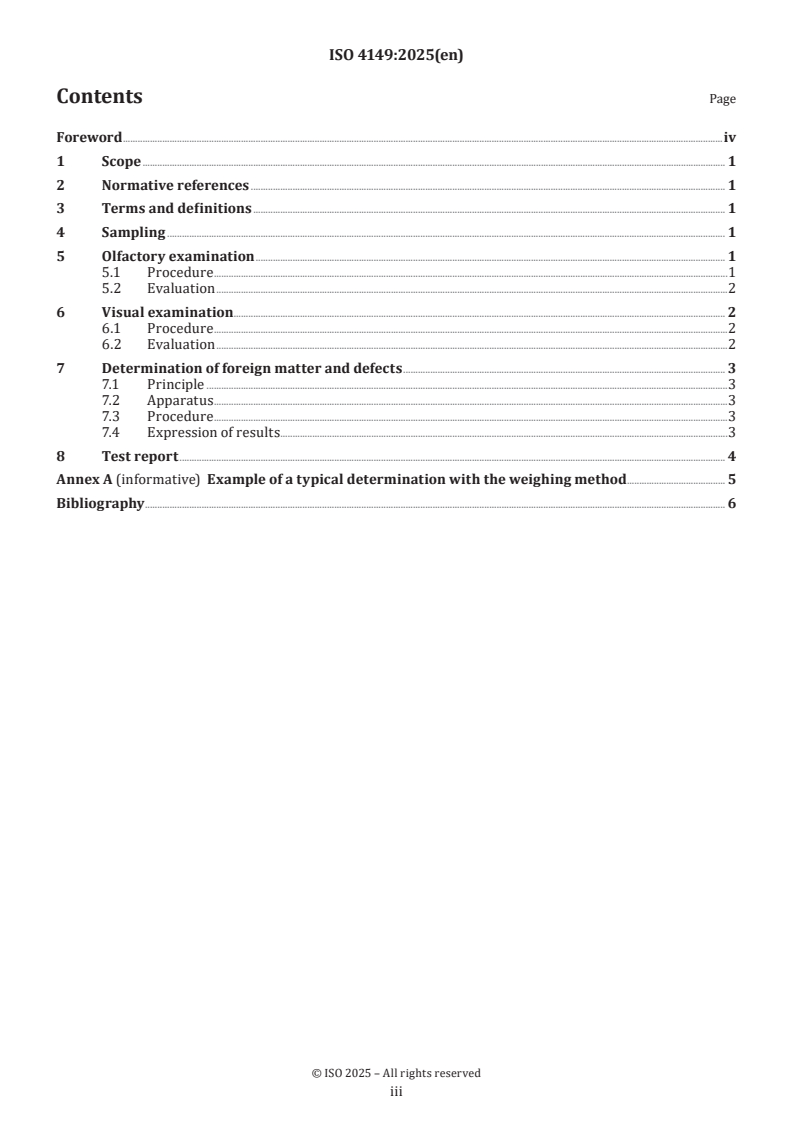
Contents Page
Foreword .iv
1 Scope . 1
2 Normative references . 1
3 Terms and definitions . 1
4 Sampling . 1
5 Olfactory examination . 1
5.1 Procedure .1
5.2 Evaluation .2
6 Visual examination. 2
6.1 Procedure .2
6.2 Evaluation .2
7 Determination of foreign matter and defects . 3
7.1 Principle .3
7.2 Apparatus .3
7.3 Procedure .3
7.4 Expression of results . .3
8 Test report . 4
Annex A (informative) Example of a typical determination with the weighing method . 5
Bibliography . 6
iii
Foreword
ISO (the International Organization for Standardization) is a worldwide federation of national standards
bodies (ISO member bodies). The work of preparing International Standards is normally carried out through
ISO technical committees. Each member body interested in a subject for which a technical committee
has been established has the right to be represented on that committee. International organizations,
governmental and non-governmental, in liaison with ISO, also take part in the work. ISO collaborates closely
with the International Electrotechnical Commission (IEC) on all matters of electrotechnical standardization.
The procedures used to develop this document and those intended for its further maintenance are described
in the ISO/IEC Directives, Part 1. In particular, the different approval criteria needed for the different types
of ISO document should be noted. This document was drafted in accordance with the editorial rules of the
ISO/IEC Directives, Part 2 (see www.iso.org/directives).
ISO draws attention to the possibility that the implementation of this document may involve the use of (a)
patent(s). ISO takes no position concerning the evidence, validity or applicability of any claimed patent
rights in respect thereof. As of the date of publication of this document, ISO had not received notice of (a)
patent(s) which may be required to implement this document. However, implementers are cautioned that
this may not represent the latest information, which may be obtained from the patent database available at
www.iso.org/patents. ISO shall not be held responsible for identifying any or all such patent rights.
Any trade name used in this document is information given for the convenience of users and does not
constitute an endorsement.
For an explanation of the voluntary nature of standards, the meaning of ISO specific terms and expressions
related to conformity assessment, as well as information about ISO’s adherence to the World Trade
Organization (WTO) principles in the Technical Barriers to Trade (TBT), see www.iso.org/iso/foreword.html.
This document was prepared by Technical Committee ISO/TC 34, Food products, Subcommittee SC 15, Coffee.
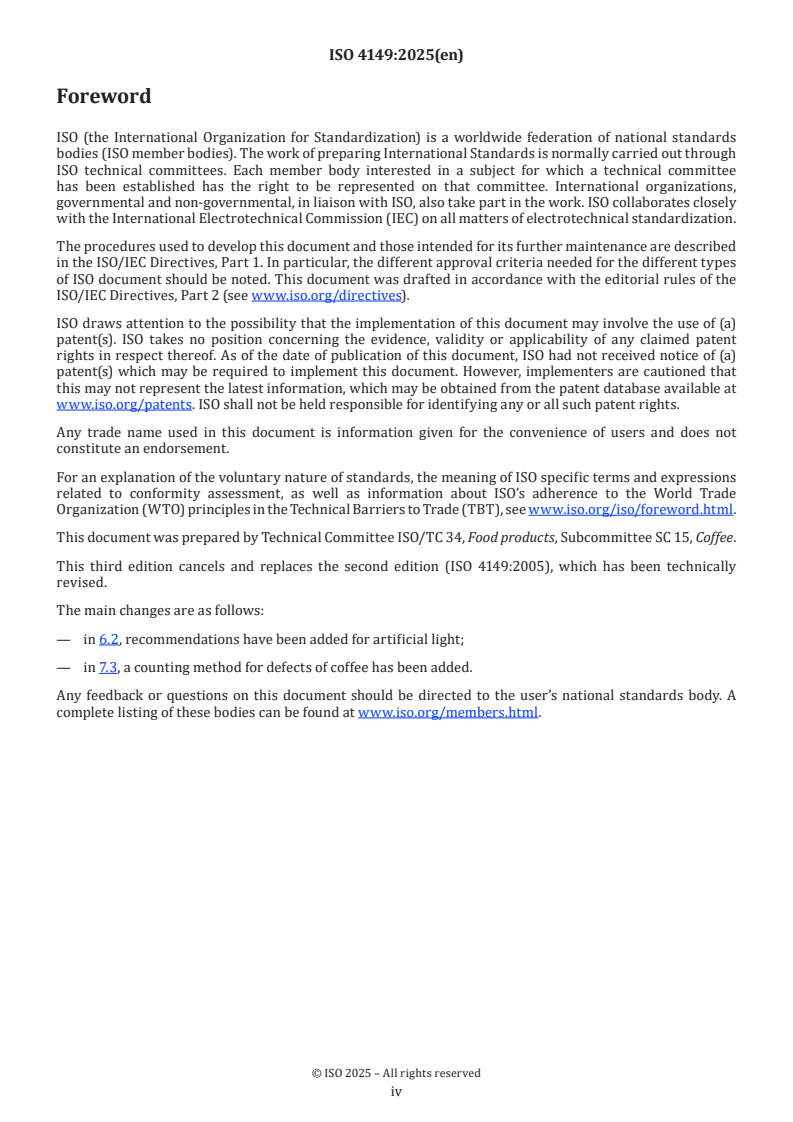
This third edition cancels and replaces the second edition (ISO 4149:2005), which has been technically
revised.
The main changes are as follows:
— in 6.2, recommendations have been added for artificial light;
— in 7.3, a counting method for defects of coffee has been added.
Any feedback or questions on this document should be directed to the user’s national standards body. A
complete listing of these bodies can be found at www.iso.org/members.html.
iv
SIST ISO 4149:2
...
International
Standard
ISO 4149
Third edition
Green coffee — Olfactory and visual
2025-11
examination and determination of
foreign matter and defects
Café vert — Examens olfactif et visuel, et détermination des
matières étrangères et des défauts
Reference number
© ISO 2025
All rights reserved. Unless otherwise specified, or required in the context of its implementation, no part of this publication may
be reproduced or utilized otherwise in any form or by any means, electronic or mechanical, including photocopying, or posting on
the internet or an intranet, without prior written permission. Permission can be requested from either ISO at the address below
or ISO’s member body in the country of the requester.
ISO copyright office
CP 401 • Ch. de Blandonnet 8
CH-1214 Vernier, Geneva
Phone: +41 22 749 01 11
Email: copyright@iso.org
Website: www.iso.org
Published in Switzerland
ii
Contents Page
Foreword .iv
1 Scope . 1
2 Normative references . 1
3 Terms and definitions . 1
4 Sampling . 1
5 Olfactory examination . 1
5.1 Procedure .1
5.2 Evaluation .2
6 Visual examination. 2
6.1 Procedure .2
6.2 Evaluation .2
7 Determination of foreign matter and defects . 3
7.1 Principle .3
7.2 Apparatus .3
7.3 Procedure .3
7.4 Expression of results . .3
8 Test report . 4
Annex A (informative) Example of a typical determination with the weighing method . 5
Bibliography . 6
iii
Foreword
ISO (the International Organization for Standardization) is a worldwide federation of national standards
bodies (ISO member bodies). The work of preparing International Standards is normally carried out through
ISO technical committees. Each member body interested in a subject for which a technical committee
has been established has the right to be represented on that committee. International organizations,
governmental and non-governmental, in liaison with ISO, also take part in the work. ISO collaborates closely
with the International Electrotechnical Commission (IEC) on all matters of electrotechnical standardization.
The procedures used to develop this document and those intended for its further maintenance are described
in the ISO/IEC Directives, Part 1. In particular, the different approval criteria needed for the different types
of ISO document should be noted. This document was drafted in accordance with the editorial rules of the
ISO/IEC Directives, Part 2 (see www.iso.org/directives).
ISO draws attention to the possibility that the implementation of this document may involve the use of (a)
patent(s). ISO takes no position concerning the evidence, validity or applicability of any claimed patent
rights in respect thereof. As of the date of publication of this document, ISO had not received notice of (a)
patent(s) which may be required to implement this document. However, implementers are cautioned that
this may not represent the latest information, which may be obtained from the patent database available at
www.iso.org/patents. ISO shall not be held responsible for identifying any or all such patent rights.
Any trade name used in this document is information given for the convenience of users and does not
constitute an endorsement.
For an explanation of the voluntary nature of standards, the meaning of ISO specific terms and expressions
related to conformity assessment, as well as information about ISO’s adherence to the World Trade
Organization (WTO) principles in the Technical Barriers to Trade (TBT), see www.iso.org/iso/foreword.html.
This document was prepared by Technical Committee ISO/TC 34, Food products, Subcommittee SC 15, Coffee.
This third edition cancels and replaces the second edition (ISO 4149:2005), which has been technically
revised.
The main changes are as follows:
— in 6.2, recommendations have been added for artificial light;
— in 7.3, a counting method for defects of coffee has been added.
Any feedback or questions on this document should be directed to the user’s national standards body. A
complete listing of these bodies can be found at www.iso.org/members.html.
iv
International Standard ISO 4149:2025(en)
Green coffee — Olfactory and visual examination and
determination of foreign matter and defects
1 Scope
This document specifies methods for the olfactory and visual examination and determination of foreign
matter and defects in green coffee from all origins. These methods can also be used for determining one
or more of the characteristics of green coffee with an impact on coffee quality for technical, commercial,
ad
...