

kSIST FprEN 13670:2026
(Main)Execution of concrete structures
- Abstract
(1) This document gives common requirements for execution of concrete structures, it applies to both in situ construction works and use of prefabricated concrete elements.
(2) This document expects the execution specification to state all the specific requirements relevant to the particular structure.
(3) This document is applicable to permanent as well as temporary concrete structures.
(4) This document does not apply to concrete members used only as equipment or construction aids for the execution.
(5) This document does not cover the specification, production and conformity of concrete.
(6) This document is not applicable to the production of precast concrete elements made in accordance with product standards.
(7) This document does not cover safety and health aspects of execution, or third-party safety requirements.
(8) This document does not cover contractual issues or responsibilities for the identified actions.
- Status
- Not Published
- Public Enquiry End Date
- 21-Dec-2025
- Technical Committee
- BBB - Concrete, reinforced concrete and prestressed concrete
- Current Stage
- 5020 - Formal vote (FV) (Adopted Project)
- Start Date
- 27-Aug-2026
- Due Date
- 15-Oct-2026



EN 13670 is a CEN European Standard for the execution of concrete structures. It specifies common requirements for how concrete structures are managed, built, inspected and finished, for constructors, designers and specialist subcontractors working on in situ construction works and prefabricated concrete elements.
EN 13670 is written to link design to execution. In practice, it tells the project team what has to be stated in the execution specification, how the work is organized on site, and how quality, geometry and acceptance are controlled.
What does EN 13670 specify?
EN 13670 gives common requirements for execution of concrete structures, for both in situ work and the use of prefabricated concrete elements. It applies to permanent and temporary concrete structures, so it is used on a wide range of building and civil engineering works.
The standard excludes concrete members used only as equipment or construction aids, the specification and production of concrete itself, the production of precast concrete elements made to product standards, safety and health matters, third-party safety requirements, and contractual responsibilities. That means it is focused on execution of the structure, not on the commercial or occupational safety framework around it.
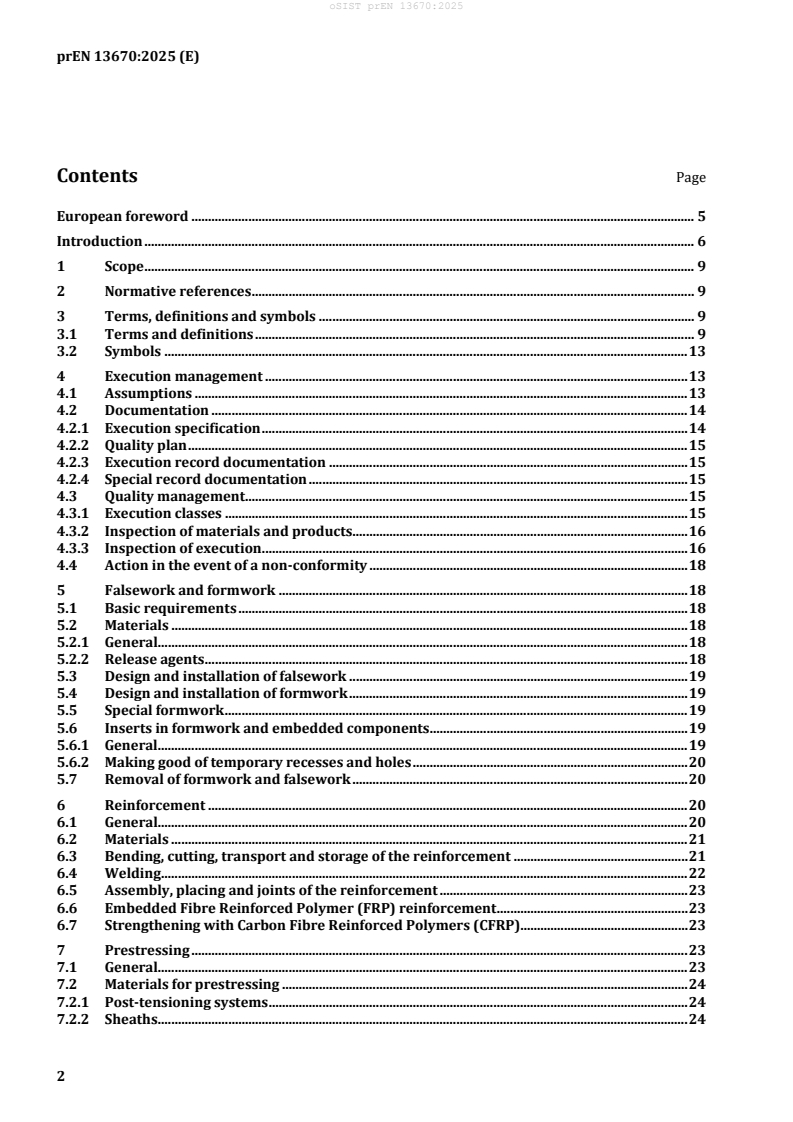
The document is organized into main clauses on scope, references, terms, execution management, falsework and formwork, reinforcement, prestressing, concreting, execution with precast concrete elements, and geometrical tolerances. It also has informative annexes A to H.
| Annex | What it covers |
|---|---|
| A | Guidance on documentation |
| B | Guidance on quality management |
| C | Guidance on falsework and formwork |
| D | Guidance on reinforcement |
| E | Guidance on prestressing |
| F | Guidance on concreting |
| G | Guidance on geometrical tolerances |
| H | Strengthening of existing concrete structures with FRP |
What are the key requirements of EN 13670?
Execution management and documentation
EN 13670 requires the work to be controlled through an execution specification, a quality plan where needed, and execution record documentation. The execution specification is the project’s central technical package, and Annex A shows what it should contain.
The standard also uses execution classes and inspection requirements to match the level of control to the work. Table 1 and Table 2 classify inspection of materials, products and execution, and Table 3 sets the type and documentation of inspection. In practice, this means the project team must decide how much checking is needed and who is responsible for it.
For CE-marked products, the Declaration of Performance and Conformity is assessed against the execution specification. Where products are not CE-marked or where there is doubt, further inspection is required. If a non-conformity is found, the standard requires an ordered review of its effect, the corrective measures needed, and whether rejection or replacement is necessary.
Falsework and formwork
Falsework and formwork must be designed and built to resist foreseeable actions and to be stiff enough to keep the finished structure within tolerance. They must also not damage the appearance, durability or function of the permanent works.
Method statements may be required for erection and dismantling, including backpropping, loading, striking and dismantling. The practical point is that temporary works must be planned as part of the execution, not treated as a separate afterthought.
Formwork must hold the concrete to the required shape, stay sufficiently tight, and be suitable for the required surface finish. Removal is only allowed after the concrete has gained enough strength to avoid surface damage, excessive deflection or climate-related damage, and the release sequence must avoid overloading the remaining supports.
Reinforcement, FRP and CFRP
EN 13670 covers ordinary reinforcement, welded reinforcement, Fibre Reinforced Polymer (FRP) reinforcement, and Carbon Fibre Reinforced Polymer (CFRP) strengthening. Reinforcing steel must comply with the relevant standards, be identifiable, and be protected from damage and harmful contamination.
The standard addresses cutting, bending, transport, storage, welding, placing, lapping and cover. Chairs and spacers must be suitable for the required cover and load, because this directly affects durability and bond. The execution specification must also state the placement details that matter on site, such as cover, spacing, joints and lap lengths.
For FRP and CFRP, execution is tied closely to the execution specification and supplier information. The standard assumes experienced specialist companies for CFRP strengthening, and Annex H gives further guidance on bonded FRP repair and strengthening, including surface preparation, application and quality assurance.
Prestressing
EN 13670 applies to bonded pre-tensioned construction, bonded post-tensioned construction, and unbonded internal or external post-tensioned construction. It expects experienced specialist companies for the work, and competence for personnel installing post-tensioning kits is linked to EN 17678-1.
Prestressing materials that are sensitive to corrosion must be protected during transport, storage and installation. Grout materials must also be protected from moisture and used within shelf life. In practice, prestressing work needs controlled handling from delivery through to permanent protection, because damage at any stage can affect long-term performance.
Concreting and curing
Concrete used under EN 13670 must comply with prEN 206-1, and the concrete specification must also reflect the actual execution method. The standard gives requirements for pre-concreting operations, reception and site transport of fresh concrete, placing and compaction, curing and protection, post-concreting operations, composite structures, and surface finish.
Fresh concrete is checked on delivery, and the standard requires visual inspection during unloading. It also requires precautions against segregation, freezing, washout and other damage, and it gives special attention to self-compacting concrete, lightweight aggregate concrete, underwater concreting and Steel Fibre Reinforced Concrete (SFRC).
Curing is treated as a defined part of execution. The standard uses curing classes, based on curing period or strength development, and requires the curing class to be stated in the execution specification. That matters because early-age protection affects surface strength, durability and cracking risk.
Precast elements and geometry
EN 13670 covers structural precast elements from reception on site, or from removal from the forms for site-manufactured elements, through installation and final acceptance. It distinguishes between factory-produced precast elements governed by product standards and site-manufactured elements that fall within this document when they are not covered by a product standard.
The standard also sets the framework for geometrical tolerances. The completed structure must stay within permitted deviations so that resistance, stability, service performance and erection compatibility are not harmed. Tolerance class 1 is the default, while tolerance class 2 is used where the execution specification says so and where reduced material factors are part of the design assumptions.
What terms does EN 13670 define?
- Execution specification - the full set of project documents, drawings and technical requirements needed to execute a particular structure.
- Execution class - a classified set of requirements for the construction work as a whole or for an individual component.
- Falsework - temporary support for part of a structure while it is not yet self-supporting.
- Formwork - the temporary or permanent structure that contains poured concrete and supports it until it can carry itself.
- Fibre Reinforced Polymer (FRP) - a composite material made of industrial fibres embedded in a polymer matrix.
- Carbon Fibre Reinforced Polymer (CFRP) - an FRP based on industrially manufactured carbon fibres in a polymer matrix.
- Steel Fibre Reinforced Concrete (SFRC) - concrete containing steel fibres to provide post-cracking residual strength.
Who uses EN 13670?
EN 13670 is used by constructors, site managers, project managers, designers, quality managers and inspectors involved in concrete structures. It is also relevant to specialist companies working on prestressing, FRP strengthening, reinforcement fabrication, and erection of precast elements.
Buyers and technical specifiers use it when they need to state execution requirements clearly in a contract or project specification. Manufacturers and suppliers use it to understand what information, documentation and product evidence the constructor will need on site.
What changed in EN 13670 from the previous edition?
The draft text states that it supersedes EN 13670:2009. The listed technical changes include updates to the main text for FRP, CFRP and SFRC, an update to Annex F on SFRC, new FRP strengthening guidance in Annex H, and alignment with EN 1992-1-1:2023 and the forthcoming prEN 206-1.
Which standards are used with EN 13670?
- prEN 206-1 - gives the requirements for concrete specification, performance, production and conformity.
- EN 446 - covers grouting procedures for prestressing tendons.
- EN 447 - gives the basic requirements for grout for prestressing tendons.
- EN 523 - covers steel strip sheaths for prestressing tendons.
- EN 10080 - is the reference for weldable reinforcing steel.
- EN ISO 17660-1 - covers welding of reinforcing steel for load-bearing welded joints.
- EN 17678-1 - gives competence requirements for personnel installing post-tensioning kits.
What does the EN 13670 document contain?
EN 13670 contains the main execution rules for concrete structures, plus detailed tables and annexes that support project specification, inspection and tolerancing. The document includes tables for execution classes, curing classes, and geometric deviations for columns, walls, beams, slabs, sections, surfaces, holes and inserts.
It also includes procedures for temporary works, reinforcement handling, prestressing operations, concrete delivery and placement, curing, and installation of precast elements. The annexes provide guidance for documentation, quality management, falsework and formwork, reinforcement, prestressing, concreting, geometrical tolerances, and FRP strengthening of existing concrete structures.
Relations
- Effective Date
- 18-Dec-2024
Get Certified
Connect with accredited certification bodies for this standard

DIBt (Deutsches Institut für Bautechnik)
German Institute for Building Technology.

DIN CERTCO
DIN Group product certification.

Aboma Certification B.V.
Specialized in construction, metal, and transport sectors.
Sponsored listings
Frequently Asked Questions
kSIST FprEN 13670:2026 is a draft published by the Slovenian Institute for Standardization (SIST). Its full title is "Execution of concrete structures". This standard covers: (1) This document gives common requirements for execution of concrete structures, it applies to both in situ construction works and use of prefabricated concrete elements. (2) This document expects the execution specification to state all the specific requirements relevant to the particular structure. (3) This document is applicable to permanent as well as temporary concrete structures. (4) This document does not apply to concrete members used only as equipment or construction aids for the execution. (5) This document does not cover the specification, production and conformity of concrete. (6) This document is not applicable to the production of precast concrete elements made in accordance with product standards. (7) This document does not cover safety and health aspects of execution, or third-party safety requirements. (8) This document does not cover contractual issues or responsibilities for the identified actions.
(1) This document gives common requirements for execution of concrete structures, it applies to both in situ construction works and use of prefabricated concrete elements. (2) This document expects the execution specification to state all the specific requirements relevant to the particular structure. (3) This document is applicable to permanent as well as temporary concrete structures. (4) This document does not apply to concrete members used only as equipment or construction aids for the execution. (5) This document does not cover the specification, production and conformity of concrete. (6) This document is not applicable to the production of precast concrete elements made in accordance with product standards. (7) This document does not cover safety and health aspects of execution, or third-party safety requirements. (8) This document does not cover contractual issues or responsibilities for the identified actions.
kSIST FprEN 13670:2026 is classified under the following ICS (International Classification for Standards) categories: 91.080.40 - Concrete structures. The ICS classification helps identify the subject area and facilitates finding related standards.
kSIST FprEN 13670:2026 has the following relationships with other standards: It is inter standard links to SIST EN 13670:2010. Understanding these relationships helps ensure you are using the most current and applicable version of the standard.
kSIST FprEN 13670:2026 is available in PDF format for immediate download after purchase. The document can be added to your cart and obtained through the secure checkout process. Digital delivery ensures instant access to the complete standard document.
Standards Content (Sample)
Contents
- Introduction
- Annex A Annex B Annex C Annex D
- Annex E Annex F Annex G Annex H
- 1 Scope
- 2 Normative references
- 3 Terms, definitions and symbols
- 3.1 Terms and definitions
- 3.1.1 backpropping
- 3.1.2 chair
- 3.1.3 construction works
- 3.1.4 constructor
- 3.1.5 erection documentation
- 3.1.6 execution
- 3.1.7 execution class
- 3.1.8 execution specification
- 3.1.9 falsework
- 3.1.10 formwork
- 3.1.11 inspection
- 3.1.12 method statement
- 3.1.13 permitted deviation
- 3.1.14 precast concrete element
- 3.1.15 project specification
- 3.1.16 quality plan
- 3.1.17 reference line
- 3.1.18 secondary line
- 3.1.19 spacer
- 3.1.20 Steel Fibre Reinforced Concrete
- 3.1.21 Carbon Fibre Reinforced Polymer
- 3.1.22 Carbon Fibre Reinforced Polymer (CFRP) System
- 3.1.23 Fibre Reinforced Polymer
- 3.1.24 fibre reinforced polymer (FRP) reinforcement
- 3.1.25 surface finish
- 3.1.26 temporary structure
- 3.1.27 tolerance
- 3.1.28 normal tolerances
- 3.1.29 special tolerances
- 3.2 Symbols
- 4 Execution management
- 4.1 Assumptions
- 4.2 Documentation
- 4.3 Quality management
- 8 Other items In accordance with the execution specification
- 10 Inspection report Not required Required
- 4 FRP Reinforcement Not to be used According to requirements given
- 5 Carbon Fibre Reinforced Polymers Not to be used According to requirements given
- 6 Prestressing reinforcement Not to be used According to requirements given
- 2 Party which Self inspection Self inspection Self inspection
- 3 Extent All construction In addition to the self In addition to the self
- 4 Inspection Not required Required
- 5 As-built Not required According to execution specification
- 4.4 Action in the event of a non-conformity
- 5 Falsework and formwork
- 5.1 Basic requirements
- 5.2 Materials
- 5.3 Design and installation of falsework
- 5.4 Design and installation of formwork
- 5.5 Special formwork
- 5.6 Inserts in formwork and embedded components
- 5.7 Removal of formwork and falsework
- 6 Reinforcement
- 6.1 General
- 6.2 Materials
- 6.3 Bending, cutting, transport and storage of the reinforcement
- 6.4 Welding
- 6.5 Assembly, placing and joints of the reinforcement
- 6.6 Embedded Fibre Reinforced Polymer (FRP) reinforcement
- 6.7 Strengthening with Carbon Fibre Reinforced Polymers (CFRP)
- 7 Prestressing
- 7.1 General
- 7.2 Materials for prestressing
- 7.3 Transport and storage
- 7.4 Installation of tendons
- 7.5 Tensioning
- 7.6 Protective measures (grouting, greasing)
- 8 Concreting
- 8.1 General
- 8.2 Specification of concrete
- 8.3 Pre-concreting operations
- 8.4 Delivery, reception and site transport of fresh concrete
- 8.5 Placing and compaction
Introduction
0.1 Introduction to EN 13670 (1) This document applies to the execution of concrete structures to achieve the intended level of safety and serviceability during its service life, as given by EN 1990, Eurocode – Basis of structural design, EN 1992, Eurocode 2 – Design of concrete structures and EN 1994, Eurocode 4 – Design of composite steel and concrete structures, with the Nationally Determined Parameters (NDPs) applicable in the place of use.
(2) This document has three functions:
a) to transfer the requirements set during design to the constructor i.e. to be a link between design and execution; b) to give a set of standardized technical requirements for the execution when ordering a concrete structure; c) to serve as a check list to ensure that the designer provides the constructor with all relevant technical information for the execution of the structure (see Annex A). (3) In order to achieve these objectives, the design should result in a set of documents and drawings giving all information required for the execution of the construction work in accordance with the plans. This set of documents is, in this document, referred to as the “execution specification”. This document leaves a number of items open to be decided in the execution specification. (4) In areas where national provisions apply, these should be referred to in the execution specification. (5) It is recognized in this document that areas such as detailed requirements for competence of personnel, and details related to the Quality Management are within the competence of the Member States.
(6) If the national CEN member publishes a National Annex to this document, it may refer to national standards approved and published by the CEN member or national provisions, which supplement this document. Alternatively, the supplementing rules can be given directly in the National Annex. (7) A detailed overview of the system of European Standards related to concrete construction works is shown in Figure 1.
oSIST prEN 13670:2025 prEN 13670:2025 (E)
Figure 1 — System of European Standards as basis for design, execution and materials selection for concrete construction works (only main modules) (8) Supplementing requirements are given in some member states when using, for example:
a) lightweight aggregate concrete; b) other materials (e.g. fibres, ultra-high performance concrete) or constituent materials; c) special technologies/innovative designs.
0.2 Provisions valid in the place of use for EN 13670 (1) National choice is allowed in this document where explicitly stated that provisions valid in the place of use may be given.
(2) The national standard implementing EN 13670 can have a National Annex or complementary standard containing all national choices to be used in the relevant country. (3) National choice is allowed in EN 13670 in the following:
4.1 (4) 4.2.1 (2) 4.2.2 (1) 4.2.4 (1) 4.3.1 (7) 4.3.2 (1) 4.3.3 (1) 4.4 (3) 5.1 (3) 5.2.2 (1) 5.3 (1) 5.4 (1) 5.4 (6) 5.7(1) 6.2 (1) NOTE 6.2 (2) 6.2 (3) 6.2 (6) 6.3 (1) b) 6.3 (1) c) 6.3 (2) 6.3 (3) 6.3 (5) 6.4 (1) 6.4 (2) 6.4 (3) 6.5 (1) 6.5 (2) 7.1 (2) 7.2.1 (1) 7.2.3 (1) 7.2.3 (2) 7.3 (1) 7.4.1 (1) 7.4.1 (3) 7.4.1 (4) 7.4.4 (1) 7.5.1 (2) 7.5.1 (7) 7.5.2 (1) 7.5.3 (1) 7.6.1 (5) 8.3 (1) 8.3 (4)
oSIST prEN 13670:2025 prEN 13670:2025 (E) 8.3 (7) 8.3 (10) 8.3 (11) 8.4 (4) 8.4 (6) 8.4 (7) 8.5.1 (1) 8.5.1 (3) 8.5.1 (4) 8.5.1 (5) 8.5.1 (6) 8.5.4 (1) 8.5.5 (2) 8.5.6 (1) 8.6 (9) 8.6 (10) 8.6 (15) 8.6 (18) 8.9 (1) 9.4.1 (1) 9.4.1 (3) 9.6.3 (1) 10.1 (3) 10.1 (5) 10.1 (6) 10.1 (7) 10.1 (8) 10.1 (11) 10.2 (3) 10.6 (3) B.4.3.1 (4) B.4.3.3 (3) c) E.7.6.1 (1) National choice is allowed in EN 13670 on the application of the following informative annexes:
Annex A Annex B Annex C Annex D
Annex E Annex F Annex G Annex H
NOTE The National Annex can contain, directly or by reference, non-contradictory complementary information for ease of implementation, provided it does not alter any provisions of this document.
oSIST prEN 13670:2025 prEN 13670:2025 (E)
1 Scope
(1) This document gives common requirements for execution of concrete structures, it applies to both in situ construction works and use of prefabricated concrete elements. (2) This document expects the execution specification to state all the specific requirements relevant to the particular structure.
(3) This document is applicable to permanent as well as temporary concrete structures. (4) This document does not apply to concrete members used only as equipment or construction aids for the execution.
(5) This document does not cover the specification, production and conformity of concrete. (6) This document is not applicable to the production of precast concrete elements made in accordance with product standards.
(7) This document does not cover safety and health aspects of execution, or third-party safety requirements.
(8) This document does not cover contractual issues or responsibilities for the identified actions.
2 Normative references
The following documents are referred to in the text in such a way that some or all of their content constitutes requirements of this document. For dated references, only the edition cited applies. For undated references, the latest edition of the referenced document (including any amendments) applies. prEN 206-1, Concrete - Specification, performance, production and conformity - Part 1: Performance, requirements, factory production control and assessment criteria for individual values EN 446, Grout for prestressing tendons - Grouting procedures EN 447, Grout for prestressing tendons - Basic requirements EN 523, Steel strip sheaths for prestressing tendons - Terminology, requirements, quality control EN 10080, Steel for the reinforcement of concrete - Weldable reinforcing steel - General EN ISO 17660-1, Welding - Welding of reinforcing steel - Part 1: Load-bearing welded joints (ISO 17660-1) EN 17678-1, Installation of post-tensioning kits for prestressing of structures - Part 1: Competence of personnel
3 Terms, definitions and symbols
3.1 Terms and definitions
For the purposes of this document, the following terms and definitions apply.
3.1.1 backpropping
propping installed at levels below the slab that supports the falsework in order to distribute the load to suitable support
oSIST prEN 13670:2025 prEN 13670:2025 (E)
3.1.2 chair
device used to secure the position between reinforcement layers e.g. supporting top reinforcement in a slab
3.1.3 construction works
everything that is constructed or results from construction operations [SOURCE: EN 1990] Note 1 to entry: The term covers both building and civil engineering works. It refers to the complete construction works comprising structural and non-structural and geotechnical elements.
3.1.4 constructor
organization executing the construction works
3.1.5 erection documentation
documents covering all drawings, technical data and requirements required for the safe erection of precast elements
3.1.6 execution
all activities carried out for the physical completion of the construction work, i.e. procurement, scaffolding, formwork, reinforcing, concreting, curing, erection of precast elements etc., and the inspection and documentation thereof
3.1.7 execution class
classified set of requirements specified for the execution of the construction works as a whole or an individual component
3.1.8 execution specification
documents covering all drawings, technical data and requirements necessary for the execution of a particular project Note 1 to entry: The execution specification is not one document but signifies the total sum of documents required for the execution of the construction work as provided by the designer to the constructor. It includes the project specification prepared to supplement and qualify the requirements of this document, as well as referring to the national provisions relevant in the place of use.
3.1.9 falsework
temporary support for a part of a structure while it is not self-supporting and for associated service load
3.1.10 formwork
structure, permanent or temporary, for containing poured concrete, moulding it to the required dimensions and supporting it until it is able to support itself
oSIST prEN 13670:2025 prEN 13670:2025 (E) Note 1 to entry: Formwork consists of the face contact material and the bearers directly supporting the face contact material.
3.1.11 inspection
conformity evaluation by observation and judgement accompanied as appropriate by measurement, testing or gauging [EN ISO 9000:2005, 3.8.2]
3.1.12 method statement
documentation describing the methods and procedures to be used to perform the work
3.1.13 permitted deviation
permitted algebraic differences between the limits of size and the corresponding reference size [SOURCE: ISO 1803:1997, 3.8, modified – ]
3.1.14 precast concrete element
concrete element cast and cured in a place other than the final location of use (factory produced or site manufactured) Note 1 to entry: Precast concrete element manufactured in compliance with relevant European product standard is called precast concrete product.
Note 2 to entry: In this document the shorter terms “precast element” and “precast product” are used.
3.1.15 project specification
project specific document describing the requirements applicable for the particular project
3.1.16 quality plan
document specifying which procedures and associated resources shall be applied by whom and when to a specific project, product, process or contract [SOURCE: EN ISO 9000:2005, 3.7.5] Note 1 to entry: Guidance might be found in EN ISO 9000 concerning the content of a quality plan.
3.1.17 reference line
line defined in the execution specification to which positions are related
3.1.18 secondary line
line used for the purpose of setting-out the proposed building and for checking and compliance of the building or building parts [SOURCE: ISO 4463-1:1989, 4.4]
oSIST prEN 13670:2025 prEN 13670:2025 (E)
3.1.19 spacer
device used to secure correct spacing between the formwork and the reinforcement
3.1.20 Steel Fibre Reinforced Concrete
SFRC concrete to which steel fibres are included into the concrete matrix to achieve post cracking residual strength [SOURCE: EN 1992-1-1:2023, 3.1.111]
3.1.21 Carbon Fibre Reinforced Polymer
CFRP fibre-polymer composite material comprising industrially manufactured carbon fibres embedded in a polymer matrix [SOURCE: EN 1992-1-1:2023, 3.1.102]
3.1.22 Carbon Fibre Reinforced Polymer (CFRP) System
composite comprising carbon fibres with an accompanying adhesive material that is bonded to an adequately prepared concrete strata for the purpose of strengthening a structural concrete component [SOURCE: EN 1992-1-1:2023, 3.1.103]
3.1.23 Fibre Reinforced Polymer
FRP fibre-polymer composite material comprising industrially manufactured fibres embedded in a polymer matrix [SOURCE: EN 1992-1-1:2023, 3.1.116]
3.1.24 fibre reinforced polymer (FRP) reinforcement
assembly of profiled or roughened fibre reinforced polymer reinforcement bars, embedded in or connected to concrete members [SOURCE: EN 1992-1-1:2023, 3.1.117]
3.1.25 surface finish
description of the appearance of the concrete surface including aspects of geometry, texture, colour etc
3.1.26 temporary structure
structure designed for a short design working life
3.1.27 tolerance
difference between upper limit of size and the lower limit of size
oSIST prEN 13670:2025 prEN 13670:2025 (E) [ISO 1803:1997, 3.11] Note 1 to entry: Geometrical tolerances for precast concrete elements are subdivided as follows:
a) production tolerances as defined in the product standards; b) erection tolerances i.e. geometrical tolerances relating to location, verticality, horizontality or other characteristics of the construction assembly; c) construction tolerances i.e. geometrical tolerances that are a combination of production, site construction and erection tolerances.
Note 2 to entry: Tolerance is an absolute value without sign, it is however commonly expressed by “the sum of the ± permitted deviation” so that the value of the tolerance is implicit.
3.1.28 normal tolerances
basic limits for geometrical deviations that ensures that the structure:
a) satisfies the design assumptions; b) achieves other functional requirements of the construction works. Note 1 to entry: In this document, normal tolerances are referred to as tolerance class 1.
3.1.29 special tolerances
other tolerances than normal tolerances
3.2 Symbols
For the purposes of this document, the following symbols apply. D smallest value of the upper sieve size D in an aggregate for the coarsest fraction of lower aggregates in the concrete permitted by the specification of concrete [EN 206] D declared value of the upper sieve size D of the coarsest fraction of aggregates actually used max in the concrete [EN 206] D largest value of the upper sieve size D in an aggregate for the coarsest fraction of upper aggregates in the concrete permitted by the specification of concrete [EN 206]
4 Execution management
4.1 Assumptions
(1) This document assumes:
a) the availability of a comprehensive design of the structure; b) a project management in charge of the supervision of the construction works which will enable the execution of a conforming structure; c) a site management which will take charge of the organization of the construction works and enable the correct and safe use of the equipment and machinery, the required quality of materials, the execution of a conforming structure and its safe use up to the delivery of the construction works.
oSIST prEN 13670:2025 prEN 13670:2025 (E) (2) When precast elements are used, the following additional assumptions are made:
a) the availability of a specific design of the precast elements conforming to the relevant standards; b) the availability of a design coordination between precast elements and site manufactured components; c) a technical specification of the precast structure with instructions for installation; d) there is an erection management to direct the erection team. (3) This document presupposes that the construction work is carried out with the necessary skill and adequate equipment and resources to perform the work in accordance with this document and the requirements of the execution specification.
(4) Provisions valid in the place of use may give additional provisions on knowledge, training and experience of personnel involved in the various tasks.
(5) It is assumed that the constructor will comply with national regulations and standards e.g. with respect to:
a) quality management; b) qualifications for the personnel doing the various activities covered by this document; c) health and safety aspects of construction; d) environmental aspects.
(6) This document assumes that the structure after completion is used as intended in the design and submitted to the planned inspection and maintenance necessary to achieve the intended design working life and to detect weaknesses or any unexpected behaviour.
4.2 Documentation
4.2.1 Execution specification
(1) Before commencement of execution of any part of the construction works, the execution specification relevant to that part of the construction works shall be complete and available. (2) The following items shall be included in the execution specification (additional items may be given in provisions valid in the place of use):
a) a reference to this document and, if published, and its National Annex; b) a reference to other relevant European standards and ETAs; c) a reference to relevant national regulations and standards; d) a project specification giving information and requirements for the particular project prepared to supplement and qualify the requirements of the above listed documents; e) drawings and other technical documents needed for the execution. NOTE Informative Annex A, Table A.1 contains a checklist of requirements and information that, as appropriate, can be included in the execution specification.
(3) In addition, where relevant procedures shall be established for:
oSIST prEN 13670:2025 prEN 13670:2025 (E) a) making alterations to previously agreed requirements; b) the distribution, the filing and recording of technical documents used for the construction works.
4.2.2 Quality plan
(1) Where a quality plan is required by the execution specification, it shall be available at site. Provisions valid in the place of use may give requirements for when a quality plan should be required and its contents.
(2) There may be one quality plan covering all activities or one overall plan supplemented by separate plans for the various phases and activities to be performed.
4.2.3 Execution record documentation
(1) A record shall be made giving the required information as specified for the execution class in Tables 1, 2 and 3.
4.2.4 Special record documentation
(1) If special documentation is required, the type and extent of the documentation shall be stated in the execution specification. Provisions valid in the place of use may give requirements for when special documentation is required and its contents.
4.3 Quality management
4.3.1 Execution classes
(1) Supervision and inspection of the construction work shall ensure that the construction is completed in accordance with the execution specification.
(2) Inspection in this context refers to verifying conformity of the properties of products and materials to be used as well as inspection of the execution of the construction works. (3) Requirements for quality management are specified using one of the following 3 classes, for which the required strictness increases from class 1 to class 3:
a) execution class 1; b) execution class 2; c) execution class 3.
(4) The execution class may refer to the complete structure, to components of the structure or to certain materials/technologies used for the execution.
(5) The execution class(es) to be used shall be stated in the execution specification. (6) This document does not deal with provisions related to degree of independence of the personnel performing the inspection.
(7) Further detailing of the requirements for the quality management regime in excess of what is given in this document, may be given in the execution specification. Additional provisions may be given in the place of use.
NOTE Informative Annex B gives guidance on quality management.
oSIST prEN 13670:2025 prEN 13670:2025 (E)
4.3.2 Inspection of materials and products
(1) The inspection requirements for conformity with the execution specification are given in Table 1. Alternative requirements may be given in provisions valid in the place of use. Table 1 — Inspection for materials and products Subject Execution class 1 Execution class 2 Execution class 3 1 Materials for scaffold, In accordance with 5.1 and 5.2 a formwork and falsework a 2 Reinforcing steel In accordance with 6.2 3 FRP Reinforcement Not to be used in In accordance with 6.2 this class 4 Carbon Fibre Reinforced Not to be used in In accordance with 6.2 Polymers (CFRP) this class 5 Prestressing system Not to be used in In accordance with 7.2 a components this class a, c 6 Fresh concrete; In accordance with 8.2 and 8.4 ready-mixed or site-mixed At reception of ready-mixed concrete a delivery ticket shall be present 7 Fresh ready-mixed or site- Not to be used in In accordance with 8.4 mixed SFRC for load- this class carrying concrete members a, b
8 Other items In accordance with the execution specification
a 9 Precast elements In accordance with 9.2 and 9.3
...