

oSIST prEN 15681-1:2007
(Main)Glass in building - Basic alumino silicate glass products - Part 1: Definitions and general physical and mechanical properties
General Information
- Abstract
This European Standard defines and classifies basic alumino silicate glass products for use in building. It indicates their chemical composition, main physical and mechanical properties, dimensional and minimum quality requirements (in respect of optical and visual faults). This European standard applies to basic alumino silicate glasses supplied in stock sizes or in cut sizes for final end use. This European standard does not apply to final cut sizes having a dimension less than 100 mm or a surface area less than 0,05 m².
- Status
- Not Published
- Public Enquiry End Date
- 30-Aug-2007
- Withdrawal Date
- 17-Apr-2011
- Technical Committee
- STV - Steklo, svetloba in razsvetljava v gradbeništvu
- Current Stage
- 98 - Abandoned project (Adopted Project)
- Start Date
- 18-Apr-2011
- Due Date
- 23-Apr-2011
- Completion Date
- 18-Apr-2011

Overview
oSIST prEN 15681-1:2007 is a European standard that specifies and classifies basic alumino silicate glass products used in the building sector. Developed by the Slovenian Institute for Standardization (SIST) and the CEN/TC 129 technical committee, this standard covers key definitions, chemical composition, general physical and mechanical properties, and the minimum quality requirements for alumino silicate glass. It applies to stock sizes or cut sizes of glass intended for final end use, with limitations regarding minimum dimensions and surface area. The document does not cover finished cut sizes below 100 mm or a surface area less than 0.05 m².
Key Topics
Definitions and Types
The standard defines three main types of basic alumino silicate glass:- Float glass: Flat, transparent or translucent, with parallel, polished faces
- Drawn sheet glass: Flat, transparent or translucent, with fire-polished surfaces
- Rolled glass: Produced by rolling, can be clear or tinted
Chemical Composition
The glass products under this standard are primarily composed of silicon dioxide (54-75%) and aluminium oxide (16-27%), with other oxides such as lithium, sodium, calcium, magnesium, zinc, potassium, zirconium, strontium, and barium allowed in smaller amounts.Physical and Mechanical Properties
Conventional values (for normal annealed glass) are provided for:- Density
- Hardness
- Young’s modulus
- Poisson’s ratio
- Bending strength
- Thermal and optical properties
Dimensional and Quality Requirements
- Stock sizes: Length 500-4500 mm, width 500-3200 mm
- Thickness tolerances and measurement methods
- Requirements for length, width, squareness, and edge quality
- Quality categories (A, B, C) on the basis of optical and visual faults
Testing and Fault Assessment
- Methods to assess optical faults (distortion)
- Visual faults: spot faults (e.g., gaseous inclusions), linear/extended faults, edge defects
Applications
Basic alumino silicate glass defined in oSIST prEN 15681-1:2007 is widely used in the construction industry, including but not limited to:
- Windows and façade glazing
- Internal partitions and glass doors
- Glass for insulating or safety glass units
- Architectural glass elements
- Any load-bearing or decorative glass applications
Meeting the minimum requirements of this standard ensures that glass components used in a building possess reliable mechanical strength, dimensional precision, and optical quality. Adherence to the standard also supports compliance with EU construction regulations and building codes.
Related Standards
oSIST prEN 15681-1:2007 is part of a family of standards concerning the use of glass in buildings. Relevant related standards include:
- EN 410: Glass in building - Determination of luminous and solar characteristics of glazing
- prEN 13474: Glass in building – Design of glass panes
- prEN 15681-2: Additional parts addressing specific requirements for processed or additional glass products
Compliance with these standards contributes to the overall safety, energy efficiency, and performance of building envelopes and interior spaces.
For specifiers, manufacturers, and installers, referencing oSIST prEN 15681-1:2007 in procurement and design documentation ensures consistency, quality, and compatibility with European market demands for basic alumino silicate glass products in building applications.
Relations
- Referred By
SIST EN 16477-1:2017 - Glass in building - Painted glass for internal use - Part 1: Requirements - Effective Date
- 28-Jan-2026
- Referred By
SIST EN 1096-1:2012 - Glass in building - Coated glass - Part 1: Definitions and classification - Effective Date
- 28-Jan-2026
- Effective Date
- 28-Jan-2026
Frequently Asked Questions
oSIST prEN 15681-1:2007 is a draft published by the Slovenian Institute for Standardization (SIST). Its full title is "Glass in building - Basic alumino silicate glass products - Part 1: Definitions and general physical and mechanical properties". This standard covers: This European Standard defines and classifies basic alumino silicate glass products for use in building. It indicates their chemical composition, main physical and mechanical properties, dimensional and minimum quality requirements (in respect of optical and visual faults). This European standard applies to basic alumino silicate glasses supplied in stock sizes or in cut sizes for final end use. This European standard does not apply to final cut sizes having a dimension less than 100 mm or a surface area less than 0,05 m².
This European Standard defines and classifies basic alumino silicate glass products for use in building. It indicates their chemical composition, main physical and mechanical properties, dimensional and minimum quality requirements (in respect of optical and visual faults). This European standard applies to basic alumino silicate glasses supplied in stock sizes or in cut sizes for final end use. This European standard does not apply to final cut sizes having a dimension less than 100 mm or a surface area less than 0,05 m².
oSIST prEN 15681-1:2007 is classified under the following ICS (International Classification for Standards) categories: 81.040.20 - Glass in building. The ICS classification helps identify the subject area and facilitates finding related standards.
oSIST prEN 15681-1:2007 has the following relationships with other standards: It is inter standard links to SIST EN 16477-1:2017, SIST EN 1096-1:2012, SIST EN 12758:2011. Understanding these relationships helps ensure you are using the most current and applicable version of the standard.
oSIST prEN 15681-1:2007 is associated with the following European legislation: EU Directives/Regulations: 305/2011, 89/106/EEC; Standardization Mandates: M/135. When a standard is cited in the Official Journal of the European Union, products manufactured in conformity with it benefit from a presumption of conformity with the essential requirements of the corresponding EU directive or regulation.
oSIST prEN 15681-1:2007 is available in PDF format for immediate download after purchase. The document can be added to your cart and obtained through the secure checkout process. Digital delivery ensures instant access to the complete standard document.
Standards Content (Sample)
SLOVENSKI STANDARD
01-julij-2007
Steklo v gradbeništvu - Osnovni proizvodi iz aluminij-silikatnega stekla - 1. del:
Definicije in splošne fizikalne in mehanske lastnosti
Glass in building - Basic alumino silicate glass products - Part 1: Definitions and general
physical and mechanical properties
Glas im Bauwesen - Basiserzeugnisse aus Alumo-Silicatglas - Teil 1: Definitionen und
allgemeine physikalische und mechanische Eigenschaften
Ta slovenski standard je istoveten z: prEN 15681-1
ICS:
81.040.20 Steklo v gradbeništvu Glass in building
2003-01.Slovenski inštitut za standardizacijo. Razmnoževanje celote ali delov tega standarda ni dovoljeno.
EUROPEAN STANDARD
DRAFT
NORME EUROPÉENNE
EUROPÄISCHE NORM
May 2007
ICS 81.040.20
English Version
Glass in building - Basic alumino silicate glass products - Part 1:
Definitions and general physical and mechanical properties
Glas im Bauwesen - Basiserzeugnisse aus Alumo-
Silicatglas - Teil 1: Definitionen und allgemeine
physikalische und mechanische Eigenschaften
This draft European Standard is submitted to CEN members for enquiry. It has been drawn up by the Technical Committee CEN/TC 129.
If this draft becomes a European Standard, CEN members are bound to comply with the CEN/CENELEC Internal Regulations which
stipulate the conditions for giving this European Standard the status of a national standard without any alteration.
This draft European Standard was established by CEN in three official versions (English, French, German). A version in any other language
made by translation under the responsibility of a CEN member into its own language and notified to the CEN Management Centre has the
same status as the official versions.
CEN members are the national standards bodies of Austria, Belgium, Bulgaria, Cyprus, Czech Republic, Denmark, Estonia, Finland,
France, Germany, Greece, Hungary, Iceland, Ireland, Italy, Latvia, Lithuania, Luxembourg, Malta, Netherlands, Norway, Poland, Portugal,
Romania, Slovakia, Slovenia, Spain, Sweden, Switzerland and United Kingdom.
Recipients of this draft are invited to submit, with their comments, notification of any relevant patent rights of which they are aware and to
provide supporting documentation.
Warning : This document is not a European Standard. It is distributed for review and comments. It is subject to change without notice and
shall not be referred to as a European Standard.
EUROPEAN COMMITTEE FOR STANDARDIZATION
COMITÉ EUROPÉEN DE NORMALISATION
EUROPÄISCHES KOMITEE FÜR NORMUNG
Management Centre: rue de Stassart, 36 B-1050 Brussels
© 2007 CEN All rights of exploitation in any form and by any means reserved Ref. No. prEN 15681-1:2007: E
worldwide for CEN national Members.
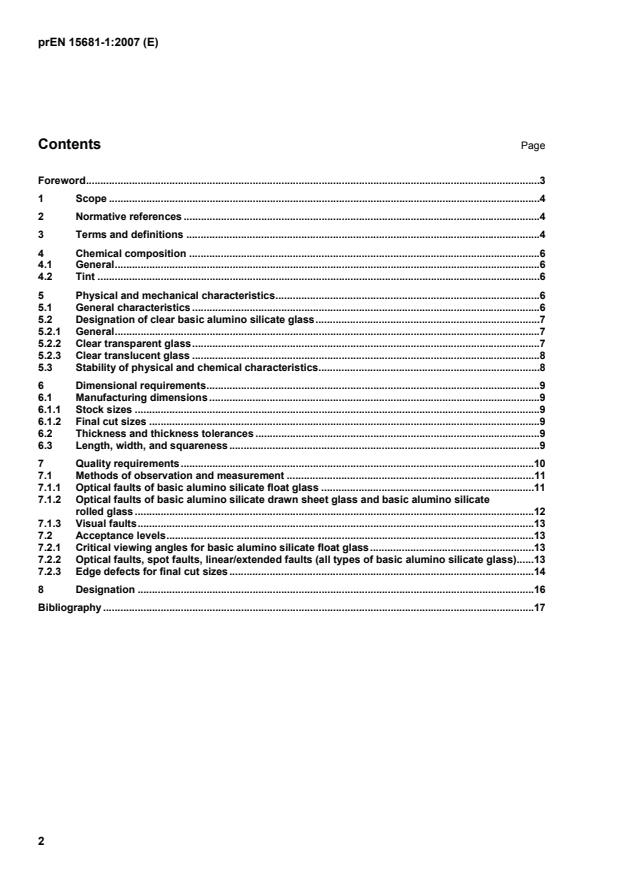
Contents Page
Foreword.3
1 Scope .4
2 Normative references .4
3 Terms and definitions .4
4 Chemical composition .6
4.1 General.6
4.2 Tint .6
5 Physical and mechanical characteristics.6
5.1 General characteristics .6
5.2 Designation of clear basic alumino silicate glass.7
5.2.1 General.7
5.2.2 Clear transparent glass.7
5.2.3 Clear translucent glass .8
5.3 Stability of physical and chemical characteristics.8
6 Dimensional requirements.9
6.1 Manufacturing dimensions .9
6.1.1 Stock sizes .9
6.1.2 Final cut sizes .9
6.2 Thickness and thickness tolerances .9
6.3 Length, width, and squareness .9
7 Quality requirements.10
7.1 Methods of observation and measurement .11
7.1.1 Optical faults of basic alumino silicate float glass .11
7.1.2 Optical faults of basic alumino silicate drawn sheet glass and basic alumino silicate
rolled glass .12
7.1.3 Visual faults.13
7.2 Acceptance levels.13
7.2.1 Critical viewing angles for basic alumino silicate float glass.13
7.2.2 Optical faults, spot faults, linear/extended faults (all types of basic alumino silicate glass).13
7.2.3 Edge defects for final cut sizes.14
8 Designation .16
Bibliography .17
Foreword
This document (prEN 15681-1:2007) has been prepared by Technical Committee CEN/TC 129 “Glass in
building”, the secretariat of which is held by NBN.
This document is currently submitted to the CEN Enquiry.
This document has been prepared under a mandate given to CEN by the European Commission and the
European Free Trade Association, and supports essential requirements of EU Directive(s).
For relationship with EU Directive(s), see informative Annex ZA which is an integral part of this document.
1 Scope
This European Standard defines and classifies basic alumino silicate glass products for use in building. It
indicates their chemical composition, main physical and mechanical properties, dimensional and minimum quality
requirements (in respect of optical and visual faults).
This European standard applies to basic alumino silicate glasses supplied in stock sizes or in cut sizes for final
end use.
This European standard does not apply to final cut sizes having a dimension less than 100 mm or a surface area
less than 0,05 m².
2 Normative references
The following referenced documents are indispensable for the application of this document. For dated
references, only the edition cited applies. For undated references, the latest edition of the referenced
document (including any amendments) applies.
EN 410, Glass in building - Determination of luminous and solar characteristics of glazing
prEN 13474, Glass in building – Design of glass panes
3 Terms and definitions
For the purposes of this European Standard, the following definitions apply.
3.1
Basic alumino silicate float glass
flat, transparent or translucent, clear or tinted basic alumino silicate glass having parallel and polished faces
obtained by continuous casting and flotation on a metal bath.
3.2
Basic alumino silicate drawn sheet glass
flat, transparent or translucent, clear or tinted basic alumino silicate glass obtained by continuous drawing and
with two surfaces fire polished.
3.3
Basic alumino silicate rolled glass
flat, transparent or translucent, clear or tinted basic alumino silicate glass obtained by rolling.
3.4
Nominal length, H
pane length defined with reference to the direction of draw of the glass ribbon as shown in Figure 1.
3.6
Nominal width, B
pane width defined with reference to the direction of draw of the glass ribbon as shown in Figure 1.
→ Direction of draw
Figure 1 — Relationship of length, width and direction of draw
3.7
stock sizes
glass delivered in manufacturers standard stock sizes.
3.8
final cut size
a pane of glass that has been cut down to the dimensions being required either for installation or processing
into a final product e.g. insulating glass units, thermally toughened safety glass.
3.9
fptical faults
these are faults, which lead to distortions on the appearance of objects observed through the glass.
3.10
visual faults
these are faults, which alter the visual quality of the glass. They are spot faults and linear / extend faults.
3.11
spot faults
a spot fault is a nucleus, which is sometimes accompanied by a halo of distorted glass. The dimension of a
spot fault comprising a nucleus with a halo is obtained by multiplying the dimension of the nucleus by a factor
of 3.
3.12
linear / extended faults
these faults can be on or in the glass, in the form of deposits, marks or scratches that occupy an extended
length or area.
3.13
edge defects
these defects can occur on the edge of a cut size piece in the form of entrant and emergent faults and / or
bevels.
3.14
concentration, c
the sum of the lengths of gaseous inclusions greater than 1,0 mm in any circle of 400 mm diameter.
4 Chemical composition
4.1 General
The basic glass products covered by this standard are all manufactured from alumino silicate glass.
The magnitude of the proportions by mass of the principal constituents of all the alumino silicate glass
products covered by this standard is as follows:
Silicon Dioxide SiO 54 - 75 %
Aluminium Oxide Al O 16 - 27 %
2 3
Σ SiO + Al O 70 – 95 %
2 2 3
Lithium Oxide Li O 0 – 8 %
Sodium Oxide Na O 0 – 8 %
Calcium Oxide CaO 0 – 3 %
Magnesium Oxide MgO 0 – 4 %
Zinc Oxide ZnO 0 – 3 %
Potassium Oxide K O 0 – 3 %
Zirconium Oxide ZrO 0 – 4 %
Strontium Oxide SrO 0 – 3 %
Barium Oxide BaO 0 – 4 %
Others 0 – 8 %
In addition to the above general composition, these glasses may also contain small quantities of other
substances
4.2 Tint
Body tinted glass is obtained by the addition of suitable materials.
5 Physical and mechanical characteristics
5.1 General characteristics
Conventional numerical values for the physical and mechanical characteristics of basic alumino silicate glass
products are given in table 1. These values, for normal annealed glass without any further toughening, are not
precise requirements with which the glass shall strictly comply, but are the generally accepted figures for use
in calculations where a high degree of accuracy is not required.
Table 1 — General characteristic values of basic alumino silicate glass
Characteristic Symbol Value and unit
o 3
Density (at 18 C) ρ 2300 – 2600 kg/m
Hardness (Knoop) HK 4 – 7 GPa
0,1/20
Young's modulus (modulus of elasticity) E 7 - 9 x 10 Pa
Poisson's ratio µ 0,2 – 0,25
6 [1]
Characteristic bending strength of float glass f 45 x 10 Pa
g,k/k
Specific heat capacity c 0,7 – 0,9 x 10 J/(kg K)
p
Nominal value of average coefficient of linear expansion between
-6
3,5 – 7,5 x10 /K
o o α
20 C and 300 C
[2]
Resistance against temperature differential and sudden 60 K
temperature change
Thermal conductivity λ 0,8 - 1,7 W/(m K)
Mean refractive index to visible radiation (at 589,3 nm) n 1,5 – 1,55
Emissivity (corrected) ε 0,837
[1]
The characteristic bending strength has to be used in conjunction with the design method given in prEN 13474
[2]
Generally accepted value that is influenced by edge quality and glass type
5.2 Designation of clear basic alumino silicate glass
5.2.1 General
A basic alumino silicate glass product is designated as clear alumino silicate glass when it is not tinted and
when the light transmittance of the glass material unmodified by the possi
...