

oSIST prEN 15384-1:2026
(Main)Packaging - Test method to determine the porosity of the internal coating of flexible aluminium tubes - Part 1: Sodium chloride test
General Information
- Abstract
This document is applicable for internally coated cylindrical and conical aluminium tubes, mainly used for the packing of pharmaceutical, cosmetic, hygiene, food or other household products.
The internal coating is used as a barrier to avoid any contact between aluminium and the product. This document defines the sodium chloride method to detect the electrolyte conductivity as one criterion for the quality of the internal coating.
NOTE The electrolyte conductivity of the internal coating is only one criterion for evaluation of the quality of an internal coating. It does not give any information on the quantity or size of any pores or uncoated areas, nor any hint on possible reactions between the aluminium tube and the product.
The electrolyte conductivity can never be used as the sole criterion for quality evaluation of the internal coating, but always with other parameters e.g. film thickness, acetone and/or ammonia resistance and of course results of enhanced stability studies.
- Status
- Not Published
- Public Enquiry End Date
- 02-Jul-2026
- Technical Committee
- EPO - Packaging - sales and grouped
- Current Stage
- 4020 - Public enquire (PE) (Adopted Project)
- Start Date
- 22-Apr-2026
- Due Date
- 09-Sep-2026
- Completion Date
- 06-Aug-2026

Overview
oSIST prEN 15384-1:2026: Packaging - Test method to determine the porosity of the internal coating of flexible aluminium tubes - Part 1: Sodium chloride test is a draft European Standard developed by CEN. This standard specifies a sodium chloride-based test method for assessing the porosity of internal coatings in flexible aluminium tubes. These tubes are commonly used in packaging pharmaceutical, cosmetic, hygiene, food, and other household products. The internal coating serves as a barrier, preventing direct contact between the product and the aluminium, thus protecting product integrity and user safety.
The sodium chloride test determines the electrolyte conductivity of the internal coating, which provides essential information about its barrier properties. However, this measurement is only one of several quality criteria and must be supported by additional tests such as coating thickness, resistance to solvents like acetone or ammonia, and results from stability studies.
Key Topics
- Purpose: To evaluate the effectiveness of internal coatings in flexible aluminium tubes by measuring their electrical conductivity after exposure to a sodium chloride solution.
- Applicability: Relevant for cylindrical and conical aluminium tubes, with particular focus on those used for sensitive applications such as medicines and foods.
- Test Method Outline:
- Utilizes an enamel conductometer and a sodium chloride solution.
- Tubes are filled with the electrolyte; electrodes are used to measure current following the application of a fixed voltage.
- The resulting current (measured in milliamperes) indicates the coating's porosity and integrity.
- Tolerances: Defined maximum conductivity values vary based on the tube’s shape and diameter, helping manufacturers benchmark the effectiveness of their coating processes.
- Test Reporting: The protocol requires detailed documentation, including batch identification, apparatus used, parameters set, sample details, test results, and any deviations from the standard method.
Applications
The sodium chloride porosity test method outlined in oSIST prEN 15384-1:2026 is vital for:
- Quality Assurance in Packaging: Ensures internally coated aluminium tubes meet safety and performance standards, especially for products sensitive to metal contamination.
- Regulatory Compliance: Supports compliance with European and international market regulations for materials in contact with pharmaceuticals, food, and cosmetics.
- Process Improvement: Offers manufacturers of flexible aluminium tubes a reliable method to monitor and enhance coating application processes.
- Risk Reduction: Helps identify potential failures in tube coatings that could lead to product degradation or contamination.
- Cross-Industry Use: Applicable to sectors including health care, beauty, food services, and household product manufacturing where product safety and quality are critical.
Related Standards
oSIST prEN 15384-1:2026 aligns and interacts with several related standards critical to the packaging and aluminium tube industries:
- EN 12374: Packaging - Flexible tubes - Terminology
- EN 13046: Packaging - Flexible cylindrical metallic tubes - Dimensions and tolerances
- EN 13047: Packaging - Flexible conical metallic tubes - Dimensions and tolerances
- ISO 2859-1: Sampling procedures for inspection by attributes - Part 1: Sampling schemes indexed by acceptance quality limit (AQL) for lot-by-lot inspection
These related documents support a comprehensive approach to quality control and manufacturing consistency in aluminium tube packaging.
By implementing the sodium chloride test described in oSIST prEN 15384-1:2026, packaging professionals and aluminium tube manufacturers can enhance their product reliability, comply with industry standards, and safeguard both product and consumer.
Relations
- Effective Date
- 01-Jun-2026
Get Certified
Connect with accredited certification bodies for this standard

Element Materials Technology
Materials testing and product certification.

BRCGS (Brand Reputation Compliance Global Standards)
Global food safety and quality standards owner.
Inštitut za kovinske materiale in tehnologije
Institute of Metals and Technology. Materials testing, metallurgical analysis, NDT.
Sponsored listings
Frequently Asked Questions
oSIST prEN 15384-1:2026 is a draft published by the Slovenian Institute for Standardization (SIST). Its full title is "Packaging - Test method to determine the porosity of the internal coating of flexible aluminium tubes - Part 1: Sodium chloride test". This standard covers: This document is applicable for internally coated cylindrical and conical aluminium tubes, mainly used for the packing of pharmaceutical, cosmetic, hygiene, food or other household products. The internal coating is used as a barrier to avoid any contact between aluminium and the product. This document defines the sodium chloride method to detect the electrolyte conductivity as one criterion for the quality of the internal coating. NOTE The electrolyte conductivity of the internal coating is only one criterion for evaluation of the quality of an internal coating. It does not give any information on the quantity or size of any pores or uncoated areas, nor any hint on possible reactions between the aluminium tube and the product. The electrolyte conductivity can never be used as the sole criterion for quality evaluation of the internal coating, but always with other parameters e.g. film thickness, acetone and/or ammonia resistance and of course results of enhanced stability studies.
This document is applicable for internally coated cylindrical and conical aluminium tubes, mainly used for the packing of pharmaceutical, cosmetic, hygiene, food or other household products. The internal coating is used as a barrier to avoid any contact between aluminium and the product. This document defines the sodium chloride method to detect the electrolyte conductivity as one criterion for the quality of the internal coating. NOTE The electrolyte conductivity of the internal coating is only one criterion for evaluation of the quality of an internal coating. It does not give any information on the quantity or size of any pores or uncoated areas, nor any hint on possible reactions between the aluminium tube and the product. The electrolyte conductivity can never be used as the sole criterion for quality evaluation of the internal coating, but always with other parameters e.g. film thickness, acetone and/or ammonia resistance and of course results of enhanced stability studies.
oSIST prEN 15384-1:2026 is classified under the following ICS (International Classification for Standards) categories: 55.120 - Cans. Tins. Tubes; 77.150.10 - Aluminium products. The ICS classification helps identify the subject area and facilitates finding related standards.
oSIST prEN 15384-1:2026 has the following relationships with other standards: It is inter standard links to SIST EN 15384-1:2017. Understanding these relationships helps ensure you are using the most current and applicable version of the standard.
oSIST prEN 15384-1:2026 is available in PDF format for immediate download after purchase. The document can be added to your cart and obtained through the secure checkout process. Digital delivery ensures instant access to the complete standard document.
Standards Content (Sample)
SLOVENSKI STANDARD
01-junij-2026
Embalaža - Preskusna metoda za ugotavljanje poroznosti notranjih prevlek
fleksibilnih aluminijastih tub - 1. del: Preskus z natrijevim kloridom
Packaging - Test method to determine the porosity of the internal coating of flexible
aluminium tubes - Part 1: Sodium chloride test
Packmittel - Prüfverfahren zur Bestimmung der Porosität der Innenbeschichtung von
Aluminiumtuben - Teil 1: Natriumchlorid-Verfahren
Emballages - Méthode d’essai pour déterminer la porosité du revêtement interne des
tubes flexibles en aluminium - Partie 1 : Essai au chlorure de sodium
Ta slovenski standard je istoveten z: prEN 15384-1
ICS:
55.120 Pločevinke. Tube Cans. Tins. Tubes
77.150.10 Aluminijski izdelki Aluminium products
2003-01.Slovenski inštitut za standardizacijo. Razmnoževanje celote ali delov tega standarda ni dovoljeno.
DRAFT
EUROPEAN STANDARD
NORME EUROPÉENNE
EUROPÄISCHE NORM
May 2026
ICS 55.120 Will supersede EN 15384-1:2017
English Version
Packaging - Test method to determine the porosity of the
internal coating of flexible aluminium tubes - Part 1:
Sodium chloride test
Emballages - Méthode d'essai pour déterminer la Packmittel - Prüfverfahren zur Bestimmung der
porosité du revêtement interne des tubes flexibles en Porosität der Innenbeschichtung von Aluminiumtuben
aluminium - Partie 1 : Essai au chlorure de sodium - Teil 1: Natriumchlorid-Verfahren
This draft European Standard is submitted to CEN members for enquiry. It has been drawn up by the Technical Committee
CEN/TC 261.
If this draft becomes a European Standard, CEN members are bound to comply with the CEN/CENELEC Internal Regulations
which stipulate the conditions for giving this European Standard the status of a national standard without any alteration.
This draft European Standard was established by CEN in three official versions (English, French, German). A version in any other
language made by translation under the responsibility of a CEN member into its own language and notified to the CEN-CENELEC
Management Centre has the same status as the official versions.
CEN members are the national standards bodies of Austria, Belgium, Bulgaria, Croatia, Cyprus, Czech Republic, Denmark, Estonia,
Finland, France, Germany, Greece, Hungary, Iceland, Ireland, Italy, Latvia, Lithuania, Luxembourg, Malta, Netherlands, Norway,
Poland, Portugal, Republic of North Macedonia, Romania, Serbia, Slovakia, Slovenia, Spain, Sweden, Switzerland, Türkiye and
United Kingdom.
Recipients of this draft are invited to submit, with their comments, notification of any relevant patent rights of which they are
aware and to provide supporting documentation.
Warning : This document is not a European Standard. It is distributed for review and comments. It is subject to change without
notice and shall not be referred to as a European Standard.
EUROPEAN COMMITTEE FOR STANDARDIZATION
COMITÉ EUROPÉEN DE NORMALISATION
EUROPÄISCHES KOMITEE FÜR NORMUNG
CEN-CENELEC Management Centre: Rue de la Science 23, B-1040 Brussels
© 2026 CEN All rights of exploitation in any form and by any means reserved Ref. No. prEN 15384-1:2026 E
worldwide for CEN national Members.
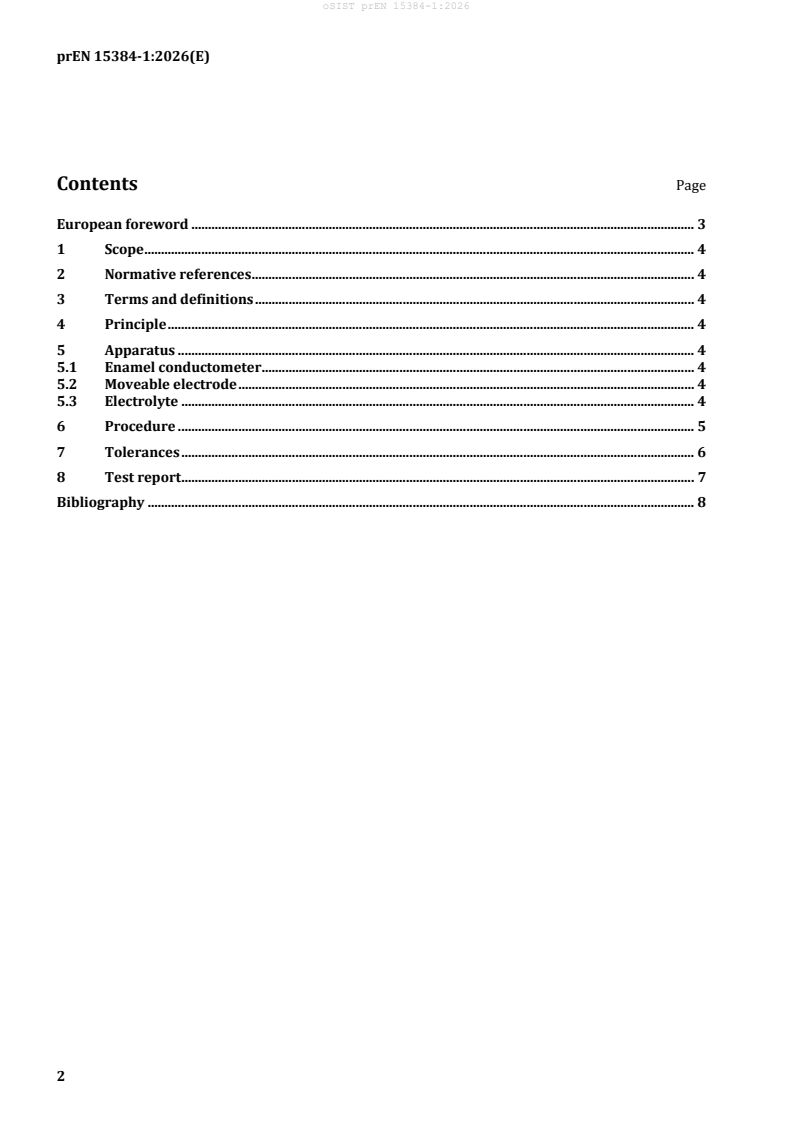
Contents Page
European foreword . 3
1 Scope . 4
2 Normative references . 4
3 Terms and definitions . 4
4 Principle . 4
5 Apparatus . 4
5.1 Enamel conductometer . 4
5.2 Moveable electrode . 4
5.3 Electrolyte . 4
6 Procedure . 5
7 Tolerances . 6
8 Test report . 7
Bibliography . 8
European foreword
This document (prEN 15384-1:2026) has been prepared by Technical Committee CEN/TC 261
“Packaging”, the secretariat of which is held by AFNOR.
This document is currently submitted to the CEN Enquiry.
This document will supersede EN 15384-1:2017.
EN 15384-1:2017:
— adding normative references
— adding terms and definitions
— adding a requirement for tube diameters smaller than 13,5 mm
1 Scope
This document is applicable for internally coated cylindrical and conical aluminium tubes, mainly used
for the packing of pharm
...