

oSIST prEN IEC 60243-2:2026
(Main)Electric strength of insulating materials - Test methods - Part 2: Additional requirements for tests using direct voltage
- Status
- Not Published
- Public Enquiry End Date
- 30-Sep-2026
- Technical Committee
- IIZS - Insulating materials and systems
- Current Stage
- 4020 - Public enquire (PE) (Adopted Project)
- Start Date
- 04-Aug-2026
- Due Date
- 22-Dec-2026
- Completion Date
- 29-Sep-2026

oSIST prEN IEC 60243-2:2026 is a draft IEC/CENELEC standard for measuring the electric strength of solid insulating materials under direct voltage. It adds requirements to the basic IEC 60243 test method so laboratories, manufacturers, and test engineers can run comparable d.c. breakdown tests and report the results in a consistent way.
What does oSIST prEN IEC 60243-2:2026 specify?
oSIST prEN IEC 60243-2:2026 specifies the additional requirements for determining the electric strength of solid insulating materials under direct voltage stress. It is read together with IEC 60243-1:2013, which provides the base test method.
The document is organized into clauses on scope, normative references, terms and definitions, the significance of the test, electrodes and test specimens, conditioning, surrounding medium, electrical apparatus, procedure, mode of voltage increase, breakdown criterion, number of tests, and report.
What are the key requirements of oSIST prEN IEC 60243-2:2026?
Clause 4 explains why d.c. tests behave differently from a.c. tests. The electric field in non-homogeneous specimens can change with the rate of voltage rise, and currents such as capacitive current, absorption current, leakage current, and sometimes partial discharge current can appear. In practice, this means the same material can give different breakdown results depending on how the voltage is applied.
Clause 5 uses the electrode configurations and specimen shapes from IEC 60243-1:2013. This keeps the d.c. test aligned with the main series, so users do not need a separate specimen design unless a product standard says otherwise.
Clause 6 requires conditioning of specimens for at least 24 h at (23 ± 2) °C and (50 ± 5) % relative humidity, unless another condition is specified or agreed. The specimens are shorted and grounded during conditioning. This matters because temperature and moisture can shift the measured electric strength.
Clause 7 requires a surrounding medium selected to prevent flashover and limit unwanted effects on the material under test. Liquids, air at elevated temperature, or solid casting materials may be used depending on the specimen and test purpose. For liquid tests, an immersion test checks compatibility between the liquid and the specimen material, and the mass change limit is given in the clause.
Clause 8 sets the electrical apparatus requirements. The voltage source must allow positive or negative polarity, keep ripple and transient content low, control the rate of voltage rise within tolerance, and include current interruption and current-limiting provisions. For large specimens, the document also requires discharge and earthing measures so stored charge does not distort the result or create a safety hazard.
Clause 10 allows the voltage to be applied using the short-time, slow rate-of-rise, very slow rate-of-rise, or proof-test modes defined in IEC 60243-1:2013. Clause 11 treats breakdown as a sudden current increase or as current reaching a specified value. In practice, the test report must show which breakdown criterion was used.
Clause 13 defines the reporting items. The report records the material identification, specimen preparation, polarity, median electric strength or breakdown voltage, thickness, surrounding medium, electrode system, voltage mode, individual results, test environment, conditioning treatment, and the type and position of breakdown. That makes the result traceable and easier to compare between laboratories.
What terms does oSIST prEN IEC 60243-2:2026 define?
The terms and definitions in IEC 60243-1:2013 apply, and the document uses several technical concepts in a specific way.
- Electric strength - the electric stress at which a specimen breaks down under the specified test conditions.
- Breakdown - failure of the specimen, identified here by a sudden current rise or by current exceeding a set value.
- Surrounding medium - the air, liquid, or casting material around the specimen during test.
- Rate of voltage rise - how fast the applied voltage increases during the test, which affects d.c. field distribution.
- Immersion test - the compatibility check used to see whether a liquid changes the specimen material before testing.
- Current-limiting resistance - a series resistance used to protect the source and reduce electrode damage at breakdown.
- Polarity - whether the applied d.c. test voltage is positive or negative.
Who uses oSIST prEN IEC 60243-2:2026?
oSIST prEN IEC 60243-2:2026 is used by laboratories that measure dielectric breakdown, by manufacturers of insulating materials, and by quality teams that need test results for product release or qualification. It also supports engineers who design and compare solid insulation systems for electrical equipment. Test and conformity assessment bodies use it to make sure d.c. electric strength results are obtained under a defined and repeatable method.
What changed in oSIST prEN IEC 60243-2:2026 from the previous edition?
oSIST prEN IEC 60243-2:2026 cancels and replaces the 3rd edition published in 2013. The stated technical changes are:
- clauses 6 and 7 were rewritten using requirements from IEC 60243-1
- the text in clauses 6 and 7 was updated for d.c. testing needs
- the test voltage source specification was harmonized with IEC 60060-1
Which standards are used with oSIST prEN IEC 60243-2:2026?
- IEC 60243-1:2013 - the base part that provides the general test method, specimen handling, procedure, breakdown criterion, and reporting structure.
- IEC 60296 - gives requirements for mineral insulating oils used as a liquid surrounding medium.
- IEC 61099 - gives specifications for unused synthetic organic esters used as insulating liquids.
- IEC 60060-1 - used as the reference for harmonizing the test voltage source requirements.
What does the oSIST prEN IEC 60243-2:2026 document contain?
The document contains a foreword, an introduction, and 13 clauses covering the full d.c. test workflow from specimen conditioning to reporting. It includes a detailed immersion test procedure for checking whether a liquid is compatible with the specimen material before testing. Clause 8 describes the test power supply, voltage measurement, charge removal, and current-limiting arrangements. Clause 13 lists the data that should appear in the report, including test polarity, individual breakdown values, and the test environment.
Relations
- Effective Date
- 27-Sep-2022
Get Certified
Connect with accredited certification bodies for this standard

IMQ S.p.A. (Certification)
Italian electrical product certification.

SLG Prüf- und Zertifizierungs GmbH
German testing and certification body.

UL Solutions
Global safety science company with testing, inspection and certification.
Sponsored listings
Frequently Asked Questions
oSIST prEN IEC 60243-2:2026 is a draft published by the Slovenian Institute for Standardization (SIST). Its full title is "Electric strength of insulating materials - Test methods - Part 2: Additional requirements for tests using direct voltage". This standard covers: Electric strength of insulating materials - Test methods - Part 2: Additional requirements for tests using direct voltage
Electric strength of insulating materials - Test methods - Part 2: Additional requirements for tests using direct voltage
oSIST prEN IEC 60243-2:2026 is classified under the following ICS (International Classification for Standards) categories: 17.220.99 - Other standards related to electricity and magnetism; 29.035.01 - Insulating materials in general. The ICS classification helps identify the subject area and facilitates finding related standards.
oSIST prEN IEC 60243-2:2026 has the following relationships with other standards: It is inter standard links to SIST EN 60243-2:2014. Understanding these relationships helps ensure you are using the most current and applicable version of the standard.
oSIST prEN IEC 60243-2:2026 is available in PDF format for immediate download after purchase. The document can be added to your cart and obtained through the secure checkout process. Digital delivery ensures instant access to the complete standard document.
Standards Content (Sample)
SLOVENSKI STANDARD
01-september-2026
Električna trdnost izolacijskih snovi - Preskusne metode - 2. del: Dodatne zahteve
za preskuse z enosmerno napetostjo
Electric strength of insulating materials - Test methods - Part 2: Additional requirements
for tests using direct voltage
Elektrische Durchschlagfestigkeit von isolierenden Werkstoffen - Prüfverfahren - Teil 2:
Zusätzliche Anforderungen für Prüfungen mit Gleichspannung
Rigidité diélectrique des matériaux isolants - Méthodes d'essai - Partie 2: Exigences
complémentaires pour les essais à tension continue
Ta slovenski standard je istoveten z: prEN IEC 60243-2:2026
ICS:
17.220.99 Drugi standardi v zvezi z Other standards related to
elektriko in magnetizmom electricity and magnetism
29.035.01 Izolacijski materiali na Insulating materials in
splošno general
2003-01.Slovenski inštitut za standardizacijo. Razmnoževanje celote ali delov tega standarda ni dovoljeno.
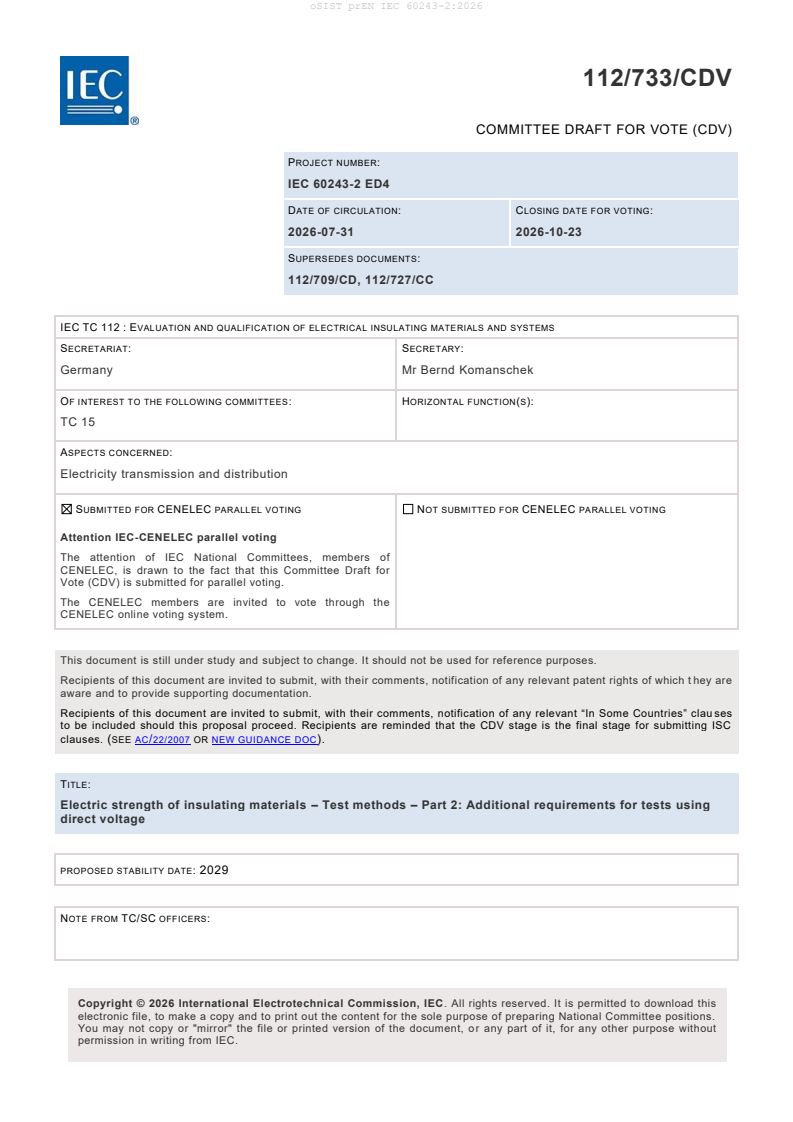
112/733/CDV
COMMITTEE DRAFT FOR VOTE (CDV)
PROJECT NUMBER:
IEC 60243-2 ED4
DATE OF CIRCULATION: CLOSING DATE FOR VOTING:
2026-07-31 2026-10-23
SUPERSEDES DOCUMENTS:
112/709/CD, 112/727/CC
IEC TC 112 : EVALUATION AND QUALIFICATION OF ELECTRICAL INSULATING MATERIALS AND SYSTEMS
SECRETARIAT: SECRETARY:
Germany Mr Bernd Komanschek
OF INTEREST TO THE FOLLOWING COMMITTEES: HORIZONTAL FUNCTION(S):
TC 15
ASPECTS CONCERNED:
Electricity transmission and distribution
SUBMITTED FOR CENELEC PARALLEL VOTING NOT SUBMITTED FOR CENELEC PARALLEL VOTING
Attention IEC-CENELEC parallel voting
The attention of IEC National Committees, members of
CENELEC, is drawn to the fact that this Committee Draft for
Vote (CDV) is submitted for parallel voting.
The CENELEC members are invited to vote through the
CENELEC online voting system.
This document is still under study and subject to change. It should not be used for reference purposes.
Recipients of this document are invited to submit, with their comments, notification of any relevant patent rights of which t hey are
aware and to provide supporting documentation.
Recipients of this document are invited to submit, with their comments, notification of any relevant “In Some Countries” clau ses
to be included should this proposal proceed. Recipients are reminded that the CDV stage is the final stage for submitting ISC
clauses. (SEE AC/22/2007 OR NEW GUIDANCE DOC).
TITLE:
Electric strength of insulating materials – Test methods – Part 2: Additional requirements for tests using
direct voltage
PROPOSED STABILITY DATE: 2029
NOTE FROM TC/SC OFFICERS:
electronic file, to make a copy and to print out the content for the sole purpose of preparing National Committee positions.
You may not copy or "mirror" the file or printed version of the document, or any part of it, for any other purpose without
permission in writing from IEC.
IEC CD 60243-2 © IEC 2026
Link to Committee Draft for Vote (CDV) online document:
Click here
How to access
This link leads you to the Online Standards Development (OSD) platform for National Mirror Committee’s
(NMC) comments. The project draft may be found further down this document.
Resource materials
We recommend NCs to review the available materials to better understand the member commenting on
the OSD platform.
This includes the:
• OSD NC roles overview
• How to add and submit comments to the IEC
Contact
Should you require any assistance, please contact the IEC IT Helpdesk.
ii
IEC CDV 60243-2 © IEC 2026
CONTENTS
FOREWORD . 2
INTRODUCTION . 4
1 Scope . 5
2 Normative references . 5
3 Terms and definitions . 5
4 Significance of the test . 5
5 Electrodes and test specimens . 6
6 Conditioning before tests . 6
7 Surrounding medium . 6
7.1 General . 6
7.2 Tests in air at elevated temperature . 6
7.3 Test in liquids . 6
7.3.1 Immersion Test . 7
7.4 Tests in solid casting materials . 7
8 Electrical apparatus . 7
8.1 Voltage source . 7
8.2 Voltage measurement . 8
9 Procedure . 8
10 Mode of increase of voltage . 8
11 Criterion of breakdown . 8
12 Number of tests . 8
13 Report . 8
Bibliography . 10
IEC CDV 60243-2 © IEC 2026
INTERNATIONAL ELECTROTECHNICAL COMMISSION
____________
Electric strength of insulating materials – Test methods –
Part 2: Additional requirements for tests using direct voltage
FOREWORD
1) The International Electrotechnical Commission (IEC) is a worldwide organization for
standardization comprising all national electrotechnical committees (IEC National Committees).
The object of IEC is to promote international co-operation on all questions concerning
standardization in the electrical and electronic fields. To this end and in addition to other
activities, IEC publishes International Standards, Technical Specifications, Technical Reports,
Publicly Available Specifications (PAS) and Guides (hereafter referred to as “IEC
Publication(s)”). Their preparation is entrusted to technical committees; any IEC National
Committee interested in the subject dealt with may participate in this preparatory work.
International, governmental and non-governmental organizations liaising with the IEC also
participate in this preparation. IEC collaborates closely with the International Organization for
Standardization (ISO) in accordance with conditions determined by agreement between the two
organizations.
2) The formal decisions or agreements of IEC on technical matters express, as nearly as
possible, an international consensus of opinion on the relevant subjects since each technical
committee has representation from all interested IEC National Committees.
3) IEC Publications have the form of recommendations for international use and are accepted
by IEC National Committees in that sense. While all reasonable efforts are made to ensure that
the technical content of IEC Publications is accurate, IEC cannot be held responsible for the
way in which they are used or for any misinterpretation by any end user.
4) In order to promote international uniformity, IEC National Committees undertake to apply
IEC Publications transparently to the maximum extent possible in their national and regional
publications. Any divergence between any IEC Publication and the corresponding national or
regional publication shall be clearly indicated in the latter.
5) IEC itself does not provide any attestation of conformity. Independent certification bodies
provide conformity assessment services and, in some areas, access to IEC marks of conformity.
IEC is not responsible for any services carried out by independent certification bodies.
6) All users should ensure that they have the latest edition of this publication.
7) No liability shall attach to IEC or its directors, employees, servants or agents including
individual experts and members of its technical committees and IEC National Committees for
any personal injury, property damage or other damage of any nature whatsoever, whether direct
or indirect, or for costs (including legal fees) and expenses arising out of the publication, use
of, or reliance upon, this IEC Publication or any other IEC Publications.
8) Attention is drawn to the Normative references cited in this publication. Use of the referenced
publications is indispensable for the correct application of this publication.
9) IEC draws attention to the possibility that the implementation of this document may involve
the use of (a) patent(s). IEC takes no position concerning the evidence, validity or applicability
of any claimed patent rights in respect thereof. As of the date of publication of this document,
IEC [had/had not] received notice of (a) patent(s), which may be required to implement this
document. However, implementers are cautioned that this may not represent the latest
IEC CDV 60243-2 © IEC 2026
information, which may be obtained from the patent database available at https://patents.iec.ch.
IEC shall not be held responsible for identifying any or all such patent rights.
IEC 60243-2 has been prepared by IEC technical committee 112: Evaluation and qualification
of electrical insulation materials and systems. It is an International Standard.
This 4th edition cancels and replaces the 3rd edition published in2013,. This edition constitutes
a technical revision.
This edition includes the following significant technical changes with respect to the previous
edition:
a) Used the requirements from IEC 60243-1 for writing chapter 6 and 7
b) Updated the paragraphs in chapter 6 and 7 regarding the needs for tests under d.c.
c) Harmonized the specification of the test voltage source according to IEC 60060-1
This standard shall be read in conjunction with IEC 60243-1.
The text of this International Standard is based on the following documents:
Draft Report on voting
112/XX/XXX 112/XX/XXX
Full information on the voting for its approval can be found in the report on voting indicated in
the above table.
The language used for the development of this International Standard is English [change
language if necessary].
This document was drafted in accordance with ISO/IEC Directives, Part 2, and developed in
accordance with ISO/IEC Directives, Part 1 and ISO/IEC Directives, IEC Supplement, available
at http://www.iec.ch/members_experts/refdocs. The main document types developed by IEC
are described in greater detail at http://www.iec.ch/publications.
A list of all parts in the IEC 60243 series, published under the general title Electric strength of
insulating materials – Test methods, can be found on the IEC website.
The committee has decided that the contents of this document will remain unchanged until the
stability date indicated on the IEC website under http://webstore.iec.ch in the data related to
the specific document. At this date, the document will be
– reconfirmed,
– withdrawn, or
– revised.
IEC CDV 60243-2 © IEC 2026
INTRODUCTION
This document describes the evaluation of eelectric strength under direct voltage stress for
determining the performance of solid insulating materials.
IEC CDV 60243-2 © IEC 2026
1 Scope
This part of IEC 60243 gives requirements additional to those in IEC 60243-1:2013 for the
determination of the electric strength of solid insulating materials under direct voltage stre
...