

SIST EN 13738:2005
(Main)Geotextiles and geotextile-related products - Determination of pullout resistance in soil
- Abstract
The standard specifies a method for determining the resistance of geotextiles and geotextile-related products to pullout from soil using a laboratory pullout box. The procedure is to provide data relating to the development of friction on materials used primarily for soil reinforcement. The test method described is a performance test procedure to be carried out using site specific soils.
- Status
- Published
- Publication Date
- 28-Feb-2005
- Technical Committee
- ITEK - Textile and textile products
- Current Stage
- 6060 - National Implementation/Publication (Adopted Project)
- Start Date
- 01-Mar-2005
- Due Date
- 01-Mar-2005
- Completion Date
- 01-Mar-2005

SIST EN 13738:2005 is the Slovenian adoption of EN 13738:2004 from SIST. It specifies a laboratory pullout-box method for measuring the pullout resistance of geotextiles and geotextile-related products in soil, so users can assess how these materials develop friction in a specific reinforcement application.
What does SIST EN 13738:2005 specify?
SIST EN 13738:2005 specifies a performance test for geotextiles and geotextile-related products pulled out of soil under controlled laboratory conditions. The method is intended to generate application-specific data, not a universal material value, because the result depends on the soil and the test setup.
The document is organized into:
- Scope
- Normative references
- Terms and definitions
- Principle
- Test specimens
- Apparatus
- Procedure
- Calculations
- Report
- Annex A, an informative annex on constant stress loading methods
| Annex | What it covers |
|---|---|
| Annex A | Pullout tests using a constant stress loading method |
What are the key requirements of SIST EN 13738:2005?
Clause 1 ties the method to soil reinforcement work: the test measures how a geotextile or geotextile-related product resists pullout from site-specific soil in a laboratory pullout box. In practice, this means the result is only meaningful when read together with the soil type and the test conditions.
Clause 5 requires sampling in accordance with EN 963, three specimens for each direction tested, and an embedded length equal to three times the specimen width. The specimens are conditioned and tested in the standard atmosphere of ISO 554, and conditioning is complete when mass change between readings falls within the stated limit. That matters because moisture and stabilization affect friction and repeatability.
Clause 6 defines the apparatus. The pullout box is rigid and open, with smooth parallel sides, a back wall, a removable front door, and a minimum size stated for standard use; the text also requires the box depth to increase if needed for coarse soil. The box, loading devices, displacement indicators and clamps must support uniform normal stress, constant displacement pullout, and accurate force and movement measurement.
Clause 7 sets out the test sequence:
- place and compact the lower soil layer
- position and clamp the specimen without damage
- place and compact the upper soil layer
- apply the normal stress before testing
- pull at constant displacement and record load and displacement
For free-draining soils, the pullout rate is specified so that excess pore pressure is not generated. Readings are taken continuously or at short intervals, and the test continues until pullout or tensile failure occurs. If clamping or equipment causes failure, the result is discarded.
Clause 8 gives the calculations. The normal stress on the specimen combines the applied stress and the stress from the soil above the specimen. Pullout resistance is then calculated differently for closed products and for open structures such as geogrids and geonets. In practice, users must choose the correct calculation route for the product type and plot resistance against displacement and against normal stress.
Clause 9 defines the report content, including the apparatus, test conditions, soil description, basic data, plots, failure mode, and specimen condition before and after testing. This is the information needed to compare tests or review fitness for use.
Annex A describes constant stress loading options, including controlled stress rate, incremental stress, and long-term creep-style loading. That annex is useful when a project needs sustained pullout behavior rather than a short-term response.
What terms does SIST EN 13738:2005 define?
- Pullout force - the force needed to pull the product out of the soil during the test.
- Pullout resistance - the pullout force divided by the specimen width at a specified displacement rate.
- Peak pullout resistance - the highest pullout resistance reached during the test.
- Wire gauge - an inextensible wire displacement gauge connected to a dial extensometer or electronic transducer.
- Normal stress (σn) - the vertical stress applied to the specimen.
- Geotextiles and geotextile-related products - the product family covered by the test method, as used throughout the document.
Who uses SIST EN 13738:2005?
SIST EN 13738:2005 is used by geotechnical laboratories, geotextile manufacturers, testing organizations, designers, and quality or procurement teams working with soil reinforcement. They use it to compare products, check suitability for a specific soil, document pullout behavior, and support project-specific material evaluation.
Which standards are used with SIST EN 13738:2005?
The document cites these standards and related references:
- EN 963 - sampling and preparation of test specimens.
- prEN ISO 10318:2000 - terms and definitions for geosynthetics.
- ISO 554 - standard atmospheres for conditioning and testing.
- EN ISO 10319 - referenced for wide-width tensile testing and specimen-width context.
- prEN ISO 12957-1 - referenced in a note on direct shear testing and checking failure type.
- ENV 1997-1 - listed in the bibliography as Eurocode 7, general geotechnical design rules.
What does the SIST EN 13738:2005 document contain?
The document contains the test principle, specimen preparation rules, apparatus requirements, procedure, calculation formulas, and report requirements. It also includes figures showing the pullout box, normal stress control devices, gauge placement, and example plots of pullout resistance versus displacement and maximum pullout resistance versus normal stress. Annex A adds alternative constant stress loading methods for short-term and long-term loading conditions.
Relations
- Effective Date
- 29-Apr-2026
- Refers
SIST EN ISO 9862:2024 - Geosynthetics - Sampling and preparation of test specimens (ISO 9862:2023) - Effective Date
- 28-Jan-2026
- Effective Date
- 28-Jan-2026
- Effective Date
- 28-Jan-2026
- Effective Date
- 09-Feb-2026
Get Certified
Connect with accredited certification bodies for this standard

Control Union Certifications
Global certification for agriculture and sustainability.

Hohenstein Institut
Textile testing and certification.

Bureau Veritas Bangladesh
Bureau Veritas certification services in Bangladesh.
Sponsored listings
Frequently Asked Questions
SIST EN 13738:2005 is a standard published by the Slovenian Institute for Standardization (SIST). Its full title is "Geotextiles and geotextile-related products - Determination of pullout resistance in soil". This standard covers: The standard specifies a method for determining the resistance of geotextiles and geotextile-related products to pullout from soil using a laboratory pullout box. The procedure is to provide data relating to the development of friction on materials used primarily for soil reinforcement. The test method described is a performance test procedure to be carried out using site specific soils.
The standard specifies a method for determining the resistance of geotextiles and geotextile-related products to pullout from soil using a laboratory pullout box. The procedure is to provide data relating to the development of friction on materials used primarily for soil reinforcement. The test method described is a performance test procedure to be carried out using site specific soils.
SIST EN 13738:2005 is classified under the following ICS (International Classification for Standards) categories: 59.080.70 - Geotextiles. The ICS classification helps identify the subject area and facilitates finding related standards.
SIST EN 13738:2005 has the following relationships with other standards: It is inter standard links to SIST ISO 554:1995, SIST EN ISO 9862:2024, SIST EN 915:1996, SIST EN ISO 10318:2005, SIST EN 60077-3:2003. Understanding these relationships helps ensure you are using the most current and applicable version of the standard.
SIST EN 13738:2005 is associated with the following European legislation: EU Directives/Regulations: 305/2011, 89/106/EEC. When a standard is cited in the Official Journal of the European Union, products manufactured in conformity with it benefit from a presumption of conformity with the essential requirements of the corresponding EU directive or regulation.
SIST EN 13738:2005 is available in PDF format for immediate download after purchase. The document can be added to your cart and obtained through the secure checkout process. Digital delivery ensures instant access to the complete standard document.
Standards Content (Sample)
2003-01.Slovenski inštitut za standardizacijo. Razmnoževanje celote ali delov tega standarda ni dovoljeno.Geotextilien und geotextilverwandte Produkte - Bestimmung des Herausziehwiderstandes aus dem BodenGéotextiles et produits apparentés aux géotextiles - Détermination de la résistance a l'arrachement du solGeotextiles and geotextile-related products - Determination of pullout resistance in soil59.080.70GeotekstilijeGeotextilesICS:Ta slovenski standard je istoveten z:EN 13738:2004SIST EN 13738:2005en01-marec-2005SIST EN 13738:2005SLOVENSKI
STANDARD
EUROPEAN STANDARDNORME EUROPÉENNEEUROPÄISCHE NORMEN 13738November 2004ICS 59.080.70; 91.100.50English versionGeotextiles and geotextile-related products - Determination ofpullout resistance in soilGéotextiles et produits apparentés aux géotextiles -Détermination de la résistance à l'arrachement du solGeotextilien und geotextilverwandte Produkte -Bestimmung des Herausziehwiderstandes aus dem BodenThis European Standard was approved by CEN on 10 September 2004.CEN members are bound to comply with the CEN/CENELEC Internal Regulations which stipulate the conditions for giving this EuropeanStandard the status of a national standard without any alteration. Up-to-date lists and bibliographical references concerning such nationalstandards may be obtained on application to the Central Secretariat or to any CEN member.This European Standard exists in three official versions (English, French, German). A version in any other language made by translationunder the responsibility of a CEN member into its own language and notified to the Central Secretariat has the same status as the officialversions.CEN members are the national standards bodies of Austria, Belgium, Cyprus, Czech Republic, Denmark, Estonia, Finland, France,Germany, Greece, Hungary, Iceland, Ireland, Italy, Latvia, Lithuania, Luxembourg, Malta, Netherlands, Norway, Poland, Portugal, Slovakia,Slovenia, Spain, Sweden, Switzerland and United Kingdom.EUROPEAN COMMITTEE FOR STANDARDIZATIONCOMITÉ EUROPÉEN DE NORMALISATIONEUROPÄISCHES KOMITEE FÜR NORMUNGManagement Centre: rue de Stassart, 36
B-1050 Brussels© 2004 CENAll rights of exploitation in any form and by any means reservedworldwide for CEN national Members.Ref. No. EN 13738:2004: ESIST EN 13738:2005
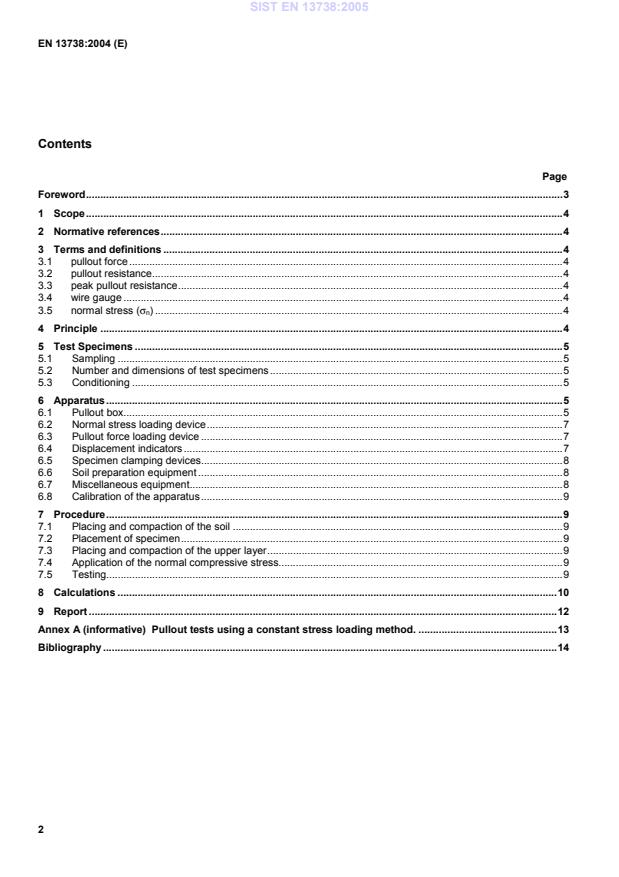
2 Contents Page Foreword.3 1 Scope.4 2 Normative references.4 3 Terms and definitions.4 3.1 pullout force.4 3.2 pullout resistance.4 3.3 peak pullout resistance.4 3.4 wire gauge.4 3.5 normal stress (σn).4 4 Principle.4 5 Test Specimens.5 5.1 Sampling.5 5.2 Number and dimensions of test specimens.5 5.3 Conditioning.5 6 Apparatus.5 6.1 Pullout box.5 6.2 Normal stress loading device.7 6.3 Pullout force loading device.7 6.4 Displacement indicators.7 6.5 Specimen clamping devices.8 6.6 Soil preparation equipment.8 6.7 Miscellaneous equipment.8 6.8 Calibration of the apparatus.9 7 Procedure.9 7.1 Placing and compaction of the soil.9 7.2 Placement of specimen.9 7.3 Placing and compaction of the upper layer.9 7.4 Application of the normal compressive stress.9 7.5 Testing.9 8 Calculations.10 9 Report.12 Annex A (informative)
Pullout tests using a constant stress loading method.13 Bibliography.14 SIST EN 13738:2005
3 Foreword This document (EN 13738:2004) has been prepared by Technical Committee CEN/TC 189, “Geosynthetics”, the secretariat of which is held by IBN. This European Standard shall be given the status of a national standard, either by publication of an identical text or by endorsement, at the latest by May 2005, and conflicting national standards shall be withdrawn at the latest by May 2005. This document includes a Bibliography. According to the CEN/CENELEC Internal Regulations, the national standards organizations of the following countries are bound to implement this European Standard: Austria, Belgium, Cyprus, Czech Republic, Denmark, Estonia, Finland, France, Germany, Greece, Hungary, Iceland, Ireland, Italy, Latvia, Lithuania, Luxembourg, Malta, Netherlands, Norway, Poland, Portugal, Slovakia, Slovenia, Spain, Sweden, Switzerland and United Kingdom.
4 1 Scope This document specifies a method for determining the resistance of geotextiles and geotextile-related products to pullout from soil using a laboratory pullout box. The goal of the procedure is to provide data relating to the development of friction on materials used primarily for soil reinforcement. The test method described is a performance test procedure to determine the fitness for use of geotextiles and geotextile-related products intended to be used in a given application. 2 Normative references The following referenced documents are indispensable for the application of this document. For dated references, only the edition cited applies. For undated references, the latest edition of the referenced document (including any amendments) applies. EN 963, Geotextiles and geotextile-related products - Sampling and preparation of test specimens
prEN ISO 10318:2000, Geosynthetics - Geotextiles, geotextile-related products, geomembranes and geosynthetic clay liners - Terms and their definitions (ISO/DIS 10318:2000) ISO 554, Standard atmospheres for conditioning and/or testing - Specifications 3 Terms and definitions For the purposes of this document, the terms and definitions given in prEN ISO 10318:2000 and the following apply. 3.1 pullout force force required to pull a geotextile or a geotextile-related product out of the soil during a pullout test 3.2 pullout resistance pullout force per width of geotextile or geotextile-related product measured at a specified rate of displacement 3.3 peak pullout resistance maximum pullout resistance measured during a pullout test 3.4 wire gauge displacement gauge consisting of an inextensible wire attached to the geotextile or geotextile-related product and monitored by connection to a dial extensometer, or electronic displacement transducer 3.5 normal stress (σσσσn) vertical stress applied to the specimen 4 Principle A horizontal force is applied to a specimen embedded between two layers of soil and the force required to pull the specimen out of the soil is recorded. The pullout resistance is calculated by dividing the pullout force by the specimen width. The test can be performed while applying vertical stress to the top soil layer. SIST EN 13738:2005
5 A plot of maximum pullout resistance versus applied normal stress is obtained by conducting a series of such tests. NOTE 1 The relationship between the pullout resistance and the normal stress obtained from the test is due in part to the pullout mechanism which occurs. The pullout resistance versus normal stress plot produced using data from this test is a function of soil grading, plasticity, as-placed density, moisture content, length and surface characteristics of the specimen and other test parameters. Therefore, results are expressed in terms of the actual test conditions. The test measures the net effect of a combination of pullout mechanisms which may vary depending on type of specimen, embedment length, relative opening size, soil type, rate of displacement and normal stress. NOTE 2 For checking the type of failure (break of reinforcement or slippage) in a site specific soil, smaller boxes, e.g. a shear box (300 mm x 300 mm) according to prEN ISO 12957–1, may be used with a specimen width similar to the one defined in EN ISO 10319.
5 Test Specimens 5.1 Sampling Take specimens in accordance with EN 963. 5.2 Number and dimensions of test specimens Cut three specimens from the test sample, for each direction to be tested, the size of the specimens to suit the dimensions of the apparatus being used. The embedded length shall be equal to three times the width of the specimen. The specimens shall be narrower, by not less than 100 mm, than the inside width of the pullout box on each side and of sufficient length to facilitate clamping.
5.3 Conditioning Condition the test specimens and conduct the tests in the standard test atmosphere, defined in ISO 554. The test specimens are considered to have been conditioned when the change in mass between two successive readings made at intervals of not less than two hours does not exceed 0,25% of the mass of the test specimens. The test shall be performed in the same atmosphere. NOTE Conditioning and/or testing at a specified relative humidity may be omitted if it can be shown that the results are not affected by this omission. 6 Apparatus 6.1 Pullout box An open rigid box consisting of two smooth parallel sides, a back wall, a horizontal split removable door and a bottom plate. The door is at the front of the apparat
...