


SIST EN 927-5:2023
(Main)Paints and varnishes - Coating materials and coating systems for exterior wood - Part 5: Assessment of the liquid water permeability
Paints and varnishes - Coating materials and coating systems for exterior wood - Part 5: Assessment of the liquid water permeability
This document specifies a test method for assessing the liquid water permeability of coating systems for exterior wood.
Beschichtungsstoffe - Beschichtungsstoffe und Beschichtungssysteme für Holz im Außenbereich - Teil 5: Beurteilung der Wasserdurchlässigkeit
Dieses Dokument legt ein Prüfverfahren zum Bewerten der Wasserdurchlässigkeit von Beschichtungs-systemen für Holz im Außenbereich.
Peintures et vernis - Produits de peinture et systèmes de peinture pour le bois en extérieur - Partie 5 : Détermination de la perméabilité à l'eau liquide
Le présent document spécifie une méthode d’essai pour évaluer la perméabilité à l’eau liquide des systèmes de peinture pour le bois en extérieur.
Barve in laki - Premazi in premazni sistemi za zaščito lesa za zunanjo uporabo - 5. del: Ocenjevanje prepustnosti vode
Ta del standarda EN 927 določa preskusno metodo za ocenjevanje prepustnosti vode pri premaznih sistemih za zaščito lesa za zunanjo uporabo z merjenjem vpojnosti vode na premazanih lesenih ploščah.
Rezultati so izraženi kot vpijanje vode v gramih na kvadratni meter v 72 urah.
General Information
- Status
- Published
- Public Enquiry End Date
- 01-Feb-2021
- Publication Date
- 20-Aug-2023
- Technical Committee
- POH - Furniture
- Current Stage
- 6060 - National Implementation/Publication (Adopted Project)
- Start Date
- 13-Jul-2023
- Due Date
- 17-Sep-2023
- Completion Date
- 21-Aug-2023
Relations
- Effective Date
- 01-Sep-2023
Overview
EN 927-5:2023 - "Paints and varnishes - Coating materials and coating systems for exterior wood - Part 5: Assessment of the liquid water permeability" (CEN, June 2023) specifies a laboratory test method to assess liquid water permeability of coating systems applied to exterior wood. The standard defines test panel selection, preparation, sealing, pre-conditioning (leaching), a 72-hour water uptake test, and how results are expressed (water absorption in g/m² per 72 h). It supersedes EN 927-5:2006 and aligns with other EN 927 series guidance on end-use classification.
Key topics and requirements
- Scope and principle: Measures water uptake of coated wood panels exposed to liquid water over 72 hours to quantify liquid water permeability.
- Test panels: Use spruce (Picea abies) free of knots and defects, specific growth-ring angle (≈45°), density ~0.4–0.5 g/cm³ at ~12% EMC; panel dimensions and off-cuts are defined for film-thickness checks.
- Coating application and sealing:
- Apply coating system to the test face only; sides and reverse faces must be sealed with a low-permeability flexible sealer (e.g., solvent-free epoxy or polyurethane).
- Sealer performance requirement: permeability not to exceed 30 ml/m² in 72 h (as control).
- Pre-conditioning (leaching): Two leaching cycles (24 h submerged, then drying) to stabilize coatings whose permeability may change on initial water exposure.
- Measurements and instrumentation:
- Water absorption recorded gravimetrically (balance to 0.01 g).
- Dry film thickness determined microscopically per EN ISO 2808:2019, method 6A (five measurements per chip).
- Results and reporting: Expressed as grams per square metre per 72 h; reporting requirements and interpretation guidance (Annex A) support linking laboratory values to end-use categories (see EN 927-1).
Practical applications and users
EN 927-5:2023 is intended for:
- Coating manufacturers - product development and performance claims for exterior wood coatings.
- Test laboratories and quality control - routine testing to verify batch consistency and compliance with specifications.
- Specifiers, architects and façade engineers - selecting coating systems based on quantified liquid water permeability for cladding, joinery and external woodwork.
- Certification bodies and compliance teams - harmonized method for regulatory or label schemes and for comparing systems across suppliers.
Practical benefits include reliable comparison of coating systems, improved material selection for durability against moisture-driven defects, and a standardized basis for product specifications and acceptance testing.
Related standards
- EN 927-1 (coating system selection and end-use categories)
- EN ISO 2808:2019 (determination of film thickness)
- ISO 554 (conditioning environment)
Keywords: EN 927-5:2023, liquid water permeability, coating systems for exterior wood, paints and varnishes, water absorption, test panels, dry film thickness, CEN.

Frequently Asked Questions
SIST EN 927-5:2023 is a standard published by the Slovenian Institute for Standardization (SIST). Its full title is "Paints and varnishes - Coating materials and coating systems for exterior wood - Part 5: Assessment of the liquid water permeability". This standard covers: This document specifies a test method for assessing the liquid water permeability of coating systems for exterior wood.
This document specifies a test method for assessing the liquid water permeability of coating systems for exterior wood.
SIST EN 927-5:2023 is classified under the following ICS (International Classification for Standards) categories: 71.100.50 - Wood-protecting chemicals; 87.040 - Paints and varnishes. The ICS classification helps identify the subject area and facilitates finding related standards.
SIST EN 927-5:2023 has the following relationships with other standards: It is inter standard links to SIST EN 927-5:2007. Understanding these relationships helps ensure you are using the most current and applicable version of the standard.
SIST EN 927-5:2023 is available in PDF format for immediate download after purchase. The document can be added to your cart and obtained through the secure checkout process. Digital delivery ensures instant access to the complete standard document.
Standards Content (Sample)
SLOVENSKI STANDARD
01-september-2023
Nadomešča:
SIST EN 927-5:2007
Barve in laki - Premazi in premazni sistemi za zaščito lesa za zunanjo uporabo - 5.
del: Ocenjevanje prepustnosti vode
Paints and varnishes - Coating materials and coating systems for exterior wood - Part 5:
Assessment of the liquid water permeability
Beschichtungsstoffe - Beschichtungsstoffe und Beschichtungssysteme für Holz im
Außenbereich - Teil 5: Beurteilung der Wasserdurchlässigkeit
Peintures et vernis - Produits de peinture et systèmes de peinture pour le bois en
extérieur - Partie 5 : Détermination de la perméabilité à l'eau liquide
Ta slovenski standard je istoveten z: EN 927-5:2023
ICS:
71.100.50 Kemikalije za zaščito lesa Wood-protecting chemicals
87.040 Barve in laki Paints and varnishes
2003-01.Slovenski inštitut za standardizacijo. Razmnoževanje celote ali delov tega standarda ni dovoljeno.
EN 927-5
EUROPEAN STANDARD
NORME EUROPÉENNE
June 2023
EUROPÄISCHE NORM
ICS 87.040 Supersedes EN 927-5:2006
English Version
Paints and varnishes - Coating materials and coating
systems for exterior wood - Part 5: Assessment of the
liquid water permeability
Peintures et vernis - Produits de peinture et systèmes Beschichtungsstoffe - Beschichtungsstoffe und
de peinture pour le bois en extérieur - Partie 5 : Beschichtungssysteme für Holz im Außenbereich - Teil
Détermination de la perméabilité à l'eau liquide 5: Beurteilung der Wasserdurchlässigkeit
This European Standard was approved by CEN on 30 April 2023.
CEN members are bound to comply with the CEN/CENELEC Internal Regulations which stipulate the conditions for giving this
European Standard the status of a national standard without any alteration. Up-to-date lists and bibliographical references
concerning such national standards may be obtained on application to the CEN-CENELEC Management Centre or to any CEN
member.
This European Standard exists in three official versions (English, French, German). A version in any other language made by
translation under the responsibility of a CEN member into its own language and notified to the CEN-CENELEC Management
Centre has the same status as the official versions.
CEN members are the national standards bodies of Austria, Belgium, Bulgaria, Croatia, Cyprus, Czech Republic, Denmark, Estonia,
Finland, France, Germany, Greece, Hungary, Iceland, Ireland, Italy, Latvia, Lithuania, Luxembourg, Malta, Netherlands, Norway,
Poland, Portugal, Republic of North Macedonia, Romania, Serbia, Slovakia, Slovenia, Spain, Sweden, Switzerland, Türkiye and
United Kingdom.
EUROPEAN COMMITTEE FOR STANDARDIZATION
COMITÉ EUROPÉEN DE NORMALISATION
EUROPÄISCHES KOMITEE FÜR NORMUNG
CEN-CENELEC Management Centre: Rue de la Science 23, B-1040 Brussels
© 2023 CEN All rights of exploitation in any form and by any means reserved Ref. No. EN 927-5:2023 E
worldwide for CEN national Members.
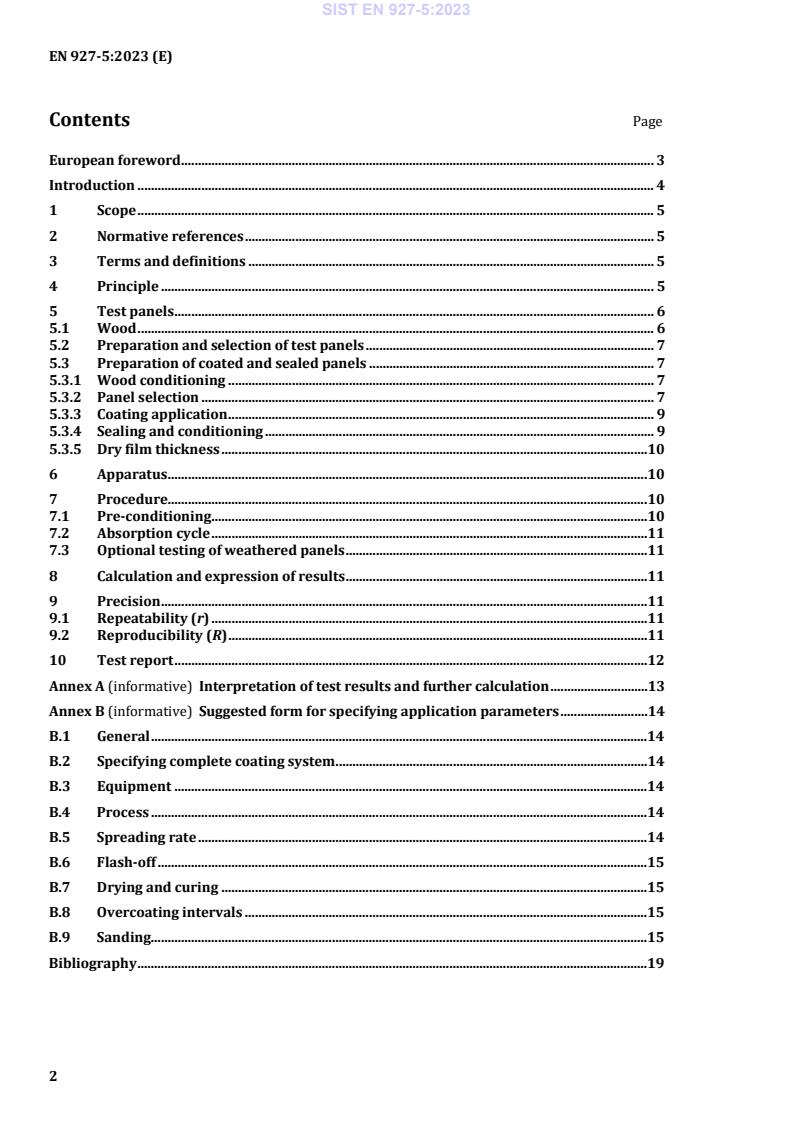
Contents Page
European foreword . 3
Introduction . 4
1 Scope . 5
2 Normative references . 5
3 Terms and definitions . 5
4 Principle . 5
5 Test panels . 6
5.1 Wood . 6
5.2 Preparation and selection of test panels . 7
5.3 Preparation of coated and sealed panels . 7
5.3.1 Wood conditioning . 7
5.3.2 Panel selection . 7
5.3.3 Coating application . 9
5.3.4 Sealing and conditioning . 9
5.3.5 Dry film thickness .10
6 Apparatus .10
7 Procedure.10
7.1 Pre-conditioning .10
7.2 Absorption cycle .11
7.3 Optional testing of weathered panels .11
8 Calculation and expression of results .11
9 Precision .11
9.1 Repeatability (r) .11
9.2 Reproducibility (R) .11
10 Test report .12
Annex A (informative) Interpretation of test results and further calculation .13
Annex B (informative) Suggested form for specifying application parameters .14
B.1 General .14
B.2 Specifying complete coating system .14
B.3 Equipment .14
B.4 Process .14
B.5 Spreading rate .14
B.6 Flash-off .15
B.7 Drying and curing .15
B.8 Overcoating intervals .15
B.9 Sanding.15
Bibliography .19
European foreword
This document (EN 927-5:2023) has been prepared by Technical Committee CEN/TC 139 “Paints and
varnishes”, the secretariat of which is held by DIN.
This European Standard shall be given the status of a national standard, either by publication of an
identical text or by endorsement, at the latest by December 2023, and conflicting national standards shall
be withdrawn at the latest by December 2023.
Attention is drawn to the possibility that some of the elements of this document may be the subject of
patent rights. CEN shall not be held responsible for identifying any or all such patent rights.
This document supersedes EN 927-5:2006.
— the selection and preparation of test panels has been clarified;
— Annex A has been rewritten to better describe the link between water absorption and end use
categories.
Any feedback and questions on this document should be directed to the users’ national standards body.
A complete listing of these bodies can be found on the CEN website.
According to the CEN-CENELEC Internal Regulations, the national standards organisations of the
following countries are bound to implement this European Standard: Austria, Belgium, Bulgaria, Croatia,
Cyprus, Czech Republic, Denmark, Estonia, Finland, France, Germany, Greece, Hungary, Iceland, Ireland,
Italy, Latvia, Lithuania, Luxembourg, Malta, Netherlands, Norway, Poland, Portugal, Republic of North
Macedonia, Romania, Serbia, Slovakia, Slovenia, Spain, Sweden, Switzerland, Türkiye and the United
Kingdom.
Introduction
The treatment of exterior wood surfaces has both aesthetic and protective functions. A vital purpose of a
coating system is to protect the wood against aesthetic deterioration (e.g. blue stain attack) and
dimensional changes. Because such attacks are mainly caused by high moisture contents in the wood, a
knowledge of the relative water permeability properties of coating materials applied to exterior wood is
helpful in selecting products for particular end-use applications, as described in EN 927-1.
1 Scope
This document specifies a test method for assessing the liquid water permeability of coating systems for
exterior wood.
2 Normative references
The following documents are referred to in the text in such a way that some or all of their content
constitutes requirements of this document. For dated references, only the edition cited applies. For
undated references, the latest edition of the referenced document (including any amendments) applies.
EN ISO 2808:2019, Paints and varnishes — Determination of film thickness (ISO 2808:2019)
ISO 554, Standard atmospheres for conditioning and/or testing — Specifications
3 Terms and definitions
For the purposes of this document, the following terms and definitions apply.
ISO and IEC maintain terminology databases for use in standardization at the following addresses:
• ISO Online browsing platform: available at https://www.iso.org/obp
• IEC Electropedia: available at https://www.electropedia.org/
3.1
water absorption
ability of a coated or uncoated wood panel to absorb water from liquid or vapour
3.2
water permeability
ability of a coating system to allow the transmission of water as liquid or vapour
[SOURCE: EN 927-1:2013, 3.13]
3.3
stable mass
mass achieved when the difference between two subsequent weighings within 24 h does not exceed
0,2 %
4 Principle
Water permeability is assessed by measuring the water uptake over a 72 h period of a coated test panel
exposed to liquid water.
The coating under test is applied to the face of a defined test panel where the remaining face and sides
are carefully sealed using a sealer of a defined mandatory low permeability.
Results are expressed as water absorption of coated wood panels in grams per square metre test surface
per 72 h.
5 Test panels
5.1 Wood
The wood shall be spruce (Picea abies) that has been selected to be free from knots and cracks, to be
straight-grained and of normal growth rate (i.e. between 3 and 8 annual rings per 10 mm). The inclination
of the growth rings to the test face shall be (45 ± 10)°. See Figure 1.
The wood shall be free from blue stain and evidence of surface or bulk infection. Abnormal porosity
(caused by bacterial attack) shall be avoided.
Abnormally porous wood can be detected qualitatively by the rapid absorption of a drop of propan-2-ol
(isopropanol) applied to the surface; the drop should not be absorbed in less than 30 s by normal wood.
The test should be carried out at not less than six places, widely separated on the rear face of the test
panel.
3 3
The density of the wood shall be between 0,4 g/cm and 0,5 g/cm when measured at an equilibrium
moisture content of approximately 12 %. The measured density shall be recorded.
Condition the wood prior to conversion into test panels in accordance with ISO 554 at (20 ± 2) °C and a
relative humidity of (65 ± 5) %.
Dimensions in millimetres
Key
1 front of panel (test face)
a
min. 3, max. 8 growth rings/10 mm
α angle of growth rings to test face min. 35°, max. 55°
Figure 1 — Selection of wood
5.2 Preparation and selection of test panels
Convert the conditioned wood into panels (340 ± 2) mm × (70 ± 2) mm × (20 ± 2) mm in size. It is
intended that after coating one panel 150 mm in length will be cut from each end of this 340 mm long
panel. This will leave an off-cut approximately 35 mm in length from the middle of the panel, to be used
in due course for the determination of film thickness (see 5.3.5 and Figure 2).
The panels shall be planed all round to a smooth and uniform finish. Any panels showing surface splitting
shall be rejected.
5.3 Preparation of coated and sealed panels
5.3.1 Wood conditioning
Prior to coating, condition the panels to constant mass in accordance with ISO 554 at (20 ± 2) °C and a
relative humidity of (65 ± 5) %. Panels shall be weighed at intervals of not less than one day until they
have reached a stable mass (see 3.3).
5.3.2 Panel selection
Select three panels (340 mm × 70 mm × 20 mm) for each of the coatings to be tested. Select six panels
(150 mm × 70 mm × 20 mm) for testing the sealer product; this set of panels will serve as sealed controls
(see Figure 2).
Mark each panel to identify the test face as that convex to the annual rings.
Dimensions in millimetres
Key
A preparation of coated samples
B preparation of sealed samples
1 3 panels (340 × 70 × 20)
2 6 panels (150 × 70 × 20)
3 6 panels (150 × 70 × 20)
4 3 off-cuts appr. (35 × 70 × 20) for measurements of paint film thickness
a coating of front sides
b cutting
c sealing of edges and back sides
d Sealing of all sides and edges.
Figure 2 — Cutting of test panels
5.3.3 Coating application
Coating systems shall be applied according to the manufacturer's specifications.
Apply each test coating system to the test face only (convex side of the panels’ growth rings). Each coating
system under test requires 3 test panels (340 mm × 70 mm × 20 mm).
When the coating systems have dried, cut a test panel 150 mm in length from both ends of each long panel
(see Figure 2).
The three small coated off-cuts are used for the determination of film thickness. Six additional panels
(150 mm × 70 mm × 20 mm) are required to check the test face with the selected sealer. This sealer and
the number of layers should be identical with the later on used sealer for sealing the test panels
(150 mm × 70 mm × 20 mm). The liquid water permeability of the sealer shall not exceed 30 ml/m in
72 h (see Figure 2).
Additional information is given in Annex B.
5.3.4 Sealing and conditioning
Panels shall be sealed in the same way whether they are applied for test coatings or control of sealer. Seal
the sides, end-grains and reverse faces of the panels against water entry using at least two coats of a
flexible coating with low moisture permeability, for example a solvent-free epoxy or polyurethane paint.
The sealer shall cover the edges completely and overlap the test face by 2 mm (see Figure 3). Apply the
sealer to the end grain so many times that a closed and uniform film is obtained.
Key
1 test face
2 2 mm
l length of the test face
w width of the test face
Figure 3 — Sealing of panels
After sealing, condition the panels in the controlled environment (see 5.3.1) until constant mass is
achieved (for typically 7 to 2
...
Questions, Comments and Discussion
Ask us and Technical Secretary will try to provide an answer. You can facilitate discussion about the standard in here.
Loading comments...