

SIST EN 302 878-4 V1.1.1:2012
(Main)Access, Terminals, Transmission and Multiplexing (ATTM) - Third Generation Transmission Systems for Interactive Cable Television Services - IP Cable Modems - Part 4: MAC and Upper Layer Protocols - DOCSIS 3.0
General Information
- Abstract
Incorporate engineering changes and update TS 102 639-4: Third Generation Transmission Systems for Interactive Cable Television Services - IP Cable Modems;Part 4: MAC and Upper Layer Protocols
- Status
- Published
- Public Enquiry End Date
- 30-Jun-2011
- Publication Date
- 10-Jan-2012
- Technical Committee
- SPN - Services and Protocols for Networks
- Current Stage
- 6060 - National Implementation/Publication (Adopted Project)
- Start Date
- 10-Jan-2012
- Due Date
- 16-Mar-2012
- Completion Date
- 11-Jan-2012
Buy Documents
en_30287804v010100c - Access, Terminals, Transmission and Multiplexing (ATTM); Third Generation Transmission Systems for Interactive Cable Television Services - IP Cable Modems; Part 4: MAC and Upper Layer Protocols; DOCSIS 3.0
en_30287804v010100v - Access, Terminals, Transmission and Multiplexing (ATTM); Third Generation Transmission Systems for Interactive Cable Television Services - IP Cable Modems; Part 4: MAC and Upper Layer Protocols; DOCSIS 3.0
en_30287804v010101p - Access, Terminals, Transmission and Multiplexing (ATTM); Third Generation Transmission Systems for Interactive Cable Television Services - IP Cable Modems; Part 4: MAC and Upper Layer Protocols; DOCSIS 3.0

Overview
SIST EN 302 878-4 V1.1.1:2012 (identical to ETSI EN 302 878-4 V1.1.1) defines the MAC and upper-layer protocols for DOCSIS 3.0 IP Cable Modems used in third‑generation interactive cable television and broadband data systems. The standard updates prior specifications (including TS 102 639-4) to incorporate engineering changes and to clarify Media Access Control (MAC), management messages and higher‑layer protocol behaviour for IP cable modem networks.
Key topics and technical scope
This part of the standard focuses on MAC and upper‑layer protocol elements essential to DOCSIS 3.0 cable broadband systems. Major topics documented include:
- DOCSIS MAC architecture: CMTS and Cable Modem (CM) models, MAC domain concepts and CMTS forwarding models.
- Quality of Service (QoS) and service flows: definitions for individual and group service flows and their role in traffic prioritization.
- Channel bonding: downstream and upstream channel bonding mechanisms to increase throughput across multiple channels.
- Upstream timing and access modes: TDMA and S‑CDMA modes, upstream intervals, mini‑slots and 6.25‑microsecond increments referenced for timing.
- MAC frame and header formats: generic MAC frames, packet/ATM PDUs, segmentation, fragmentation and extended headers.
- MAC management messages: time synchronization (SYNC), Upstream Channel Descriptor (UCD), MAP messages, ranging (RNG) and registration (REG) procedures.
- Multicast and higher‑layer protocols: multicast operation, IP transport, provisioning and management of CMs and CPEs.
- Relationship to physical HFC topology: RF topology, frequency assignment and Cable Modem Service Group (CM‑SG) considerations.
Practical applications and users
This standard is intended for engineers, system architects and product developers working on:
- Cable broadband equipment: CMTS vendors, cable modem manufacturers and chipset designers implementing DOCSIS 3.0 MAC and management functionality.
- Network operators and integrators: cable operators planning provisioning, QoS, channel bonding and multicast services on HFC networks.
- Firmware and software developers: implementers of MAC layer stacks, provisioning agents and management systems for IP Cable Modems. Practical uses include ensuring interoperability of CMs and CMTSs, implementing DOCSIS 3.0 channel bonding and QoS features, and aligning provisioning/management with ETSI/SIST requirements.
Related standards
- ETSI EN 302 878-4 V1.1.1 (source/parallel)
- TS 102 639-4 (earlier specification updated by this document)
- DOCSIS family standards (industry references for PHY and system-level profiles)
Keywords: DOCSIS 3.0, IP Cable Modems, MAC layer, CMTS, cable modem, channel bonding, QoS, MAC management, cable broadband, HFC.
Buy Documents
en_30287804v010100c - Access, Terminals, Transmission and Multiplexing (ATTM); Third Generation Transmission Systems for Interactive Cable Television Services - IP Cable Modems; Part 4: MAC and Upper Layer Protocols; DOCSIS 3.0
en_30287804v010100v - Access, Terminals, Transmission and Multiplexing (ATTM); Third Generation Transmission Systems for Interactive Cable Television Services - IP Cable Modems; Part 4: MAC and Upper Layer Protocols; DOCSIS 3.0
en_30287804v010101p - Access, Terminals, Transmission and Multiplexing (ATTM); Third Generation Transmission Systems for Interactive Cable Television Services - IP Cable Modems; Part 4: MAC and Upper Layer Protocols; DOCSIS 3.0
Get Certified
Connect with accredited certification bodies for this standard

BSI Group
BSI (British Standards Institution) is the business standards company that helps organizations make excellence a habit.

NYCE
Mexican standards and certification body.
Sponsored listings
Frequently Asked Questions
SIST EN 302 878-4 V1.1.1:2012 is a standard published by the Slovenian Institute for Standardization (SIST). Its full title is "Access, Terminals, Transmission and Multiplexing (ATTM) - Third Generation Transmission Systems for Interactive Cable Television Services - IP Cable Modems - Part 4: MAC and Upper Layer Protocols - DOCSIS 3.0". This standard covers: Incorporate engineering changes and update TS 102 639-4: Third Generation Transmission Systems for Interactive Cable Television Services - IP Cable Modems;Part 4: MAC and Upper Layer Protocols
Incorporate engineering changes and update TS 102 639-4: Third Generation Transmission Systems for Interactive Cable Television Services - IP Cable Modems;Part 4: MAC and Upper Layer Protocols
SIST EN 302 878-4 V1.1.1:2012 is classified under the following ICS (International Classification for Standards) categories: 35.180 - IT Terminal and other peripheral equipment. The ICS classification helps identify the subject area and facilitates finding related standards.
SIST EN 302 878-4 V1.1.1:2012 is available in PDF format for immediate download after purchase. The document can be added to your cart and obtained through the secure checkout process. Digital delivery ensures instant access to the complete standard document.
Standards Content (Sample)
Draft ETSI EN 302 878-4 V1.1.0 (2011-04)
European Standard
Access, Terminals, Transmission and Multiplexing (ATTM);
Third Generation Transmission Systems for
Interactive Cable Television Services - IP Cable Modems;
Part 4: MAC and Upper Layer Protocols;
DOCSIS 3.0
2 Draft ETSI EN 302 878-4 V1.1.0 (2011-04)
Reference
DEN/ATTM-003006-4
Keywords
access, broadband, cable, data, IP, IPCable,
modem
ETSI
650 Route des Lucioles
F-06921 Sophia Antipolis Cedex - FRANCE
Tel.: +33 4 92 94 42 00 Fax: +33 4 93 65 47 16
Siret N° 348 623 562 00017 - NAF 742 C
Association à but non lucratif enregistrée à la
Sous-Préfecture de Grasse (06) N° 7803/88
Important notice
Individual copies of the present document can be downloaded from:
http://www.etsi.org
The present document may be made available in more than one electronic version or in print. In any case of existing or
perceived difference in contents between such versions, the reference version is the Portable Document Format (PDF).
In case of dispute, the reference shall be the printing on ETSI printers of the PDF version kept on a specific network drive
within ETSI Secretariat.
Users of the present document should be aware that the document may be subject to revision or change of status.
Information on the current status of this and other ETSI documents is available at
http://portal.etsi.org/tb/status/status.asp
If you find errors in the present document, please send your comment to one of the following services:
http://portal.etsi.org/chaircor/ETSI_support.asp
Copyright Notification
No part may be reproduced except as authorized by written permission.
The copyright and the foregoing restriction extend to reproduction in all media.
© European Telecommunications Standards Institute 2011.
All rights reserved.
TM TM TM TM
DECT , PLUGTESTS , UMTS , TIPHON , the TIPHON logo and the ETSI logo are Trade Marks of ETSI registered
for the benefit of its Members.
TM
3GPP is a Trade Mark of ETSI registered for the benefit of its Members and of the 3GPP Organizational Partners.
LTE™ is a Trade Mark of ETSI currently being registered
for the benefit of its Members and of the 3GPP Organizational Partners.
GSM® and the GSM logo are Trade Marks registered and owned by the GSM Association.
ETSI
3 Draft ETSI EN 302 878-4 V1.1.0 (2011-04)
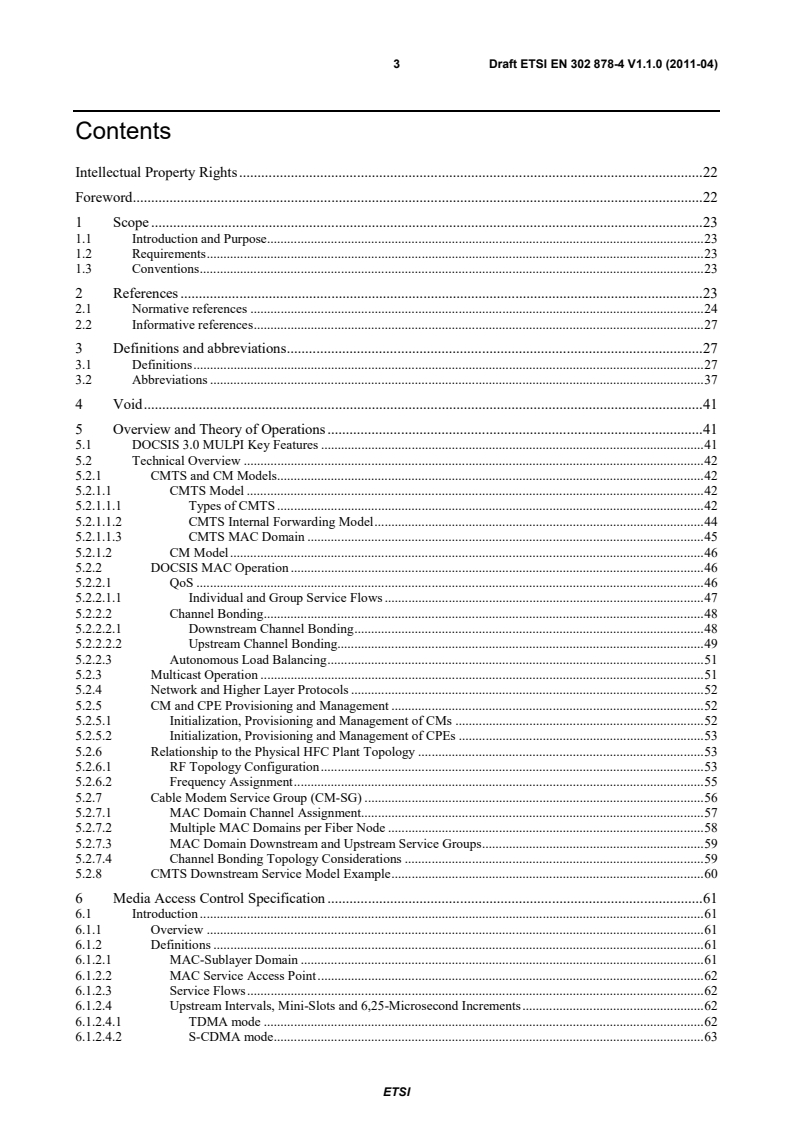
Contents
Intellectual Property Rights . 22
Foreword . 22
1 Scope . 23
1.1 Introduction and Purpose . 23
1.2 Requirements . 23
1.3 Conventions . 23
2 References . 23
2.1 Normative references . 24
2.2 Informative references . 27
3 Definitions and abbreviations . 27
3.1 Definitions . 27
3.2 Abbreviations . 37
4 Void . 41
5 Overview and Theory of Operations . 41
5.1 DOCSIS 3.0 MULPI Key Features . 41
5.2 Technical Overview . 42
5.2.1 CMTS and CM Models . 42
5.2.1.1 CMTS Model . 42
5.2.1.1.1 Types of CMTS . 42
5.2.1.1.2 CMTS Internal Forwarding Model . 44
5.2.1.1.3 CMTS MAC Domain . 45
5.2.1.2 CM Model . 46
5.2.2 DOCSIS MAC Operation . 46
5.2.2.1 QoS . 46
5.2.2.1.1 Individual and Group Service Flows . 47
5.2.2.2 Channel Bonding . 48
5.2.2.2.1 Downstream Channel Bonding . 48
5.2.2.2.2 Upstream Channel Bonding . 49
5.2.2.3 Autonomous Load Balancing . 51
5.2.3 Multicast Operation . 51
5.2.4 Network and Higher Layer Protocols . 52
5.2.5 CM and CPE Provisioning and Management . 52
5.2.5.1 Initialization, Provisioning and Management of CMs . 52
5.2.5.2 Initialization, Provisioning and Management of CPEs . 53
5.2.6 Relationship to the Physical HFC Plant Topology . 53
5.2.6.1 RF Topology Configuration . 53
5.2.6.2 Frequency Assignment . 55
5.2.7 Cable Modem Service Group (CM-SG) . 56
5.2.7.1 MAC Domain Channel Assignment. 57
5.2.7.2 Multiple MAC Domains per Fiber Node . 58
5.2.7.3 MAC Domain Downstream and Upstream Service Groups . 59
5.2.7.4 Channel Bonding Topology Considerations . 59
5.2.8 CMTS Downstream Service Model Example . 60
6 Media Access Control Specification . 61
6.1 Introduction . 61
6.1.1 Overview . 61
6.1.2 Definitions . 61
6.1.2.1 MAC-Sublayer Domain . 61
6.1.2.2 MAC Service Access Point . 62
6.1.2.3 Service Flows . 62
6.1.2.4 Upstream Intervals, Mini-Slots and 6,25-Microsecond Increments . 62
6.1.2.4.1 TDMA mode . 62
6.1.2.4.2 S-CDMA mode . 63
ETSI
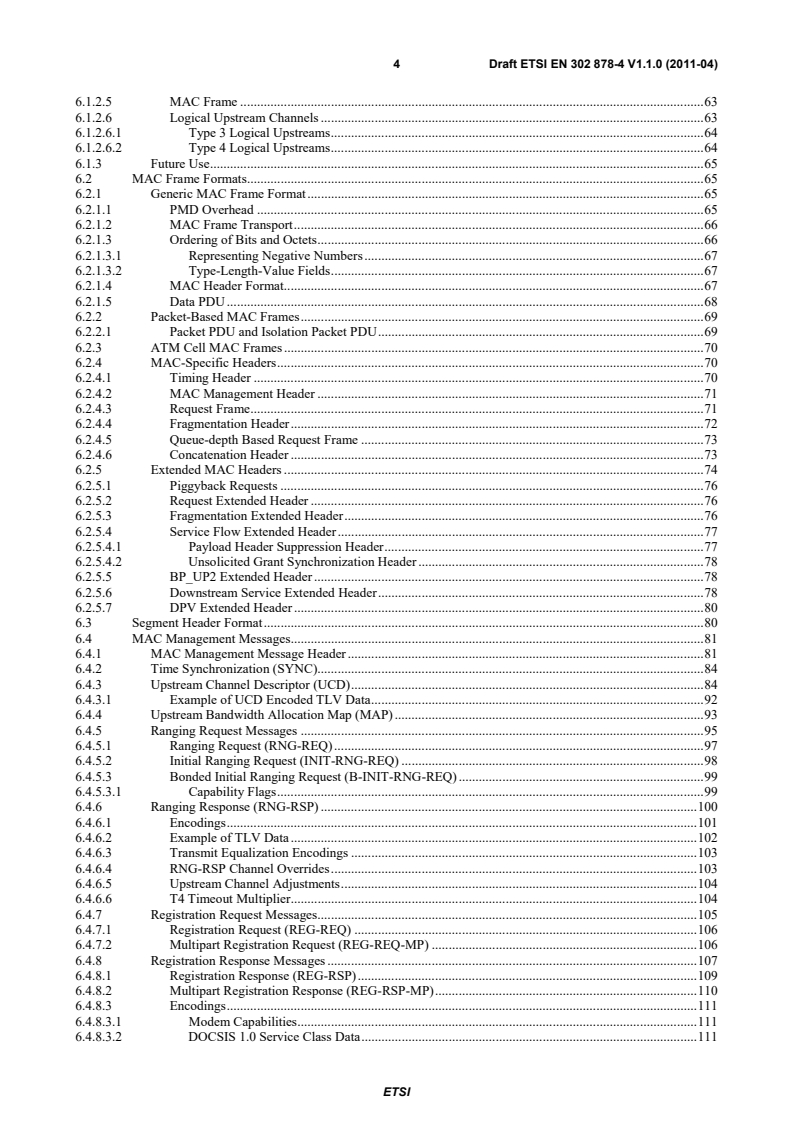
4 Draft ETSI EN 302 878-4 V1.1.0 (2011-04)
6.1.2.5 MAC Frame . 63
6.1.2.6 Logical Upstream Channels . 63
6.1.2.6.1 Type 3 Logical Upstreams . 64
6.1.2.6.2 Type 4 Logical Upstreams . 64
6.1.3 Future Use . 65
6.2 MAC Frame Formats. 65
6.2.1 Generic MAC Frame Format . 65
6.2.1.1 PMD Overhead . 65
6.2.1.2 MAC Frame Transport . 66
6.2.1.3 Ordering of Bits and Octets . 66
6.2.1.3.1 Representing Negative Numbers . 67
6.2.1.3.2 Type-Length-Value Fields . 67
6.2.1.4 MAC Header Format. 67
6.2.1.5 Data PDU . 68
6.2.2 Packet-Based MAC Frames . 69
6.2.2.1 Packet PDU and Isolation Packet PDU . 69
6.2.3 ATM Cell MAC Frames . 70
6.2.4 MAC-Specific Headers . 70
6.2.4.1 Timing Header . 70
6.2.4.2 MAC Management Header . 71
6.2.4.3 Request Frame . 71
6.2.4.4 Fragmentation Header . 72
6.2.4.5 Queue-depth Based Request Frame . 73
6.2.4.6 Concatenation Header . 73
6.2.5 Extended MAC Headers . 74
6.2.5.1 Piggyback Requests . 76
6.2.5.2 Request Extended Header . 76
6.2.5.3 Fragmentation Extended Header . 76
6.2.5.4 Service Flow Extended Header . 77
6.2.5.4.1 Payload Header Suppression Header . 77
6.2.5.4.2 Unsolicited Grant Synchronization Header . 78
6.2.5.5 BP_UP2 Extended Header . 78
6.2.5.6 Downstream Service Extended Header . 78
6.2.5.7 DPV Extended Header . 80
6.3 Segment Header Format . 80
6.4 MAC Management Messages. 81
6.4.1 MAC Management Message Header . 81
6.4.2 Time Synchronization (SYNC). 84
6.4.3 Upstream Channel Descriptor (UCD) . 84
6.4.3.1 Example of UCD Encoded TLV Data . 92
6.4.4 Upstream Bandwidth Allocation Map (MAP) . 93
6.4.5 Ranging Request Messages . 95
6.4.5.1 Ranging Request (RNG-REQ) . 97
6.4.5.2 Initial Ranging Request (INIT-RNG-REQ) . 98
6.4.5.3 Bonded Initial Ranging Request (B-INIT-RNG-REQ) . 99
6.4.5.3.1 Capability Flags . 99
6.4.6 Ranging Response (RNG-RSP) . 100
6.4.6.1 Encodings . 101
6.4.6.2 Example of TLV Data . 102
6.4.6.3 Transmit Equalization Encodings . 103
6.4.6.4 RNG-RSP Channel Overrides . 103
6.4.6.5 Upstream Channel Adjustments . 104
6.4.6.6 T4 Timeout Multiplier. 104
6.4.7 Registration Request Messages . 105
6.4.7.1 Registration Request (REG-REQ) . 106
6.4.7.2 Multipart Registration Request (REG-REQ-MP) . 106
6.4.8 Registration Response Messages . 107
6.4.8.1 Registration Response (REG-RSP) . 109
6.4.8.2 Multipart Registration Response (REG-RSP-MP) . 110
6.4.8.3 Encodings . 111
6.4.8.3.1 Modem Capabilities . 111
6.4.8.3.2 DOCSIS 1.0 Service Class Data . 111
ETSI
5 Draft ETSI EN 302 878-4 V1.1.0 (2011-04)
6.4.9 Registration Acknowledge (REG-ACK) . 112
6.4.10 Upstream Channel Change Request (UCC-REQ) . 113
6.4.11 Upstream Channel Change Response (UCC-RSP) . 114
6.4.12 Dynamic Service Addition - Request (DSA-REQ) . 114
6.4.12.1 CM-Initiated Dynamic Service Addition . 115
6.4.12.2 CMTS-Initiated Dynamic Service Addition . 115
6.4.13 Dynamic Service Addition - Response (DSA-RSP) . 116
6.4.13.1 CM-Initiated Dynamic Service Addition . 117
6.4.13.2 CMTS-Initiated Dynamic Service Addition . 117
6.4.14 Dynamic Service Addition - Acknowledge (DSA-ACK) . 117
6.4.15 Dynamic Service Change - Request (DSC-REQ) . 118
6.4.16 Dynamic Service Change - Response (DSC-RSP) . 120
6.4.17 Dynamic Service Change - Acknowledge (DSC-ACK) . 121
6.4.18 Dynamic Service Deletion - Request (DSD-REQ) . 122
6.4.19 Dynamic Service Deletion - Response (DSD-RSP) . 122
6.4.20 Dynamic Channel Change - Request (DCC-REQ) . 123
6.4.20.1 Encodings . 124
6.4.20.1.1 Upstream Channel ID . 124
6.4.20.1.2 Downstream Parameters . 124
6.4.20.1.3 Initialization Technique . 125
6.4.20.1.4 UCD Substitution . 126
6.4.20.1.5 Security Association Identifier (SAID) Substitution . 127
6.4.20.1.6 Service Flow Substitutions . 127
6.4.20.1.7 CMTS MAC Address . 128
6.4.21 Dynamic Channel Change - Response (DCC-RSP) . 129
6.4.21.1 Encodings . 129
6.4.21.1.1 CM Jump Time . 130
6.4.22 Dynamic Channel Change - Acknowledge (DCC-ACK) . 130
6.4.23 Device Class Identification Request (DCI-REQ) . 131
6.4.24 Device Class Identification Response (DCI-RSP) . 132
6.4.25 Upstream Transmitter Disable (UP-DIS) . 132
6.4.26 Test Request (TST-REQ) . 134
6.4.27 Downstream Channel Descriptor (DCD) . 135
6.4.28 MAC Domain Descriptor (MDD) . 135
6.4.28.1 TLV Encodings . 136
6.4.28.1.1 Downstream Active Channel List TLV . 136
6.4.28.1.2 MAC Domain Downstream Service Group (MD-DS-SG) TLV . 137
6.4.28.1.3 Downstream Ambiguity Resolution Frequency List TLV . 138
6.4.28.1.4 Receive Channel Profile Reporting Control TLV . 138
6.4.28.1.5 IP Initialization Parameters TLV . 139
6.4.28.1.6 Early Authentication and Encryption (EAE) Enable/Disable TLV . 139
6.4.28.1.7 Upstream Active Channel List TLV . 140
6.4.28.1.8 Upstream Ambiguity Resolution Channel List TLV . 140
6.4.28.1.9 Upstream Frequency Range TLV . 141
6.4.28.1.10 Symbol Clock Locking Indicator . 141
6.4.28.1.11 CM-STATUS Event Control . 141
6.4.28.1.12 Upstream Transmit Power Reporting . 142
6.4.28.1.13 DSG DA-to-DSID Association Entry . 142
6.4.28.1.14 CM-STATUS Event Enable for Non-Channel-Specific Events . 142
6.4.28.1.15 Extended Upstream Transmit Power Support . 143
6.4.29 Dynamic Bonding Change Request (DBC-REQ) . 143
6.4.30 Dynamic Bonding Change Response (DBC-RSP) . 144
6.4.31 Dynamic Bonding Change Acknowledge (DBC-ACK) . 146
6.4.32 DOCSIS Path Verify Request (DPV-REQ) . 146
6.4.33 DOCSIS Path Verify Response (DPV-RSP) . 148
6.4.34 Status Report (CM-STATUS). 148
6.4.34.1 TLV Encodings . 149
6.4.35 CM Control Request (CM-CTRL-REQ). 149
6.4.35.1 TLV Encodings . 150
6.4.36 CM Control Response (CM-CTRL-RSP) . 150
7 Media Access Control Protocol Operation . 151
ETSI
6 Draft ETSI EN 302 878-4 V1.1.0 (2011-04)
7.1 Timing and Synchronization . 151
7.1.1 Global Timing Reference . 151
7.1.2 CM Synchronization . 152
7.1.3 Ranging . 152
7.1.3.1 Broadcast Initial Ranging . 152
7.1.3.2 Unicast Initial Ranging . 153
7.1.4 Timing Units and Relationships . 153
7.1.4.1 TDMA Timing Units and Relationships . 153
7.1.4.1.1 Mini-Slot Capacity . 153
7.1.4.1.2 Mini-Slot Numbering . 154
7.1.4.2 S-CDMA Timing Units and Relationships . 154
7.1.4.2.1 Mini-Slot Capacity . 154
7.1.4.2.2 Mini-Slot Numbering . 154
7.2 Upstream Data Transmission . 155
7.2.1 Upstream Bandwidth Allocation . 155
7.2.1.1 The Allocation MAP MAC Management Message . 156
7.2.1.2 Information Elements . 156
7.2.1.2.1 The Request IE . 156
7.2.1.2.2 The Request/Data IE . 157
7.2.1.2.3 The Initial Maintenance IE . 157
7.2.1.2.4 The Station Maintenance IE . 157
7.2.1.2.5 Short and Long Data Grant IEs . 157
7.2.1.2.6 Data Acknowledge IE . 158
7.2.1.2.7 Expansion IE . 158
7.2.1.2.8 Null IE . 158
7.2.1.2.9 Advanced PHY Short and Long Data Grant IEs . 158
7.2.1.2.10 Advanced PHY Unsolicited Grant IE . 159
7.2.1.3 Requesting with Multiple Transmit Channel Mode Disabled . 159
7.2.1.4 Requesting with Multiple Transmit Channel Mode Enabled . 160
7.2.1.4.1 Request Mechanisms for Segment Header OFF Service Flows . 160
7.2.1.4.2 Request Mechanisms for Segment Header ON Service Flows . 160
7.2.1.5 Information Element Feature Usage Summary . 165
7.2.1.6 Map Transmission and Timing . 165
7.2.1.7 Protocol Example . 166
7.2.1.8 MAP Generation Example - Two Logical Upstreams. 167
7.2.2 Upstream Transmission and Contention Resolution . 168
7.2.2.1 Contention Resolution Overview . 168
7.2.2.1.1 Contention Resolution with Multiple Transmit Channel Mode Disabled . 168
7.2.2.1.2 Contention Resolution with Multiple Transmit Channel Mode Enabled. 169
7.2.2.2 Transmit Opportunities . 171
7.2.2.3 CM Bandwidth Utilization . 172
7.2.3 Upstream Service Flow Scheduling Services . 172
7.2.3.1 Unsolicited Grant Service . 173
7.2.3.2 Real-Time Polling Service . 173
7.2.3.3 Unsolicited Grant Service with Activity Detection . 174
7.2.3.4 Non-Real-Time Polling Service . 175
7.2.3.5 Best Effort Service . 175
7.2.3.6 Other Services . 175
7.2.3.6.1 Committed Information Rate (CIR). 175
7.2.3.7 Parameter Applicability for Upstream Service Scheduling . 175
7.2.3.8 CM Transmit Behavior . 176
7.2.4 Continuous Concatenation and Fragmentation . 176
7.2.5 Pre-3.0 DOCSIS Concatenation and Fragmentation . 177
7.2.5.1 Concatenation . 177
7.2.5.2 Fragmentation . 178
7.2.5.2.1 CM Fragmentation Support . 180
7.2.5.2.2 CMTS Fragmentation Support . 182
7.2.5.2.3 Fragmentation Example . 183
7.2.5.2.4 Pre-Registration Fragmentation . 185
7.2.5.2.5 Considerations for Concatenated Packets and Fragmentation . 186
7.3 Upstream - Downstream Channel Association within a MAC Domain . 186
7.3.1 Primary Downstream Channels . 186
ETSI
7 Draft ETSI EN 302 878-4 V1.1.0 (2011-04)
7.3.2 MAP and UCD Messages . 187
7.3.3 Multiple MAC Domains . 187
7.4 DSID Definition . 187
7.5 Quality of Service . 188
7.5.1 Concepts . 188
7.5.1.1 Service Flows . 188
7.5.1.2 Classifiers . 190
7.5.1.2.1 Upstream and Downstream QoS Classifiers . 190
7.5.1.2.2 Upstream Drop Classifiers. 192
7.5.2 Object Model . 192
7.5.3 Service Classes . 194
7.5.4 Authorization . 195
7.5.5 States of Service Flows . 195
7.5.5.1 Deferred Service Flows . 195
7.5.5.1.1 Provisioned Service Flows . 196
7.5.5.1.2 Authorized Service Flows . 196
7.5.5.2 Admitted Service Flows . 196
7.5.5.3 Active Service Flows . 197
7.5.6 Service Flows and Classifiers . 197
7.5.6.1 Policy-Based Classification and Service Classes . 198
7.5.7 General Operation . 198
7.5.7.1 Static Operation . 198
7.5.7.2 Dynamic Service Flow Creation - CM Initiated. 199
7.5.7.3 Dynamic Service Flow Creation - CMTS Initiated . 200
7.5.7.4 Dynamic Service Flow Modification and Deletion . 200
7.5.8 QoS Support for Joined IP Multicast Traffic . 201
7.5.8.1 Overview . 202
7.5.8.2 Group Configuration and Group QoS Configuration Tables . 203
7.5.8.3 Instantiating Group Classifier Rules and Group Service Flows . 204
7.5.8.3.1 Examples of GCR and GSF Instantiation . 206
7.5.8.4 Default Group Service Flows . 212
7.5.8.5 Service Class QoS Parameter Changes . 212
7.5.8.6 Group QoS Configuration Changes . 212
7.5.9 Other Multicast and Broadcast Traffic. 213
7.6 Downstream Traffic Priority . 213
7.6.1 Traffic Priority Ordering and Mapping to CM Output Queues. 213
7.7 Payload Header Suppression . 214
7.7.1 Overview . 214
7.7.1.1 PHSI-indexed PHS . 215
7.7.1.2 DSID-indexed PHS . 215
7.7.2 Example Applications . 216
7.7.3 Operation . 216
7.7.4 Signalling .
...
Final draft ETSI EN 302 878-4 V1.1.0 (2011-09)
European Standard
Access, Terminals, Transmission and Multiplexing (ATTM);
Third Generation Transmission Systems for
Interactive Cable Television Services - IP Cable Modems;
Part 4: MAC and Upper Layer Protocols;
DOCSIS 3.0
2 Final draft ETSI EN 302 878-4 V1.1.0 (2011-09)
Reference
DEN/ATTM-003006-4
Keywords
access, broadband, cable, data, IP, IPCable,
modem
ETSI
650 Route des Lucioles
F-06921 Sophia Antipolis Cedex - FRANCE
Tel.: +33 4 92 94 42 00 Fax: +33 4 93 65 47 16
Siret N° 348 623 562 00017 - NAF 742 C
Association à but non lucratif enregistrée à la
Sous-Préfecture de Grasse (06) N° 7803/88
Important notice
Individual copies of the present document can be downloaded from:
http://www.etsi.org
The present document may be made available in more than one electronic version or in print. In any case of existing or
perceived difference in contents between such versions, the reference version is the Portable Document Format (PDF).
In case of dispute, the reference shall be the printing on ETSI printers of the PDF version kept on a specific network drive
within ETSI Secretariat.
Users of the present document should be aware that the document may be subject to revision or change of status.
Information on the current status of this and other ETSI documents is available at
http://portal.etsi.org/tb/status/status.asp
If you find errors in the present document, please send your comment to one of the following services:
http://portal.etsi.org/chaircor/ETSI_support.asp
Copyright Notification
No part may be reproduced except as authorized by written permission.
The copyright and the foregoing restriction extend to reproduction in all media.
© European Telecommunications Standards Institute 2011.
All rights reserved.
TM TM TM
DECT , PLUGTESTS , UMTS and the ETSI logo are Trade Marks of ETSI registered for the benefit of its Members.
TM
3GPP and LTE™ are Trade Marks of ETSI registered for the benefit of its Members and
of the 3GPP Organizational Partners.
GSM® and the GSM logo are Trade Marks registered and owned by the GSM Association.
ETSI
3 Final draft ETSI EN 302 878-4 V1.1.0 (2011-09)
Contents
Intellectual Property Rights . 22
Foreword . 22
1 Scope . 23
1.1 Introduction and Purpose . 23
1.2 Requirements . 23
1.3 Conventions . 23
2 References . 23
2.1 Normative references . 24
2.2 Informative references . 27
3 Definitions and abbreviations . 27
3.1 Definitions . 27
3.2 Abbreviations . 37
4 Void . 41
5 Overview and Theory of Operations . 41
5.1 DOCSIS 3.0 MULPI Key Features . 41
5.2 Technical Overview . 42
5.2.1 CMTS and CM Models . 42
5.2.1.1 CMTS Model . 42
5.2.1.1.1 Types of CMTS . 42
5.2.1.1.2 CMTS Internal Forwarding Model . 44
5.2.1.1.3 CMTS MAC Domain . 45
5.2.1.2 CM Model . 46
5.2.2 DOCSIS MAC Operation . 46
5.2.2.1 QoS . 46
5.2.2.1.1 Individual and Group Service Flows . 47
5.2.2.2 Channel Bonding . 48
5.2.2.2.1 Downstream Channel Bonding . 48
5.2.2.2.2 Upstream Channel Bonding . 49
5.2.2.3 Autonomous Load Balancing . 51
5.2.3 Multicast Operation . 51
5.2.4 Network and Higher Layer Protocols . 52
5.2.5 CM and CPE Provisioning and Management . 52
5.2.5.1 Initialization, Provisioning and Management of CMs . 52
5.2.5.2 Initialization, Provisioning and Management of CPEs . 53
5.2.6 Relationship to the Physical HFC Plant Topology . 53
5.2.6.1 RF Topology Configuration . 53
5.2.6.2 Frequency Assignment . 55
5.2.7 Cable Modem Service Group (CM-SG) . 56
5.2.7.1 MAC Domain Channel Assignment. 57
5.2.7.2 Multiple MAC Domains per Fibre Node . 58
5.2.7.3 MAC Domain Downstream and Upstream Service Groups . 59
5.2.7.4 Channel Bonding Topology Considerations . 59
5.2.8 CMTS Downstream Service Model Example . 60
6 Media Access Control Specification . 61
6.1 Introduction . 61
6.1.1 Overview . 61
6.1.2 Definitions . 61
6.1.2.1 MAC-Sublayer Domain . 61
6.1.2.2 MAC Service Access Point . 62
6.1.2.3 Service Flows . 62
6.1.2.4 Upstream Intervals, Mini-Slots and 6,25-Microsecond Increments . 62
6.1.2.4.1 TDMA mode . 62
6.1.2.4.2 S-CDMA mode . 63
ETSI
4 Final draft ETSI EN 302 878-4 V1.1.0 (2011-09)
6.1.2.5 MAC Frame . 63
6.1.2.6 Logical Upstream Channels . 63
6.1.2.6.1 Type 3 Logical Upstreams . 64
6.1.2.6.2 Type 4 Logical Upstreams . 64
6.1.3 Future Use . 65
6.2 MAC Frame Formats. 65
6.2.1 Generic MAC Frame Format . 65
6.2.1.1 PMD Overhead . 65
6.2.1.2 MAC Frame Transport . 66
6.2.1.3 Ordering of Bits and Octets . 66
6.2.1.3.1 Representing Negative Numbers . 67
6.2.1.3.2 Type-Length-Value Fields . 67
6.2.1.4 MAC Header Format. 67
6.2.1.5 Data PDU . 68
6.2.2 Packet-Based MAC Frames . 69
6.2.2.1 Packet PDU and Isolation Packet PDU . 69
6.2.3 ATM Cell MAC Frames . 70
6.2.4 MAC-Specific Headers . 70
6.2.4.1 Timing Header . 70
6.2.4.2 MAC Management Header . 71
6.2.4.3 Request Frame . 71
6.2.4.4 Fragmentation Header . 72
6.2.4.5 Queue-depth Based Request Frame . 73
6.2.4.6 Concatenation Header . 73
6.2.5 Extended MAC Headers . 74
6.2.5.1 Piggyback Requests . 76
6.2.5.2 Request Extended Header . 76
6.2.5.3 Fragmentation Extended Header . 76
6.2.5.4 Service Flow Extended Header . 77
6.2.5.4.1 Payload Header Suppression Header . 77
6.2.5.4.2 Unsolicited Grant Synchronization Header . 78
6.2.5.5 BP_UP2 Extended Header . 78
6.2.5.6 Downstream Service Extended Header . 78
6.2.5.7 DPV Extended Header . 80
6.3 Segment Header Format . 80
6.4 MAC Management Messages. 81
6.4.1 MAC Management Message Header . 81
6.4.2 Time Synchronization (SYNC). 84
6.4.3 Upstream Channel Descriptor (UCD) . 84
6.4.3.1 Example of UCD Encoded TLV Data . 92
6.4.4 Upstream Bandwidth Allocation Map (MAP) . 93
6.4.5 Ranging Request Messages . 95
6.4.5.1 Ranging Request (RNG-REQ) . 97
6.4.5.2 Initial Ranging Request (INIT-RNG-REQ) . 98
6.4.5.3 Bonded Initial Ranging Request (B-INIT-RNG-REQ) . 99
6.4.5.3.1 Capability Flags . 99
6.4.6 Ranging Response (RNG-RSP) . 100
6.4.6.1 Encodings . 101
6.4.6.2 Example of TLV Data . 102
6.4.6.3 Transmit Equalization Encodings . 103
6.4.6.4 RNG-RSP Channel Overrides . 103
6.4.6.5 Upstream Channel Adjustments . 104
6.4.6.6 T4 Timeout Multiplier. 104
6.4.7 Registration Request Messages . 105
6.4.7.1 Registration Request (REG-REQ) . 106
6.4.7.2 Multipart Registration Request (REG-REQ-MP) . 106
6.4.8 Registration Response Messages . 107
6.4.8.1 Registration Response (REG-RSP) . 109
6.4.8.2 Multipart Registration Response (REG-RSP-MP) . 110
6.4.8.3 Encodings . 111
6.4.8.3.1 Modem Capabilities . 111
6.4.8.3.2 DOCSIS 1.0 Service Class Data . 111
ETSI
5 Final draft ETSI EN 302 878-4 V1.1.0 (2011-09)
6.4.9 Registration Acknowledge (REG-ACK) . 112
6.4.10 Upstream Channel Change Request (UCC-REQ) . 113
6.4.11 Upstream Channel Change Response (UCC-RSP) . 114
6.4.12 Dynamic Service Addition - Request (DSA-REQ) . 114
6.4.12.1 CM-Initiated Dynamic Service Addition . 115
6.4.12.2 CMTS-Initiated Dynamic Service Addition . 115
6.4.13 Dynamic Service Addition - Response (DSA-RSP) . 116
6.4.13.1 CM-Initiated Dynamic Service Addition . 117
6.4.13.2 CMTS-Initiated Dynamic Service Addition . 117
6.4.14 Dynamic Service Addition - Acknowledge (DSA-ACK) . 117
6.4.15 Dynamic Service Change - Request (DSC-REQ) . 118
6.4.16 Dynamic Service Change - Response (DSC-RSP) . 120
6.4.17 Dynamic Service Change - Acknowledge (DSC-ACK) . 121
6.4.18 Dynamic Service Deletion - Request (DSD-REQ) . 122
6.4.19 Dynamic Service Deletion - Response (DSD-RSP) . 122
6.4.20 Dynamic Channel Change - Request (DCC-REQ) . 123
6.4.20.1 Encodings . 124
6.4.20.1.1 Upstream Channel ID . 124
6.4.20.1.2 Downstream Parameters . 124
6.4.20.1.3 Initialization Technique . 125
6.4.20.1.4 UCD Substitution . 126
6.4.20.1.5 Security Association Identifier (SAID) Substitution . 127
6.4.20.1.6 Service Flow Substitutions . 127
6.4.20.1.7 CMTS MAC Address . 128
6.4.21 Dynamic Channel Change - Response (DCC-RSP) . 129
6.4.21.1 Encodings . 129
6.4.21.1.1 CM Jump Time . 130
6.4.22 Dynamic Channel Change - Acknowledge (DCC-ACK) . 130
6.4.23 Device Class Identification Request (DCI-REQ) . 131
6.4.24 Device Class Identification Response (DCI-RSP) . 132
6.4.25 Upstream Transmitter Disable (UP-DIS) . 132
6.4.26 Test Request (TST-REQ) . 134
6.4.27 Downstream Channel Descriptor (DCD) . 135
6.4.28 MAC Domain Descriptor (MDD) . 135
6.4.28.1 TLV Encodings . 136
6.4.28.1.1 Downstream Active Channel List TLV . 136
6.4.28.1.2 MAC Domain Downstream Service Group (MD-DS-SG) TLV . 137
6.4.28.1.3 Downstream Ambiguity Resolution Frequency List TLV . 138
6.4.28.1.4 Receive Channel Profile Reporting Control TLV . 138
6.4.28.1.5 IP Initialization Parameters TLV . 139
6.4.28.1.6 Early Authentication and Encryption (EAE) Enable/Disable TLV . 139
6.4.28.1.7 Upstream Active Channel List TLV . 140
6.4.28.1.8 Upstream Ambiguity Resolution Channel List TLV . 140
6.4.28.1.9 Upstream Frequency Range TLV . 141
6.4.28.1.10 Symbol Clock Locking Indicator . 141
6.4.28.1.11 CM-STATUS Event Control . 141
6.4.28.1.12 Upstream Transmit Power Reporting . 142
6.4.28.1.13 DSG DA-to-DSID Association Entry . 142
6.4.28.1.14 CM-STATUS Event Enable for Non-Channel-Specific Events . 142
6.4.28.1.15 Extended Upstream Transmit Power Support . 143
6.4.29 Dynamic Bonding Change Request (DBC-REQ) . 143
6.4.30 Dynamic Bonding Change Response (DBC-RSP) . 144
6.4.31 Dynamic Bonding Change Acknowledge (DBC-ACK) . 146
6.4.32 DOCSIS Path Verify Request (DPV-REQ) . 146
6.4.33 DOCSIS Path Verify Response (DPV-RSP) . 148
6.4.34 Status Report (CM-STATUS). 148
6.4.34.1 TLV Encodings . 149
6.4.35 CM Control Request (CM-CTRL-REQ). 149
6.4.35.1 TLV Encodings . 150
6.4.36 CM Control Response (CM-CTRL-RSP) . 150
7 Media Access Control Protocol Operation . 151
ETSI
6 Final draft ETSI EN 302 878-4 V1.1.0 (2011-09)
7.1 Timing and Synchronization . 151
7.1.1 Global Timing Reference . 151
7.1.2 CM Synchronization . 152
7.1.3 Ranging . 152
7.1.3.1 Broadcast Initial Ranging . 152
7.1.3.2 Unicast Initial Ranging . 153
7.1.4 Timing Units and Relationships . 153
7.1.4.1 TDMA Timing Units and Relationships . 153
7.1.4.1.1 Mini-Slot Capacity . 153
7.1.4.1.2 Mini-Slot Numbering . 154
7.1.4.2 S-CDMA Timing Units and Relationships . 154
7.1.4.2.1 Mini-Slot Capacity . 154
7.1.4.2.2 Mini-Slot Numbering . 154
7.2 Upstream Data Transmission . 155
7.2.1 Upstream Bandwidth Allocation . 155
7.2.1.1 The Allocation MAP MAC Management Message . 156
7.2.1.2 Information Elements . 156
7.2.1.2.1 The Request IE . 156
7.2.1.2.2 The Request/Data IE . 157
7.2.1.2.3 The Initial Maintenance IE . 157
7.2.1.2.4 The Station Maintenance IE . 157
7.2.1.2.5 Short and Long Data Grant IEs . 157
7.2.1.2.6 Data Acknowledge IE . 158
7.2.1.2.7 Expansion IE . 158
7.2.1.2.8 Null IE . 158
7.2.1.2.9 Advanced PHY Short and Long Data Grant IEs . 158
7.2.1.2.10 Advanced PHY Unsolicited Grant IE . 159
7.2.1.3 Requesting with Multiple Transmit Channel Mode Disabled . 159
7.2.1.4 Requesting with Multiple Transmit Channel Mode Enabled . 160
7.2.1.4.1 Request Mechanisms for Segment Header OFF Service Flows . 160
7.2.1.4.2 Request Mechanisms for Segment Header ON Service Flows . 160
7.2.1.5 Information Element Feature Usage Summary . 165
7.2.1.6 Map Transmission and Timing . 165
7.2.1.7 Protocol Example . 166
7.2.1.8 MAP Generation Example - Two Logical Upstreams. 167
7.2.2 Upstream Transmission and Contention Resolution . 168
7.2.2.1 Contention Resolution Overview . 168
7.2.2.1.1 Contention Resolution with Multiple Transmit Channel Mode Disabled . 168
7.2.2.1.2 Contention Resolution with Multiple Transmit Channel Mode Enabled. 169
7.2.2.2 Transmit Opportunities . 171
7.2.2.3 CM Bandwidth Utilization . 172
7.2.3 Upstream Service Flow Scheduling Services . 172
7.2.3.1 Unsolicited Grant Service . 173
7.2.3.2 Real-Time Polling Service . 173
7.2.3.3 Unsolicited Grant Service with Activity Detection . 174
7.2.3.4 Non-Real-Time Polling Service . 175
7.2.3.5 Best Effort Service . 175
7.2.3.6 Other Services . 175
7.2.3.6.1 Committed Information Rate (CIR). 175
7.2.3.7 Parameter Applicability for Upstream Service Scheduling . 175
7.2.3.8 CM Transmit Behavior . 176
7.2.4 Continuous Concatenation and Fragmentation . 176
7.2.5 Pre-3.0 DOCSIS Concatenation and Fragmentation . 177
7.2.5.1 Concatenation . 177
7.2.5.2 Fragmentation . 178
7.2.5.2.1 CM Fragmentation Support . 180
7.2.5.2.2 CMTS Fragmentation Support . 182
7.2.5.2.3 Fragmentation Example . 183
7.2.5.2.4 Pre-Registration Fragmentation . 185
7.2.5.2.5 Considerations for Concatenated Packets and Fragmentation . 186
7.3 Upstream - Downstream Channel Association within a MAC Domain . 186
7.3.1 Primary Downstream Channels . 186
ETSI
7 Final draft ETSI EN 302 878-4 V1.1.0 (2011-09)
7.3.2 MAP and UCD Messages . 187
7.3.3 Multiple MAC Domains . 187
7.4 DSID Definition . 187
7.5 Quality of Service . 188
7.5.1 Concepts . 188
7.5.1.1 Service Flows . 188
7.5.1.2 Classifiers . 190
7.5.1.2.1 Upstream and Downstream QoS Classifiers . 190
7.5.1.2.2 Upstream Drop Classifiers. 192
7.5.2 Object Model . 192
7.5.3 Service Classes . 194
7.5.4 Authorization . 195
7.5.5 States of Service Flows . 195
7.5.5.1 Deferred Service Flows . 195
7.5.5.1.1 Provisioned Service Flows . 196
7.5.5.1.2 Authorized Service Flows . 196
7.5.5.2 Admitted Service Flows . 196
7.5.5.3 Active Service Flows . 197
7.5.6 Service Flows and Classifiers . 197
7.5.6.1 Policy-Based Classification and Service Classes . 198
7.5.7 General Operation . 198
7.5.7.1 Static Operation . 198
7.5.7.2 Dynamic Service Flow Creation - CM Initiated. 199
7.5.7.3 Dynamic Service Flow Creation - CMTS Initiated . 200
7.5.7.4 Dynamic Service Flow Modification and Deletion . 200
7.5.8 QoS Support for Joined IP Multicast Traffic . 201
7.5.8.1 Overview . 202
7.5.8.2 Group Configuration and Group QoS Configuration Tables . 203
7.5.8.3 Instantiating Group Classifier Rules and Group Service Flows . 204
7.5.8.3.1 Examples of GCR and GSF Instantiation . 206
7.5.8.4 Default Group Service Flows . 212
7.5.8.5 Service Class QoS Parameter Changes . 212
7.5.8.6 Group QoS Configuration Changes . 212
7.5.9 Other Multicast and Broadcast Traffic. 213
7.6 Downstream Traffic Priority . 213
7.6.1 Traffic Priority Ordering and Mapping to CM Output Queues. 213
7.7 Payload Header Suppression . 214
7.7.1 Overview . 214
7.7.1.1 PHSI-indexed PHS . 215
7.7.1.2 DSID-indexed PHS . 215
7.7.2 Example Applications . 216
7.7.3 Operation . 216
7.7.4 Signalling .
...
European Standard
Access, Terminals, Transmission and Multiplexing (ATTM);
Third Generation Transmission Systems for
Interactive Cable Television Services - IP Cable Modems;
Part 4: MAC and Upper Layer Protocols;
DOCSIS 3.0
2 ETSI EN 302 878-4 V1.1.1 (2011-11)
Reference
DEN/ATTM-003006-4
Keywords
access, broadband, cable, data, IP, IPCable,
modem
ETSI
650 Route des Lucioles
F-06921 Sophia Antipolis Cedex - FRANCE
Tel.: +33 4 92 94 42 00 Fax: +33 4 93 65 47 16
Siret N° 348 623 562 00017 - NAF 742 C
Association à but non lucratif enregistrée à la
Sous-Préfecture de Grasse (06) N° 7803/88
Important notice
Individual copies of the present document can be downloaded from:
http://www.etsi.org
The present document may be made available in more than one electronic version or in print. In any case of existing or
perceived difference in contents between such versions, the reference version is the Portable Document Format (PDF).
In case of dispute, the reference shall be the printing on ETSI printers of the PDF version kept on a specific network drive
within ETSI Secretariat.
Users of the present document should be aware that the document may be subject to revision or change of status.
Information on the current status of this and other ETSI documents is available at
http://portal.etsi.org/tb/status/status.asp
If you find errors in the present document, please send your comment to one of the following services:
http://portal.etsi.org/chaircor/ETSI_support.asp
Copyright Notification
No part may be reproduced except as authorized by written permission.
The copyright and the foregoing restriction extend to reproduction in all media.
© European Telecommunications Standards Institute 2011.
All rights reserved.
TM TM TM
DECT , PLUGTESTS , UMTS and the ETSI logo are Trade Marks of ETSI registered for the benefit of its Members.
TM
3GPP and LTE™ are Trade Marks of ETSI registered for the benefit of its Members and
of the 3GPP Organizational Partners.
GSM® and the GSM logo are Trade Marks registered and owned by the GSM Association.
ETSI
3 ETSI EN 302 878-4 V1.1.1 (2011-11)
Contents
Intellectual Property Rights . 22
Foreword . 22
1 Scope . 23
1.1 Introduction and Purpose . 23
1.2 Requirements . 23
1.3 Conventions . 23
2 References . 23
2.1 Normative references . 24
2.2 Informative references . 27
3 Definitions and abbreviations . 27
3.1 Definitions . 27
3.2 Abbreviations . 37
4 Void . 41
5 Overview and Theory of Operations . 41
5.1 DOCSIS 3.0 MULPI Key Features . 41
5.2 Technical Overview . 42
5.2.1 CMTS and CM Models . 42
5.2.1.1 CMTS Model . 42
5.2.1.1.1 Types of CMTS . 42
5.2.1.1.2 CMTS Internal Forwarding Model . 44
5.2.1.1.3 CMTS MAC Domain . 45
5.2.1.2 CM Model . 46
5.2.2 DOCSIS MAC Operation . 46
5.2.2.1 QoS . 46
5.2.2.1.1 Individual and Group Service Flows . 47
5.2.2.2 Channel Bonding . 48
5.2.2.2.1 Downstream Channel Bonding . 48
5.2.2.2.2 Upstream Channel Bonding . 49
5.2.2.3 Autonomous Load Balancing . 51
5.2.3 Multicast Operation . 51
5.2.4 Network and Higher Layer Protocols . 52
5.2.5 CM and CPE Provisioning and Management . 52
5.2.5.1 Initialization, Provisioning and Management of CMs . 52
5.2.5.2 Initialization, Provisioning and Management of CPEs . 53
5.2.6 Relationship to the Physical HFC Plant Topology . 53
5.2.6.1 RF Topology Configuration . 53
5.2.6.2 Frequency Assignment . 55
5.2.7 Cable Modem Service Group (CM-SG) . 56
5.2.7.1 MAC Domain Channel Assignment. 57
5.2.7.2 Multiple MAC Domains per Fibre Node . 58
5.2.7.3 MAC Domain Downstream and Upstream Service Groups . 59
5.2.7.4 Channel Bonding Topology Considerations . 59
5.2.8 CMTS Downstream Service Model Example . 60
6 Media Access Control Specification . 61
6.1 Introduction . 61
6.1.1 Overview . 61
6.1.2 Definitions . 61
6.1.2.1 MAC-Sublayer Domain . 61
6.1.2.2 MAC Service Access Point . 62
6.1.2.3 Service Flows . 62
6.1.2.4 Upstream Intervals, Mini-Slots and 6,25-Microsecond Increments . 62
6.1.2.4.1 TDMA mode . 62
6.1.2.4.2 S-CDMA mode . 63
ETSI
4 ETSI EN 302 878-4 V1.1.1 (2011-11)
6.1.2.5 MAC Frame . 63
6.1.2.6 Logical Upstream Channels . 63
6.1.2.6.1 Type 3 Logical Upstreams . 64
6.1.2.6.2 Type 4 Logical Upstreams . 64
6.1.3 Future Use . 65
6.2 MAC Frame Formats. 65
6.2.1 Generic MAC Frame Format . 65
6.2.1.1 PMD Overhead . 65
6.2.1.2 MAC Frame Transport . 66
6.2.1.3 Ordering of Bits and Octets . 66
6.2.1.3.1 Representing Negative Numbers . 67
6.2.1.3.2 Type-Length-Value Fields . 67
6.2.1.4 MAC Header Format. 67
6.2.1.5 Data PDU . 68
6.2.2 Packet-Based MAC Frames . 69
6.2.2.1 Packet PDU and Isolation Packet PDU . 69
6.2.3 ATM Cell MAC Frames . 70
6.2.4 MAC-Specific Headers . 70
6.2.4.1 Timing Header . 70
6.2.4.2 MAC Management Header . 71
6.2.4.3 Request Frame . 71
6.2.4.4 Fragmentation Header . 72
6.2.4.5 Queue-depth Based Request Frame . 73
6.2.4.6 Concatenation Header . 73
6.2.5 Extended MAC Headers . 74
6.2.5.1 Piggyback Requests . 76
6.2.5.2 Request Extended Header . 76
6.2.5.3 Fragmentation Extended Header . 76
6.2.5.4 Service Flow Extended Header . 77
6.2.5.4.1 Payload Header Suppression Header . 77
6.2.5.4.2 Unsolicited Grant Synchronization Header . 78
6.2.5.5 BP_UP2 Extended Header . 78
6.2.5.6 Downstream Service Extended Header . 78
6.2.5.7 DPV Extended Header . 80
6.3 Segment Header Format . 80
6.4 MAC Management Messages. 81
6.4.1 MAC Management Message Header . 81
6.4.2 Time Synchronization (SYNC). 84
6.4.3 Upstream Channel Descriptor (UCD) . 84
6.4.3.1 Example of UCD Encoded TLV Data . 92
6.4.4 Upstream Bandwidth Allocation Map (MAP) . 93
6.4.5 Ranging Request Messages . 95
6.4.5.1 Ranging Request (RNG-REQ) . 97
6.4.5.2 Initial Ranging Request (INIT-RNG-REQ) . 98
6.4.5.3 Bonded Initial Ranging Request (B-INIT-RNG-REQ) . 99
6.4.5.3.1 Capability Flags . 99
6.4.6 Ranging Response (RNG-RSP) . 100
6.4.6.1 Encodings . 101
6.4.6.2 Example of TLV Data . 102
6.4.6.3 Transmit Equalization Encodings . 103
6.4.6.4 RNG-RSP Channel Overrides . 103
6.4.6.5 Upstream Channel Adjustments . 104
6.4.6.6 T4 Timeout Multiplier. 104
6.4.7 Registration Request Messages . 105
6.4.7.1 Registration Request (REG-REQ) . 106
6.4.7.2 Multipart Registration Request (REG-REQ-MP) . 106
6.4.8 Registration Response Messages . 107
6.4.8.1 Registration Response (REG-RSP) . 109
6.4.8.2 Multipart Registration Response (REG-RSP-MP) . 110
6.4.8.3 Encodings . 111
6.4.8.3.1 Modem Capabilities . 111
6.4.8.3.2 DOCSIS 1.0 Service Class Data . 111
ETSI
5 ETSI EN 302 878-4 V1.1.1 (2011-11)
6.4.9 Registration Acknowledge (REG-ACK) . 112
6.4.10 Upstream Channel Change Request (UCC-REQ) . 113
6.4.11 Upstream Channel Change Response (UCC-RSP) . 114
6.4.12 Dynamic Service Addition - Request (DSA-REQ) . 114
6.4.12.1 CM-Initiated Dynamic Service Addition . 115
6.4.12.2 CMTS-Initiated Dynamic Service Addition . 115
6.4.13 Dynamic Service Addition - Response (DSA-RSP) . 116
6.4.13.1 CM-Initiated Dynamic Service Addition . 117
6.4.13.2 CMTS-Initiated Dynamic Service Addition . 117
6.4.14 Dynamic Service Addition - Acknowledge (DSA-ACK) . 117
6.4.15 Dynamic Service Change - Request (DSC-REQ) . 118
6.4.16 Dynamic Service Change - Response (DSC-RSP) . 120
6.4.17 Dynamic Service Change - Acknowledge (DSC-ACK) . 121
6.4.18 Dynamic Service Deletion - Request (DSD-REQ) . 122
6.4.19 Dynamic Service Deletion - Response (DSD-RSP) . 122
6.4.20 Dynamic Channel Change - Request (DCC-REQ) . 123
6.4.20.1 Encodings . 124
6.4.20.1.1 Upstream Channel ID . 124
6.4.20.1.2 Downstream Parameters . 124
6.4.20.1.3 Initialization Technique . 125
6.4.20.1.4 UCD Substitution . 126
6.4.20.1.5 Security Association Identifier (SAID) Substitution . 127
6.4.20.1.6 Service Flow Substitutions . 127
6.4.20.1.7 CMTS MAC Address . 128
6.4.21 Dynamic Channel Change - Response (DCC-RSP ) . 129
6.4.21.1 Encodings . 129
6.4.21.1.1 CM Jump Time . 130
6.4.22 Dynamic Channel Change - Acknowledge (DCC-ACK) . 130
6.4.23 Device Class Identification Request (DCI-REQ) . 131
6.4.24 Device Class Identification Response (DCI-RSP) . 132
6.4.25 Upstream Transmitter Disable (UP-DIS) . 132
6.4.26 Test Request (TST-REQ) . 134
6.4.27 Downstream Channel Descriptor (DCD) . 135
6.4.28 MAC Domain Descriptor (MDD) . 135
6.4.28.1 TLV Encodings . 136
6.4.28.1.1 Downstream Active Channel List TLV . 136
6.4.28.1.2 MAC Domain Downstream Service Group (MD-DS-SG) TLV . 137
6.4.28.1.3 Downstream Ambiguity Resolution Frequency List TLV . 138
6.4.28.1.4 Receive Channel Profile Reporting Control TLV . 138
6.4.28.1.5 IP Initialization Parameters TLV . 139
6.4.28.1.6 Early Authentication and Encryption (EAE) Enable/Disable TLV . 139
6.4.28.1.7 Upstream Active Channel List TLV . 140
6.4.28.1.8 Upstream Ambiguity Resolution Channel List TLV . 140
6.4.28.1.9 Upstream Frequency Range TLV . 141
6.4.28.1.10 Symbol Clock Locking Indicator . 141
6.4.28.1.11 CM-STATUS Event Control . 141
6.4.28.1.12 Upstream Transmit Power Reporting . 142
6.4.28.1.13 DSG DA-to-DSID Association Entry . 142
6.4.28.1.14 CM-STATUS Event Enable for Non-Channel-Specific Events . 142
6.4.28.1.15 Extended Upstream Transmit Power Support . 143
6.4.29 Dynamic Bonding Change Request (DBC-REQ) . 143
6.4.30 Dynamic Bonding Change Response (DBC-RSP) . 144
6.4.31 Dynamic Bonding Change Acknowledge (DBC-ACK) . 146
6.4.32 DOCSIS Path Verify Request (DPV-REQ) . 146
6.4.33 DOCSIS Path Verify Response (DPV-RSP) . 148
6.4.34 Status Report (CM-STATUS). 148
6.4.34.1 TLV Encodings . 149
6.4.35 CM Control Request (CM-CTRL-REQ). 149
6.4.35.1 TLV Encodings . 150
6.4.36 CM Control Response (CM-CTRL-RSP) . 150
7 Media Access Control Protocol Operation . 151
ETSI
6 ETSI EN 302 878-4 V1.1.1 (2011-11)
7.1 Timing and Synchronization . 151
7.1.1 Global Timing Reference . 151
7.1.2 CM Synchronization . 152
7.1.3 Ranging . 152
7.1.3.1 Broadcast Initial Ranging . 152
7.1.3.2 Unicast Initial Ranging . 153
7.1.4 Timing Units and Relationships . 153
7.1.4.1 TDMA Timing Units and Relationships . 153
7.1.4.1.1 Mini-Slot Capacity . 153
7.1.4.1.2 Mini-Slot Numbering . 154
7.1.4.2 S-CDMA Timing Units and Relationships . 154
7.1.4.2.1 Mini-Slot Capacity . 154
7.1.4.2.2 Mini-Slot Numbering . 154
7.2 Upstream Data Transmission . 155
7.2.1 Upstream Bandwidth Allocation . 155
7.2.1.1 The Allocation MAP MAC Management Message . 156
7.2.1.2 Information Elements . 156
7.2.1.2.1 The Request IE . 156
7.2.1.2.2 The Request/Data IE . 157
7.2.1.2.3 The Initial Maintenance IE . 157
7.2.1.2.4 The Station Maintenance IE . 157
7.2.1.2.5 Short and Long Data Grant IEs . 157
7.2.1.2.6 Data Acknowledge IE . 158
7.2.1.2.7 Expansion IE . 158
7.2.1.2.8 Null IE . 158
7.2.1.2.9 Advanced PHY Short and Long Data Grant IEs . 158
7.2.1.2.10 Advanced PHY Unsolicited Grant IE . 159
7.2.1.3 Requesting with Multiple Transmit Channel Mode Disabled . 159
7.2.1.4 Requesting with Multiple Transmit Channel Mode Enabled . 160
7.2.1.4.1 Request Mechanisms for Segment Header OFF Service Flows . 160
7.2.1.4.2 Request Mechanisms for Segment Header ON Service Flows . 160
7.2.1.5 Information Element Feature Usage Summary . 165
7.2.1.6 Map Transmission and Timing . 165
7.2.1.7 Protocol Example . 166
7.2.1.8 MAP Generation Example - Two Logical Upstreams. 167
7.2.2 Upstream Transmission and Contention Resolution . 168
7.2.2.1 Contention Resolution Overview . 168
7.2.2.1.1 Contention Resolution with Multiple Transmit Channel Mode Disabled . 168
7.2.2.1.2 Contention Resolution with Multiple Transmit Channel Mode Enabled. 169
7.2.2.2 Transmit Opportunities . 171
7.2.2.3 CM Bandwidth Utilization . 172
7.2.3 Upstream Service Flow Scheduling Services . 172
7.2.3.1 Unsolicited Grant Service . 173
7.2.3.2 Real-Time Polling Service . 173
7.2.3.3 Unsolicited Grant Service with Activity Detection . 174
7.2.3.4 Non-Real-Time Polling Service . 175
7.2.3.5 Best Effort Service . 175
7.2.3.6 Other Services . 175
7.2.3.6.1 Committed Information Rate (CIR). 175
7.2.3.7 Parameter Applicability for Upstream Service Scheduling . 175
7.2.3.8 CM Transmit Behavior . 176
7.2.4 Continuous Concatenation and Fragmentation . 176
7.2.5 Pre-3.0 DOCSIS Concatenation and Fragmentation . 177
7.2.5.1 Concatenation . 177
7.2.5.2 Fragmentation . 178
7.2.5.2.1 CM Fragmentation Support . 180
7.2.5.2.2 CMTS Fragmentation Support . 182
7.2.5.2.3 Fragmentation Example . 183
7.2.5.2.4 Pre-Registration Fragmentation . 185
7.2.5.2.5 Considerations for Concatenated Packets and Fragmentation . 186
7.3 Upstream - Downstream Channel Association within a MAC Domain . 186
7.3.1 Primary Downstream Channels . 186
ETSI
7 ETSI EN 302 878-4 V1.1.1 (2011-11)
7.3.2 MAP and UCD Messages . 187
7.3.3 Multiple MAC Domains . 187
7.4 DSID Definition . 187
7.5 Quality of Service . 188
7.5.1 Concepts . 188
7.5.1.1 Service Flows . 188
7.5.1.2 Classifiers . 190
7.5.1.2.1 Upstream and Downstream QoS Classifiers . 190
7.5.1.2.2 Upstream Drop Classifiers. 192
7.5.2 Object Model . 192
7.5.3 Service Classes . 194
7.5.4 Authorization . 195
7.5.5 States of Service Flows . 195
7.5.5.1 Deferred Service Flows . 195
7.5.5.1.1 Provisioned Service Flows . 196
7.5.5.1.2 Authorized Service Flows . 196
7.5.5.2 Admitted Service Flows . 196
7.5.5.3 Active Service Flows . 197
7.5.6 Service Flows and Classifiers . 197
7.5.6.1 Policy-Based Classification and Service Classes . 198
7.5.7 General Operation . 198
7.5.7.1 Static Operation . 198
7.5.7.2 Dynamic Service Flow Creation - CM Initiated. 199
7.5.7.3 Dynamic Service Flow Creation - CMTS Initiated . 200
7.5.7.4 Dynamic Service Flow Modification and Deletion . 200
7.5.8 QoS Support for Joined IP Multicast Traffic . 201
7.5.8.1 Overview . 202
7.5.8.2 Group Configuration and Group QoS Configuration Tables . 203
7.5.8.3 Instantiating Group Classifier Rules and Group Service Flows . 204
7.5.8.3.1 Examples of GCR and GSF Instantiation . 206
7.5.8.4 Default Group Service Flows . 212
7.5.8.5 Service Class QoS Parameter Changes . 212
7.5.8.6 Group QoS Configuration Changes . 212
7.5.9 Other Multicast and Broadcast Traffic. 213
7.6 Downstream Traffic Priority . 213
7.6.1 Traffic Priority Ordering and Mapping to CM Output Queues. 213
7.7 Payload Header Suppression . 214
7.7.1 Overview . 214
7.7.1.1 PHSI-indexed PHS . 215
7.7.1.2 DSID-indexed PHS . 215
7.7.2 Example Applications . 216
7.7.3 Operation . 216
7.7.4 Signalling . 218
7.7.4.1 Signalling PHSI-Indexed Payload He
...
2003-01.Slovenski inštitut za standardizacijo. Razmnoževanje celote ali delov tega standarda ni dovoljeno.Access, Terminals, Transmission and Multiplexing (ATTM) - Third Generation Transmission Systems for Interactive Cable Television Services - IP Cable Modems - Part 4: MAC and Upper Layer Protocols - DOCSIS 3.035.180Terminalska in druga periferna oprema ITIT Terminal and other peripheral equipmentICS:Ta slovenski standard je istoveten z:EN 302 878-4 Version 1.1.1SIST EN 302 878-4 V1.1.1:2012en01-februar-2012SIST EN 302 878-4 V1.1.1:2012SLOVENSKI
STANDARD
European Standard SIST EN 302 878-4 V1.1.1:2012
ETSI ETSI EN 302 878-4 V1.1.1 (2011-11) 2
Reference DEN/ATTM-003006-4 Keywords access, broadband, cable, data, IP, IPCable, modem ETSI 650 Route des Lucioles F-06921 Sophia Antipolis Cedex - FRANCE
Tel.: +33 4 92 94 42 00
Fax: +33 4 93 65 47 16
Siret N° 348 623 562 00017 - NAF 742 C Association à but non lucratif enregistrée à la Sous-Préfecture de Grasse (06) N° 7803/88
Important notice Individual copies of the present document can be downloaded from: http://www.etsi.org The present document may be made available in more than one electronic version or in print. In any case of existing or perceived difference in contents between such versions, the reference version is the Portable Document Format (PDF). In case of dispute, the reference shall be the printing on ETSI printers of the PDF version kept on a specific network drive within ETSI Secretariat. Users of the present document should be aware that the document may be subject to revision or change of status. Information on the current status of this and other ETSI documents is available at http://portal.etsi.org/tb/status/status.asp If you find errors in the present document, please send your comment to one of the following services: http://portal.etsi.org/chaircor/ETSI_support.asp Copyright Notification No part may be reproduced except as authorized by written permission. The copyright and the foregoing restriction extend to reproduction in all media.
© European Telecommunications Standards Institute 2011. All rights reserved.
DECTTM, PLUGTESTSTM, UMTSTM and the ETSI logo are Trade Marks of ETSI registered for the benefit of its Members. 3GPPTM and LTE™ are Trade Marks of ETSI registered for the benefit of its Members and of the 3GPP Organizational Partners. GSM® and the GSM logo are Trade Marks registered and owned by the GSM Association. SIST EN 302 878-4 V1.1.1:2012
ETSI ETSI EN 302 878-4 V1.1.1 (2011-11) 3 Contents Intellectual Property Rights . 22 Foreword . 22 1 Scope . 23 1.1 Introduction and Purpose . 23 1.2 Requirements . 23 1.3 Conventions . 23 2 References . 23 2.1 Normative references . 24 2.2 Informative references . 27 3 Definitions and abbreviations . 27 3.1 Definitions . 27 3.2 Abbreviations . 37 4 Void . 41 5 Overview and Theory of Operations . 41 5.1 DOCSIS 3.0 MULPI Key Features . 41 5.2 Technical Overview . 42 5.2.1 CMTS and CM Models . 42 5.2.1.1 CMTS Model . 42 5.2.1.1.1 Types of CMTS . 42 5.2.1.1.2 CMTS Internal Forwarding Model . 44 5.2.1.1.3 CMTS MAC Domain . 45 5.2.1.2 CM Model . 46 5.2.2 DOCSIS MAC Operation . 46 5.2.2.1 QoS . 46 5.2.2.1.1 Individual and Group Service Flows . 47 5.2.2.2 Channel Bonding . 48 5.2.2.2.1 Downstream Channel Bonding . 48 5.2.2.2.2 Upstream Channel Bonding . 49 5.2.2.3 Autonomous Load Balancing . 51 5.2.3 Multicast Operation . 51 5.2.4 Network and Higher Layer Protocols . 52 5.2.5 CM and CPE Provisioning and Management . 52 5.2.5.1 Initialization, Provisioning and Management of CMs . 52 5.2.5.2 Initialization, Provisioning and Management of CPEs . 53 5.2.6 Relationship to the Physical HFC Plant Topology . 53 5.2.6.1 RF Topology Configuration . 53 5.2.6.2 Frequency Assignment . 55 5.2.7 Cable Modem Service Group (CM-SG) . 56 5.2.7.1 MAC Domain Channel Assignment. 57 5.2.7.2 Multiple MAC Domains per Fibre Node . 58 5.2.7.3 MAC Domain Downstream and Upstream Service Groups . 59 5.2.7.4 Channel Bonding Topology Considerations . 59 5.2.8 CMTS Downstream Service Model Example . 60 6 Media Access Control Specification . 61 6.1 Introduction . 61 6.1.1 Overview . 61 6.1.2 Definitions . 61 6.1.2.1 MAC-Sublayer Domain . 61 6.1.2.2 MAC Service Access Point . 62 6.1.2.3 Service Flows . 62 6.1.2.4 Upstream Intervals, Mini-Slots and 6,25-Microsecond Increments . 62 6.1.2.4.1 TDMA mode . 62 6.1.2.4.2 S-CDMA mode . 63 SIST EN 302 878-4 V1.1.1:2012
ETSI ETSI EN 302 878-4 V1.1.1 (2011-11) 4 6.1.2.5 MAC Frame . 63 6.1.2.6 Logical Upstream Channels . 63 6.1.2.6.1 Type 3 Logical Upstreams . 64 6.1.2.6.2 Type 4 Logical Upstreams . 64 6.1.3 Future Use . 65 6.2 MAC Frame Formats. 65 6.2.1 Generic MAC Frame Format . 65 6.2.1.1 PMD Overhead . 65 6.2.1.2 MAC Frame Transport . 66 6.2.1.3 Ordering of Bits and Octets . 66 6.2.1.3.1 Representing Negative Numbers . 67 6.2.1.3.2 Type-Length-Value Fields . 67 6.2.1.4 MAC Header Format. 67 6.2.1.5 Data PDU . 68 6.2.2 Packet-Based MAC Frames . 69 6.2.2.1 Packet PDU and Isolation Packet PDU . 69 6.2.3 ATM Cell MAC Frames . 70 6.2.4 MAC-Specific Headers . 70 6.2.4.1 Timing Header . 70 6.2.4.2 MAC Management Header . 71 6.2.4.3 Request Frame . 71 6.2.4.4 Fragmentation Header . 72 6.2.4.5 Queue-depth Based Request Frame . 73 6.2.4.6 Concatenation Header . 73 6.2.5 Extended MAC Headers . 74 6.2.5.1 Piggyback Requests . 76 6.2.5.2 Request Extended Header . 76 6.2.5.3 Fragmentation Extended Header . 76 6.2.5.4 Service Flow Extended Header . 77 6.2.5.4.1 Payload Header Suppression Header . 77 6.2.5.4.2 Unsolicited Grant Synchronization Header . 78 6.2.5.5 BP_UP2 Extended Header . 78 6.2.5.6 Downstream Service Extended Header . 78 6.2.5.7 DPV Extended Header . 80 6.3 Segment Header Format . 80 6.4 MAC Management Messages. 81 6.4.1 MAC Management Message Header . 81 6.4.2 Time Synchronization (SYNC). 84 6.4.3 Upstream Channel Descriptor (UCD) . 84 6.4.3.1 Example of UCD Encoded TLV Data . 92 6.4.4 Upstream Bandwidth Allocation Map (MAP) . 93 6.4.5 Ranging Request Messages . 95 6.4.5.1 Ranging Request (RNG-REQ) . 97 6.4.5.2 Initial Ranging Request (INIT-RNG-REQ) . 98 6.4.5.3 Bonded Initial Ranging Request (B-INIT-RNG-REQ) . 99 6.4.5.3.1 Capability Flags . 99 6.4.6 Ranging Response (RNG-RSP) . 100 6.4.6.1 Encodings . 101 6.4.6.2 Example of TLV Data . 102 6.4.6.3 Transmit Equalization Encodings . 103 6.4.6.4 RNG-RSP Channel Overrides . 103 6.4.6.5 Upstream Channel Adjustments . 104 6.4.6.6 T4 Timeout Multiplier. 104 6.4.7 Registration Request Messages . 105 6.4.7.1 Registration Request (REG-REQ) . 106 6.4.7.2 Multipart Registration Request (REG-REQ-MP) . 106 6.4.8 Registration Response Messages . 107 6.4.8.1 Registration Response (REG-RSP) . 109 6.4.8.2 Multipart Registration Response (REG-RSP-MP) . 110 6.4.8.3 Encodings . 111 6.4.8.3.1 Modem Capabilities . 111 6.4.8.3.2 DOCSIS 1.0 Service Class Data . 111 SIST EN 302 878-4 V1.1.1:2012
ETSI ETSI EN 302 878-4 V1.1.1 (2011-11) 5 6.4.9 Registration Acknowledge (REG-ACK) . 112 6.4.10 Upstream Channel Change Request (UCC-REQ) . 113 6.4.11 Upstream Channel Change Response (UCC-RSP) . 114 6.4.12 Dynamic Service Addition - Request (DSA-REQ) . 114 6.4.12.1 CM-Initiated Dynamic Service Addition . 115 6.4.12.2 CMTS-Initiated Dynamic Service Addition . 115 6.4.13 Dynamic Service Addition - Response (DSA-RSP) . 116 6.4.13.1 CM-Initiated Dynamic Service Addition . 117 6.4.13.2 CMTS-Initiated Dynamic Service Addition . 117 6.4.14 Dynamic Service Addition - Acknowledge (DSA-ACK) . 117 6.4.15 Dynamic Service Change - Request (DSC-REQ) . 118 6.4.16 Dynamic Service Change - Response (DSC-RSP) . 120 6.4.17 Dynamic Service Change - Acknowledge (DSC-ACK) . 121 6.4.18 Dynamic Service Deletion - Request (DSD-REQ) . 122 6.4.19 Dynamic Service Deletion - Response (DSD-RSP) . 122 6.4.20 Dynamic Channel Change - Request (DCC-REQ) . 123 6.4.20.1 Encodings . 124 6.4.20.1.1 Upstream Channel ID . 124 6.4.20.1.2 Downstream Parameters . 124 6.4.20.1.3 Initialization Technique . 125 6.4.20.1.4 UCD Substitution . 126 6.4.20.1.5 Security Association Identifier (SAID) Substitution . 127 6.4.20.1.6 Service Flow Substitutions . 127 6.4.20.1.7 CMTS MAC Address . 128 6.4.21 Dynamic Channel Change - Response (DCC-RSP) . 129 6.4.21.1 Encodings . 129 6.4.21.1.1 CM Jump Time . 130 6.4.22 Dynamic Channel Change - Acknowledge (DCC-ACK) . 130 6.4.23 Device Class Identification Request (DCI-REQ) . 131 6.4.24 Device Class Identification Response (DCI-RSP) . 132 6.4.25 Upstream Transmitter Disable (UP-DIS) . 132 6.4.26 Test Request (TST-REQ) . 134 6.4.27 Downstream Channel Descriptor (DCD) . 135 6.4.28 MAC Domain Descriptor (MDD) . 135 6.4.28.1 TLV Encodings . 136 6.4.28.1.1 Downstream Active Channel List TLV . 136 6.4.28.1.2 MAC Domain Downstream Service Group (MD-DS-SG) TLV . 137 6.4.28.1.3 Downstream Ambiguity Resolution Frequency List TLV . 138 6.4.28.1.4 Receive Channel Profile Reporting Control TLV . 138 6.4.28.1.5
IP Initialization Parameters TLV . 139 6.4.28.1.6 Early Authentication and Encryption (EAE) Enable/Disable TLV . 139 6.4.28.1.7 Upstream Active Channel List TLV . 140 6.4.28.1.8 Upstream Ambiguity Resolution Channel List TLV . 140 6.4.28.1.9 Upstream Frequency Range TLV . 141 6.4.28.1.10 Symbol Clock Locking Indicator . 141 6.4.28.1.11 CM-STATUS Event Control . 141 6.4.28.1.12 Upstream Transmit Power Reporting . 142 6.4.28.1.13 DSG DA-to-DSID Association Entry . 142 6.4.28.1.14 CM-STATUS Event Enable for Non-Channel-Specific Events . 142 6.4.28.1.15 Extended Upstream Transmit Power Support . 143 6.4.29 Dynamic Bonding Change Request (DBC-REQ) . 143 6.4.30 Dynamic Bonding Change Response (DBC-RSP) . 144 6.4.31 Dynamic Bonding Change Acknowledge (DBC-ACK) . 146 6.4.32 DOCSIS Path Verify Request (DPV-REQ) . 146 6.4.33 DOCSIS Path Verify Response (DPV-RSP) . 148 6.4.34 Status Report (CM-STATUS). 148 6.4.34.1 TLV Encodings . 149 6.4.35 CM Control Request (CM-CTRL-REQ). 149 6.4.35.1 TLV Encodings . 150 6.4.36 CM Control Response (CM-CTRL-RSP) . 150 7 Media Access Control Protocol Operation . 151 SIST EN 302 878-4 V1.1.1:2012
ETSI ETSI EN 302 878-4 V1.1.1 (2011-11) 6 7.1 Timing and Synchronization . 151 7.1.1 Global Timing Reference . 151 7.1.2 CM Synchronization . 152 7.1.3 Ranging . 152 7.1.3.1 Broadcast Initial Ranging . 152 7.1.3.2 Unicast Initial Ranging . 153 7.1.4 Timing Units and Relationships . 153 7.1.4.1 TDMA Timing Units and Relationships . 153 7.1.4.1.1 Mini-Slot Capacity . 153 7.1.4.1.2 Mini-Slot Numbering . 154 7.1.4.2 S-CDMA Timing Units and Relationships . 154 7.1.4.2.1 Mini-Slot Capacity . 154 7.1.4.2.2 Mini-Slot Numbering . 154 7.2 Upstream Data Transmission . 155 7.2.1 Upstream Bandwidth Allocation . 155 7.2.1.1 The Allocation MAP MAC Management Message . 156 7.2.1.2 Information Elements . 156 7.2.1.2.1 The Request IE . 156 7.2.1.2.2 The Request/Data IE . 157 7.2.1.2.3 The Initial Maintenance IE . 157 7.2.1.2.4 The Station Maintenance IE . 157 7.2.1.2.5 Short and Long Data Grant IEs . 157 7.2.1.2.6 Data Acknowledge IE . 158 7.2.1.2.7 Expansion IE . 158 7.2.1.2.8 Null IE . 158 7.2.1.2.9 Advanced PHY Short and Long Data Grant IEs . 158 7.2.1.2.10 Advanced PHY Unsolicited Grant IE . 159 7.2.1.3 Requesting with Multiple Transmit Channel Mode Disabled . 159 7.2.1.4 Requesting with Multiple Transmit Channel Mode Enabled . 160 7.2.1.4.1 Request Mechanisms for Segment Header OFF Service Flows . 160 7.2.1.4.2 Request Mechanisms for Segment Header ON Service Flows . 160 7.2.1.5 Information Element Feature Usage Summary . 165 7.2.1.6 Map Transmission and Timing . 165 7.2.1.7 Protocol Example . 166 7.2.1.8 MAP Generation Example - Two Logical Upstreams. 167 7.2.2 Upstream Transmission and Contention Resolution . 168 7.2.2.1 Contention Resolution Overview . 168 7.2.2.1.1 Contention Resolution with Multiple Transmit Channel Mode Disabled . 168 7.2.2.1.2 Contention Resolution with Multiple Transmit Channel Mode Enabled. 169 7.2.2.2 Transmit Opportunities . 171 7.2.2.3 CM Bandwidth Utilization . 172 7.2.3 Upstream Service Flow Scheduling Services . 172 7.2.3.1 Unsolicited Grant Service . 173 7.2.3.2 Real-Time Polling Service . 173 7.2.3.3 Unsolicited Grant Service with Activity Detection . 174 7.2.3.4 Non-Real-Time Polling Service . 175 7.2.3.5 Best Effort Service . 175 7.2.3.6 Other Services . 175 7.2.3.6.1 Committed Information Rate (CIR). 175 7.2.3.7 Parameter Applicability for Upstream Service Scheduling . 175 7.2.3.8 CM Transmit Behavior . 176 7.2.4 Continuous Concatenation and Fragmentation . 176 7.2.5 Pre-3.0 DOCSIS Concatenation and Fragmentation . 177 7.2.5.1 Concatenation . 177 7.2.5.2 Fragmentation . 178 7.2.5.2.1 CM Fragmentation Support . 180 7.2.5.2.2 CMTS Fragmentation Support . 182 7.2.5.2.3 Fragmentation Example . 183 7.2.5.2.4 Pre-Registration Fragmentation . 185 7.2.5.2.5 Considerations for Concatenated Packets and Fragmentation . 186 7.3 Upstream - Downstream Channel Association within a MAC Domain . 186 7.3.1 Primary Downstream Channels . 186 SIST EN 302 878-4 V1.1.1:2012
ETSI ETSI EN 302 878-4 V1.1.1 (2011-11) 7 7.3.2 MAP and UCD Messages . 187 7.3.3 Multiple MAC Domains . 187 7.4 DSID Definition . 187 7.5 Quality of Service . 188 7.5.1 Concepts . 188 7.5.1.1 Service Flows . 188 7.5.1.2 Classifiers . 190 7.5.1.2.1 Upstream and Downstream QoS Classifiers . 190 7.5.1.2.2 Upstream Drop Classifiers. 192 7.5.2 Object Model . 192 7.5.3 Service Classes . 194 7.5.4 Authorization . 195 7.5.5 States of Service Flows . 195 7.5.5.1 Deferred Service Flows . 195 7.5.5.1.1 Provisioned Service Flows . 196 7.5.5.1.2 Authorized Service Flows . 196 7.5.5.2 Admitted Service Flows . 196 7.5.5.3 Active Service Flows . 197 7.5.6 Service Flows and Classifiers . 197 7.5.6.1 Policy-Based Classification and Service Classes . 198 7.5.7 General Operation . 198 7.5.7.1 Static Operation . 198 7.5.7.2 Dynamic Service Flow Creation - CM Initiated. 199 7.5.7.3 Dynamic Service Flow Creation - CMTS Initiated . 200 7.5.7.4 Dynamic Service Flow Modification and Deletion . 200 7.5.8 QoS Support for Joined IP Multicast Traffic . 201 7.5.8.1 Overview . 202 7.5.8.2 Group Configuration and Group QoS Configuration Tables . 203 7.5.8.3 Instantiating Group Classifier Rules and Group Service Flows . 204 7.5.8.3.1 Examples of GCR and GSF Instantiation . 206 7.5.8.4 Default Group Service Flows . 212 7.5.8.5 Service Class QoS Parameter Changes . 212 7.5.8.6 Group QoS Configuration Changes . 212 7.5.9 Other Multicast and Broadcast Traffic. 213 7.6 Downstream Traffic Priority . 213 7.6.1 Traffic Priority Ordering and Mapping to CM Output Queues. 213 7.7 Payload Header Suppression . 214 7.7.1 Overview . 214 7.7.1.1 PHSI-indexed PHS . 215 7.7.1.2 DSID-indexed PHS . 215 7.7.2 Example Applications . 216 7.7.3 Operation . 216 7.7.4 Signalling .
...