

kSIST FprEN 17180:2026
(Main)Sterilizers for medical purposes - Low temperature vapourized hydrogen peroxide sterilizers - Requirements and testing
- Abstract
This document specifies requirements and tests for low temperature hydrogen peroxide sterilizers, using vaporized aqueous solution of hydrogen peroxide as the sterilizing agent.
These sterilizers are used for the sterilization of medical devices, particularly thermolabile medical devices.
This document specifies minimum requirements for:
— the performance and design of sterilizers intended to deliver a process capable of sterilizing medical devices;
— the equipment and controls of these sterilizers needed for operation, control, and monitoring, and which can be used for validation of the sterilization processes;
— the test equipment and test procedures used to verify the sterilizer performance specified by this document.
This document does not specify requirements for sterilizer intended to process liquids, biological waste, or human tissues unless part of a medical device.
This document does not describe a quality management system for the control of all stages of the manufacture of the sterilizer.
NOTE Attention is drawn to the standards for quality management, e.g. EN ISO 13485:2016.
This document does not specify requirements and tests for decontamination systems for use in rooms, enclosures, or environmental spaces.
- Status
- Not Published
- Public Enquiry End Date
- 17-May-2023
- Technical Committee
- VAZ - Healthcare
- Current Stage
- 5020 - Formal vote (FV) (Adopted Project)
- Start Date
- 17-Sep-2026
- Due Date
- 05-Nov-2026
- Completion Date
- 24-Sep-2026

kSIST FprEN 17180:2026 is a SIST publication of the European draft standard for low temperature vapourized hydrogen peroxide sterilizers for medical purposes. It specifies requirements and tests for sterilizers that use vaporized aqueous hydrogen peroxide as the sterilizing agent, mainly for medical devices, especially thermolabile medical devices. It is aimed at manufacturers, test laboratories, validators, installers, and purchasers who need to check design, controls, performance, and verification methods.
What does kSIST FprEN 17180:2026 specify?
kSIST FprEN 17180:2026 sets minimum requirements for the performance and design of low temperature hydrogen peroxide sterilizers, the controls needed to operate and monitor them, and the test equipment and test procedures used to verify performance. The scope is focused on sterilizers for medical devices, not room decontamination systems.
The document excludes equipment intended to process liquids, biological waste, or human tissues unless those tissues are part of a medical device. It also does not set up a quality management system for manufacture.
The document is organized into clauses on scope, normative references, terms and definitions, general requirements, design and construction, indicating and recording devices, services and local environment, emissions, test instrumentation, performance and assessment, information supplied, and packaging. The annexes then cover the test programme, test instrumentation, test loads, detailed test procedures, measurement methods for hydrogen peroxide, environmental aspects, and illustrations of control and recording.
| Annex | What it covers |
|---|---|
| A | Test programme, including type tests, works tests, and installation qualification provisions |
| B | Test instrumentation, including pressure, temperature, sterilant supply, PTTDs, biological indicators, and sterile barrier systems |
| C | Test loads for small load and full load testing |
| D | Test procedures for performance and microbiological testing |
| E | Measurement methods for H2O2 in liquids and gaseous compositions |
| F | Tests for H2O2 in ambient air and liquid H2O on load |
| G | Optional protective measures linked to the safety clauses |
| H | Environmental aspects across the life cycle of VH2O2 sterilizers |
| I | Illustrations of the interrelationship between control and recording |
What are the key requirements of kSIST FprEN 17180:2026?
kSIST FprEN 17180:2026 is built around three practical questions: can the sterilizer be designed safely, can it control and record the cycle reliably, and can it prove sterilization performance on the test loads defined in the document? The clauses tie those answers to design controls, instrumentation, testing, and user information.
Design, safety, and type definition
Clause 4 introduces the type-of-sterilizer concept, so design changes can be judged consistently when demonstrating conformity. Clause 4 also requires calibration of sterilizer instrumentation and test instruments, and it requires means to connect reference instruments for calibration.
In practice, this means manufacturers need a controlled design-development process and traceable calibration arrangements before they can claim that a sterilizer type meets the standard.
Mechanical design and protection
Clause 5 requires risk-based design, protection against unauthorized access, and protective measures for electrical, mechanical, thermal, fluid, radiation, and component hazards. It also covers chamber materials, chamber dimensions, doors and interlocks, temperature control and insulation, test connections, pipework, the H2O2 vaporizer, evacuation, frame and panelling, vibration, ancillary equipment, transport, and user interfaces.
In practice, the sterilizer has to be built so users cannot open the door during a cycle, so hot surfaces and exhausts are controlled, and so components in contact with the process are suitable for the chemical environment. The clause also makes usability part of the safety discussion, which matters when operators must select cycles, read status, and respond to faults.
Control, monitoring, and recording
Clause 6 requires an automatic controller with permanently stored pre-set programmes, separate measuring chains, software control, broken-sensor indication, and failure detection. It also requires instruments for temperature, pressure, time, sterilizing agent control, status indication, operating-cycle counting, and recording.
In practice, this means the sterilizer must not only run a programmed cycle, but also show what happened during the cycle and keep records that can be reviewed later. Annex I expands this by showing how control data and independent data can be compared so a failed cycle does not appear successful.
Operating cycles and services
Clause 6 and Clause 7 cover leak testing, sterilization cycles, and the services the sterilizer depends on, such as sterilant supply, electrical supply, water, steam if used, vacuum if used, lighting, drainage, compressed air, air and inert gases, and ventilation. Clause 7 also requires the user to be informed about installation-site services that are outside the sterilizer.
In practice, buyers need to confirm that the site can provide the right utilities, and installers need to check that those utilities match the sterilizer’s specified needs. The sterilant, its container, and its associated packaging must be identified clearly and its hazard information must be stated.
Emissions and operating environment
Clause 8 addresses electromagnetic emissions, noise, exhaust emissions, and heat emission. It links the sterilizer to EMC and noise-related requirements and requires control of hydrogen peroxide exhaust and residual liquid that could affect users.
In practice, this is the part that affects the workroom: ventilation, exposure control, and the surrounding equipment environment all matter. Heat and noise are not just comfort issues - they can affect installation layout and operating conditions.
Performance and assessment
Clause 10 is the core verification section. It covers attainment conditions, including temperature, pressure, and sterilant supply; microbiological performance; reduced cycle concepts; and load dryness. The annexes then define the instruments, test loads, and test procedures used to demonstrate those claims.
In practice, the sterilizer must show that it can reach the required cycle conditions, that biological indicators are inactivated in the defined tests, and that the load leaves the chamber without visible wetness. That is what buyers, validators, and quality teams usually need to see before release for use.
Information supplied and packaging
Clause 11 requires information before purchase, before installation, at marking and labelling stage, and in the instructions for use. Clause 12 requires packaging that protects the sterilizer during transport, storage, and installation.
In practice, this clause supports procurement and acceptance checks. It tells the buyer what data should be available before purchase and what site preparation information should be available before installation.
What terms does kSIST FprEN 17180:2026 define?
- Automatic controller - the device that steps the equipment through the required cycle stages according to programmed cycle parameters.
- Biological indicator (BI) - a test system containing viable microorganisms with a specified resistance to a specified sterilization process.
- Cycle variable - a property used to control, monitor, indicate, or record an operating cycle, such as time, temperature, pressure, or concentration.
- Operating cycle - the complete set of process stages carried out in a specified sequence; loading and unloading are not part of the cycle.
- PTTD (penetration type test device) - a specified device used in type tests to check minimum sterilizing-agent penetration performance for a defined cycle.
- Reference measurement point - the location of the sensor that controls the operating cycle.
- Sterilant - the chemical or combination of chemicals used to generate the sterilizing agent.
Who uses kSIST FprEN 17180:2026?
kSIST FprEN 17180:2026 is used by sterilizer manufacturers, design engineers, validation teams, test laboratories, and quality and regulatory staff working on medical sterilizers. It is also relevant to buyers, installers, and service teams who need to confirm site utilities, acceptance tests, operating instructions, and maintenance access.
In healthcare supply chains, the standard is most relevant when the sterilizer is intended for medical devices that cannot tolerate high temperature processing. That is where the cycle design, microbiological performance, records, and user information matter most.
Which standards are used with kSIST FprEN 17180:2026?
| Standard | What it contributes |
|---|---|
| EN 868-5, EN 868-9 | Packaging requirements and test methods for terminally sterilized medical devices |
| EN 60204-1 | General electrical equipment safety for machinery |
| EN IEC 61010-2-040 | Particular safety requirements for sterilizers and washer-disinfectors used to treat medical materials |
| EN IEC 61326-1 | EMC requirements for measurement, control, and laboratory equipment |
| EN 60584-1, EN IEC 60751 | Temperature sensor and thermocouple specifications and tolerances |
| EN 61010-1 | General electrical safety requirements for measurement, control, and laboratory use |
| EN 62366-1 | Usability engineering for medical devices |
| EN ISO 3746 | Noise measurement method |
| EN ISO 11138-1 | General requirements for biological indicators |
| EN ISO 11607-1, EN ISO 11607-2 | Sterile barrier systems and their validation |
| EN ISO 14971 | Risk management for medical devices |
| EN ISO 15223-1, EN ISO 20417 | Symbols and information supplied by the manufacturer |
| ISO 2861 | Dimensions of clamped-type quick-release vacuum couplings |
| ISO 22441 | Development, validation, and routine control of VH2O2 sterilization processes for medical devices |
What does the kSIST FprEN 17180:2026 document contain?
The document includes an example operating cycle profile and a table of data to be recorded, which help users understand what needs to be measured and stored during a VH2O2 cycle. It also includes recommended testing for sterilizing-agent exposure and a figure showing the relationship between cycle variables.
Annex B gives detailed requirements for the test equipment, including pressure and temperature measurement, sterilant supply measurement, penetration type test devices, biological indicators, and sterile barrier systems. Annex C defines the test loads used for small-load and full-load performance testing.
Annex D sets out the test procedures, including chamber temperature tests, empty-chamber microbiological distribution tests, small-load and full-load physical and microbiological tests, penetration performance tests with PTTDs, air leakage tests, and drying tests. These procedures are the basis for type testing, works testing, and the evidence used in validation work.
Annex E and Annex F describe methods for measuring hydrogen peroxide in liquids, gases, ambient air, and on load. Annex H covers environmental aspects across the life cycle of the sterilizer, and Annex I illustrates how control and recording are related in practical system architectures.
Relations
- Effective Date
- 28-Jan-2026
Get Certified
Connect with accredited certification bodies for this standard

BSI Group
BSI (British Standards Institution) is the business standards company that helps organizations make excellence a habit.

TÜV Rheinland
TÜV Rheinland is a leading international provider of technical services.

TÜV SÜD
TÜV SÜD is a trusted partner of choice for safety, security and sustainability solutions.
Sponsored listings
Frequently Asked Questions
kSIST FprEN 17180:2026 is a draft published by the Slovenian Institute for Standardization (SIST). Its full title is "Sterilizers for medical purposes - Low temperature vapourized hydrogen peroxide sterilizers - Requirements and testing". This standard covers: This document specifies requirements and tests for low temperature hydrogen peroxide sterilizers, using vaporized aqueous solution of hydrogen peroxide as the sterilizing agent. These sterilizers are used for the sterilization of medical devices, particularly thermolabile medical devices. This document specifies minimum requirements for: — the performance and design of sterilizers intended to deliver a process capable of sterilizing medical devices; — the equipment and controls of these sterilizers needed for operation, control, and monitoring, and which can be used for validation of the sterilization processes; — the test equipment and test procedures used to verify the sterilizer performance specified by this document. This document does not specify requirements for sterilizer intended to process liquids, biological waste, or human tissues unless part of a medical device. This document does not describe a quality management system for the control of all stages of the manufacture of the sterilizer. NOTE Attention is drawn to the standards for quality management, e.g. EN ISO 13485:2016. This document does not specify requirements and tests for decontamination systems for use in rooms, enclosures, or environmental spaces.
This document specifies requirements and tests for low temperature hydrogen peroxide sterilizers, using vaporized aqueous solution of hydrogen peroxide as the sterilizing agent. These sterilizers are used for the sterilization of medical devices, particularly thermolabile medical devices. This document specifies minimum requirements for: — the performance and design of sterilizers intended to deliver a process capable of sterilizing medical devices; — the equipment and controls of these sterilizers needed for operation, control, and monitoring, and which can be used for validation of the sterilization processes; — the test equipment and test procedures used to verify the sterilizer performance specified by this document. This document does not specify requirements for sterilizer intended to process liquids, biological waste, or human tissues unless part of a medical device. This document does not describe a quality management system for the control of all stages of the manufacture of the sterilizer. NOTE Attention is drawn to the standards for quality management, e.g. EN ISO 13485:2016. This document does not specify requirements and tests for decontamination systems for use in rooms, enclosures, or environmental spaces.
kSIST FprEN 17180:2026 is classified under the following ICS (International Classification for Standards) categories: 11.080.10 - Sterilizing equipment. The ICS classification helps identify the subject area and facilitates finding related standards.
kSIST FprEN 17180:2026 has the following relationships with other standards: It is inter standard links to SIST EN ISO 21363:2022. Understanding these relationships helps ensure you are using the most current and applicable version of the standard.
kSIST FprEN 17180:2026 is associated with the following European legislation: EU Directives/Regulations: 2017/745; Standardization Mandates: M/575, M/575 AMD 1, M/575 AMD 2. When a standard is cited in the Official Journal of the European Union, products manufactured in conformity with it benefit from a presumption of conformity with the essential requirements of the corresponding EU directive or regulation.
kSIST FprEN 17180:2026 is available in PDF format for immediate download after purchase. The document can be added to your cart and obtained through the secure checkout process. Digital delivery ensures instant access to the complete standard document.
Standards Content (Sample)
SLOVENSKI STANDARD
oSIST prEN 17180:2023
01-maj-2023
Sterilizatorji za uporabo v medicini - Sterilizatorji s paro z nizko temperaturo in z
vodikovim peroksidom - Zahteve in preskušanje
Sterilizers for medical purposes - Low temperature vapourized hydrogen peroxide
sterilizers - Requirements and testing
Sterilisatoren für medizinische Zwecke - Niedertemperatur-Sterilisatoren mit
verdampftem Wasserstoffperoxid - Anforderungen und Prüfverfahren
Stérilisateurs à usage médical Stérilisateurs à la vapeur de peroxyde dhydrogène à
basse température Exigences et essais
Ta slovenski standard je istoveten z: prEN 17180
ICS:
11.080.10 Sterilizacijska oprema Sterilizing equipment
oSIST prEN 17180:2023 en,fr,de
2003-01.Slovenski inštitut za standardizacijo. Razmnoževanje celote ali delov tega standarda ni dovoljeno.
oSIST prEN 17180:2023
oSIST prEN 17180:2023
DRAFT
EUROPEAN STANDARD
prEN 17180
NORME EUROPÉENNE
EUROPÄISCHE NORM
February 2023
ICS
English Version
Sterilizers for medical purposes - Low temperature
vapourized hydrogen peroxide sterilizers - Requirements
and testing
Stérilisateurs à usage médical ¿ Stérilisateurs à la Sterilisatoren für medizinische Zwecke -
vapeur de peroxyde d¿hydrogène à basse température Niedertemperatur-Sterilisatoren mit verdampftem
¿ Exigences et essais Wasserstoffperoxid - Anforderungen und
Prüfverfahren; Deutsche und Englische Fassung PWI
EN 17180:2019
This draft European Standard is submitted to CEN members for enquiry. It has been drawn up by the Technical Committee
CEN/TC 102.
If this draft becomes a European Standard, CEN members are bound to comply with the CEN/CENELEC Internal Regulations
which stipulate the conditions for giving this European Standard the status of a national standard without any alteration.
This draft European Standard was established by CEN in three official versions (English, French, German). A version in any other
language made by translation under the responsibility of a CEN member into its own language and notified to the CEN-CENELEC
Management Centre has the same status as the official versions.
CEN members are the national standards bodies of Austria, Belgium, Bulgaria, Croatia, Cyprus, Czech Republic, Denmark, Estonia,
Finland, France, Germany, Greece, Hungary, Iceland, Ireland, Italy, Latvia, Lithuania, Luxembourg, Malta, Netherlands, Norway,
Poland, Portugal, Republic of North Macedonia, Romania, Serbia, Slovakia, Slovenia, Spain, Sweden, Switzerland, Türkiye and
United Kingdom.
Recipients of this draft are invited to submit, with their comments, notification of any relevant patent rights of which they are
aware and to provide supporting documentation.
Warning : This document is not a European Standard. It is distributed for review and comments. It is subject to change without
notice and shall not be referred to as a European Standard.
EUROPEAN COMMITTEE FOR STANDARDIZATION
COMITÉ EUROPÉEN DE NORMALISATION
EUROPÄISCHES KOMITEE FÜR NORMUNG
CEN-CENELEC Management Centre: Rue de la Science 23, B-1040 Brussels
© 2023 CEN All rights of exploitation in any form and by any means reserved Ref. No. prEN 17180:2023 E
worldwide for CEN national Members.
oSIST prEN 17180:2023
prEN 17180:2023 (E)
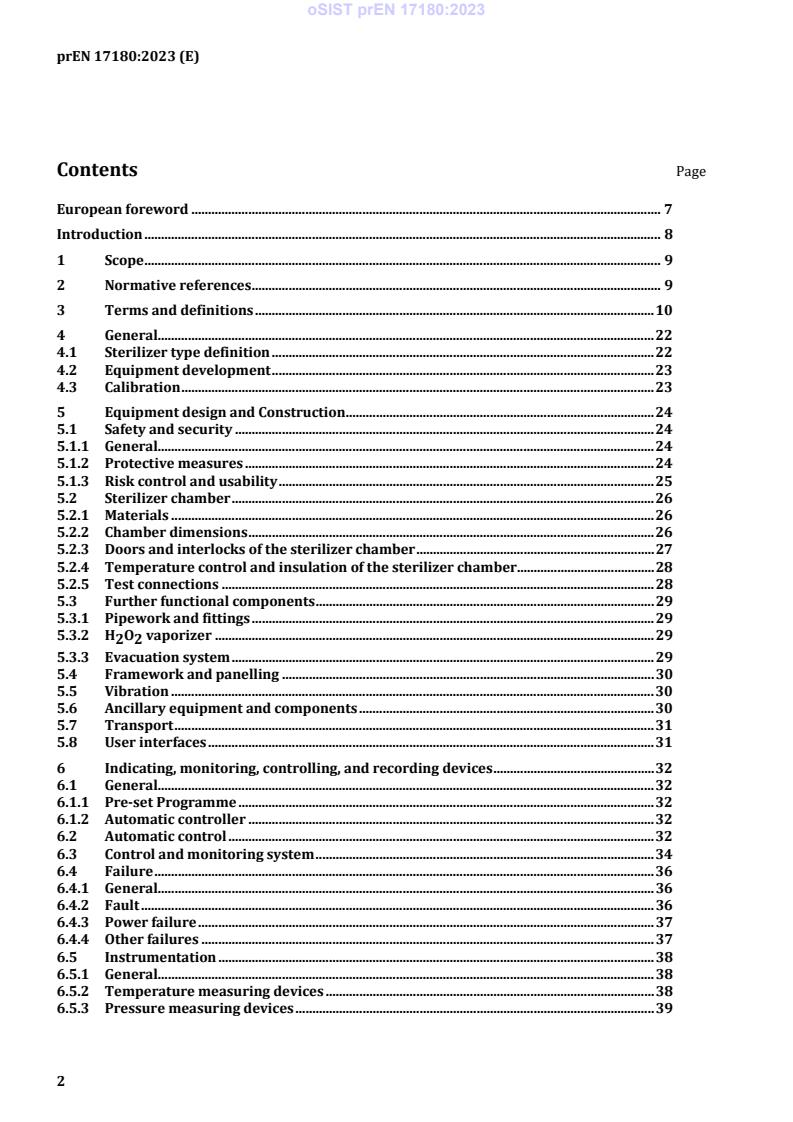
Contents Page
European foreword . 7
Introduction . 8
1 Scope . 9
2 Normative references . 9
3 Terms and definitions . 10
4 General. 22
4.1 Sterilizer type definition . 22
4.2 Equipment development . 23
4.3 Calibration . 23
5 Equipment design and Construction . 24
5.1 Safety and security . 24
5.1.1 General. 24
5.1.2 Protective measures . 24
5.1.3 Risk control and usability . 25
5.2 Sterilizer chamber . 26
5.2.1 Materials . 26
5.2.2 Chamber dimensions . 26
5.2.3 Doors and interlocks of the sterilizer chamber . 27
5.2.4 Temperature control and insulation of the sterilizer chamber . 28
5.2.5 Test connections . 28
5.3 Further functional components . 29
5.3.1 Pipework and fittings . 29
5.3.2 H O vaporizer . 29
2 2
5.3.3 Evacuation system . 29
5.4 Framework and panelling . 30
5.5 Vibration . 30
5.6 Ancillary equipment and components . 30
5.7 Transport . 31
5.8 User interfaces . 31
6 Indicating, monitoring, controlling, and recording devices . 32
6.1 General. 32
6.1.1 Pre-set Programme . 32
6.1.2 Automatic controller . 32
6.2 Automatic control . 32
6.3 Control and monitoring system . 34
6.4 Failure . 36
6.4.1 General. 36
6.4.2 Fault . 36
6.4.3 Power failure . 37
6.4.4 Other failures . 37
6.5 Instrumentation . 38
6.5.1 General. 38
6.5.2 Temperature measuring devices . 38
6.5.3 Pressure measuring devices . 39
oSIST prEN 17180:2023
prEN 17180:2023 (E)
6.5.4 Time measuring devices . 40
6.5.5 Sterilizing agent control and measuring devices . 41
Indicating devices . 41
6.5.6 General . 41
6.5.7 Cycle parameter indicating devices . 41
6.5.8 Cycle parameter indications . 43
6.5.9 Status indicators and indications . 43
6.5.10 Operating cycle counter . 44
6.6 Recorders . 44
6.6.1 General . 44
6.6.2 Records . 45
Table 1 — Example for VH2O2 operating cycle and data to be recorded (for cycle profile, see
Figure 1) . 46
Figure 1 — Schematic example of a VH2O2 operating cycle profile (for programme step
numbering and related operating cycle stages, see Table 1) . 47
6.6.3 Analog presentation of records . 48
6.6.4 Digital records . 48
6.6.5 Data format for applied sterilant amount . 48
6.7 Operating cycles . 48
6.7.1 General . 48
6.7.2 Leak test . 48
6.7.3 Sterilization cycles . 49
7 Services and local environment . 49
7.1 General . 49
7.2 Sterilant and sterilizing agent . 50
7.3 Electrical supply . 50
7.4 Water . 51
7.5 Steam . 51
7.6 Vacuum . 51
7.7 Lighting . 51
7.8 Drainage and discharges . 51
7.9 Compressed air . 51
7.10 Air and inert gases. 52
7.11 Ventilation and environment . 52
8 Emissions . 52
8.1 Electromagnetic emissions . 52
8.2 Noise . 52
8.3 Exhaust emissions . 53
8.4 Heat emission . 53
9 Test instrumentation . 54
10 Performance and assessment . 54
10.1 General . 54
Table 2 — Recommended testing to demonstrate Sterilizing Agent Exposure . 55
Figure 2 — Schematic example of a VH2O2 operating cycle profile demonstrating
relationship of cycle variables . 56
10.2 Attainment conditions . 57
10.2.1 Temperature reference measurement point . 57
10.2.2 H O temperature band . 57
2 2
10.2.3 Temperature profile . 57
oSIST prEN 17180:2023
prEN 17180:2023 (E)
10.2.4 Pressure profile requirements . 57
10.2.5 Sterilant and sterilizing agent . 58
10.3 Microbiological performance . 59
10.3.1 General. 59
10.3.2 Reduced cycle . 59
10.3.3 Microbiological efficacy . 59
10.4 Load dryness . 59
11 Information to be supplied . 60
11.1 General. 60
11.2 Information to be available prior to purchase . 60
11.3 Information prior to installation . 60
11.4 Marking and labelling . 61
11.5 Instructions for use . 62
12 Packaging . 63
Annex A (informative) Test programme . 64
A.1 General. 64
A.2 Type test . 65
A.3 Works test . 66
A.4 Installation qualification (IQ) provisions . 66
Annex B (normative) Test instrumentation . 67
B.1 General. 67
B.2 Pressure instrumentation . 67
B.3 Pressure recording . 67
B.4 Temperature probes . 68
B.5 Temperature recording instrument . 68
B.6 Sterilant supply and concentration measurement system . 68
B.7 Penetration Type Test devices (PTTDs) . 69
B.7.1 General. 69
B.7.2 PTTD construction. 69
B.7.3 Indicator systems for PTTDs . 70
B.7.4 Other type test devices . 71
B.7.5 Biological indicators and indicator systems . 71
B.8 Sterile barrier systems . 71
B.8.1 General. 71
B.8.2 Sterile Barrier Systems for standard test loads . 72
Annex C (normative) Test loads . 73
C.1 General. 73
C.2 General. 73
C.2.1 Test load unit . 73
C.2.2 Small load . 74
oSIST prEN 17180:2023
prEN 17180:2023 (E)
C.3 General . 74
C.3.1 Full load . 74
Annex D (normative) Test procedures. 75
D.1 General . 75
Figure D.1 — Biological indicator and small load unit locations for conducting physical and
microbiological performance test in cylindrical chambers . 77
Figure D.2 — Biological indicator and small load unit locations for conducting physical and
microbiological performance test in rectangular chambers . 78
D.2 Test procedures . 78
D.2.1 Sterilizer chamber temperature test . 78
D.2.2 Microbiological empty chamber distribution test . 79
D.2.3 Small load physical performance test . 79
D.2.4 Small load microbiological performance test . 80
D.2.5 Full load physical performance test. 80
D.2.6 Full load microbiological performance test . 81
D.2.7 Penetration performance test with PTTD . 81
D.2.8 Air Leakage test . 82
D.2.9 Drying test . 82
Annex E (informative) Measurement of hydrogen peroxide . 83
E.1 General . 83
E.2 H O in liquids . 83
2 2
E.2.1 Selection of test method . 83
E.2.2 Spectrometric analysis of H O contents in liquids . 84
2 2
E.2.2.1 Equipment . 84
E.2.2.2 Calibration. 84
E.2.2.3 Operation . 85
E.3 H O in gaseous compositions . 85
2 2
E.3.1 Selection of measurement method . 85
E.3.2 Measurement of gaseous H2O2 using electro chemical sensors . 86
E.3.3 Calibration and operation . 86
Annex F (normative) Efficacy of H O removal . 87
2 2
F.1 H O in ambient air . 87
2 2
F.1.1 Purpose of test . 87
F.1.2 Test scope . 87
F.1.3 Instrumentation . 87
F.1.4 Acceptance criteria . 87
oSIST prEN 17180:2023
prEN 17180:2023 (E)
F.2 Liquid H O on load . 87
2 2
F.2.1 Purpose of test . 87
F.2.2 Test scope . 88
F.2.3 Acceptance criteria. 88
Annex G (normative) Protective measures. 89
Annex H (informative) Environmental aspects . 91
H.1 Environmental aspects regarding the life cycle of VH2O2 sterilizers - General
Environmental aspects . 91
H.2 Hydrogen peroxide . 91
H.2.1 Physico-Chemical properties . 92
H.2.2 Classification criteria and labelling requirements . 92
H.3 Environmental impact . 93
Annex I (informative) Illustrations of the interrelationship between control and recording
................................................................................................................................................................... 96
I.1 Introduction . 96
I.1.1 General. 96
I.1.2 Illustration 1 . 96
Figure I.1 — Illustration 1 of the interrelationship between control and recording [Source:
ISO/TS 22421:2021, Figure B.1] . 97
I.2 Illustration 2 . 98
Figure I.2 — Illustration 2 of the interrelationship between control and recording [Source:
ISO/TS 22421:2021, Figure B.2] . 98
I.3 Illustration 3 . 99
I.3.1 General. 99
I.3.2 Main objectives . 100
I.3.3 Control data processing system . 100
I.3.4 Independent data processing system . 100
I.3.5 Cycle control function . 100
I.3.6 Means for failure detection . 101
I.3.7 Data retention module . 101
I.3.8 Controls and indicating devices . 101
I.3.9 Recorder . 101
I.3.10 Optional printer . 101
Annex J (normative) Technical information and documentation . 102
Annex ZA (informative) Relationship between this European Standard and the General
Safety and Performance Requirements of Regulation (EU) 2017/745 aimed to be
covered . 104
Bibliography . 121
oSIST prEN 17180:2023
prEN 17180:2023 (E)
European foreword
This document (prEN 17180:2023) has been prepared by Technical Committee CEN/TC 102 “Sterilizers
for medical purposes”, the secretariat of which is held by DIN.
This document is currently submitted to the CEN Enquiry.
A first draft (prEN 17180:2017) was published in 2017, but the status of the project was set back to a
preliminary work item. The following changes were made to the first draft:
— the structure of the main text has been widely adapted to the structure of ISO/TS 22421:2021 and
harmonized with the current revisions of EN 14180 and EN 1422 in 2022;
— most definitions have been adapted with reference to EN ISO 11139:2018;
— a separate clause ‘Protective measures’ has been implemented for referencing to individual clauses
of EN IEC 61010-2-040 and an Annex G ‘protective measures’ has been created;
— requirements on the control and monitoring system have been merged into a clause and informative
illustrations have been provided in an Annex I;
— an Annex J ‘Technical information and documentation’ has been added to consider Annex II of the
European Medical Device Regulation (MDR).
This document has been prepared under a standardization request given to CEN by the European
Commission and the European Free Trade Association and supports essential requirements of EU
Regulation(s).
For relationship with EU Regulation(s), see informative Annex ZA, which is an integral part of this
document.
oSIST prEN 17180:2023
prEN 17180:2023 (E)
Introduction
This document specifies minimum requirements and test methods for sterilizers performing a low
temperature sterilization process using a composition of water and hydrogen peroxide (H O ),
2 2
vaporized, and injected into the sterilizer chamber as sterilizing agent. Vaporized hydrogen peroxide
(H O ) sterilizers process typically below 60°C and are primarily used for the sterilization of
2 2
thermolabile or moisture-sensitive medical devices in health care facilities but can also be used for
sterilization of other reusable medical devices that have been established to be compatible with VH2O2
processes. The sterilizers operate automatically using pre-set cycles. VH2O2 sterilizers can also be used
by medical device manufacturers during commercial production.
Like the other standardized low temperature sterilization processes using ethylene oxide (EN 1422 and
EN ISO 11135) or low temperature steam and formaldehyde (EN 14180 and EN ISO 25424), the VH2O2
sterilization processes are specified by physical and chemical parameters and verified using physical,
chemical, and microbiological means. The sterilizers operate automatically using pre-set cycles.
The tests described in this document are reference tests intended to demonstrate conformity with the
performance requirements specified in this document. They may be used in type tests, works tests, in
validation and re-qualification, or in periodic and routine tests carried out by the user. Validation and
routine control of sterilization processes are essential to ensure their efficacy. This document does not
cover validation and routine control of a VH2O2 sterilization process. EN ISO 14937 provides general
requirements and guidance on validation and routine control of such processes. ISO 22441 provides
specific requirements for validation and routine control of VH2O2 sterilization.
Some VH2O2 sterilizers have processes that demonstrate some level of inactivation of the causative
agents of spongiform encephalopathies such as scrapie, bovine spongiform encephalopathy, and
Creutzfeldt-Jakob Disease. However, this inactivation is process, cycle, and test protocol specific, and not
equipment specific, therefore this inactivation is not addressed in this document, and no specific test
methods are provided.
Planning and design of products applying to this document should consider not only technical aspects
but also the environmental impact from the product during its life cycle. Environmental aspects are
addressed in Annex H of this document.
NOTE Specifications on general equipment safety are addressed in EN 61010-1, EN IEC 61010-2-040, and are
not repeated in this document. EN 60204-1 can also apply (see Annex G). Requirements on occupational safety and
health are not specified in this document. National regulations can exist.
oSIST prEN 17180:2023
prEN 17180:2023 (E)
1 Scope
This document specifies requirements and tests for low temperature hydrogen peroxide sterilizers, using
vaporized aqueous solution of hydrogen peroxide as the sterilizing agent.
These sterilizers are used for the sterilization of medical devices, particularly thermolabile medical
devices.
This document specifies minimum requirements:
— for the performance and design of sterilizers intended to deliver a process capable of sterilizing
medical devices;
— for the equipment and controls of these sterilizers needed for operation, control, and monitoring,
and which can be used for validation of the sterilization processes;
— for the test equipment and test procedures used to verify the sterilizer performance specified by this
document.
This document does not specify requirements for equipment intended to process liquids, biological
waste, or human tissues unless part of a medical device.
This document does not describe a quality management system for the control of all stages of the
manufacture of the sterilizer.
NOTE Attention is drawn to the standards for quality management, e.g. EN ISO 13485.
This document does not specify requirements and tests for decontamination systems for use in rooms,
enclosures, or environmental spaces.
2 Normative references
The following documents are referred to in the text in such a way that some or all of their content
constitutes requirements of this document. For dated references, only the edition cited applies. For
undated references, the latest edition of the referenced document (including any amendments) applies.
EN 868-5:2018, Packaging for terminally sterilized medical devices - Part 5: Sealable pouches and reels of
porous materials and plastic film construction - Requirements and test methods
EN 868-9:2018, Packaging for terminally sterilized medical devices - Part 9: Uncoated nonwoven materials
of polyolefines - Requirements and test methods
EN 60204-1:2018, Safety of machinery - Electrical equipment of machines - Part 1: General requirements
EN 60584-1:2013, Thermocouples - Part 1: EMF specifications and tolerances
EN 61010-1:2010, Safety requirements for electrical equipment for measurement, control, and laboratory
use - Part 1: General requirements
EN IEC 61326-1:2021, Electrical equipment for measurement, control and laboratory use - EMC
requirements - Part 1: General requirements
EN 62366-1:2015/A1:2020, Medical devices - Part 1: Application of usability engineering to medical
devices
EN IEC 60751:2022, Industrial platinum resistance thermometers and platinum temperature sensors
oSIST prEN 17180:2023
prEN 17180:2023 (E)
EN IEC 61010-2-040:2021, Safety requirements for electrical equipment for measurement, control, and
laboratory use - Part 2-040: Particular requirements for sterilizers and washer-disinfectors used to treat
medical materials
EN ISO 3746:2010, Acoustics - Determination of sound power levels and sound energy levels of noise sources
using sound pressure - Survey method using an enveloping measurement surface over a reflecting plane (ISO
3746:2010)
EN ISO 11138-1:2017, Sterilization of health care products - Biological indicators - Part 1: General
requirements (ISO 11138-1:2017)
EN ISO 11607-1:2020, Packaging for terminally sterilized medical devices - Part 1: Requirements for
materials, sterile barrier systems and packaging systems (ISO 11607-1:2019)
EN ISO 11607-2:2020, Packaging for terminally sterilized medical devices - Part 2: Validation requirements
for forming, sealing and assembly processes (ISO 11607-2:2019)
EN ISO 14971:2019, Medical devices - Application of risk management to medical devices (ISO 14971:2019)
EN ISO 15223-1:2021, Medical devices - Symbols to be used with information to be supplied by the
manufacturer - Part 1: General requirements (ISO 15223-1:2021)
EN ISO 20417:2021, Medical devices - Information to be supplied by the manufacturer (ISO 20417:2021,
Corrected version 2021-12)
ISO 2861:2020, Vacuum technology — Dimensions of clamped-type quick-release couplings
ISO 22441:2022, Sterilization of health care products — Low temperature vaporized hydrogen peroxide —
Requirements for the development, validation and routine control of a sterilization process for medical
devices
3 Terms and definitions
For the purposes of this document, the following terms and definitions apply.
ISO and IEC maintain terminological databases for use in standardization at the following addresses:
• IEC Electropedia: available at https://www.electropedia.org/
• ISO Online browsing platform: available at https://www.iso.org/obp
3.1
access device
means by which entry to restricted parts of equipment is achieved
Note 1 to entry: This can be by dedicated key, code, or tool.
[SOURCE: EN ISO 11139:2018, 3.4]
3.2
accompanying information
information accompanying or marked on a sterilizer and containing information for the user or those
accountable for the installation, use, maintenance, decommissioning and disposal of the sterilizer,
particularly regarding safe use
oSIST prEN 17180:2023
prEN 17180:2023 (E)
Note 1 to entry: The accompanying information can be regarded as part of the sterilizer.
Note 2 to entry: The accompanying information can consist of the label (see 3.29), marking, instructions for use,
technical description, installation manual, quick reference guide, etc.
Note 3 to entry: Accompanying information is not necessarily a written or printed document but could involve
auditory, visual, or tactile materials and multiple media types (e.g. CD/DVD-ROM, USB stick, website).
[SOURCE: EN ISO 20417:2021, 3.2, modified — “Medical device or accessory” has been changed to
“sterilizer”, the term “processing” has been removed, Note 1 to entry has been modified to exclude a
requirement and Note 4 to entry has been deleted.]
3.3
automatic controller
device that directs the equipment sequentially throug
...