


kSIST FprEN 1999-1-3:2022
(Main)Eurocode 9 - Design of aluminium structures - Part 1-3: Structures susceptible to fatigue
Eurocode 9 - Design of aluminium structures - Part 1-3: Structures susceptible to fatigue
1.1 Scope of EN 1999-1-3
(1) This document gives the basis for the design of aluminium alloy structures subject to fatigue in the ultimate limit state.
(2) This document gives rules for:
- safe life design;
- damage tolerant design;
- design assisted by testing.
(3) This document does not cover pressurized containment vessels or pipework.
1.2 Assumptions
(1) The general assumptions of EN 1990 apply.
(2) The provisions of EN 1999-1-1 apply.
(3) EN 1999-1-3 is intended to be used in conjunction with EN 1990, EN 1991 (all parts), relevant parts in EN 1992 to EN 1999, EN 1090-1 and EN 1090-3 for requirements for execution, and ENs, EADs and ETAs for construction products relevant to aluminium structures.
Eurocode 9 - Bemessung und Konstruktion von Aluminiumtragwerken - Teil 1-3: Ermüdungsbeanspruchte Tragwerke
1.1 Anwendungsbereich von EN 1999 1 3
(1) EN 1999 1 1 enthält die Grundlage für die Bemessung von ermüdungsbeanspruchten Tragwerken aus Aluminiumlegierungen für den Grenzzustand der Tragfähigkeit.
(2) Dieses Dokument enthält Regeln für:
— schwingbruchsichere Bemessung;
— schadenstolerante Bemessung;
— versuchsunterstützte Bemessung.
(3) Druckbehälter oder Rohrleitungen sind nicht Gegenstand dieses Dokuments.
1.2 Annahmen
(1) Es gelten die allgemeinen Annahmen nach EN 1990.
(2) Es gelten die Festlegungen nach EN 1999 1 1.
(3) Dieses Dokument ist dazu vorgesehen, in Verbindung mit EN 1990, EN 1991 (alle Teile), relevanten Teilen in EN 1992 bis EN 1999, EN 1090 1 und EN 1090 3 zu Anforderungen an die Ausführung und EN, EAD und ETA zu Bauprodukten, die maßgebend für Aluminiumtragwerke sind, angewendet zu werden.
Eurocode 9 - Calcul des structures en aluminium - Partie 1-3 : Structures sensibles à la fatigue
1.1 Domaine d'application de l'EN 1999-1-3
(1) Le présent document donne les règles fondamentales de calcul des structures en alliage d'aluminium sensibles à la fatigue dans l'état limite ultime.
(2) Le présent document fournit les règles pour :
- le calcul en appliquant la méthode de la durée de vie sûre ;
- le calcul en appliquant la méthode de la tolérance à l’endommagement ;
- le calcul assisté par des essais.
(3) Le présent document ne couvre pas les récipients de confinement ou les conduites sous pression.
1.2 Hypothèses
(1) Les hypothèses générales données dans l'EN 1990 s'appliquent.
(2) Les dispositions de l'EN 1999-1-1 s'appliquent.
(3) L'EN 1999-1-3 est destinée à être utilisée avec l'EN 1990, l'EN 1991 (toutes les parties), les parties concernées de l'EN 1992 à l'EN 1999, l'EN 1090-1 et l'EN 1090-3 pour ce qui concerne les exigences relatives à l'exécution, ainsi qu'avec les EN, DEE et ATE pour ce qui concerne les produits de construction convenant aux structures en aluminium.
Evrokod 9 - Projektiranje konstrukcij iz aluminijevih zlitin - 1-3. del: Konstrukcije, občutljive na utrujanje
1.1 Področje uporabe standarda EN 1999-1-3
(1) Ta dokument podaja podlago za projektiranje konstrukcij iz aluminijevih zlitin, ki so v mejnem stanju izpostavljene utrujanju.
(2) Ta dokument podaja pravila za:
– projektiranje po kriteriju varne življenjske dobe;
– projektiranje po kriteriju tolerance škode;
– projektiranje s pomočjo preskušanja.
(3) Ta dokument ne obravnava tlačnih posod ali cevi.
1.2 Predpostavke
(1) Veljajo splošne predpostavke za standard EN 1990.
(2) Veljajo določbe standarda EN 1999-1-1.
(3) Standard EN 1999-1-3 je namenjen za uporabo skupaj s standardi EN 1990, EN 1991 (vsi deli), ustreznimi deli standardov od EN 1992 do EN 1999, standardoma EN 1090-1 in EN 1090-3 za zahteve za izvedbo in standardi EN, EAD in ETA za gradbene proizvode, ki veljajo za aluminijaste konstrukcije.
General Information
Relations
Standards Content (Sample)
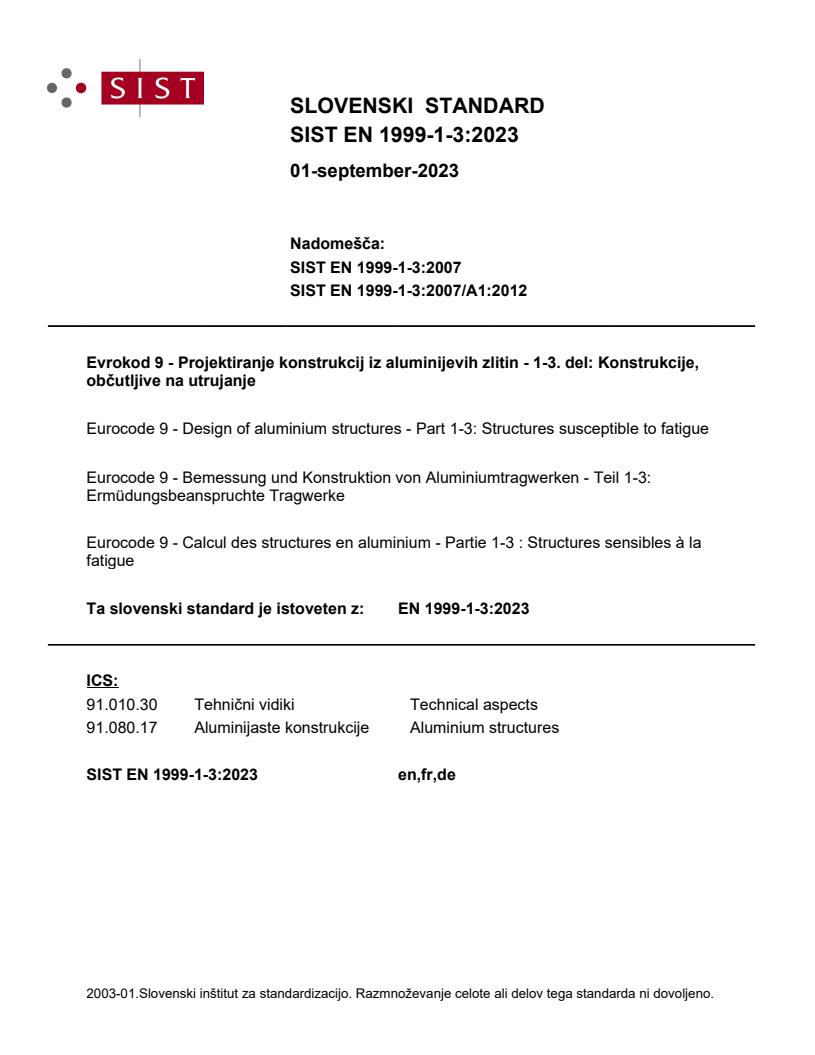
SLOVENSKI STANDARD
SIST EN 1999-1-3:2023
01-september-2023
Nadomešča:
SIST EN 1999-1-3:2007
SIST EN 1999-1-3:2007/A1:2012
Evrokod 9 - Projektiranje konstrukcij iz aluminijevih zlitin - 1-3. del: Konstrukcije,
občutljive na utrujanje
Eurocode 9 - Design of aluminium structures - Part 1-3: Structures susceptible to fatigue
Eurocode 9 - Bemessung und Konstruktion von Aluminiumtragwerken - Teil 1-3:
Ermüdungsbeanspruchte Tragwerke
Eurocode 9 - Calcul des structures en aluminium - Partie 1-3 : Structures sensibles à la
fatigue
Ta slovenski standard je istoveten z: EN 1999-1-3:2023
ICS:
91.010.30 Tehnični vidiki Technical aspects
91.080.17 Aluminijaste konstrukcije Aluminium structures
SIST EN 1999-1-3:2023 en,fr,de
2003-01.Slovenski inštitut za standardizacijo. Razmnoževanje celote ali delov tega standarda ni dovoljeno.
SIST EN 1999-1-3:2023
SIST EN 1999-1-3:2023
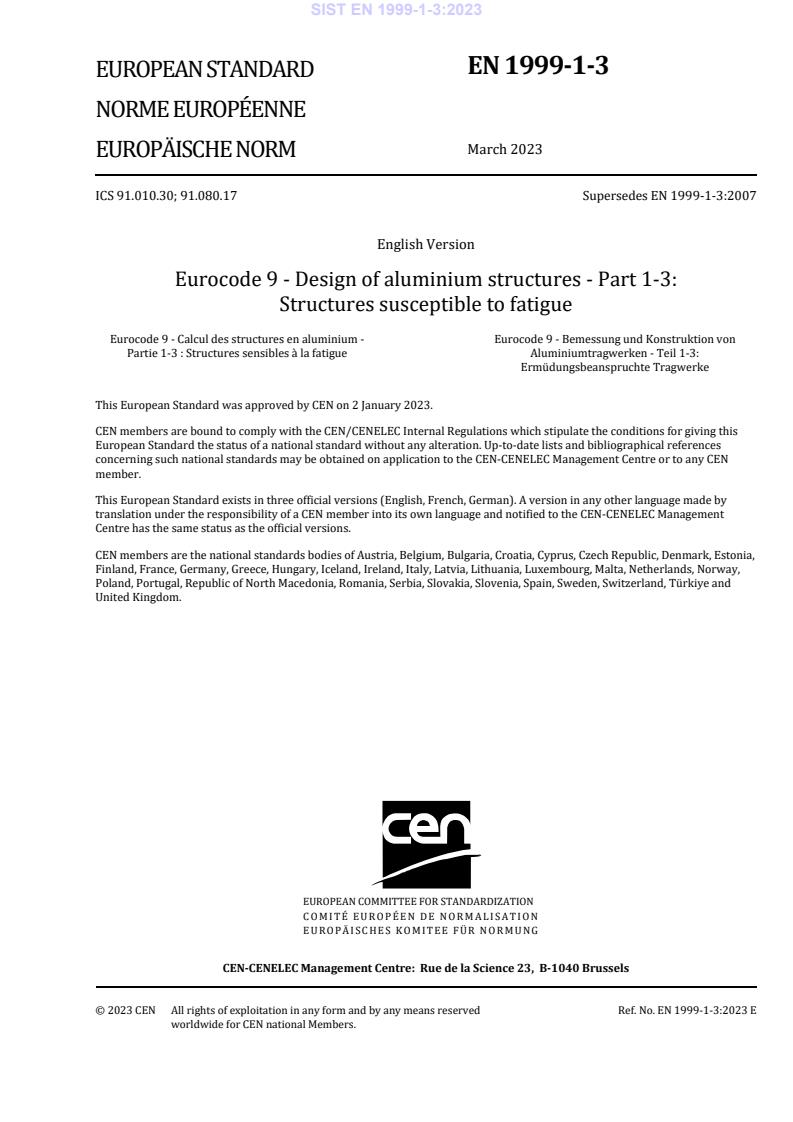
EN 1999-1-3
EUROPEAN STANDARD
NORME EUROPÉENNE
March 2023
EUROPÄISCHE NORM
ICS 91.010.30; 91.080.17 Supersedes EN 1999-1-3:2007
English Version
Eurocode 9 - Design of aluminium structures - Part 1-3:
Structures susceptible to fatigue
Eurocode 9 - Calcul des structures en aluminium - Eurocode 9 - Bemessung und Konstruktion von
Partie 1-3 : Structures sensibles à la fatigue Aluminiumtragwerken - Teil 1-3:
Ermüdungsbeanspruchte Tragwerke
This European Standard was approved by CEN on 2 January 2023.
CEN members are bound to comply with the CEN/CENELEC Internal Regulations which stipulate the conditions for giving this
European Standard the status of a national standard without any alteration. Up-to-date lists and bibliographical references
concerning such national standards may be obtained on application to the CEN-CENELEC Management Centre or to any CEN
member.
This European Standard exists in three official versions (English, French, German). A version in any other language made by
translation under the responsibility of a CEN member into its own language and notified to the CEN-CENELEC Management
Centre has the same status as the official versions.
CEN members are the national standards bodies of Austria, Belgium, Bulgaria, Croatia, Cyprus, Czech Republic, Denmark, Estonia,
Finland, France, Germany, Greece, Hungary, Iceland, Ireland, Italy, Latvia, Lithuania, Luxembourg, Malta, Netherlands, Norway,
Poland, Portugal, Republic of North Macedonia, Romania, Serbia, Slovakia, Slovenia, Spain, Sweden, Switzerland, Türkiye and
United Kingdom.
EUROPEAN COMMITTEE FOR STANDARDIZATION
COMITÉ EUROPÉEN DE NORMALISATION
EUROPÄISCHES KOMITEE FÜR NORMUNG
CEN-CENELEC Management Centre: Rue de la Science 23, B-1040 Brussels
© 2023 CEN All rights of exploitation in any form and by any means reserved Ref. No. EN 1999-1-3:2023 E
worldwide for CEN national Members.
SIST EN 1999-1-3:2023
Contents
European foreword . 7
Introduction . 8
1 Scope . 11
1.1 Scope of EN 1999-1-3 . 11
1.2 Assumptions . 11
2 Normative references . 11
3 Terms, definitions and symbols . 12
3.1 Terms and definitions . 12
3.2 Symbols . 16
4 Basis of design . 18
4.1 Basic rules . 18
4.2 Methods of fatigue design . 19
4.2.1 Safe life design (SLD) . 19
4.2.2 Damage tolerant design (DTD) . 19
4.2.3 Design assisted by testing . 19
4.3 Fatigue loading . 19
4.3.1 Sources of fatigue loading . 19
4.3.2 Derivation of fatigue loading . 20
4.3.3 Equivalent fatigue loading . 20
4.4 Partial factors for fatigue loads . 21
4.5 Execution requirements . 21
4.5.1 General . 21
4.5.2 Execution classes . 21
4.5.3 Execution specification . 21
4.5.4 Operation manual . 22
4.5.5 Inspection and maintenance manual . 22
5 Materials, constituent products and connecting devices . 22
6 Durability . 23
7 Structural analysis . 24
7.1 Global analysis . 24
7.1.1 General . 24
7.1.2 Use of beam elements . 25
7.1.3 Use of membrane, shell and solid elements . 25
7.2 Types of stresses . 26
7.2.1 General . 26
7.2.2 Nominal stresses . 26
7.2.3 Modified nominal stresses . 26
7.2.4 Hot spot stresses. 27
7.3 Derivation of stresses . 29
7.3.1 Derivation of nominal stresses . 29
7.3.2 Derivation of modified nominal stresses . 29
7.3.3 Derivation of hot spot stresses . 30
7.3.4 Stress orientation . 30
7.4 Stress ranges for specific initiation sites . 30
7.4.1 Parent material, welds, and mechanically fastened joints. 30
7.4.2 Fillet and partial penetration butt welds . 30
SIST EN 1999-1-3:2023
7.5 Adhesive bonds . 31
7.6 Castings . 31
7.7 Stress spectra . 31
7.8 Calculation of equivalent stress range for standardized fatigue load models . 31
7.8.1 General . 31
7.8.2 Design value of stress range . 32
8 Fatigue resistance and detail categories . 32
8.1 Detail categories . 32
8.1.1 General . 32
8.1.2 Factors affecting detail category . 32
8.1.3 Constructional details . 33
8.2 Fatigue strength data . 33
8.2.1 Classified constructional details . 33
8.2.2 Unclassified details . 36
8.2.3 Adhesively bonded joints. 36
8.2.4 Determination of the reference hot spot strength values . 36
8.3 Effect of mean stress . 36
8.3.1 General . 36
8.3.2 Parent material and mechanically fastened joints . 36
8.3.3 Welded joints . 36
8.3.4 Adhesive joints . 37
8.3.5 Low endurance range . 37
8.3.6 Cycle counting for R-ratio calculations . 37
8.4 Effect of exposure conditions . 37
8.5 Improvement techniques. 38
Annex A (normative) Basis for calculation of fatigue resistance . 39
A.1 Use of this annex . 39
A.2 Scope and field of application . 39
A.3 General . 39
A.3.1 Influence of fatigue on design . 39
A.3.2 Mechanism of failure . 39
A.3.3 Potential sites for fatigue cracking. 40
A.3.4 Conditions for fatigue susceptibility . 40
A.4 Safe life design . 41
A.4.1 General . 41
A.4.2 Prerequisites for safe life design . 42
A.4.3 Design approach . 42
A.4.4 Cycle counting . 44
A.4.5 Derivation of stress spectrum . 45
A.5 Damage tolerant design . 46
A.5.1 Prerequisites for damage tolerant design . 46
A.5.2 Structural layout and detailing . 47
A.5.3 Determination of inspection strategy for damage tolerant design . 47
Annex B (informative) Guidance on assessment of crack growth by fracture mechanics . 50
SIST EN 1999-1-3:2023
B.1 Use of this informative annex . 50
B.2 Scope and field of application . 50
B.3 Principles . 50
B.3.1 Flaw dimensions . 50
B.3.2 Crack growth relationship . 51
B.4 Crack growth data A and m . 52
B.5 Geometry function y . 53
B.6 Integration of crack growth . 53
B.7 Assessment of maximum crack size a . 54
Annex C (informative) Testing for fatigue design . 61
C.1 Use of this informative annex . 61
C.2 Scope and field of application . 61
C.3 Derivation of action loading data . 61
C.3.1 Fixed structures subject to mechanical action . 61
C.3.2 Fixed structures subject to actions due to exposure conditions . 62
C.3.3 Moving structures . 62
C.4 Derivation of stress data . 62
C.4.1 Component test data . 62
C.4.2 Structure test data . 63
C.4.3 Verification of stress history . 63
C.5 Derivation of endurance data . 63
C.5.1 Component testing . 63
C.5.2 Full scale testing . 64
C.5.3 Acceptance . 64
C.6 Crack growth data . 67
C.7 Reporting . 67
Annex D (informative) Stress analysis . 69
D.1 Use of this informative annex . 69
D.2 Scope and field of application . 69
D.3 Use of finite elements for fatigue analysis . 69
D.3.1 Element types . 69
D.3.2 Further guidance on use of finite elements . 70
D.4 Stress concentration factors . 70
D.5 Limitation of fatigue induced by repeated local buckling . 72
Annex E (informative) Adhesively bonded joints . 73
E.1 Use of this informative annex . 73
SIST EN 1999-1-3:2023
E.2 Scope and field of application . 73
Annex F (informative) Low cycle fatigue range . 76
F.1 Use of this informative annex . 76
F.2 Scope and field of application . 76
F.3 Modification to fatigue strength curves. 76
F.4 Test data . 77
Annex G (informative) Influence of applied stress ratio R . 78
G.1 Use of this informative annex . 78
G.2 Scope and field of application . 78
G.3 Enhancement of fatigue strength . 78
G.4 Enhancement cases . 78
G.4.1 Case 1 . 78
G.4.2 Case 2 . 79
G.4.3 Case 3 . 80
Annex H (informative) Fatigue strength improvement of welds. 81
H.1 Use of this informative annex . 81
H.2 Scope and field of application . 81
H.3 Machining or grinding . 82
H.4 Dressing by TIG or plasma. 83
H.5 Peening . 83
Annex I (informative) Castings . 84
I.1 Use of this informative annex . 84
I.2 Scope and field of application . 84
I.3 Fatigue strength data . 84
I.3.1 Cast material. 84
I.3.2 Welded material . 84
I.3.3 Mechanically joined castings . 85
I.3.4 Adhesively bonded castings . 85
I.4 Quality requirements . 85
Annex J (informative) Detail category tables . 87
J.1 Use of this informative annex . 87
J.2 Scope and field of application . 87
Annex K (informative) Hot spot reference detail method . 116
K.1 Use of this informative annex . 116
K.2 Scope and field of application . 116
K.3 Hot spot reference detail method . 116
SIST EN 1999-1-3:2023
Annex L (informative) Guidance on use of design methods, selection of partial factors,
limits for damage values, inspection intervals and execution parameters if Annex J is
adopted . 117
L.1 Use of this informative annex . 117
L.2 Scope and field of application . 117
L.3 Safe life design approach . 117
L.3.1 General . 117
L.3.2 SLD-I . 117
L.3.3 SLD-II . 118
L.4 Damage tolerant design approach . 118
L.4.1 General . 118
L.4.2 DTD-I . 118
L.4.3 DTD-II . 119
L.5 Start of inspection and inspection intervals . 119
L.6 Partial factors γ and the values of D . 120
Mf Lim
L.7 Parameters for execution . 122
L.7.1 Service category . 122
L.7.2 Calculation of utilization grade . 123
Bibliography . 125
SIST EN 1999-1-3:2023
European foreword
This document (EN 1999-1-3:2023) has been prepared by Technical Committee CEN/TC250 “Structural
Eurocodes”, the secretariat of which is held by BSI. CEN/TC 250 is responsible for all Structural
Eurocodes and has been assigned responsibility for structural and geotechnical design matters by CEN.
This European Standard shall be given the status of a national standard, either by publication of an
identical text or by endorsement, at the latest by September 2027, and conflicting national standards shall
be withdrawn at the latest by March 2028.
Attention is drawn to the possibility that some of the elements of this document may be the subject of
patent rights. CEN shall not be held responsible for identifying any or all such patent rights.
This document supersedes EN 1999-1-3:2007.
The first generation of EN Eurocodes was published between 2002 and 2007. This document forms part
of the second generation of the Eurocodes, which have been prepared under Mandate M/515 issued to
CEN by the European Commission and the European Free Trade Association.
The Eurocodes have been drafted to be used in conjunction with relevant execution, material, product
and test standards, and to identify requirements for execution, materials, products and testing that are
relied upon by the Eurocodes.
The Eurocodes recognize the responsibility of each Member State and have safeguarded their right to
determine values related to regulatory safety matters at national level through the use of National
Annexes.
The main changes compared to the previous edition are listed below:
— Some reorganization of the text and its coherence with EN 1999-1-1 and the other Eurocodes;
— Improvement of figures;
— Improvement of detail categories for fillet-welded joints between members (Table J.9);
— Improvement of detail categories for bolted joints (Table J.15);
— Inclusion of Friction Stir Welding (FSW) in the scope;
— Inclusion of detail categories for members with Friction Stir Welding (New Table J.17)
Any feedback and questions on this document should be directed to the users’ national standards body.
A complete listing of these bodies can be found on the CEN website.
According to the CEN-CENELEC Internal Regulations, the national standards organisations of the
following countries are bound to implement this European Standard: Austria, Belgium, Bulgaria, Croatia,
Cyprus, Czech Republic, Denmark, Estonia, Finland, France, Germany, Greece, Hungary, Iceland, Ireland,
Italy, Latvia, Lithuania, Luxembourg, Malta, Netherlands, Norway, Poland, Portugal, Republic of North
Macedonia, Romania, Serbia, Slovakia, Slovenia, Spain, Sweden, Switzerland, Türkiye and the United
Kingdom.
SIST EN 1999-1-3:2023
Introduction
0.1 Introduction to the Eurocodes
The Structural Eurocodes comprise the following standards generally consisting of a number of Parts:
• EN 1990 Eurocode: Basis of structural and geotechnical design
• EN 1991 Eurocode 1: Actions on structures
• EN 1992 Eurocode 2: Design of concrete structures
• EN 1993 Eurocode 3: Design of steel structures
• EN 1994 Eurocode 4: Design of composite steel and concrete structures
• EN 1995 Eurocode 5: Design of timber structures
• EN 1996 Eurocode 6: Design of masonry structures
• EN 1997 Eurocode 7: Geotechnical design
• EN 1998 Eurocode 8: Design of structures for earthquake resistance
• EN 1999 Eurocode 9: Design of aluminium structures
• New parts are under development, e.g. Eurocode for design of structural glass
The Eurocodes are intended for use by designers, clients, manufacturers, constructors, relevant
authorities (in exercising their duties in accordance with national or international regulations),
educators, software developers, and committees drafting standards for related product, testing and
execution standards.
NOTE Some aspects of design are most appropriately specified by relevant authorities or, where not specified,
can be agreed on a project-specific basis between relevant parties such as designers and clients. The Eurocodes
identify such aspects making explicit reference to relevant authorities and relevant parties.
0.2 Introduction to EN 1999 (all parts)
EN 1999 (all parts) applies to the design of buildings and civil engineering and structural works made of
aluminium. It complies with the principles and requirements for the safety and serviceability of
structures, the basis of their design and verification that are given in EN 1990 – Basis of structural design.
EN 1999 (all parts) is only concerned with requirements for resistance, serviceability, durability and fire
resistance of aluminium structures. Other requirements, e.g. concerning thermal or sound insulation, are
not considered.
EN 1999 (all parts) does not cover the special requirements of seismic design. Provisions related to such
requirements are given in EN 1998, which complements, and is consistent with EN 1999.
Eurocode 9 is subdivided in various parts:
— EN 1999-1-1 Design of Aluminium Structures — Part 1-1: General rules.
— EN 1999-1-2 Design of Aluminium Structures — Part 1-2: Structural fire design.
— EN 1999-1-3 Design of Aluminium Structures — Part 1-3: Structures susceptible to fatigue.
SIST EN 1999-1-3:2023
— EN 1999-1-4 Design of Aluminium Structures — Part 1-4: Cold-formed structural sheeting.
— EN 1999-1-5 Design of Aluminium Structures — Part 1-5: Shell structures.
0.3 Introduction to EN 1999-1-3
This document gives the basis for the design of aluminium alloy structures subject to fatigue in the
ultimate limit state.
0.4 Verbal forms used in the Eurocodes
The verb “shall” expresses a requirement strictly to be followed and from which no deviation is permitted
in order to comply with the Eurocodes.
The verb “should” expresses a highly recommended choice or course of action. Subject to national
regulation and/or any relevant contractual provisions, alternative approaches could be used/adopted
where technically justified.
The verb “may” expresses a course of action permissible within the limits of the Eurocodes.
The verb “can” expresses possibility and capability; it is used for statements of fact and clarification of
concepts.
0.5 National annex for EN 1999-1-3
National choice is allowed in this document where explicitly stated within notes. National choice includes
the selection of values for Nationally Determined Parameters (NDPs).
The national standard implementing EN 1999-1-3 can have a National Annex containing all national
choices to be used for the design of buildings and civil engineering works to be constructed in the relevant
country.
When no national choice is given, the default choice given in this document is to be used.
When no national choice is made and no default is given in this document, the choice can be specified by
a relevant authority or, where not specified, agreed for a specific project by appropriate parties.
National choice is allowed in EN 1999-1-3 through the following clauses:
4.1(2) 4.3.1(2) 4.3.2(5) 4.4(1) – 2 choices
7.8.1(1) 7.8.2(1)
5(1) 6(2)
8.1.3(1) – 2 choices 8.2.1(2) 8.2.1(7) 8.2.1(10)
A.4.1(4) A.4.1(5) E.2(6) E.2(8)
I.3.2(1) I.3.3.2(1) I.3.4(1) L.4.2(5)
L.5(2) L.6(3) – 2 choices L.6(4) L.6(5)
L.7.1(1)
SIST EN 1999-1-3:2023
National choice is allowed in EN 1999-1-3 on the application of the following informative annexes:
Annex B Annex C Annex D Annex E
Annex F Annex G Annex H Annex I
Annex J Annex K Annex L
The National Annex can contain, directly or by reference, non-contradictory complementary information
for ease of implementation, provided it does not alter any provisions of the Eurocodes.
SIST EN 1999-1-3:2023
1 Scope
1.1 Scope of EN 1999-1-3
(1) EN 1999-1-1 gives the basis for the design of aluminium alloy structures subject to fatigue in the
ultimate limit state.
(2) This document gives rules for:
— safe life design;
— damage tolerant design;
— design assisted by testing.
(3) This document does not cover pressurized containment vessels or pipework.
1.2 Assumptions
(1) The general assumptions of EN 1990 apply.
(2) The provisions of EN 1999-1-1 apply.
(3) This document is intended to be used in conjunction with EN 1990, EN 1991 (all parts), relevant parts
in EN 1992 to EN 1999, EN 1090-1 and EN 1090-3 for requirements for execution, and ENs, EADs and
ETAs for construction products relevant to aluminium structures.
2 Normative references
The following documents are referred to in the text in such a way that some or all of their content
constitutes requirements of this document. For dated references, only the edition cited applies. For
undated references, the latest edition of the referenced document (including any amendments) applies.
NOTE See the Bibliography for a list of other documents cited that are not normative references, including
those referenced as recommendations (i.e. through ‘should’ clauses) and permissions (i.e. through ‘may’ clauses).
EN 1090-3:2019, Execution of steel structures and aluminium structures - Part 3: Technical requirements
for aluminium structures
EN 1990, Eurocode - Basis of structural design
EN 1999-1-1:2023, Eurocode 9 — Design of aluminium structures — Part 1-1: General rules
SIST EN 1999-1-3:2023
3 Terms, definitions and symbols
3.1 Terms and definitions
For the purposes of this document, the terms and definitions given in EN 1990, EN 1999-1-1:2023 and
the following apply.
3.1.1
fatigue
weakening of a structural part, through crack initiation and propagation caused by repeated stress
fluctuations
3.1.2
fatigue loading
set of typical load events described by the positions or movements of actions, their variation in intensity
and their frequency and sequence of occurrence
3.1.3
loading event
defined load sequence applied to the structure, which, for design purposes, is assumed to repeat at a given
frequency
3.1.4
nominal stress
stress in the parent material adjacent to a potential crack location, calculated in accordance with simple
elastic strength of materials theory, i.e. assuming that plane sections remain plane and that all stress
concentration effects are ignored
3.1.5
modified nominal stress
nominal stress increased by an appropriate geometrical stress concentration factor, K , to allow only for
gt
geometric changes of cross section which have not been taken into account in the classification of a
particular constructional detail
3.1.6
geometric stress
structural stress
elastic stress at a point, taking into account all geometrical discontinuities, but ignoring any local
singularities where the transition radius tends to zero, such as notches due to small discontinuities, e.g.
weld toes, cracks, crack like features, normal machining marks etc., and is in principle the same stress
parameter as the modified nominal stress, but generally evaluated by a different method
3.1.7
geometric stress concentration factor
ratio between the geometric stress evaluated with the assumption of linear elastic behaviour of the
material and the nominal stress
3.1.8
hot spot stress
geometric stress at a specified initiation site in a particular type of geometry, such as a weld toe in an
angle hollow section joint, for which the fatigue strength, expressed in terms of the hot spot stress range,
is usually known
SIST EN 1999-1-3:2023
3.1.9
stress history
continuous chronological record, either measured or calculated, of the stress variation at a particular
point in a structure for a given period of time
3.1.10
stress turning point
value of stress in a stress history where the rate of change of stress changes sign
3.1.11
stress peak
turning point where the rate of change of stress changes from positive to negative
3.1.12
stress valley
turning point where the rate of change of stress changes from negative to positive
3.1.13
constant amplitude
relating to a stress history where the stress alternates between stress peaks and stress valleys of constant
values
3.1.14
variable amplitude
relating to any stress history containing more than one value of peak or valley stress
3.1.15
stress cycle
part of a constant amplitude stress history where the stress starts and finishes at the same value but, in
doing so passes through one stress peak and one stress valley (in any sequence) and a specific part of a
variable amplitude stress history as determined by a cycle counting method
3.1.16
cycle counting
process of transforming a variable amplitude stress history into a sp
...
Questions, Comments and Discussion
Ask us and Technical Secretary will try to provide an answer. You can facilitate discussion about the standard in here.