

SIST EN 3475-302:2009
(Main)Aerospace series - Cable, electrical, aircraft use - Test methods - Part 302: Voltage proof test
- Abstract
This standard specifies a method of performing voltage proof tests on finished cables and cables in course of production.
It shall be used together with EN 3475-100.
- Status
- Published
- Publication Date
- 26-Jan-2009
- Technical Committee
- I13 - Imaginarni 13
- Current Stage
- 6060 - National Implementation/Publication (Adopted Project)
- Start Date
- 07-Jan-2009
- Due Date
- 14-Mar-2009
- Completion Date
- 27-Jan-2009

SIST EN 3475-302:2009 is the Slovenian adoption of EN 3475-302:2006 from SIST for aerospace cable testing. It specifies voltage proof tests for finished electrical cables and cables in course of production, and it is used together with EN 3475-100. In practice, it tells manufacturers and test laboratories how to check that cable insulation, jackets, or screened constructions withstand the required voltage without perforation or flash-over.
What does SIST EN 3475-302:2009 specify?
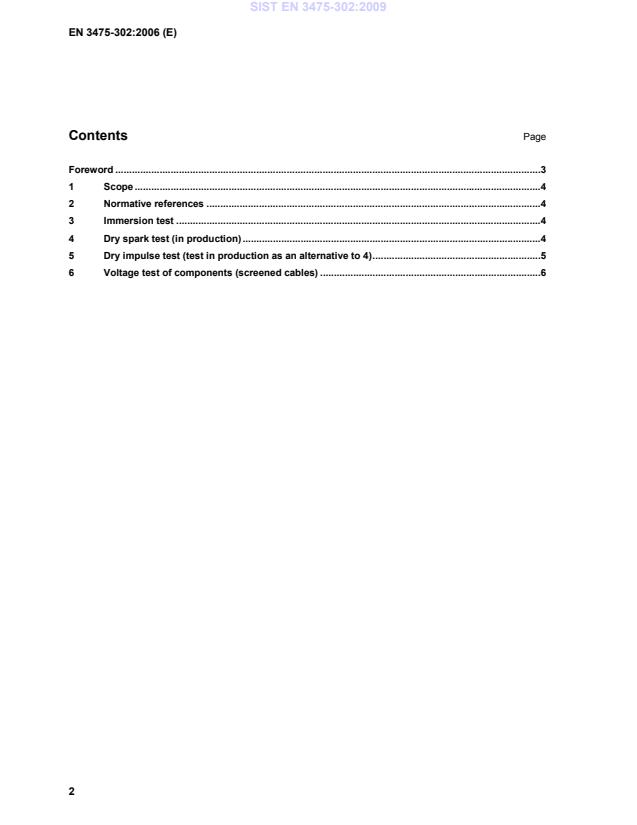
SIST EN 3475-302:2009 specifies methods for voltage proof testing of aircraft-use electrical cables. The document is organized into scope, normative references, then four test sections: immersion test, dry spark test, dry impulse test, and voltage test of components for screened cables.
The scope is practical and narrow: it applies to finished cables and to cables during production. That matters because the standard covers both laboratory verification and in-line production testing.
What are the key requirements of SIST EN 3475-302:2009?
Clause 1 says the standard is to be used with EN 3475-100. In practice, that means the general rules from Part 100 apply first, and this part only adds the voltage proof test methods.
Clause 3, Immersion test uses 15 m specimens immersed in a saline solution before voltage is applied for 5 min at 40 Hz to 60 Hz. The voltage rises at a controlled rate, and there must be no perforation of the insulation or jacket. For the reader, this is the wet-condition proof test: it checks whether the cable still withstands voltage after immersion.
Clause 3 also distinguishes how the test is connected: for single and multicore jacketed cables without shield, the voltage is applied between the conductor(s) and an electrode in the liquid; for shielded and jacketed cables, it is applied between the shield and the electrode. This matters because the test arrangement must match the cable construction.
Clause 4, Dry spark test applies to all finished cables in production. Each part of the insulation or jacket must pass through the electrode long enough to be exposed to test voltage for at least 0.20 s, with no flash-over or perforation. In practice, this is the continuous in-line screening test that helps find insulation defects before shipment.
Clause 5, Dry impulse test is an alternative production test to Clause 4. It uses a beaded-chain electrode, a negative pulse waveform, a defined pulse rate, a calibrated voltmeter, and an error-detection circuit that stops the cable if a fault is found. For production, this means the equipment must not only apply voltage, but also detect and react to insulation faults automatically.
Clause 5 also requires calibration and coverage of the whole cable length, including the ends, with a defined speed so each point sees a limited number of pulses. If a defect is found, the damaged section must be cut away. This matters because the method is intended for full-length production control, not just spot checking.
Clause 6, Voltage test of components applies to screened cables at ambient temperature, with the r.m.s. voltage specified in the technical specification and applied for at least 1 min. The voltage is applied between one component and the other components and the screen connected together, with no perforation allowed. This is the check for internal separation inside screened cable constructions.
What terms does SIST EN 3475-302:2009 define?
- Voltage proof test - a withstand test used to verify that the cable insulation or jacket does not break down under applied voltage.
- Dry spark test - a production test where the cable passes through an electrode and is checked continuously for surface insulation faults.
- Dry impulse test - a production test that uses a pulsed high-voltage waveform instead of a continuous spark test.
- Screened cables - cables with a screen that is part of the voltage test arrangement in Clauses 4 to 6.
- Flash-over - an unwanted electrical discharge across or along the insulation surface.
- r.m.s. - root mean square, the voltage value used in Clause 6 for the component test.
Who uses SIST EN 3475-302:2009?
SIST EN 3475-302:2009 is used by aerospace cable manufacturers, production test operators, and test laboratories working on aircraft-use electrical cables. Quality teams and buyers use it when they need a defined proof-test method for acceptance, process control, or supplier verification. It is also relevant to organizations specifying tests for screened and unscreened cable constructions.
What changed in SIST EN 3475-302:2009 from the previous edition?
The European text behind this standard supersedes EN 3475-302:2002. The foreword does not list further technical changes in the provided text.
Which standards are used with SIST EN 3475-302:2009?
- EN 3475-100 - the general part for aerospace cable test methods, used together with this part as the common basis for application.
What does the SIST EN 3475-302:2009 document contain?
The document contains the test methods and test arrangements for voltage proof testing of aerospace cables. It sets out the immersion setup, the dry spark production test, the dry impulse alternative with calibration and fault detection, and the voltage test for screened cable components.
It also gives the practical details needed to run the tests: electrode arrangements, connection points, timing, line-speed conditions, waveform characteristics, and pass/fail criteria based on perforation or flash-over. These are the parts a manufacturer or laboratory uses to set up equipment, run production screening, and document test results.
Relations
- Effective Date
- 01-Mar-2009
- Effective Date
- 28-Jan-2026
- Effective Date
- 09-Sep-2026
- Effective Date
- 09-Sep-2026
- Effective Date
- 28-Jan-2026
- Effective Date
- 28-Jan-2026
- Effective Date
- 28-Jan-2026
- Effective Date
- 28-Jan-2026
- Effective Date
- 28-Jan-2026
- Effective Date
- 28-Jan-2026
- Effective Date
- 28-Jan-2026
- Effective Date
- 28-Jan-2026
- Effective Date
- 28-Jan-2026
- Effective Date
- 28-Jan-2026
- Effective Date
- 28-Jan-2026
Get Certified
Connect with accredited certification bodies for this standard

BUREAU VERITAS Certification Germany
Bureau Veritas certification in Germany.

Element Materials Technology
Materials testing and product certification.

AQMS Ltd.
AQMS provides ISO certification to SMEs across the UK.
Sponsored listings
Frequently Asked Questions
SIST EN 3475-302:2009 is a standard published by the Slovenian Institute for Standardization (SIST). Its full title is "Aerospace series - Cable, electrical, aircraft use - Test methods - Part 302: Voltage proof test". This standard covers: This standard specifies a method of performing voltage proof tests on finished cables and cables in course of production. It shall be used together with EN 3475-100.
This standard specifies a method of performing voltage proof tests on finished cables and cables in course of production. It shall be used together with EN 3475-100.
SIST EN 3475-302:2009 is classified under the following ICS (International Classification for Standards) categories: 49.060 - Aerospace electric equipment and systems. The ICS classification helps identify the subject area and facilitates finding related standards.
SIST EN 3475-302:2009 has the following relationships with other standards: It is inter standard links to SIST EN 3475-302:2004, SIST EN 3475-100:2010, SIST EN 4604-010:2026, SIST EN 4604-009:2026, SIST EN 2713-012:2022, SIST EN 2267-009:2017, SIST EN 4612-012:2011, SIST EN 4612-002:2019, SIST EN 4604-005:2015, SIST EN 2713-012:2017, SIST EN 3475-605:2010, SIST EN 2714-014:2010, SIST EN 3475-411:2015, SIST EN 4612-004:2012, SIST EN 2714-006:2009. Understanding these relationships helps ensure you are using the most current and applicable version of the standard.
SIST EN 3475-302:2009 is available in PDF format for immediate download after purchase. The document can be added to your cart and obtained through the secure checkout process. Digital delivery ensures instant access to the complete standard document.
Standards Content (Sample)
2003-01.Slovenski inštitut za standardizacijo. Razmnoževanje celote ali delov tega standarda ni dovoljeno.Luft- und Raumfahrt - Elektrische Leitungen für Luftfahrtverwendung - Prüfverfahren - Teil 302: SpannungsfestigkeitSérie aérospatiale - Câbles électriques à usage aéronautique - Méthodes d'essais - Partie 302 : Tenue en tensionAerospace series - Cable, electrical, aircraft use - Test methods - Part 302: Voltage proof test49.060Aerospace electric equipment and systemsICS:Ta slovenski standard je istoveten z:EN 3475-302:2006SIST EN 3475-302:2009en,de01-marec-2009SIST EN 3475-302:2009SLOVENSKI
STANDARDSIST EN 3475-302:20041DGRPHãþD
EUROPEAN STANDARDNORME EUROPÉENNEEUROPÄISCHE NORMEN 3475-302May 2006ICS 49.060Supersedes EN 3475-302:2002
English VersionAerospace series - Cable, electrical, aircraft use - Test methods- Part 302: Voltage proof testSérie aérospatiale - Câbles électriques à usageaéronautique - Méthodes d'essais - Partie 302 : Tenue entensionLuft- und Raumfahrt - Elektrische Leitungen fürLuftfahrtverwendung - Prüfverfahren - Teil 302:SpannungsfestigkeitThis European Standard was approved by CEN on 13 January 2006.CEN members are bound to comply with the CEN/CENELEC Internal Regulations which stipulate the conditions for giving this EuropeanStandard the status of a national standard without any alteration. Up-to-date lists and bibliographical references concerning such nationalstandards may be obtained on application to the Central Secretariat or to any CEN member.This European Standard exists in three official versions (English, French, German). A version in any other language made by translationunder the responsibility of a CEN member into its own language and notified to the Central Secretariat has the same status as the officialversions.CEN members are the national standards bodies of Austria, Belgium, Cyprus, Czech Republic, Denmark, Estonia, Finland, France,Germany, Greece, Hungary, Iceland, Ireland, Italy, Latvia, Lithuania, Luxembourg, Malta, Netherlands, Norway, Poland, Portugal, Romania,Slovakia, Slovenia, Spain, Sweden, Switzerland and United Kingdom.EUROPEAN COMMITTEE FOR STANDARDIZATIONCOMITÉ EUROPÉEN DE NORMALISATIONEUROPÄISCHES KOMITEE FÜR NORMUNGManagement Centre: rue de Stassart, 36
B-1050 Brussels© 2006 CENAll rights of exploitation in any form and by any means reservedworldwide for CEN national Members.Ref. No. EN 3475-302:2006: ESIST EN 3475-302:2009
30 g distilled water 1 000 g wetting agent 2 g After immersion for 1 h, the voltage specified by the technical specification with a frequency of 40 Hz to 60 Hz, shall be applied between the conductor of the cable and the screen, if present, or an electrode in contact with the liquid for 5 min. Single and multicore (jacketed) without shield: between the conductor(s) and an electrode in contact with the liquid Sh
...