

SIST EN 16484:2023
(Main)Leather - Requirements for the determination of the origin of leather production
General Information
- Abstract
This document defines the requirements that are necessary to confer the origin of leather production based on the principle of the last substantial transformation according to Non-Preferential Rules of Origin.
This document is applicable to leather only and it is applicable also to leather with hair. Furs are excluded.
The country of origin of raw hides and skins isn’t relevant for the application of this document.
- Status
- Published
- Public Enquiry End Date
- 20-Dec-2022
- Publication Date
- 19-Oct-2023
- Technical Committee
- IUSN - Leather
- Current Stage
- 6060 - National Implementation/Publication (Adopted Project)
- Start Date
- 11-Oct-2023
- Due Date
- 16-Dec-2023
- Completion Date
- 20-Oct-2023

Overview
SIST EN 16484:2023 is a European standard developed by CEN that specifies the requirements for determining the origin of leather production. This standard focuses exclusively on leather, including leather with hair, but excludes furs. Its framework is based on the Non-Preferential Rules of Origin and emphasizes the principle of the last substantial transformation in the leather manufacturing process. The country of origin of raw hides and skins is not considered relevant under this standard.
Adopted in September 2023 and replacing EN 16484:2015, this standard harmonizes terminology with EN 15987:2022 for leather and crust definitions and provides clear guidelines to declare the country of origin for tanned leather, crust leather, and finished leather products. It is mandatory for CEN members to implement SIST EN 16484:2023 by March 2024.
Key Topics
Scope and Application
Applies solely to leather products, including leather with hair, while furs are excluded. Relevant for leather producers who need to declare the leather’s country of origin based on substantive processing steps.Definitions and Terminology
Aligns with EN 15987:2022 for key terms such as 'leather,' 'tanned leather,' 'crust,' and 'substantial transformation.'- Leather is defined as animal-origin hides/skins that are tanned and retain their fibrous structure.
- Substantial transformation refers to production steps that fundamentally change leather properties and establish origin.
Determination of Origin
The country where the last substantial transformation occurred is the country of origin. Key stages:- Tanning is the substantial transformation for raw hides to tanned leather (e.g., wet blue).
- Retanning, fatliquoring, and dyeing represent the substantial transformation for crust leather and finished leather.
- Finishing steps that occur after retanning may be indicated separately but do not affect origin.
Documentation and Traceability
Companies must maintain verifiable, objective records-such as production orders, transport documents, and process control logs-to confirm where substantial transformations occurred. Self-declaration by companies is insufficient.Marking and Labeling Requirements
Marking or labeling leather with origin information must be durable and visible, including:- Product identification
- Country of origin (e.g., "Leather produced in Italy")
- Country of finishing if different
- Reference to SIST EN 16484:2023
- Company identification
Applications
SIST EN 16484:2023 is vital for industries and companies involved in leather production and trade. Its practical value includes:
- Leather Manufacturers - To accurately declare and label the origin of leather materials, ensuring compliance with international trade rules and consumer transparency.
- Customs and Regulatory Authorities - To verify the origin of leather products in accordance with Non-Preferential Rules of Origin, facilitating correct tariff classification and trade facilitation.
- Supply Chain Management - To enable traceability and quality assurance in leather supply chains, providing documented evidence of origin through all production stages.
- Marketing and Consumer Confidence - Origin declaration enhances brand value and meets consumer demands for product provenance transparency.
Related Standards
- EN 15987:2022 – Provides terminology and definitions essential to leather trade and is referenced for clarifying terms used in SIST EN 16484:2023.
- EN ISO 9001:2015 – Quality management system standards referenced for requirements on documentation and record control relevant to origin determination.
- Various European customs and trade regulations (e.g., Council Regulation No 2913/92) support the framework of Non-Preferential Rules of Origin applied in this standard.
Implementing SIST EN 16484:2023 ensures that leather producers meet robust, harmonized standards for origin determination, enhancing global trade integrity and consumer trust in leather products.
Relations
- Effective Date
- 28-Jan-2026
- Effective Date
- 19-Jan-2023
Get Certified
Connect with accredited certification bodies for this standard

Control Union Certifications
Global certification for agriculture and sustainability.

Hohenstein Institut
Textile testing and certification.

Bureau Veritas Bangladesh
Bureau Veritas certification services in Bangladesh.
Sponsored listings
Frequently Asked Questions
SIST EN 16484:2023 is a standard published by the Slovenian Institute for Standardization (SIST). Its full title is "Leather - Requirements for the determination of the origin of leather production". This standard covers: This document defines the requirements that are necessary to confer the origin of leather production based on the principle of the last substantial transformation according to Non-Preferential Rules of Origin. This document is applicable to leather only and it is applicable also to leather with hair. Furs are excluded. The country of origin of raw hides and skins isn’t relevant for the application of this document.
This document defines the requirements that are necessary to confer the origin of leather production based on the principle of the last substantial transformation according to Non-Preferential Rules of Origin. This document is applicable to leather only and it is applicable also to leather with hair. Furs are excluded. The country of origin of raw hides and skins isn’t relevant for the application of this document.
SIST EN 16484:2023 is classified under the following ICS (International Classification for Standards) categories: 59.140.30 - Leather and furs. The ICS classification helps identify the subject area and facilitates finding related standards.
SIST EN 16484:2023 has the following relationships with other standards: It is inter standard links to SIST EN 15987:2022, SIST EN 16484:2016. Understanding these relationships helps ensure you are using the most current and applicable version of the standard.
SIST EN 16484:2023 is available in PDF format for immediate download after purchase. The document can be added to your cart and obtained through the secure checkout process. Digital delivery ensures instant access to the complete standard document.
Standards Content (Sample)
SLOVENSKI STANDARD
01-december-2023
Usnje - Zahteve za ugotavljanje porekla proizvodnje usnja
Leather - Requirements for the determination of the origin of leather production
Leder - Anforderungen an die Bestimmung der Herkunft von Leder
Cuir - Exigences relatives à la détermination de l'origine de la production du cuir
Ta slovenski standard je istoveten z: EN 16484:2023
ICS:
59.140.30 Usnje in krzno Leather and furs
2003-01.Slovenski inštitut za standardizacijo. Razmnoževanje celote ali delov tega standarda ni dovoljeno.
EN 16484
EUROPEAN STANDARD
NORME EUROPÉENNE
September 2023
EUROPÄISCHE NORM
ICS 59.140.30 Supersedes EN 16484:2015
English Version
Leather - Requirements for the determination of the origin
of leather production
Cuir - Exigences relatives à la détermination de Leder - Anforderungen an die Bestimmung der
l'origine de la production du cuir Herkunft von Leder
This European Standard was approved by CEN on 7 August 2023.
CEN members are bound to comply with the CEN/CENELEC Internal Regulations which stipulate the conditions for giving this
European Standard the status of a national standard without any alteration. Up-to-date lists and bibliographical references
concerning such national standards may be obtained on application to the CEN-CENELEC Management Centre or to any CEN
member.
This European Standard exists in three official versions (English, French, German). A version in any other language made by
translation under the responsibility of a CEN member into its own language and notified to the CEN-CENELEC Management
Centre has the same status as the official versions.
CEN members are the national standards bodies of Austria, Belgium, Bulgaria, Croatia, Cyprus, Czech Republic, Denmark, Estonia,
Finland, France, Germany, Greece, Hungary, Iceland, Ireland, Italy, Latvia, Lithuania, Luxembourg, Malta, Netherlands, Norway,
Poland, Portugal, Republic of North Macedonia, Romania, Serbia, Slovakia, Slovenia, Spain, Sweden, Switzerland, Türkiye and
United Kingdom.
EUROPEAN COMMITTEE FOR STANDARDIZATION
COMITÉ EUROPÉEN DE NORMALISATION
EUROPÄISCHES KOMITEE FÜR NORMUNG
CEN-CENELEC Management Centre: Rue de la Science 23, B-1040 Brussels
© 2023 CEN All rights of exploitation in any form and by any means reserved Ref. No. EN 16484:2023 E
worldwide for CEN national Members.
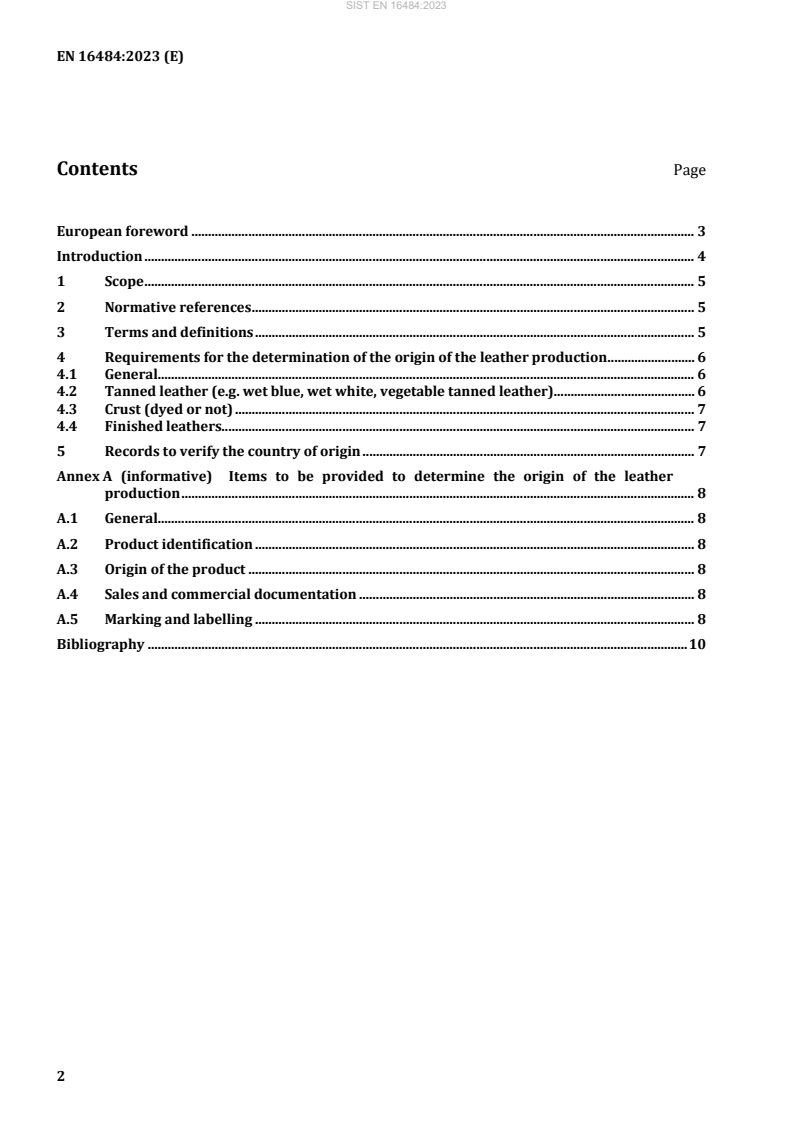
Contents Page
European foreword . 3
Introduction . 4
1 Scope . 5
2 Normative references . 5
3 Terms and definitions . 5
4 Requirements for the determination of the origin of the leather production . 6
4.1 General. 6
4.2 Tanned leather (e.g. wet blue, wet white, vegetable tanned leather) . 6
4.3 Crust (dyed or not) . 7
4.4 Finished leathers. 7
5 Records to verify the country of origin . 7
Annex A (informative) Items to be provided to determine the origin of the leather
production . 8
A.1 General. 8
A.2 Product identification . 8
A.3 Origin of the product . 8
A.4 Sales and commercial documentation . 8
A.5 Marking and labelling . 8
Bibliography . 10
European foreword
This document (EN 16484:2023) has been prepared by Technical Committee CEN/TC 289 “Leather”,
the secretariat of which is held by UNI.
This European Standard shall be given the status of a national standard, either by publication of an
identical text or by endorsement, at the latest by March 2024, and conflicting national standards shall
be withdrawn at the latest by March 2024.
Attention is drawn to the possibility that some of the elements of this document may be the subject of
patent rights. CEN shall not be held responsible for identifying any or all such patent rights.
This document supersedes EN 16484:2015.
The main changes compared to the previous edition are listed below:
— Alignment of the following terms and definitions with EN 15987:2022:
— 3.1 “Leather”;
— 3.4 “Crust”.
Any feedback and questions on this document should be directed to the users’ national standards body.
A complete listing of these bodies can be found on the CEN website.
According to the CEN-CENELEC Internal Regulations, the national standards organisations of the
following countries are bound to implement this European Standard: Austria, Belgium, Bulgaria,
Croatia, Cyprus, Czech Republic, Denmark, Estonia, Finland, France, Germany, Greece, Hungary, Iceland,
Ireland, Italy, Latvia, Lithuania, Luxembourg, Malta, Netherlands, Norway, Poland, Portugal, Republic of
North Macedonia, Romania, Serbia, Slovakia, Slovenia, Spain, Sweden, Switzerland, Türkiye and the
United Kingdom.
Introduction
This document has been prepared for defining the conditions for determining the origin of the leather
production in conformity with the international Non-Preferential Rules of Origin and for fulfilling,
where applicable, the requirements for supplying the declaration of the country of origin of the leather
production.
When the origin of the leather production is declared, it is essential to make certain that the statement
is accurate. Therefore, it needs to relate to objective and verifiable requirements.
This document applies to leather only. Leather articles, such as leather bags, leather goods, leather
accessories, leather footwear, leather clothes or leather clothes accessories, leather upholstered
furniture, etc. are subject to their own respective rules of origin. It is not possible to determine
implicitly the origin of leather used (partially or totally) from the declared origin of leather articles.
Conversely, the origin of the leather used does not automatically confer the origin to the leather article.
1 Scope
This document defines the requirements that are necessary to confer the origin of leather production
based on the principle of the last substantial transformation according to Non-Preferential Rules of
Origin.
This document is applicable to leather only and it is applicable also to leather with hair. Furs are
excluded.
The country of origin of raw hides and skins isn’t relevant for the application of this document.
2 Normative r
...