

SIST EN 1912:2024
(Main)Structural Timber - Strength classes - Assignment of visual grades and species
General Information
- Abstract
This document lists visual strength grades, species and sources of timber, and specifies the strength classes to which they are assigned. The assignments listed are for strength classes documented in EN 338.
Structural timber that has previously been graded cannot be re-graded to the same or different grades unless the method of determining characteristic values has made allowances for changes to the timber population caused by the previous grading.
NOTE 1 Consequently, the assignments stated in this document apply to timber that has not been previously strength graded in a way that introduces a bias on the population of timber to be graded, as compared to ungraded material.
Species/grades or species combination/grades are assigned to strength classes in accordance with EN 14081-1 and supporting standards, such as EN 384.
This document contains a list of assignments but is not intended to be exhaustive.
NOTE 2 Timber graded by machine to EN 14081-1 is graded directly to the strength classes and marked accordingly. Machine grading is therefore not referenced in this document.
- Status
- Published
- Public Enquiry End Date
- 22-Jan-2023
- Publication Date
- 11-Aug-2024
- Technical Committee
- KON.005 - Timber structures
- Current Stage
- 6060 - National Implementation/Publication (Adopted Project)
- Start Date
- 19-Jul-2024
- Due Date
- 23-Sep-2024
- Completion Date
- 12-Aug-2024

Overview
SIST EN 1912:2024 – Structural Timber – Strength Classes – Assignment of Visual Grades and Species is a key European and Slovenian standard that supports the assignment of visual strength grades to structural timber based on species and source. Developed by the Slovenian Institute for Standardization (SIST) in alignment with CEN/TC 124, this 2024 edition supersedes previous versions and aligns with the latest requirements for timber used in construction.
The standard provides a comprehensive list of timber species, their sources, and the corresponding strength classes in line with EN 338. It details the visual grading process and the standards referenced, ensuring the quality and structural integrity of timber products used in load-bearing structures. The assignment only applies to timber that has not been previously strength graded in a way that biases the population, ensuring accurate classification.
Key Topics
- Timber Species and Sources: Lists recognized species and their sources, categorizing them according to geographical origin such as Central, Eastern, and Northern Europe; Caribbean; South East Asia; and both Tropical and West Africa.
- Strength Class Assignments: Assigns species/grades to strength classes ranging from C14 to C35 for softwoods and D30 to D75 for hardwoods, referencing documented visual grading standards.
- Grading Standards: Outlines the visual grading standards applied, such as EN 14081-1, EN 384, and national standards (e.g., DIN, UNE, BS, NF, NLGA), ensuring consistency in classification.
- Assignment Conditions: Stipulates that re-grading is not permitted unless population changes are fully accounted for, preserving the reliability of strength class assignments.
- Scope of Assignments: Emphasizes that the list is not exhaustive and applies only to timber visually graded under standardised methods, excluding machine-graded timber.
- Reference to Supporting Standards: Provides the necessary cross-references to EN 338 for strength classes and supporting standards for property determination and marking.
Applications
SIST EN 1912:2024 is essential for:
- Building Design and Construction: Ensuring that structural timber selected for residential, commercial, or industrial projects meets European safety and performance requirements.
- Timber Grading Facilities: Guiding visual graders in assigning correct strength classes using proven and standardized procedures.
- Quality Control in Supply Chains: Supporting the documentation and verification of timber grading and origin in supply chains, which is crucial for compliance, sustainability, and traceability.
- Regulatory Compliance: Assisting manufacturers, importers, and distributors to fulfill legal and market requirements, as well as harmonised conformity for CE marking under the Construction Products Regulation (CPR).
- Specification by Designers and Engineers: Enabling precise specification of timber products and their classes for structural applications, helping optimize material usage and safety.
Related Standards
SIST EN 1912:2024 requires cross-reference and compliance with various related standards, including:
- EN 338: Timber structures – Strength classes.
- EN 14081-1: General requirements for strength graded structural timber.
- EN 384: Determination of characteristic values of mechanical properties and density.
- National Grading Standards: DIN 4074, NF B 52-001, UNI 11035, BS 4978, NLGA, INSTA 142, and more, for specific geographic sources.
- EN 13556: Commercial timber names.
- BS 5756: Grading hardwoods for structural use.
Practical Value
Adopting SIST EN 1912:2024 delivers:
- Consistency and Reliability: Ensures that only visually graded, ungraded material is assigned to strength classes, minimizing structural risk.
- International Recognition: Harmonizes Slovene and EU timber grading practices, supporting export and cross-border projects.
- Design Flexibility: Offers a wide range of recognized species and grades for design, accommodating diverse sourcing and project requirements.
- Sustainability: By verifying species and sources, the standard helps support sustainable forestry and responsible timber use.
Keywords: structural timber, strength classes, visual grading, timber species, timber source, EN 338, timber grading standard, construction timber, SIST EN 1912, timber classification, European Standard, Slovenia, timber quality, EN 14081-1, EN 384, timber design, timber compliance, timber supply chain.
Relations
- Effective Date
- 01-Sep-2024
- Replaces
SIST EN 1912:2012 - Structural Timber - Strength classes - Assignment of visual grades and species - Effective Date
- 01-Sep-2024
- Effective Date
- 28-Jan-2026
- Effective Date
- 28-Jan-2026
- Effective Date
- 28-Jan-2026
- Effective Date
- 28-Jan-2026
- Effective Date
- 28-Jan-2026
- Effective Date
- 28-Jan-2026
- Effective Date
- 28-Jan-2026
- Effective Date
- 28-Jan-2026
- Effective Date
- 28-Jan-2026
- Effective Date
- 28-Jan-2026
Get Certified
Connect with accredited certification bodies for this standard

Gozdarski inštitut Slovenije
Slovenian Forestry Institute. Forest management certification support, timber testing.
Sponsored listings
Frequently Asked Questions
SIST EN 1912:2024 is a standard published by the Slovenian Institute for Standardization (SIST). Its full title is "Structural Timber - Strength classes - Assignment of visual grades and species". This standard covers: This document lists visual strength grades, species and sources of timber, and specifies the strength classes to which they are assigned. The assignments listed are for strength classes documented in EN 338. Structural timber that has previously been graded cannot be re-graded to the same or different grades unless the method of determining characteristic values has made allowances for changes to the timber population caused by the previous grading. NOTE 1 Consequently, the assignments stated in this document apply to timber that has not been previously strength graded in a way that introduces a bias on the population of timber to be graded, as compared to ungraded material. Species/grades or species combination/grades are assigned to strength classes in accordance with EN 14081-1 and supporting standards, such as EN 384. This document contains a list of assignments but is not intended to be exhaustive. NOTE 2 Timber graded by machine to EN 14081-1 is graded directly to the strength classes and marked accordingly. Machine grading is therefore not referenced in this document.
This document lists visual strength grades, species and sources of timber, and specifies the strength classes to which they are assigned. The assignments listed are for strength classes documented in EN 338. Structural timber that has previously been graded cannot be re-graded to the same or different grades unless the method of determining characteristic values has made allowances for changes to the timber population caused by the previous grading. NOTE 1 Consequently, the assignments stated in this document apply to timber that has not been previously strength graded in a way that introduces a bias on the population of timber to be graded, as compared to ungraded material. Species/grades or species combination/grades are assigned to strength classes in accordance with EN 14081-1 and supporting standards, such as EN 384. This document contains a list of assignments but is not intended to be exhaustive. NOTE 2 Timber graded by machine to EN 14081-1 is graded directly to the strength classes and marked accordingly. Machine grading is therefore not referenced in this document.
SIST EN 1912:2024 is classified under the following ICS (International Classification for Standards) categories: 79.040 - Wood, sawlogs and sawn timber. The ICS classification helps identify the subject area and facilitates finding related standards.
SIST EN 1912:2024 has the following relationships with other standards: It is inter standard links to SIST EN 1912:2012/AC:2013, SIST EN 1912:2012, SIST EN 384:2016+A2:2022, SIST EN 14081-1:2016, SIST EN 17121:2019, SIST EN 384:2010, SIST EN 13964:2014, SIST EN 13964:2004, SIST EN 16737:2016, SIST-TP CEN/TR 16239:2011, SIST EN 14081-1:2016+A1:2019, SIST EN 14081-1:2006+A1:2011. Understanding these relationships helps ensure you are using the most current and applicable version of the standard.
SIST EN 1912:2024 is available in PDF format for immediate download after purchase. The document can be added to your cart and obtained through the secure checkout process. Digital delivery ensures instant access to the complete standard document.
Standards Content (Sample)
SLOVENSKI STANDARD
01-september-2024
Nadomešča:
SIST EN 1912:2012
SIST EN 1912:2012/AC:2013
Konstrukcijski les - Trdnostni razredi - Določitev trdnostnih razredov na podlagi
vizualnega razvrščanja in vrste lesa
Structural Timber - Strength classes - Assignment of visual grades and species
Bauholz für tragende Zwecke - Festigkeitsklassen - Zuordnung von visuellen
Sortierklassen und Holzarten
Bois de structure - Classes de résistance - Affectation des classes visuelles et des
essences
Ta slovenski standard je istoveten z: EN 1912:2024
ICS:
79.040 Les, hlodovina in žagan les Wood, sawlogs and sawn
timber
2003-01.Slovenski inštitut za standardizacijo. Razmnoževanje celote ali delov tega standarda ni dovoljeno.
EN 1912
EUROPEAN STANDARD
NORME EUROPÉENNE
May 2024
EUROPÄISCHE NORM
ICS 79.040 Supersedes EN 1912:2012
English Version
Structural Timber - Strength classes - Assignment of visual
grades and species
Bois de structure - Classes de résistance - Affectation Bauholz für tragende Zwecke - Festigkeitsklassen -
des classes visuelles et des essences Zuordnung von visuellen Sortierklassen und Holzarten
This European Standard was approved by CEN on 8 April 2024.
CEN members are bound to comply with the CEN/CENELEC Internal Regulations which stipulate the conditions for giving this
European Standard the status of a national standard without any alteration. Up-to-date lists and bibliographical references
concerning such national standards may be obtained on application to the CEN-CENELEC Management Centre or to any CEN
member.
This European Standard exists in three official versions (English, French, German). A version in any other language made by
translation under the responsibility of a CEN member into its own language and notified to the CEN-CENELEC Management
Centre has the same status as the official versions.
CEN members are the national standards bodies of Austria, Belgium, Bulgaria, Croatia, Cyprus, Czech Republic, Denmark, Estonia,
Finland, France, Germany, Greece, Hungary, Iceland, Ireland, Italy, Latvia, Lithuania, Luxembourg, Malta, Netherlands, Norway,
Poland, Portugal, Republic of North Macedonia, Romania, Serbia, Slovakia, Slovenia, Spain, Sweden, Switzerland, Türkiye and
United Kingdom.
EUROPEAN COMMITTEE FOR STANDARDIZATION
COMITÉ EUROPÉEN DE NORMALISATION
EUROPÄISCHES KOMITEE FÜR NORMUNG
CEN-CENELEC Management Centre: Rue de la Science 23, B-1040 Brussels
© 2024 CEN All rights of exploitation in any form and by any means reserved Ref. No. EN 1912:2024 E
worldwide for CEN national Members.
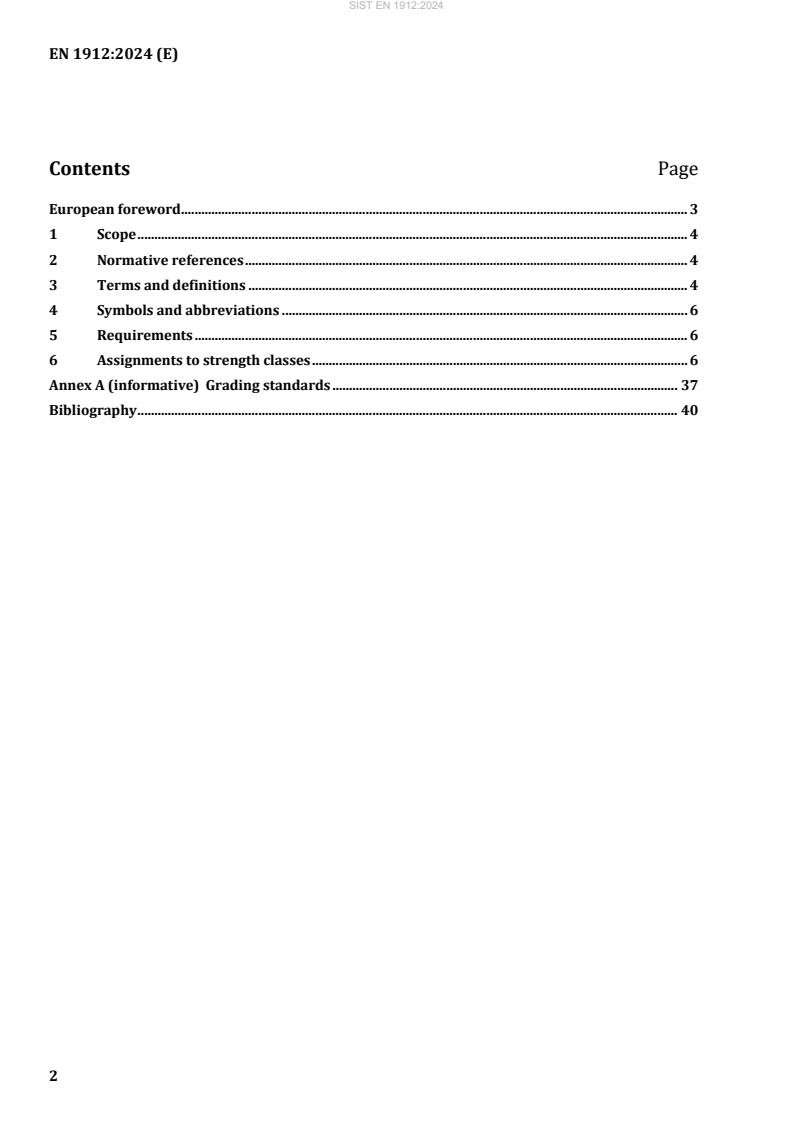
Contents Page
European foreword . 3
1 Scope . 4
2 Normative references . 4
3 Terms and definitions . 4
4 Symbols and abbreviations . 6
5 Requirements . 6
6 Assignments to strength classes . 6
Annex A (informative) Grading standards . 37
Bibliography . 40
European foreword
This document (EN 1912:2024) has been prepared by Technical Committee CEN/TC 124 “Timber
structures”, the secretariat of which is held by AFNOR.
This European Standard shall be given the status of a national standard, either by publication of an
identical text or by endorsement, at the latest by November 2024, and conflicting national standards shall
be withdrawn at the latest by November 2024.
Attention is drawn to the possibility that some of the elements of this document may be the subject of
patent rights. CEN shall not be held responsible for identifying any or all such patent rights.
This document supersedes EN 1912:2012.
Any feedback and questions on this document should be directed to the users’ national standards body.
A complete listing of these bodies can be found on the CEN website.
According to the CEN-CENELEC Internal Regulations, the national standards organisations of the
following countries are bound to implement this European Standard: Austria, Belgium, Bulgaria, Croatia,
Cyprus, Czech Republic, Denmark, Estonia, Finland, France, Germany, Greece, Hungary, Iceland, Ireland,
Italy, Latvia, Lithuania, Luxembourg, Malta, Netherlands, Norway, Poland, Portugal, Republic of North
Macedonia, Romania, Serbia, Slovakia, Slovenia, Spain, Sweden, Switzerland, Türkiye and the United
Kingdom
1 Scope
This document lists visual strength grades, species and sources of timber, and specifies the strength
classes to which they are assigned. The assignments listed are for strength classes documented in EN 338.
Structural timber that has previously been graded cannot be re-graded to the same or different grades
unless the method of determining characteristic values has made allowances for changes to the timber
population caused by the previous grading.
NOTE 1 Consequently, the assignments stated in this document apply to timber that has not been previously
strength graded in a way that introduces a bias on the population of timber to be graded, as compared to ungraded
material.
Species/grades or species combination/grades are assigned to strength classes in accordance with
EN 14081-1 and supporting standards, such as EN 384.
This document contains a list of assignments but is not intended to be exhaustive.
NOTE 2 Timber graded by machine to EN 14081-1 is graded directly to the strength classes and marked
accordingly. Machine grading is therefore not referenced in this document.
2 Normative references
The following documents are referred to in the text in such a way that some or all of their content
constitutes requirements of this document. For dated references, only the edition cited applies. For
undated references, the latest edition of the referenced document (including any amendments) applies.
EN 384, Structural timber — Determination of characteristic values of mechanical properties and density
EN 14081-1, Timber structures — Strength graded structural timber with rectangular cross section — Part
1: General requirements
3 Terms and definitions
For the purposes of this document, the following terms and definitions apply.
ISO and IEC maintain terminological databases for use in standardization at the following addresses:
— IEC Electropedia: available at https://www.electropedia.org/
— ISO Online browsing platform: available at https://www.iso.org/obp
3.1
Caribbean
Bahamas, Belize, Colombia (Northern part), Costa Rica, Cuba, El Salvador, Guatemala, Honduras, Mexico
(South Eastern part), Nicaragua, Panama
3.2
Central Europe
Austria, Belgium, Czech Republic, France (Alsace region), Germany, Hungary, Italy (Northern part),
Liechtenstein, Luxembourg, Netherlands, Poland, Slovakia, Slovenia, Switzerland
3.3
Eastern Europe
Azerbaijan, Belarus, Georgia, Moldova, Romania, Russia (European part: Northwest Russia, Volga, South
Russia, North Caucasus), Ukraine
3.4
Nordic countries
Denmark, Finland, Iceland, Norway and Sweden
3.5
Northern Europe
Denmark, Estonia, Finland, Iceland, Latvia, Lithuania, Norway, Sweden
3.6
South East Asia
Brunei Darussalam, Cambodia, Indonesia, Laos, Malaysia, Myanmar, Singapore, Thailand, Timor-Leste,
Viet Nam
3.7
timber source
identifiable geographical origin of a species or species combination from which timber is, or is intended
to be, strength graded
3.8
timber species
individual species or combination of species, linked to botanical identification
3.9
Tropical Africa
Angola, Benin, Burundi, Cameroon, Central African Republic, Chad, the Democratic Republic of the Congo,
The Congo, Equatorial Guinea, Ethiopia, Gabon, Ghana, Guinea, Guinea-Bissau, Côte d’Ivoire, Kenya,
Liberia, Malawi, Mozambique, Nigeria, Rwanda, Sierra Leone, South Sudan, Sudan, Tanzania, Togo,
Uganda, Zambia, Zimbabwe
3.10
West Africa
Benin, Ghana, Guinea, Guinea-Bissau, Côte d’Ivoire, Liberia, Nigeria, Sierra Leone, Togo
3.11
West and Central Africa
Benin, Cameroon, Central African Republic, Chad, the Democratic Republic of the Congo, The Congo,
Equatorial Guinea, Gabon, Ghana, Guinea, Guinea-Bissau, Côte d’Ivoire, Liberia, Niger, Nigeria, Sierra
Leone, Togo, Uganda
4 Symbols and abbreviations
AGR Approved Grading Report
CNE Europe Central Europe, Northern Europe and Eastern Europe
5 Requirements
Application of the grading assignments listed in in Tables 1, 2 and 3 shall be carried out in accordance
with the requirements of EN 14081-1 and supporting standards, such as EN 384.
6 Assignments to strength classes
The timber grades, species and sources listed are considered to meet the requirements of the strength
classes of EN 338 to which they are assigned in Tables 1, 2 and 3. Softwoods are assigned to C or T classes.
Hardwoods are usually assigned to D classes but may be assigned to C or T classes if their strength profile
is similar to that of softwoods. Table 4 and Table 5 identify the botanical names and four digit code
according to EN 13556 for the commercial names of timber species listed in Tables 1, 2 and 3. The grading
of species combinations, either by commercial names or botanical names, is valid for a batch of timber
even if only one of the species is present in the graded batch.
The assignments to strength classes given in this document are based on approved grading reports
(AGRs) accepted by CEN/TC 124, other testing reports, or proven practice over time. Further assignments
in future versions of this standard shall be approved by CEN/TC 124 based on AGRs. A current list of
reports is available through CEN/TC 124 secretariat. Further AGRs may be used as documentation before
the information they contain becomes available in an amendment or revision of EN 1912. In the event of
any discrepancy between an earlier dated AGR and this standard, this standard shall take precedence.
The timber grades, species and sources listed meet the requirements of the strength classes to which they
are assigned in Tables 1, 2 and 3, with reference to the grading standards listed in Annex A and the visual
grading requirements given in EN 14081-1.
Table 1 — Assignment of grades of species to bending (C) strength classes
Timber species
Basis of
Strength
Grading standard Grade Source
assignment
Commercial
Class
Botanical name(s)
a
name(s)
C35 TS 1265:2012 Class Anatolian Pinus nigra subsp. Türkiye TC124–
1 black pine pallasiana 2021
C35 DIN 4074-1:2012 S13, Douglas fir Pseudotsuga Germany TC124–
S13K menziesii and 2011
Austria
C35 ÖNORM DIN 4074-1:2012 S13, Douglas fir Pseudotsuga Germany TC124–
S13K menziesii and 2011
Austria
C35 TS 1265:2012 Class Scots pine Pinus sylvestris Türkiye TC124–
1 (redwood) 2022
TC124–
C35 UNE 56546:2022 MEF Shining gum Eucalyptus nitens Spain
C35 TS 1265:2012 Class Turkish red Pinus brutia Türkiye TC124–
1 pine 2022
Timber species
Basis of
Strength
Grading standard Grade Source assignment
Commercial
Class
Botanical name(s)
a
name(s)
C30 UNI 11035-1:2022 S1 Douglas fir Pseudotsuga Italy TC124–
menziesii 2010
Width and thickness ≤ 100 mm
C30 ČSN 73 2824–1:2015 S13, European Larix decidua CNE Old
S13K larch Europe
C30 DIN 4074-1:2012 S13, European Larix decidua CNE Old
Europe
S13K larch
C30 ÖNORM DIN 4074-1:2012 S13, European Larix decidua CNE Old
Europe
S13K larch
C30 SIA 265/2:2023 S13, European Larix decidua CNE Old
Europe
S13K larch
C30 INSTA 142:2009 T3 European Larix decidua Northern Old
larch Europe
C30 NEN 5499:2007/A1:2011 T3 European Larix decidua Northern Old
larch Europe
French pine Pinus nigra subsp. TC124–
C30 NF B 52–001–1:2018 ST-I France
(not laricio, Pinus nigra 2022
including subsp. nigra, Pinus
maritime) sylvestris
C30 STN 49 1531:2001 S0 Norway Picea abies Slovakia TC124–
spruce 2007
C30 UNE 56544:2022 ME1 Salzmann Pinus nigra subsp. Spain TC124–
pine salzmannii 2003
C30 ČSN 73 2824–1:2015 S13, Scots pine Pinus sylvestris CNE Old
S13K (redwood) Europe
C30 DIN 4074-1:2012 S13, Scots pine Pinus sylvestris CNE 1994
S13K (redwood) Europe
C30 ÖNORM DIN 4074-1:2012 S13, Scots pine Pinus sylvestris CNE 1994
S13K (redwood) Europe
C30 SIA 265/2:2023 S13, Scots pine Pinus sylvestris CNE 1994
S13K (redwood) Europe
C30 INSTA 142:2009 T3 Scots pine Pinus sylvestris Northern Old
(redwood) Europe
C30 NEN 5499:2007/A1:2011 T3 Scots pine Pinus sylvestris Northern Old
(redwood) Europe
C30 ČSN 73 2824–1:2015 S13, Spruce and Picea abies, Abies CNE Old
S13K fir alba Europe
(whitewood)
C30 DIN 4074-1:2012 S13, Spruce and Picea abies, Abies CNE Old, 2020
S13K fir alba Europe for Central
(whitewood) Europe
C30 ÖNORM DIN 4074-1:2012 S13, Spruce and Picea abies, Abies CNE Old, 2020
S13K fir alba Europe for Central
(whitewood) Europe
Timber species
Basis of
Strength
Grading standard Grade Source assignment
Commercial
Class
Botanical name(s)
a
name(s)
C30 SIA 265/2:2023 S13, Spruce and Picea abies, Abies CNE Old, 2020
S13K fir alba Europe for Central
(whitewood) Europe
C30 NF B 52–001–1:2018 ST-I Spruce and Picea abies, Abies France Before 2010
fir alba
(whitewood)
C30 UNI 11035-1:2022 S1 Spruce and Picea abies, Abies Italy TC124–
fir alba 2021
(whitewood)
C30 INSTA 142:2009 T3 Spruce and Picea abies, Abies Northern Old
fir alba Europe
(whitewood)
C30 NEN 5499:2007/A1:2011 T3 Spruce and Picea abies, Abies Northern Old
fir alba Europe
(whitewood)
C30 UNI 11035-2:2022 LS Sweet Castanea sativa Italy TC124–
chestnut 2021
C27 TS 1265:2012 Class Caucasian Abies Türkiye TC124–
1 and taurus nordmanniana, 2021
fir Abies cilicica, Abies
bornmuelleriana,
Abies equi-trojani
C27 NF B 52–001–1:2018 ST-I European Larix decidua France Before 2010
larch
C27 TS 1265:2012 Class Oriental Picea orientalis Türkiye TC124–
1 spruce 2023
C27 DIN 4074-5:2008 LS13, Poplar Populus nigra Germany TC124–
LS13K (nigra) 2008
C27 UNE 56544:2022 ME1 Scots pine Pinus sylvestris Spain TC124–
(redwood) 2003
C27 TS 1265:2012 Class Scots pine Pinus sylvestris Türkiye TC124–
2 (redwood) 2022
C24 TS 1265:2012 Class Anatolian Pinus nigra subsp. Türkiye TC124–
2 black pine pallasiana 2021
C24 BS 4978:2007+A2:2017 SS Caribbean Pinus caribaea, Caribbean Old
pitch pine Pinus oocarpa
C24 I.S. 127:2015 SS Caribbean Pinus caribaea, Caribbean Old
pitch pine Pinus oocarpa
C24 TS 1265:2012 Class Caucasian Abies Türkiye TC124–
2 and taurus nordmanniana, 2021
fir Abies cilicica, Abies
bornmuelleriana,
Abies equi-trojani
C24 TS 1265:2012 Class Cedar of Cedrus libani Türkiye TC124–
1 Lebanon 2023
Timber species
Basis of
Strength
Grading standard Grade Source assignment
Commercial
Class
Botanical name(s)
a
name(s)
C24 UNI 11035-1:2022 S2 and Corsican Pinus nigra subsp. Italy TC124–
better pine laricio 2010
C24 NF B 52–001–1:2018 ST-II Douglas fir Pseudotsuga France Before 2010
menziesii
C24 DIN 4074-1:2012 S10, Douglas fir Pseudotsuga Germany TC124–
and
S10K menziesii 2011
Austria
C24 ÖNORM DIN 4074-1:2012 S10, Douglas fir Pseudotsuga Germany TC124–
S10K menziesii and 2011
Austria
C24 UNI 11035-1:2022 S2 and Douglas fir Pseudotsuga Italy TC124–
better menziesii 2021
C24 BS 4978:2007+A2:2017 SS Douglas fir- Pseudotsuga USA and Old
Western menziesii, Larix Canada
larch occidentalis
C24 I.S. 127:2015 SS Douglas fir- Pseudotsuga USA and Old
Western menziesii, Larix
Canada
larch occidentalis
C24 NLGA:2022 J&P Douglas fir- Pseudotsuga USA and Old
Sel, Western menziesii, Larix Canada
SLF larch occidentalis
Sel
C24 ČSN 73 2824–1:2015 S10, European Larix decidua CNE Old
S10K larch Europe
C24 DIN 4074-1:2012 S10, European Larix decidua CNE Old
S10K larch Europe
C24 ÖNORM DIN 4074-1:2012 S10, European Larix decidua CNE Old
S10K larch Europe
C24 SIA 265/2:2023 S10, European Larix decidua CNE Old
S10K larch Europe
C24 NF B 52–001–1:2018 ST-II European Larix decidua France Before 2010
larch
C24 INSTA 142:2009 T2 European Larix decidua Northern Old
larch Europe
European Northern
C24 NEN 5499:2007/A1:2011 T2 Larix decidua Old
larch Europe
C24 NF B 52–001–1:2018 ST-II French pine Pinus nigra subsp. France TC124–
(not laricio, Pinus nigra 2022
including subsp. nigra, Pinus
maritime) sylvestris
C24 BS 4978:2007+A2:2017 SS Hem-fir Abies amabilis, Abies USA and Old
concolor, Abies Canada
grandis, Abies
magnifica, Abies
Timber species
Basis of
Strength
Grading standard Grade Source assignment
Commercial
Class
Botanical name(s)
a
name(s)
procera, Tsuga
heterophylla
C24 I.S. 127:2015 SS Hem-fir Abies amabilis, Abies USA and Old
concolor, Abies Canada
grandis, Abies
magnifica, Abies
procera, Tsuga
heterophylla
C24 NLGA:2022 J&P Hem-fir Abies amabilis, Abies USA and Old
Sel, concolor, Abies Canada
SLF grandis, Abies
Sel magnifica, Abies
procera, Tsuga
heterophylla
C24 BS 4978:2007+A2:2017 SS Larch Larix decidua, UK Old
(European, Larix × marschlinsii,
Japanese and Larix kaempferi
hybrid)
C24 I.S. 127:2015 SS Larch Larix decidua, UK Old
(European, Larix × marschlinsii,
Japanese and Larix kaempferi
hybrid)
C24 NF B 52–001–1:2018 ST-II Maritime Pinus pinaster France TC124–
pine 2022
C24 UNE 56544:2022 ME1 Maritime Pinus pinaster Spain TC124–
pine 1999
C24 STN 49 1531:2001 SI Norway Picea abies Slovakia TC124–
spruce 2007
C24 BS 4978:2007+A2:2017 SS Paraná pine Araucaria Brazil Old
angustifolia
C24 I.S. 127:2015 SS Paraná pine Araucaria Brazil Old
angustifolia
C24 NF B 52–001–1:2018 ST-II Poplar Populus × canadensis France Before 2010
(canadensis) cv 'Robusta',
'Dorskamp', 'I 214', 'I
4551'
TC124–
C24 UNE 56544:2022 ME1 Radiata pine Pinus radiata Spain
C24 BS 4978:2007+A2:2017 SS Scots pine Pinus sylvestris CNE Old
(redwood) Europe
C24 I.S. 127:2015 SS Scots pine Pinus sylvestris CNE Old
(redwood) Europe
C24 ČSN 73 2824–1:2015 S10, Scots pine Pinus sylvestris CNE Old
S10K (redwood) Europe
Timber species
Basis of
Strength
Grading standard Grade Source assignment
Commercial
Class
Botanical name(s)
a
name(s)
C24 DIN 4074-1:2012 S10, Scots pine Pinus sylvestris CNE 2007
S10K (redwood) Europe
C24 ÖNORM DIN 4074-1:2012 S10, Scots pine Pinus sylvestris CNE 2007
S10K (redwood) Europe
C24 SIA 265/2:2023 S10, Scots pine Pinus sylvestris CNE 2007
(redwood) Europe
S10K
C24 INSTA 142:2009 T2 Scots pine Pinus sylvestris Northern Old
(redwood) Europe
C24 NEN 5499:2007/A1:2011 T2 Scots pine Pinus sylvestris Northern Old
(redwood) Europe
C24 INSTA 142:2009 T2 Sitka spruce Picea sitchensis Denmark Old
and and
better Norway
C24 NF B 52–001–1:2018 ST-II Sitka spruce Picea sitchensis France TC124–
C24 BS 4978:2007+A2:2017 SS Southern Pinus echinata, Pinus USA Old
pine elliottii, Pinus
palustris, Pinus
taeda
C24 I.S. 127:2015 SS Southern Pinus echinata, Pinus USA Old
pine elliottii, Pinus
palustris, Pinus
taeda
C24 BS 4978:2007+A2:2017 SS S-P-F Abies balsamea, USA and Old
Abies lasiocarpa, Canada
Picea engelmannii,
Picea glauca, Picea
mariana, Picea
rubens, Pinus
banksiana, Pinus
contorta, Pinus
ponderosa
C24 I.S. 127:2015 SS S-P-F Abies balsamea, USA and Old
Abies lasiocarpa, Canada
Picea engelmannii,
Picea glauca, Picea
mariana, Picea
rubens, Pinus
banksiana, Pinus
contorta, Pinus
ponderosa
C24 NLGA:2022 J&P S-P-F Abies balsamea, USA and Old
Sel, Abies lasiocarpa, Canada
SLF Picea engelmannii,
Sel Picea glauca, Picea
mariana, Picea
rubens, Pinus
banksiana, Pinus
Timber species
Basis of
Strength
Grading standard Grade Source assignment
Commercial
Class
Botanical name(s)
a
name(s)
contorta, Pinus
ponderosa
C24 BS 4978:2007+A2:2017 SS Spruce and Picea abies, Abies CNE Old
fir alba Europe
(whitewood)
C24 I.S. 127:2015 SS Spruce and Picea abies, Abies CNE Old
fir alba Europe
(whitewood)
C24 ČSN 73 2824–1:2015 S10, Spruce and Picea abies, Abies CNE Old
S10K fir alba Europe
(whitewood)
C24 DIN 4074-1:2012 S10, Spruce and Picea abies, Abies CNE Old, 2020
S10K fir alba Europe for Central
(whitewood) Europe
C24 ÖNORM DIN 4074-1:2012 S10, Spruce and Picea abies, Abies CNE Old, 2020
S10K fir alba Europe for Central
(whitewood) Europe
C24 SIA 265/2:2023 S10, Spruce and Picea abies, Abies CNE Old, 2020
S10K fir alba Europe for Central
(whitewood) Europe
C24 NF B 52–001–1:2018 ST-II Spruce and Picea abies, Abies France Before 2010
fir alba
(whitewood)
C24 UNI 11035-1:2022 S2 Spruce and Picea abies, Abies Italy TC124–
fir alba 2021
(whitewood)
C24 INSTA 142:2009 T2 Spruce and Picea abies, Abies Northern Old
fir alba Europe
(whitewood)
C24 NEN 5499:2007/A1:2011 T2 Spruce and Picea abies, Abies Northern Old
fir alba Europe
(whitewood)
Spruce and Picea abies, Abies TC124–
C24 SIST DIN 4074-1:2009 S10 Slovenia
fir alba 2011
(whitewood)
C24 NF B 52–001–1:2018 ST-II Sweet Castanea sativa France TC124–
chestnut 2016
C24 TS 1265:2012 Class Turkish red Pinus brutia Türkiye TC124–
2 pine 2022
C22 BS 4978:2007+A2:2017 SS British pine Pinus nigra subsp. UK Old
laricio, Pinus
sylvestris
C22 I.S. 127:2015 SS British pine Pinus nigra subsp. UK Old
laricio, Pinus
sylvestris
Timber species
Basis of
Strength
Grading standard Grade Source assignment
Commercial
Class
Botanical name(s)
a
name(s)
C22 UNI 11035-1:2022 S2 Douglas fir Pseudotsuga Italy TC124–
menziesii 2010
C22 UNI 11035-1:2022 S2 and European Larix decidua Italy TC124–
better larch 2010
C22 TS 1265:2012 Class Oriental Picea orientalis Türkiye TC124–
2 spruce 2023
C22 DIN 4074-5:2008 LS10 Poplar Populus nigra Germany TC124–
and (nigra) 2008
better,
LS10K
and
better
C22 UNE 56544:2022 MEG Salzmann Pinus nigra subsp. Spain TC124–
pine salzmannii 2008
Width and thickness ≥ 70 mm
C22 UNE 56544:2022 MEG Scots pine Pinus sylvestris Spain TC124–
(redwood) 2008
Width and thickness ≥ 70 mm
Class Cedar of TC124–
C20 TS 1265:2012 Cedrus libani Türkiye
2 Lebanon 2023
C20 NLGA:2022 No.1 Douglas fir- Pseudotsuga Canada TC124–
and Western menziesii, Larix 2005
better larch occidentalis
C20 NLGA:2022 No.1 Hem-fir Abies amabilis, Abies Canada TC124–
and concolor, Abies 2005
better grandis, Abies
magnifica, Abies
procera, Tsuga
heterophylla
C20 TS 1265:2012 Class Oriental Picea orientalis Türkiye TC124–
3 spruce 2023
C20 UNE 56544:2022 MEG Radiata pine Pinus radiata Spain TC124–
Width and thickness ≥ 70 mm
C20 TS 1265:2012 Class Scots pine Pinus sylvestris Türkiye TC124–
3 (redwood) 2022
C20 NLGA:2022 No.1 S-P-F Abies balsamea, Canada Old
and Abies lasiocarpa,
better Picea engelmannii,
Picea glauca, Picea
mariana, Picea
rubens, Pinus
banksiana, Pinus
contorta, Pinus
ponderosa
C20 TS 1265:2012 Class Turkish red Pinus brutia Türkiye TC124–
3 pine 2022
Timber species
Basis of
Strength
Grading standard Grade Source assignment
Commercial
Class
Botanical name(s)
a
name(s)
C18 TS 1265:2012 Class Anatolian Pinus nigra subsp. Türkiye TC124–
3 black pine pallasiana 2021
C18 BS 4978:2007+A2:2017 SS British Picea abies, Picea UK and Old
spruce sitchensis Ireland
C18 I.S. 127:2015 SS British Picea abies, Picea UK and 1987
spruce Ireland
sitchensis
C18 BS 4978:2007+A2:2017 GS Caribbean Pinus caribaea, Caribbean Old
pitch pine
Pinus oocarpa
C18 I.S. 127:2015 GS Caribbean Pinus caribaea, Caribbean Old
pitch pine
Pinus oocarpa
C18 TS 1265:2012 Class Caucasian Abies Türkiye TC124–
3 and taurus nordmanniana, 2021
fir Abies cilicica, Abies
bornmuelleriana,
Abies equi-trojani
C18 NF B 52–001–1:2018 ST-III Douglas fir Pseudotsuga France Before 2010
menziesii
C18 DIN 4074-1:2012 S7, Douglas fir Pseudotsuga Germany TC124–
S7K menziesii and 2011
Austria
C18 ÖNORM DIN 4074-1:2012 S7, Douglas fir Pseudotsuga Germany TC124–
S7K menziesii and 2011
Austria
C18 BS 4978:2007+A2:2017 SS Douglas fir Pseudotsuga UK Old
menziesii
C18 I.S. 127:2015 SS Douglas fir Pseudotsuga UK Old
menziesii
C18 NF B 52–001–1:2018 ST-III European Larix decidua France Before 2010
larch
C18 UNI 11035-1:2022 S3 European Larix decidua Italy TC124–
larch 2010
C18 INSTA 142:2009 T1 European Larix decidua Northern Old
larch Europe
C18 NEN 5499:2007/A1:2011 T1 European Larix decidua Northern Old
larch Europe
C18 NF B 52–001–1:2018 ST-III French pine Pinus nigra subsp. France TC124–
(not laricio, Pinus nigra 2022
including subsp. nigra, Pinus
maritime) sylvestris
C18 NF B 52–001–1:2018 ST-III Maritime Pinus pinaster France TC124–
pine 2022
C18 NP 4305:1995 E Maritime Pinus pinaster Portugal Old
pine
Timber species
Basis of
Strength
Grading standard Grade Source assignment
Commercial
Class
Botanical name(s)
a
name(s)
C18 UNE 56544:2022 ME2 Maritime Pinus pinaster Spain TC124–
pine 1999
C18 NF B 52–001–1:2018 ST-III Poplar Populus × canadensis France Before 2010
(canadensis) cv 'Robusta',
'Dorskamp', 'I 214', 'I
4551'
C18 UNE 56544:2022 ME2 Radiata pine Pinus radiata Spain TC124–
C18 UNE 56544:2022 ME2 Salzmann Pinus nigra subsp. Spain TC124–
pine salzmannii 2003
C18 ČSN 73 2824–1:2015 S7, Scots pine Pinus sylvestris CNE Old
S7K (redwood) Europe
C18 DIN 4074-1:2012 S7, Scots pine Pinus sylvestris CNE TC124–
S7K (redwood) Europe 2008
C18 ÖNORM DIN 4074-1:2012 S7, Scots pine Pinus sylvestris CNE TC124–
S7K (redwood) Europe 2008
C18 SIA 265/2:2023 S7, Scots pine Pinus sylvestris CNE TC124–
S7K (redwood) Europe 2008
C18 INSTA 142:2009 T1 Scots pine Pinus sylvestris Northern Old
(redwood) Europe
C18 NEN 5499:2007/A1:2011 T1 Scots pine Pinus sylvestris Northern Old
(redwood) Europe
C18 UNE 56544:2022 ME2 Scots pine Pinus sylvestris Spain TC124–
(redwood) 2003
C18 BS 4978:2007+A2:2017 SS Sitka spruce Picea sitchensis Canada Old
C18 I.S. 127:2015 SS Sitka spruce Picea sitchensis Canada Old
C18 NLGA:2022 J&P Sitka spruce Picea sitchensis Canada Old
Sel,
SLF
Sel
C18 INSTA 142:2009 T1 Sitka spruce Picea sitchensis Denmark Old
and
Norway
C18 NF B 52–001–1:2018 ST-III Sitka spruce Picea sitchensis France TC124–
C18 BS 4978:2007+A2:2017 GS Southern Pinus echinata, Pinus USA Old
pine elliottii, Pinus
palustris, Pinus
taeda
C18 I.S. 127:2015 GS Southern Pinus echinata, Pinus USA Old
pine elliottii, Pinus
palustris, Pinus
taeda
Timber species
Basis of
Strength
Grading standard Grade Source assignment
Commercial
Class
Botanical name(s)
a
name(s)
C18 ČSN 73 2824–1:2015 S7, Spruce and Picea abies, Abies CNE Old
S7K fir alba Europe
(whitewood)
C18 DIN 4074-1:2012 S7, Spruce and Picea abies, Abies CNE Old, 2020
S7K fir alba Europe for Central
(whitewood) Europe
C18 ÖNORM DIN 4074-1:2012 S7, Spruce and Picea abies, Abies CNE Old, 2020
S7K fir alba Europe for Central
(whitewood) Europe
C18 SIA 265/2:2023 S7, Spruce and Picea abies, Abies CNE Old, 2020
S7K fir alba Europe for Central
(whitewood) Europe
C18 NF B 52–001–1:2018 ST-III Spruce and Picea abies, Abies France Before 2010
fir alba
(whitewood)
C18 UNI 11035-1:2022 S3 Spruce and Picea abies, Abies Italy TC124–
fir alba 2010
(whitewood)
C18 INSTA 142:2009 T1 Spruce and Picea abies, Abies Northern Old
fir alba Europe
(whitewood)
C18 NEN 5499:2007/A1:2011 T1 Spruce and Picea abies, Abies Northern Old
fir alba Europe
(whitewood)
C18 SIST DIN 4074-1:2009 S7 Spruce and Picea abies, Abies Slovenia TC124–
fir alba 2011
(whitewood)
C18 NF B 52–001–1:2018 ST-III Sugi Cryptomeria Réunion TC124–
(Japanese japonica (France) 2012
cedar)
C18 NF B 52–001–1:2018 ST-III Sweet Castanea sativa France TC124–
chestnut 2016
Western red
C18 BS 4978:2007+A2:2017 SS Thuja plicata Canada Old
cedar
C18 I.S. 127:2015 SS Western red Thuja plicata Canada Old
cedar
C18 NLGA:2022 J&P Western red Thuja plicata Canada Old
Sel, cedar
SLF
Sel
C18 BS 4978:2007+A2:2017 SS Western Abies balsamea, USA Old
white woods Abies lasiocarpa,
Picea engelmannii,
Pinus contorta, Pinus
lambertiana, Pinus
monticola, Pinus
Timber species
Basis of
Strength
Grading standard Grade Source assignment
Commercial
Class
Botanical name(s)
a
name(s)
ponderosa, Tsuga
mertensiana
C18 I.S. 127:2015 SS Western Abies balsamea, USA Old
white woods Abies lasiocarpa,
Picea engelmannii,
Pinus contorta, Pinus
lambertiana, Pinus
monticola, Pinus
ponderosa, Tsuga
mertensiana
C16 TS 1265:2012 Class Cedar of Cedrus libani Türkiye TC124–
3 Lebanon 2023
C16 BS 4978:2007+A2:2017 GS Douglas fir- Pseudotsuga USA and Old
Western menziesii, Larix Canada
larch occidentalis
C16 I.S. 127:2015 GS Douglas fir- Pseudotsuga USA and Old
Western menziesii, Larix Canada
larch occidentalis
C16 NLGA:2022 J&P Douglas fir- Pseudotsuga USA and Old
No.1, Western menziesii, Larix Canada
J&P larch occidentalis
No.2,
SLF
No.1,
SLF
No.2
C16 ČSN 73 2824–1:2015 S7, European Larix decidua CNE Old
S7K larch Europe
C16 DIN 4074-1:2012 S7, European Larix decidua CNE Old
S7K larch Europe
C16 ÖNORM DIN 4074-1:2012 S7, European Larix decidua CNE Old
S7K larch Europe
C16 SIA 265/2:2023 S7, European Larix decidua CNE Old
S7K larch Europe
C16 BS 4978:2007+A2:2017 GS Hem-fir Abies amabilis, Abies USA and Old
concolor, Abies Canada
grandis, Abies
magnifica, Abies
procera, Tsuga
heterophylla
...