

SIST EN 15782:2009
(Main)Animal feeding stuffs - Determination of nicarbazin - High-performance liquid chromatographic method
- Abstract
This European Standard specifies a method for the determination of additive use of nicarbazin in animal feeding stuffs and premixtures (maximum concentration 2,5% nicarbazin) using high performance liquid chromatography. Nicarbazin is a 1:1 equimolar mixture of 4,4’-dinitrocarbanilide (DNC) and 4,6-dimethyl-2-pyriminol (HDP). Nicarbazin is generally determined by using DNC as the target compound. In this method the DNC moiety of nicarbazin is detected.
The limit of quantitation is 20 mg/kg. The limit of detection is 0,5 mg/kg
NOTE A lower limit of quantitation may be achievable but should be validated by the user.
- Status
- Published
- Publication Date
- 16-Nov-2009
- Technical Committee
- KŽP - Agricultural food products
- Current Stage
- 6060 - National Implementation/Publication (Adopted Project)
- Start Date
- 03-Nov-2009
- Due Date
- 08-Jan-2010
- Completion Date
- 17-Nov-2009



SIST EN 15782:2009 is the Slovenian adoption of EN 15782:2009, a CEN European Standard for animal feeding stuffs. It specifies a high-performance liquid chromatographic (HPLC) method for determining nicarbazin in animal feeding stuffs and premixtures, using the 4,4’-dinitrocarbanilide (DNC) moiety as the measured target. The method reports a limit of quantitation of 20 mg/kg and a limit of detection of 0.5 mg/kg.
What does SIST EN 15782:2009 specify?
SIST EN 15782:2009 specifies a laboratory method for additive use of nicarbazin in animal feeding stuffs and premixtures with a maximum concentration of 2.5% nicarbazin. The document is organized into clauses 1 to 10, followed by an informative annex and a bibliography.
| Annex | What it covers |
|---|---|
| Annex A | Results of an interlaboratory study and precision data |
The standard states that nicarbazin is a 1:1 equimolar mixture of DNC and HDP, but the method detects the DNC moiety. In practice, that means the analyst measures the marker component rather than the full mixture.
What are the key requirements of SIST EN 15782:2009?
Clause 2 sets out the principle: samples are extracted with acetonitrile/methanol, and animal feeding stuffs also receive added water before extraction. The extract is then measured by reverse phase isocratic HPLC at 350 nm. In practice, the analyst must prepare the matrix correctly and use a UV detector set for the DNC signal.
Clause 3 requires analytical-grade reagents and specifies the extraction solvent, eluent, reference standard, stock standard solution and daily working standards. The working standards span 0 to 10 µg/ml and are prepared fresh each day. This matters because the calibration curve and extraction chemistry control the result.
Clause 4 defines the key apparatus: an HPLC system with a 20 µl injection volume, 1.0 ml/min flow rate, RP C18 column, UV detection at 350 nm, plus a shaker, microfilters, an ultrasonic bath and a 50 °C water bath. The column may be equivalent if it gives satisfactory separation of DNC. In practice, the method depends on consistent separation, clean extracts and stable detector response.
Clauses 5 and 6 address sampling and test sample preparation. The standard says sampling is outside the method, compound feed must be milled through a 1 mm screen, premixes are not milled, and samples and extracts should be protected from daylight. This is important because nicarbazin is light-sensitive and poor homogeneity can distort the measured content.
Clause 7 gives separate extraction procedures for premixtures and animal feeding stuffs, including heating, mechanical mixing, sonication, settling, dilution into the calibration range and filtration before analysis. The HPLC section also requires repeated injection of the calibration solution until stable peak areas and retention times are obtained, then injection of each calibration solution to build the calibration graph. In practice, this means the laboratory must produce a clean, quantifiable extract and prove the system is behaving consistently before reporting results.
Clause 8 gives the calculation based on extraction volume, measured concentration in the extract, test portion mass and any dilution factor. The result is reported as mass fraction in mg/kg. That lets the laboratory convert the instrument reading back to the original sample.
Clause 9 links the method to precision performance, repeatability, reproducibility and recovery. Clause 10 sets the minimum test report content, including sample identification, sampling method if known, the method reference, any deviations or incidents, and the result.
What terms does SIST EN 15782:2009 define?
- Nicarbazin - A 1:1 equimolar mixture of DNC and HDP used as the analyte in this method.
- 4,4’-dinitrocarbanilide (DNC) - The target compound actually measured as the nicarbazin marker.
- 4,6-dimethyl-2-pyriminol (HDP) - The other component of nicarbazin’s equimolar mixture.
- High-performance liquid chromatography (HPLC) - The separation technique used to measure DNC in the extract.
- Premixtures - Feed mixtures that the standard includes alongside animal feeding stuffs.
Who uses SIST EN 15782:2009?
SIST EN 15782:2009 is used by feed testing laboratories, quality control teams in animal feed manufacture, and organizations that verify additive use in feeding stuffs and premixtures. It is relevant wherever nicarbazin content must be measured for routine control, product release, or regulatory checking. The interlaboratory study in Annex A shows the method was evaluated on broiler feed and a premixture matrix.
Which standards are used with SIST EN 15782:2009?
- EN ISO 6497 - Provides a recommended sampling method for animal feeding stuffs.
- ISO 6498 - Gives guidance for preparation of test samples.
- EN ISO 3696 - Specifies water quality for analytical laboratory use, supporting the reagent water requirement.
What does the SIST EN 15782:2009 document contain?
The document contains the analytical principle, reagent specifications, apparatus requirements, sampling note, sample preparation instructions, extraction procedures for premixtures and animal feeding stuffs, HPLC operating conditions, calibration steps, calculation formula, precision statements and test report content. It also includes Annex A, which summarizes an interlaboratory study and precision data from multiple laboratories. The bibliography points readers to related sampling, sample preparation and laboratory-water standards, plus background studies on the method.
Get Certified
Connect with accredited certification bodies for this standard

Control Union Certifications
Global certification for agriculture and sustainability.

ECOCERT
Organic and sustainability certification.

FSC International
Forest Stewardship Council certification.
Sponsored listings
Frequently Asked Questions
SIST EN 15782:2009 is a standard published by the Slovenian Institute for Standardization (SIST). Its full title is "Animal feeding stuffs - Determination of nicarbazin - High-performance liquid chromatographic method". This standard covers: This European Standard specifies a method for the determination of additive use of nicarbazin in animal feeding stuffs and premixtures (maximum concentration 2,5% nicarbazin) using high performance liquid chromatography. Nicarbazin is a 1:1 equimolar mixture of 4,4’-dinitrocarbanilide (DNC) and 4,6-dimethyl-2-pyriminol (HDP). Nicarbazin is generally determined by using DNC as the target compound. In this method the DNC moiety of nicarbazin is detected. The limit of quantitation is 20 mg/kg. The limit of detection is 0,5 mg/kg NOTE A lower limit of quantitation may be achievable but should be validated by the user.
This European Standard specifies a method for the determination of additive use of nicarbazin in animal feeding stuffs and premixtures (maximum concentration 2,5% nicarbazin) using high performance liquid chromatography. Nicarbazin is a 1:1 equimolar mixture of 4,4’-dinitrocarbanilide (DNC) and 4,6-dimethyl-2-pyriminol (HDP). Nicarbazin is generally determined by using DNC as the target compound. In this method the DNC moiety of nicarbazin is detected. The limit of quantitation is 20 mg/kg. The limit of detection is 0,5 mg/kg NOTE A lower limit of quantitation may be achievable but should be validated by the user.
SIST EN 15782:2009 is classified under the following ICS (International Classification for Standards) categories: 65.120 - Animal feeding stuffs. The ICS classification helps identify the subject area and facilitates finding related standards.
SIST EN 15782:2009 is associated with the following European legislation: EU Directives/Regulations: 70/373/EC; Standardization Mandates: M/382. When a standard is cited in the Official Journal of the European Union, products manufactured in conformity with it benefit from a presumption of conformity with the essential requirements of the corresponding EU directive or regulation.
SIST EN 15782:2009 is available in PDF format for immediate download after purchase. The document can be added to your cart and obtained through the secure checkout process. Digital delivery ensures instant access to the complete standard document.
Standards Content (Sample)
2003-01.Slovenski inštitut za standardizacijo. Razmnoževanje celote ali delov tega standarda ni dovoljeno.ORþOMLYRVWLFuttermittel - Bestimmung von Nicarbazin - Hochleistungsflüssigchromatographisches VerfahrenAliments des animaux - Détermination de la nicarbazine - Méthode de chromatographie liquide hautes performancesAnimal feeding stuffs - Determination of nicarbazin - High-performance liquid chromatographic method65.120KrmilaAnimal feeding stuffsICS:Ta slovenski standard je istoveten z:EN 15782:2009SIST EN 15782:2009en,fr,de01-december-2009SIST EN 15782:2009SLOVENSKI
STANDARD
EUROPEAN STANDARDNORME EUROPÉENNEEUROPÄISCHE NORMEN 15782August 2009ICS 65.120 English VersionAnimal feeding stuffs - Determination of nicarbazin - High-performance liquid chromatographic methodAliments des animaux - Détermination de la nicarbazine -Méthode de chromatographie liquide hautes performancesFuttermittel - Bestimmung von Nicarbazin -Hochleistungsflüssigchromatographisches VerfahrenThis European Standard was approved by CEN on 3 July 2009.CEN members are bound to comply with the CEN/CENELEC Internal Regulations which stipulate the conditions for giving this EuropeanStandard the status of a national standard without any alteration. Up-to-date lists and bibliographical references concerning such nationalstandards may be obtained on application to the CEN Management Centre or to any CEN member.This European Standard exists in three official versions (English, French, German). A version in any other language made by translationunder the responsibility of a CEN member into its own language and notified to the CEN Management Centre has the same status as theofficial versions.CEN members are the national standards bodies of Austria, Belgium, Bulgaria, Cyprus, Czech Republic, Denmark, Estonia, Finland,France, Germany, Greece, Hungary, Iceland, Ireland, Italy, Latvia, Lithuania, Luxembourg, Malta, Netherlands, Norway, Poland, Portugal,Romania, Slovakia, Slovenia, Spain, Sweden, Switzerland and United Kingdom.EUROPEAN COMMITTEE FOR STANDARDIZATIONCOMITÉ EUROPÉEN DE NORMALISATIONEUROPÄISCHES KOMITEE FÜR NORMUNGManagement Centre:
Avenue Marnix 17,
B-1000 Brussels© 2009 CENAll rights of exploitation in any form and by any means reservedworldwide for CEN national Members.Ref. No. EN 15782:2009: ESIST EN 15782:2009
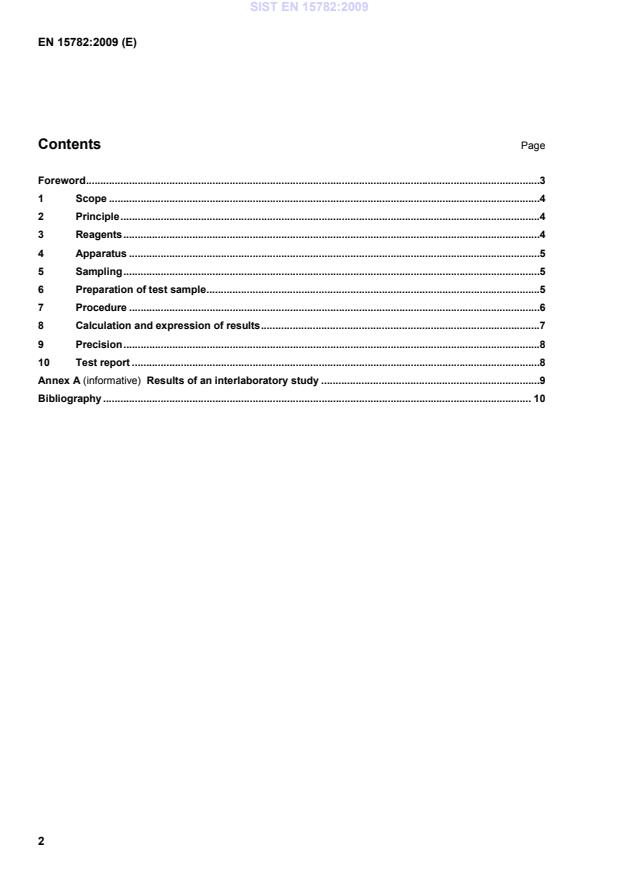
Results of an interlaboratory study .9 Bibliography . 10
1 Scope This European Standard specifies a method for the determination of additive use of nicarbazin in animal feeding stuffs and premixtures (maximum concentration 2,5% nicarbazin) using high performance liquid chromatography. Nicarbazin is a 1:1 equimolar mixture of 4,4’-dinitrocarbanilide (DNC) and 4,6-dimethyl-2-pyriminol (HDP). Nicarbazin is generally determined by using DNC as the target compound. In this method the DNC moiety of nicarbazin is detected. The limit of quantitation is 20 mg/kg. The limit of detection is 0,5 mg/kg NOTE A lower limit of quantitation may be achievable but should be validated by the user. 2 Principle Samples are extracted using an acetonitrile/methanol mixture. For feeding stuffs, water is added additionally. An aliquot of the extract is assayed using a reverse phase isocratic HPLC method which measures the 4,4’dinitrocarbanilide moiety at a wavelength of 350 nm. 3 Reagents Use only reagents of recognized analytical grade, unless otherwise specified.
3.1 Water, resistance > 10 MOhm.cm-1. 3.2 Acetonitrile (CH3CN), HPLC grade. 3.3 Methanol (CH3OH), HPLC grade. 3.4 Extraction solvent
Mix 500 ml of acetonitrile (3.2) with 500 ml of methanol (3.3). Mix well using a magnetic stir plate and stir bar. 3.5 Eluent for liquid chromatography
Mix 650 ml acetonitrile (3.2) with 350 ml of purified water (3.1). Mix well using a magnetic stir plate and stir bar and degas (e.g. with helium) before use. 3.6 Nicarbazin reference standard 3.7 Standard solutions 3.7.1 Nicarbazin stock standard solution, 100 µµµµg/ml Dissolve 10 mg, weighed to the nearest 0,1 mg, of nicarbazin reference standard (3.6) in 100 ml extraction solvent (3.4). To aid with dissolution, sonication for approximately 5 min is recommended. Mix well. This solution is stable for 24 h when stored in subdued light at ambient or refrigerated storage conditions (see remark 3.7.1). NOTE 1 The solubility of the nicarbazin reference standard in extraction solvent is critical. The nicarbazin concentrations in the prepared stock solutions must be monitored by use of a cuvet spectrophotometer as follows. Prepare a solution of 10 µg/ml by diluting the prepared stock standard solution (3.7.1) with acetonitrile. Record a UV-Vis spectrum between 220 nm and 450 nm using a mixture of methanol/acetonitrile (5:95 v/v) as a reference solution. The maximum SIST EN 15782:2009
Prepare a range of calibration working standards containing 0 µg/ml; 0,25 µg/ml; 0,5 µg/ml; 1 µg/ml; 2 µg/ml; 5 µg/ml and 10 µg/ml nicarbazin by diluting the stock standard solution (3.7.1) with HPLC eluent (3.5). Working standards must be prepared daily. 4 Apparatus Usual laboratory apparatus and, in particular, the following. 4.1 High performance liquid chromatography system consisting of the following: 4.1.1 An autosampler or manual injector set to inject a volume of 20 µl. 4.1.2 A pump set to deliver a constant eluent flow rate of 1,0 ml/min. 4.1.3 HPLC column, 250 mm x 4,6 mm packed with RP C18, 5 µm material, or equivalent.
NOTE A Nova-Pak or Bonda-Pak column is recommended, but also other columns can be used provided that a satisfactory separation of DNC is achieved. 4.1.4 A detector allowing the measurement of absorbance of UV light at a wavelength of 350 nm. 4.2 Mechanical shaker (e.g. Gyratory shaker, wrist action shaker or
...