

kSIST FprEN 17542-4:2026
(Main)Earthworks - Geotechnical laboratory tests - Part 4: Test method for measurement of collapse potential of soils
- Abstract
This document specifies the test method for the determination of the magnitude of one-dimensional collapse that occurs when unsaturated soils are inundated with water. This method is used to determine two parameters related to the collapsibility of a soil: the collapse index and the collapse potential.
This test method specifies the technique for specimen preparation, the apparatus and the procedure for quantifying the amount of height change associated with collapse and procedures for reporting test results.
The procedure given in this test method is applicable to both undisturbed samples or remolded specimens. It is a one single sample test procedure.
- Status
- Not Published
- Public Enquiry End Date
- 18-Dec-2025
- Technical Committee
- ZEM - Earthworks
- Current Stage
- 5020 - Formal vote (FV) (Adopted Project)
- Start Date
- 24-Jun-2026
- Due Date
- 12-Aug-2026

kSIST FprEN 17542-4:2026 is a SIST draft standard in the Earthworks - Geotechnical laboratory tests series. It specifies a laboratory test method for measuring the collapse potential of unsaturated soils when they are inundated with water, including specimen preparation, apparatus, procedure, calculation of collapse index and collapse potential, and reporting.
What does kSIST FprEN 17542-4:2026 specify?
kSIST FprEN 17542-4:2026 specifies a one-dimensional collapse test for soils that are unsaturated before wetting. It is used to determine two measures of collapsibility - the collapse index and the collapse potential - from the height change that occurs after inundation.
The standard applies to both undisturbed samples and remolded specimens, and it is written as a single-sample test procedure. In practice, that means a laboratory can use one prepared specimen to obtain the collapse result for a design or investigation case.
The document is organized into clauses on scope, normative references, terms and definitions, apparatus, specimen specification, test method, and test report.
| Annex | What it covers |
|---|---|
| Annex A | Example test report forms, including sample data tables and example curves |
| Annex B | Example evaluation of the degree of collapse from collapse potential |
What are the key requirements of kSIST FprEN 17542-4:2026?
Apparatus and specimen preparation
kSIST FprEN 17542-4:2026 requires apparatus in accordance with EN ISO 17892-5, and the porous stones shall be air-dried before use. This matters because extra water in the stones can alter the specimen moisture condition and affect the measured collapse.
Specimens may be undisturbed, remolded, or compacted, and they are prepared using the guidance of EN ISO 17892-5. The oedometer cell is assembled and calibrated to the same companion standard, so the collapse measurement is made in a controlled one-dimensional loading setup.
Loading, wetting, and timing
kSIST FprEN 17542-4:2026 describes the test as a simple sample oedometer test. The final vertical stress before wetting depends on whether the collapse index or the collapse potential is being determined and on the design situation; if the stress is not known, 200 kPa is given as the reference value.
The procedure starts with a seating stress of 5 kPa, then applies load increments at hourly intervals until the final vertical stress is reached. The document limits the time between pre-wetting load increments to one hour to reduce evaporation, so the specimen condition stays stable before flooding.
Wetting is done from the bottom porous stone to remove air from the specimen. If possible, the water should come from the same location as the sample; otherwise distilled-deionized water is used, and the origin of the water must be reported. This is important because the wetting water is part of the test condition.
After inundation, the load step is held for at least 24 hours or until primary consolidation is complete in accordance with EN ISO 17892-5. The test then records the final deformation and the final water content and specimen mass.
Calculation and reporting
kSIST FprEN 17542-4:2026 defines collapse index and collapse potential from the measured height change after wetting. The calculations are based on the specimen height before wetting and the dial readings before and after inundation, so the laboratory must keep the measurement sequence consistent.
The test report has to state that the test was carried out in accordance with the standard and include the laboratory name, site identification, sample origin or reconstituted specimen preparation details, specimen dimensions, water origin, oedometer cell description, initial and final water content, initial degree of saturation and dry unit weight, applied vertical stress at inundation, time plots, void ratio plots, collapse index, collapse potential, and any deviations. In practice, this is the record a client or reviewer needs to judge the result.
What terms does kSIST FprEN 17542-4:2026 define?
- Collapse - the decrease in height of a confined soil at given water content and dry unit weight after wetting under constant vertical stress.
- Collapse index (sc) - the percentage decrease in specimen height after flooding, measured against the height before wetting.
- Collapse potential (Ipc) - the percentage decrease in specimen height after wetting under a defined applied vertical stress, relative to the initial specimen height.
- sc - the symbol used for collapse index in the document and in the test report.
- Ipc - the symbol used for collapse potential in the document and in the test report.
Who uses kSIST FprEN 17542-4:2026?
kSIST FprEN 17542-4:2026 is used by geotechnical laboratories, earthworks and foundation engineers, site investigation teams, and quality managers who need to assess how an unsaturated soil behaves when it is wetted. It is also relevant to buyers and project teams that specify laboratory testing for soil collapsibility, because the report content tells them what evidence they should expect from the lab.
Which standards are used with kSIST FprEN 17542-4:2026?
The document cites four normative references:
- EN ISO 17892-1 - provides the method for determining water content, which is used for the initial and final moisture measurements.
- EN ISO 17892-2 - provides the method for determining bulk density, which supports the dry unit weight data in the report.
- EN ISO 17892-5 - provides the incremental loading oedometer test, and supplies the apparatus, preparation, loading, and consolidation procedures used here.
- EN ISO 22475-1 - provides technical principles for soil sampling and the sample origin information reported for undisturbed material.
What does the kSIST FprEN 17542-4:2026 document contain?
The document contains the test method, the calculation framework, and the reporting requirements for measuring collapse potential in soils. It also includes an example report package in Annex A, with tables for specimen identification, specimen parameters, dial readings over time, final void ratio, results, and observations, plus example consolidation and void ratio curves.
Annex B gives an example way to interpret the degree of collapse from collapse potential at a chosen vertical stress. Together with the main text, these annexes show how the test result is measured, checked, and reported for design or investigation work.
Get Certified
Connect with accredited certification bodies for this standard

Zavod za gradbeništvo Slovenije (ZAG) - Inšpekcija
ZAG inspection body for construction products, structures, and materials.
Sponsored listings
Frequently Asked Questions
kSIST FprEN 17542-4:2026 is a draft published by the Slovenian Institute for Standardization (SIST). Its full title is "Earthworks - Geotechnical laboratory tests - Part 4: Test method for measurement of collapse potential of soils". This standard covers: This document specifies the test method for the determination of the magnitude of one-dimensional collapse that occurs when unsaturated soils are inundated with water. This method is used to determine two parameters related to the collapsibility of a soil: the collapse index and the collapse potential. This test method specifies the technique for specimen preparation, the apparatus and the procedure for quantifying the amount of height change associated with collapse and procedures for reporting test results. The procedure given in this test method is applicable to both undisturbed samples or remolded specimens. It is a one single sample test procedure.
This document specifies the test method for the determination of the magnitude of one-dimensional collapse that occurs when unsaturated soils are inundated with water. This method is used to determine two parameters related to the collapsibility of a soil: the collapse index and the collapse potential. This test method specifies the technique for specimen preparation, the apparatus and the procedure for quantifying the amount of height change associated with collapse and procedures for reporting test results. The procedure given in this test method is applicable to both undisturbed samples or remolded specimens. It is a one single sample test procedure.
kSIST FprEN 17542-4:2026 is classified under the following ICS (International Classification for Standards) categories: 93.020 - Earthworks. Excavations. Foundation construction. Underground works. The ICS classification helps identify the subject area and facilitates finding related standards.
kSIST FprEN 17542-4:2026 is available in PDF format for immediate download after purchase. The document can be added to your cart and obtained through the secure checkout process. Digital delivery ensures instant access to the complete standard document.
Standards Content (Sample)
SLOVENSKI STANDARD
oSIST prEN 17542-4:2025
01-december-2025
Zemeljska dela - Geotehnični laboratorijski preskusi - 4. del: Preskusna metoda za
merjenje potenciala zrušitve tal
Earthworks - Geotechnical laboratory tests - Part 4: Test method for measurement of
collapse potential of soils
Erdarbeiten - Geotechnische Laborversuche - Teil 4: Prüfmethode zur Messung des
Einsturzpotentials von Böden
Ta slovenski standard je istoveten z: prEN 17542-4
ICS:
93.020 Zemeljska dela. Izkopavanja. Earthworks. Excavations.
Gradnja temeljev. Dela pod Foundation construction.
zemljo Underground works
oSIST prEN 17542-4:2025 en,fr,de
2003-01.Slovenski inštitut za standardizacijo. Razmnoževanje celote ali delov tega standarda ni dovoljeno.
oSIST prEN 17542-4:2025
oSIST prEN 17542-4:2025
DRAFT
EUROPEAN STANDARD
prEN 17542-4
NORME EUROPÉENNE
EUROPÄISCHE NORM
October 2025
ICS 93.020
English Version
Earthworks - Geotechnical laboratory tests - Part 4: Test
method for measurement of collapse potential of soils
Erdarbeiten - Geotechnische Laborversuche - Teil 4:
Prüfmethode zur Messung des Einsturzpotentials von
Böden
This draft European Standard is submitted to CEN members for enquiry. It has been drawn up by the Technical Committee
CEN/TC 396.
If this draft becomes a European Standard, CEN members are bound to comply with the CEN/CENELEC Internal Regulations
which stipulate the conditions for giving this European Standard the status of a national standard without any alteration.
This draft European Standard was established by CEN in three official versions (English, French, German). A version in any other
language made by translation under the responsibility of a CEN member into its own language and notified to the CEN-CENELEC
Management Centre has the same status as the official versions.
CEN members are the national standards bodies of Austria, Belgium, Bulgaria, Croatia, Cyprus, Czech Republic, Denmark, Estonia,
Finland, France, Germany, Greece, Hungary, Iceland, Ireland, Italy, Latvia, Lithuania, Luxembourg, Malta, Netherlands, Norway,
Poland, Portugal, Republic of North Macedonia, Romania, Serbia, Slovakia, Slovenia, Spain, Sweden, Switzerland, Türkiye and
United Kingdom.
Recipients of this draft are invited to submit, with their comments, notification of any relevant patent rights of which they are
aware and to provide supporting documentation.
Warning : This document is not a European Standard. It is distributed for review and comments. It is subject to change without
notice and shall not be referred to as a European Standard.
EUROPEAN COMMITTEE FOR STANDARDIZATION
COMITÉ EUROPÉEN DE NORMALISATION
EUROPÄISCHES KOMITEE FÜR NORMUNG
CEN-CENELEC Management Centre: Rue de la Science 23, B-1040 Brussels
© 2025 CEN All rights of exploitation in any form and by any means reserved Ref. No. prEN 17542-4:2025 E
worldwide for CEN national Members.
oSIST prEN 17542-4:2025
prEN 17542-4:2025 (E)
Contents Page
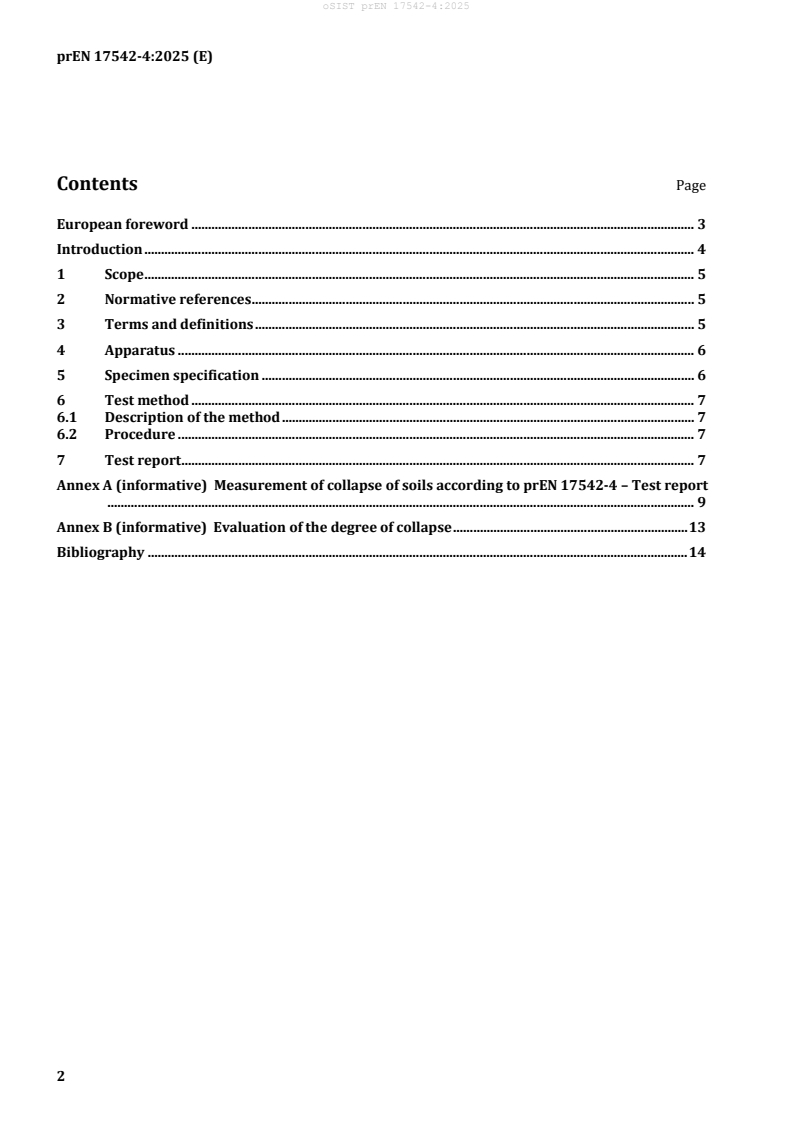
European foreword . 3
Introduction . 4
1 Scope . 5
2 Normative references . 5
3 Terms and definitions . 5
4 Apparatus . 6
5 Specimen specification . 6
6 Test method . 7
6.1 Description of the method . 7
6.2 Procedure . 7
7 Test report . 7
Annex A (informative) Measurement of collapse of soils according to prEN 17542-4 – Test report
............................................................................................................................................................................... 9
Annex B (informative) Evaluation of the degree of collapse . 13
Bibliography . 14
oSIST prEN 17542-4:2025
prEN 17542-4:2025 (E)
European foreword
This document (prEN 17542-4:2025) has been prepared by Technical Committee
CEN/TC 396 “Earthworks”, the secretariat of which is held by AFNOR.
This document is currently submitted to the CEN Enquiry.
oSIST prEN 17542-4:2025
prEN 17542-4:2025 (E)
Introduction
The collapse of a soil is the decrease of height that can occur when unsaturated soils are immersed. This
document defines the collapse index and the collapse potential that qualifies this phenomenon.
NOTE A collapsible soil can withstand relatively large applied vertical stress with small settlement while it has
a low water content and degree of saturation, but this soil will exhibit settlement (that could be large) after wetting
with no additional increase in stress.
oSIST prEN 17542-4:2025
prEN 17542-4:2025 (E)
1 Scope
This document specifies the test method for the determination of the magnitude of one-dimensional
collapse that occurs when unsaturated soils are inundated with water. This method is used to determine
two parameters related with the collapsibility of a soil: the collapse index and the collapse potential.
This test method specifies the technique for specimen preparation, the apparatus and the procedure for
quantifying the amount of height change associated with collapse and procedures for reporting test
results.
The procedure given in this test method is applicable to both undisturbed samples or remolded
specimens. It is a one single sample test procedure.
2 Normative references
The following documents are referred to in the text in such a way that some or all of their content
constitutes requirements of this document. For dated references, only the edition cited applies. For
undated references, the latest edition of the referenced document (including any amendments) applies.
EN ISO 17892-1, Geotechnical investigation and testing — Laboratory testing of soil — Part 1:
Determination of water content (ISO 17892-1)
EN ISO 17892-2, Geotechnical investigation and testing — Laboratory testing of soil — Part 2:
Determination of bulk density (ISO 17892-2)
EN ISO 17892-5, Geotechnical investigation and testing — Laboratory testing of soil — Part 5: Incremental
loading œdometer test (ISO 17892-5)
EN ISO 22475-1, Geotechnical investigation and testing — Sampling methods and groundwater
measurements — Part 1: Technical principles for the sampling of soil, rock and groundwater (ISO 22475-1)
3 Terms and definitions
For the purposes of this document, the following terms and definitions apply.
ISO and IEC maintain terminology databases for use in standardization at the following addresses:
— ISO Online browsing platform: available at https://www.iso.org/obp/
— IEC Electropedia: available at https://www.electropedia.org/
3.1
collapse
decrease in height of a confined soil with a given water content and a given dry unit weight after wetting
at a constant applied vertical stress
Note 1 to entry: This stress is to be determined as appropriate for the design situation.
3.2
collapse index
I
sc
decrease in height of a specimen consolidated to a given vertical stress after flooding, ex
...