

kSIST FprEN IEC 63327:2026
(Main)Automatic floor treatment machines for commercial use - Particular requirements
- Status
- Not Published
- Public Enquiry End Date
- 29-Apr-2026
- Technical Committee
- VGA - Safety of household and similar electrical appliances
- Current Stage
- 5020 - Formal vote (FV) (Adopted Project)
- Start Date
- 13-Nov-2026
- Due Date
- 01-Jan-2027
- Completion Date
- 16-Nov-2026

kSIST FprEN IEC 63327:2026 is the Slovenian adoption of the IEC draft standard for automatic floor treatment machines for commercial use. It specifies particular safety requirements for powered indoor machines used for sweeping, scrubbing, wet or dry pick-up, polishing, waxing, sealing, powder detergents and shampooing, including their docking stations and automatic docking functions.
The document is aimed at manufacturers, test laboratories, certification bodies and technical teams that need to design, evaluate or buy these machines for commercial environments.
What does kSIST FprEN IEC 63327:2026 specify?
kSIST FprEN IEC 63327:2026 specifies safety requirements for automatic floor treatment machines intended for commercial indoor use. It applies in addition to IEC 60335-2-72, and for machines solely designed for wet or dry pick-up it also brings in selected requirements from IEC 60335-2-69.
The document is organized into Clauses 1 to 8, then normative Annexes FF, GG, HH and KK, plus informative Annexes II and JJ. In practice, the clauses cover scope, references, terms, general requirements, test conditions, starting, stability and mechanical hazards, and construction, while the annexes add machine-specific and docking-station-specific requirements.
| Annex | What it covers |
|---|---|
| FF | Additional requirements for automatic floor treatment machines not equipped with a manual mode |
| GG | Requirements for docking stations for automatic floor treatment machines for commercial use |
| HH | Requirements to avoid backsiphonage at docking stations |
| II | Emission of acoustical noise of docking stations |
| JJ | Minimum performance level required and an alternative route to fulfil safety functions |
| KK | Impact force evaluation |
The scope covers machines that may operate in automatic mode or manual mode, and it includes rechargeable-battery power systems. It excludes several other machine types and application areas, such as household appliances, road sweepers, corrosive or explosive environments, vehicles, ships and aircraft, medical equipment and machines with parts extending beyond the contact zone.
What are the key requirements of kSIST FprEN IEC 63327:2026?
The most important requirements are about speed, stopping performance, obstacle detection, docking safety, control-system integrity and warnings. The document is built around preventing hazardous contact with people and surroundings in normal use and foreseeable misuse.
Operating modes, speeds and starting
Clause 6 and Clause 7 set different expectations for type 1 and type 2 machines. Type 2 machines need access control or a supervisory function for initial automatic start-up, which means the operator must deliberately enable the machine before it can begin automatic motion.
The document also limits automatic mode speed. In open space, automatic mode speed shall not exceed 6 km/h, and in confined space it shall not exceed 4 km/h. For the reader, this means speed control is not just a convenience feature - it is part of the safety design and must be verified by measurement.
Stopping, sensing and surface hazards
Clause 7 requires the machine to avoid hazardous contact with obstacles and to have a stopping distance matched to its speed. The stopping distance formula in 7.3 links the allowed stopping distance to the machine’s maximum rated automatic speed, so the control system and braking performance must be designed together.
The same clause requires detection of abrupt surface elevation changes such as stairs or drop-offs. The machine must detect and stop at changes of 11 cm or greater in all travel directions, which matters for use in public spaces where edges and steps may appear unexpectedly.
Contact zones, restart and safety-related control
Clause 7 defines stopping zone, contact zone and hazardous contact, and uses them in a sequence of obstacle tests. The machine must not enter hazardous contact when obstacles move into the stopping zone, and in the contact zone it must trigger stop category 0 or 1.
Clause 7.8 requires the safety-related parts of the control system to monitor their own operating status before and during operation, and any detected failure must lead to stop category 0 or 1 with the driving wheels locked. In practice, this means safety functions cannot rely only on software intent - they must fail to a safe state and require operator intervention when a real fault is detected.
Docking and docking-station safety
Clause 7.12 and Annex GG address automatic docking. The machine must avoid crushing hazards during docking, move slowly, give acoustic or visual warnings, keep safety distances before docking starts and use a detection system near the docking station.
Annex GG adds the safety requirements for the docking station itself, including classification, protection against water ingress, marking, instructions, live-part protection, heating, leakage current, moisture resistance, mechanical hazards, wiring, components and supply connections. For users and buyers, this matters because the docking station is treated as a safety-relevant appliance, not just an accessory.
Control-system performance levels
Clause 7.5 and Annex JJ connect the safety functions to performance level (PL) requirements under ISO 13849-1 and to safety integrity level (SIL) under IEC 62061. Annex JJ identifies the main safety-critical functions, such as limiting automatic speed, preventing intrusion into stopping and contact zones, providing a locked state, and issuing stop or switch-off commands.
That means designers must choose and document the safety architecture for each function, not just for the machine as a whole. The annex gives the target integrity level for different machine categories, including machines with bumper systems.
Bumper systems and impact force
Annex KK covers machines with bumper systems and the evaluation of impact force. It sets a test method for measuring collision force against obstacles and applies different treatment depending on machine type and speed.
This is important in practice because bumper systems change the risk profile: the machine can touch an obstacle, but the contact force still has to stay within the specified limits.
What terms does kSIST FprEN IEC 63327:2026 define?
- Automatic floor treatment machine - a machine that operates automatically on a defined working area and may also work in manual mode.
- Type 1 machine - an automatic floor treatment machine with limited automatic speed, height and mass.
- Type 2 machine - any automatic floor treatment machine that is not a type 1 machine.
- Automatic mode - the mode in which the machine performs its task without direct human intervention.
- Manual mode - the mode in which the machine is operated by the operator, for example by pushbuttons or a joystick, and not in automatic mode.
- Stopping zone - the zone in which the machine can avoid a static object.
- Contact zone - the boundary where contact with an object may occur and where motion could be hazardous.
- Docking station - a unit that can charge, supply power, fill liquids, empty waste, exchange data or provide navigation information to the machine.
- Supervisory function - a remote function that allows monitoring and communication, including restart under defined conditions.
- Hazardous contact - contact with an obstacle above a specified force level.
Who uses kSIST FprEN IEC 63327:2026?
Manufacturers use this standard to design automatic floor treatment machines and docking stations with the required safety functions, controls, marking and instructions. Test laboratories use it to set up obstacle tests, speed measurements, docking tests and impact-force evaluation.
Certification bodies and conformity assessors use it to judge whether the machine and docking station meet the relevant safety requirements. Buyers, facility managers and cleaning contractors use it when comparing commercial cleaning equipment for shopping malls, schools, offices, hospitals, hotels and similar premises.
What changed in kSIST FprEN IEC 63327:2026 from the previous edition?
This document supersedes IEC SC 61J: Safety of electrical motor-operated cleaning appliances for commercial use.
Which standards are used with kSIST FprEN IEC 63327:2026?
- IEC 60335-1:2020 - the general safety basis used together with the docking-station annex and several construction clauses.
- IEC 60335-2-69:2021 - adds requirements for wet and dry vacuum cleaners when the machine is solely designed for wet or dry pick-up, and is also referenced for hazardous dust and ESD-protected areas.
- IEC 60335-2-72:2021 - the main companion standard for commercial floor treatment machines, with this document adding particular requirements on top of it.
- IEC 61032 - provides probes used for access and interlock verification.
- IEC 61058-1 - supports testing of interlock switches and related switching devices.
- IEC 61770:2008 - provides the basis for backsiphonage protection at water connections.
- IEC 62061 - used alongside ISO 13849-1 for functional safety of control systems.
- ISO 13849-1 - provides the performance level framework used for safety-related control parts.
- ISO 13857:2019 - provides safety distances used before docking starts.
- ISO 18646-1:2016 - used for speed measurement in confined space.
- ISO 8373:2012 - supplies source vocabulary for control-system and robot-related terms.
- ISO 13856-3:2013 - provides the test obstacles used in contact and stopping evaluations.
What does the kSIST FprEN IEC 63327:2026 document contain?
The document contains a structured set of test conditions and verification methods for commercial automatic floor treatment machines and their docking stations. It includes obstacle dimensions, measurement setups for confined-space speed, stopping-zone and contact-zone arrangements, start-up and restart checks, docking-process layouts and impact-force test arrangements.
It also includes tables that support safety architecture decisions and classification, such as the water-ingress protection table for docking stations and the PL/SiL correlation tables in Annex JJ. The figures support the practical test setups for confined-space speed, obstacle positioning and docking, while Annex KK provides the force-measurement arrangement used to check bumper-system impact forces.
For docking stations, the document contains detailed requirements for marking, instructions, protection against live parts, leakage current, moisture resistance, mechanical strength, wiring, components, supply connections and heat/fire resistance. For noise, Annex II gives a measurement and declaration framework for docking-station emissions, including how to report and verify results.
Relations
- Effective Date
- 20-Jan-2026
Get Certified
Connect with accredited certification bodies for this standard

CIS Institut d.o.o.
Personal Protective Equipment (PPE) certification body. Notified Body NB-2890 for EU Regulation 2016/425 PPE.

Kiwa BDA Testing
Building and construction product certification.
Kmetijski inštitut Slovenije
Agricultural Institute of Slovenia. Soil testing, plant health, agricultural product analysis.
Sponsored listings
Frequently Asked Questions
kSIST FprEN IEC 63327:2026 is a draft published by the Slovenian Institute for Standardization (SIST). Its full title is "Automatic floor treatment machines for commercial use - Particular requirements". This standard covers: Automatic floor treatment machines for commercial use - Particular requirements
Automatic floor treatment machines for commercial use - Particular requirements
kSIST FprEN IEC 63327:2026 is classified under the following ICS (International Classification for Standards) categories: 13.120 - Domestic safety; 97.080 - Cleaning appliances. The ICS classification helps identify the subject area and facilitates finding related standards.
kSIST FprEN IEC 63327:2026 has the following relationships with other standards: It is inter standard links to SIST EN IEC 63327:2021. Understanding these relationships helps ensure you are using the most current and applicable version of the standard.
kSIST FprEN IEC 63327:2026 is available in PDF format for immediate download after purchase. The document can be added to your cart and obtained through the secure checkout process. Digital delivery ensures instant access to the complete standard document.
Standards Content (Sample)
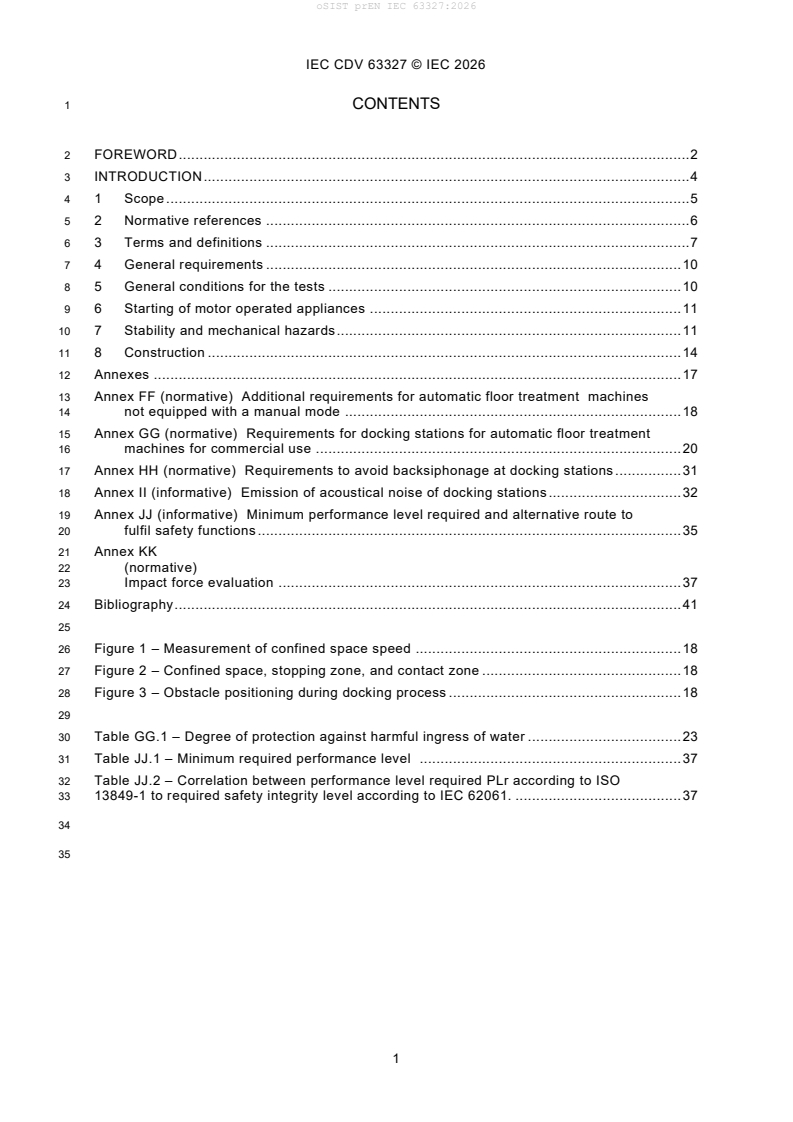
Contents
- 2 FOREWORD
- 3 INTRODUCTION
- 4 1 Scope
- 5 2 Normative references
- 6 3 Terms and definitions
- 7 4 General requirements
- 8 5 General conditions for the tests
- 9 6 Starting of motor operated appliances
- 10 7 Stability and mechanical hazards
- 11 8 Construction
- 12 Annexes
- 13 Annex FF (normative) Additional requirements for automatic floor treatment machines 14 not equipped with a manual mode
- 15 Annex GG (normative) Requirements for docking stations for automatic floor treatment 16 machines for commercial use
- 17 Annex HH (normative) Requirements to avoid backsiphonage at docking stations
- 18 Annex II (informative) Emission of acoustical noise of docking stations
- 19 Annex JJ (informative) Minimum performance level required and alternative route to 20 fulfil safety functions
- 21 Annex KK 22 (normative) 23 Impact force evaluation
- 24 Bibliography
- 26 Figure 1 – Measurement of confined space speed
- 27 Figure 2 – Confined space, stopping zone, and contact zone
- 28 Figure 3 – Obstacle positioning during docking process
- 30 Table GG.1 – Degree of protection against harmful ingress of water
- 31 Table JJ.1 – Minimum required performance level
- 32 Table JJ.2 – Correlation between performance level required PLr according to ISO 33 13849-1 to required safety integrity level according to IEC 62061
110 INTRODUCTION 111 It has been assumed in the drafting of this International Standard that the execution of its 112 provisions is entrusted to appropriately qualified and experienced persons.
113 This standard recognizes the internationally accepted level of protection against hazards such 114 as electrical, mechanical, thermal, fire and radiation of appliances when operated as in normal 115 use taking into account the manufacturer's instructions. It also covers abnormal situations that 116 can be expected in practice and takes into account the way in which electromagnetic 117 phenomena can affect the safe operation of appliances.
118 This standard takes into account the requirements of IEC 60364 as far as possible so that there 119 is compatibility with the wiring rules when the appliance is connected to the supply mains. 120 However, national wiring rules may differ.
121 This standard is a product family standard dealing with the safety of appliances and takes 122 precedence over horizontal and generic standards covering the same subject.
123 NOTE Horizontal and generic standards covering a hazard are not applicable since they have been taken into 124 consideration when developing the general and particular requirements for the IEC 60335 series of standards. For 125 example, in the case of temperature requirements for surfaces on many appliances, generic standards, such as 126 ISO 13732-1 for hot surfaces, are not applicable in addition to Part 1 or part 2 standards. 127 An appliance that complies with the text of this standard will not necessarily be considered to 128 comply with the safety principles of the standard if, when examined and tested, it is found to 129 have other features that impair the level of safety covered by these requirements. 130 An appliance employing materials or having forms of construction differing from those detailed 131 in the requirements of this standard may be examined and tested according to the intent of the 132 requirements and, if found to be substantially equivalent, may be considered to comply with the 133 standard.
136 AUTOMATIC FLOOR TREATMENT MACHINES FOR COMMERCIAL USE – 137 PARTICULAR REQUIREMENTS 138 139 140 141 1 Scope 142 This International Standard deals with the safety of powered automatic floor treatment 143 machines intended for commercial use indoors for the following applications:
144 – sweeping, 145 – scrubbing, 146 – wet or dry pick-up, 147 – polishing, 148 – application of wax, sealing products and powder-based detergents, 149 – shampooing 150 of floors.
151 The requirements given by this standard are applied in addition to the requirements for 152 commercial floor treatment machines in IEC 60335-2-72, as far as applicable. 153 For automatic floor treatment machines solely designed for wet or dry pick-up, additional or 154 modified requirements of IEC 60335-2-69 where stated are applicable.
155 Machines covered by this standard can operate in automatic or manual mode.
156 Modified requirements are given in Annex FF of this standard for automatic floor treatment 157 machines not equipped with a manual mode.
158 The automatic floor treatment machines covered by this standard are designed to avoid 159 hazardous contact with persons in the environment applied. It is recognized that automatic 160 floor treatment machines for commercial use might require operation within close proximity 161 to large groups of people, such as in shopping malls and schools.
162 Throughout this standard, the term “machine” is used to refer to an automatic floor treatment 163 machine.
164 The following power systems are covered:
165 – rechargeable batteries that are recharged by built-in battery chargers or off-board battery 166 chargers which may be incorporated within the circuitry of the machine, or mounted on the 167 machine and incorporated within the enclosure of the automatic floor treatment machine; 168 or powered by batteries that need to be removed to be recharged with a charger that is 169 external to the machine, 170 – Other systems are under consideration.
171 This standard does not apply to 172 – vacuum cleaners and water-suction cleaning appliances and automatic battery-operated 173 cleaners for household use (IEC 60335-2-2); 174 – floor treatment machines and wet scrubbing machines for household use 175 (IEC 60335‑2‑10); 176 – battery chargers (IEC 60335-2-29);
177 – floor treatment machines for commercial use (IEC 60335-2-67); 178 – spray extraction machines for commercial use (IEC 60335-2-68); 179 – road sweepers; 180 NOTE 101 In Europe, the EN 17106 series covers road sweepers.
181 – machines designed for use on slopes with a gradient exceeding 20 %; 182 – machines equipped with a power take-off (PTO); 183 – machines designed for use in corrosive or explosive environments (dust, vapour or gas); 184 – machines designed for use in vehicles or on board of ships or aircraft.
185 – vacuum cleaners designed for pickup of combustible dust; 186 – appliances for medical purposes (IEC 60601-1); 187 – driverless industrial trucks and their systems (ISO 3691-4); 188 – robots and robotic devices: Safety requirements of personal care robots (ISO 13482) 189 – machines with parts that extend beyond the contact zone of the machine; 190 NOTE 102 Components of the machine that operate outside the contact zone can be evaluated differently. 191 – machines designed for picking up liquids with a flash point below 55 °C.
192 NOTE 103 The flash point temperature limit can vary in different countries. National regulations will need to be 193 taken into account.
194 NOTE 104 Attention is drawn to the fact that in many countries additional requirements on the safe use of the 195 equipment covered can be specified by the national health authorities, the national authorities responsible for the 196 protection of labour, the national water supply authorities and similar authorities . 197 2 Normative references 198 The following documents are referred to in the text in such a way that some or all of their content 199 constitutes requirements of this document. For dated references, only the edition cited applies. 200 For undated references, the latest edition of the referenced document (including any 201 amendments) applies.
202 IEC 60335-1:2020, Household and similar electrical appliances – Safety – Part 1: General 203 requirements 204 IEC 60335-2-69:2021, Household and similar electrical appliances – Safety – Part 2-69:
205 Particular requirements for wet and dry vacuum cleaners, including power brush, for commercial 206 use 207 IEC 60335-2-72:2021, Household and similar electrical appliances – Safety – Part 2-72:
208 Particular requirements for floor treatment machines with or without traction drive, for 209 commercial use 210 IEC 61032, Protection of persons and equipment by enclosures – Probes for verification 211 IEC 61058-1, Switches for appliances – Part 1: General requirements 212 IEC 61770:2008, Electric appliances connected to the water mains – Avoidance of 213 backsiphonage and failure of hose-sets 214 IEC 62061, Safety of machinery – Functional safety of safety-related control systems 215 ISO 13849-1, Safety of machinery – Safety-related parts of control systems – Part 1: General 216 principles for design 217 ISO 13857:2019, Safety of machinery – Safety distances to prevent hazard zones being 218 reached by upper and lower limbs 219 ISO 18646-1:2016, Robotics – Performance criteria and related test methods for service robots 220 – Part 1: Locomotion for wheeled robots 221 3 Terms and definitions 222 Clause 3 of IEC 60335-2-69:2021 and IEC 60335-2-72:2021 applies, except as follows:
223 NOTE The 200 numbering in Clause 3 of this standard is applied to avoid overlap with the numbering of Clause 3 224 of IEC 60335-2-69 and IEC 60335-2-72.
225 Addition:
226 3.201 227 automatic floor treatment machine 228 machine that operates automatically on a defined working area and that may also be able to be 229 operated in a manual mode 230 Note 1 to entry: Definition of the work area and floor surface can be done by operator action, (temporary) physical 231 limitations or by autonomous (initial) exploratory mode of the machine.
232 3.202 233 type 1 machine 234 automatic floor treatment machine having 235 – a maximum rated automatic speed not exceeding 3 km/h, and 236 – a height during normal operation not exceeding 50 cm above the ground, and 237 – a mass during normal operation not exceeding 20 kg 238 Note 1 to entry: If a GVW is available, the mass is replaced by this value.
239 3.203 240 type 2 machine 241 automatic floor treatment machine other than a type 1 machine 242 3.204 243 control system 244 set of logic control and power functions which allows to monitor and control the mechanical 245 structure of the machine and to communicate with the environment (equipment and operators) 246 [SOURCE: ISO 8373:2012, 2.7 modified – "monitoring" has been changed to "to monitor", 247 "robot" has been changed to "machine", "communication" has been changed to "communicate" 248 and "users" has been changed to "operators"] 249 3.205 250 manual mode 251 operating mode in which the machine can be operated by, for example, pushbuttons or a joystick 252 and that excludes operation in automatic mode 253 Note 1 to entry: It includes manual cleaning and transportation modes.
254 [SOURCE: ISO 8373:2012, 5.3.10.2, modified – "robot" has been changed to "machine", 255 "operation" has been changed to "mode" and the note to entry has been added ] 257 automatic mode 258 operating mode in which the machine accomplishes its assigned mission without direct human 259 intervention 260 3.207 261 locked state 262 condition in which the driving wheels are being prevented from moving with a locking 263 mechanism that can be unlocked by the intervention of the authorized operator only 264 Note 1 to entry: A locking mechanism can be the traction drive or the service brake. 265 3.208 266 rated automatic speed 267 maximum speed of the machine during operation in automatic mode in open space 268 3.209 269 access control 270 security measure enabling the operator to gain access to the control of the machine 271 Note 1 to entry: It includes, but is not limited to, a key-protected control device. 272 3.210 273 stopping distance 274 maximum distance travelled by the machine between the initiation of the stop and the complete 275 standstill 276 Note 1 to entry: The stopping distance in 0 includes machine reaction time.
277 [SOURCE: ISO 18646-1:2016, 3.10, modified – "mobile platform origin" has been changed to 278 "machine", "full stop of the mobile platform" has been changed to "complete standstill" and the 279 note to entry has been added] 280 3.211 281 stop category 0 282 stopping by immediate removal of power to the machine actuators (i.e., an uncontrolled stop) 283 [SOURCE: IEC 60204-1:2016, 9.2.2] 284 3.212 285 stop category 1 286 controlled stop with power available to the machine actuators to achieve the stop and then 287 removal of power when the stop is achieved 288 [SOURCE: IEC 60204-1:2016, 9.2.2] 289 3.213 290 stop category 2 291 controlled stop with power left available to the machine actuators 292 [SOURCE: IEC 60204-1:2016, 9.2.2, modified – "remaining" has been changed to "left" and the 293 note to entry has been added] 294 3.214 295 stopping zone 296 fixed or variable-sized zone in which the machine has the capabilities to avoid a static object 297 Note 1 to entry: See Figure 2.
299 contact zone 300 boundary in which the machine is assumed to be in contact with the object, and the allowable 301 motion of the machine could be hazardous at that boundary 302 Note 1 to entry: See Figure 2.
303 Note 2 to entry: Hazardous exposed moving side brushes are included in the contact zone. 304 3.216 305 open space 306 area that is not considered to be a confined space 307 3.217 308 confined space 309 area in which the distance from the nearest continuous wall or obstacle is less than 0,5 m from 310 the machine transport width parallel to the direction of motion 311 Note 1 to entry: See Figure 2.
312 3.218 313 machine transport width 314 minimum width the machine can pass through to indicate the maneuverability of the machine 315 during transport 316 Note 1 to entry: It does not indicate the effective cleaning width of the machine. 317 [SOURCE: IEC 62885-9:2019, Clause 7, modified – "not the effective cleaning width of the 318 machine" has been deleted and the note to entry has been added] 319 3.219 320 docking station 321 unit that may provide one or more of the following functions for the automatic floor treatment 322 machine:
323 – manual or automatic battery charging facilities, 324 – AC and/or DC power supply, 325 – filling water with or without detergents, 326 – filling detergents, 327 – filling water for wet batteries, 328 – emptying of wastewater, dust, coarse dirt, 329 – communication connections, 330 – navigation information 331 Note 1 to entry: A docking station is also known as a base unit.3.220 332 Hazardous contact 333 A contact with a force >150 N impacting an obstacle 334 Note to entry 1: The force is measured per Annex KK with the safety system on for type 2 machines. 335 Note 2 to entry: if a bumper system is applied, additional requirements apply including deactivation of parts of the 336 obstacle detection system.
337 3.221 338 bumper system 339 device sensing a person or obstacle using physical contact means 341 Supervisory function 342 function allowing remote surveillance of the floor treatment machine in automatic mode allowing 343 sending and receiving information including restart of the machine into automatic mode after stop 344 category 0 or stop category 1 under specified conditions 345 Note 1 to entry: A restart is not considered possible after a stop category 0 or stop category 1 is triggered based 346 on a detected failure in the safety-related parts of the control system.
347 Note 2 to entry: A restart is considered to be possible after a stop category 0 or stop category 1 is triggered 348 based on an obstacle entering the contact zone when required conditions within this standard are met. 349 4 General requirements 350 The machine shall be constructed as follows:
351 The machine when in manual mode shall fulfil the requirements for commercial floor treatment 352 machines according to IEC 60335-2-72:2021 unless stated otherwise in this standard. Further 353 requirements for the automatic mode are given within the main body of this standard. Machines 354 shall be constructed in their manual and automatic mode so that they function safely to cause 355 no danger to persons or surroundings avoiding hazardous contact during normal use, even in 356 the event of carelessness, and during installation, adjusting, maintenance, cleaning, repairing, 357 or transportation.
358 In general, this principle is achieved by fulfilling the relevant requirements specified in this 359 standard and compliance is checked by carrying out all the relevant tests.
360 For ride-on machines in automatic mode, operator presence on the machine shall be 361 prevented either by sensing which stops the machine from operating, or design features which 362 prevent operator presence.
363 Modified requirements to IEC 60335-2-72:2021 are given in normative Annex FF of this 364 standard for automatic floor treatment machines not equipped with a manual mode. 365 For the purposes of this standard, the term ‘appliance’ as used in IEC 60335-1:2020 is to be 366 read as ‘machine’.
367 368 5 General conditions for the tests 369 5.1 The following test obstacles, taken from ISO 13856-3, shall be covered in black felt or 370 coarse fabric with a reflectance between 5 % and 10 %:
371 a) Obstacle 1 – a cylinder with a diameter of 200 mm and a length of 600 mm, placed 372 horizontally; and 373 b) Obstacle 2 – a cylinder with a diameter of 70 mm and a height of 400 mm, placed vertically. 374 NOTE To perform the test, the obstacle can be attached to a flat plate with a handle or a cord can be used to place 375 the obstacle.
376 5.2 The obstacles shall be of a weight withstanding certain contact by a machine. Obstacle 377 1 shall have a mass ≥ 10 kg and Obstacle 2 a mass ≥ 5 kg.
378 Compliance is checked by the following test:
379 A test force of 150 N is applied on the outer diameter of each obstacle. The diameter of the obstacle 380 shall not be deformed by more than 1 mm.
381 5.3 Tests shall be conducted at lighting level between 100 lx and 1000 lx.
382 6 Starting of motor operated appliances 383 It shall only be possible to start the type 2 machine in automatic mode from initial start-up by 384 intended actuation of an access control provided for the purpose or via a supervisory 385 function. This requirement does not apply when restarting the type 2 machine in automatic 386 mode after a stop category 0 or stop category 1, unless it is is triggered based on a detected 387 failure in the safety-related parts of the control system per clause 7.8. This requirement only 388 applies to components where the unexpected starting might cause a hazard. It does not apply 389 to components such as suction units, pumps, etc.
390 Compliance is checked by inspection and test.
391 7 Stability and mechanical hazards 392 7.1 Machines in automatic mode, operating in an open space environment, shall not exceed 393 6 km/h. Machines in automatic mode operating in a confined space environment shall not 394 exceed 4 km/h.
395 NOTE 1 As specified in this standard, manual mode speed can be higher than automatic mode speed. 396 Compliance for machine speed operating in confined space environment is checked by 397 measurement in accordance with the test procedure as described below.
398 The test area of the confined space environment consists of two continuous walls or obstacles, 399 each with a minimum length equal to the machine transport length and a minimum height of 1 400 m. One wall is located on one side of the machine, and the other wall is located on the opposite 401 side of the machine starting from the location where the first wall ends. The two walls are placed 402 in the direction of travel of the machine so that they are within the confined space distance on 403 each side from the machine transport width. Sensors are allocated at each end of the test 404 area to measure the start and finish of the machine traversal.
405 NOTE 2 An example of test set up is shown in Figure 1.
406 The machine, loaded to the GVW rating, traverses towards the confined space test set-up area 407 at the maximum open space speed and enters the confined space test area. The confined 408 space speed is measured from the start and end of the machine traversal through the confined 409 space test set-up area. The average speed shall be measured over three successful speed 410 measurements.
411 Compliance is checked by measurement in accordance with ISO 18646-1:2016, Clause 5, with 412 the machine loaded to the GVW rating.
413 7.2 Machines that can function in manual mode as ride-on machine or a walk-behind 414 machine with traction drive shall not be possible to operate with the higher speed of manual 415 mode when operating in automatic mode.
416 Compliance is checked by inspection and measurement.
417 7.3 The detection system shall be capable of avoiding hazardous contact with obstacles in 418 the directions in which the machine is capable of motion at distances greater than S , as a 419 calculated in 0, for the maximum speed the machine can travel in that direction. In case a 420 bumper system is applied, additional requirements apply as given in normative Annex KK. This 421 requirement is not applicable to type 1 machines not exceeding a speed of 1,5 km/h and to 422 automatic floor treatment machines during the docking process to the docking station.
...