


SIST EN 12952-6:2022
(Main)Water-tube boilers and auxiliary installations - Part 6: Inspection during construction; documentation and marking of pressure parts of the boiler
Water-tube boilers and auxiliary installations - Part 6: Inspection during construction; documentation and marking of pressure parts of the boiler
This European Standard specifies requirements for the inspection during construction, documentation and marking of water-tube boilers as defined in EN 12952-1.
Wasserrohrkessel und Anlagenkomponenten - Teil 6: Prüfung während der Herstellung, Dokumentation und Kennzeichnung für drucktragende Kesselteile
Chaudières à tubes d'eau et installations auxiliaires - Partie 6: Contrôles pendant la construction, documentation et marquage des parties sous pression de la chaudière
Vodocevni kotli in pomožne napeljave - 6. del: Kontrola med izdelavo, dokumentacija in označevanje tlačno obremenjenih delov kotla
Ta evropski standard določa zahteve za kontrolo med izdelavo, dokumentiranjem in označevanjem vodocevnih kotlov, kot je določeno v standardu EN 12952-1.
General Information
- Status
- Published
- Public Enquiry End Date
- 02-Apr-2020
- Publication Date
- 17-Jan-2022
- Technical Committee
- TLP - Pressure vessels
- Current Stage
- 6100 - Translation of adopted SIST standards (Adopted Project)
- Start Date
- 06-May-2022
- Due Date
- 05-May-2023
- Completion Date
- 05-Oct-2022
Relations
- Effective Date
- 01-Feb-2022
Overview
EN 12952-6:2021 is the CEN European Standard that sets requirements for inspection during construction, documentation and marking of pressure parts of water-tube boilers (as defined in EN 12952-1). Updated in 2021 (superseding the 2011 edition), this part of the EN 12952 series focuses on activities and records that demonstrate manufacturing quality, traceability and conformity with applicable regulations (see Annex ZA for links to EU requirements).
Key topics and technical requirements
The standard addresses practical and technical controls manufacturers and inspectors must apply during boiler construction. Major topics include:
- Inspection planning and organization
- Roles, competency of the manufacturer and conformity assessment procedures.
- Calibration requirements for inspection equipment.
- Non-destructive testing (NDT) of parent materials and welds
- Specified NDT methods: visual, penetrant, magnetic particle, radiographic and ultrasonic testing, including automated phased-array where applicable.
- Qualification of NDT personnel and reporting requirements.
- Production test plates for drums
- Requirements for sample test plates and both non‑destructive and destructive test types (tensile, bend, impact, macroscopic examination, hardness checks).
- Acceptance criteria and non‑conformance
- Procedures for interpreting NDT and destructive test results and actions for non-conforming items.
- Final inspection and hydrostatic testing
- Visual/dimensional checks and hydrostatic pressure test procedures for completed pressure parts.
- Documentation and marking
- Mandatory records, traceability data, and marking of pressure parts to ensure identification throughout the boiler lifecycle.
- Special cases
- Annex A: additional NDT and volumetric testing requirements for chemical recovery boilers.
- References
- Cross-references to EN 12952 series parts and key EN/ISO NDT and welding standards (e.g., EN ISO 9712, EN ISO 17636, EN ISO 17640).
Practical applications
EN 12952-6 is used to:
- Ensure structural integrity and safety of water-tube boiler pressure parts during manufacture.
- Standardize NDT scope, test sampling and acceptance criteria to reduce manufacturing defects.
- Provide documentary evidence and markings required for regulatory compliance, commissioning and in-service traceability.
- Support conformity assessment under pressure equipment regulations (national/EU).
Who should use this standard
- Boiler manufacturers and fabricators of pressure parts
- NDT technicians, welding engineers and quality managers
- Independent inspection bodies and notified bodies
- Plant owners, EPC contractors and procurement specialists who need to specify inspection and documentation requirements
Related standards
- EN 12952 series (Parts 1–18) - design, materials, workmanship, testing
- EN/ISO standards referenced for NDT and welding qualifications (e.g., EN ISO 9712, EN ISO 17636-1/2, EN ISO 17640)
Keywords: EN 12952-6:2021, water-tube boilers, inspection during construction, documentation, marking, pressure parts, NDT, hydrostatic test, boiler inspection, conformity.


Frequently Asked Questions
SIST EN 12952-6:2022 is a standard published by the Slovenian Institute for Standardization (SIST). Its full title is "Water-tube boilers and auxiliary installations - Part 6: Inspection during construction; documentation and marking of pressure parts of the boiler". This standard covers: This European Standard specifies requirements for the inspection during construction, documentation and marking of water-tube boilers as defined in EN 12952-1.
This European Standard specifies requirements for the inspection during construction, documentation and marking of water-tube boilers as defined in EN 12952-1.
SIST EN 12952-6:2022 is classified under the following ICS (International Classification for Standards) categories: 27.060.30 - Boilers and heat exchangers. The ICS classification helps identify the subject area and facilitates finding related standards.
SIST EN 12952-6:2022 has the following relationships with other standards: It is inter standard links to SIST EN 12952-6:2011. Understanding these relationships helps ensure you are using the most current and applicable version of the standard.
SIST EN 12952-6:2022 is associated with the following European legislation: EU Directives/Regulations: 2014/68/EU; Standardization Mandates: M/071. When a standard is cited in the Official Journal of the European Union, products manufactured in conformity with it benefit from a presumption of conformity with the essential requirements of the corresponding EU directive or regulation.
SIST EN 12952-6:2022 is available in PDF format for immediate download after purchase. The document can be added to your cart and obtained through the secure checkout process. Digital delivery ensures instant access to the complete standard document.
Standards Content (Sample)
SLOVENSKI STANDARD
01-februar-2022
Nadomešča:
SIST EN 12952-6:2011
Vodocevni kotli in pomožne napeljave - 6. del: Kontrola med izdelavo,
dokumentacija in označevanje tlačno obremenjenih delov kotla
Water-tube boilers and auxiliary installations - Part 6: Inspection during construction;
documentation and marking of pressure parts of the boiler
Wasserrohrkessel und Anlagenkomponenten - Teil 6: Prüfung während der Herstellung,
Dokumentation und Kennzeichnung für drucktragende Kesselteile
Chaudières à tubes d'eau et installations auxiliaires - Partie 6: Contrôles pendant la
construction, documentation et marquage des parties sous pression de la chaudière
Ta slovenski standard je istoveten z: EN 12952-6:2021
ICS:
27.060.30 Grelniki vode in prenosniki Boilers and heat exchangers
toplote
2003-01.Slovenski inštitut za standardizacijo. Razmnoževanje celote ali delov tega standarda ni dovoljeno.
EN 12952-6
EUROPEAN STANDARD
NORME EUROPÉENNE
December 2021
EUROPÄISCHE NORM
ICS 27.040 Supersedes EN 12952-6:2011
English Version
Water-tube boilers and auxiliary installations - Part 6:
Inspection during construction, documentation and
marking of pressure parts of the boiler
Chaudières à tubes d'eau et installations auxiliaires - Wasserrohrkessel und Anlagenkomponenten - Teil 6:
Partie 6: Contrôles pendant la construction, Prüfung während der Herstellung, Dokumentation und
documentation et marquage des parties sous pression Kennzeichnung für drucktragende Kesselteile
de la chaudière
This European Standard was approved by CEN on 1 November 2021.
CEN members are bound to comply with the CEN/CENELEC Internal Regulations which stipulate the conditions for giving this
European Standard the status of a national standard without any alteration. Up-to-date lists and bibliographical references
concerning such national standards may be obtained on application to the CEN-CENELEC Management Centre or to any CEN
member.
This European Standard exists in three official versions (English, French, German). A version in any other language made by
translation under the responsibility of a CEN member into its own language and notified to the CEN-CENELEC Management
Centre has the same status as the official versions.
CEN members are the national standards bodies of Austria, Belgium, Bulgaria, Croatia, Cyprus, Czech Republic, Denmark, Estonia,
Finland, France, Germany, Greece, Hungary, Iceland, Ireland, Italy, Latvia, Lithuania, Luxembourg, Malta, Netherlands, Norway,
Poland, Portugal, Republic of North Macedonia, Romania, Serbia, Slovakia, Slovenia, Spain, Sweden, Switzerland, Turkey and
United Kingdom.
EUROPEAN COMMITTEE FOR STANDARDIZATION
COMITÉ EUROPÉEN DE NORMALISATION
EUROPÄISCHES KOMITEE FÜR NORMUNG
CEN-CENELEC Management Centre: Rue de la Science 23, B-1040 Brussels
© 2021 CEN All rights of exploitation in any form and by any means reserved Ref. No. EN 12952-6:2021 E
worldwide for CEN national Members.
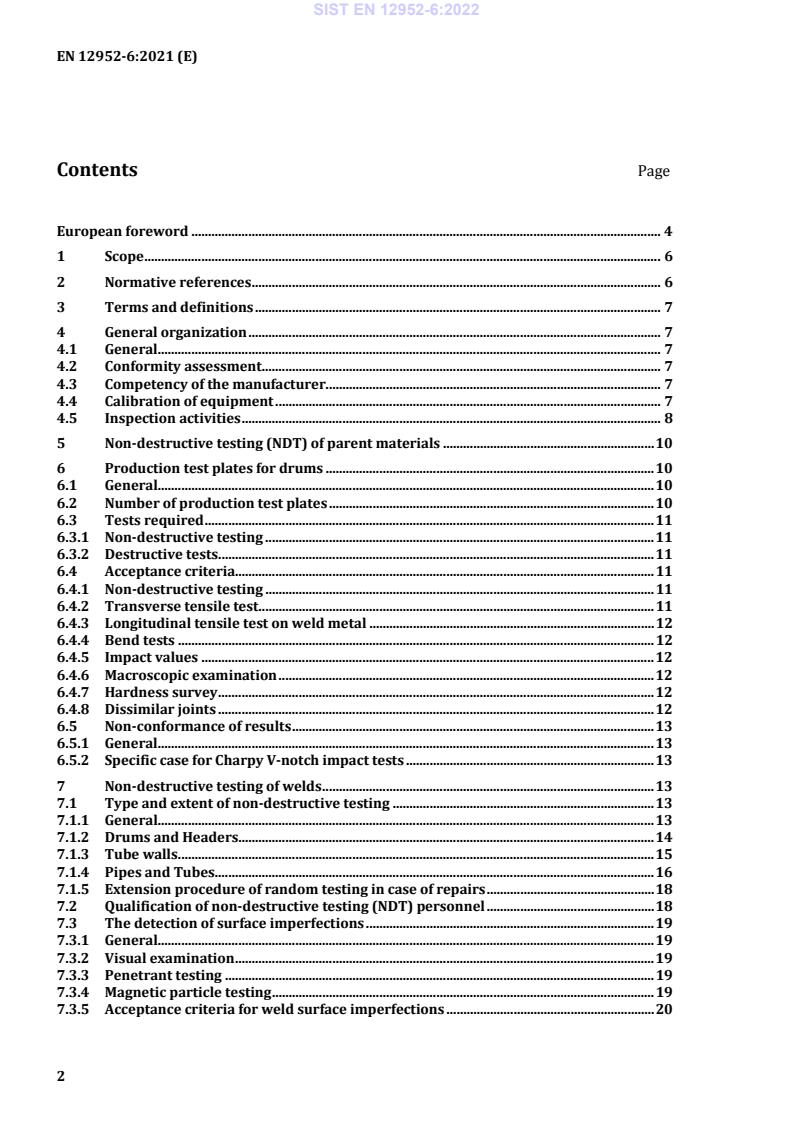
Contents Page
European foreword . 4
1 Scope . 6
2 Normative references . 6
3 Terms and definitions . 7
4 General organization . 7
4.1 General. 7
4.2 Conformity assessment . 7
4.3 Competency of the manufacturer. 7
4.4 Calibration of equipment . 7
4.5 Inspection activities . 8
5 Non-destructive testing (NDT) of parent materials . 10
6 Production test plates for drums . 10
6.1 General. 10
6.2 Number of production test plates . 10
6.3 Tests required . 11
6.3.1 Non-destructive testing . 11
6.3.2 Destructive tests . 11
6.4 Acceptance criteria. 11
6.4.1 Non-destructive testing . 11
6.4.2 Transverse tensile test . 11
6.4.3 Longitudinal tensile test on weld metal . 12
6.4.4 Bend tests . 12
6.4.5 Impact values . 12
6.4.6 Macroscopic examination . 12
6.4.7 Hardness survey . 12
6.4.8 Dissimilar joints . 12
6.5 Non-conformance of results . 13
6.5.1 General. 13
6.5.2 Specific case for Charpy V-notch impact tests . 13
7 Non-destructive testing of welds . 13
7.1 Type and extent of non-destructive testing . 13
7.1.1 General. 13
7.1.2 Drums and Headers. 14
7.1.3 Tube walls . 15
7.1.4 Pipes and Tubes . 16
7.1.5 Extension procedure of random testing in case of repairs . 18
7.2 Qualification of non-destructive testing (NDT) personnel . 18
7.3 The detection of surface imperfections . 19
7.3.1 General. 19
7.3.2 Visual examination . 19
7.3.3 Penetrant testing . 19
7.3.4 Magnetic particle testing . 19
7.3.5 Acceptance criteria for weld surface imperfections . 20
7.4 Testing for volumetric imperfections . 22
7.4.1 Radiographic testing . 22
7.4.2 Ultrasonic testing . 25
7.5 Non-destructive testing reports . 26
8 Final inspection . 27
8.1 Visual and dimensional examinations . 27
8.2 Hydrostatic pressure test . 27
8.2.1 General . 27
8.2.2 Test procedure . 27
9 Documentation . 28
10 Marking . 29
Annex A (normative) Special requirements for chemical recovery boilers . 30
A.1 General . 30
A.2 Special requirements for non-destructive testing (NDT) of welds . 30
A.2.1 General . 30
A.2.2 Special requirements for NDT of welds in a chemical recovery boiler - Volumetric
testing . 30
A.2.3 Methods of testing . 30
Annex B (informative) Significant technical changes between this document and the
previous edition . 31
Annex ZA (informative) Relationship between this European Standard and the essential
requirements of Directive 2014/68/EU aimed to be covered . 32
Bibliography . 33
European foreword
This document (EN 12952-6:2021) has been prepared by Technical Committee CEN/TC 269 “Shell and
water-tube boilers”, the secretariat of which is held by DIN.
This European Standard shall be given the status of a national standard, either by publication of an
identical text or by endorsement, at the latest by June 2022, and conflicting national standards shall be
withdrawn at the latest by June 2022.
Attention is drawn to the possibility that some of the elements of this document may be the subject of
patent rights. CEN shall not be held responsible for identifying any or all such patent rights.
This document supersedes EN 12952-6:2011.
Annex B provides details of significant technical changes between this document and the previous
edition.
EN 12952 series concerning water-tube boilers and auxiliary installations consists of the following parts:
• Part 1: General;
• Part 2: Materials for pressure parts of boilers and accessories;
• Part 3: Design and calculation for pressure parts;
• Part 4: In service boiler life expectancy calculations;
• Part 5: Workmanship and construction of pressure parts of the boiler;
• Part 6: Inspection during construction, documentation and marking of pressure parts of the boiler;
• Part 7: Requirements for equipment for the boiler;
• Part 8: Requirements for firing systems for liquid and gaseous fuels for the boiler;
• Part 9: Requirements for firing systems for pulverized solid fuels for the boiler;
• Part 10: Requirements for safeguards against excessive pressure;
• Part 11: Requirements for limiting devices of the boiler and accessories;
• Part 12: Requirements for boiler feedwater and boiler water quality;
• Part 13: Requirements for flue gas cleaning systems;
• Part 14: Requirements for flue gas DENOX-systems using liquefied pressurized ammonia and ammonia
water solution;
• Part 15: Acceptance tests;
• Part 16: Requirements for grate and fluidized-bed firing systems for solid fuels for the boiler;
• CR 12952 Part 17: Guideline for the involvement of an inspection body independent of the
manufacturer.
• Part 18: Operating instructions
Although these parts can be obtained separately, it should be recognized that the parts are inter-
dependent. As such, the design and manufacture of water-tube boilers requires the application of more
than one part in order for the requirements of the document to be satisfactorily fulfilled.
NOTE A “Boiler Helpdesk” has been established in CEN/TC 269 which can be contacted for any questions
regarding the application of EN 12952 series and EN 12953 series, see the following website: http://www.boiler-
helpdesk.din.de
This document has been prepared under a Standardization Request given to CEN by the European
Commission and the European Free Trade Association, and supports essential requirements of EU
Directive(s) / Regulation(s).
For relationship with EU Directive(s) / Regulation(s), see informative Annex ZA, which is an integral part
of this document.
Any feedback and questions on this document should be directed to the users’ national standards body.
A complete listing of these bodies can be found on the CEN website.
According to the CEN-CENELEC Internal Regulations, the national standards organisations of the
following countries are bound to implement this European Standard: Austria, Belgium, Bulgaria, Croatia,
Cyprus, Czech Republic, Denmark, Estonia, Finland, France, Germany, Greece, Hungary, Iceland, Ireland,
Italy, Latvia, Lithuania, Luxembourg, Malta, Netherlands, Norway, Poland, Portugal, Republic of North
Macedonia, Romania, Serbia, Slovakia, Slovenia, Spain, Sweden, Switzerland, Turkey and the United
Kingdom.
1 Scope
This document specifies requirements for the inspection during construction, documentation and
marking of water-tube boilers as defined in EN 12952-1:2015.
2 Normative references
The following documents are referred to in the text in such a way that some or all of their content
constitutes requirements of this document. For dated references, only the edition cited applies. For
undated references, the latest edition of the referenced document (including any amendments) applies.
EN 12952-1:2015, Water-tube boilers and auxiliary installations - Part 1: General
EN 12952-2:2021, Water-tube boilers and auxiliary installations — Part 2: Materials for pressure parts of
boilers and accessories
EN 12952-3:2011, Water-tube boilers and auxiliary installations - Part 3: Design and calculation for
pressure parts of the boiler
EN 12952-5:2021, Water-tube boilers and auxiliary installations — Part 5: Workmanship and construction
of pressure parts of the boiler
EN ISO 3452-1:2021, Non-destructive testing - Penetrant testing - Part 1: General principles
(ISO 3452-1:2021)
EN ISO 5817:2014, Welding - Fusion-welded joints in steel, nickel, titanium and their alloys (beam welding
excluded) - Quality levels for imperfections (ISO 5817:2014)
EN ISO 6520-1:2007, Welding and allied processes - Classification of geometric imperfections in metallic
materials - Part 1: Fusion welding (ISO 6520-1:2007)
EN ISO 9712:2012, Non-destructive testing - Qualification and certification of NDT personnel
(ISO 9712:2012)
EN ISO 11666:2018, Non-destructive testing of welds - Ultrasonic testing - Acceptance levels
(ISO 11666:2018)
EN ISO 13588:2019, Non-destructive testing of welds - Ultrasonic testing - Use of automated phased array
technology (ISO 13588:2019)
EN ISO 15614-1:2017, Specification and qualification of welding procedures for metallic materials -
Welding procedure test - Part 1: Arc and gas welding of steels and arc welding of nickel and nickel alloys
(ISO 15614-1:2017, Corrected version 2017-10-01)
EN ISO 17636-1:2013, Non-destructive testing of welds - Radiographic testing - Part 1: X- and gamma-ray
techniques with film (ISO 17636-1:2013)
EN ISO 17636-2:2013, Non-destructive testing of welds - Radiographic testing - Part 2: X- and gamma-ray
techniques with digital detectors (ISO 17636-2:2013)
EN ISO 17637:2016, Non-destructive testing of welds - Visual testing of fusion-welded joints
(ISO 17637:2016)
EN ISO 17638:2016, Non-destructive testing of welds - Magnetic particle testing (ISO 17638:2016)
EN ISO 17640:2018, Non-destructive testing of welds - Ultrasonic testing - Techniques, testing levels, and
assessment (ISO 17640:2018)
CEN ISO/TR 20172:2009, Welding - Grouping systems for materials - European materials
(ISO/TR 20172:2009)
EN ISO 23277:2015, Non-destructive testing of welds - Penetrant testing - Acceptance levels
(ISO 23277:2015)
EN ISO 23278:2015, Non-destructive testing of welds - Magnetic particle testing - Acceptance levels
(ISO 23278:2015)
3 Terms and definitions
For the purposes of this document the terms and definitions given in EN 12952-1:2015 and the following
apply.
ISO and IEC maintain terminological databases for use in standardization at the following addresses:
• ISO Online browsing platform: available at http://www.iso.org/obp
• IEC Electropedia: available at http://www.electropedia.org/
3.1
inspection
conformity evaluation by observation and judgement accompanied as appropriate by measurement,
testing or gauging
4 General organization
4.1 General
The manufacturer shall be responsible for ensuring the boiler conforms to the requirements of this
document. Conformance shall be confirmed by completing a series of inspection activities as detailed in
Table 1.
Except where explicitly stated otherwise in this document, inspection activities applicable to a
manufacturer’s works shall also be applicable to operations carried out on a construction site.
4.2 Conformity assessment
Guidance in the use of the conformity assessment procedures is given in CR 12952-17:2002.
4.3 Competency of the manufacturer
If an assessment of the competency of the manufacturer is required, guidance is given in EN 12952-
5:2021, Annex F.
4.4 Calibration of equipment
The manufacturer shall establish procedures to ensure that tools, gauges, instruments and other
measuring and testing devices used in the manufacture and inspection activities affecting boiler product
quality, are properly controlled, calibrated and adjusted at specific intervals, to maintain accuracy within
defined limits.
4.5 Inspection activities
The manufacturer shall confirm that the boiler components, as a minimum, conform to the requirements
of this document by performing and authenticating the activities listed in Table 1.
Depending upon the conformity assessment module adopted, some of the inspection activities listed
should also be assessed by a responsible authority. For the guidance of the manufacturer, the specific
involvement of such a responsible authority is indicated in CR 12952-17.
Table 1 — List of inspection activities to be undertaken by the manufacturer
Reference Area of activity Inspection operation
1 Design and general documentation
1.1 Design data/ Ensure that the design data/calculations conform to:
calculations
— technical specifications, if applicable;
— the requirements of this document.
1.2 Manufacturing Ensure that drawing information conforms to:
drawings
— design data and calculations;
— technical specifications, if applicable;
— the requirements of this Document.
1.3 Purchase Ensure that material and component specifications conform to:
specifications
— technical specifications, if applicable;
— manufacturing drawings;
— the requirements of this document.
1.4 Specifications for sub- Ensure that the specification for sub-contracted parts conform
contracted parts to:
— technical specifications, if applicable;
— manufacturing drawings;
— the requirements of this document.
2 Material
2.1 Material certificates Verify that certificate information and results conform to the
design specification.
2.2 Welding consumables Verify that the consumables to be used are in accordance with
the design specification.
2.3 Material identification Identify the material with the material certificates and check the
markings.
2.4 Transfer of Ensure that the transfer of identification marks is in accordance
identification marks with the approved procedure.
2.5 Acceptance of sub- Verify that sub-contracted parts conform to the manufacturer’s
contracted parts specification.
3 Manufacturing and welding
3.1 Welding procedure Verify that appropriate welding specifications are available and
specifications that their contents are compatible with the welding procedure
qualifications.
Reference Area of activity Inspection operation
3.2 Welding procedure Verify that the welding procedures are appropriate for the
qualifications materials and the field of welding application, and that they have
been approved by a responsible authority.
3.3 Welder qualification/ Verify that the welder/operator qualifications have been
Operator qualification approved by a responsible authority and that they are available
and valid.
3.4 Forming procedures Verify that forming procedures are available, where applicable,
and their contents are appropriate to the product to be formed.
3.5 Joint preparations Examine material cut edges where thermal cutting has been
used and confirm machined preparations are to the correct
profile.
3.6 Formed parts Examine formed parts in accordance with the requirements of
EN 12952-5:2021, Clause 7.
3.7 Weld assembly Examine the weld assembly, including dimensional check.
3.8 Weld root Examine second side of weld assembly, if applicable, after the
first side of weld has been completed and the root cleaned.
3.9 Production test plates, Identify and mark production test plates.
if any
Verify that any PWHT on production test plates independent of
the component complies with the specific heat treatment
applied to the component.
Examine NDT reports on production test plates.
Identify and mark the test specimens taken from production test
plates for mechanical tests.
Verify that the test information and results from the mechanical
tests conform to the requirements of this document.
4 Non-destructive testing (NDT)
4.1 Non-destructive Verify that appropriate non-destructive testing procedures are
testing procedures available and ensure the qualification of the originator is
appropriate.
4.2 Non-destructive Ensure the non-destructive testing operator’s qualifications are
testing operator appropriate and that they have been approved by a responsible
qualifications authority.(cat. III +IV)
4.3 Non-destructive Scrutinize any radiographs and check conformance to the
testing operation acceptance criteria.
Scrutinize the operator’s ultrasonic testing reports.
4.4 Non-destructive Verify that the information and results conform to the
testing reports acceptance criteria.
5 Post-weld heat treatment (PWHT)
5.1 PWHT procedures Verify that the post-weld heat treatment procedures conform to
this document.
Reference Area of activity Inspection operation
5.2 PWHT records Verify that temperature/time recordings conform to the
requirements of this document.
6 Final inspection and marking
6.1 Pre-hydrostatic Carry out dimensional checking, visual examination and
pressure test identification of accessible parts after component completion,
inspection prior to hydrostatic pressure test.
6.2 Hydrostatic pressure Ensure the final hydrostatic pressure test is carried out in
test accordance with the requirements of this document.
6.3 Post-hydrostatic Perform visual examination on completion of the hydrostatic
pressure test pressure test.
inspection
Check marking on nameplate.
6.4 Safety devices Ensure the provision of safety equipment.
6.5 Manufacturer’s data Ensure completeness of the data dossier — see Clause 9.
dossier
5 Non-destructive testing (NDT) of parent materials
The NDT of parent materials shall be in accordance with EN 12952-2:2021.
6 Production test plates for drums
6.1 General
The material used for production test plates shall comply with the same standard and grade, or the same
specification, as that used for the construction of the drums of the water-tube boiler. As a minimum, plates
shall be from the same steel making process and of the same nominal thickness as the drum plates. Where
possible, the plates shall be selected from the same cast as that used for the manufacture of the drum.
The dimensions of the test plates shall be large enough to allow the preparation of all the test specimens
required by 6.3.2, and in no case shall their length be shorter than 350 mm.
The test plates shall be attached, wherever practical, to the drum plate so that the weld carried out on the
production test plate is a continuation of the longitudinal weld.
Production test plates shall receive an identical post-weld heat treatment or stress relief as that applied
to the production weld.
6.2 Number of production test plates
The number of production test plates required shall be as follows:
a) longitudinal welds: One production test plate per welding procedure qualification per drum and per
header;
b) circumferential welds: If the welding procedure qualification is the same as that for the longitudinal
seam of the drum, no additional production test plate is required. If the welding procedure
qualification differs from that of the longitudinal joint, then one production test plate shall be
performed per welding procedure qualification per year.
6.3 Tests required
6.3.1 Non-destructive testing
The test plates shall be subjected to non-destructive testing identical with the production welds they are
representing.
6.3.2 Destructive tests
The test plates and methods of testing shall be in accordance with the requirements of EN ISO 15614-
1:2017, Level 2 for welding procedure qualification.
The following destructive test shall be performed on each production test plate:
a) 1 transverse tensile test at room temperature;
b) 1 longitudinal tensile test on weld metal for production test plates with thickness greater or equal to
20 mm. The test shall be performed at the design temperature of the drum;
c) 1 transverse root bend test;
d) 1 transverse face bend test;
e) 1 transverse side bend test;
f) a series of Charpy V-notch impact tests at room temperature on the deposited material, the number
of test specimens depending on the thickness of the parent material:
1) 3 specimens for thickness less than or equal to 50 mm — taken at the mid thickness;
2) 6 specimens for thickness greater than 50 mm — 3 at the surface of the material, and 3 at the
mid thickness;
g) a series of impact tests at room temperature in the heat affected zone, the number of test specimens
depending on the thickness of the parent material:
1) 3 specimens for thickness less than or equal to 50 mm — taken at the mid thickness;
2) 6 specimens for thickness greater than 50 mm — 3 at the surface of the material, and 3 at the
mid thickness;
h) 1 macroscopic examination;
i) 1 hardness test in accordance with EN ISO 15614-1:2017, Level 2.
6.4 Acceptance criteria
6.4.1 Non-destructive testing
The results obtained from the non-destructive testing of production test plates shall meet the same
acceptance criteria as those required for production welds.
6.4.2 Transverse tensile test
The test results shall meet the following requirements, depending on the position where the fracture
occurs during the test:
• if the fracture occurs in the parent material: the minimum ultimate tensile strength specified for the
relevant parent material;
• if the fracture occurs in the weld: the minimum ultimate tensile strength specified for the relevant
parent material or, for designs based on the R proof strength, 90 % of the minimum ultimate
p0,2
tensile strength specified for the relevant parent material.
6.4.3 Longitudinal tensile test on weld metal
The test result shall meet the specified minimum R value for parent material at the design temperature.
p0,2
6.4.4 Bend tests
During testing, the test specimens shall not reveal any open imperfections greater than 3 mm in any
direction. Imperfections appearing at the corners of a test specimen during testing, shall be ignored in
the evaluation.
6.4.5 Impact values
The test results shall meet the following requirements, depending on the parent material and the position
where the tests for ferritic steels are performed:
a) Charpy V-notch impact tests in the weld deposit:
1) minimum average value: the average value specified for the parent material used in the welding
procedure qualification at the test temperature;
2) minimum single value: one single value may be lower than the value required for the minimum
average value, but shall not be less than 70 % of the minimum average value;
b) Charpy V-notch impact tests in the heat affected zone:
1) minimum average value: 27 J, except for steel group 6 where 24 J is permitted;
2) minimum single value: one single value may be lower than the value required for the minimum
average value, but not be less than 21 J, or 19 J for steel group 6.
6.4.6 Macroscopic examination
Imperfections detected shall be accepted in accordance with the acceptance levels in 7.3 and 7.4.
In addition, the sequence of weld deposition in multi-layer welds, shall be examined, and shall show no
significant deviations in layer sequence, or in weld bead shape, from those defined in the relevant welding
procedure specification.
6.4.7 Hardness survey
For non-post-weld heat treated situations, the maximum acceptable hardness value shall be 350 HV10.
Where post-weld heat treatment is applied, the maximum acceptable hardness value shall be 320 HV10.
Provided that the ductility of the weld has been adequately demonstrated in accordance with the bend
tests as specified in 6.4.4 and the impact tests as specified in 6.4.5, local deviations in the heat affected
zone hardness values specified above shall be acceptable.
6.4.8 Dissimilar joints
In the case of joints of dissimilar joints, the weld metal values shall meet the lower of the specified
minimum values for the parent material as required by 6.4.2, 6.4.3, 6.4.5 and 6.4.7.
6.5 Non-conformance of results
6.5.1 General
If the results from any test performed on a production test plate do not comply with the requirements of
6.4, the reasons for the failure shall be investigated by the manufacturer who shall ensure that any
remedial action considered necessary will not impair the safety of the boiler.
When the failure of a destructive test is due to a weld defect in the section, two identical additional tests
shall be performed:
• if both retests comply with the requirements of 6.4, the test results shall be deemed to comply with
this document;
• if either retest does not comply with the requirements of 6.4, the cause shall be investigated by the
manufacturer who shall ensure that any remedial action considered necessary will not impair the
safety of the boiler.
6.5.2 Specific case for Charpy V-notch impact tests
In the event of the results of the Charpy V-notch impact re-test failing to comply with the requirements
of 6.4.5, the provisions of either a) or b) shall be permitted:
a) the manufacturer shall carry out further heat treatment of the production test plate provided that
the same heat treatment cycle is applied to those parts of the boiler drum(s) represented, and
provided that no significant adverse effects are caused. After such repeat heat treatment, all the tests
required on a production test plate shall be carried out. The results shall comply with the initial
requirements;
b) the welds represented by the test specimens having particular Charpy V-notch values less than
required by 6.4.5 shall be accepted as fit for the intended purpose after due consideration of the
specified cause and level of impact test results and of the weld quality.
There are no requirements in this document for fracture mechanics testing. Where such tests are carried
out, they should be carried out at the manufacturer’s responsibility using the latest state of the art
procedures which should ensure that, by their use, the safety of the boiler is not impaired.
7 Non-destructive testing of welds
7.1 Type and extent of non-destructive testing
7.1.1 General
Non-destructive testing (NDT) shall be carried out by personnel following written procedures. Personnel
responsible for non-destructive testing, including interpretation, evaluation and reporting, shall be
qualified and certified in accordance with the requirements of 7.2.
If the required extent of non-destructive testing is less than 100 %, the specified NDT procedures shall
be used in the earliest possible phase of the manufacturing process to ensure that acceptable welds are
achieved.
The samples shall be
a) randomly selected
b) representative of a lot of welds.
The sample shall include at least one complete length.
If the number of samples required is too small, then combinations of thick-walled tubes and smaller
diameters or combinations of thin-walled tubes and larger diameters are preferable. The work of all
welders and welding operators shall be examined.
A lot of welds is the number of welds carried out by a welder or operator according to a given welding
instruction
All welds carried out during the manufacture and erection of a water-tube boiler shall be visually
examined.
Non-destructive testing shall be performed on each component of a water-tube boiler as given in 7.1.2,
7.1.3 and 7.1.4, to the following extent:
c) Surface imperfection detection:
1) on drums: magnetic particle testing shall be used;
2) on headers and tubes: magnetic particle testing shall be used, except in the cases of steel group 1
and steel group 8 and for pressure connection welds for tube stubs on headers with a nominal
diameter less than or equal to 80 mm for steel group 2 and steel group 5, where penetrant testing
may be used;
d) Volumetric imperfection detection:
in general, ultrasonic testing shall be preferred to radiographic testing for ferritic steels. The
volumetric imperfection detection requirements are specified in 7.1.2, 7.1.3 and 7.1.4;
Hardness testing can also be used as a method to determine if post weld heat treatment has been
completed where required.
For steel group 1.1 and 1.2, the required non-destructive testing of welds shall be performed before or
after any required post-weld heat treatment. For all other materials, the required non-destructive testing
of welds shall be performed after any required post-weld heat treatment, except in the case of
circumferential welds in tubes of steel group 5.1 and 5.2 with an outside diameter equal to or less than
114,3 mm and a nominal thickness equal to or less than 7,1 mm, where testing may be carried out before
final post-weld heat treatment.
When in 7.1.2, 7.1.3 and 7.1.4 the non-destructive testing is specified on a random basis, the selected
welds for testing shall include a sample of each welder’s work for each welding procedure specification
on the component concerned. The number of welds to be examined shall then be as a minimum equal to
the given rates as indicated in the Table 2, Table 3 and Table 4 of the total number of welds performed
by each welder following the same welding procedure specification on the same component.
Where this document requires non-destructive testing on a rate of less than 100 % of welds, and when
that testing reveals imperfections that do not comply with the acceptance levels stated in 7.3 and 7.4, the
percentage rate of testing for the concerned welder shall be increased in accordance with 7.1.5.
When examined welds reveal imperfections that do not comply with the acceptance levels stated in 7.3
or 7.4, these imperfections shall be repaired. After repairing, these welds shall be post-weld heat treated
in accordance with the requirements specified for the original weld. The original non-destructive testing
shall then be repeated.
7.1.2 Drums and Headers
Drums and Headers shall be examined to the requirements of Table 2.
Table 2 — NDT of drum and header welds
a,b
Longitudinal and circumferential welds Pressure connection welds Attachment welds
Material
d
MT/PT
RT/UT
group to
c e
CEN ISO/ d e MT/PT RT if t < 15 mm e MT/PT RT/UT
o b
Non-load Load
TR 20172:
UT if t ≥ 15 mm carrying carrying
[mm] [mm] [%] [%] [mm] % [%] [%] [%]
≤ 15 10 0
≤ 25 10 100 10 100
1.1, 1.2, 1.3,
all 15 < eb ≤ 25 10 10
1.4
> 25 100 100 > 25 100 100 10 100
2.1, 2.2, 3.1, ≤ 15 10 0-
3.2, 3.3, 4.1,
15 < e ≤ 25 100 10
b
4.2
5.1, 5.2, 5.3, all all 100 100 10 100
5.4
> 25 100 100
6.1, 6.2, 6.3,
6.4
< 8
≤ 70 (end plate 100 –
all
thickness)
(flat end
> 8
f
welds)
> 70 (end plate 100 100
thickness)
a
All welds at the branch until the first isolating valve.
b
If ultrasonic testing is not possible, radiographic testing is permitted instead.
c
Magnetic particle testing, but penetrant testing is acceptable in the case of test restrictions and for steel group 8
d
In the case of test restrictions, other methods are permitted which provide the same level of safety.
e
No volumetric imperfection detection is required if d < 142 mm
f
ends in accordance with EN 12952-3:2011, Figure 10.3–1 c), d), f), g)
7.1.3 Tube walls
Tube walls shall be examined to the requirements of Table 3. For circumferential welds at boiler tubes
with d < 76,1 mm tested by using elliptical radiographic technique it is sufficient to have 1 partial image
o
per weld provided that the other requirements of EN ISO 17636-1:2013 are met; percentage in Table 3
relates to the number of welds.
Table 3 — NDT of welds of tube walls
circumferential welds longitudinal transversal fin-to- Attachment welds
Material
fin-to-fin welds fin welds
group to
Non-load carrying Load carrying
CEN ISO/
MT/PT RT MT/PT MT/PT RT
TR 20172:
MT/PT MT/PT
[%] [%] [%] [%] [%] [%] [%]
1.1–1.4, e/d < 0,12: 20
o
0 0 0 5 10 100
5.1–5.4 e/do ≥ 0,12: 30
all other
a
material 10 30 10 10 5 10 100
groups
a
only assembly welds
7.1.4 Pipes and Tubes
Pipes and tubes shall be examined to the requirements of Table 4. For circumferential welds at boiler
tubes with d < 76,1 mm tested by using elliptical radiographic technique it is sufficient to have 1 partial
o
image per weld provided that the other requirements of EN ISO 17636-1:2013 are met; percentage in
Table 4 relates to the number of welds.
Table 4 — NDT of pipe and tube welds for water and steam until first isolating valve
Attachment
c
circumferential welds Pressure connection welds
welds
Material
group to
MT/PT
RT/UT
CEN ISO/
a b
d e MT/PT RT if t < 15 mm e MT/PT RT/UT
0 b
Non-load Load
TR 20172:
UT if t ≥ 15 mm carrying carrying
[mm] [mm] [%] [%] [mm] % [%] [%] [%]
≤ 15 10 0 – 10
≤ 76,1 ≤ 25 10 10
15 < e ≤ 25 10 10 – 10
b
≤ 15 10 0 10 100
≤ 25 10 10
76,1 < d ≤ 142 15 < e ≤ 25 10 10 10 100
0 b
1.1
1.2
> 25 100 10 > 25 10 10 10 100
≤ 15 10 0 10 100
≤ 25 100 10
> 142 15 < e ≤ 25 10 10 10 100
b
> 25 100 100 > 25 100 100 10 100
≤ 15 10 0 – 10
≤ 76,1 ≤ 25 10 10
15 < eb ≤ 25 10 10 – 10
1.3, 1.4,
≤ 15 10 0 10 100
2.1, 2.2,
≤ 25 10 10
3.1, 3.2,
76,1 < d0 ≤ 142 15 < eb ≤ 25 10 10 10 100
3.3, 4.1,
> 25 100 100 > 25 100 100 10 100
4.2,
5.1, 5.2, 100 100 ≤ 15 10 0 10 100
≤ 25
5.3, 5.4,
> 142 100 100 15 < eb ≤ 25 10 10 10 100
> 25 100 100 > 25 100 100 10 100
≤ 15 25 0 – 10
≤ 76,1 ≤ 25 25 25
15 < e ≤ 25 25 25 – 10
b
≤ 15 25 25 10 100
6.1, 6.2,
≤ 25 25 25
76,1 < d ≤ 142 15 < e ≤ 25 100 25 10 100
6.3, 6.4, 0 b
7.1, 7.2
> 25 100 100 > 25 100 100 10 100
8.1, 8.2, 8.3
100 100 ≤ 15 100 25 10 100
≤ 25
> 142 100 100 15 < e ≤ 25 100 25 10 100
b
> 25 100 100 > 25 100 100 10 100
100 100
100 (RT) 100 (RT)
Dissimilar
(manually) (manually)
all all all n.a. n.a.
d
e e
welds
10 10
e e
10 10
a
Magnetic particle testing, but penetrant testing is acceptable in the case of test restrictions and for steel group 8 or when
using nickel-based or austenitic welding filler metals.
b
No volumetric imperfection detection is required if d0 < 142 mm
c
If an ultrasonic examination is not possible, radiographic testing is permitted instead.
d
martensitic-austenitic
e
for partially or fully mechanical welding processes
7.1.5 Exten
...
SLOVENSKI SIST EN 12952-6
STANDARD februar 2022
Vodocevni kotli in pomožne napeljave – 6. del: Kontrola med izdelavo,
dokumentacija in označevanje tlačno obremenjenih delov kotla
Water-tube boilers and auxiliary installations – Part 6: Inspection during
construction; documentation and marking of pressure parts of the boiler
Wasserrohrkessel und Anlagenkomponenten – Teil 6: Prüfung während der
Herstellung, Dokumentation und Kennzeichnung für drucktragende Kesselteile
Chaudières à tubes d'eau et installations auxiliaires – Partie 6: Contrôles pendant
la construction, documentation et marquage des parties sous pression de la
chaudière
Referenčna oznaka
ICS 27.040 SIST EN 12952-6:2022 (sl)
Nadaljevanje na straneh II in III ter od 1 do 32
2022-10: Slovenski inštitut za standardizacijo. Razmnoževanje ali kopiranje celote ali delov tega dokumenta ni dovoljeno.
SIST EN 12952-6 : 2022
NACIONALNI UVOD
Standard SIST EN 12952-6 (sl), Vodocevni kotli in pomožne napeljave – 6. del: Kontrola med izdelavo,
dokumentacija in označevanje tlačno obremenjenih delov kotla, 2022, ima status slovenskega
standarda in je istoveten evropskemu standardu EN 12952-6 (en), Water-tube boilers and auxiliary
installations – Part 6: Inspection during construction; documentation and marking of pressure parts of
the boiler, 2021.
Ta standard nadomešča SIST EN 12952-6:2011.
NACIONALNI PREDGOVOR
Evropski standard EN 12952-6:2021 je pripravil tehnični odbor Evropskega komiteja za standardizacijo
CEN/TC 269 "Mnogovodni in vodocevni kotli", katerega sekretariat vodi DIN.
Slovenski standard SIST EN 12952-6:2022 je prevod evropskega standarda EN 12952-6:2021. V
primeru spora glede besedila slovenskega prevoda v tem standardu je odločilen izvirni evropski
standard v angleškem jeziku. Slovensko izdajo standarda je pripravil tehnični odbor SIST/TC TLP
Tlačne posode.
Odločitev za privzem tega standarda je 17. januarja 2022 sprejel tehnični odbor SIST/TC TLP Tlačne
posode.
ZVEZA S STANDARDI
S privzemom tega evropskega standarda veljajo za omejeni namen referenčnih standardov vsi
standardi, navedeni v izvirniku, razen tistih, ki so že sprejeti v nacionalno standardizacijo:
SIST EN 12952-1:2016 Vodocevni kotli in pomožne napeljave – 1. del: Splošno
SIST EN 12952-2:2022 Vodocevni kotli in pomožne napeljave – 2. del: Materiali za tlačno
obremenjene dele in opremo kotla
SIST EN 12952-3:2012 Vodocevni kotli in pomožne napeljave – 3. del: Konstruiranje in izračun
tlačno obremenjenih delov
SIST EN 12952-5:2022 Vodocevni kotli in pomožne napeljave – 5. del: Izdelava in izvedba tlačno
obremenjenih delov kotla
SIST EN ISO 3452-1:2021 Neporušitvene preiskave – Pregled s penetranti – 1. del: Splošna načela
(ISO 3452-1:2021)
SIST EN ISO 5817:2014 Varjenje – Talilno zvarjeni spoji na jeklu, niklju, titanu in njihovih zlitinah
(varjenje s snopom izključeno) – Stopnje sprejemljivosti nepopolnosti
(ISO 5817:2014)
SIST EN ISO 6520-1:2008 Varjenje in sorodni postopki – Klasifikacija geometrijskih nepopolnosti v
kovinskih materialih – 1. del: Talilno varjenje (ISO 6520-1:2007)
SIST EN ISO 9712:2012 Neporušitvene preiskave – Kvalificiranje in certificiranje osebja za
neporušitvene preiskave – Splošna načela (ISO 9712:2012)
SIST EN ISO 11666:2018 Neporušitveno preskušanje zvarnih spojev – Ultrazvočno preskušanje –
Stopnje sprejemljivosti (ISO 11666:2018)
SIST EN ISO 13588:2019 Neporušitveno preskušanje zvarnih spojev – Ultrazvočno preskušanje –
Uporaba avtomatske tehnike s faznim krmiljenjem (FA-tehnika)
(ISO 13588:2019)
II
SIST EN 12952-6 : 2022
SIST EN ISO 15614-1:2017 Popis in kvalifikacija varilnih postopkov za kovinske materiale – Preskus
varilnega postopka – 1. del: Obločno in plamensko varjenje jekel in
obločno varjenje niklja in nikljevih zlitin (ISO 15614-1:2017, popravljena
verzija 2017-10-01)
SIST EN ISO 17636-1:2013 Neporušitveno preskušanje zvarnih spojev – Radiografske preiskave –
1. del: X- in gama žarki z uporabo filmov (ISO 17636-1:2013)
SIST EN ISO 17636-2:2013 Neporušitvene preiskave zvarnih spojev – Radiografske preiskave –
2. del: X- in gama žarki z uporabo digitalnih detektorjev
(ISO 17636-2:2013)
SIST EN ISO 17637:2017 Neporušitveno preskušanje zvarov – Vizualni pregled zvarnih spojev pri
talilnem varjenju (ISO 17637:2016)
SIST EN ISO 17638:2017 Neporušitveno preskušanje zvarov – Preskušanje z magnetnimi delci
(ISO 17638:2016)
SIST EN ISO 17640:2019 Neporušitveno preskušanje zvarnih spojev – Ultrazvočno preskušanje
– Tehnike, stopnje preskušanja in ocenjevanje (ISO 17640:2018)
SIST-TP CEN ISO/TR 20172:2013 Varjenje – Razvrščanje materialov v skupine – Evropski materiali
(ISO/TR 20172:2009)
SIST EN ISO 23277:2015 Neporušitvene preiskave zvarnih spojev – Preiskave zvarnih spojev s
penetranti – Stopnje sprejemljivosti (ISO 23277:2015)
SIST EN ISO 23278:2015 Neporušitvene preiskave zvarnih spojev – Preiskave zvarnih spojev z
magnetnimi delci – Stopnje sprejemljivosti (ISO 23278:2015)
OSNOVA ZA IZDAJO STANDARDA
– privzem evropskega standarda EN 12952-6:2021
OPOMBE
– Povsod, kjer se v besedilu standarda uporablja izraz "evropski standard", v SIST EN 12952-6:2022
to pomeni "slovenski standard".
– Nacionalni uvod in nacionalni predgovor nista sestavni del standarda.
– Ta nacionalni dokument je istoveten EN 12952-6:2021 in je objavljen z dovoljenjem
Upravni center
CEN-CENELEC
Rue de la Science 23
B-1040 Bruselj
This national document is identical with EN 12952-6:2021 and is published with the permission of
CEN- CENELEC
Management Centre
Rue de la Science 23
B-1040 Brussels
III
SIST EN 12952-6 : 2022
IV
EVROPSKI STANDARD EN 12952-6
EUROPEAN STANDARD
NORME EUROPÉENNE
december 2021
EUROPÄISCHE NORM
ICS 27.040 Nadomešča EN 12952-6:2011
Slovenska izdaja
Vodocevni kotli in pomožne napeljave – 6. del: Kontrola med izdelavo,
dokumentacija in označevanje tlačno obremenjenih delov kotla
Water-tube boilers and auxiliary Chaudières à tubes d'eau et Wasserrohrkessel und
installations – Part 6: Inspection installations auxiliaires – Anlagenkomponenten – Teil 6:
during construction; Partie 6: Contrôles pendant la Prüfung während der
documentation and marking of construction, documentation et Herstellung, Dokumentation und
pressure parts of the boiler marquage des parties sous Kennzeichnung für
pression de la chaudière drucktragende Kesselteile
Ta evropski standard je CEN sprejel 1. novembra 2021.
Člani CEN morajo izpolnjevati določila notranjih predpisov CEN/CENELEC, s katerimi je predpisano,
da mora biti ta evropski standard brez kakršnih koli sprememb sprejet kot nacionalni standard.
Seznami najnovejših izdaj teh nacionalnih standardov in njihovi bibliografski podatki so na voljo na
zahtevo pri Upravnem centru CEN-CENELEC ali katerem koli članu CEN.
Ta evropski standard obstaja v treh uradnih izdajah (angleški, francoski in nemški). Izdaje v drugih
jezikih, ki jih člani CEN na lastno odgovornost prevedejo in izdajo ter prijavijo pri Upravnem centru
CEN-CENELEC, veljajo kot uradne izdaje.
Člani CEN so nacionalni organi za standarde Avstrije, Belgije, Bolgarije, Cipra, Češke republike,
Danske, Estonije, Finske, Francije, Grčije, Hrvaške, Irske, Islandije, Italije, Latvije, Litve,
Luksemburga, Madžarske, Malte, Nemčije, Nizozemske, Norveške, Poljske, Portugalske, Republike
Severna Makedonija, Romunije, Slovaške, Slovenije, Srbije, Španije, Švedske, Švice, Turčije in
Združenega kraljestva.
CEN
Evropski komite za standardizacijo
European Committee for Standardization
Comité Européen de Normalisation
Europäisches Komitee für Normung
Upravni center CEN-CENELEC: Rue de la Science 23, B-1040 Bruselj
© 2021 CEN Vse pravice do izkoriščanja v kakršnikoli obliki in na kakršenkoli Ref. oznaka EN 12952-6:2021 E
način imajo nacionalni člani CEN.
SIST EN 12952-6 : 2022
VSEBINA Stran
Evropski predgovor . 4
1 Področje uporabe . 6
2 Zveze s standardi . 6
3 Izrazi in definicije . 7
4 Splošna organizacija . 7
4.1 Splošno . 7
4.2 Ugotavljanje skladnosti . 7
4.3 Usposobljenost proizvajalca . 7
4.4 Umerjanje opreme . 7
4.5 Kontrolne dejavnosti . 8
5 Neporušitveno preskušanje (NDT) osnovnih materialov . 10
6 Preskusne plošče za delovne preskuse za bobne . 10
6.1 Splošno . 10
6.2 Število preskusnih plošč . 10
6.3 Zahtevani preskusi . 10
6.3.1 Neporušitveno preskušanje . 10
6.3.2 Porušitveni preskusi . 10
6.4 Kriteriji sprejemljivosti . 11
6.4.1 Neporušitveno preskušanje . 11
6.4.2 Prečni natezni preskus . 11
6.4.3 Vzdolžni natezni preskus čistega vara . 11
6.4.4 Upogibni preskusi . 11
6.4.5 Vrednosti udarne žilavosti . 11
6.4.6 Makroskopski pregled . 12
6.4.7 Nadzor trdote . 12
6.4.8 Raznovrstni spoji . 12
6.5 Neskladnost rezultatov . 12
6.5.1 Splošno . 12
6.5.2 Poseben primer za udarne preskuse po Charpyju z V-zarezo . 13
7 Neporušitveno preskušanje zvarov . 13
7.1 Vrsta in obseg neporušitvenega preskušanja . 13
7.1.1 Splošno . 13
7.1.2 Bobni in zbiralne komore . 14
7.1.3 Cevne stene . 15
7.1.4 Cevovodi in cevi . 16
7.1.5 Postopek razširitve preskušanja naključno izbranih vzorcev v primeru popravil . 18
7.2 Kvalifikacija osebja za neporušitveno preskušanje (NDT) . 18
7.3 Odkrivanje površinskih nepravilnosti . 18
7.3.1 Splošno . 18
SIST EN 12952-6 : 2022
7.3.2 Vizualni pregled . 19
7.3.3 Preskušanje s penetranti (PT) . 19
7.3.4 Preskušanje z magnetnimi delci (MT) . 19
7.3.5 Kriteriji sprejemljivosti za površinske nepravilnosti zvarov . 20
7.4 Preskušanje za odkrivanje volumetričnih nepravilnosti . 22
7.4.1 Radiografsko preskušanje (RT) . 22
7.4.2 Ultrazvočno preskušanje (UT) . 25
7.5 Poročila o neporušitvenem preskušanju . 26
8 Končna kontrola . 26
8.1 Vizualni in dimenzijski pregledi . 26
8.2 Hidrostatični tlačni preskus . 27
8.2.1 Splošno . 27
8.2.2 Preskusni postopek . 27
9 Dokumentacija . 28
10 Označevanje . 28
Dodatek A (normativni): Posebne zahteve za kotle na odpadno gorivo . 29
A.1 Splošno . 29
A.2 Posebne zahteve za neporušitveno preskušanje (NDT) zvarov . 29
A.2.1 Splošno . 29
A.2.2 Posebne zahteve za neporušitveno preskušanje zvarov v kotlu na odpadno gorivo –
Volumetrično preskušanje . 29
A.2.3 Metode preskušanja . 29
Dodatek B (informativni): Pomembne tehnične spremembe med tem dokumentom in
predhodno izdajo . 30
Dodatek ZA (informativni): Povezava med tem evropskim standardom in bistvenimi zahtevami
Direktive 2014/68/EU, na katere se nanaša . 31
Literatura . 32
SIST EN 12952-6 : 2022
Evropski predgovor
Ta dokument (EN 12952-6:2021) je pripravil tehnični odbor CEN/TC 269 "Mnogovodni in vodocevni
kotli", katerega sekretariat vodi DIN.
Ta evropski standard mora dobiti status nacionalnega standarda bodisi z objavo istovetnega besedila
ali z razglasitvijo najpozneje do junija 2022, nacionalne standarde, ki so v nasprotju s tem standardom,
pa je treba razveljaviti najpozneje do junija 2022.
Opozoriti je treba na možnost, da so lahko nekateri elementi tega dokumenta predmet patentnih pravic.
CEN ni odgovoren za ugotavljanje posameznih ali vseh takih patentnih pravic.
Ta dokument nadomešča standard EN 12952-6:2011.
V dodatku B so podrobno opisane pomembne tehnične spremembe med to in predhodno izdajo tega
dokumenta.
Skupino EN 12952, ki obravnava vodocevne kotle in pomožne napeljave, sestavljajo naslednji deli:
‒ 1. del: Splošno
‒ 2. del: Materiali za tlačno obremenjene dele in opremo kotla
‒ 3. del: Konstruiranje in izračun tlačno obremenjenih delov
‒ 4. del: Izračun pričakovane življenjske dobe obratovanja
‒ 5. del: Izdelava in izvedba tlačno obremenjenih delov kotla
‒ 6. del: Kontrola med izdelavo, dokumentacija in označevanje tlačno obremenjenih delov kotla
‒ 7. del: Zahteve za opremo kotla
‒ 8. del: Zahteve za gorilnike kotlov na tekoča in plinasta goriva
‒ 9. del: Zahteve za gorilnike kotlov na premogov prah
‒ 10. del: Zahteve za opremo in varnostne naprave za preprečevanje prekoračitve tlaka
‒ 11. del: Zahteve za omejilne naprave kotla in opremo
‒ 12. del: Zahteve za kakovost napajalne in kotelne vode
‒ 13. del: Zahteve za čistilne naprave dimnih plinov
‒ 14. del: Zahteve za naprave dimnih plinov DENOX na tekoči amoniak in vodno raztopino amoniaka
‒ 15. del: Prevzemni preskusi
‒ 16. del: Zahteve za kurilne sisteme na trdna goriva z zgorevalno rešetko ali z lebdečo plastjo
‒ CR 12952 – 17. del: Smernice za vključevanje kontrolnega organa, neodvisnega od proizvajalca
‒ 18. del: Navodila za obratovanje
Čeprav je te dele mogoče pridobiti posamično, je treba upoštevati, da so deli medsebojno odvisni. Zato
je treba pri konstruiranju in proizvodnji vodocevnih kotlov uporabljati več delov, da so zahteve
dokumenta zadovoljivo izpolnjene.
OPOMBA: CEN/TC 269 je vzpostavil "Službo za pomoč v zvezi s kotli", na katero se je mogoče obrniti v primeru kakršnihkoli
vprašanj glede uporabe evropskih standardov skupine EN 12952 in EN 12953; glej naslednje spletno mesto:
http://www.boiler-helpdesk.din.de
Ta dokument je bil pripravljen na podlagi mandata, ki sta ga Evropska komisija in Evropsko združenje
za prosto trgovino podelila CEN, in podpira bistvene zahteve direktiv/uredb EU.
SIST EN 12952-6 : 2022
Za povezavo z direktivami/uredbami EU glej informativni dodatek ZA, ki je sestavni del tega dokumenta.
Uporabnik naj vse povratne informacije ali vprašanja v zvezi s tem dokumentom posreduje
nacionalnemu organu za standarde v svoji državi. Celoten seznam teh organov je na voljo na spletnem
mestu CEN.
V skladu z notranjimi predpisi CEN-CENELEC morajo ta evropski standard obvezno uvesti nacionalne
organizacije za standardizacijo naslednjih držav: Avstrije, Belgije, Bolgarije, Cipra, Češke republike,
Danske, Estonije, Finske, Francije, Grčije, Hrvaške, Irske, Islandije, Italije, Latvije, Litve, Luksemburga,
Madžarske, Malte, Nemčije, Nizozemske, Norveške, Poljske, Portugalske, Republike Severna
Makedonija, Romunije, Slovaške, Slovenije, Srbije, Španije, Švedske, Švice, Turčije in Združenega
kraljestva.
SIST EN 12952-6 : 2022
1 Področje uporabe
Ta dokument določa zahteve za kontrolo med izdelavo, dokumentacijo in označevanje vodocevnih
kotlov, kot je določeno v standardu EN 12952-1:2015.
2 Zveze s standardi
Naslednji dokumenti so v besedilu navedeni tako, da nekateri njihovi deli ali celotna vsebina
predstavljajo zahteve tega dokumenta. Pri datiranih sklicevanjih se uporablja samo navedena izdaja.
Pri nedatiranih sklicevanjih se uporablja zadnja izdaja dokumenta, na katerega se sklicuje (vključno z
morebitnimi dopolnili).
EN 12952-1:2015 Vodocevni kotli in pomožne napeljave – 1. del: Splošno
EN 12952-2:2021 Vodocevni kotli in pomožne napeljave – 2. del: Materiali za tlačno
obremenjene dele in opremo kotla
EN 12952-3:2011 Vodocevni kotli in pomožne napeljave – 3. del: Konstruiranje in izračun tlačno
obremenjenih delov
EN 12952-5:2021 Vodocevni kotli in pomožne napeljave – 5. del: Izdelava in izvedba tlačno
obremenjenih delov kotla
EN ISO 3452-1:2021 Neporušitvene preiskave – Preskušanje s penetranti – 1. del: Splošna načela
(ISO 3452-1:2021)
EN ISO 5817:2014 Varjenje – Talilno zvarjeni spoji na jeklu, niklju, titanu in njihovih zlitinah
(varjenje s snopom izključeno) – Stopnje sprejemljivosti nepopolnosti
(ISO 5817:2014)
EN ISO 6520-1:2007 Varjenje in sorodni postopki – Klasifikacija geometrijskih nepopolnosti v
kovinskih materialih – 1. del: Talilno varjenje (ISO 6520-1:2007)
EN ISO 9712:2012 Neporušitvene preiskave – Kvalificiranje in certificiranje osebja za
neporušitvene preiskave – Splošna načela (ISO 9712:2012)
EN ISO 11666:2018 Neporušitveno preskušanje zvarnih spojev – Ultrazvočno preskušanje –
Stopnje sprejemljivosti (ISO 11666:2018)
EN ISO 13588:2019 Neporušitveno preskušanje zvarnih spojev – Ultrazvočno preskušanje –
Uporaba avtomatske tehnike s faznim krmiljenjem (FA-tehnika)
(ISO 13588:2019)
EN ISO 15614-1:2017 Popis in kvalifikacija varilnih postopkov za kovinske materiale – Preskus
varilnega postopka – 1. del: Obločno in plamensko varjenje jekel in obločno
varjenje niklja in nikljevih zlitin (ISO 15614-1:2017, popravljena verzija 2017-
10-01)
EN ISO 17636-1:2013 Neporušitveno preskušanje zvarnih spojev – Radiografske preiskave –
1. del: X- in gama žarki z uporabo filmov (ISO 17636-1:2013)
EN ISO 17636-2:2013 Neporušitvene preiskave zvarnih spojev – Radiografske preiskave –
2. del: X- in gama žarki z uporabo digitalnih detektorjev (ISO 17636-2:2013)
EN ISO 17637:2016 Neporušitveno preskušanje zvarov – Vizualni pregled zvarnih spojev pri
talilnem varjenju (ISO 17637:2016)
EN ISO 17638:2016 Neporušitveno preskušanje zvarov – Preskušanje z magnetnimi delci
(ISO 17638:2016)
EN ISO 17640:2018 Neporušitveno preskušanje zvarnih spojev – Ultrazvočno preskušanje –
Tehnike, stopnje preskušanja in ocenjevanje (ISO 17640:2018)
SIST EN 12952-6 : 2022
CEN ISO/TR 20172:2009 Varjenje – Razvrščanje materialov v skupine – Evropski materiali
(ISO/TR 20172:2009)
EN ISO 23277:2015 Neporušitvene preiskave zvarnih spojev – Preiskave zvarnih spojev s
penetranti – Stopnje sprejemljivosti (ISO 23277:2015)
EN ISO 23278:2015 Neporušitvene preiskave zvarnih spojev – Preiskave zvarnih spojev z
magnetnimi delci – Stopnje sprejemljivosti (ISO 23278:2015)
3 Izrazi in definicije
V tem dokumentu se uporabljajo izrazi in definicije, navedeni v standardu EN 12952-1:2015, in naslednji.
ISO in IEC hranita terminološke zbirke podatkov za uporabo pri standardizaciji na naslednjih naslovih:
‒ brskanje po spletni strani ISO: na voljo na spletnem mestu http://www.iso.org/obp
‒ IEC Electropedia: na voljo na spletnem mestu http://www.electropedia.org/
3.1
kontrola
ocenjevanje skladnosti s pregledom in presojo, ki po potrebi vključuje merjenje, preskušanje ali
primerjavo
4 Splošna organizacija
4.1 Splošno
Proizvajalec je odgovoren za zagotavljanje skladnosti kotla z zahtevami tega dokumenta. Skladnost je
treba potrditi z vrsto kontrolnih dejavnosti, kot je podrobneje opisano v preglednici 1.
Kontrolne dejavnosti, ki se uporabljajo pri proizvodnji, se smejo uporabljati tudi pri postopkih, ki se
izvajajo na mestu vgradnje, razen kadar je v tem dokumentu izrecno navedeno drugače.
4.2 Ugotavljanje skladnosti
Navodilo za uporabo postopkov ugotavljanja skladnosti je podano v tehničnem poročilu CR
12952- 17:2002.
4.3 Usposobljenost proizvajalca
Če je zahtevana ocena usposobljenosti proizvajalca, je navodilo podano v dodatku F standarda
EN 12952-5:2021.
4.4 Umerjanje opreme
Proizvajalec mora vzpostaviti postopke za zagotavljanje ustreznega nadzora, umerjanja in nastavitve
orodij, merilnikov, instrumentov ter drugih merilnih in preskuševalnih naprav za uporabo pri proizvodnih
in kontrolnih dejavnostih, ki vplivajo na kakovost kotlov, in sicer ob določenih intervalih, da se ohrani
točnost znotraj določenih omejitev.
SIST EN 12952-6 : 2022
4.5 Kontrolne dejavnosti
Proizvajalec mora potrditi, da so deli kotlov v skladu vsaj z zahtevami tega dokumenta, tako da izvede
in overi kontrolne dejavnosti, navedene v preglednici 1.
Glede na izbrani modul ugotavljanja skladnosti naj nekatere od naštetih kontrolnih dejavnosti oceni tudi
pristojni organ. Kot navodilo za proizvajalca je vključevanje takšnega pristojnega organa opredeljeno v
tehničnem poročilu CR 12952-17.
Preglednica 1: Seznam kontrolnih dejavnosti, ki jih mora izvesti proizvajalec
Sklic Področje dejavnosti Kontrolni postopek
1 Konstruiranje in splošna dokumentacija
1.1 Konstrukcijski Zagotoviti je treba, da so konstrukcijski podatki/izračuni v skladu:
podatki/izračuni
‒ s tehničnimi specifikacijami, če je ustrezno;
‒ z zahtevami tega dokumenta.
1.2 Proizvodni načrti Zagotoviti je treba, da so podatki načrta v skladu:
‒ s konstrukcijskimi podatki in izračuni;
‒ s tehničnimi specifikacijami, če je ustrezno;
‒ z zahtevami tega dokumenta.
Specifikacije za Zagotoviti je treba, da so specifikacije materialov in sestavnih delov
1.3
dobavitelje kotla v skladu:
‒ s tehničnimi specifikacijami, če je ustrezno;
‒ s proizvodnimi načrti;
‒ z zahtevami tega dokumenta.
1.4 Specifikacije za Zagotoviti je treba, da je specifikacija za podpogodbene dele v skladu:
podpogodbene dele
‒ s tehničnimi specifikacijami, če je ustrezno;
‒ s proizvodnimi načrti;
‒ z zahtevami tega dokumenta.
2 Material
2.1 Certifikati o materialih Preveriti je treba, ali so podatki certifikatov in rezultati v skladu s
specifikacijo konstruiranja.
2.2 Dodajni materiali za Preveriti je treba, ali so dodajni materiali, ki bodo uporabljeni, v skladu
varjenje s specifikacijo konstruiranja.
2.3 Označevanje materialov Materiale je treba identificirati s certifikati o materialih in preveriti
oznake.
2.4 Zagotoviti je treba, da je prenos identifikacijskih oznak v skladu z
Prenos
odobrenim postopkom.
identifikacijskih oznak
2.5 Sprejemljivost Preveriti je treba, ali so podpogodbeni deli v skladu s specifikacijo
podpogodbenih delov proizvajalca kotla.
3 Proizvodnja in varjenje
3.1 Popis varilnih postopkov Preveriti je treba, ali so na voljo ustrezni popisi varilnih postopkov in ali
je njihova vsebina v skladu s kvalifikacijami varilnih postopkov.
3.2 Kvalifikacija varilnih Preveriti je treba, ali so varilni postopki primerni za materiale in
postopkov področje uporabe varjenja ter ali jih je odobril pristojni organ.
SIST EN 12952-6 : 2022
Sklic Področje dejavnosti Kontrolni postopek
3.3 Kvalifikacija Preveriti je treba, ali je kvalifikacije varilcev/varilnih operaterjev odobril
varilcev/varilnih pristojni organ ter ali so na voljo in veljavne.
operaterjev
3.4 Postopki preoblikovanja Preveriti je treba, ali so postopki preoblikovanja na voljo, kadar je to
primerno, in ali je njihova vsebina v skladu z izdelkom, ki bo
preoblikovan.
3.5 Priprava zvarnih robov Pregledati je treba odrezane robove materiala, pri katerem je bilo
uporabljeno toplotno rezanje, in potrditi, da so priprave na strojno
obdelavo primerne za ustrezen profil.
3.6 Preoblikovani deli Pregledati je treba preoblikovane dele v skladu z zahtevami v točki 7
standarda EN 12952-5:2021.
3.7 Zvarjenci Pregledati je treba zvarjence, vključno z dimenzijskim pregledom.
Pregledati je treba drugo stran zvarjenca, če je to mogoče, in sicer, ko
3.8 Koren zvara
je končan prvi varek in je koren očiščen.
3.9 Preskusne plošče za Identificirati in označiti je treba preskusne plošče za delovni preskus.
delovni preskus, če so
Preveriti je treba, ali je morebitna toplotna obdelava po varjenju
na voljo
(PWHT) pri preskusnih ploščah za delovni preskus iz kateregakoli dela
kotla skladna z določeno toplotno obdelavo ustreznega dela kotla.
Pregledati je treba poročila o neporušitvenem preskušanju (NDT)
preskusnih plošč za delovni preskus.
Identificirati in označiti je treba preskušance za mehanske preskuse,
odvzete s preskusnih plošč za delovne preskuse.
Preveriti je treba, ali so podatki in rezultati mehanskih preskusov v
skladu z zahtevami tega dokumenta.
4 Neporušitveno preskušanje (NDT)
4.1 Postopki Preveriti je treba, ali so na voljo ustrezni postopki neporušitvenega
neporušitvenega preskušanja in ali je avtor postopka (oseba, ki je pripravila
preskušanja postopek) ustrezno kvalificiran.
4.2 Kvalifikacija osebja za Zagotoviti je treba, da je osebje za neporušitveno preskušanje ustrezno
neporušitveno kvalificirano ter da ima odobritev pristojnega organa (kategoriji III in IV).
preskušanje
4.3 Izvedba Preučiti je treba vse radiograme in preveriti skladnost s kriteriji
neporušitvenega sprejemljivosti.
preskušanja
Preučiti je treba poročila o ultrazvočnem preskušanju.
4.4 Poročila o Preveriti je treba, ali so podatki in rezultati v skladu s kriteriji
neporušitvenem sprejemljivosti.
preskušanju
5 Toplotna obdelava po varjenju (PWHT)
5.1 Postopki toplotne Preveriti je treba, ali so postopki toplotne obdelave po varjenju v skladu
obdelave po varjenju s tem dokumentom.
5.2 Zapisi o toplotni obdelavi Preveriti je treba, ali so podatki o temperaturi/času zapisani v skladu z
po varjenju zahtevami tega dokumenta.
6 Končna kontrola in označevanje
6.1 Kontrola pred Pred hidrostatičnim tlačnim preskusom je treba izvesti dimenzijski
hidrostatičnim tlačnim pregled, vizualni pregled in identifikacijo dostopnih delov po
preskusom dokončanju delov kotla.
6.2 Hidrostatični tlačni Zagotoviti je treba, da se hidrostatični tlačni preskus izvede v skladu z
preskus zahtevami tega dokumenta.
SIST EN 12952-6 : 2022
Sklic Področje dejavnosti Kontrolni postopek
6.3 Kontrola po Po opravljenem hidrostatičnem tlačnem preskusu je treba izvesti
hidrostatičnem tlačnem vizualni pregled.
preskusu
Preveriti je treba oznake na napisni ploščici.
6.4 Varnostne naprave Zagotoviti je treba izvajanje zahtev za varnostno opremo.
6.5 Proizvajalčeva Zagotoviti je treba popolnost dokumentacije – glej točko 9.
dokumentacija
5 Neporušitveno preskušanje (NDT) osnovnih materialov
Neporušitveno preskušanje osnovnih materialov mora biti v skladu s standardom EN 12952-2:2021.
6 Preskusne plošče za delovne preskuse za bobne
6.1 Splošno
Material, ki se uporablja za delovni preskus, mora biti skladen s standardom in vrsto ali specifikacijo, ki
se uporablja za izdelavo bobnov vodocevnega kotla. Material mora izhajati vsaj iz enakega postopka
izdelave jekla in imeti enako nazivno debelino kot material bobna. Kadar je to mogoče, je treba pločevino
izbrati iz šarže, ki je bila uporabljena za izdelavo bobna.
Mere preskusnih plošč za delovne preskuse morajo biti dovolj velike, da omogočajo pripravo vseh
preskušancev, zahtevanih v točki 6.3.2, v nobenem primeru pa ne smejo biti manjše od 350 mm.
Preskusne plošče za delovni preskus je treba pritrditi, kadar je to mogoče, na pločevino bobna, tako da
je zvar na preskusni plošči za delovni preskus nadaljevanje vzdolžnega zvara bobna.
Preskusne plošče za delovne preskuse je treba po varjenju enako toplotno obdelati ali pri njih odpraviti
napetost kot pri proizvodnem zvaru.
6.2 Število preskusnih plošč
Zahtevano je naslednje število preskusnih plošč:
a) vzdolžni zvari: ena preskusna plošča na vsako kvalifikacijo varilnega postopka na boben in na
zbiralno komoro;
b) obodni zvari: če je kvalifikacija varilnega postopka enaka kvalifikaciji vzdolžnega spoja bobna,
dodatna preskusna plošča ni potrebna. Če se kvalifikacija varilnega postopka razlikuje od
kvalifikacije vzdolžnega spoja, je potrebna ena preskusna plošča na kvalifikacijo varilnega
postopka na leto.
6.3 Zahtevani preskusi
6.3.1 Neporušitveno preskušanje
V okviru delovnih preskusov je treba na preskusnih ploščah izvesti enako neporušitveno preskušanje
kot pri proizvodnih zvarih, ki jih predstavljajo.
6.3.2 Porušitveni preskusi
Preskusne plošče in metode preskušanja morajo biti v skladu z zahtevami iz standarda EN ISO
15614- 1:2017, stopnja 2, za kvalifikacijo varilnih postopkov.
Na vsaki preskusni plošči je treba izvesti naslednje porušitvene preskuse:
a) en (1) prečni natezni preskus pri sobni temperaturi;
SIST EN 12952-6 : 2022
b) en (1) vzdolžni natezni preskus čistega vara za preskusne plošče z debelino, večjo ali enako
20 mm. Preskus je treba izvesti pri temperaturi, za katero je boben zasnovan;
c) en (1) prečni upogibni preskus preko korena;
d) en (1) prečni upogibni preskus preko temena;
e) en (1) prečni stranski upogibni preskus;
f) niz udarnih preskusov po Charpyju z V-zarezo pri sobni temperaturi na dodanem materialu; število
preskušancev je odvisno od debeline osnovnega materiala:
1) trije (3) preskušanci za debelino, manjšo ali enako 50 mm – vzeto iz sredine debeline;
2) šest (6) preskušancev za debelino, večjo od 50 mm – trije (3) s površine materiala, trije (3) iz
sredine debeline;
g) niz udarnih preskusov pri sobni temperaturi v toplotno vplivanem območju; število preskušancev je
odvisno od debeline osnovnega materiala:
1) trije (3) preskušanci za debelino, manjšo ali enako 50 mm – vzeto iz sredine debeline;
2) šest (6) preskušancev za debelino, večjo od 50 mm – trije (3) s površine materiala, trije (3) iz
sredine debeline;
h) en (1) makroskopski pregled;
i) en (1) preskus trdote v skladu s standardom EN ISO 15614-1:2017, stopnja 2.
6.4 Kriteriji sprejemljivosti
6.4.1 Neporušitveno preskušanje
Rezultati neporušitvenega preskušanja v okviru delovnih preskusov morajo izpolnjevati enake kriterije
sprejemljivosti, kot so zahtevani za proizvodne zvare.
6.4.2 Prečni natezni preskus
Rezultati preskusa morajo izpolnjevati naslednje zahteve, odvisno od mesta, kjer med preskusom pride
do zloma:
– če pride do zloma v osnovnem materialu: najmanjša natezna trdnost, določena za osnovni material,
ki se uporablja za kvalifikacijo postopka;
– če pride do zloma v zvaru: najmanjša natezna trdnost, določena za osnovni material, ki se uporablja
za kvalifikacijo postopka, ali 90 % najmanjše natezne trdnosti, določene za osnovni material, za
elemente, konstruirane na osnovi meje tečenja R .
p0,2
6.4.3 Vzdolžni natezni preskus čistega vara
Rezultat preskusa mora ustrezati določeni najmanjši vrednosti R za osnovni material pri temperaturi,
p0,2
za katero je zasnovan.
6.4.4 Upogibni preskusi
Med preskušanjem se pri preskušancih ne smejo pokazati nobene odprte nepravilnosti, večje od 3 mm,
v katerikoli smeri. Nepravilnosti, ki se med preskušanjem pojavijo na vogalih preskušanca, je treba pri
oceni prezreti.
6.4.5 Vrednosti udarne žilavosti
Rezultati preskusa morajo izpolnjevati naslednje zahteve, odvisno od osnovnega materiala in mesta,
kjer so bili odvzeti preskušanci za feritna jekla:
SIST EN 12952-6 : 2022
a) udarni preskusi po Charpyju z V-zarezo v čistih varih:
1) najmanjša povprečna vrednost: povprečna vrednost, določena za osnovni material, ki se
uporablja pri kvalifikaciji varilnih postopkov pri preskusni temperaturi;
2) najmanjša posamezna vrednost: posamezna vrednost je lahko manjša od vrednosti, zahtevane
za najmanjšo povprečno vrednost, vendar ne sme biti manjša od 70 % najmanjše povprečne
vrednosti;
b) udarni preskusi po Charpyju z V-zarezo v toplotno vplivanem območju:
1) najmanjša povprečna vrednost: 27 J, razen za jekla iz skupine 6, pri kateri je dovoljena vrednost
24 J;
2) najmanjša posamezna vrednost: posamezna vrednost je lahko manjša od vrednosti, zahtevane
za najmanjšo povprečno vrednost, vendar ne sme biti manjša od 21 J ali 19 J za jekla iz skupine
6.
6.4.6 Makroskopski pregled
Nepravilnosti je treba vrednotiti v skladu s stopnjami sprejemljivosti v točkah 7.3 in 7.4.
Poleg tega je treba pregledati zaporedje varkov pri večslojnih zvarih, ki ne sme kazati nobenih
pomembnih odstopanj v zaporedju varkov ali obliki varov od tistih, ki so opredeljeni v popisu varilnih
postopkov.
6.4.7 Nadzor trdote
V primerih brez toplotne obdelave po varjenju je lahko največja sprejemljiva vrednost trdote 350 HV10.
Kadar se uporabi toplotna obdelava po varjenju, je lahko največja sprejemljiva vrednost trdote
320 HV10.
Če je bila duktilnost zvara ustrezno dokazana v skladu z upogibnimi preskusi, kot je določeno v točki
6.4.4, in udarnimi preskusi, kot je določeno v točki 6.4.5, so lokalna odstopanja vrednosti trdote za
toplotno vplivana območja sprejemljiva.
6.4.8 Raznovrstni spoji
V primeru raznovrstnih spojev morajo vrednosti za čisti zvar ustrezati najmanjši vrednosti, zahtevani za
osnovni material z najmanjšo trdnostjo v skladu s točkami 6.4.2, 6.4.3, 6.4.5 in 6.4.7.
6.5 Neskladnost rezultatov
6.5.1 Splošno
Če rezultati kateregakoli preskusa, izvedenega na preskusni plošči za delovni preskus, niso v skladu z
zahtevami iz točke 6.4, mora proizvajalec raziskati vzroke za neuspešno izveden preskus in zagotoviti,
da nobeni nujni korektivni ukrepi ne bodo vplivali na varnost kotla.
Kadar je porušitveni preskus nesprejemljiv zaradi napake v zvaru v določenem odseku, je treba narediti
dva enaka dodatna preskusa:
– če sta oba ponovna preskusa v skladu z zahtevami iz točke 6.4, se šteje, da so rezultati v skladu s
tem dokumentom;
– če eden od ponovnih preskusov ni v skladu z zahtevami iz točke 6.4, mora proizvajalec raziskati
vzroke za neuspešno izveden preskus in zagotoviti, da nobeni nujni korektivni ukrepi ne bodo
vplivali na varnost kotla.
SIST EN 12952-6 : 2022
6.5.2 Poseben primer za udarne preskuse po Charpyju z V-zarezo
Če rezultati ponovnega udarnega preskusa po Charpyju z V-zarezo niso v skladu z zahtevami iz točke
6.4.5, morajo veljati določila iz točke a) ali b):
a) proizvajalec mora dodatno toplotno obdelati preskusno ploščo za delovni preskus in zagotoviti, da
na delih bobna kotla, na katere se preskus nanaša, uporabi enak cikel toplotne obdelave in da s
tem ne povzroči nobenih pomembnih negativnih učinkov. Po takšni ponovljeni toplotni obdelavi je
treba na preskusni plošči za delovni preskus izvesti vse zahtevane preskuse. Rezultati morajo biti
v skladu s prvotnimi zahtevami;
b) zvari, ki jih predstavljajo preskušanci z V-zarezo po Charpyju z določenimi vrednostmi, ki so manjše
od zahtevanih v točki 6.4.5, je treba sprejeti kot ustrezne za predviden namen po skrbni preučitvi
določenega vzroka ter vrednosti rezultatov udarnega preskusa in kakovosti zvara.
V tem dokumentu ni nobenih zahtev za mehansko preskušanje zloma. Kadar se izvajajo takšni preskusi,
naj se izvajajo na proizvajalčevo odgovornost z najnovejšimi postopki, ki naj zagotovijo, da njihova
uporaba ne vpliva na varnost kotla.
7 Neporušitveno preskušanje zvarov
7.1 Vrsta in obseg neporušitvenega preskušanja
7.1.1 Splošno
Neporušitveno preskušanje (NDT) mora izvajati osebje ob upoštevanju zapisanih postopkov. Osebje,
odgovorno za neporušitveno preskušanje, vključno z razlago, vrednotenjem in poročanjem, mora biti
kvalificirano in certificirano v skladu z zahtevami iz točke 7.2.
Če je zahtevani obseg neporušitvenega preskušanja manjši od 100 %, je treba določene postopke
neporušitvenega preskušanja uporabiti v najzgodnejši možni fazi proizvodnega procesa, da se zagotovi
sprejemljivost zvarov.
Vzorci morajo biti:
a) naključno izbrani;
b) reprezentativni vzorci serije zvarov.
Vzorec mora vključevati vsaj eno celotno dolžino.
Če je število zahtevanih vzorcev premajhno, so zaželene kombinacije debelostenskih cevi in manjših
premerov ali kombinacije tankostenskih cevi in večjih premerov. Delo vseh varilcev in varilnih
operaterjev je treba preveriti.
Serija zvarov je število zvarov, ki jih izvede varilec ali varilni operater v skladu z danim navodilom za
varjenje.
Vse zvare, izdelane med proizvodnjo in montažo vodocevnega kotla, je treba vizualno pregledati.
Neporušitveno preskušanje je treba izvesti na vsakem delu vodocevnega kotla, kot je navedeno v točkah
7.1.2, 7.1.3 in 7.1.4, in sicer v naslednjem obsegu:
c) odkrivanje površinskih nepravilnosti:
1) na bobnih: uporabiti je treba preskušanje z magnetnimi delci;
2) na zbiralnih komorah in ceveh: uporabiti je treba preskušanje z magnetnimi delci, razen v
primerih jekel iz skupin 1 in 8 ter za tlačno obremenjene priključke na zbiralnih komorah z
nazivnim premerom, manjšim ali enakim 80 mm za jekla iz skupin 2 in 5, pri katerih je mogoče
uporabiti preskušanje s penetranti;
SIST EN 12952-6 : 2022
d) odkrivanje volumetričnih nepravilnosti:
na splošno ima pri feritnih jeklih ultrazvočno preskušanje prednost pred radiografskim
preskušanjem. Zahteve za odkrivanje volumetričnih nepravilnosti so določene v točkah 7.1.2, 7.1.3
in 7.1.4.
Preskus trdote je mogoče uporabiti tudi kot metodo za ugotavljanje, ali je bila toplotna obdelava po
varjenju zaključena, kjer je to potrebno.
Za jekla iz skupine 1.1 in 1.2 je treba zahtevano neporušitveno preskušanje zvarov izvesti pred
morebitno zahtevano toplotno obdelavo po varjenju ali po njej. Pri vseh drugih materialih je treba
zahtevano neporušitveno preskušanje zvarov izvesti po kakršnikoli zahtevani toplotni obdelavi po
varjenju, razen v primeru obodnih zvarov na ceveh iz jekel iz skupine 5.1 in 5.2 z zunanjim premerom,
enakim ali manjšim od 114,3 mm, ter z nazivno debelino, enako ali manjšo od 7,1 mm, pri katerih se
preskušanje lahko izvede pred končno toplotno obdelavo po varjenju.
Kadar je v točkah 7.1.2, 7.1.3 in 7.1.4 določeno neporušitveno preskušanje naključno izbranih vzorcev,
morajo izbrani zvari za preskušanje vključevati vzorec pri vsakem varilcu za vsak popis varilnega
postopka na i
...
Questions, Comments and Discussion
Ask us and Technical Secretary will try to provide an answer. You can facilitate discussion about the standard in here.
Loading comments...