

SIST EN 13042-5:2004+A1:2009
(Main)Machines and plants for the manufacture, treatment and processing of hollow glass - Safety requirements - Part 5: Presses
- Abstract
1.1 This standard contains the requirements for the design and installation of glass presses including equipment for feeding of portions of molten glass to the mould, loading equipment and equipment for discharging articles (take-out) when these are integral parts of the presses.
1.2 !This standard deals with all significant hazards, hazardous situations and events relevant to glass presses when they are used as intended and under the conditions of misuse which are reasonably foreseeable by the manufacturer (see Clause 4). This standard specifies the appropriate technical measures to eliminate or reduce risks from the significant hazards commissioning, operation and maintenance."
1.3 This standard does not deal with forming machines for hollow glass where the press operation is only a part of the hot-forming process, such as the press/blow process of IS machines (see !EN 13042-3").
1.4 This standard does not deal with gob feeders (see !EN 13042-1") and handling machines for feeding (see !EN 13042-2") which are self-standing machines and dealt with in other standards of the series regarding machinery used in the production of hollow glass.
1.5 This document is not applicable to presses which are manufactured before the date of publication of this document by CEN.
1.6 This standard deals only with hazards arising from the application of components which may be used in glass presses, such as motors and continuous handling equipment. More particular safety requirements are dealt with within standards more specific to that component, including noise.
1.7 This standard does not deal with equipment for cooling and waste ejection with air or heating from an outside system.
- Status
- Published
- Publication Date
- 16-Aug-2009
- Technical Committee
- I13 - Imaginarni 13
- Current Stage
- 6060 - National Implementation/Publication (Adopted Project)
- Start Date
- 13-Jul-2009
- Due Date
- 17-Sep-2009
- Completion Date
- 17-Aug-2009
- Directive
- 2006/42/EC - Directive 2006/42/EC of the European Parliament and of the Council of 17 May 2006 on machinery, and amending Directive 95/16/EC (recast)OJ Ref: C 309,TIP C,7.9.2026 UMIK 20.1.2027 OJ Date: 18-Dec-2009 Conflicting Date: 20-Jan-2027

SIST EN 13042-5:2004+A1:2009 is the Slovenian adoption of EN 13042-5:2003+A1:2009 from CEN. It specifies safety requirements for the design and installation of glass presses used in the manufacture, treatment and processing of hollow glass. The standard is written for manufacturers, installers and users who need to control hazards during commissioning, operation, setting and maintenance.
What does SIST EN 13042-5:2004+A1:2009 specify?
SIST EN 13042-5:2004+A1:2009 specifies machine-specific safety measures for glass presses, including integral feeding, loading and take-out equipment. It is a type-C standard, so it focuses on the hazards of this machine family and the safeguards needed in real use.
The scope limits the document to glass presses and their integral equipment. It excludes press/blow forming machines where pressing is only one part of the hot-forming process, self-standing gob feeders and handling machines for feeding, presses made before CEN published the document, and cooling or waste-ejection equipment with air or external heating systems.
| Annex | What it covers |
|---|---|
| Annex A | Examples of safeguarding hazards of crushing, drawing-in and entanglement at rotating tables |
| Annex B | Illustration of a mould set |
| Annex ZA | Relationship with EU Directive 98/37/EC |
| Annex ZB | Relationship with EU Directive 2006/42/EC |
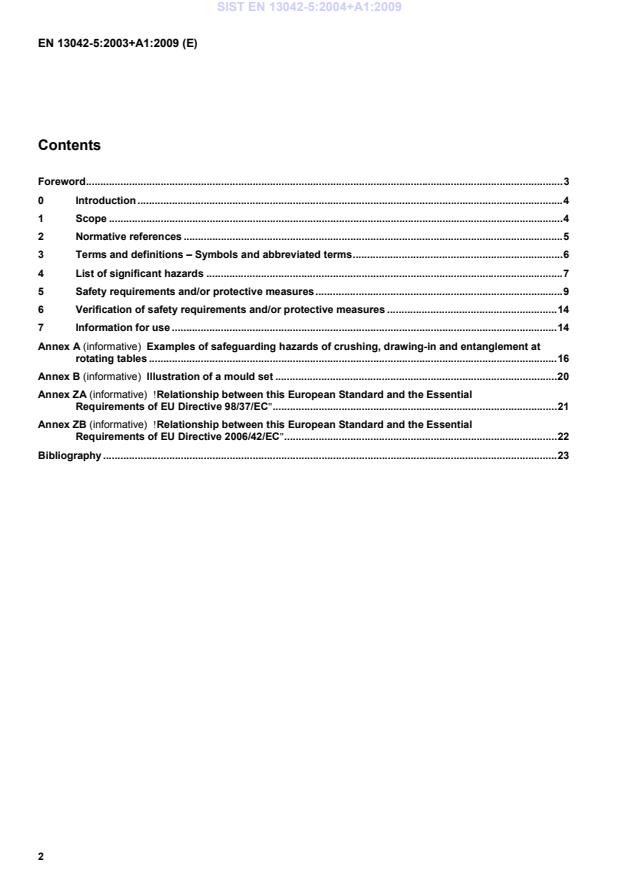
The document is organized into introduction, scope, normative references, terms and definitions, list of significant hazards, safety requirements and/or protective measures, verification, and information for use.
What are the key requirements of SIST EN 13042-5:2004+A1:2009?
SIST EN 13042-5:2004+A1:2009 combines guarding, control-system design, stopping performance, and user information to reduce the main risks from presses. The practical message is that the machine must stay safe not only in automatic production, but also during setting, mold change and maintenance.
Hazards and risk assessment
Clause 4 lists the main hazards: crushing, drawing-in, entanglement, electrical shock, burns, fire, ergonomic strain, unexpected start-up, stopping failures and slipping. Before using the standard, the manufacturer is expected to carry out a general risk assessment for the actual machine and its intended use.
Guarding and physical layout
Clause 5.1 addresses crushing hazards around moving mould parts, rotating or sliding tables, loading equipment and take-out devices. The document uses fixed gaps, fixed or interlocking guards, smooth table surfaces, fixed covers and trip devices to keep hands and arms away from danger zones.
Control system and stopping
Clauses 5.5 to 5.12 require a lockable energy disconnecting device, emergency-stop equipment, stop-control devices near the machine and a control system that avoids unexpected start-up after power returns. The emergency-stop arrangement must be positioned where operators actually work, including manual controls, the press station, mould-change areas and the main control panel.
Setting and mode changes
Clause 5.13 requires manual control for setting operations to use a hold-to-run device, with movements of the plunger and ring limited to a safe low speed. This matters because setting and job change are the times when people are closest to the tooling and the risk of crushing is highest.
Hydraulics, pneumatics and gravity
Clauses 5.2 to 5.4, 5.16 and 5.17 deal with hot water, hydraulic liquid, electrical and hose routing, and unintended downward movement caused by leaks or gravity. The machine must protect people from steam, hot water discharge, oil spread, heat damage to cables and hoses, and sudden drops of moving assemblies.
Noise, handling and user information
Clauses 5.19 and 5.20 address lifting aids for mould change and noise control. The document also requires noise declaration, low-noise design measures and specific information in the instruction handbook, so the user knows what to measure, what to warn about and how to work safely.
What terms does SIST EN 13042-5:2004+A1:2009 define?
SIST EN 13042-5:2004+A1:2009 defines the main machine and operating terms used throughout the safety requirements.
- Glass presses - machines that shape molten glass by pressure in a mould set as the mould parts close linearly.
- Mould set - the configuration made up of the plunger, ring and lower mould.
- Mould change - replacement of a mould set or its parts by identical ones to keep production running.
- Job change - replacement of a mould set to produce a different product.
- Setting operations - work needed for mould change or job change.
- Start-up delay - the time from the first start signal in automatic mode to the first movement of the automatic cycle.
- Cycle-single control mode - a mode where each working cycle is manually initiated and then stops automatically at the end of the cycle.
- Automatic control mode - a mode where cycles repeat automatically after a manual start until a stop signal is given.
Who uses SIST EN 13042-5:2004+A1:2009?
SIST EN 13042-5:2004+A1:2009 is used by glass-press manufacturers, machine integrators, safety engineers, maintenance teams and plant operators in hollow-glass production. Buyers and quality managers use it when specifying press safety features, checking guarding and control systems, and reviewing instructions and marking. It is also relevant during commissioning, setting, job change and maintenance planning.
What changed in SIST EN 13042-5:2004+A1:2009 from the previous edition?
SIST EN 13042-5:2004+A1:2009 supersedes EN 13042-5:2003 and incorporates Amendment 1, approved by CEN on 5 June 2009. The text marks amended passages with tags. The foreword also states that the standard supports the essential requirements of EU Directive 98/37/EC and EU Directive 2006/42/EC through Annexes ZA and ZB.
Which standards are used with SIST EN 13042-5:2004+A1:2009?
SIST EN 13042-5:2004+A1:2009 relies on several cross-cutting safety and measurement standards:
| Standard | What it contributes |
|---|---|
| EN ISO 12100-1, EN ISO 12100-2 | Risk-assessment terminology and design principles |
| EN 349 | Minimum gaps to avoid crushing |
| EN 953 | Requirements for fixed and movable guards |
| EN 982, EN 983 | Safety requirements for hydraulic and pneumatic systems |
| EN 1037 | Prevention of unexpected start-up |
| EN 60204-1 | Electrical equipment of machines and shock protection |
| EN ISO 13849-1 | Safety-related parts of control systems |
| EN ISO 13850 | Emergency-stop design |
| EN ISO 11201, EN ISO 11202, EN ISO 11204 | Noise measurement methods |
| EN ISO 11688-1 | Low-noise machine design guidance |
| EN ISO 4871 | Noise-emission declaration and verification |
| EN 61508-5 | Examples for determining safety integrity levels |
| EN 12464-1 | Workplace lighting guidance |
| EN 13042-1, EN 13042-2, EN 13042-3 | Related parts for gob feeders, handling machines for feeding, and IS machines |
What does the SIST EN 13042-5:2004+A1:2009 document contain?
SIST EN 13042-5:2004+A1:2009 contains a hazard list, machine-specific safeguards, verification methods and user-information requirements. It includes a verification table that links each safety measure to visual, functional or measuring checks, so users can see how conformity is confirmed in practice. Annex A gives illustrated guarding examples for rotating tables, and Annex B shows the mould-set layout used by the standard.
Relations
- Effective Date
- 09-Feb-2026
- Effective Date
- 28-Jan-2026
- Effective Date
- 28-Jan-2026
- Effective Date
- 28-Jan-2026
- Effective Date
- 28-Jan-2026
- Effective Date
- 28-Jan-2026
- Effective Date
- 28-Jan-2026
- Effective Date
- 28-Jan-2026
- Effective Date
- 28-Jan-2026
- Effective Date
- 28-Jan-2026
- Effective Date
- 28-Jan-2026
- Effective Date
- 28-Jan-2026
- Effective Date
- 28-Jan-2026
- Effective Date
- 28-Jan-2026
- Refers
SIST EN 12464-1:2004 - Light and lighting - Lighting of work places - Part 1: Indoor work places - Effective Date
- 28-Jan-2026
Frequently Asked Questions
SIST EN 13042-5:2004+A1:2009 is a standard published by the Slovenian Institute for Standardization (SIST). Its full title is "Machines and plants for the manufacture, treatment and processing of hollow glass - Safety requirements - Part 5: Presses". This standard covers: 1.1 This standard contains the requirements for the design and installation of glass presses including equipment for feeding of portions of molten glass to the mould, loading equipment and equipment for discharging articles (take-out) when these are integral parts of the presses. 1.2 !This standard deals with all significant hazards, hazardous situations and events relevant to glass presses when they are used as intended and under the conditions of misuse which are reasonably foreseeable by the manufacturer (see Clause 4). This standard specifies the appropriate technical measures to eliminate or reduce risks from the significant hazards commissioning, operation and maintenance." 1.3 This standard does not deal with forming machines for hollow glass where the press operation is only a part of the hot-forming process, such as the press/blow process of IS machines (see !EN 13042-3"). 1.4 This standard does not deal with gob feeders (see !EN 13042-1") and handling machines for feeding (see !EN 13042-2") which are self-standing machines and dealt with in other standards of the series regarding machinery used in the production of hollow glass. 1.5 This document is not applicable to presses which are manufactured before the date of publication of this document by CEN. 1.6 This standard deals only with hazards arising from the application of components which may be used in glass presses, such as motors and continuous handling equipment. More particular safety requirements are dealt with within standards more specific to that component, including noise. 1.7 This standard does not deal with equipment for cooling and waste ejection with air or heating from an outside system.
1.1 This standard contains the requirements for the design and installation of glass presses including equipment for feeding of portions of molten glass to the mould, loading equipment and equipment for discharging articles (take-out) when these are integral parts of the presses. 1.2 !This standard deals with all significant hazards, hazardous situations and events relevant to glass presses when they are used as intended and under the conditions of misuse which are reasonably foreseeable by the manufacturer (see Clause 4). This standard specifies the appropriate technical measures to eliminate or reduce risks from the significant hazards commissioning, operation and maintenance." 1.3 This standard does not deal with forming machines for hollow glass where the press operation is only a part of the hot-forming process, such as the press/blow process of IS machines (see !EN 13042-3"). 1.4 This standard does not deal with gob feeders (see !EN 13042-1") and handling machines for feeding (see !EN 13042-2") which are self-standing machines and dealt with in other standards of the series regarding machinery used in the production of hollow glass. 1.5 This document is not applicable to presses which are manufactured before the date of publication of this document by CEN. 1.6 This standard deals only with hazards arising from the application of components which may be used in glass presses, such as motors and continuous handling equipment. More particular safety requirements are dealt with within standards more specific to that component, including noise. 1.7 This standard does not deal with equipment for cooling and waste ejection with air or heating from an outside system.
SIST EN 13042-5:2004+A1:2009 is classified under the following ICS (International Classification for Standards) categories: 81.100 - Equipment for the glass and ceramics industries. The ICS classification helps identify the subject area and facilitates finding related standards.
SIST EN 13042-5:2004+A1:2009 has the following relationships with other standards: It is inter standard links to SIST EN 61508-5:2011, SIST EN ISO 11201:1997, SIST EN ISO 12100-1:2004, SIST EN 983:1998, SIST EN 953:2000, SIST EN ISO 11688-1:1999, SIST EN ISO 11204:1997, SIST EN 2286:2001, SIST EN ISO 4871:1997, SIST EN ISO 13850:2008, SIST EN ISO 13849-1:2008, SIST EN ISO 11202:1997, SIST EN ISO 12100-2:2004, SIST EN 982:1998, SIST EN 12464-1:2004. Understanding these relationships helps ensure you are using the most current and applicable version of the standard.
SIST EN 13042-5:2004+A1:2009 is associated with the following European legislation: EU Directives/Regulations: 2006/42/EC, 98/37/EC; Standardization Mandates: M/079, M/396. When a standard is cited in the Official Journal of the European Union, products manufactured in conformity with it benefit from a presumption of conformity with the essential requirements of the corresponding EU directive or regulation.
SIST EN 13042-5:2004+A1:2009 is available in PDF format for immediate download after purchase. The document can be added to your cart and obtained through the secure checkout process. Digital delivery ensures instant access to the complete standard document.
Standards Content (Sample)
2003-01.Slovenski inštitut za standardizacijo. Razmnoževanje celote ali delov tega standarda ni dovoljeno.Stroji in obrati za proizvodnjo, obdelavo in predelavo votlega stekla - Varnostne zahteve - 5. del: StiskalniceMaschinen und Anlagen für die Herstellung, Be- und Verarbeitung von Hohlglas - Sicherheitsanforderungen - Teil 5: PressenMachines et installations pour la production, le façonnage et la transformation du verre creux - Exigences de sécurité - Partie 5: PressesMachines and plants for the manufacture, treatment and processing of hollow glass - Safety requirements - Part 5: Presses81.100Equipment for the glass and ceramics industriesICS:Ta slovenski standard je istoveten z:EN 13042-5:2003+A1:2009SIST EN 13042-5:2004+A1:2009en,fr01-september-2009SIST EN 13042-5:2004+A1:2009SLOVENSKI
STANDARD
EUROPEAN STANDARD NORME EUROPÉENNE EUROPÄISCHE NORM
EN 13042-5:2003+A1
July 2009 ICS 81.100 Supersedes EN 13042-5:2003English Version
Machines and plants for the manufacture, treatment and processing of hollow glass - Safety requirements - Part 5: Presses
Machines et installations pour la production, le façonnage et la transformation du verre creux - Exigences de sécurité - Partie 5: Presses
Maschinen und Anlagen für die Herstellung, Be- und Verarbeitung von Hohlglas - Sicherheitsanforderungen - Teil 5: Pressen This European Standard was approved by CEN on 7 May 2003 and includes Amendment 1 approved by CEN on 5 June 2009.
CEN members are bound to comply with the CEN/CENELEC Internal Regulations which stipulate the conditions for giving this European Standard the status of a national standard without any alteration. Up-to-date lists and bibliographical references concerning such national standards may be obtained on application to the CEN Management Centre or to any CEN member.
This European Standard exists in three official versions (English, French, German). A version in any other language made by translation under the responsibility of a CEN member into its own language and notified to the CEN Management Centre has the same status as the official versions.
CEN members are the national standards bodies of Austria, Belgium, Bulgaria, Cyprus, Czech Republic, Denmark, Estonia, Finland, France, Germany, Greece, Hungary, Iceland, Ireland, Italy, Latvia, Lithuania, Luxembourg, Malta, Netherlands, Norway, Poland, Portugal, Romania, Slovakia, Slovenia, Spain, Sweden, Switzerland and United Kingdom.
EUROPEAN COMMITTEE FOR STANDARDIZATION
COMITÉ EUROPÉEN DE NORMALISATION EUROPÄISCHES KOMITEE FÜR NORMUNG
Management Centre:
Avenue Marnix 17,
B-1000 Brussels © 2009 CEN All rights of exploitation in any form and by any means reserved worldwide for CEN national Members. Ref. No. EN 13042-5:2003+A1:2009: ESIST EN 13042-5:2004+A1:2009
Examples of safeguarding hazards of crushing, drawing-in and entanglement at rotating tables . 16 Annex B (informative)
Illustration of a mould set . 20 Annex ZA (informative)
!Relationship between this European Standard and the Essential
Requirements of EU Directive 98/37/EC" . 21 Annex ZB (informative)
!Relationship between this European Standard and the Essential
Requirements of EU Directive 2006/42/EC" . 22 Bibliography . 23
There are hazards at other times, e.g. movements initiated by personnel or failure of the controls during setting.
Safety requirements laid down in this standard relative to the movements of mould parts therefore deal especially with the manual control of glass presses for setting operations as defined in 3.7. When compiling this standard, it was assumed that: movements of mould parts (plunger and ring) in hydraulically and pneumatically operated presses result from the movements of the rod or of the cylinder; harmful materials such as asbestos and toxic substances are not used; noise generated by the glass press is itself not a significant hazard, but noise by air-cooling of hot articles and the mould and by pneumatic waste ejection with air from an outside system may cause the necessity of wearing ear protection by the operator. glass presses are not intended to be used in potentially explosive atmospheres. When provisions of this type-C standard are different from those which are stated in type-A or -B standards, the provisions of this type-C standard take precedence over the provisions of the other standards for machines that have been designed and built according to the provisions of this type-C standard. 1 Scope 1.1 This standard contains the requirements for the design and installation of glass presses including equipment for feeding of portions of molten glass to the mould, loading equipment and equipment for discharging articles (take-out) when these are integral parts of the presses. 1.2 !This standard deals with all significant hazards, hazardous situations and events relevant to glass presses when they are used as intended and under the conditions of misuse which are reasonably foreseeable by the manufacturer (see Clause 4).
This standard specifies the appropriate technical measures to eliminate or reduce risks arising from the significant hazards during commissioning, operation and maintenance." 1.3 This standard does not deal with forming machines for hollow glass where the press operation is only a part of the hot-forming process, such as the press/blow process of IS machines (see !EN 13042-3"). 1.4 This standard does not deal with gob feeders (see !EN 13042-1") and handling machines for feeding (see !EN 13042-2") which are self-standing machines and dealt with in other standards of the series regarding machinery used in the production of hollow glass. 1.5 This document is not applicable to presses which are manufactured before the date of publication of this document by CEN. 1.6 This standard deals only with hazards arising from the application of components which may be used in glass presses, such as motors and continuous handling equipment.
More particular safety requirements are dealt with within standards more specific to that component, including noise. SIST EN 13042-5:2004+A1:2009
Additional definitions specifically needed for this document are added below: 3.1 glass presses machines, where the shaping of molten glass is performed by the action of pressure in a mould set as a result of the linear closing travel of the different parts of the mould set (lower mould, ring, plunger) 3.2 ring part of the mould set to close the gap between plunger and lower mould in press position 3.3 mould set configuration consisting of plunger, ring and lower mould, see annex B (informative) 3.4 mould change replacement of a mould set or parts of it by identical ones in order to maintain production 3.5 job change replacement of a mould set in order to produce another product 3.6 adjustment regulation of machine functions, e.g. pressing load, cooling, lubrication during normal operation 3.7 setting operations all work which is necessary for mould change or job change 3.8 start-up delay
time between the first given start signal for the start of the machine in the automatic mode and the first movement of the automatic cycle of the machine
3.9 loading equipment device to feed already pre-formed glass parts into the press 3.10 working cycle all movements completed by parts of the mould from fully open to fully closed and back to fully open 3.11 cycle-single (control) mode operating method where each working cycle has to be operated positively by the operator and is stopped automatically when the cycle is completed SIST EN 13042-5:2004+A1:2009
!!!!Table 1 — List of significant hazards Clause Hazards Danger zone/ dangerous item Preventive measures see clause 4.1 Mechanical
4.1.1 crushing of hand and arm the closing travel of the plunger and the ring against the lower mould during setting operations 5.6.1, 5.13-5.13.2, 5.18 4.1.2 crushing of hand and arm the opening travel of the plunger and the ring and of the piston rod or cylinder with adapters against fixed parts of the press during setting operations 5.1, 5.6.1, 5.13-5.13.2, 5.18 4.1.3 crushing of hand and arm between ring and plunger during setting operations 5.6.1, 5.13-5.13.2, 5.19 4.1.4 crushing of hand and arm between moving piston rod or cylinder with adapter and plunger, ring or cage on their travel for the mounting of the plunger, ring or cage during setting operations 5.13-5.13.2
4.1.5 crushing of hand and arm closing movement of a divided lower mould during setting operations 5.13 4.1.6 crushing of the hand between cam (or piston) and divided (lower) mould, e.g. basket mould, during setting operations 5.13 SIST EN 13042-5:2004+A1:2009
Fire ignition of inflammable hydraulic fluid 5.3 4.5 Neglecting ergonomic principles
4.5.1 excessive effort mould parts, mould set 5.19 4.5.1 human behaviour untrained personnel 7.1.9 4.5.2 inadequate design of manual controls areas with hazards resulting in burns5.8.1 4.5.3 inadequate design of display units switching mode 5.8.2, 5.8.3, 7.1.10 4.6 Unexpected start-up, malfunction
4.6.1 failure/disorder of the control system, energy supply all dangerous movements 5.7, 5.9-5.12, 5.14-5.16, 7.1.2, 7.1.3 4.6.2 external influences, e.g. heat, gravity electrical equipment, lifted machine parts 5.4, 5.17, 5.18.1, 5.18.2 4.7 Impossibility of stopping the machine in the best possible conditions all dangerous movements 5.5, 5.6, 5.18, 7.1.4 4.7 Slip spilled oil (lubrication) 7.1.8 " SIST EN 13042-5:2004+A1:2009
This specific risk assessment is part of the general risk assessment relating to the hazards not covered by this standard. Where the means of reducing the risk is by the arrangement of the installed machine or by a safe system of work, the manufacturer shall include in the Information for use a reference to the reduction means to be provided, including training, and to any limiting value of the requirement and, if appropriate, to the means of verification. 5.1 Crushing hazards of hand and arm by pistons or cylinders and their adapters (with or without mould parts) against other moving or fixed parts during the opening travel of plunger and ring shall be prevented as far as is practicable by design, such as providing a minimum gap of 120 mm (see Table 1 of EN 349:1993). 5.1.1 Crushing and impact hazards from the movement of loading equipment and the take-out during the “automatic” operation mode shall be safeguarded by fixed or interlocking distance guards conforming to the requirements of 3.2.2 and 3.5 of EN 953:1997. 5.1.2 Entanglement hazards of the body caused by the movement of rotating or sliding tables together with mounted equipment such as mould parts, shall be avoided or safeguarded by: 5.1.2.1 Having a smooth outside edge and surfac
...