


SIST EN 17109:2020
(Main)Mountaineering equipment - Individual safety systems for rope courses - Safety requirements and test methods
Mountaineering equipment - Individual safety systems for rope courses - Safety requirements and test methods
This document specifies safety requirements and test methods for components of an individual safety system for protection against a fall from height used in permanent and mobile rope courses as defined in EN 15567 1.
The products considered in this standard are not intended to limit, by themselves, the deceleration of the fall of the user, as defined in EN 15567 1. For this requirement, it is essential to consider the whole ropes course system.
Safety lines and harness are not covered in this standard.
Bergsteigerausrüstung - Einzelsicherungssysteme für Seilgärten - Sicherheitsanforderungen und Prüfverfahren
Dieses Dokument legt sicherheitstechnische Anforderungen und Prüfverfahren für Bestandteile von Einzelsicherungssystemen zum Schutz gegen Absturz zum Einsatz in permanenten und mobilen Seilgärten nach der Definition in EN 15567 1 fest.
Die in dieser Norm betrachteten Produkte sind für sich genommen nicht dazu bestimmt, die Verzögerung beim Absturz des Nutzers nach Definition in EN 15567 1 zu begrenzen. Hierfür ist es erforderlich, das komplette Seilgartensystem zu betrachten.
Sicherungsebenen und Anseilgurte werden in dieser Norm nicht behandelt.
Équipement d’alpinisme et d’escalade - Systèmes d’assurage individuels pour parcours acrobatiques en hauteur - Exigences de sécurité et méthodes d’essai
Le présent document spécifie des exigences de sécurité et des méthodes d'essai qui s'appliquent aux composants des systèmes d'assurage individuels de protection contre les chutes de hauteur utilisés dans les parcours acrobatiques en hauteur permanents et mobiles tels que définis dans l'EN 15567 1.
Les produits traités dans la présente norme n'ont pas pour objet de limiter, en tant que tels, la décélération de la chute de l'utilisateur telle que définie dans l'EN 15567 1. Pour ce qui est de cette exigence, il est essentiel de prendre en considération l'ensemble du dispositif de parcours acrobatique en hauteur.
Les lignes de vie et les harnais ne sont pas couverts par la présente norme.
Gorniška oprema - Vrvni plezalni parki - Individualni varnostni sistem - Varnostne zahteve in preskusne metode
General Information
- Status
- Withdrawn
- Public Enquiry End Date
- 14-Jun-2017
- Publication Date
- 19-Apr-2020
- Withdrawal Date
- 05-Nov-2024
- Technical Committee
- SPO - Sports
- Current Stage
- 9900 - Withdrawal (Adopted Project)
- Start Date
- 04-Nov-2024
- Due Date
- 27-Nov-2024
- Completion Date
- 06-Nov-2024
Relations
- Effective Date
- 01-Dec-2024
- Effective Date
- 17-Nov-2021


Frequently Asked Questions
SIST EN 17109:2020 is a standard published by the Slovenian Institute for Standardization (SIST). Its full title is "Mountaineering equipment - Individual safety systems for rope courses - Safety requirements and test methods". This standard covers: This document specifies safety requirements and test methods for components of an individual safety system for protection against a fall from height used in permanent and mobile rope courses as defined in EN 15567 1. The products considered in this standard are not intended to limit, by themselves, the deceleration of the fall of the user, as defined in EN 15567 1. For this requirement, it is essential to consider the whole ropes course system. Safety lines and harness are not covered in this standard.
This document specifies safety requirements and test methods for components of an individual safety system for protection against a fall from height used in permanent and mobile rope courses as defined in EN 15567 1. The products considered in this standard are not intended to limit, by themselves, the deceleration of the fall of the user, as defined in EN 15567 1. For this requirement, it is essential to consider the whole ropes course system. Safety lines and harness are not covered in this standard.
SIST EN 17109:2020 is classified under the following ICS (International Classification for Standards) categories: 97.220.40 - Outdoor and water sports equipment. The ICS classification helps identify the subject area and facilitates finding related standards.
SIST EN 17109:2020 has the following relationships with other standards: It is inter standard links to SIST EN 17109:2020+A1:2024, SIST EN 17109:2020/kprA1:2024. Understanding these relationships helps ensure you are using the most current and applicable version of the standard.
SIST EN 17109:2020 is associated with the following European legislation: EU Directives/Regulations: 2016/425, 89/686/EEC; Standardization Mandates: M/031. When a standard is cited in the Official Journal of the European Union, products manufactured in conformity with it benefit from a presumption of conformity with the essential requirements of the corresponding EU directive or regulation.
SIST EN 17109:2020 is available in PDF format for immediate download after purchase. The document can be added to your cart and obtained through the secure checkout process. Digital delivery ensures instant access to the complete standard document.
Standards Content (Sample)
SLOVENSKI STANDARD
01-maj-2020
Gorniška oprema - Vrvni plezalni parki - Individualni varnostni sistem - Varnostne
zahteve in preskusne metode
Mountaineering equipment - Individual safety systems for rope courses - Safety
requirements and test methods
Bergsteigerausrüstung - Einzelsicherungssysteme für Seilgärten -
Sicherheitsanforderungen und Prüfverfahren
Équipement d’alpinisme et d’escalade - Systèmes d’assurage individuels pour parcours
acrobatiques en hauteur - Exigences de sécurité et méthodes d’essai
Ta slovenski standard je istoveten z: EN 17109:2020
ICS:
97.220.40 Oprema za športe na Outdoor and water sports
prostem in vodne športe equipment
2003-01.Slovenski inštitut za standardizacijo. Razmnoževanje celote ali delov tega standarda ni dovoljeno.
EN 17109
EUROPEAN STANDARD
NORME EUROPÉENNE
March 2020
EUROPÄISCHE NORM
ICS 97.220.40
English Version
Mountaineering equipment - Individual safety systems for
rope courses - Safety requirements and test methods
Équipement d'alpinisme et d'escalade - Systèmes Bergsteigerausrüstung - Individuelle
d'assurage individuels pour parcours acrobatiques en Sicherheitssysteme für Seilgärten -
hauteur - Exigences de sécurité et méthodes d'essai Sicherheitsanforderungen und Prüfverfahren
This European Standard was approved by CEN on 15 December 2019.
CEN members are bound to comply with the CEN/CENELEC Internal Regulations which stipulate the conditions for giving this
European Standard the status of a national standard without any alteration. Up-to-date lists and bibliographical references
concerning such national standards may be obtained on application to the CEN-CENELEC Management Centre or to any CEN
member.
This European Standard exists in three official versions (English, French, German). A version in any other language made by
translation under the responsibility of a CEN member into its own language and notified to the CEN-CENELEC Management
Centre has the same status as the official versions.
CEN members are the national standards bodies of Austria, Belgium, Bulgaria, Croatia, Cyprus, Czech Republic, Denmark, Estonia,
Finland, France, Germany, Greece, Hungary, Iceland, Ireland, Italy, Latvia, Lithuania, Luxembourg, Malta, Netherlands, Norway,
Poland, Portugal, Republic of North Macedonia, Romania, Serbia, Slovakia, Slovenia, Spain, Sweden, Switzerland, Turkey and
United Kingdom.
EUROPEAN COMMITTEE FOR STANDARDIZATION
COMITÉ EUROPÉEN DE NORMALISATION
EUROPÄISCHES KOMITEE FÜR NORMUNG
CEN-CENELEC Management Centre: Rue de la Science 23, B-1040 Brussels
© 2020 CEN All rights of exploitation in any form and by any means reserved Ref. No. EN 17109:2020 E
worldwide for CEN national Members.
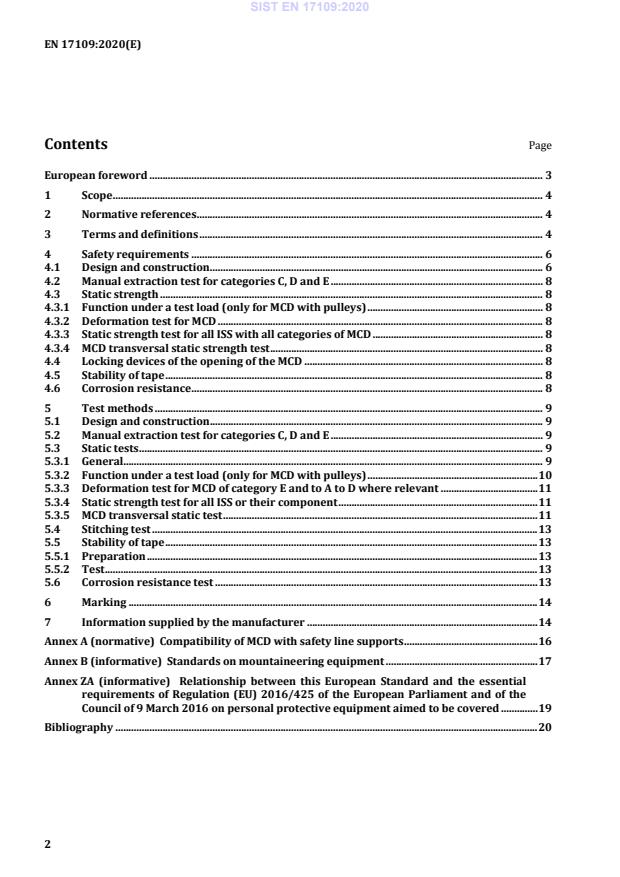
Contents Page
European foreword . 3
1 Scope . 4
2 Normative references . 4
3 Terms and definitions . 4
4 Safety requirements . 6
4.1 Design and construction . 6
4.2 Manual extraction test for categories C, D and E . 8
4.3 Static strength . 8
4.3.1 Function under a test load (only for MCD with pulleys) . 8
4.3.2 Deformation test for MCD . 8
4.3.3 Static strength test for all ISS with all categories of MCD . 8
4.3.4 MCD transversal static strength test . 8
4.4 Locking devices of the opening of the MCD . 8
4.5 Stability of tape . 8
4.6 Corrosion resistance . 8
5 Test methods . 9
5.1 Design and construction . 9
5.2 Manual extraction test for categories C, D and E . 9
5.3 Static tests . 9
5.3.1 General. 9
5.3.2 Function under a test load (only for MCD with pulleys) . 10
5.3.3 Deformation test for MCD of category E and to A to D where relevant . 11
5.3.4 Static strength test for all ISS or their component . 11
5.3.5 MCD transversal static test . 11
5.4 Stitching test . 13
5.5 Stability of tape . 13
5.5.1 Preparation . 13
5.5.2 Test . 13
5.6 Corrosion resistance test . 13
6 Marking . 14
7 Information supplied by the manufacturer . 14
Annex A (normative) Compatibility of MCD with safety line supports . 16
Annex B (informative) Standards on mountaineering equipment . 17
Annex ZA (informative) Relationship between this European Standard and the essential
requirements of Regulation (EU) 2016/425 of the European Parliament and of the
Council of 9 March 2016 on personal protective equipment aimed to be covered . 19
Bibliography . 20
European foreword
This document (EN 17109:2020) has been prepared by Technical Committee CEN/TC 136 “Sports,
playground and other recreational facilities and equipment”, the secretariat of which is held by DIN.
This European Standard shall be given the status of a national standard, either by publication of an
identical text or by endorsement, at the latest by September 2020, and conflicting national standards
shall be withdrawn at the latest by September 2020.
Attention is drawn to the possibility that some of the elements of this document may be the subject of
patent rights. CEN shall not be held responsible for identifying any or all such patent rights.
This document has been prepared under a standardization request given to CEN by the European
Commission and the European Free Trade Association, and supports essential requirements of
EU Regulation 2016/425.
For relationship with EU Regulation 2016/425, see informative Annex ZA, which is an integral part of
this document.
According to the CEN-CENELEC Internal Regulations, the national standards organisations of the
following countries are bound to implement this European Standard: Austria, Belgium, Bulgaria,
Croatia, Cyprus, Czech Republic, Denmark, Estonia, Finland, France, Germany, Greece, Hungary, Iceland,
Ireland, Italy, Latvia, Lithuania, Luxembourg, Malta, Netherlands, Norway, Poland, Portugal, Republic of
North Macedonia, Romania, Serbia, Slovakia, Slovenia, Spain, Sweden, Switzerland, Turkey and the
United Kingdom.
1 Scope
This document specifies safety requirements and test methods for components of an individual safety
system for protection against a fall from height used in permanent and mobile rope courses as defined
in EN 15567-1.
The products considered in this standard are not intended to limit, by themselves, the deceleration of
the fall of the user, as defined in EN 15567-1. For this requirement, it is essential to consider the whole
ropes course system.
Safety lines and harnesses are not covered in this standard.
2 Normative references
The following documents are referred to in the text in such a way that some or all of their content
constitutes requirements of this document. For dated references, only the edition cited applies. For
undated references, the latest edition of the referenced document (including any amendments) applies.
EN 565:2017, Mountaineering equipment - Tape - Safety requirements and test methods
EN 12275:2013, Mountaineering equipment - Connectors - Safety requirements and test methods
EN 15567-1:2015, Sports and recreational facilities - Ropes courses - Part 1: Construction and safety
requirements
EN ISO 9227:2017, Corrosion tests in artificial atmospheres - Salt spray tests (ISO 9227:2017)
ISO 7000:2004, Graphical symbols for use on equipment — Registered
3 Terms and definitions
For the purposes of this document, the following terms and definitions apply.
ISO and IEC maintain terminological databases for use in standardization at the following addresses:
• IEC Electropedia: available at http://www.electropedia.org/
• ISO Online browsing platform: available at http://www.iso.org/obp
3.1
ropes course
constructed facility with restricted access and requiring supervision consisting of one or more activity
systems, support systems and, if needed, an appropriate safety system
[SOURCE: EN 15567-1:2015, 3.1 modified: Note 1 deleted]
3.2
individual safety system
ISS
component(s) connecting the harness to the safety line for protection against fall from height consisting
of mobile connecting device(s), lanyard(s) and a connecting system to the harness which may be
supplied as a pre-assembled product, or supplied by one or more manufacturer(s) and may be
assembled by a user to make an ISS
EXAMPLE See Figure 1
Key
1 safety line
2 mobile connecting device
3 lanyard
4 connecting system to the harness
5 harness
Figure 1 — Example of ISS
3.3
safety line
flexible or rigid, horizontal, vertical or sloping, continuous or discontinuous device used as a protection
against falling from a height
Note 1 to entry: In this standard, any part of a rope course where the mobile connecting device (MCD) is intended
to be connected is considered as safety line (e.g. safety line, anchor point, fall arrester, integrated trolley/rail
systems).
[SOURCE: EN 15567-1:2015, 3.13, modified: Note 1 included]
3.4
mobile connecting device
MCD
part of the ISS which is used to connect it to the safety line and allows the user to move along the safety
line
EXAMPLE Shuttles, pulleys, connectors.
3.5
lanyard
part of the ISS connecting the MCD to the connecting system to the harness
3.6
category A MCD
self-closing device which is not automatically self-locking
EXAMPLE Self-closing or screw gate connector.
3.7
category B MCD
self-locking device
EXAMPLE Self-locking connector.
3.8
category C MCD
interlocking device designed to reduce the likelihood of unintentional detaching from the safety system
3.9
category D MCD
interlocking device designed to prevent unintentional detaching from the safety system
3.10
category E MCD
device that is permanently attached during operation and can only be opened with a tool
3.11
connecting system to the harness
device which connects the lanyard to the harness
3.12
safety line supports
supports on which the MCD can transit
Note 1 to entry: These supports could be (non-exhaustive list): fittings junction between ropes, switch brackets,
terminal brackets, mobile anchor points
4 Safety requirements
4.1 Design and construction
For category E MCD, the lanyard, excluding the attachment loop, shall not pass through the opening of
the MCD.
All the connections within reach of the user, between
— the MCD and the lanyard,
— the lanyard and the connecting system to the harness,
— the connecting system to the harness and the harness
shall be openable only by a tool.
A lark's foot connection is considered as non-openable. When connections between the lanyard and the
MCD are made by a lark’s foot, the loop of the lark's foot connection on the MCD shall be short enough in
order to avoid disassembly of the lanyard when the MCD is connected to the safety line (see Figure 2).
Figure 2 — Size of the loop of the lark's foot connection
Parts of the ISS, which can come in contact with the user's body, shall be free from burrs and sharp
edges.
Rotating parts of MCD with pulleys shall be unreachable by the fingers. Any hole through which the
pulley wheel(s) can be reached during use shall not allow a pin of 8 mm diameter (±0,1 mm) to go
through. This requirement is not applicable to the space between pulley wheel(s) and safety line (see
Figure 3, key 6).
Key
1 safety line
2 MCD
3 lanyard
4 connecting system to the harness
5 harness
6 space between pulley wheel(s) and safety line
Figure 3 — Spaces between pulley wheel(s) and safety line
If any pulley wheel(s) axle is secured by nuts or screws, the nuts and/or screws shall be locked and
secured by means other than friction.
Where stitching is used to provide safety and strength (e.g. in joints) it shall be possible to inspect it and
the stitching shall contrast with the textile element in colour or surface appearance.The MCD shall be
designed to ensure that the loading is in pre-determined direction(s).
Only for category E, the connection between the lanyard and the MCD shall not be able to be placed into
the opening of the MCD without a tool.
The functioning of the MCD system shall be in accordance with the information supplied by the
manufacturer (see Clause 7) and the category or categories as described in 3.6 to 3.10.
4.2 Manual extraction test for categories C, D and E
Only for MCD which are used on cable safety lines when tested in accordance with 5.2, the MCD shall
not be able to be removed from the cable.
4.3 Static strength
4.3.1 Function under a test load (only for MCD with pulleys)
For MCD with pulleys, when tested in accordance with 5.3.2, the pulley wheel(s) of the MCD shall be
able to rotate 10 times in both directions (see Figure 6).
If the MCD is one-directional, then the requirement is only for the intended direction.
4.3.2 Deformation test for MCD
This test applies to MCD of category E and to other categories, where relevant.
When tested in accordance with 5.3.3 when the load is released, the permanent deformation of the MCD
opening shall be less than 0,5 mm.
4.3.3 Static strength test for all ISS with all categories of MCD
When tested in accordance with 5.3.4, the load shall not be released.
4.3.4 MCD transversal static strength test
This test applies to MCD of category E and to other categories, if relevant.
When tested i
...
Questions, Comments and Discussion
Ask us and Technical Secretary will try to provide an answer. You can facilitate discussion about the standard in here.
Loading comments...